Results by title
1917 books match the query 'Law' and 526 start with t
The Firm, the Market, and the Law
R. H. Coase
University of Chicago Press, 1987
Few other economists have been read and cited as often as R.H. Coase has been, even though, as he admits, "most economists have a different way of looking at economic problems and do not share my conception of the nature of our subject." Coase's particular interest has been that part of economic theory that deals with firms, industries, and markets—what is known as price theory or microeconomics. He has always urged his fellow economists to examine the foundations on which their theory exists, and this volume collects some of his classic articles probing those very foundations. "The Nature of the Firm" (1937) introduced the then-revolutionary concept of transaction costs into economic theory. "The Problem of Social Cost" (1960) further developed this concept, emphasizing the effect of the law on the working of the economic system. The remaining papers and new introductory essay clarify and extend Coarse's arguments and address his critics.
"These essays bear rereading. Coase's careful attention to actual institutions not only offers deep insight into economics but also provides the best argument for Coase's methodological position. The clarity of the exposition and the elegance of the style also make them a pleasure to read and a model worthy of emulation."—Lewis A. Kornhauser, Journal of Economic Literature
Ronald H. Coase was awarded the Nobel Prize in Economic Science in 1991.
The First Amendment Lives On
Conversations Commemorating Hugh M. Hefner's Legacy of Enduring Free Speech and Free Press ValuesStuart N. Brotman
University of Missouri Press, 2022
Hugh M. Hefner’s legacy of enduring free speech and free press values is embodied in the Hugh M. Hefner First Amendment Awards, established in 1979, which honor leading First Amendment scholars and advocates. Hefner also had a lifelong interest in film censorship issues and supported teaching about them at the University of Southern California for 20 years. His deep commitment to these values was confirmed when the author was granted unrestricted access to over 3,000 personal scrapbooks, which Hefner had kept in order to track free speech and press issues during his lifetime.
The format of the book is an homage to the in-depth conversational interviews Hefner pioneered as the editor and publisher of Playboy magazine. Stuart Brotman conducted in-person conversations with eight persons who in their lifetimes have come to represent a “greatest generation” of free speech and free press scholars and advocates. Notably, these conversations include:
Geoffrey R. Stone
Floyd Abrams
Nadine Strossen
Burt Neuborne
David D. Cole
Lucy A. Dalglish
Bob Corn-Revere
Rick Jewell
The First Fifteen
How Asian American Women Became Federal JudgesSusan Oki Mollway
Rutgers University Press, 2022
This book tells the stories of the first fifteen. In the process, it recounts remarkable tales of Asian women overcoming adversity and achieving the American dream, despite being the daughters of a Chinese garment worker, Japanese Americans held in internment camps during World War II, Vietnamese refugees, and penniless Indian immigrants. Yet The First Fifteen also explores how far Asian Americans and women still have to go before the federal judiciary reflects America as a whole.
In a candid series of interviews, these judges reflect upon the personal and professional experiences that led them to this distinguished position, as well as the nerve-wracking political process of being nominated and confirmed for an Article III judgeship. By sharing their diverse stories, The First Fifteen paints a nuanced portrait of how Asian American women are beginning to have a voice in determining American justice.
The First Global Prosecutor
Promise and ConstraintsMartha Minow, C. Cora True-Frost, and Alex Whiting, editors
University of Michigan Press, 2015
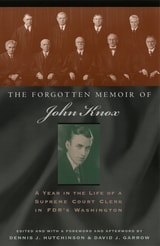
The Forgotten Memoir of John Knox
A Year in the Life of a Supreme Court Clerk in FDR's WashingtonJohn Knox
University of Chicago Press, 2002
When John Frush Knox (1907-1997) wrote these words, he was in the middle of law school, and his attempt at surpassing Pepys—part scrapbook, part social commentary, and part recollection—had already reached 750 pages. His efforts as a chronicler might have landed in a family attic had he not secured an eminent position after graduation as law clerk to Justice James C. McReynolds—arguably one of the most disagreeable justices to sit on the Supreme Court—during the tumultuous year when President Franklin D. Roosevelt tried to "pack" the Court with justices who would approve his New Deal agenda. Knox's memoir instead emerges as a record of one of the most fascinating periods in American history.
The Forgotten Memoir of John Knox—edited by Dennis J. Hutchinson and David J. Garrow—offers a candid, at times naïve, insider's view of the showdown between Roosevelt and the Court that took place in 1937. At the same time, it marvelously portrays a Washington culture now long gone. Although the new Supreme Court building had been open for a year by the time Knox joined McReynolds' staff, most of the justices continued to work from their homes, each supported by a small staff. Knox, the epitome of the overzealous and officious young man, after landing what he believes to be a dream position, continually fears for his job under the notoriously rude (and nakedly racist) justice. But he soon develops close relationships with the justice's two black servants: Harry Parker, the messenger who does "everything but breathe" for the justice, and Mary Diggs, the maid and cook. Together, they plot and sidestep around their employer's idiosyncrasies to keep the household running while history is made in the Court.
A substantial foreword by Dennis Hutchinson and David Garrow sets the stage, and a gallery of period photos of Knox, McReynolds, and other figures of the time gives life to this engaging account, which like no other recaptures life in Washington, D.C., when it was still a genteel southern town.
The Forgotten Men
Serving a Life without Parole SentenceLeigey, Margaret E
Rutgers University Press, 2015
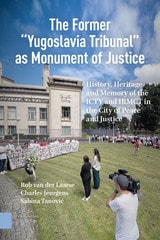
The Former “Yugoslavia Tribunal” as Monument of Justice
History, Heritage and Memory of the ICTY and IRMCT in the City of Peace and JusticeRob van der Laarse
Amsterdam University Press, 2025

The Foundational Role of the United States Supreme Court
Reinforcing Legitimacy Through Internal ReformTessa van Buchem
Central European University Press, 2027
The Foundational Role of the United States Supreme Court
Reinforcing Legitimacy Through Internal ReformTessa van Buchem
Central European University Press, 2027
The Foundations of Natural Morality
On the Compatibility of Natural Rights and the Natural LawS. Adam Seagrave
University of Chicago Press, 2014
With The Foundations of Natural Morality, S. Adam Seagrave addresses this controversy, offering an entirely new account of natural morality that compellingly unites the concepts of natural law and natural rights. Seagrave agrees with Strauss that the idea of natural rights is distinctly modern and does not derive from traditional natural law. Despite their historical distinctness, however, he argues that the two ideas are profoundly compatible and that the thought of John Locke and Thomas Aquinas provides the key to reconciling the two sides of this long-standing debate. In doing so, he lays out a coherent concept of natural morality that brings together thinkers from Plato and Aristotle to Hobbes and Locke, revealing the insights contained within these disparate accounts as well as their incompleteness when considered in isolation. Finally, he turns to an examination of contemporary issues, including health care, same-sex marriage, and the death penalty, showing how this new account of morality can open up a more fruitful debate.
The Fourth Amendment
Original Understandings and Modern PolicingMichael J.Z. Mannheimer
University of Michigan Press, 2023
Police are required to obey the law. While that seems obvious, courts have lost track of that requirement due to misinterpreting the two constitutional provisions governing police conduct: the Fourth and Fourteenth Amendments. The Fourth Amendment forbids "unreasonable searches and seizures" and is the source of most constitutional constraints on policing. Although that provision technically applies only to the federal government, the Fourteenth Amendment, ratified in the wake of the Civil War, has been deemed to apply the Fourth Amendment to the States.
This book contends that the courts’ misinterpretation of these provisions has led them to hold federal and state law enforcement mistakenly to the same constitutional standards. The Fourth Amendment was originally understood as a federalism, or “states’ rights,” provision that, in effect, required federal agents to adhere to state law when searching or seizing. Thus, applying the same constraint to the States is impossible. Instead, the Fourteenth Amendment was originally understood in part as requiring that state officials (1) adhere to state law, (2) not discriminate, and (3) not be granted excessive discretion by legislators. These principles should guide judicial review of modern policing. Instead, constitutional constraints on policing are too strict and too forgiving at the same time. In this book, Michael J.Z. Mannheimer calls for a reimagination of what modern policing could look like based on the original understandings of the Fourth and Fourteenth Amendments.

The Free List
Property Without TaxesAlfred Balk
Russell Sage Foundation, 1971
The Fugitive's Properties
Law and the Poetics of PossessionStephen M. Best
University of Chicago Press, 2004
Best also argues that legal principles dealing with fugitives and indebted persons provided a sophisticated precursor to intellectual property law as it dealt with rights in appearance, expression, and other abstract aspects of personhood. In this conception of property as fleeting, indeed fugitive, American law preserved for much of the rest of the century slavery's most pressing legal imperative: the production of personhood as a market commodity. By revealing the paradoxes of this relationship between fugitive slave law and intellectual property law, Best helps us to understand how race achieved much of its force in the American cultural imagination. A work of ambitious scope and compelling cross-connections, The Fugitive's Properties sets new agendas for scholars of American literature and legal culture.
The Future of Healthcare Reform in the United States
Edited by Anup Malani and Michael H. Schill
University of Chicago Press, 2015
In the years since the passage of the Patient Protection and Affordable Care Act (PPACA, or, colloquially, Obamacare), most of the discussion about it has been political. But as the politics fade and the law's many complex provisions take effect, a much more interesting question begins to emerge: How will the law affect the American health care regime in the coming years and decades?
This book brings together fourteen leading scholars from the fields of law, economics, medicine, and public health to answer that question. Taking discipline-specific views, they offer their analyses and predictions for the future of health care reform. By turns thought-provoking, counterintuitive, and even contradictory, the essays together cover the landscape of positions on the PPACA's prospects. Some see efficiency growth and moderating prices; others fear a strangling bureaucracy and spiraling costs. The result is a deeply informed, richly substantive discussion that will trouble settled positions and lay the groundwork for analysis and assessment as the law's effects begin to become clear.
The Future of the Voting Rights Act
David Epstein
Russell Sage Foundation, 2006
The Gay Rights Question in Contemporary American Law
Andrew Koppelman
University of Chicago Press, 2002
The Gay Rights Question in Contemporary American Law offers an unusually nuanced analysis of the most pressing gay rights issues. Does antigay discrimination violate the Constitution? Is there any sound moral objection to homosexual conduct? Are such objections the moral and constitutional equivalent of racism? Must state laws recognizing same-sex unions be given effect in other states? Should courts take account of popular resistance to gay equality? Koppelman sheds new light on all these questions. Sure to upset purists on either side of the debate, Koppelman's book criticizes the legal arguments advanced both for and against gay rights. Just as important, it places these arguments in broader moral and social contexts, offering original, pragmatic, and workable legal solutions.

The General Data Protection Regulation in Plain Language
Bart van der Sloot
Amsterdam University Press, 2020
This book sets out the most important obligations of individuals and organisations that process data about others. These include taking technical security measures, carrying out an impact assessment and registering all data-processing procedures within an organisation. It also discusses the rights of citizens whose data are processed, such as the right to be forgotten, the right to information and the right to data portability.

The General Data Protection Regulation in Plain Language
Bart van der Sloot
Amsterdam University Press, 2020
This book sets out the most important obligations of individuals and organisations that process data about others. These include taking technical security measures, carrying out an impact assessment and registering all data-processing procedures within an organisation. It also discusses the rights of citizens whose data are processed, such as the right to be forgotten, the right to information and the right to data portability.

The Geneva Conventions Under Assault
Edited by Sarah Perrigo and Jim Whitman
Pluto Press, 2010
Outrages committed during violent conflict and as part of the 'war on terror' are not only an affront to human dignity -- they also violate the Geneva Conventions.
This book examines recent high-profile cases of repeated and open abuse of the Conventions. The contributors explore why these and related violations of international humanitarian law cannot be viewed as anomalies, but must be regarded as part of a pattern which is set to undermine the Geneva Conventions as a whole.
The contributors argue that an international system in which there is diminishing legal restraint on the use of force means that the world will become less secure and more volatile, even for those in the most powerful countries. Individuals everywhere face the prospect of a horrifying vulnerability.
This is the first scholarly yet accessible work to consider the meanings of outrages such as the normalisation of torture, as well as the worrying new normative, technical and tactical developments that challenge the purpose and standing of the Geneva Conventions.
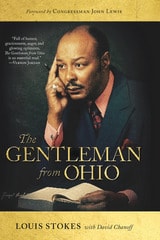
The Gentleman from Ohio
Louis Stokes with David Chanoff with a foreword by Congressman John Lewis
The Ohio State University Press, 2016
Prior to Louis Stokes’s tenure in Congress he served for many years as a criminal defense lawyer and chairman of the Cleveland NAACP Legal Redress Committee. Among the Supreme Court Cases he argued, the Terry “Stop and Frisk” case is regarded as one of the twenty-five most significant cases in the court’s history. The Gentleman from Ohio chronicles this and other momentous events in the life and legacy of Ohio’s first black representative—a man who, whether in law or politics, continually fought for the principles he believed in and helped lead the way for African Americans in the world of mainstream American politics.
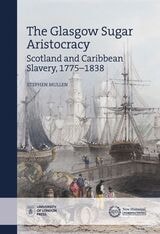
The Glasgow Sugar Aristocracy
Scotland and Caribbean Slavery, 1775–1838Stephen Mullen
University of London Press, 2020
This important book assesses the size and nature of Caribbean slavery’s economic impact on British society. The Glasgow Sugar Aristocracy, a grouping of West India merchants and planters, became active before the emancipation of chattel slavery in the British West Indies in 1834. Many acquired nationally significant fortunes, and their investments percolated into the Scottish economy and wider society. At its core, the book traces the development of merchant capital and poses several interrelated questions during an era of rapid transformation, namely, what impact the private investments of West India merchants and colonial adventurers had on metropolitan society and the economy, as well as the wider effects of such commerce on industrial and agricultural development.
The book also examines the fortunes of temporary Scottish economic migrants who traveled to some of the wealthiest of the Caribbean islands, presenting the first large-scale survey of repatriated slavery fortunes via case studies of Scots in Jamaica, Grenada, and Trinidad before emancipation in 1834. It, therefore, takes a new approach to illuminate the world of individuals who acquired West Indian fortunes and ultimately explores, in an Atlantic frame, the interconnections between the colonies and metropole in the late eighteenth and early nineteenth centuries.
The Global Debate over Constitutional Property
Lessons for American Takings JurisprudenceGregory S. Alexander
University of Chicago Press, 2006
A society’s traditions and culture, Alexander argues, have a much greater effect on property rights. Laws must aim, then, to change cultural ideas of property, rather than deem whether one has the right to own it. Ultimately, Alexander builds a strong case for improving American takings law by borrowing features from the laws of other countries—particularly those laws based on the idea that owning property not only confers rights, but also entails responsibilities to society as a whole.
The Global Environment and International Law
By Joseph F. C. DiMento
University of Texas Press, 2003
2004 — A Choice Outstanding Academic Book
International law has become the key arena for protecting the global environment. Since the 1970s, literally hundreds of international treaties, protocols, conventions, and rules under customary law have been enacted to deal with such problems as global warming, biodiversity loss, and toxic pollution. Proponents of the legal approach to environmental protection have already achieved significant successes in such areas as saving endangered species, reducing pollution, and cleaning up whole regions, but skeptics point to ongoing environmental degradation to argue that international law is an ineffective tool for protecting the global environment.
In this book, Joseph DiMento reviews the record of international efforts to use law to make our planet more livable. He looks at how law has been used successfully—often in highly innovative ways—to influence the environmental actions of governments, multinational corporations, and individuals. And he also assesses the failures of international law in order to make policy recommendations that could increase the effectiveness of environmental law. He concludes that a "supranational model" is not the preferred way to influence the actions of sovereign nations and that international environmental law has been and must continue to be a laboratory to test approaches to lawmaking and implementation for the global community.
The Glorious Revolution and the Continuity of Law
Richard S. Kay
Catholic University of America Press, 2014
The Gloss of Harmony
The Politics of Policy-Making in Multilateral OrganisationsBirgit Muller
Pluto Press, 2013
The Gloss of Harmony focuses on agencies of the United Nations, examining the paradox of entrusting relatively powerless and underfunded organisations with the responsibility of tackling some of the essential problems of our time. The book shows how international organisations shape the world in often unexpected and unpredictable ways.
The authors of this collection look not only at the official objectives and unintended consequences of international governance but also at how international organisations involve collective and individual actors in policy making, absorb critique, attempt to neutralise political conflict and create new political fields with local actors and national governments.
The Gloss of Harmony identifies the micro-social processes and complexities within multilateral organisations which have, up to now, been largely invisible. This book will have wide appeal not only to students and academics in anthropology, business studies and sociology but also to all practitioners concerned with international governance.
The Governance of Friendship
Law and Gender in the DecameronMichael Sherberg
The Ohio State University Press, 2011
Through a series of close readings at all three levels of the text—the author’s statements, the frame narrative, and the stories themselves—Sherberg shows how Boccaccio exposes and explores gender tensions rooted in a notion of the patriarchal household, which finds its own rationale in the natural-law postulate of the inferiority of women. Relying on the writings of the great twentieth-century legal theorist Hans Kelsen, Sherberg demonstrates how through the complex architecture of the Decameron Boccaccio dismantles the logic of natural law, exposing it instead as a rhetoric used by men to justify their control of women.
The Governance of Friendship aims well to advance our understanding of Boccaccio as an intellectual: not only steeped in the key texts of his time, but also at the forefront of critical thinking about such issues as law and gender which will play out over the coming centuries and beyond.

The Government and Politics of the European Union
Neill Nugent
Duke University Press, 0
There have been many developments within the European Union since the last edition of this volume. In May 2004, the EU increased in size from fifteen to twenty-five member states, and, in so doing, became a pan-European, rather than Western European, organization. The following month, national leaders reached agreement on the contents of the long-discussed and exhaustively negotiated Constitutional Treaty only to see the fruits of their labors rejected in 2005 by voters in France and the Netherlands. These are only the most obvious manifestations of a constantly evolving integration process addressed throughout the book. Every chapter has been extensively revised since the last edition.
The Government and Politics of the European Union also includes reflections on the conceptual and theoretical tools used to analyze the integration process and the EU, as well as on the factors likely to influence the Union’s future development.

The Grasping Hand
"Kelo v. City of New London" and the Limits of Eminent DomainIlya Somin
University of Chicago Press, 2015
In this detailed study of one of the most controversial Supreme Court cases in modern times, Ilya Somin argues that Kelo was a grave error. Economic development and “blight” condemnations are unconstitutional under both originalist and most “living constitution” theories of legal interpretation. They also victimize the poor and the politically weak for the benefit of powerful interest groups and often destroy more economic value than they create. Kelo itself exemplifies these patterns. The residents targeted for condemnation lacked the influence needed to combat the formidable government and corporate interests arrayed against them. Moreover, the city’s poorly conceived development plan ultimately failed: the condemned land lies empty to this day, occupied only by feral cats. The Supreme Court’s unpopular ruling triggered an unprecedented political reaction, with forty-five states passing new laws intended to limit the use of eminent domain. But many of the new laws impose few or no genuine constraints on takings. The Kelo backlash led to significant progress, but not nearly as much as it may have seemed.
Despite its outcome, the closely divided 5-4 ruling shattered what many believed to be a consensus that virtually any condemnation qualifies as a public use under the Fifth Amendment. It also showed that there is widespread public opposition to eminent domain abuse. With controversy over takings sure to continue, The Grasping Hand offers the first book-length analysis of Kelo by a legal scholar, alongside a broader history of the dispute over public use and eminent domain and an evaluation of options for reform.
The Grasping Hand
"Kelo v. City of New London" and the Limits of Eminent DomainIlya Somin
University of Chicago Press, 2015
In this detailed study of one of the most controversial Supreme Court cases in modern times, Ilya Somin argues that Kelo was a grave error. Economic development and “blight” condemnations are unconstitutional under both originalist and most “living constitution” theories of legal interpretation. They also victimize the poor and the politically weak for the benefit of powerful interest groups and often destroy more economic value than they create. Kelo itself exemplifies these patterns. The residents targeted for condemnation lacked the influence needed to combat the formidable government and corporate interests arrayed against them. Moreover, the city’s poorly conceived development plan ultimately failed: the condemned land lies empty to this day, occupied only by feral cats. The Supreme Court’s unpopular ruling triggered an unprecedented political reaction, with forty-five states passing new laws intended to limit the use of eminent domain. But many of the new laws impose few or no genuine constraints on takings. The Kelo backlash led to significant progress, but not nearly as much as it may have seemed.
Despite its outcome, the closely divided 5-4 ruling shattered what many believed to be a consensus that virtually any condemnation qualifies as a public use under the Fifth Amendment. It also showed that there is widespread public opposition to eminent domain abuse. With controversy over takings sure to continue, The Grasping Hand offers the first book-length analysis of Kelo by a legal scholar, alongside a broader history of the dispute over public use and eminent domain and an evaluation of options for reform.
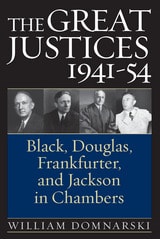
The Great Justices, 1941-54
Black, Douglas, Frankfurter, and Jackson in ChambersWilliam Domnarski
University of Michigan Press, 2006
This is rare and little-examined territory: in the public consciousness the Supreme Court is usually seen as an establishment whose main actors, the justices, remain above emotion, vitriol, and gossip, the better to interpret our nation of laws. Yet the Court's work is always an interchange of ideas and individuals, and the men and women who make up the Court, despite or because of their best intentions, are as human as the rest of us. Appreciating that human dimension helps us to discover some of the Court's secrets, and a new way to understand the Court and its role.
Comparing four brilliant but very different jurists of the Roosevelt Court-Hugo Black, William O. Douglas, Felix Frankfurter, and Robert Jackson-William Domnarski paints a startling picture of the often deeply ambiguous relationship between ideas and reality, between the law and the justices who interpret and create it. By pulling aside the veil of decorous tradition, Domnarski brings to light the personalities that shaped one of the greatest Courts of our time-one whose decisions continue to affect judicial thinking today.
William Domnarski is the author of In the Opinion of the Court (1996), a study of the history and nature of federal court judicial opinions. He holds a J.D. from the University of Connecticut and a Ph.D. in English from the University of California. Domnarski currently practices law in California, where he is also working on a forthcoming biography of legendary Hollywood lawyer Bert Fields.
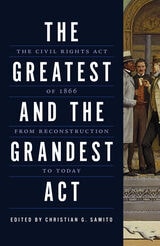
The Greatest and the Grandest Act
The Civil Rights Act of 1866 from Reconstruction to TodayEdited by Christian G. Samito
Southern Illinois University Press, 2018
Essays examine the history and legal ramifications of the act and highlight competing impulses within it, including the often-neglected Section 9, which allows the president to use the nation’s military in its enforcement; an investigation of how the Thirteenth Amendment operated to overturn the Dred Scott case; and New England’s role in the passage of the act. The act is analyzed as it operated in several states such as Kentucky, Missouri, and South Carolina during Reconstruction. There is also a consideration of the act and its interpretation by the Supreme Court in its first decades. Other essays include a discussion of the act in terms of contract rights and in the context of the post–World War II civil rights era as well as an analysis of the act’s backward-looking and forward-looking nature.
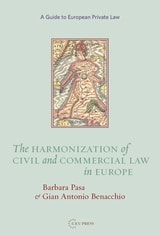
The Harmonization of Civil and Commercial Law in Europe
Gian Antonio Benacchio
Central European University Press, 2005
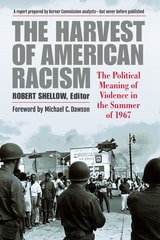
The Harvest of American Racism
The Political Meaning of Violence in the Summer of 1967Robert Shellow
University of Michigan Press, 2018
In the summer of 1967, in response to violent demonstrations that rocked 164 U.S. cities, the National Advisory Commission on Civil Disorders, a.k.a. the Kerner Commission, was formed. The Commission sought reasons for the disturbances, including the role that law enforcement played. Chief among its research projects was a study of 23 American cities, headed by social psychologist Robert Shellow. An early draft of the scientists’ analysis, titled “The Harvest of American Racism: The Political Meaning of Violence in the Summer of 1967,” provoked the Commission’s staff in November 1967 by uncovering political causes for the unrest; the team of researchers was fired, and the controversial report remained buried at the LBJ Presidential Library until now.
The first publication of the Harvest report half a century later reveals that many of the issues it describes are still with us, including how cities might more effectively and humanely react to groups and communities in protest. In addition to the complete text of the suppressed Harvest report, the book includes an introduction by Robert Shellow that provides useful historical context; personal recollections from four of the report’s surviving social scientists, Robert Shellow, David Boesel, Gary T. Marx, and David O. Sears; and an appendix outlining the differences between the unpublished Harvest analysis and the well-known Kerner Commission Report that followed it.
“The [Harvest of American Racism] report was rejected by Johnson administration functionaries as being far too radical—politically ‘unviable’… Social science can play an extremely positive role in fighting racial and other injustice and inequality, but only if it is matched with a powerful political will to implement the findings. That will has never come from within an American presidential administration—that will has only been forged in black and other radical communities’ movements for justice. The political power for change, as incremental as it has been, has come from within those communities. Washington responds, it does not lead."
—from the Foreword by Michael C. Dawson
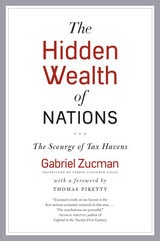
The Hidden Wealth of Nations
The Scourge of Tax HavensGabriel Zucman
University of Chicago Press, 2015
In The Hidden Wealth of Nations, Zucman offers an inventive and sophisticated approach to quantifying how big the problem is, how tax havens work and are organized, and how we can begin to approach a solution. His research reveals that tax havens are a quickly growing danger to the world economy. In the past five years, the amount of wealth in tax havens has increased over 25%—there has never been as much money held offshore as there is today. This hidden wealth accounts for at least $7.6 trillion, equivalent to 8% of the global financial assets of households. Fighting the notion that any attempts to vanquish tax havens are futile, since some countries will always offer more advantageous tax rates than others, as well the counter-argument that since the financial crisis tax havens have disappeared, Zucman shows how both sides are actually very wrong. In The Hidden Wealth of Nations he offers an ambitious agenda for reform, focused on ways in which countries can change the incentives of tax havens. Only by first understanding the enormity of the secret wealth can we begin to estimate the kind of actions that would force tax havens to give up their practices.
Zucman’s work has quickly become the gold standard for quantifying the amount of the world’s assets held in havens. In this concise book, he lays out in approachable language how the international banking system works and the dangerous extent to which the large-scale evasion of taxes is undermining the global market as a whole. If we are to find a way to solve the problem of increasing inequality, The Hidden Wealth of Nations is essential reading.
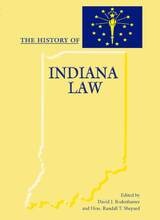
The History of Indiana Law
David J. Bodenhamer
Ohio University Press, 2006
The History of Indiana Law explores the ways in which the state’s legal culture responded to—and at times resisted—the influence of national legal developments, including the tortured history of race relations in Indiana. Legal issues addressed by the contributors include the Indiana constitutional tradition, civil liberties, race, women’s rights, family law, welfare and the poor, education, crime and punishment, juvenile justice, the role of courts and judiciary, and landmark cases. The essays describe how Indiana law has adapted to the needs of an increasingly complex society.
The History of Indiana Law is an indispensable reference and invaluable first source to learn about law and society in Indiana during almost two centuries of statehood.

The History of Indiana Law
David J. Bodenhamer
Ohio University Press, 2006
Long regarded as a center for middle-American values, Indiana is also a cultural crossroads that has produced a rich and complex legal and constitutional heritage. The History of Indiana Law traces this history through a series of expert articles by identifying the themes that mark the state’s legal development and establish its place within the broader context of the Midwest and nation.
The History of Indiana Law explores the ways in which the state’s legal culture responded to—and at times resisted—the influence of national legal developments, including the tortured history of race relations in Indiana. Legal issues addressed by the contributors include the Indiana constitutional tradition, civil liberties, race, women’s rights, family law, welfare and the poor, education, crime and punishment, juvenile justice, the role of courts and judiciary, and landmark cases. The essays describe how Indiana law has adapted to the needs of an increasingly complex society.
The History of Indiana Law is an indispensable reference and invaluable first source to learn about law and society in Indiana during almost two centuries of statehood.
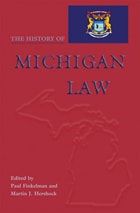
The History of Michigan Law
Paul Finkelman
Ohio University Press, 2006
The History of Michigan Law offers the first serious survey of Michigan’s rich legal past. Michigan legislators have played a leading role in developing modern civil rights law, protecting the environment, and assuring the right to counsel for those accused of crimes. Michigan was the first jurisdiction in the English-speaking world to abolish the death penalty. As the state industrialized, its legal system responded to the competing demands and interests of farmers, railroads, entrepreneurs, and workers.
Michigan was a beacon of liberty for fugitive slaves and free blacks before the Civil War and an early leader in the adoption of laws to protect civil rights and prohibit discrimination after that conflict. The state was the site of the Ossian Sweet murder trial, which illustrated the tensions in Michigan between law and popular ideology. The History of Michigan Law documents and analyzes these legal developments and others, including the history of labor law, women’s rights, and legal education.
This landmark volume will serve as the entry point for all future studies that involve law and society in Michigan and will be invaluable in the comparative study of state law. As the Michigan Supreme Court enters its third century, The History of Michigan Law has relevance beyond the legal community, for scholars and students of American history.
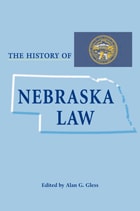
The History of Nebraska Law
Alan G. Gless
Ohio University Press, 2008
In the aftermath of the Civil War, legislators in the Nebraska Territory grappled with the responsibility of forming a state government as well as with the larger issues of reconstructing the Union, protecting civil rights, and redefining federal-state relations. In the years that followed, Nebraskans coped with regional and national economic collapses. Nebraska women struggled for full recognition in the legal profession. Meyer v. Nebraska, a case involving a teacher in a one-room rural Nebraska schoolhouse, changed the course of American constitutional doctrine and remains one of the cornerstones of civil liberties law. And Roscoe Pound, a boy from Lincoln, went on to become one of the nation’s great legal philosophers.
Nebraska holds a prominent position in the field of Native American legal history, and the state’s original inhabitants have been at the center of many significant developments in federal Indian policy. Nebraska Indian legal history is replete with stories of failure and success, heartache and triumph, hardship and hope. These stories are more than a mere record of the past, of treaties broken or trials won—they are reminders of the ongoing and sometimes tense relations among the many peoples and nations that make up the heartland.
Much of Nebraska law reflects mainstream American law, yet Nebraskans also have been open to experiment and innovation. The state revamped the legislative process by establishing the nation’s only unicameral legislature and pioneered public employment collective bargaining and dispute resolution through its industrial relations commission and its relaxation of strict separation of powers. These seemingly contradictory trends, however, are but differing expressions of a single underlying principle inscribed in the state’s motto: “Equality Before the Law.”
The History of the Common Law of England
Sir Matthew Hale
University of Chicago Press, 1973
The Hollow Hope
Can Courts Bring About Social Change?Gerald N. Rosenberg
University of Chicago Press, 1991
Rosenberg presents, with remarkable skill, an overwhelming case that efforts to use the courts to generate significant reforms in civil rights, abortion, and women's rights were largely failures.
"The real strength of The Hollow Hope . . . is its resuscitation of American Politics—the old-fashioned representative kind—as a valid instrument of social change. Indeed, the flip side of Mr. Rosenberg's argument that courts don't do all that much is the refreshing view that politics in the best sense of the word—as deliberation and choice over economic and social changes, as well as over moral issues—is still the core of what makes America the great nation it is. . . . A book worth reading."—Gary L. McDowell, The Washington Times
The Hollow Hope
Can Courts Bring About Social Change?Gerald N. Rosenberg
University of Chicago Press, 2023
Since its first publication in 1991, The Hollow Hope has spurred debate and challenged assumptions on both the left and the right about the ability of courts to bring about durable political and social change. What Gerald N. Rosenberg argued then, and what he confirms today through new evidence in this edition, is that it is nearly impossible to generate significant reforms through litigation: American courts are ineffective and relatively weak, far from the uniquely powerful sources for change they are often portrayed to be.
This third edition includes new data and a substantially updated analysis of civil rights, abortion rights and access, women’s rights, and marriage equality. Addressing changes in the political and social environment, Rosenberg draws lessons from the re-segregation of public schools, victories in marriage equality, and new obstacles to abortion access. Through these and other cases, the third edition confirms the power of the book’s original explanatory framework and deepens our understanding of the limits of judicial action in support of social reform, as well as the conditions under which courts do produce change. Up-to-date, thorough, and thought-provoking, The Hollow Hope remains vital reading.
The Hollow Hope
Can Courts Bring About Social Change? Second EditionGerald N. Rosenberg
University of Chicago Press, 2008
Finding that the answer is still a resounding no, Rosenberg reaffirms his powerful contention that it’s nearly impossible to generate significant reforms through litigation. The reason? American courts are ineffective and relatively weak—far from the uniquely powerful sources for change they’re often portrayed as. Rosenberg supports this claim by documenting the direct and secondary effects of key court decisions—particularly Brown v. Board of Education and Roe v. Wade. He reveals, for example, that Congress, the White House, and a determined civil rights movement did far more than Brown to advance desegregation, while pro-choice activists invested too much in Roe at the expense of political mobilization. Further illuminating these cases, as well as the ongoing fight for same-sex marriage rights, Rosenberg also marshals impressive evidence to overturn the common assumption that even unsuccessful litigation can advance a cause by raising its profile.
Directly addressing its critics in a new conclusion, The Hollow Hope, Second Edition promises to reignite for a new generation the national debate it sparked seventeen years ago.
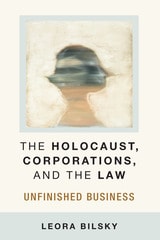
The Holocaust, Corporations, and the Law
Unfinished BusinessLeora Bilsky
University of Michigan Press, 2017
Leora Bilsky argues class action litigation and settlement offer a mode of accountability well suited to addressing the bureaucratic nature of business involvement in atrocities. Prior to these lawsuits, legal treatment of the Holocaust was dominated by criminal law and its individualistic assumptions, consistently failing to relate to the structural aspects of Nazi crimes. Engaging critically with contemporary debates about corporate responsibility for human rights violations and assumptions about “law,” she argues for the need to design processes that make multinational corporations accountable, and examines the implications for transitional justice, the relationship between law and history, and for community and representation in a post-national world. Her novel interpretation of the restitution lawsuits not only adds an important dimension to the study of Holocaust trials, but also makes an innovative contribution to broader and pressing contemporary legal and political debates. In an era when corporations are ever more powerful and international, Bilsky’s arguments will attract attention beyond those interested in the Holocaust and its long shadow.
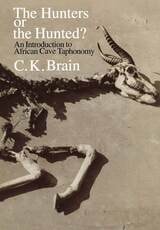
The Hunters or the Hunted?
An Introduction to African Cave TaphonomyC. K. Brain
University of Chicago Press, 1981
The Idea of a China Arrest Warrant
Surrender of Fugitive Offenders between Mainland China, Hong Kong, and MacauYanhong Yin
Hong Kong University Press, 2025
Hong Kong and Macau have both been Special Administrative Regions of China since 1999. To this day, however, the two SARs and mainland China have yet to form a cohesive agreement for extradition. Yanhong Yin proposes a theoretical model, the China Arrest Warrant, that fulfills three essential criteria: compliance with the framework of “one country, two systems,” allowance for differences within the three divergent legal systems, and sufficient human rights protection.
This model takes direct inspiration from the European Arrest Warrant, which is undergirded by the principle of mutual recognition—the idea that while states may make different decisions on a wide range of matters, results will be accepted equivalently to decisions made by one’s own state. The success of the European Union’s adoption of mutual recognition across political, economic, and legal situations is instrumental in providing a blueprint for judicial cooperation among mainland China, Hong Kong SAR, and Macau SAR.
The Idea of a China Arrest Warrant seeks to resolve a legal quandary that has existed for decades without resolution, and is essential reading in criminal and constitutional law.
The Illusion of Equality
The Rhetoric and Reality of Divorce ReformMartha Albertson Fineman
University of Chicago Press, 1991

The Impossible Machine
A Genealogy of South Africa's Truth and Reconciliation CommissionAdam Sitze
University of Michigan Press, 2016
Adam Sitze meticulously traces the origins of South Africa’s Truth and Reconciliation Commission back to two well-established instruments of colonial and imperial governance: the jurisprudence of indemnity and the commission of inquiry. This genealogy provides a fresh, though counterintuitive, understanding of the TRC’s legal, political, and cultural importance. The TRC’s genius, Sitze contends, is not the substitution of “forgiving” restorative justice for “strict” legal justice but rather the innovative adaptation of colonial law, sovereignty, and government. However, this approach also contains a potential liability: if the TRC’s origins are forgotten, the very enterprise intended to overturn the jurisprudence of colonial rule may perpetuate it. In sum, Sitze proposes a provocative new means by which South Africa’s Truth and Reconciliation Commission should be understood and evaluated.
The Intellectual Properties of Learning
A Prehistory from Saint Jerome to John LockeJohn Willinsky
University of Chicago Press, 2017
Willinsky begins with Saint Jerome in the fifth century, then traces the evolution of reading, writing, and editing practices in monasteries, schools, universities, and among independent scholars through the medieval period and into the Renaissance. He delves into the influx of Islamic learning and the rediscovery of classical texts, the dissolution of the monasteries, and the founding of the Bodleian Library before finally arriving at John Locke, whose influential lobbying helped bring about the first copyright law, the Statute of Anne of 1710. Willinsky’s bravura tour through this history shows that learning gave rise to our idea of intellectual property while remaining distinct from, if not wholly uncompromised by, the commercial economy that this concept inspired, making it clear that today’s push for marketable intellectual property threatens the very nature of the quest for learning on which it rests.
The Internationalization of Palace Wars
Lawyers, Economists, and the Contest to Transform Latin American StatesYves Dezalay and Bryant G. Garth
University of Chicago Press, 2002
Based on more than 300 extensive interviews with major players in governments, foundations, law firms, universities, and think tanks, Dezalay and Garth examine both the production of northern exports such as neoliberal economics and international human rights law and the ways they are received south of the United States. They find that the content of what is exported and how it fares are profoundly shaped by domestic struggles for power and influence—"palace wars"—in the nations involved. For instance, challenges to the eastern intellectual establishment influenced the Reagan-era export of University of Chicago-style neoliberal economics to Chile, where it enjoyed a warm reception from Pinochet and his allies because they could use it to discredit the previous regime.
Innovative and sophisticated, The Internationalization of Palace Wars offers much needed concrete information about the transnational processes that shape our world.
The Intruders
Unreasonable Searches and Seizures from King John to John AshcroftDash, Samuel
Rutgers University Press, 2004
What led to the Fourth Amendment’s protection of the people against unreasonable searches and seizures, codified in written law for the first time in history, and are we in danger of losing that protection? Celebrated lawyer Samuel Dash, known for his role as Chief Counsel of the Watergate Committee, explores the struggle for privacy. He does so by telling the dramatic tales of the people who were involved in influential legal battles, including landmark Supreme Court cases.
Covering almost eight-hundred years of history, Dash begins with the time of King John of England and the Magna Carta, then moves to colonial America as colonists resisted searches mandated under King George. These tensions contributed to the birth of the United States and the adoption of our Bill of Rights with its Fourth Amendment, protecting people against unreasonable searches and seizures.
How effective that protection has been is the story of the next two centuries. Dash explores U.S. Supreme Court cases through the sometimes humorous experiences of the people involved, including the unlucky gambler with a shoplifting wife and the police lieutenant turned king of bootleggers. To some extent, judicial safeguarding of Fourth Amendment protections depended on who made up the majority of the Court at any given time.
By 2001 a conservative majority of the Court had given law enforcement agents greater search powers than ever before. Dash challenges the legal justification of the Bush Administration’s grab for greater search, seizure, and wiretap powers after the 9/11 terrorists’ attacks. He reminds us of government abuses of power in prior emergencies in American history. For Dash, the best security is our belief in individual liberty and the enforcement of our Bill of Rights.