Results by title
968 books match the query 'Movements' and 273 start with t
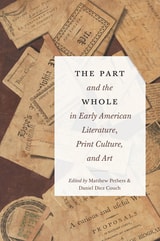
The Part and the Whole in Early American Literature, Print Culture, and Art
Matthew Pethers
Bucknell University Press, 2024
The essays in this pathbreaking collection consider the significance of varied early American fragmentary genres and practices—from diaries and poetry, to almanacs and commonplace books, to sermons and lists, to Indigenous ruins and other material shards and fragments—often overlooked by critics in a scholarly privileging of the “whole.” Contributors from literary studies, book history, and visual culture discuss a host of canonical and non-canonical figures, from Edward Taylor and Washington Irving to Mary Rowlandson and Sarah Kemble Knight, offering insight into the many intellectual, ideological, and material variations of “form” that populated the early American cultural landscape. As these essays reveal, the casting of the fragmentary as aesthetically eccentric or incomplete was a way of reckoning with concerns about the related fragmentation of nation, society, and self. For a contemporary audience, they offer new ways to think about the inevitable gaps and absences in our cultural and historical archive.

The Passionate Triangle
Rebecca Zorach
University of Chicago Press, 2011
Triangles abounded in the intellectual culture of early modern Europe—the Christian Trinity was often mapped as a triangle, for instance, and perspective, a characteristic artistic technique, is based on a triangular theory of vision. Renaissance artists, for their part, often used shapes and lines to arrange figures into a triangle on the surface of a painting—a practice modern scholars call triangular composition. But is there secret meaning in the triangular arrangements artists used, or just a pleasing symmetry? What do triangles really tell us about the European Renaissance and its most beguiling works of art?
In this book, Rebecca Zorach takes us on a lively hunt for the triangle’s embedded significance. From the leisure pursuits of Egyptian priests to Jacopo Tintoretto’s love triangles, Zorach explores how the visual and mathematical properties of triangles allowed them to express new ideas and to inspire surprisingly intense passions. Examining prints and paintings as well as literary, scientific, and philosophical texts, The Passionate Triangle opens up an array of new ideas, presenting unexpected stories of the irrational, passionate, melancholic, and often erotic potential of mathematical thinking before the Scientific Revolution.
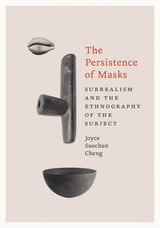
The Persistence of Masks
Surrealism and the Ethnography of the SubjectJoyce Suechun Cheng
University of Minnesota Press, 2025
An examination of surrealism’s unofficial ethnography of marginalized subjectivities
In interwar Paris, the encounter between surrealism and the nascent discipline of ethnology led to an intellectual project now known as “ethnographic surrealism.” In The Persistence of Masks, Joyce Suechun Cheng considers the ethnographic dimension of the surrealist movement in its formative years through a close look at the reviews Documents (1929–30) and Minotaure (1933–39) as well as the surrealist writer-turned-ethnographer Michel Leiris’s ethnography of possession. Analyzing surrealist aesthetic criticism, art, poetry, and field research in terms of a common interest in marginalized modes of subjectivity, Cheng argues that the surrealists used the figures of the mask, the veil, the hand, and the hat to radically reconceive the subject as nonhegemonic, nonanthropocentric, and feminine-identified.
Though ethnographic surrealism usually refers to the collaboration between professional ethnologists at the Institut de l’Ethnologie in Paris and Georges Bataille’s so-called dissident circle of surrealists, Cheng demonstrates that surrealism’s unofficial ethnography began long before the founding of the movement. Starting with André Breton’s wartime text “Subject” (1916), written when he was still a young psychiatric intern treating traumatized soldiers, she shows how the future surrealist poet shifted from a clinical to a para-ethnographic approach to subjectivity when adopting his patient’s first-person voice as a textual mask.
Revealing surrealism to be always implicitly ethnographic, Cheng uncovers deep affinities between archrivals Breton and Bataille, highlights psychiatry’s underacknowledged role in surrealism’s lay ethnography, and theorizes the surrealists’ feminine identification as a means of critiquing power. By broadening the scope of ethnographic surrealism, The Persistence of Masks offers new insights that challenge longstanding beliefs about this multifaceted movement in poetry, the arts, and culture.
The Personalism of Edith Stein
A Synthesis of Thomism and PhenomenologyRobert McNamara
Catholic University of America Press, 2023
The Personality of Power
A Theory of Fascism for Anti-fascist LifeBrian Massumi
Duke University Press, 2025
The Phantom of the Ego
Modernism and the Mimetic UnconsciousNidesh Lawtoo
Michigan State University Press, 2013
The Phantom of the Ego is the first comparative study that shows how the modernist account of the unconscious anticipates contemporary discoveries about the importance of mimesis in the formation of subjectivity. Rather than beginning with Sigmund Freud as the father of modernism, Nidesh Lawtoo starts with Friedrich Nietzsche’s antimetaphysical diagnostic of the ego, his realization that mimetic reflexes—from sympathy to hypnosis, to contagion, to crowd behavior—move the soul, and his insistence that psychology informs philosophical reflection. Through a transdisciplinary, comparative reading of landmark modernist authors like Nietzsche, Joseph Conrad, D. H. Lawrence, and Georges Bataille, Lawtoo shows that, before being a timely empirical discovery, the “mimetic unconscious” emerged from an untimely current in literary and philosophical modernism. This book traces the psychological, ethical, political, and cultural implications of the realization that the modern ego is born out of the spirit of imitation; it is thus, strictly speaking, not an ego, but what Nietzsche calls, “a phantom of the ego.” The Phantom of the Ego opens up a Nietzschean back door to the unconscious that has mimesis rather than dreams as its via regia, and argues that the modernist account of the “mimetic unconscious” makes our understanding of the psyche new.
The Phenomenological Study of Religion
Key Texts and SourcesChristina M. Gschwandtner
Northwestern University Press, 2026
Presenting a wide-ranging selection of works and commentary in religious phenomenology
Phenomenology is a central method employed to study religious phenomena within religious studies, philosophy of religion, and philosophical theology. This expertly edited collection brings together historical sources and newly commissioned essays from various ways of investigating religion phenomenologically both to diversify the field and to make available important works that have not been previously translated into English. The Phenomenological Study of Religion includes not only representative texts from well-known phenomenological philosophers and scholars of religion but also selections from significant thinkers that have not been studied as widely, along with contributions from leading contemporary voices. This volume offers scholars and students at all levels of expertise broad exposure to the various configurations of the phenomenological study of religion.
The Phenomenology of Aesthetic Experience
Mikel Dufrenne
Northwestern University Press, 1973
A perennial classic in the SPEP series, the work is rounded out by a detailed "Translator's Foreword" especially helpful to readers in aesthetics interested in the context and circumstances around which the original was published as well as the phenomenological background of the book.
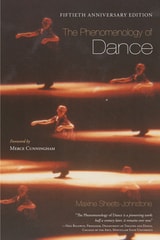
The Phenomenology of Dance
Maxine Sheets-Johnstone
Temple University Press, 2015
Back in print after nearly 20 years, The Phenomenology of Dance provides an informed approach to teaching dance and to dance education, appreciation, criticism, and choreography. In addition to the foreword by Merce Cunningham from the original edition, and the preface from the second edition, this fiftieth anniversary edition includes an in-depth introduction that critically and constructively addresses present-day scholarship on movement and dance.
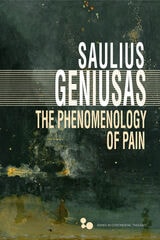
The Phenomenology of Pain
Saulius Geniusas
Ohio University Press, 2020
The Phenomenology of Pain is the first book-length investigation of its topic to appear in English. Groundbreaking, systematic, and illuminating, it opens a dialogue between phenomenology and such disciplines as cognitive science and cultural anthropology to argue that science alone cannot clarify the nature of pain experience without incorporating a phenomenological approach. Building on this premise, Saulius Geniusas develops a novel conception of pain grounded in phenomenological principles: pain is an aversive bodily feeling with a distinct experiential quality, which can only be given in original first-hand experience, either as a feeling-sensation or as an emotion.
Geniusas crystallizes the fundamental methodological principles that underlie phenomenological research. On the basis of those principles, he offers a phenomenological clarification of the fundamental structures of pain experience and contests the common conflation of phenomenology with introspectionism. Geniusas analyzes numerous pain dissociation syndromes, brings into focus the de-personalizing and re-personalizing nature of chronic pain experience, and demonstrates what role somatization and psychologization play in pain experience. In the process, he advances Husserlian phenomenology in a direction that is not explicitly worked out in Husserl’s own writings.
The Phenomenon of Life
Toward a Philosophical BiologyHans Jonas
Northwestern University Press, 2001
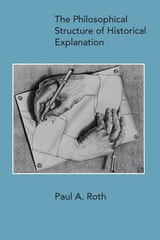
The Philosophical Structure of Historical Explanation
Paul A. Roth
Northwestern University Press, 2019
In The Philosophical Structure of Historical Explanation, Paul A. Roth resolves disputes persisting since the nineteenth century about the scientific status of history. He does this by showing why historical explanations must take the form of a narrative, making their logic explicit, and revealing how the rational evaluation of narrative explanation becomes possible. Roth situates narrative explanations within a naturalistic framework and develops a nonrealist (irrealist) metaphysics and epistemology of history—arguing that there exists no one fixed past, but many pasts. The book includes a novel reading of Thomas S. Kuhn’s The Structure of Scientific Revolutions, showing how it offers a narrative explanation of theory change in science. This book will be of interest to researchers in historiography, philosophy of history, philosophy of science, philosophy of social science, and epistemology.
The Philosophy of Hegel as a Doctrine of the Concreteness of God and Humanity
Volume One: The Doctrine of GodI. A. Il’in, Translated by Philip T. Grier
Northwestern University Press, 2010
This landmark two-volume translation from Russian of The Philosophy of Hegel as a Doctrine of the Concreteness of God and Humanity marks the first appearance in English of any of the works of Russian philosopher Ivan Aleksandrovich Il’in (Ilyin). Originally published in 1918, on the eve of the Russian civil war, Il'in's commentary on Hegel marked both an apogee of Russian Silver Age philosophy and a significant manifestation of the resurgence of interest in Hegel that began in the early twentieth century.
A. F. Losev accurately observed in the same year it appeared: “Neither the study of Hegel nor the study of contemporary Russian philosophical thought is any longer thinkable without this book of I. A. Il’in’s.” Some Hegel scholars may know this work through the abridged translation into German that Il’in produced himself in 1946. However, that edition omitted most of the original volume two. Noted Hegel scholar Philip T. Grier’s edition—with an introduction setting Il’in’s work in its proper historical, cultural, and philosophical contexts and annotation throughout—represents the first opportunity for non-Russian-speaking readers to acquaint themselves with the full scope of Il’in’s still provocative interpretation of Hegel.
Volume 1 is "The Doctrine of God." Volume 2 is "The Doctrine of Humanity."
The Philosophy of Hegel as a Doctrine of the Concreteness of God and Humanity
Volume Two: The Doctrine of HumanityI. A. Il’in, Translated by Philip T. Grier
Northwestern University Press, 2011
The publication of volume 2 of Philip T. Grier’s translation of The Philosophy of Hegel as a Doctrine of the Concreteness of God and Humanity completes the first appearance in English of any of the works of Russian philosopher I. A. Il’in (Ilyin).
Most of the contents of volume 2 will be unknown even to those who have read the 1946 German version prepared by Il’in, because in that version he omitted eight of the original ten chapters. These omitted chapters provide an extended reflection on the central categories of Hegel’s moral, legal, and political philosophies, as well as of the philosophy of history. The topics examined are, in order: freedom, humanity, will, right, morality, ethical life, personhood and its virtue, and the state. Contained within these chapters are some notably insightful expositions of core doctrines in Hegel’s philosophy.
Il’in’s colleague A. F. Losev accurately observed in the same year the text first appeared: “Neither the study of Hegel nor the study of contemporary Russian philosophical thought is any longer thinkable without this book of I. A. Il’in’s.”
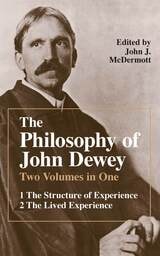
The Philosophy of John Dewey
Volume 1. The Structure of Experience. Volume 2: The Lived ExperienceJohn Dewey
University of Chicago Press, 1981
John J. McDermott's anthology, The Philosophy of John Dewey, provides the best general selection available of the writings of America's most distinguished philosopher and social critic. This comprehensive collection, ideal for use in the classroom and indispensable for anyone interested in the wide scope of Dewey's thought and works, affords great insight into his role in the history of ideas and the basic integrity of his philosophy.
This edition combines in one book the two volumes previously published separately. Volume 1, "The Structure of Experience," contains essays on metaphysics, the logic of inquiry, the problem of knowledge, and value theory. In volume 2, "The Lived Experience," Dewey's writings on pedagogy, ethics, the aesthetics of the "live creature," politics, and the philosophy of culture are presented. McDermott has prefaced each essay with a helpful explanatory note and has written an excellent general introduction to the anthology.
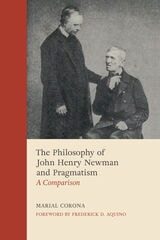
The Philosophy of John Henry Newman and Pragmatism
A ComparisonMarial Corona
Catholic University of America Press, 2023

The Philosophy of Paul Elmer More
The Ethical Basis of Life and LettersFolke Leander
University of Missouri Press, 2026
Folke Leander (1910-1981) was a prolific and internationally known Swedish philosopher. He is best known in the United States as an explicator of the New Humanism, an informal movement of literary and cultural criticism founded by Paul Elmer More (1864-1937) and Irving Babbitt (1865-1933).
Leander’s manuscript for The Philosophy of Paul Elmer More was completed in the early 1970s, but because of the academic environment at the time and the book’s special philosophical focus, Leander was unable to find a publisher. Since then, the work existed only as a typescript, a copy of which he left with Claes G. Ryn, his former student and collaborator, in the hope that one day in more favorable intellectual circumstances it might be published.
Leander is rare among the scholars of the New Humanism for his first-rate philosophical training, depth of insight, and clarity of expression. In The Philosophy of Paul Elmer More he grapples carefully and precisely with the most fundamental tenets of the New Humanism. Although very supportive of the movement, Leander provides essential critiques of its contentions—and even improves upon some of them in crucial respects. In a series of concise, limpid chapters, he explains and assesses such fundamental—but often hazily understood—Humanist concepts as the “inner check,” “naturalism,” and “the higher will.” The result is a book essential for anyone who wants to understand the New Humanism.
The Philosophy of Punishment and the History of Political Thought
Edited by Peter Karl Koritansky
University of Missouri Press, 2011
For the last half century, the philosophical debates over punishment have been deadlocked at two schools of thought: Utilitarianism and Retributivism. In his introduction, Koritansky provides an overview of the stymied debate by analyzing H. L. A. Hart’s argument for a philosophy unifying the theories of Utilitarianism and Retributivism. While Koritansky allows that both theories have contributed substantially to the contemporary understanding of punishment, he points out that Hart’s lack of success in combining these theories proves that both are less than ideal. From this starting point, Koritansky urges transcendence from these two theories in order to respond to new developments and circumstances surrounding the enactment of punishment today.
Conveniently divided into three sections, the book explores pagan and Christian premodern thought; early modern thought, culminating in chapters on Kant and classic Utilitarianism; and postmodern thought as exemplified in the theories of Nietzsche and Foucault. In all, the essays probe the work of Plato, Saint Augustine, Saint Thomas Aquinas, Thomas Hobbes, Immanuel Kant, Cesere Beccaria, Jeremy Bentham, John Stuart Mill, Friedrich Nietzsche, and Michel Foucault.
These essays devoted to the philosophy of punishment from the perspective of political thought delve deep into key contributions from thinkers of all eras to help further debates on punishment, provide the history of political thought in order to trace changes and effects on future theories, as well as expose the roots of the two prevailing schools of thought. This collection will engage all social scientists interested in the issue of punishment and energize the ongoing debate surrounding this complex issue.
The Poems of John Dewey
Edited by Jo Ann Boydston
Southern Illinois University Press, 1977
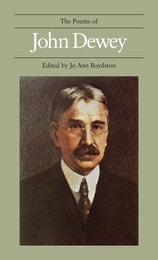
A literary discovery of considerable magnitude, these 98 previously unpublished poems by John Dewey, written principally in the 1910–18 period, illuminate an emotive aspect in his intellectual life often not manifest in the prose works.
Rumors of the existence of the poems have circulated among students of Dewey’s life and writings since 1957,when Mrs. Roberta Dewey gained possession of them from the Columbia University Columbiana collection. But except for the few persons who saw copies made by the French scholar Deladelle five years after Dewey’s death, the poems have remained inaccessible until now.
None of the poems has hitherto been published. Mrs. Roberta Dewey and Dewey’s children from his first marriage seem not to have known of Dewey’s experiments in verse during his lifetime. And, as evidence presented here now shows, only two or three acquaintances knew of actual poems written by Dewey, one of them the Polish-American novelist Anzia Yezierska, who had a brief emotional involvement with Dewey in the 1917–18 period. The factual, rather than inferential, evidence of Dewey’s relationship with Anzia Yezierska appears in the poems, which, taken as a whole, provide revealing insights into Dewey’s feelings and illuminate not only aspects of his emotions but of his thought as well.
The fact that Dewey did not publish the poetry himself, together with the circumstances of its discovery and unusual history, has led to the exceptionally careful editorial treatment of the poems given here. Scholars will find all the evidence for the authorship of the manuscripts clearly presented and all the changes and alterations carefully recorded. This edition has received the Modern Language Association of America Center for Editions of American Authors Seal as an “approved text.”

The Politics of Social Protest
Comparative Perspectives on States and Social MovementsJ. Craig Jenkins and Bert Klandermans, Editors
University of Minnesota Press, 1995
The Politics of Social Protest was first published in 1995. Minnesota Archive Editions uses digital technology to make long-unavailable books once again accessible, and are published unaltered from the original University of Minnesota Press editions.
Bringing together celebrated scholars from diverse traditions and backgrounds, The Politics of Social Protest focuses on the reciprocal relationships among social movements, states, and political parties. The volume is organized around three key questions: Why do citizens resort to the often risky and demanding strategy of using disruptive protest when other channels of political intervention appear to be available? What is the relationship between social protest movements and systems of political representation? And what is the impact of the structure and development of the state on social movements themselves?
Contributors include Ronald Aminzade, University of Minnesota; Paul Burstein, University of Washington; Russell J. Dalton, University of California, Irvine; Donatella della Porta, University of Florence; Henry Dietz, University of Texas, Austin; Rachel L. Einwohner, University of Washington; Steven E. Finkel, University of Virginia; Jerrold D. Green, University of Arizona; Jocelyn Hollander, University of Washington; Hanspeter Kriesi, University of Geneva; Diarmuid Maguire, University of Sydney; Bronislaw Misztal, Indiana University, Fort Wayne; Edward N. Muller, University of Arizona; Michael Nollert, University of Trier; Karl-Dieter Opp, University of Hamburg; Dieter Rucht, Wissenschaftszentrum Berlin; Michael Wallace, Indiana University; and Gadi Wolfsfeld, Hebrew University of Jerusalem.
J. Craig Jenkins is professor of sociology at The Ohio State University. He is the author of The Politics of Insurgency: The Farm Worker Movement of the 1960's (1985).
Bert Klandermans is professor of applied social psychology at Free University in Amsterdam, the Netherlands. He has published widely on social movements in journals such as the American Sociological Review, Sociological Forum, and the European Journal of Social Psychology. He is the editor of the Social Movements, Protest, and Contention series for the University of Minnesota Press.
Copublished with UCL Press, London.
The Possibility of Philosophy
Course Notes from the Collège de France, 1959–1961Maurice Merleau-Ponty, Edited by Stéphanie Ménasé with a foreword by Claude Lefort, Translated from the French by Keith Whitmoyer
Northwestern University Press, 2022
The Post Card
From Socrates to Freud and BeyondJacques Derrida
University of Chicago Press, 1987
You were reading a somewhat retro loveletter, the last in history. But you have not yet received it. Yes, its lack or excess of address prepares it to fall into all hands: a post card, an open letter in which the secret appears, but indecipherably.
What does a post card want to say to you? On what conditions is it possible? Its destination traverses you, you no longer know who you are. At the very instant when from its address it interpellates, you, uniquely you, instead of reaching you it divides you or sets you aside, occasionally overlooks you. And you love and you do not love, it makes of you what you wish, it takes you, it leaves you, it gives you.
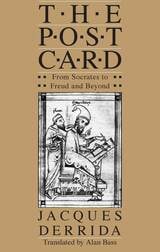
On the other side of the card, look, a proposition is made to you, S and p, Socrates and plato. For once the former seems to write, and with his other hand he is even scratching. But what is Plato doing with his outstretched finger in his back? While you occupy yourself with turning it around in every direction, it is the picture that turns you around like a letter, in advance it deciphers you, it preoccupies space, it procures your words and gestures, all the bodies that you believe you invent in order to determine its outline. You find yourself, you, yourself, on its path.
The thick support of the card, a book heavy and light, is also the specter of this scene, the analysis between Socrates and Plato, on the program of several others. Like the soothsayer, a "fortune-telling book" watches over and speculates on that-which-must-happen, on what it indeed might mean to happen, to arrive, to have to happen or arrive, to let or to make happen or arrive, to destine, to address, to send, to legate, to inherit, etc., if it all still signifies, between here and there, the near and the far, da und fort, the one or the other.
You situate the subject of the book: between the posts and the analytic movement, the pleasure principle and the history of telecommunications, the post card and the purloined letter, in a word the transference from Socrates to Freud, and beyond. This satire of epistolary literature had to be farci, stuffed with addresses, postal codes, crypted missives, anonymous letters, all of it confided to so many modes, genres, and tones. In it I also abuse dates, signatures, titles or references, language itself.
J. D.
"With The Post Card, as with Glas, Derrida appears more as writer than as philosopher. Or we could say that here, in what is in part a mock epistolary novel (the long section is called "Envois," roughly, "dispatches" ), he stages his writing more overtly than in the scholarly works. . . . The Post Card also contains a series of self-reflective essays, largely focused on Freud, in which Derrida is beautifully lucid and direct."—Alexander Gelley, Library Journal
The Poster
Art, Advertising, Design, and Collecting, 1860s–1900sRuth E. Iskin
Dartmouth College Press, 2014
The Powers of Sensibility
Aesthetic Politics through Adorno, Foucault, and RancièreMichael Feola
Northwestern University Press, 2018
Feola provides insightful engagements with the works of Adorno, Foucault, and Rancière as well as a survey of contemporary debates on aesthetics and politics. He uses this aesthetic framework to develop a more robust account of political agency, demonstrating that politics is not reducible to the exchange of views or the building of institutions, but rather incorporates public modes of feeling, seeing, and hearing (or not-seeing and not-hearing). These sensory modes must themselves be transformed in the work of emancipatory politics.
The book explores the core question: what does the aesthetic offer that is missing from the official languages of politics, citizenship, and power? Of interest to readers in the fields of critical theory, political theory, continental philosophy, and aesthetics, The Powers of Sensibility roots itself within the classical tradition of critical theory and yet uses these resources to speak to a variety of contemporary political movements.
The Practical Past
Hayden White
Northwestern University Press, 2014
Hayden White borrows the title for The Practical Past from philosopher Michael Oakeshott, who used the term to describe the accessible material and literary-artistic artifacts that individuals and institutions draw on for guidance in quotidian affairs. The Practical Past, then, forms both a summa of White’s work to be drawn upon and a new direction in his thinking about the writing of history.
White’s monumental Metahistory: The Historical Imagination in Nineteenth-Century Europe (1973) challenged many of the commonplaces of professional historical writing and wider assumptions about the ontology of history itself. It formed the basis of his argument that we can never recover “what actually happened”in the past and cannot really access even material culture in context. Forty years on, White sees “professional history" as falling prey to narrow specialization, and he calls upon historians to take seriously the practical past of explicitly “artistic” works, such as novels and dramas, and literary theorists likewise to engage historians.
The Pragmatic Mind
Explorations in the Psychology of BeliefMark Bauerlein
Duke University Press, 1997
Bauerlein extracts from Emerson, James, and Peirce an intellectual focus that can be used to advance the broad social and academic reforms that the new pragmatists hail. He claims that, in an effort to repudiate the phony universalism of much contemporary theory, the new generation of theorists has ignored the fact that its visions of pragmatic action are grounded in this "old" school, not just in a way of doing things but also in a way of thinking about things. In other words, despite its inclination to regard psychological questions as irrelevant, Bauerlein shows that the pragmatic method demands a pragmatic mind—that is, a concept of cognition, judgment, habit, and belief. He shows that, in fact, such a concept of mind does exist, in the work of the "old" pragmatists.
The Premodern Condition
Medievalism and the Making of TheoryBruce Holsinger
University of Chicago Press, 2005
Holsinger shows that the preoccupation with medieval cultures and practices among Bataille, Derrida, Lacan, Barthes, Bourdieu, and their cohorts was so wide ranging that it merits recognition as one of the most significant epiphenomena of postwar French thought. Not simply an object of nostalgic longing or an occasional source of literary exempla, the medieval epoch was continually mined by these thinkers for specific philosophical vocabularies, social formations, and systems of thought.
To supplement its master thesis, The Premodern Condition also contains original essays by Bataille and Bourdieu—translated here for the first time into English—that testify in various ways to the strange persistence of medievalisms in French postwar avant-garde writings. What results is an important and original work that will be a touchstone for specialists in medieval studies and critical theory alike.
The Presence of Myth
Leszek Kolakowski
University of Chicago Press, 1989
With The Presence of Myth, Kolakowski demonstrates that no matter how hard man strives for purely rational thought, there has always been-and always will be-a reservoir of mythical images that lend "being" and "consciousness" a specifically human meaning.
"Kolakowski undertakes a philosophy of culture which extends to all realms of human intercourse—intellectual, artistic, scientific, and emotional. . . . [His] book has real significance for today, and may well become a classic in the philosophy of culture."—Anglican Theological Review

The Price of Living
The Stories We Tell About the PoorS. Shankar
Duke University Press, 2027
The Primacy of Perception
And Other Essays on Phenomenological Psychology, the Philosophy of Art, History and PoliticsMaurice Merleau-Ponty
Northwestern University Press, 1964
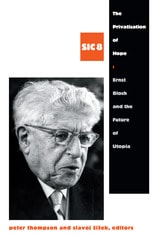
The Privatization of Hope
Ernst Bloch and the Future of Utopia, SIC 8Peter Thompson and Slavoj Žižek, eds.
Duke University Press, 2013
Contributors. Roland Boer, Frances Daly, Henk de Berg, Vincent Geoghegan, Wayne Hudson, Ruth Levitas, David Miller, Catherine Moir, Caitríona Ní Dhúill, Welf Schröter, Johan Siebers, Peter Thompson, Francesca Vidal, Rainer Ernst Zimmermann, Slavoj Žižek
The Problem of Genesis in Husserl's Philosophy
Jacques Derrida
University of Chicago Press, 2003
For Derrida, the problem of genesis in Husserl's philosophy is that both temporality and meaning must be generated by prior acts of the transcendental subject, but transcendental subjectivity must itself be constituted by an act of genesis. Hence, the notion of genesis in the phenomenological sense underlies both temporality and atemporality, history and philosophy, resulting in a tension that Derrida sees as ultimately unresolvable yet central to the practice of phenomenology.
Ten years later, Derrida moved away from phenomenology entirely, arguing in his introduction to Husserl's posthumously published Origin of Geometry and his own Speech and Phenomena that the phenomenological project has neither resolved this tension nor expressly worked with it. The Problem of Genesis complements these other works, showing the development of Derrida's approach to phenomenology as well as documenting the state of phenomenological thought in France during a particularly fertile period, when Levinas, Sartre, Merleau-Ponty, Ricoeur, and Tran-Duc-Thao, as well as Derrida, were all working through it. But the book is most important in allowing us to follow Derrida's own development as a philosopher by tracing the roots of his later work in deconstruction to these early critical reflections on Husserl's phenomenology.
"A dissertation is not merely a prerequisite for an academic job. It may set the stage for a scholar's life project. So, the doctoral dissertations of Max Weber and Jacques Derrida, never before available in English, may be of more than passing interest. In June, the University of Chicago Press will publish Mr. Derrida's dissertation, The Problem of Genesis in Husserl's Philosophy, which the French philosopher wrote in 1953-54 as a doctoral student, and which did not appear in French until 1990. From the start, Mr Derrida displayed his inventive linguistic style and flouting of convention."—Danny Postel, Chronicle of Higher Education
The Problem of Passing
Sandra Harvey
Duke University Press, 2026

The Promise of Beauty
Mimi Thi Nguyen
Duke University Press, 2024
The Promise of Happiness
Sara Ahmed
Duke University Press, 2010
Ahmed draws on the intellectual history of happiness, from classical accounts of ethics as the good life, through seventeenth-century writings on affect and the passions, eighteenth-century debates on virtue and education, and nineteenth-century utilitarianism. She engages with feminist, antiracist, and queer critics who have shown how happiness is used to justify social oppression, and how challenging oppression causes unhappiness. Reading novels and films including Mrs. Dalloway, The Well of Loneliness, Bend It Like Beckham, and Children of Men, Ahmed considers the plight of the figures who challenge and are challenged by the attribution of happiness to particular objects or social ideals: the feminist killjoy, the unhappy queer, the angry black woman, and the melancholic migrant. Through her readings she raises critical questions about the moral order imposed by the injunction to be happy.
The Promise of Pragmatism
Modernism and the Crisis of Knowledge and AuthorityJohn Patrick Diggins
University of Chicago Press, 1994
"Diggins, an eminent historian of American intellectual life, has written a timely and impressive book charting the rich history of American pragmatism and placing William James, Charles Peirce, John Dewey, George Herbert Mead, Sidney Hook, and Richard Rorty in their times and in the light of contemporary concerns. The book also draws on an alternative set of American thinkers to explore the blind spots in the pragmatic temper."—William Connolly, New York Times Book Review
"An extraordinarily ambitious work of both analysis and synthesis. . . . Diggins's book is rewarding in its thoughtfulness and its nuanced presentation of ideas."—Daniel J. Silver, Commentary
"Diggins's superbly informed book comprises a comprehensive history of American pragmatic thought. . . . It contains expert descriptions of James, John Dewey and Charles Sanders Peirce, the first generation of American pragmatists. . . . Diggins is just as good on the revival of pragmatism that's taken place over the last 20 years in America. . . . [A] richly intelligent book."—Mark Edmundson, Washington Post Book World
The Prose of the World
Maurice Merleau-Ponty
Northwestern University Press, 1973
The Question of God in Heidegger's Phenomenology
George Kovacs
Northwestern University Press, 1990
The Religion of Existence
Asceticism in Philosophy from Kierkegaard to SartreNoreen Khawaja
University of Chicago Press, 2016
At the heart of existentialism, Noreen Khawaja argues, is a story about secular thought experimenting with the traditions of European Christianity. This book explores how a distinctly Protestant asceticism formed the basis for the chief existentialist ideal, personal authenticity, which is reflected in approaches ranging from Kierkegaard’s religious theory of the self to Heidegger’s phenomenology of everyday life to Sartre’s global mission of atheistic humanism. Through these three philosophers, she argues, we observe how ascetic norms have shaped one of the twentieth century’s most powerful ways of thinking about identity and difference—the idea that the “true” self is not simply given but something that each of us is responsible for producing.
Engaging with many central figures in modern European thought, this book will appeal to philosophers and historians of European philosophy, scholars of modern Christianity, and those working on problems at the intersection of religion and modernity.
The Remains of Reason
On Meaning after LacanDominik Finkelde
Northwestern University Press, 2025
Unpacking the central role of the unconscious in the relationship between mind and world
Over a series of careful readings and accessible discussions, prefaced by a foreword from Eric Santner, Dominik Finkelde analyzes the central role of the unconscious in the relationship between mind and world. Moving beyond Freud, Kant, and Hegel and toward the contemporary work of the Ljubljana School, he explores how humans relate to facts and the influence of the unconscious on questions regarding truth, perception, and meaning.
Aspects of recognition and unconscious processes of transference are at stake in these fundamental questions of perception and knowledge, though these have been widely ignored in epistemological and ontological debates in contemporary philosophy. Finkelde draws on both the continental and analytic traditions, ultimately building from the work of current-day interlocutors to interrogate questions concerning the influence of enigmatic signifiers, the role of sublime objects of ideology, the importance of fantasy cultivation and transgression, and the power of jouissance as an ontological factor.
The Renaissance Philosophy of Man
Petrarca, Valla, Ficino, Pico, Pomponazzi, VivesEdited by Ernst Cassirer, Paul Oskar Kristeller, and John Herman Randall Jr.
University of Chicago Press, 1956
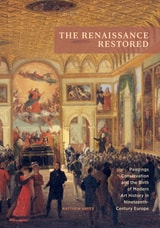
The Renaissance Restored
Paintings Conservation and the Birth of Modern Art History in Nineteenth-Century EuropeMatthew Hayes
J. Paul Getty Trust, The, 2021
Repairing works of art and writing about them—the practices that became art conservation and art history—share a common ancestry. By the nineteenth century the two fields had become inseparably linked. While the art historical scholarship of this period has been widely studied, its restoration practices have received less scrutiny—until now.
This book charts the intersections between art history and conservation in the treatment of Italian Renaissance paintings in nineteenth-century Europe. Initial chapters discuss the restoration of works by Giotto and Titian, framed by the contemporary scholarship of art historians such as Jacob Burckhardt, G. B. Cavalcaselle, and Joseph Crowe that was redefining the earlier age. Subsequent chapters recount how paintings conservation was integrated into museum settings. The narrative uses period texts, unpublished archival materials, and historical photographs in probing how paintings looked at a time when scholars were writing the foundational texts of art history, and how contemporary restorers were negotiating the appearances of these works. The book proposes a model for a new conservation history, object focused yet enriched by consideration of a wider cultural horizon.
The Revival of Pragmatism
New Essays on Social Thought, Law, and CultureMorris Dickstein, ed.
Duke University Press, 1998
As the twenty-five intellectuals who take part in this discussion show, pragmatism has become a complex terrain on which a rich variety of contemporary debates have been played out. Contributors such as Richard Rorty, Stanley Cavell, Nancy Fraser, Robert Westbrook, Hilary Putnam, and Morris Dickstein trace pragmatism’s cultural and intellectual evolution, consider its connection to democracy, and discuss its complex relationship to the work of Emerson, Nietzsche, and Wittgenstein. They show the influence of pragmatism on black intellectuals such as W. E. B. Du Bois, explore its view of poetic language, and debate its effects on social science, history, and jurisprudence. Also including essays by critics of the revival such as Alan Wolfe and John Patrick Diggins, the volume concludes with a response to the whole collection from Stanley Fish.
Including an extensive bibliography, this interdisciplinary work provides an in-depth and broadly gauged introduction to pragmatism, one that will be crucial for understanding the shape of the transformations taking place in the American social and philosophical scene at the end of the twentieth century.
Contributors. Richard Bernstein, David Bromwich, Ray Carney, Stanley Cavell, Morris Dickstein, John Patrick Diggins, Stanley Fish, Nancy Fraser, Thomas C. Grey, Giles Gunn, Hans Joas, James T. Kloppenberg, David Luban, Louis Menand, Sidney Morgenbesser, Richard Poirier, Richard A. Posner, Ross Posnock, Hilary Putnam, Ruth Anna Putnam, Richard Rorty, Michel Rosenfeld, Richard H. Weisberg, Robert B. Westbrook, Alan Wolfe
The Rhythm of Thought
Art, Literature, and Music after Merleau-PontyJessica Wiskus
University of Chicago Press, 2013

The Romance of Individualism in Emerson and Nietzsche
David Mikics
Ohio University Press, 2027
The great American thinker Ralph Waldo Emerson and the influential German philosopher Friedrich Nietzsche, though writing in different eras and ultimately developing significantly different philosophies, both praised the individual’s wish to be transformed, to be fully created for the first time. Emerson and Nietzsche challenge us to undertake the task of identity on our own, in order to see (in Nietzsche’s phrase) “how one becomes what one is.”
David Mikics’s The Romance of Individualism in Emerson and Nietzsche examines the argument, as well as the affinity, between these two philosophers. Nietzsche was an enthusiastic reader of Emerson and inherited from him an interest in provocation as a means of instruction, an understanding of the permanent importance of moods and transitory moments in our lives, and a sense of the revolutionary character of impulse. Both were deliberately outrageous thinkers, striving to shake us out of our complacency.
Rather than choosing between Emerson and Nietzsche, Mikics attends to Nietzsche’s struggle with Emerson’s example and influence. Elegant in its delivery, The Romance of Individualism in Emerson and Nietzsche offers a significant commentary on the visions of several contemporary theorists whose interests intersect with those of Emerson and Nietzsche, especially Stanley Cavell, Jacques Lacan, Slavoj Zizek, and Harold Bloom.
The Saint and the Atheist
Thomas Aquinas and Jean-Paul SartreJoseph S. Catalano
University of Chicago Press, 2021
Compact and open to readers of varying backgrounds, this book represents Catalano’s efforts to bring a lifetime of work on Sartre into an accessible consideration of philosophical questions by placing him in conversation with Aquinas, and it serves as a primer on key ideas of both philosophers. By bringing together these two figures, Catalano offers a fruitful space for thinking through some of the central questions about faith, conscience, freedom, and the meaning of life.
The Saving Line
Benjamin, Adorno, and the Caesuras of HopeMárton Dornbach
Northwestern University Press, 2021
Walter Benjamin and Theodor Adorno both turned to canonical literary narratives to determine why the Enlightenment project was derailed and how this failure might be remedied. The resultant works, Benjamin’s major essay on Goethe’s Elective Affinities and Adorno’s meditation on the Odyssey in Dialectic of Enlightenment, are centrally concerned with the very act of narration. Márton Dornbach’s groundbreaking book reconstructs a hitherto unnoticed, wide-ranging dialogue between these foundational texts of the Frankfurt School.
At the heart of Dornbach’s argument is a critical model that Benjamin built around the concept of caesura, a model Adorno subsequently reworked. Countering an obscurantism that would become complicit in the rise of fascism, the two theorists aligned moments of arrest in narratives mired in unreason. Although this model responded to a specific historical emergency, it can be adapted to identify utopian impulses in a variety of works.
The Saving Line throws fresh light on the intellectual exchange and disagreements between Benjamin and Adorno, the problematic conjunction of secular reason and negative theology in their thinking, and their appropriations of ancient and modern legacies. It will interest scholars of philosophy and literature, critical theory, German Jewish thought, classical reception studies, and narratology.
The School and Society
John Dewey. Edited by Jo Ann Boydston. Introduction by Joe R. Burnett
Southern Illinois University Press, 1980
First published in 1899,The School and Society describes John Dewey’s experiences with his own famous Laboratory School, started in 1896.
Dewey’s experiments at the Laboratory School reflected his original social and educational philosophy based on American experience and concepts of democracy, not on European education models then in vogue. This forerunner of the major works shows Dewey’s pervasive concern with the need for a rich, dynamic, and viable society.
In his introduction to this volume, Joe R. Burnett states Dewey’s theme. Industrialization, urbanization, science, and technology have created a revolution the schools cannot ignore. Dewey carries this theme through eight chapters: The School and Social Progress; The School and the Life of the Child; Waste in Education; Three Years of the University Elementary School; The Psychology of Elementary Education; Froebel’s Educational Principles; The Psychology of Occupations; and the Development of Attention.
The Secrets We Keep
Hidden Histories of the Byzantine EmpireRoland Betancourt
J. Paul Getty Trust, The, 2024
Secrecy has played a role throughout human history and continues to capture the popular imagination. Some of the most seductive aspects of the Byzantine Empire—such as the relics of the imperial palace and the military uses of Greek fire—have been shrouded in mystery for centuries. This book provides a brief history of secrecy in Byzantium and examines the role of the art historian in uncovering the truth, demonstrating how visual evidence can not only reveal new findings but also purposely conceal answers.
Art historians face many challenges in their search for hidden knowledge, including accessing accounts preserved in fragmentary glimpses and reconciling how practices of speculation and reconstruction result in different, and sometimes contradictory, understandings. With pressing urgency, this book asks scholars to consider their role in articulating the stories of marginalized people, particularly for queer and trans history.
At the core of these investigations is the quest to discover how clandestine knowledge was transmitted and how relationships were strengthened by collective secret keeping, as well as how concealment is used as a strategy for exercising power. With insights into the religious, imperial, military, and cultural uses of secrecy, this book offers an intriguing look at the ways secrecy manifested itself during the Byzantine Empire and the implications it has for the issues we face today.
The Sensible World and the World of Expression
Course Notes from the Collège de France, 1953Maurice Merleau-Ponty, Translated from the French with an introduction and notes by Bryan Smyth
Northwestern University Press, 2020
The Sensible World and the World of Expression was a course of lectures that Merleau-Ponty gave at the Collège de France after his election to the chair of philosophy in 1952. The publication and translation of Merleau-Ponty’s notes from this course provide an exceptional view into the evolution of his thought at an important point in his career.
In these notes, we see that Merleau-Ponty’s consideration of the problem of the perception of movement leads him to make a self-critical return to Phenomenology of Perception in order to rethink the perceptual encounter with the sensible world as essentially expressive, and hence to revise his understanding of the body schema accordingly in terms of praxical motor possibilities. Sketching out an embodied dialectic of expressive praxis that would link perception with art, language, and other cultural and intersubjective phenomena, up to and including truth, Merleau-Ponty’s notes for these lectures thus afford an exciting glimpse of how he aspired to overcome the impasse of ontological dualism.
Situated midway between Phenomenology of Perception and The Visible and the Invisible, these notes mark a juncture of crucial importance with regard to Merleau-Ponty’s later efforts to work out the ontological underpinnings of phenomenology in terms of a new dialectical conception of nature and history.