Results by title
1066 books match the query 'Political' and 230 start with t
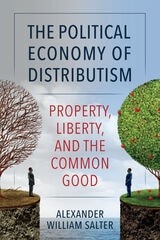
The Political Economy of Distributism
Property, Liberty, and the Common GoodAlexander William Salter
Catholic University of America Press, 2023
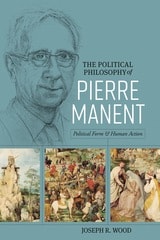
The Political Philosophy of Pierre Manent
Political Form and Human ActionJoseph Wood
Catholic University of America Press, 2024

The Political and Social Theory of Max Weber
Collected EssaysWolfgang J. Mommsen
University of Chicago Press, 1989

The Politics of Decolonial Investigations
Walter D. Mignolo
Duke University Press, 2021
The Politics of Fear
Joseph R. McCarthy and the SenateRobert Griffith
University of Massachusetts Press, 1970
Winner of the Organization of American Historians’ Frederick Jackson Turner Award
Originally published in 1970, and now a classic in its field, The Politics of Fear traces the rise and fall of one of America’s most notorious political demagogues. Robert Griffith concludes that McCarthy’s enormous power owed less to the force of the senator’s unique personality than to the issues and symbols with which he identified and that McCarthy was the product, not the progenitor, of the postwar politics of anticommunism. For this edition, Griffith has provided a new introduction covering the recent literature on McCarthyism and the changing views on the topic.
The Politics of Responsibility
Chad Lavin
University of Illinois Press, 2007
Politics cannot function without responsibility, but there have been serious disagreements about how responsibility is to be understood and huge controversies about how it is to be distributed, rewarded, legislated, and enforced. The liberal notions of personal responsibility that have dominated political thinking in the West for more than a century are rooted in the familiar territory of individual will and causal blame, but these theories have been assailed as no longer adequate to explain or address the political demands of a global social structure. Informed by Marx, Foucault, and Butler, Chad Lavin argues for a "postliberal" theory of responsibility, formulating responsibility as a process that is anchored in a persistent ability to respond, not reproach. Lavin works this formulation through discussions of contemporary political issues such as globalization, police brutality, and abortion.
Rather than assigning individual blame, postliberal responsibility challenges the supposed autonomy of individual subjects by taking structural arguments into account. Lavin concludes that a liberal concept of responsibility gives rise to a moralistic and oppressive approach to social problems, while a postliberal approach highlights a shared responsibility for developing collective solutions to systemic problems. Postliberal responsibility not only suggests more generous and democratic responses to social ills, it also allows us to theorize a greater range of issues that demand political response.

The Politics of Truth and Other Untimely Essays
The Crisis of Civic ConsciousnessEllis Sandoz
University of Missouri Press, 1999
A fascinating collection of studies, The Politics of Truth and Other Untimely Essays explores the historical and theoretical underpinnings of personal liberty and free government and provides a trenchant analysis of the crisis of civic consciousness endangering both of them today. The book addresses a range of issues in contemporary political philosophy and constitutional theory. These are seen to be all the more urgent in importance because of the surging aspirations for liberty in the wake of the collapse of the Soviet empire and the post-Cold War anomaly of crisis, malaise, and disarray in free government itself in America and in other bastions of modern democracy.
While each essay can stand alone, there is an underlying thematic unity to the collection. The fundamental problem considered throughout is whether and to what extent the fall of communism may mark an epoch in world history. These questions are applied to the East Central European nations struggling to achieve free government and personal liberty. The elements required to identify the preconditions of liberty are addressed and specific attention is given to the terms of institutionalization in the American founding.
Several essays focus on American political thought, with emphasis on the Declaration of Independence and the Constitution. Two elements, in particular, are treated: the jurisprudential and common law background to the American political tradition and the centrality of religion within the unfolding of the American political experiment. Sandoz explores the uncommon alliance of philosophers, statesmen, and evangelists during the nation's founding. This alliance, nurturing communities of persons bound together by their faith and a mutual regard for one another, played a vital role in the establishment of the system of freedom under law.
Sandoz sees the tension between religion and natural law as a constant in the human struggle for freedom. That the preservation of liberty under law is no easy task is acknowledged and addressed as it can be seen in the American founding, in the post-communist struggle of East Central Europe, and in the deepening contemporary crisis of American society. Anyone interested in the "politics" of "truth" will appreciate this volume.
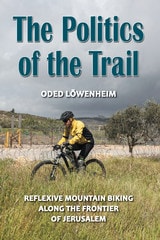
The Politics of the Trail
Reflexive Mountain Biking along the Frontier of JerusalemOded Löwenheim
University of Michigan Press, 2014
In The Politics of the Trail, Löwenheim confronts this tension by focusing on his encounters with three places along the trail: the separation fence between Israel and the Palestinians; the ruins of the Palestinian village Qalunya, demolished in 1948; and the trail connecting the largest 9/11 memorial site outside of the U.S. with a top-secret nuclear-proof bunker for the Israeli cabinet. He shares the stories of the people he meets along the way and considers how his own subjectivity is shaped by the landscape and culture of conflict. Moreover, he deconstructs, challenges, and resists the concepts and institutions that constitute such a culture and invites conversation about the idea of conflict as a culture.
The Possible Form of an Interlocution
W. E. B. Du Bois and Max Weber in CorrespondenceNahum Dimitri Chandler
Duke University Press, 2025
The Postmodern Imagination of Russell Kirk
Gerald J. Russello
University of Missouri Press, 2007
Author of The Conservative Mind, Russell Kirk (1918–1994) was a principal architect of the American intellectual conservative movement. This book takes a closer look at his works on such subjects as law, history, economics, and statesmanship to introduce a new generation of readers to the depth and range of his thought.
Kirk probed the very meaning of conservatism for modern intellectuals, and in The Postmodern Imagination of Russell Kirk, Gerald Russello examines such key concepts of his thought as imagination, historical consciousness, the interplay between the individual and tradition, and the role of narrative in constructing individual and societal identity. By stressing the importance of Kirk’s perception of imagination, he offers a new approach to understanding him, showing not only that Kirk laid the groundwork for the “new conservatism” of the 1950s and ’60s, but also that his work evolved into a sophisticated critique of modernity paralleled in the work of some postmodern critics of liberalism.
In order to reconstruct Kirk’s attack on modernity, Russello examines his textbook on economics, his fiction, his work on Robert Taft and Orestes Brownson, his writings on the role of the statesman, and his neglected essays such as “The Age of Discussion” and “The Age of Sentiments.” Russello shows that Kirk welcomed the rise of some form of postmodernism, seeing in it a new opportunity for conservatism to engage the wider culture. Through this analysis, he situates Kirk within wider currents of contemporary thought, connecting him not only with such major thinkers as Lyotard, Boorstin, and Koestler but also with such lesser-known figures as Bernard Iddings Bell, Charles Baudouin, and Christopher Dawson.
By examining Kirk’s development of the imagination as a tool of conservative discourse, Russello offers an alternative genealogy for conservative thought that melds its antimodernism with postmodern themes. He has forged a lively and provocative work that provides unusual perspectives on Kirk within the wider context of debate over the future of conservatism in a time of shifting alliances—a book that will be a valuable resource for anyone seeking to understand Kirk or conservative thought.
The Powers of Dignity
The Black Political Philosophy of Frederick DouglassNick Bromell
Duke University Press, 2021
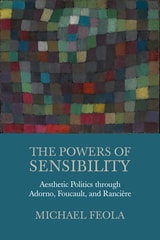
The Powers of Sensibility
Aesthetic Politics through Adorno, Foucault, and RancièreMichael Feola
Northwestern University Press, 2018
Feola provides insightful engagements with the works of Adorno, Foucault, and Rancière as well as a survey of contemporary debates on aesthetics and politics. He uses this aesthetic framework to develop a more robust account of political agency, demonstrating that politics is not reducible to the exchange of views or the building of institutions, but rather incorporates public modes of feeling, seeing, and hearing (or not-seeing and not-hearing). These sensory modes must themselves be transformed in the work of emancipatory politics.
The book explores the core question: what does the aesthetic offer that is missing from the official languages of politics, citizenship, and power? Of interest to readers in the fields of critical theory, political theory, continental philosophy, and aesthetics, The Powers of Sensibility roots itself within the classical tradition of critical theory and yet uses these resources to speak to a variety of contemporary political movements.
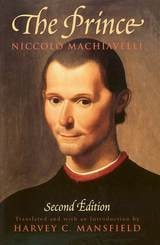
The Prince
Second EditionNiccolò Machiavelli
University of Chicago Press, 1998
The Prince remains as lively and shocking today as when it was written almost five hundred years ago. Initially denounced as a collection of sinister maxims and a recommendation of tyranny, it has more recently been defended as the first scientific treatment of politics as it is practiced rather than as it ought to be practiced. Harvey C. Mansfield's brilliant translation of this classic work, along with the new materials added for this edition, make it the definitive version of The Prince, indispensable to scholars, students, and those interested in the dark art of politics.
This revised edition of Mansfield's acclaimed translation features an updated bibliography, a substantial glossary, an analytic introduction, a chronology of Machiavelli's life, and a map of Italy in Machiavelli's time.
"Of the other available [translations], that of Harvey C. Mansfield makes the necessary compromises between exactness and readability, as well as providing an excellent introduction and notes."—Clifford Orwin, The Wall Street Journal
"Mansfield's work . . . is worth acquiring as the best combination of accuracy and readability."—Choice
"There is good reason to assert that Machiavelli has met his match in Mansfield. . . . [He] is ready to read Machiavelli as he demands to be read—plainly and boldly, but also cautiously."—John Gueguen, The Sixteenth Century Journal
The Prince
Second EditionNiccolò Machiavelli
University of Chicago Press, 1998
The most famous book on politics ever written, The Prince remains as lively and shocking today as when it was written almost five hundred years ago. Initially denounced as a collection of sinister maxims and a recommendation of tyranny, it has more recently been defended as the first scientific treatment of politics as it is practiced rather than as it ought to be practiced. Harvey C. Mansfield's brilliant translation of this classic work, along with the new materials added for this edition, make it the definitive version of The Prince, indispensable to scholars, students, and those interested in the dark art of politics.
This revised edition of Mansfield's acclaimed translation features an updated bibliography, a substantial glossary, an analytic introduction, a chronology of Machiavelli's life, and a map of Italy in Machiavelli's time.
"Of the other available [translations], that of Harvey C. Mansfield makes the necessary compromises between exactness and readability, as well as providing an excellent introduction and notes."—Clifford Orwin, The Wall Street Journal
"Mansfield's work . . . is worth acquiring as the best combination of accuracy and readability."—Choice
"There is good reason to assert that Machiavelli has met his match in Mansfield. . . . [He] is ready to read Machiavelli as he demands to be read—plainly and boldly, but also cautiously."—John Gueguen, The Sixteenth Century Journal
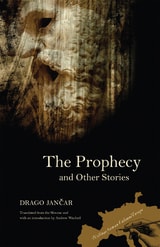
The Prophecy and Other Stories
Drago Jancar
Northwestern University Press, 2009
These newly collected short stories reveal a master at the top of his game. Drago Jancar possesses an acute understanding of the human psyche, enabling his stories to resonate beyond their particular milieu. This collection features seven pieces, drawn from four different collections, that together present the struggle of individuals against powerful forces. The characters try to make sense of a world of shifting borders and changing names that make the idea of a "homeland"—either literal or figurative—a dream rather than a reality.
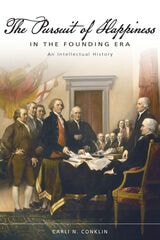
The Pursuit of Happiness in the Founding Era
An Intellectual HistoryCarli N. Conklin
University of Missouri Press, 2020
Scholars have long debated the meaning of the pursuit of happiness, yet have tended to define it narrowly, focusing on a single intellectual tradition, and on the use of the term within a single text, the Declaration of Independence. In this insightful volume, Carli Conklin considers the pursuit of happiness across a variety of intellectual traditions, and explores its usage in two key legal texts of the Founding Era, the Declaration and William Blackstone’s Commentaries on the Laws of England.
For Blackstone, the pursuit of happiness was a science of jurisprudence, by which his students could know, and then rightly apply, the first principles of the Common Law. For the founders, the pursuit of happiness was the individual right to pursue a life lived in harmony with the law of nature and a public duty to govern in accordance with that law. Both applications suggest we consider anew how the phrase, and its underlying legal philosophies, were understood in the founding era. With this work, Conklin makes important contributions to the fields of early American intellectual and legal history.
The Pursuit of Unity and Perfection in History
Klaus Vondung
St. Augustine's Press, 2020
Particular focus in following the thread of unity and perfection in human intellectual and practical ambitions ultimately hones in on the combination of religion and politics. Vondung in these essays unpacks the ways in which this continues to fascinate and disturb us, and in his expertise he uses National Socialism to connect this pursuit of unity and perfection to what he calls one of the signature marks of modernity––namely, secular apocalypticism. This claim stands in opposition to Eric Voegelin’s remark that Gnosticism, rather, is “the nature of modernity.” Vondung, who studied and wrote his dissertation under Voegelin, grapples with the contrast of these positions. Vondung is willing to challenge Voegelin, but ultimately his treatment of the latter bears the quality of tribute to this great scholar.
Vondung also explores the points of contact between apocalypticism and Hermetic speculation. Despite the independence of the religious and philosophical doctrines of Hermeticism, there are parallels to be found. Apocalypticism and Hermeticism originated in antiquity and yet each represents a tradition that still holds footing today. Vondung furthermore leads the reader to see the project of salvation found in both even as each operates with a different scope.
This collection of essays centers itself on a perspective of the human pursuit of unity and perfection, directly or indirectly, as objectives of intellectual endeavors, existential ideals, as social or political outcomes, and in the case of National Socialism even as perverse aberrations that led to the Holocaust. Vondung’s particular treatment of Voegelin’s work likewise establishes what the former identifies as a stand-out question of this study: Does the search for order in history show us the unity of the history of humankind?
The Quaker City, or The Monks of Monk Hall
A Romance of Philadelphia Life, Mystery, and CrimeGeorge Lippard
University of Massachusetts Press, 1995

The Radical Lord Radnor
The Public Life of Viscount Folkestone, Third Earl of Radnor (1779-1869)Ronald K. Huch
University of Minnesota Press, 1977
The Radical Lord Radnor was first published in 1977. Minnesota Archive Editions uses digital technology to make long-unavailable books once again accessible, and are published unaltered from the original University of Minnesota Press editions.
The third Earl of Radnor, born William Pleydell-Bouverie, served in the British House of Commons for twenty-seven years (1801–1828) as Viscount Folkestone and in the House of Lords for twenty years (1828–1848). Although he was a great hereditary landowner, Lord Radnor was the most radical nobleman to serve in Parliament in the first half of the nineteenth century. In this political biography, Professor Huch traces Lord Radnor's entire parliamentary career.
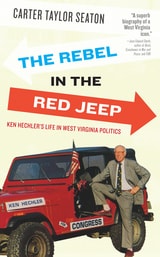
The Rebel in the Red Jeep
Ken Hechler's Life in West Virginia PoliticsCarter Taylor Seaton
West Virginia University Press, 2017
This biography recounts a century of accomplishments, from Hechler’s introduction of innovative teaching methods at major universities, to his work as a speechwriter and researcher for President Harry Truman, and finally to his time representing West Virginia in the US House of Representatives and as the secretary of state.
In West Virginia, where he resisted mainstream political ideology, Hechler was the principal architect behind the Federal Coal Mine Health and Safety Act of 1969 and constantly battled big coal, strip-mining, and fellow politicians alike. He and his signature red jeep remain a fixture in West Virginia. Since 2004, Hechler has campaigned against mountaintop removal mining. He was arrested for trespassing during a protest in 2009 at the age of 94.
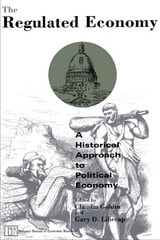
The Regulated Economy
A Historical Approach to Political EconomyEdited by Claudia Goldin and Gary D. Libecap
University of Chicago Press, 1994
The Regulated Economy examines how constituent groups emerged and demanded government action to solve perceived economic problems, such as exorbitant railroad and utility rates, bank failure, falling agricultural prices, the immigration of low-skilled workers, workplace injury, and the financing of government. The contributors look at how preexisting policies, institutions, and market structures shaped regulatory activity; the origins of regulatory movements at the state and local levels; the effects of consensus-building on the timing and content of legislation; and how well government policies reflect constituency interests.
A wide-ranging historical view of the way interest group demands and political bargaining have influenced the growth of economic regulation in the United States, this book is important reading for economists, political scientists, and public policy experts.
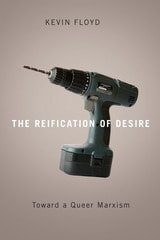
The Reification of Desire
Toward a Queer MarxismKevin Floyd
University of Minnesota Press, 2009
Kevin Floyd brings queer critique to bear on the Marxian categories of reification and totality and considers the dialectic that frames the work of Georg Lukács, Herbert Marcuse, and Fredric Jameson. Reading the work of these theorists together with influential queer work by such figures as Michel Foucault and Judith Butler, and alongside reconsiderations of such texts as The Sun Also Rises and Midnight Cowboy, Floyd reformulates these two central categories that have been inseparable from a key strand of Marxist thought and have marked both its explanatory power and its limitations. Floyd theorizes a dissociation of sexuality from gender at the beginning of the twentieth century in terms of reification to claim that this dissociation is one aspect of a larger dynamic of social reification enforced by capitalism.
Developing a queer examination of reification and totality, Kevin Floyd ultimately argues that the insights of queer theory require a fundamental rethinking of both.
The Religion of Humanity
The Illusion of Our TimesPierre Manent
St. Augustine's Press, 2022
The Religion of Humanity: The Illusion of Our Time is the first anthology in any language of the writings of the contemporary French political philosopher, Pierre Manent, on “the religion of Humanity.” The striking phrase comes from nineteenth-century French thinker, Auguste Comte (1798–1857). Comte coined the phrase and indeed created an atheistic religion of a self-adoring Humanity. In the aftermath of the Cold War, Manent observed victorious democracy interpreting itself in a similar framework. He took it upon himself to track this development, analyze it, and warn his fellow Europeans of its deleterious political, intellectual, moral, and spiritual effects. With conceptual precision and (most often) a sober tone, many contemporary sacred cows were gored. But in addition to cursing the humanitarian darkness, he also lit many candles of judicious political, philosophical, moral, and spiritual analysis. This anthology is thus almost unique in its subject matter, and certainly unique in its treatment of the subject. It is a rarity and gem: a first-rate work of political philosophy.
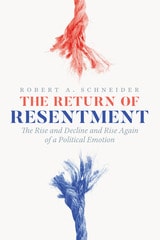
The Return of Resentment
The Rise and Decline and Rise Again of a Political EmotionRobert A. Schneider
University of Chicago Press, 2023
The term “resentment,” often casually paired with words like “hatred,” “rage,” and “fear,” has dominated US news analysis since November 2016. Despite its increased use, this word seems to defy easy categorization. Does “resentment” describe many interlocking sentiments, or is it just another way of saying “anger”? Does it suggest an irrational grievance, as opposed to a legitimate callout of injustice? Does it imply political leanings, or is it nonpartisan by nature?
In The Return of Resentment, Robert A. Schneider explores these questions and more, moving from eighteenth-century Britain to the aftermath of the French Revolution to social movements throughout the twentieth century. Drawing on a wide range of writers, thinkers, and historical experiences, Schneider illustrates how resentment has morphed across time, coming to express a collective sentiment felt by people and movements across the political spectrum. In this history, we discover resentment’s modernity and its ambiguity—how it can be used to dismiss legitimate critique and explain away violence, but also convey a moral stance that demands recognition. Schneider anatomizes the many ways resentment has been used to label present-day movements, from followers of Trump and supporters of Brexit to radical Islamicists and proponents of identity politics. Addressing our contemporary political situation in a novel way, The Return of Resentment challenges us to think critically about the roles different emotions play in politics.
The Rhetoric of Fascism
Edited by Nathan Crick
University of Alabama Press, 2022
Decoding the discourse: Rhetorical foundations of authoritarian power.
Fascism has resurfaced as one of the most pressing problems of our time. The rise of extremist parties and candidates in Europe, the United States, and around the globe has led even mainstream political commentators to begin using the term “fascism” to describe dangerous movements that have revived and repackaged many of the strategies long thought to have been relegated to the margins of political rhetoric. No longer just confined to the state regimes of the past, fascism thrives today as a globally self-augmenting, self-propagating rhetorical phenomenon with a variety of faces and expressions.
The Rhetoric of Fascism defines and interprets the common persuasive devices that characterize fascist discourse to understand the nature of its enduring appeal. By approaching fascism from a rhetorical perspective, this volume complements established political and sociological understandings of fascism as a movement or regime. A rhetorical approach studies fascism less as a party one joins than as a set of persuasive strategies one adopts. Fascism spreads precisely because it is not a coherent entity. Instead, it exists as a loosely bound and often contradictory collection of persuasive trajectories that have attained enough coherence to mobilize and channel the passions of a self-constituted mass of individuals.
Introductory chapters focus on general theories of fascism drawn from twentieth-century history and theory. Contributors investigate specific historical figures and their relationship to contemporary rhetorics, focusing on a specific rhetorical device that is characteristic of fascist rhetoric. A common thread throughout every chapter is that fascist devices are appealing because they speak to us in the familiar language of our culture. As we are seduced by one device at a time, we soon find ourselves part of a movement, a group, or a campaign that makes us act in ways we might never have imagined. This volume reveals that fascism may be closer to home than we think.
CONTRIBUTORS
Patrick D. Anderson / Rya Butterfield / Nathan Crick / Elizabeth R. Earle / Zac Gershberg / Stephen J. Hartnett / Marie-Odile N. Hobeika / Sean Illing / Jacob A. Miller / Fernando Ismael Quiñones Valdivia / Patricia Roberts-Miller / Raquel M. Robvais / Bradley A. Serber / Ryan Skinnell
The Rise of Common-Sense Conservatism
The American Right and the Reinvention of the Scottish EnlightenmentAntti Lepistö
University of Chicago Press, 2021
In considering the luminaries of American neoconservative thought—among them Irving Kristol, Gertrude Himmelfarb, James Q. Wilson, and Francis Fukuyama—Lepistö argues that the centrality of their conception of the common man accounts for the enduring power and influence of their thought. Intriguingly, Lepistö locates the roots of this conception in the eighteenth-century Scottish Enlightenment, revealing how leading neoconservatives weaponized the ideas of Adam Smith, Thomas Reid, and David Hume to denounce postwar liberal elites, educational authorities, and social reformers. Their reconfiguration of Scottish Enlightenment ideas ultimately gave rise to a defining force in modern conservative politics: the common sense of the common man. Whether twenty-first-century politicians who invoke the grievances of “the people” are conscious of this unusual lineage or not, Lepistö explains both the persistence of the trope and the complicity of some conservative thinkers with the Trump regime.
The River of Angry Dogs
A MemoirMira Hamermesh
Pluto Press, 2004
As a young Jewish teenager Hamermesh escaped the horrors of German-occupied Poland and was spared the experience of the ghetto and the concentration camp that claimed most of her family. Mira shows how her status as a refugee has continued to influence her throughout her life. The journey led her across Europe and eventually to Palestine in 1941; her account of that region, before the establishment of Israel, provides a fascinating insight into the historical setting for today's conflict.
Having settled in London where she studied art and married, she eventually won a place at the celebrated Polish Film School in Lodz. At the height of the Cold War Mira Hamermesh commuted across the Iron Curtain – her experience of a divided Europe offers many insights into the political factors that affected people's everyday lives. Mira's theme of political conflict, so often explored in her films, is brought to life here in an intimate account that will live long in the memory.
The Roma - A Minority in Europe
Historical, Political and Social PerspectivesYehuda Bauer
Central European University Press, 2007
The main issues arising from the encounter between Roma people and surrounding European society since the time of their arrival in Medieval Europe until today are discussed in this work. The history of their persecution and genocide during the Nazi era, in particular, is central to the present volume. Significantly, some authors sought to emphasize the continuing history of prejudice and persecution, which reached a peak during the Nazi era and persisted after the war. Current questions of social integration in Europe, as well as that of ethnic definition and the construction of ethnic-national identity constitute another principal pillar of the book. The complexity of issues involved, such as collective memory, myth-making and social constructionism, trigger intense debate among researchers dealing with Romani studies.
The Second Birth
On the Political Beginnings of Human ExistenceTilo Schabert
University of Chicago Press, 2015
Schabert traces different figurations of power inherent to our singular existence, things such as numbers, time, thought, and desire, showing how they render our lives political ones—and, thus, how politics exists in us individually, long before it plays a role in the establishment of societies and institutions. Through these figurations of power, Schabert argues, we learn how to institute our own government within the political forces that already surround us—to create our own world within the one into which we have been born. In a stunning vision of human agency, this book ultimately sketches a political cosmos in which we are all builders, in which we can be at once political and free.
The Social Contract in the Ruins
Natural Law and Government by ConsentPaul R. DeHart
University of Missouri Press, 2024
Most scholars who write on social contract and classical natural law perceive an irreconcilable tension between them. Social contract theory is widely considered the political-theoretic concomitant of modern philosophy. Against the regnant view, The Social Contract in the Ruins, argues that all attempts to ground political authority and obligation in agreement alone are logically self-defeating. Political authority and obligation require an antecedent moral ground. But this moral ground cannot be constructed by human agreement or created by sheer will—human or divine. All accounts of morality as constructed or made collapse into self-referential incoherence. Only an uncreated, real good can coherently ground political authority and obligation or the proposition that rightful government depends on the consent of the governed. Government by consent requires classical natural law for its very coherence.
The Social Life of Democracy
Sundar Sarukkai
Seagull Books, 2022
TheSocial Life of Democracy is a response to the polarization of our times and the crisis in democracy being experienced across the world today. Drawing from B. R. Ambedkar’s view that democracy is not a form of government but more a form of society and mental disposition, this book argues that democracy needs to be seen as a form of social life that must be part of our everyday practice. Noting that the obstacles to realizing Ambedkar’s vision of democracy are both material and conceptual, philosopher Sundar Sarukkai critically examines the meaning of democratic action and the function of democracy in different domains ranging from homes to governments. He also examines its relation to labor, science, and religion, and analyzes the ethical processes that are central to democracy. Finally, clarifying the concepts of truth in politics and the ideas of freedom and choice, he persuasively argues in favor of bringing democracy into our everyday lives rather than leaving it exclusively in the domain of electoral politics.
The Socratic Way of Life
Xenophon’s “Memorabilia”Thomas L. Pangle
University of Chicago Press, 2018
In the first part of the book, Pangle analyzes Xenophon’s defense of Socrates against the two charges of injustice upon which he was convicted by democratic Athens: impiety and corruption of the youth. In the second part, Pangle analyzes Xenophon’s account of how Socrates’s life as a whole was just, in the sense of helping through his teaching a wide range of people. Socrates taught by never ceasing to raise, and to progress in answering, the fundamental and enduring civic questions: what is pious and impious, noble and ignoble, just and unjust, genuine statesmanship and genuine citizenship. Inspired by Hegel’s and Nietzsche’s assessments of Xenophon as the true voice of Socrates, The Socratic Way of Life establishes the Memorabilia as the groundwork of all subsequent political philosophy.

The Spear Will Bend
The Tumultuous Life of a Burmese DemocratWin Htein
National University of Singapore Press, 2026
A rare insider’s account of Burmese history, including the nation’s ongoing civil conflicts.
Burma's ongoing travails have been framed by the conflict between former State Counsellor Aung San Suu Kyi and successive military juntas. Win Htein has been closely involved in many of these skirmishes. Involved in the formation of the National League for Democracy (NLD) in 1988, he became a key NLD figure, member of parliament, and one of “The Lady’s” closest confidantes. His detailed insider’s account of the NLD’s twists and turns over decades of military repression and a few brief years of democratic resurgence is unmatched.
In many ways, Htein's life has been intertwined with his country's recent history. Born during the Japanese invasion of British Burma in 1941, he grew up in the tumultuous years of Burma's independence. A military cadet when General Ne Win seized power in 1962, he later took part in the fight against communist and separatist organizations. He reveals several unknown stories from his time inside the military, which ended in 1977 when, in the aftermath of a failed military coup, he began a new career in business. In 1988, he became involved in the pro-democracy movement and joined the personal staff of Suu Kyi. His arrest, torture, and imprisonment the following year after the movement’s suppression and Suu Kyi’s house arrest began decades of detention, release, and political struggle. Following the 2021 coup, once again, he is behind bars.

The Squatters' Movement in Europe
Commons and Autonomy as Alternatives to CapitalismEdited by Squatting Europe Kollective
Pluto Press, 2014
The Squatters' Movement in Europe is the first definitive guide to squatting as an alternative to capitalism. It offers a unique insider's view on the movement – its ideals, actions and ways of life. At a time of growing crisis in Europe with high unemployment, dwindling social housing and declining living standards, squatting has become an increasingly popular option.
The book is written by an activist-scholar collective, whose members have direct experience of squatting: many are still squatters today. There are contributions from the Netherlands, Spain, the USA, France, Italy, Germany, Switzerland and the UK.
In an age of austerity and precarity this book shows what has been achieved by this resilient social movement, which holds lessons for policy-makers, activists and academics alike.

The Stars, The Earth, The River
Short Stories by Le Minh KhueLe Minh Khue
Northwestern University Press, 1997
The Stars, the Earth, the River contains an excellent introduction by the translators, grounding the stories in Le Minh Khue's personal history. You simultaneously feel the rage of the author and the narrator when Khue disparagingly notes that the conversations around her center on luxuries, motor scooters, and business deals. Of what use, these stories ask, is such suffering? How can a culture honor the losses of war?
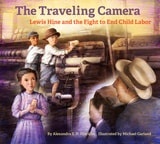
The The Traveling Camera
Lewis Hine and the Fight to End Child LaborAlexandra S. D. Hinrichs
J. Paul Getty Trust, The, 2021
Stunning visuals and poetic text combine to tell the inspiring story of Lewis Hine (1874–1940), a teacher and photographer who employed his art as a tool for social reform. Working for the National Child Labor Committee, Hine traveled the United States, taking pictures of children as young as five toiling under dangerous conditions in cotton mills, seafood canneries, farms, and coal mines. He often wore disguises to sneak into factories, impersonating a machinery inspector or traveling salesman. He said, “If I could tell this story in words, I wouldn’t need to lug a camera.” His poignant pictures attracted national attention and were instrumental in the passage of child labor laws. The Traveling Camera contains extensive back matter, including a time line, original photos, and a bibliography.
Ages six to nine.
The Theological Basis of Liberal Modernity in Montesquieu's "Spirit of the Laws"
Thomas L. Pangle
University of Chicago Press, 2010
The Spirit of the Laws—Montesquieu’s huge, complex, and enormously influential work—is considered one of the central texts of the Enlightenment, laying the foundation for the liberally democratic political regimes that were to embody its values. In his penetrating analysis, Thomas L. Pangle brilliantly argues that the inherently theological project of Enlightenment liberalism is made more clearly—and more consequentially— in Spirit than in any other work.
In a probing and careful reading, Pangle shows how Montesquieu believed that rationalism, through the influence of liberal institutions and the spread of commercial culture, would secularize human affairs. At the same time, Pangle uncovers Montesquieu’s views about the origins of humanity’s religious impulse and his confidence that political and economic security would make people less likely to sacrifice worldly well-being for otherworldly hopes. With the interest in the theological aspects of political theory and practice showing no signs of diminishing, this book is a timely and insightful contribution to one of the key achievements of Enlightenment thought.
The Theological Metaphors of Marx
Enrique Dussel
Duke University Press, 2024
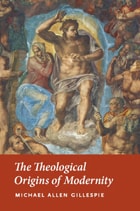
The Theological Origins of Modernity
Michael Allen Gillespie
University of Chicago Press, 2008
Exposing the religious roots of our ostensibly godless age, Michael Allen Gillespie reveals in this landmark study that modernity is much less secular than conventional wisdom suggests. Taking as his starting point the collapse of the medieval world, Gillespie argues that from the very beginning moderns sought not to eliminate religion but to support a new view of religion and its place in human life. He goes on to explore the ideas of such figures as William of Ockham, Petrarch, Erasmus, Luther, Descartes, and Hobbes, showing that modernity is best understood as a series of attempts to formulate a new and coherent metaphysics or theology.
“Bringing the history of political thought up to date and situating it against the backdrop of contemporary events, Gillespie’s analyses provide us a way to begin to have conversations with the Islamic world about what is perhaps the central question within each of the three monotheistic religions: if God is omnipotent, then what is the place of human freedom?”—Joshua Mitchell, Georgetown University
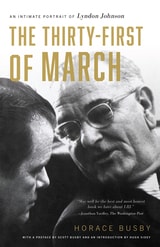
The Thirty-first of March
An Intimate Portrait of Lyndon JohnsonHorace Busby, with a Preface by Scott Busby and an Introduction by Hugh Sidey
University of Texas Press, 2023
An intimate retelling of Lyndon B. Johnson’s politics and presidency by one of his closest advisors.
Horace Busby was one of LBJ’s most trusted advisors; their close working and personal relationship spanned twenty years. In The Thirty-First of March he offers an indelible portrait of a president and a presidency at a time of crisis. From the aftereffects of the Kennedy assassination, when Busby was asked by the newly sworn-in president to sit by his bedside during his first troubled nights in office, to the concerns that defined the Great Society—civil rights, the economy, social legislation, housing, and the Vietnam War—Busby not only articulated and refined Johnson's political thinking, he also helped shape the most ambitious, far-reaching legislative agenda since FDR's New Deal.
Here is Johnson the politician, Johnson the schemer, Johnson who advised against JFK’s choice of an open limousine that fateful day in Dallas, and Johnson the father, sickened by the deaths of young men fighting and dying in Vietnam on his orders. The Thirty-first of March is a rare glimpse into the inner sanctum of Johnson's presidency, as seen through the eyes of one of the people who understood him best.
The Ties That Bind
Julius M. Moravcsik
Central European University Press, 2004
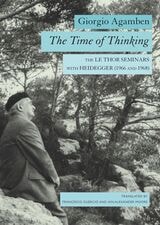
The Time of Thinking
The Le Thor Seminars with Heidegger (1966 and 1968)Giorgio Agamben
Seagull Books, 2026
A glimpse into philosopher Giorgio Agamben's formative encounter with Martin Heidegger, told through his notes from the Le Thor seminars.
What does it mean for thought to have a time of its own? In The Time of Thinking, Italian philosopher Giorgio Agamben presents the notes he took during two seminars with Martin Heidegger at Le Thor, Provence, preserving the compressed, working rhythm of a notebook while clarifying only what might otherwise be opaque. Throughout these pages, vignettes from Agamben's time in Le Thor—walking among pines to a precipitous viewpoint once painted by Paul Cézanne, sitting in quiet recollection—open onto reflections on memory, youth, and the shape of a life not yet “filled in.” Illustrated with archival materials, the book offers a small, carefully composed record of philosophical attention: not a retrospective monument, but a living trace of thought as it happens in time and place.
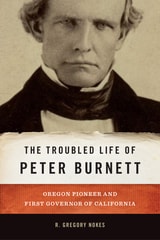
The Troubled Life of Peter Burnett
Oregon Pioneer and First Governor of CaliforniaR. Gregory Nokes
Oregon State University Press, 2018
It was one heck of a resume. Yet with the exception of the wagon road to California, in none of these roles was Burnett considered successful or well remembered. Indeed, he resigned from many of his most important positions, including the governorship, where he was widely perceived a failure.
Burnett’s weakness was that he refused to take advice from others. He insisted on marching to his own drum, even when it led to some terrible decisions. A former slaveholder, he could never seem to get beyond his single-minded goal of banning blacks and other minorities from the West.
The Troubled Life of Peter Burnett is the first full-length biography of this complicated character. Historians, scholars, and general readers with an interest in Western history will welcome R. Gregory Nokes’ accessible and deeply researched account.
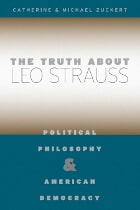
The Truth about Leo Strauss
Political Philosophy and American DemocracyCatherine H. Zuckert and Michael P. Zuckert
University of Chicago Press, 2006
Is Leo Strauss truly an intellectual forebear of neoconservatism and a powerful force in shaping Bush administration foreign policy? The Truth about Leo Strauss puts this question to rest, revealing for the first time how the popular media came to perpetuate such an oversimplified view of such a complex and wide-ranging philosopher. More important, it corrects our perception of Strauss, providing the best general introduction available to the political thought of this misunderstood figure.
Catherine and Michael Zuckert—both former students of Strauss—guide readers here to a nuanced understanding of how Strauss’s political thought fits into his broader philosophy. Challenging the ideas that Strauss was an inflexible conservative who followed in the footsteps of Nietzsche, Heidegger, and Carl Schmitt, the Zuckerts contend that Strauss’s signature idea was the need for a return to the ancients. This idea, they show, stemmed from Strauss’s belief that modern thought, with its relativism and nihilism, undermines healthy politics and even the possibility of real philosophy. Identifying this view as one of Strauss’s three core propositions—America is modern, modernity is bad, and America is good—they conclude that Strauss was a sober defender of liberal democracy, aware of both its strengths and its weaknesses.
The Zuckerts finish, appropriately, by examining the varied work of Strauss’s numerous students and followers, revealing the origins—rooted in the tensions within his own thought—oftheir split into opposing camps. Balanced and accessible, The Truth about Leo Strauss is a must-read for anyone who wants to more fully comprehend this enigmatic philosopher and his much-disputed legacy.

The University in the Twenty-first Century
Teaching the New Enlightenment in the Digital AgeHannes Klöpper
Central European University Press, 2016
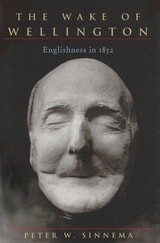
The Wake of Wellington
Englishness in 1852Peter W. Sinnema
Ohio University Press, 2006
Soldier, hero, and politician, the Duke of Wellington is one of the best-known figures of nineteenth-century England. From his victory at Waterloo over Napoleon in 1815, he rose to become prime minister of his country. But Peter Sinnema finds equal fascination in Victorian England’s response to the duke’s death.
The Wake of Wellington considers Wellington’s spectacular funeral pageant in the fall of 1852—an unprecedented event that attracted one and a half million spectators to London—as a threshold event against which the life of the soldier-hero and High Tory statesman could be re-viewed and represented.
Canvassing a profuse and dramatically proliferating Wellingtoniana, Sinnema examines the various assumptions behind, and implications of, the Times’s celebrated claim that the Irish-born Wellington “was the very type and model of an Englishman.” The dead duke, as Sinnema demonstrates, was repeatedly caught up in interpretive practices that stressed the quasi-symbolic relations between hero and nation.
The Wake of Wellington provides a unique view of how in death Wellington and his career were promoted as the consummation of a national destiny intimately bound up with Englishness itself, and with what it meant to be English at midcentury.
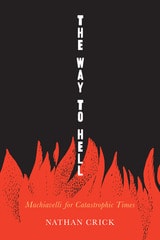
The Way to Hell
Machiavelli for Catastrophic TimesNathan Crick
University of Alabama Press, 2024
An incisive and erudite survey of Machiavelli, the catastrophes of his times and ours, and his counsel for responding to an era of constant crises.
Catastrophe looms. Political, environmental, epidemic, and military crises arrive with increasing frequency. In The Way to Hell, Nathan Crick argues that our perilous times call for the strongest medicine in the Western canon: Machiavelli. Crick reminds contemporary readers about the Florentine master’s advice—that one must learn the road to Hell precisely to avoid taking it.
Like a knowledgeable friend, Crick offers contemporary readers a guide to Machiavelli’s world, work, and warnings. He takes in the sweep of Western history, comparing Machiavelli’s work with ancient sources such as Cicero and Thucydides. And as Machiavelli has never stopped provoking comment, Crick treats readers to a feast of responses to Machiavelli’s work—caustic, learned, and humorous—in the five centuries since he lived.
Including both Machiavelli’s best-known works, The Prince and Discourses on Livy, as well as his personal correspondence and comic plays, Crick asks anew the questions that bedeviled Machiavelli’s beloved Florentine republic: When is force necessary? When are lies justified? Is cruelty defensible? When does social protest slip into violent revolution? What is the correct response to catastrophe?
Like Machiavelli himself, The Way to Hell is witty, stimulating, and challenging. In a world seemingly on the road to Hell, Machiavelli offers an alternative route. His bracing vision exhorts readers to see the dangers in their path and to take action with vigor and determination. Far from a vision of cynicism, Machiavelli offers a beacon of hope for a world that seems on the brink.
The Weimar Origins of Rhetorical Inquiry
David L. Marshall
University of Chicago Press, 2020
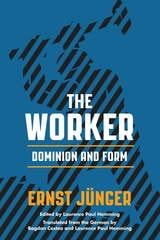
The Worker
Dominion and FormErnst Jünger, Edited by Laurence Paul Hemming, Translated from the German by Bogdan Costea and Laurence Paul Hemming
Northwestern University Press, 2018
Martin Heidegger considered Jünger “the only genuine follower of Nietzsche,” singularly providing “an interpretation which took shape in the domain of that metaphysics which already determines our epoch, even against our knowledge; this metaphysics is Nietzsche's doctrine of the ‘will to power.’” In The Worker, Jünger examines some of the defining questions of that epoch: the nature of individuality, society, and the state; morality, justice, and law; and the relationships between freedom and power and between technology and nature.
This work, appearing in its entirety in English translation for the first time, is an important contribution to debates on work, technology, and politics by one of the most controversial German intellectuals of the twentieth century. Not merely of historical interest, The Worker carries a vital message for contemporary debates about world economy, political stability, and equality in our own age, one marked by unsettling parallels to the 1930s.
The World Computer
Derivative Conditions of Racial CapitalismJonathan Beller
Duke University Press, 2021