Results by title
28167 books match the query 'History' and 6372 start with t

The History of Byzantine and Eastern Canon Law to 1500
Wilfried Hartmann
Catholic University of America Press, 2012

The History of Capitalism in Mexico
Its Origins, 1521–1763By Enrique Semo
University of Texas Press, 1992
What lies at the center of the Mexican colonial experience? Should Mexican colonial society be construed as a theoretical monolith, capitalist from its inception, or was it essentially feudal, as traditional historiography viewed it? In this pathfinding study, Enrique Semo offers a fresh vision: that the conflicting social formations of capitalism, feudalism, and tributary despotism provided the basic dynamic of Mexico's social and economic development.
Responding to questions raised by contemporary Mexican society, Semo sees the origin of both backwardness and development not in climate, race, or a heterogeneous set of unrelated traits, but rather in the historical interaction of each social formation. In his analysis, Mexico's history is conceived as a succession of socioeconomic formations, each growing within the "womb" of its predecessor. Semo sees the task of economic history to analyze each of these formations and to construct models that will help us understand the laws of its evolution. His premise is that economic history contributes to our understanding of the present not by formulating universal laws, but by studying the laws of development and progression of concrete economic systems.
The History of Capitalism in Mexico opens with the Conquest and concludes with the onset of the profound socioeconomic transformation of the last fifty years of the colony, a period clearly representing the precapitalist phase of Mexican development. In the course of his discussion, Semo addresses the role of dependency—an important theoretical innovation—and introduces the concept of tributary despotism, relating it to the problems of Indian society and economy. He also provides a novel examination of the changing role of the church throughout Mexican colonial history. The result is a comprehensive picture, which offers a provocative alternative to the increasingly detailed and monographic approach that currently dominates the writing of history.
Originally published as Historia del capitalismo en México in 1973, this classic work is now available for the first time in English. It will be of interest to specialists in Mexican colonial history, as well as to general readers.
The History of Cartography, Volume 3 (Replacement Volume)
Cartography in the European Renaissance, Part 1Edited by David Woodward
University of Chicago Press, 2007
Cartography in the European Renaissance treats the period from 1450 to 1650, long considered the most important in the history of European mapping. This period witnessed a flowering in the production of maps comparable to that in the fields of literature and fine arts. Scientific advances, appropriations of classical mapping techniques, burgeoning trade routes—all such massive changes drove an explosion in the making and using of maps. While this volume presents detailed histories of mapping in such well-documented regions as Italy and Spain, it also breaks significant new ground by treating Renaissance Europe in its most expansive geographical sense, giving careful attention to often-neglected regions like Scandinavia, East-Central Europe, and Russia, and by providing innovative interpretive essays on the technological, scientific, cultural, and social aspects of cartography.
Lavishly illustrated with more than a thousand maps, many in color, the two volumes of Cartography in the European Renaissance will be the unsurpassable standard in its field, both defining it and propelling it forward.
The History of Cartography, Volume 3 (Replacement Volume)
Cartography in the European Renaissance, Part 2Edited by David Woodward
University of Chicago Press, 2007
Cartography in the European Renaissance treats the period from 1450 to 1650, long considered the most important in the history of European mapping. This period witnessed a flowering in the production of maps comparable to that in the fields of literature and fine arts. Scientific advances, appropriations of classical mapping techniques, burgeoning trade routes—all such massive changes drove an explosion in the making and using of maps. While this volume presents detailed histories of mapping in such well-documented regions as Italy and Spain, it also breaks significant new ground by treating Renaissance Europe in its most expansive geographical sense, giving careful attention to often-neglected regions like Scandinavia, East-Central Europe, and Russia, and by providing innovative interpretive essays on the technological, scientific, cultural, and social aspects of cartography.
Lavishly illustrated with more than a thousand maps, many in color, the two volumes of Cartography in the European Renaissance will be the unsurpassable standard in its field, both defining it and propelling it forward.

The History of Cartography, Volume Four
Cartography in the European EnlightenmentEdited by Matthew H. Edney and Mary Sponberg Pedley
University of Chicago Press, 2020
The social and intellectual changes that swept Enlightenment Europe also transformed many of its mapmaking practices. A new emphasis on geometric principles gave rise to improved tools for measuring and mapping the world, even as large-scale cartographic projects became possible under the aegis of powerful states. Yet older mapping practices persisted: Enlightenment cartography encompassed a wide variety of processes for making, circulating, and using maps of different types. The volume’s more than four hundred encyclopedic articles explore the era’s mapping, covering topics both detailed—such as geodetic surveying, thematic mapping, and map collecting—and broad, such as women and cartography, cartography and the economy, and the art and design of maps. Copious bibliographical references and nearly one thousand full-color illustrations complement the detailed entries.
The History of Cartography, Volume One
Cartography in Prehistoric, Ancient, and Medieval Europe and the MediterraneanEdited by J. B. Harley and David Woodward
University of Chicago Press, 1987
Volume One addresses the prehistorical and historical mapping traditions of premodern Europe and the Mediterranean world. A substantial introductory essay surveys the historiography and theoretical development of the history of cartography and situates the work of the multi-volume series within this scholarly tradition. Cartographic themes include an emphasis on the spatial-cognitive abilities of Europe's prehistoric peoples and their transmission of cartographic concepts through media such as rock art; the emphasis on mensuration, land surveys, and architectural plans in the cartography of Ancient Egypt and the Near East; the emergence of both theoretical and practical cartographic knowledge in the Greco-Roman world; and the parallel existence of diverse mapping traditions (mappaemundi, portolan charts, local and regional cartography) in the Medieval period.
Throughout the volume, a commitment to include cosmographical and celestial maps underscores the inclusive definition of "map" and sets the tone for the breadth of scholarship found in later volumes of the series.
The History of Cartography, Volume Six
Cartography in the Twentieth CenturyEdited by Mark Monmonier
University of Chicago Press, 2015
The twentieth century is a pivotal period in map history. The transition from paper to digital formats led to previously unimaginable dynamic and interactive maps. Geographic information systems radically altered cartographic institutions and reduced the skill required to create maps. Satellite positioning and mobile communications revolutionized wayfinding. Mapping evolved as an important tool for coping with complexity, organizing knowledge, and influencing public opinion in all parts of the globe and at all levels of society. Volume 6 covers these changes comprehensively, while thoroughly demonstrating the far-reaching effects of maps on science, technology, and society—and vice versa.
The lavishly produced volume includes more than five hundred articles accompanied by more than a thousand images. Hundreds of expert contributors provide both original research, often based on their own participation in the developments they describe, and interpretations of larger trends in cartography. Designed for use by both scholars and the general public, this definitive volume is a reference work of first resort for all who study and love maps.
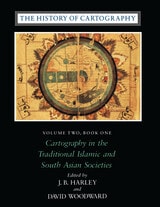
The History of Cartography, Volume Two, Book One
Cartography in the Traditional Islamic and South Asian SocietiesEdited by J. B. Harley and David Woodward
University of Chicago Press, 1992
"[The six-volume set] is certain to be the standard reference for all subsequent scholarship. The editors . . . have assembled and analyzed a vast collection of knowledge. . . . If the first volume is an indication, the complete set will be comprehensive and judicious." —John Noble Wilford, New York Times Book Review
"As well as enlarging the mind and lifting the spirits through the sheer magnitude of its endeavor, the collection delights the senses. The illustrations are exquisite: browsing fingers will instinctively alight on the sheaf of maps reproduced on stock slightly thicker than that of the text. The maps are so beguiling in the tantalizing glimpses they offer of other, seemingly incomprehensible, worlds, that the sight of them will stir the connoisseur in even the most-guarded scholar." —Ronald Rees, Geographical Review
"The corpus it brings to light, along with the extensive references, bibliography, and exhaustive appendices containing valuable comments about many of the pieces discussed, together make this book an important resource for the scholar."—Robert Provin, Professional Geographer
"This volume is a landmark of new research and will certainly contribute to further discoveries, translations, interpretations, inventories, more precise dating and the construction of stemmata." —Christian Jacob, Cartographica
"In seeking to characterize the cartography of premodern Islamic and south Asian societies, the editors offer the image of an archipelago of cartographically conscious islands in a silent sea. The research potential which they have revealed is clearly vast and underappreciated, with many islands still to be discovered or enlarged. This important book, does more, therefore, than plug a huge gap in cartographic historiography. It provides the foundation for crosscultural cartographic research in two major world regions."-Jeffrey Stone, Ecumene
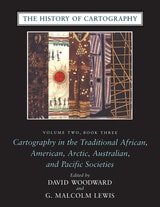
The History of Cartography, Volume Two, Book Three
Cartography in the Traditional African, American, Arctic, Australian, and Pacific SocietiesEdited by David Woodward and G. Malcolm Lewis
University of Chicago Press, 1998
"The maps in this book provide an evocative picture of how indigenous peoples view and represent their worlds. They illuminate not only questions of material culture but also the cognitive systems and social motivations that underpin them" (from the introduction).
Although they are often rendered in forms unfamiliar to Western eyes, maps have existed in most cultures. In this latest book of the acclaimed History of Cartography, contributors from a broad variety of disciplines collaborate to describe and address the significance of traditional cartographies. Whether painted on rock walls in South Africa, chanted in a Melanesian ritual, or fashioned from palm fronds and shells in the Marshall Islands, all indigenous maps share a crucial role in representing and codifying the spatial knowledge of their various cultures. Some also serve as repositories of a group's sacred or historical traditions, while others are exquisite art objects.
The indigenous maps discussed in this book offer a rich resource for disciplines such as anthropology, archaeology, art history, ethnology, geography, history, psychology, and sociology. Copious illustrations and carefully researched bibliographies enhance the scholarly value of this definitive reference.
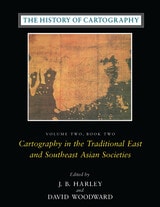
The History of Cartography, Volume Two, Book Two
Cartography in the Traditional East and Southeast Asian SocietiesEdited by J. B. Harley and David Woodward
University of Chicago Press, 1994
Volume 2, book 2, considers the cartographic traditions of China, Korea, Japan, Vietnam, Tibet, Burma, Thailand, Laos, Malaysia, Indonesia, Brunei, and the Philippines, presenting significant new research and interpretation of archaeological, literary, and graphic sources. Richly illustrated with forty color plates and over five hundred black and white illustrations, the book includes a number of rare and elaborate maps, many previously unpublished.

The History of Continental Philosophy
Edited by Alan D. Schrift
University of Chicago Press, 2010
From Kant to Kierkegaard, from Hegel to Heidegger, continental philosophers have indelibly shaped the trajectory of Western thought since the eighteenth century. Although much has been written about these monumental thinkers, students and scholars lack a definitive guide to the entire scope of the continental tradition. The most comprehensive reference work to date, this eight-volume History of Continental Philosophy will both encapsulate the subject and reorient our understanding of it. Beginning with an overview of Kant’s philosophy and its initial reception, the History traces the evolution of continental philosophy through major figures as well as movements such as existentialism, phenomenology, hermeneutics, and poststructuralism. The final volume outlines the current state of the field, bringing the work of both historical and modern thinkers to bear on such contemporary topics as feminism, globalization, and the environment. Throughout, the volumes examine important philosophical figures and developments in their historical, political, and cultural contexts.
The first reference of its kind, A History of Continental Philosophy has been written and edited by internationally recognized experts with a commitment to explaining complex thinkers, texts, and movements in rigorous yet jargon-free essays suitable for both undergraduates and seasoned specialists. These volumes also elucidate ongoing debates about the nature of continental and analytic philosophy, surveying the distinctive, sometimes overlapping characteristics and approaches of each tradition. Featuring helpful overviews of major topics and plotting road maps to their underlying contexts, A History of Continental Philosophy is destined to be the resource of first and last resort for students and scholars alike.

The History of Courts and Procedure in Medieval Canon Law
Wilfried Hartmann
Catholic University of America Press, 2016

The History of Democracy
A Marxist InterpretationBrian S. Roper
Pluto Press, 2012
Brian Roper refreshes our understanding of democracy using a Marxist theoretical framework. He traces the history of democracy from ancient Athens to the emergence of liberal representative and socialist participatory democracy in Europe and North America, through to the global spread of democracy during the past century.
Roper argues that democracy cannot be understood separately from underlying processes of exploitation and class struggle. He offers an engaging Marxist critique of representative democracy, and raises the possibility of alternative democratic forms. The History of Democracy will be of interest to students and scholars of history and politics and all those concerned about the past, present and future of democracy.

The History of Development of Building Construction in Chicago
Frank A. Randall
University of Illinois Press, 1999
Generations have relied on the Randall book as the most authoritative and comprehensive guide to buildings in the Chicago central area. This edition is updated with information about fifty additional buildings from the time frame of the original text, 1830-1949; new data for four hundred buildings from the period 1950-98; and a number of additional plates from the rare Rand McNally Views of Chicago.
The second edition of The History of the Development of Building Construction in Chicago is a tribute to Frank Randall's vision and an indispensable resource to Chicago area architects, engineers, preservation specialists, and other members of the building industry.
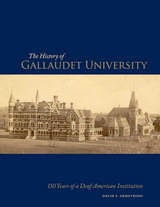
The History of Gallaudet University
150 Years of a Deaf American InstitutionDavid F. Armstrong
Gallaudet University Press, 2014
At first a tiny college of fewer than 200 students, Gallaudet’s growth paralleled the emergence of the American Deaf Community and the history of the nation in general. In the same way that the country’s land-grant universities brought higher education to more American students than ever before, Gallaudet offered the same opportunities to deaf students for the first time. Gallaudet mirrored other institutions in addressing major issues of the time, from legislated segregation to the Civil Rights movement that inspired the struggle by deaf people to gain control of the governance of their university. Most critically, this volume details poignantly the evolution of American Sign Language as a language of scholarship at Gallaudet during a time when its use in educational institutions was largely discouraged or prohibited. Through story and image, it traces the historic path that Gallaudet traveled to be recognized as the finest institution of higher education for deaf people in the world.

The History of Inclusion in the United States
Robert L. Osgood
Gallaudet University Press, 2005
As a significant term, inclusion came into use relatively recently in the long history of special education in the United States. Since the 1800s, when children with disabilities first were segregated for instruction in public schools, professionals and parents have called for more equitable, “normal” treatment of these students, and for closer contact with their nondisabled peers. Through the years, the central issues of the discussions between educators and parents have focused on who should be considered disabled and who should bear responsibility for planning and providing for their education. The History of Inclusion in the United States traces the antecedents of this ongoing debate to answer questions about what inclusion is, how it came to be, and where it might go.
In this comprehensive study, author Robert L. Osgood reveals how the idea of inclusion has evolved into broader realms of thought and practice. In its earliest manifestations, educators dwelled upon the classroom setting itself, wondering whether “disabled” children belonged there; if not, why not; and if so, how this could be accomplished? By the late 1960s, the scope of the discussion had shifted to assess the comprehensive structures of special education and its relationship with general education. The History of Inclusion seamlessly follows this progression into the present decade, in which current educational policy questions the need for any sort of separate “special education” in principle and structure.

The History of Indiana Law
David J. Bodenhamer
Ohio University Press, 2006
The History of Indiana Law explores the ways in which the state’s legal culture responded to—and at times resisted—the influence of national legal developments, including the tortured history of race relations in Indiana. Legal issues addressed by the contributors include the Indiana constitutional tradition, civil liberties, race, women’s rights, family law, welfare and the poor, education, crime and punishment, juvenile justice, the role of courts and judiciary, and landmark cases. The essays describe how Indiana law has adapted to the needs of an increasingly complex society.
The History of Indiana Law is an indispensable reference and invaluable first source to learn about law and society in Indiana during almost two centuries of statehood.

The History of Indiana Law
David J. Bodenhamer
Ohio University Press, 2006
Long regarded as a center for middle-American values, Indiana is also a cultural crossroads that has produced a rich and complex legal and constitutional heritage. The History of Indiana Law traces this history through a series of expert articles by identifying the themes that mark the state’s legal development and establish its place within the broader context of the Midwest and nation.
The History of Indiana Law explores the ways in which the state’s legal culture responded to—and at times resisted—the influence of national legal developments, including the tortured history of race relations in Indiana. Legal issues addressed by the contributors include the Indiana constitutional tradition, civil liberties, race, women’s rights, family law, welfare and the poor, education, crime and punishment, juvenile justice, the role of courts and judiciary, and landmark cases. The essays describe how Indiana law has adapted to the needs of an increasingly complex society.
The History of Indiana Law is an indispensable reference and invaluable first source to learn about law and society in Indiana during almost two centuries of statehood.

The History of Intimacy
PoemsGabeba Baderoon
Northwestern University Press, 2021
Born on the coastal shores of Port Elizabeth, Baderoon is one of South Africa’s most acclaimed literary voices. In The History of Intimacy—originally published by Kwela Books—she crafts resonant poems about a writer’s beginnings, love across boundaries, and “how not to be alone.”
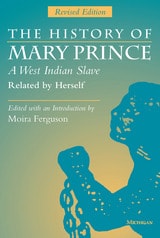
The History of Mary Prince, A West Indian Slave, Related by Herself
Revised EditionMoira Ferguson, Editor
University of Michigan Press, 1997
First published in London and Edinburgh in 1831, and well into its third edition that year, The History of Mary Prince inflamed public opinion and created political havoc. Never before had the sufferings and indignities of enslavement been seen through the eyes of a woman--a woman struggling for freedom in the face of great odds.
Moira Ferguson's edition of the book added an introduction, annotations, and appendices. The book has found popularity both in the classroom and with the general public. Recently, an adaptation of the memoirs of Mary Prince appeared as one segment of "A Skirt Through History," a six-part feature film series produced by the BBC. Mary Prince's story has also been the centerpiece of BBC radio broadcasts.
In this revised and expanded edition of The History of Mary Prince, Ferguson has added new material, based on her extensive research in Bermuda and London. The book includes new details of Mary Prince's experiences as a freewoman in England, the transcripts of several libel cases brought against her, and the reactions of British society, as seen in prominent periodicals of the day, against the original publication of The History of Mary Prince. This new material brings greater depth and detail and serves to more fully illustrate and contextualize the life of this remarkable woman.
Moira Ferguson is James E. Ryan Professor of English and Women's Literature, University of Nebraska.

The History of Medieval Canon Law in the Classical Period, 1140-1234
From Gratian to the Decretals of Pope Gregory IX (History of Medieval Canon Law)Wilfried Hartmann
Catholic University of America Press, 2008

The History of Michigan Law
Paul Finkelman
Ohio University Press, 2006
The History of Michigan Law offers the first serious survey of Michigan’s rich legal past. Michigan legislators have played a leading role in developing modern civil rights law, protecting the environment, and assuring the right to counsel for those accused of crimes. Michigan was the first jurisdiction in the English-speaking world to abolish the death penalty. As the state industrialized, its legal system responded to the competing demands and interests of farmers, railroads, entrepreneurs, and workers.
Michigan was a beacon of liberty for fugitive slaves and free blacks before the Civil War and an early leader in the adoption of laws to protect civil rights and prohibit discrimination after that conflict. The state was the site of the Ossian Sweet murder trial, which illustrated the tensions in Michigan between law and popular ideology. The History of Michigan Law documents and analyzes these legal developments and others, including the history of labor law, women’s rights, and legal education.
This landmark volume will serve as the entry point for all future studies that involve law and society in Michigan and will be invaluable in the comparative study of state law. As the Michigan Supreme Court enters its third century, The History of Michigan Law has relevance beyond the legal community, for scholars and students of American history.

The History of Modern Japanese Education
Constructing the National School System, 1872-1890Duke, Benjamin
Rutgers University Press, 2014

The History of Nebraska Law
Alan G. Gless
Ohio University Press, 2008
In the aftermath of the Civil War, legislators in the Nebraska Territory grappled with the responsibility of forming a state government as well as with the larger issues of reconstructing the Union, protecting civil rights, and redefining federal-state relations. In the years that followed, Nebraskans coped with regional and national economic collapses. Nebraska women struggled for full recognition in the legal profession. Meyer v. Nebraska, a case involving a teacher in a one-room rural Nebraska schoolhouse, changed the course of American constitutional doctrine and remains one of the cornerstones of civil liberties law. And Roscoe Pound, a boy from Lincoln, went on to become one of the nation’s great legal philosophers.
Nebraska holds a prominent position in the field of Native American legal history, and the state’s original inhabitants have been at the center of many significant developments in federal Indian policy. Nebraska Indian legal history is replete with stories of failure and success, heartache and triumph, hardship and hope. These stories are more than a mere record of the past, of treaties broken or trials won—they are reminders of the ongoing and sometimes tense relations among the many peoples and nations that make up the heartland.
Much of Nebraska law reflects mainstream American law, yet Nebraskans also have been open to experiment and innovation. The state revamped the legislative process by establishing the nation’s only unicameral legislature and pioneered public employment collective bargaining and dispute resolution through its industrial relations commission and its relaxation of strict separation of powers. These seemingly contradictory trends, however, are but differing expressions of a single underlying principle inscribed in the state’s motto: “Equality Before the Law.”
The History of Philosophy
A Reader's GuideDonald Phillip Verene
Northwestern University Press, 2008
With the aim of guiding readers along, in Hegel’s words, “the long process of education towards genuine philosophy,” this introduction emphasizes the importance of striking up a conversation with the past. Only by looking to past masters and their works, it holds, can old memories and prior thought be brought fully to bear on the present. This living past invigorates contemporary practice, enriching today’s study and discoveries.
In this book, groundbreaking philosopher and author Donald Verene addresses two themes: why should one study the historically “great” texts and, if such a study is necessary, how can one undertake it? Acting out against the rejection of the idea that there is a philosophical canon, he centers his argument on the “tetralogy” of Plato, Aristotle, Kant, and Hegel. From his opening look at the rhetorical tradition, he brings those core ideals forward to classical Roman and medieval philosophers and then on into Renaissance and modern philosophy, including contemporary thinkers such as Derrida and Foucault. This vital chronological outline is supplemented by Verene’s contextualizing commentary. In ensuing sections, he offers guidance on reading philosophical works with “intellectual empathy,” suggests 100 essential works to establish a canon, illustrates the role of philosophers in history and society, and examines the nature of history itself. Ultimately, Verene concludes that history may be essential to philosophy, but philosophy is more than just its history.

The History of Special Education
From Isolation to IntegrationMargret A. Winzer
Gallaudet University Press, 1993

The History of Temple University Japan
An Experiment in International EducationRichard Joslyn and Bruce Stronach
Temple University Press, 2023
The authors recount the development of the academic program, the recruitment of students, and the support from Temple that enabled curricular and pedagogical improvement.
They also address the university’s relationships with three Japanese partners, and the financial threats and crises TUJ faced over the decades.
The History of Temple University Japan is not only an important documentation of TUJ, but also a history of U.S.-Japanese relations. What emerges is the significant impact TUJ has had on the thousands of students, faculty, and staff who have been a part of this international academic institution.

The History of Tense/Aspect/Mood/Voice in the Mayan Verbal Complex
By John S. Robertson
University of Texas Press, 1992
Mayan civilization, renowned for its mathematics, writing, architecture, religion, calendrics, and agriculture, fascinates scholars and a wide lay public as archaeology and glyphic decipherment reveal more of its secrets. In this pathfinding study of the Mayan language family, John S. Robertson explores major changes that have occurred in the core of Mayan grammar from the earliest, reconstructed ancestral language down through the colonial languages to the modern languages that are spoken today.
Building on groundwork already laid in phonological studies and in the study of the pronominal system, Robertson's examination of tense/ aspect/ mood/voice is the next logical step in the general linguistic study of Mayan. Robertson offers careful consideration of all the major subgroups of Mayan, from Yucatecan to Quichean, as they are spoken today. He also draws extensively on colonial documents assembled by bilingual Spanish-Mayan speaking clerics. These documents provide a check on the accuracy of both the reconstructed ancient language, Common Mayan, and the theoretical evolution of the modern languages from this ancestor. The study will also be of value to students of the Maya glyphs, since it discusses the grammatical system that most probably underlies the glyphic representations.
Beyond its obvious interest for Mayan linguistics, the study proposes a theory of language change that will be important for all students of comparative linguistics. Robertson's work sets forth the basic, universal assumptions that provide for an appropriate description of the grammatical systems of all languages. It will be a significant reference for future researchers.

The History of Wisconsin, Volume I
From Exploration to StatehoodAlice E. Smith
Wisconsin Historical Society Press, 1973

The History of Wisconsin, Volume II
Civil War Era, 1848-1873Richard N. Current
Wisconsin Historical Society Press, 1976
This second volume in the History of Wisconsin series introduces us to the first generation of statehood, from the conversion of prairie and forests into farmland to the development of cities and industry. In addition, this volume presents a synthesis of the Civil War and Reconstruction era in Wisconsin. Scarcely a decade after entering the Union, the state was plunged into the nationwide debate over slavery, the secession crisis, and a war in which 11,000 "Badger Boys in Blue" gave their lives. Wisconsin's role in the Civil War is chronicled, along with the post-war years. Complete with photographs from the Historical Society's collections, as well as many pertinent maps, this book is a must-have for anyone interested in this era of Wisconsin's history.
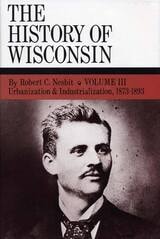
The History of Wisconsin, Volume III
Urbanization & Industrialization 1873-1893Robert C. Nesbit
Wisconsin Historical Society Press, 1985
Although the years from 1873-1893 lacked the well known, dramatic events of the periods before and after, this period presented a major transformation in Wisconsin's economy. The third volume in the History of Wisconsin series presents a balanced, comprehensive, and witty account of these two decades of dynamic growth and change in Wisconsin society, business, and industry. Concentrating on three major areas: the economy, communities, and politics and government, this volume in the History of Wisconsin series adds substantially to our knowledge and understanding of this crucial, but generally little-understood, period.
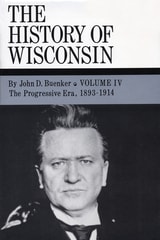
The History of Wisconsin, Volume IV
The Progressive Era, 1893-1914John D. Buenker
Wisconsin Historical Society Press, 1998
Published in Wisconsin's Sesquicentennial year, this fourth volume in The History of Wisconsin series covers the twenty tumultuous years between the World's Columbian Exposition and the First World War when Wisconsin essentially reinvented itself, becoming the nation's "laboratory of democracy."
The period known as the Progressive Era began to emerge in the mid-1890s. A sense of crisis and a widespread clamor for reform arose in reaction to rapid changes in population, technology, work, and society. Wisconsinites responded with action: their advocacy of women's suffrage, labor rights and protections, educational reform, increased social services, and more responsive government led to a veritable flood of reform legislation that established Wisconsin as the most progressive state in the union.
As governor and U.S. Senator from Wisconsin, Robert M. La Follette, Sr., was the most celebrated of the Progressives, but he was surrounded by a host of pragmatic idealists from politics, government, and the state university. Although the Progressives frequently disagreed over priorities and tactics, their values and core beliefs coalesced around broad-based participatory democracy, the application of scientific expertise to governance, and an active concern for the welfare of all members of society-what came to be known as "the Wisconsin Idea."

The History of Wisconsin, Volume V
War, a New Era, and Depression, 1914-1940Paul W. Glad
Wisconsin Historical Society Press, 1990
The fifth volume in The History of Wisconsin series covers the years from the outbreak of World War I to the eve of American entry into World War II. In between, the rise of the woman's movement, the advent of universal suffrage, and the "great experiment" of Prohibition are explored, along with the contest between newly emergent labor unions and powerful business and industrial corporations. Author Paul W. Glad also investigates the Great Depression in Wisconsin and its impact on rural and urban families in the state. Photographs and maps further illustrate this volume which tells the story of one of the most exciting and stressful eras in the history of the state.
The History of Wisconsin, Volume VI
Continuity and Change, 1940-1965William F. Thompson
Wisconsin Historical Society Press, 1988
The sixth and final volume in the History of Wisconsin series examines the period from 1940-1965, in which state and nation struggled to maintain balance and traditions. Some of the major developments analyzed in this volume include: coping with three wars, racial and societal conflict, technological innovation, population shifts to and from cities and suburbs, and accompanying stress in politics, government, and society as a whole. Using dozens of photographs to visually illustrate this period in the state's history, this volume upholds the high standards set forth in the previous volumes.
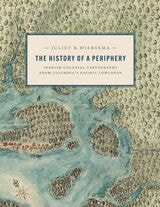
The History of a Periphery
Spanish Colonial Cartography from Colombia's Pacific LowlandsJuliet B. Wiersema
University of Texas Press, 2024
2025 ALAA Book Award, Association for Latin American Art/Arvey Foundation, College Art Association
An exploration of Colombian maps in New Granada.
During the late Spanish colonial period, the Pacific Lowlands, also called the Greater Chocó, was famed for its rich placer deposits. Gold mined here was central to New Granada’s economy yet this Pacific frontier in today’s Colombia was considered the “periphery of the periphery.” Infamous for its fierce, unconquered Indigenous inhabitants and its brutal tropical climate, it was rarely visited by Spanish administrators, engineers, or topographers and seldom appeared in detail on printed maps of the period.
In this lavishly illustrated and meticulously researched volume, Juliet Wiersema uncovers little-known manuscript cartography and makes visible an unexamined corner of the Spanish empire. In concert with thousands of archival documents from Colombia, Spain, and the United States, she reveals how a "periphery" was imagined and projected, largely for political or economic reasons. Along the way, she unearths untold narratives about ephemeral settlements, African adaptation and autonomy, Indigenous strategies of resistance, and tenuous colonialisms on the margins of a beleaguered viceroyalty.
The History of the American Indians
A Critical EditionJames Adair; edited, introduced, and annotated by Kathryn E. Holland Braund
University of Alabama Press, 2009
A fully annotated edition of a classic work detailing the cultures of five southeastern American Indian tribes during the Contact Period
James Adair was an Englishman who lived and traded among the southeastern Indians for more than 30 years, from 1735 to 1768. During that time he covered the territory from the Appalachian Mountains to the Mississippi River. He encountered and lived among Indians, advised governors, spent time with settlers, and worked tirelessly for the expansion of British interests against the French and the Spanish. Adair’s acceptance by the Creeks, Choctaws, Cherokees, and Chickasaws provided him the opportunity to record, compare, and analyze their cultures and traditions.Adair’s written work, first published in England in 1775, is considered one of the finest histories of the Native Americans. His observations provide one of the earliest and what many modern scholars regard as the best account of southeastern Indian cultures. This edition adheres to current standards of literary editing, following the original closely, and provides fully annotated and indexed critical apparatus.
The History of the Common Law of England
Sir Matthew Hale
University of Chicago Press, 1973

The History of the Devil
Vilém Flusser
University of Minnesota Press, 2014
In 1939, a young Vilém Flusser faced the Nazi invasion of his hometown of Prague. He escaped with his wife to Brazil, taking with him only two books: a small Jewish prayer book and Goethe’s Faust. Twenty-six years later, in 1965, Flusser would publish The History of the Devil, and it is the essence of those two books that haunts his own. From that time his life as a philosopher was born. While Flusser would later garner attention in Europe and elsewhere as a thinker of media culture, The History of the Devil is considered by many to be his first significant work, containing nascent forms of the main themes that would come to preoccupy him over the following decades.
In The History of the Devil, Flusser frames the human situation from a pseudo-religious point of view. The phenomenal world, or “reality” in a general sense, is identified as the “Devil,” and that which transcends phenomena, or the philosophers’ and theologians’ “reality,” is identified as “God.” Referencing Wittgenstein’s Tractatus Logico-Philosophicus in its structure, Flusser provocatively leads the reader through an existential exploration of nothingness as the bedrock of reality, where “phenomenon” and “transcendence,” “Devil” and “God” become fused and confused. So radically confused, in fact, that Flusser suggests we abandon the quotation marks from the terms “Devil” and “God.” At this moment of abysmal confusion, we must make the existential decisions that give direction to our lives.

The History of the Devil
Vilém Flusser
University of Minnesota Press, 2027
A fascinating exploration into the early work of the celebrated philosopher of media culture and technology, Vilém Flusser
In 1939, a young Vilém Flusser faced the Nazi invasion of his hometown of Prague. He escaped with his wife to Brazil, taking with him only two books: a small Jewish prayer book and Goethe’s Faust. Twenty-six years later, in 1965, Flusser would publish The History of the Devil, and it is the essence of those two books that haunts his own. From that time his life as a philosopher was born. While Flusser would later garner attention in Europe and elsewhere as a thinker of media culture, The History of the Devil is considered by many to be his first significant work, containing nascent forms of the main themes that would come to preoccupy him over the following decades.
In The History of the Devil, Flusser frames the human situation from a pseudo-religious point of view. The phenomenal world, or “reality” in a general sense, is identified as the “Devil,” and that which transcends phenomena, or the philosophers’ and theologians’ “reality,” is identified as “God.” Referencing Wittgenstein’s Tractatus Logico-Philosophicus in its structure, Flusser provocatively leads the reader through an existential exploration of nothingness as the bedrock of reality, where “phenomenon” and “transcendence,” “Devil” and “God” become fused and confused. So radically confused, in fact, that Flusser suggests we abandon the quotation marks from the terms “Devil” and “God.” At this moment of abysmal confusion, and of the downfall of all values, we must make the existential decisions that give direction to our lives.
The History of the Incas
By Pedro Sarmiento de Gamboa
University of Texas Press, 2007
The History of the Incas may be the best description of Inca life and mythology to survive Spanish colonization of Peru. Pedro Sarmiento de Gamboa, a well-educated sea captain and cosmographer of the viceroyalty, wrote the document in Cuzco, the capital of the Inca Empire, just forty years after the arrival of the first Spaniards. The royal sponsorship of the work guaranteed Sarmiento direct access to the highest Spanish officials in Cuzco. It allowed him to summon influential Incas, especially those who had witnessed the fall of the Empire. Sarmiento also traveled widely and interviewed numerous local lords (curacas), as well as surviving members of the royal Inca families. Once completed, in an unprecedented effort to establish the authenticity of the work, Sarmiento's manuscript was read, chapter by chapter, to forty-two indigenous authorities for commentary and correction.
The scholars behind this new edition (the first to be published in English since 1907) went to similarly great lengths in pursuit of accuracy. Translators Brian Bauer and Vania Smith used an early transcript and, in some instances, the original document to create the text. Bauer and Jean-Jacques Decoster's introduction lays bare the biases Sarmiento incorporated into his writing. It also theorizes what sources, in addition to his extensive interviews, Sarmiento relied upon to produce his history. Finally, more than sixty new illustrations enliven this historically invaluable document of life in the ancient Andes.

The History of the Race Idea (CW3)
From Ray to CarusEric Voegelin, Edited & Intro by by Klaus Vondung, & Translated by Ruth Hein
University of Missouri Press, 0
The History of the Royal Botanic Gardens Kew
Ray Desmond
Royal Botanic Gardens, Kew, 2007
Kew's heritage - the herbarium, art and architecture, from Kew Palace and Burton's great Palm House to the Princess of Wales Conservatory, state of the art laboratories and new Davies Alpine House - is illustrated and described, together with the events leading to its UNESCO World Heritage Site status in 2003. Lastly, it is a social history of the Gardens, and of the scientists, architects, designers and gardeners who have made Kew.
Detailed appendices and bibliography have been updated, and two new chapters added, bringing the book up to date as the authoritative reference work on Kew, its history and function.
The Hittites and Their World
Billie Jean Collins
SBL Press, 2007

The Hoarders
Material Deviance in Modern American CultureScott Herring
University of Chicago Press, 2014
In The Hoarders, Scott Herring provides an in-depth examination of how modern hoarders came into being, from their onset in the late 1930s to the present day. He finds that both the idea of organization and the role of the clutterologist are deeply ingrained in our culture, and that there is a fine line between clutter and deviance in America. Herring introduces us to Jill, whose countertops are piled high with decaying food and whose cabinets are overrun with purchases, while the fly strips hanging from her ceiling are arguably more fly than strip. When Jill spots a decomposing pumpkin about to be jettisoned, she stops, seeing in the rotting, squalid vegetable a special treasure. “I’ve never seen one quite like this before,” she says, and looks to see if any seeds remain. It is from moments like these that Herring builds his questions: What counts as an acceptable material life—and who decides? Is hoarding some sort of inherent deviation of the mind, or a recent historical phenomenon grounded in changing material cultures? Herring opts for the latter, explaining that hoarders attract attention not because they are mentally ill but because they challenge normal modes of material relations. Piled high with detailed and, at times, disturbing descriptions of uncleanliness, The Hoarders delivers a sweeping and fascinating history of hoarding that will cause us all to reconsider how we view these accumulators of clutter.

The Hocking Valley Railway
Edward H. Miller
Ohio University Press, 2024
The Hodayot (Thanksgiving Psalms)
A Study Edition of 1QHaEileen M. Schuller
SBL Press, 2012
The Hogg Family and Houston
Philanthropy and the Civic IdealBy Kate Sayen Kirkland
University of Texas Press, 2009
Progressive former governor James Stephen Hogg moved his business headquarters to Houston in 1905. For seven decades, his children Will, Ima, and Mike Hogg used their political ties, social position, and family fortune to improve the lives of fellow Houstonians.
As civic activists, they espoused contested causes like city planning and mental health care. As volunteers, they inspired others to support social service, educational, and cultural programs. As philanthropic entrepreneurs, they built institutions that have long outlived them: the Houston Symphony, the Museum of Fine Arts, Memorial Park, and the Hogg Foundation. The Hoggs had a vision of Houston as a great city—a place that supports access to parklands, music, and art; nurtures knowledge of the "American heritage which unites us"; and provides social service and mental health care assistance. This vision links them to generations of American idealists who advanced a moral response to change.
Based on extensive archival sources, The Hogg Family and Houston explains the impact of Hogg family philanthropy for the first time. This study explores how individual ideals and actions influence community development and nurture humanitarian values. It examines how philanthropists and volunteers mold Houston's traditions and mobilize allies to meet civic goals. It argues that Houston's generous citizens have long believed that innovative cultural achievement must balance aggressive economic expansion.

The Holistic Inspiration of Physics
The Underground History of Electromagnetic TheoryDusek, Val
Rutgers University Press, 1999
While many books have claimed parallels between modern physics and Eastern philosophy, none have dealt with the historical influences of both Chinese traditional thought and non-mechanistic, holistic western thought on the philosophies of the scientists who developed electromagnetic field theory. In The Holistic Inspirations of Physics, R. Valentine Dusek asks: to what extent is classical field theory a product of organic and holistic philosophies and frameworks?
Electromagnetic theory has been greatly influenced by holistic worldviews, Dusek posits, and he highlights three alternative scientific systems that made the development of electromagnetic theory possible: medieval Chinese science, Western Renaissance occultism, and the German romantic traditions. He situates these "alternative" approaches in their social context and background, and traces their connection with components of “accepted” physical science in relation to a number of social movements and philosophical theories.
Readers will learn of specific contributions made by these alternative traditions, such as the Chinese inventing the compass and discovering the earth's magnetic field and magnetic declination. Western alchemical ideas of active forces and "occult" influences contributed to Newton's theory of gravitation force as action at a distance, rather as a result of purely mechanical collisions and contact action.
Dusek also describes the extent to which women's culture supplied (often without credit) the philosophical background ideas that were absorbed into mainstream field theory.

The Hollywood War Film
Critical Observations from World War I to IraqDaniel Binns
Intellect Books, 2017
Looking closely at films such as All Quiet on the Western Front, Full Metal Jacket, and The Hurt Locker, Binns reveals the commonalities in Hollywood films despite the distinct conflicts and eras they represent, and he shows how contemporary war films closely echo earlier films in their nationalistic and idealistic depictions. Offering a trenchant analysis of some of the most important war films from the past century, this book will be of interest to anyone who has been captivated by how film has dealt with one of humanity’s most difficult, but far too common, realities.

The Holocaust & the Exile of Yiddish
A History of the Algemeyne EntsiklopedyeBarry Trachtenberg
Rutgers University Press, 2022
The Holocaust & the Exile of Yiddish untangles the complicated saga of the Algemeyne entsiklopedye and its editors. The editors continued to publish volumes and revise the encyclopedia’s mission while their primary audience, Eastern European Jews, faced persecution and genocide under Nazi rule, and the challenge of reestablishing themselves in the first decades after World War II. Historian Barry Trachtenberg reveals how, over the course of the middle decades of the twentieth century, the project sparked tremendous controversy in Jewish cultural and political circles, which debated what the purpose of a Yiddish encyclopedia should be, as well as what knowledge and perspectives it should contain. Nevertheless, this is not only a story about destruction and trauma, but also one of tenacity and continuity, as the encyclopedia’s compilers strove to preserve the heritage of Yiddish culture, to document its near-total extermination in the Holocaust, and to chart its path into the future.