Results by title
8812 books match the query 'Political Science' and 1911 start with t
The Borders of Justice
Etienne Balibar
Temple University Press, 2013
International in scope and featuring a diverse group of contributors, The Borders of Justice investigates the complexities of transitional justice that emerge from its “social embeddedness.” This original and provocative collection of essays, which stem from a collective research program on social justice undertaken by the Calcutta Research Group, confronts the concept and practices of justice. The editors and contributors question the relationship between geography, methodology, and justice—how and why justice is meted out differently in different places.
Expanding on Michael Walzer's idea of the “spheres of justice,” the contributors argue that justice is burdened with our notions of social realities and expectations, in addition to the influence of money, law, and government. Chapters provide close readings of Pascal, Plato and Marx, theories on global justice, the relationship between liberalism and multiculturalism, struggles of social injustice, and how and where we draw the borders of justice.
The Bosses' Union
How Employers Organized to Fight Labor before the New DealVilja Hulden
University of Illinois Press, 2023
Vilja Hulden reveals how this tension provided the opening for pro-business organizations to shift public attention from concerns about inequality and dangerous working conditions to a belief that unions trampled on an individual's right to work. Inventing the term closed shop, employers mounted what they called an open-shop campaign to undermine union demands that workers at unionized workplaces join the union. Employer organizations lobbied Congress to resist labor's proposals as tyrannical, brought court cases to taint labor's tactics as illegal, and influenced newspaper coverage of unions. While employers were not a monolith nor all-powerful, they generally agreed that unions were a nuisance. Employers successfully leveraged money and connections to create perceptions of organized labor that still echo in our discussions of worker rights.
The Boundaries of Blackness
AIDS and the Breakdown of Black PoliticsCathy Cohen
University of Chicago Press, 1999
The Boundaries of Blackness is the first full-scale exploration of the social, political, and cultural impact of AIDS on the African-American community. Informed by interviews with activists, ministers, public officials, and people with AIDS, Cathy Cohen unflinchingly brings to light how the epidemic fractured, rather than united, the black community. She traces how the disease separated blacks along different fault lines and analyzes the ensuing struggles and debates.
More broadly, Cohen analyzes how other cross-cutting issues—of class, gender, and sexuality—challenge accepted ideas of who belongs in the community. Such issues, she predicts, will increasingly occupy the political agendas of black organizations and institutions and can lead to either greater inclusiveness or further divisiveness.
The Boundaries of Blackness, by examining the response of a changing community to an issue laced with stigma, has much to teach us about oppression, resistance, and marginalization. It also offers valuable insight into how the politics of the African-American community—and other marginal groups—will evolve in the twenty-first century.

The Boy Governor
Stevens T. Mason and the Birth of Michigan PoliticsDon Faber
University of Michigan Press, 2012
In 1831, Stevens T. Mason was named Secretary of the Michigan Territory at the tender age of 19, two years before he could even vote. The youngest presidential appointee in American history, Mason quickly stamped his persona on Michigan life in large letters. After championing the territory's successful push for statehood without congressional authorization, he would defend his new state's border in open defiance of the country's political elite and then orchestrate its expansion through the annexation of the Upper Peninsula---all before his official election as Michigan's first governor at age 24, the youngest chief executive in any state's history.
The Boy Governor tells the complete story of this dominant political figure in Michigan's early development. Capturing Mason's youthful idealism and visionary accomplishments, including his advocacy for a strong state university and legislating for the creation of the Soo Locks, this biography renders a vivid portrait of Michigan's first governor---his conflicts, his desires, and his sense of patriotism. This book will appeal to anyone with a love of American history and interest in the many, larger-than-life personalities that battled on the political stage during the Jacksonian era.

The Boy Is Gone
Conversations with a Mau Mau GeneralLaura Lee P. Huttenbach
Ohio University Press, 2015
A story with the power to change how people view the last years of colonialism in East Africa, The Boy Is Gone portrays the struggle for Kenyan independence in the words of a freedom fighter whose life spanned the twentieth century’s most dramatic transformations. Born into an impoverished farm family in the Meru Highlands, Japhlet Thambu grew up wearing goatskins and lived to stand before his community dressed for business in a pressed suit, crisp tie, and freshly polished shoes. For most of the last four decades, however, he dressed for work in the primary school classroom and on his lush tea farm.
The General, as he came to be called from his leadership of the Mau Mau uprising sixty years ago, narrates his life story in conversation with Laura Lee Huttenbach, a young American who met him while backpacking in Kenya in 2006. A gifted storyteller with a keen appreciation for language and a sense of responsibility as a repository of his people’s history, the General talks of his childhood in the voice of a young boy, his fight against the British in the voice of a soldier, and his long life in the voice of shrewd elder. While his life experiences are his alone, his story adds immeasurably to the long history of decolonization as it played out across Africa, Asia, and the Americas.
The Bracero Program
Interest Groups and Foreign PolicyBy Richard B. Craig
University of Texas Press, 1971
Long before “Cesar Chávez” and “Chicano” became commonly known, the word “bracero” had established itself in the language of American politics. The Mexican Farm Labor Program—or bracero program as it came to be known—was from its inception in 1942 a highly controversial issue. At international, national, and subnational levels, it remained the focal point of an intense interest-group struggle. This struggle and its group combatants provide the central concern of this study.
In the early 1940’s agribusiness interests had sought to contract Mexican laborers (“braceros”) for work on United States farms. With the entry of the United States into World War II, legislation was passed for contracting braceros on a large scale. What was originally a wartime measure soon became an institution. During twenty-two years, 4.2 million braceros were contracted. The United States, at the insistence of the Mexican government, became a partner in the program, ensuring that the braceros were provided housing, set wages, and other benefits.
The program was, however, detrimental to one group in the United States: the native farmworker. Not only was the bracero provided guarantees that the native could not demand, but the bracero also got the native’s job.
During the late forties and fifties, organized labor gathered its forces in Congress to oppose the program. Finally, an administration favorable to the native farmworker threw its support behind the native laborer, and through the Department of labor measures were passed that made it less attractive to hire foreign labor.
In the end, the anti-bracero forces won out in Congress and defeated extension of the Mexican Farm Labor program. At the same time, the United States government, by setting the working standards for foreign workers, brought about an improvement in the working conditions and wages of native farm laborers.
Besides the conflicts between domestic interests, Craig examines the international conflicts and issues involved, as well as the international agreements that were the basis of bracero contracting. He discusses with perception the program’s immediate and long-range effects on Mexico. His study analyzes and clarifies one of the most controversial domestic and international programs of the twentieth century.
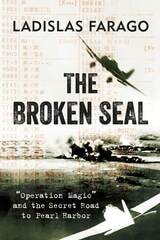
The Broken Seal
"Operation Magic" and the Secret Road to Pearl HarborLadislas Farago
Westholme Publishing, 1967
“In this fascinating account. . . . Mr. Farago’s investigation suggests that the real villain was the system itself.”—New York Times
“In this well-written and informative account. . . Mr. Farago provides many new facts from both American and Japanese sources.”—Library Journal
“A good history of Japanese and American code-breaking operations between 1921 and December 7, 1941. . . . Farago is important because in this technical study of cryptology he has arrived independently at the same general conclusion as did the non-revisionist diplomatic historians: there was no plot by Roosevelt or his advisers.”—Choice
“His conclusions should act as a corrective to the enthusiasts who claim that intelligence always provides the complete answer.”—Times Literary Supplement
The Broken Seal: The Story of “Operation Magic” and the Pearl Harbor Disaster explores the questions of why, if the United States knew the Japanese codes, did we not anticipate the December 7, 1941 surprise attack and how did the Japanese spy system in Hawaii operate? As a chief of research and planning in the Special Warfare Branch of the Office of Naval Intelligence, the author had access to both Japanese and American classified material to write this study. The author’s intent was to independently ascertain the validity of earlier claims that the Pearl Harbor attack could have been avoided. The result is an eminently readable and engrossing story, first published in 1968, of the relationship between America and Japan in the interwar years and the relentless cat-and-mouse intelligence game conducted by both sides. Despite more recent suppositions that there was a conspiracy among American and British officials to ignore warnings of a Japanese attack that had been gleaned from deciphered diplomatic codes in order to force America into a world war, the author confirms that human error and misjudgment and the actual state of intelligence interpretation at the time made an accurate assessment of Japanese intentions impossible.
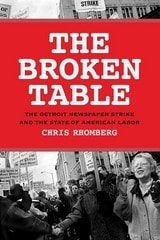
The Broken Table
The Detroit Newspaper Strike and the State of American LaborChris Rhomberg
Russell Sage Foundation, 2012
The Browning of the New South
Jennifer A. Jones
University of Chicago Press, 2019

The Brutus Revival
Parricide and Tyrranicide During the RenaissanceManfredi Piccolomini
Southern Illinois University Press, 1991
In a discussion of the Renaissance revival of classical culture, Piccolomini considers the period’s mythologizing of Brutus, Caesar’s assassin. He cites Dante as the initiator of an important literary, dramatic, political, and artistic theme and explains how the historical Brutus was changed by literature and theatre into a symbol of the just citizen rebelling against the unjust tyrant.
Piccolomini discusses several Renaissance political conspiracies modeled after Brutus’ act and explores how those conspiracies, in turn, formed the basis for the theme’s recurrence in Italian, French, and English theatre of the period.
The Burden of the Past
Problems of Historical Perception in Japan-Korea RelationsKan Kimura; Translated by Marie Speed
University of Michigan Press, 2019
Utilizing Japanese and South Korean newspaper databases to review discussion of the two countries’ disputed historical perceptions from the end of World War II to the present, The Burden of the Past provides readers with the historical framework and the major players involved, offering much-needed clarity on such polarizing issues. By seeing behind the public discourse and political rhetoric, this book offers a firmer footing for a discussion and the steps toward resolution.

The Business State
Empire and Big Business in the Twentieth-Century British StateIan Kumekawa
University of Chicago Press, 2027
Narrates how big business guided policy and expanded the state in early twentieth-century Britain.
During World War I, British businessmen streamed into government service. When Britain faced unprecedented economic challenges after the war’s end, civil servants turned to the same businessmen with whom they had worked. The result was a durable public-private network of both bureaucrats and executives: the business state.
In this book, Ian Kumekawa throws light on the previously obscured and hidden world of the business state and the economic thinking of its administrators. He breaks new methodological ground by treating the state and business together as a single entity. Twentieth-century states, he argues, were porous networks in which lines between business and governance were not clearly defined. In liberal democracies, the term “business-friendly” has long been understood as synonymous with laissez-faire. The Business State explores the historical limits of that assumption by focusing on Britain, the self-identified small, liberal state par excellence. In doing so, the book shows how a liberal democracy was effectively co-opted by private interests and explores how actively assisting big business became not just acceptable—but a political necessity.

The Business of America
The Cultural Production of a Post-War NationGraham Thompson
Pluto Press, 2004
The first part of the book examines how white male literary culture has been largely hostile to business during this period and how it has represented transnational shifts in the nature of business as threats to supposedly American values like the individual, the family, or freedom. The book charts the way that such an uneasiness towards business relies upon a discourse about America, business and empire that is increasingly untenable in the post-war world.
By way of comparison, The Business of America looks at how literature by women and by writers from different racial, ethnic and sexual groups often deals with business from the more localised angle of work. Graham Thompson shows how this attention to work provides a less abstract and more oppositional approach to the connection between business and America.
The CIA in Ecuador
Marc Becker
Duke University Press, 2021
The CIA in Guatemala
The Foreign Policy of InterventionBy Richard H. Immerman
University of Texas Press, 1982
Using documents obtained through the Freedom of Information Act, recently opened archival collections, and interviews with the actual participants, Immerman provides us with a definitive, powerfully written, and tension-packed account of the United States' clandestine operations in Guatemala and their consequences in Latin America today.
The CIA in Hollywood
How the Agency Shapes Film and TelevisionBy Tricia Jenkins
University of Texas Press, 2016
What’s your impression of the CIA? A bumbling agency that can’t protect its own spies? A rogue organization prone to covert operations and assassinations? Or a dedicated public service that advances the interests of the United States? Astute TV and movie viewers may have noticed that the CIA’s image in popular media has spanned this entire range, with a decided shift to more positive portrayals in recent years. But what very few people know is that the Central Intelligence Agency has been actively engaged in shaping the content of film and television, especially since it established an entertainment industry liaison program in the mid-1990s.
The CIA in Hollywood offers the first full-scale investigation of the relationship between the Agency and the film and television industries. Tricia Jenkins draws on numerous interviews with the CIA’s public affairs staff, operations officers, and historians, as well as with Hollywood technical consultants, producers, and screenwriters who have worked with the Agency, to uncover the nature of the CIA’s role in Hollywood. In particular, she delves into the Agency’s and its officers’ involvement in the production of The Agency, In the Company of Spies, Alias, The Recruit, The Sum of All Fears, Enemy of the State, Syriana, The Good Shepherd, and more. Her research reveals the significant influence that the CIA now wields in Hollywood and raises important and troubling questions about the ethics and legality of a government agency using popular media to manipulate its public image.
The Calling of History
Sir Jadunath Sarkar and His Empire of TruthDipesh Chakrabarty
University of Chicago Press, 2015
Through close readings of more than twelve hundred letters to and from Sarkar along with other archival documents, Dipesh Chakrabarty demonstrates that historians in colonial India formulated the basic concepts and practices of the field via vigorous—and at times bitter and hurtful—debates in the public sphere. He furthermore shows that because of its non-technical nature, the discipline as a whole remains susceptible to pressure from both the public and the academy even today. Methodological debates and the changing reputations of scholars like Sarkar, he argues, must therefore be understood within the specific contexts in which particular histories are written.
Insightful and with far-reaching implications for all historians, The Calling of History offers a valuable look at the double life of history and how tensions between its public and private sides played out in a major scholar’s career.
The Cancer Stage of Capitalism
From Crisis to CureJohn McMurtry
Pluto Press, 2013
The Cancer Stage of Capitalism is a modern classic of critical philosophy and political economy, renowned for its depth and comprehensive research. It provides a step by step diagnosis of the continuing economic collapse in the US and Europe and has had an enormous influence on new visions of economic alternatives.
John McMurtry argues that our world disorder of unending crises is the predictable result of a cancerous economic system multiplying out of all control and destroying ecological, social and organic life - a process he describes as 'global ecogenocide'. In this updated edition he explains the ‘social immune response’ required to fight the ‘macro cancer’, something which has already been shown in developments such as the Occupy movement and the democratic social transformation of Latin America.
In an official global culture increasingly destructive of life, this book shows the necessity and possibility of building a sustainable society based on a universal commitment to life and nature.
The Capacity Contract
Intellectual Disability and the Question of CitizenshipStacy Clifford Simplican
University of Minnesota Press, 2015
In the first sustained examination of disability through the lens of political theory, The Capacity Contract shows how the exclusion of disabled people has shaped democratic politics. Stacy Clifford Simplican demonstrates how disability buttresses systems of domination based on race, sex, and gender. She exposes how democratic theory and politics have long blocked from political citizenship anyone whose cognitive capacity falls below a threshold level⎯marginalization with real-world repercussions on the implementation of disability rights today.
Simplican’s compelling ethnographic analysis of the self-advocacy movement describes the obstacles it faces. From the outside, the movement must confront stiff budget cuts and dwindling memberships; internally, self-advocates must find ways to demand political standing without reinforcing entrenched stigma against people with profound cognitive disabilities. And yet Simplican’s investigation also offers democratic theorists and disability activists a more emancipatory vision of democracy as it relates to disability⎯one that focuses on enabling people to engage in public and spontaneous action to disrupt exclusion and stigma.
Taking seriously democratic promises of equality and inclusion, The Capacity Contract rejects conceptions of political citizenship that privilege cognitive capacity and, instead, centers such citizenship on action that is accessible to all people.
The Capital Times
A Proudly Radical Newspaper’s Century Long Fight for Justice and for PeaceJohn Nichols
Wisconsin Historical Society Press, 2017
As Madison’s Capital Times marks its 100th anniversary in 2017, editors Dave Zweifel and John Nichols recall the remarkable history of a newspaper that served as the tribune of Robert M. La Follette and the progressive movement, earned the praise of Franklin Delano Roosevelt for its stalwart opposition to fascism, battled Joe McCarthy during the "Red Scare," championed civil rights, women’s rights, and LGBTQ rights, opposed the Vietnam War and the invasion of Iraq, and stood with Russ Feingold when he cast the only US Senate vote against the Patriot Act. The Capital Times did not do this from New York or Washington but from the middle of America, with a readership of farmers, factory workers, teachers, and shopkeepers who stood by The Cap Times when the newspaper was boycotted, investigated, and attacked for its determination.
At a point when journalism is under assault, when newspapers struggle to survive, and "old media" struggles to find its way in a digital age, The Capital Times remains unbowed—still living up to the description Lord Francis Williams, the British newspaper editor, wrote 50 years ago: "The vast majority of American papers are as dull as weed-covered ditch-water; vast Saharas of cheap advertising with occasional oases of editorial matter written to bring happiness to the Chamber of Commerce and pain and irritation to none; the bland leading the bland.… Just here and there are a few relics of the old fighting muckraking tradition of American journalism, like The Capital Times of Madison."

The Capitalist Imaginaries of Popular Music
Charles Fairchild
Intellect Books, 2027
Traditionally, popular music has long been said to intrinsically contest, resist, and defy the powers that be. This new book challenges this long-standing orthodoxy, arguing that popular music is not so much a form of resistance to authority, but it often perpetuates the very power it is supposed to be raging against: neoliberal capitalism.
This misconception of popular music came to dominance in the mid-1980s and persists today, even when the vast majority of people have been disempowered, impoverished, and marginalized at home, at work, and in politics. This book explains why such a robust, pervasive, and persistent set of ideas about popular music has taken such a tenacious hold despite substantive evidence to the contrary.
The Capitals of Capital
The Rise and Fall of Trading Floors, 1960–2001Aaron Shkuda
University of Chicago Press, 0
How the transition from physical trading floors to automated ones changed central business districts and urban policy.
Wall Street is defined by the New York Stock Exchange’s headquarters, while the Chicago Board of Trade’s iconic building anchors LaSalle Street in the city’s Loop. These buildings have not moved in a century, but their trading floors have experienced dramatic changes over the past sixty years. While thousands of commuters still work in and around Wall Street, most stocks are traded via computer. Not even the NYSE’s servers are onsite.
The Capitals of Capital charts the rise and dematerialization of stock-exchange trading floors in New York and Chicago, demonstrating how the finance industry has long been entwined with urban planning and development. Aaron Shkuda shows in detail how the industry came to dominate cities both economically and spatially, tracing the demands of firms like Chase Manhattan Bank and the Chicago Mercantile Exchange for larger central facilities, better tax breaks, and other accommodations—until technological developments shifted their priorities from spaces for people to capacity for machines. Shkuda’s history of trading floors reveals financial institutions as change agents in urbanism; through their evolving construction proposals, they forced elected officials, urban planners, architects, and voters to consider the value of trading floors, their significance to a city and its people, and what kind of resources they deserved. Today, as Wall Street towers are converted to apartments and server farms, The Capitals of Capital sheds light on the ever-shifting relationship between the finance industry and urban spaces.
The Capture Chain
US Military Detainment from Truman to TrumpRichard Nisa
University of Minnesota Press, 2027
A penetrating look into the hidden networks of wartime capture, circulation, and detainment by United States military personnel
The Capture Chain offers a detailed history of the United States’ detention practices and the evolving infrastructure designed for the apprehension, control, and transportation of people during times of war. Spanning eight decades and several major conflicts, this work examines the hidden spaces and logistical networks connecting the front lines and prisoner-of-war camps—sites that exist at the fraught intersection of life maintenance and death distribution.
Detailing the routes, protocols, research methods, and technical systems that constitute what Richard Nisa terms the global capture chain, this book underscores how such military architectures have become increasingly sophisticated and technologically advanced since the dawn of the Cold War. Drawing on declassified military documents, diplomatic records from the Geneva Conventions, and memoirs written by soldiers and prisoners, The Capture Chain offers unprecedented insight into this shifting geography of psychological and physical violence.
Using archival research to draw links between behavioral science studies during the Korean War, Vietnam-era computation, and post-9/11 rendition networks and digital biometrics, The Capture Chain introduces new ways of understanding urgent contemporary debates around autonomous warfare, mass surveillance, and detainment. By introducing the capture chain as both a historical object and a methodological lens, Nisa highlights the legal and moral grey area that constitutes the ongoing militarized maintenance of human life.
Retail e-book files for this title are screen-reader friendly with images accompanied by short alt text and/or extended descriptions.
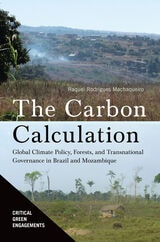
The Carbon Calculation
Global Climate Policy, Forests, and Transnational Governance in Brazil and MozambiqueRaquel Rodrigues Machaqueiro
University of Arizona Press, 2023
Focusing on REDD+ (Reducing Emissions from Deforestation and Forest Degradation), the book demonstrates how industrialized countries are able to maintain their socioeconomic models largely unaltered while claiming to address global warming using forests in the Global South to offset their pollution. By examining the creation and implementation of REDD+ historically and ethnographically, the book traces the social life of this mechanism as it travels across a complex network spanning several interacting levels: international, national, and local. Through cases in the Brazilian state of Acre and the Zambézia province in Mozambique, the author demonstrates how global climate policy has created new opportunities and rationales for unprecedented levels of intervention in the Global South—all under the guise of saving the planet.
The Carbon Calculation critically highlights the ways in which politics has reinforced a scientific focus on one possible solution to the problem of climate change—namely those that largely absolve the industrialized world from undertaking politically painful transformations in its own economic model.

The Carceral Surround
R. Joshua Scannell
University of Minnesota Press, 2026
How digital technologies entrench state power—and a new vision for resistance
As law enforcement agencies deploy increasingly advanced technologies to suppress dissent, hunt migrants, and target marginalized communities, The Carceral Surround offers a powerful new theory of police and prison power in the digital age. Making sense of the rapid expansion of digital carceral infrastructure in a nation that claims to value freedom and individual rights, R. Joshua Scannell moves beyond familiar debates over privacy to show that understanding digital policing requires confronting the political and racial logics that sustain police power.
Drawing on digital media theory, science and technology studies, critical race and ethnic studies, and carceral theory, The Carceral Surround reveals how twenty-first-century policing is less about managing crime than about governing possibility. Carceral power now operates across every register of daily life through predictive analytics, risk modeling, and algorithmic systems that track, sort, and preempt. From social media archives and facial recognition software to satellite mapping and radiation sensors, Scannell charts how seemingly disparate media converge into an environment of control that links technocratic governance to the maintenance of racial hierarchy and capitalist order.
Tracing today’s technoauthoritarian regime from the NYPD’s assault on Black Lives Matter protesters in 2020 to the Stop LAPD Spying Coalition’s campaign to end predictive policing contracts, The Carceral Surround is a rare hybrid of critique and refusal, illuminating the digital logic of US authoritarianism while imagining pathways for collective resistance beyond its grasp.
Retail e-book files for this title are screen-reader friendly.
The Carrot or the Stick for School Desegregation Policy
Magnet Schools or Forced BusingChristine H. Rossell
Temple University Press, 1991

The Case for the Prosecution in the Ciceronian Era
Michael C. Alexander
University of Michigan Press, 2003
The Causes and Consequences of Increasing Inequality
Edited by Finis Welch
University of Chicago Press, 2001
This volume draws together a panel of distinguished scholars who address these issues in terms comprehensible to noneconomists. Their findings are surprising, suggesting that factors such as trade imbalances, immigration rates, and differences in educational resources do not account for recent increases in the inequality of wealth and earnings. Rather, the contributors maintain that these discrepancies can be attributed to workplace demand for high-skilled labor. They also insist that further research must examine the organization of industry in order to better understand the concurrent devaluation of manual labor.
Addressing a topic that is of considerable public interest, this collection helps move the issue of increasing economic inequality in America to the center of the public policy arena.
Contributors: Donald R. Deere, Claudia Goldin, Lawrence F. Katz, James P. Smith, Franco Peracchi, Gary Solon, Eric A. Hanushek, Julie A. Somers, Marvin H. Kosters, William Cline, Finis Welch, Angus Deaton, Charles Murray, Kevin Murphy
The Causes of Human Behavior
Implications for Theory and Method in the Social SciencesLawrence B. Mohr
University of Michigan Press, 1996
The Causes of Post-Mobilization Leadership Change and Continuity
A Comparative Analysis of Post-Color Revolution in Ukraine, Kyrgyzstan, and GeorgiaVasili Rukhadze
University of Michigan Press, 2021
Vasili Rukhadze examines the factors that contributed to post-uprising leadership durability in the Ukraine, Kyrgyzstan, and Georgia in 2004–12, after these countries underwent their so-called “Color Revolutions.” Using structured, focused comparison and process tracing, he argues that the key independent variable influencing post-mobilization leadership durability is ruling coalition size and cohesion. He demonstrates that if the ruling coalitions are large and fragmented, as in the Ukraine and Kyrgyzstan, the coalitions disintegrate, thus facilitating the downfall of the governments. Alternatively, if the ruling coalition is small and cohesive, as in Georgia, the coalition maintains unity, hence helping the government to stay in power.
This study advances the debate on regime changes. By drawing a clear distinction between political leaderships that come to power as a result of popular uprisings and governments that take power through normal democratic processes, military coup, or any other means, the research offers one of the first studies on post-mobilization leadership. Rukhadze helps scholars differentiate between the factors that affect durability of post-uprising leadership from those factors that impact durability of all other political leadership, in turn equipping researchers with new tools to study power politics.
The Challenge of Hegemony
Grand Strategy, Trade, and Domestic PoliticsSteven E. Lobell
University of Michigan Press, 2005
"His conceptually rigorous and tightly reasoned study . . . reminds us that power is never value neutral but organizes commercial systems in liberal or imperial terms."
---Perspectives on Politics
"Lobell's book is tightly written, nicely argued and thoroughly researched to a fault. He seems to delight in historical detail. The complexity of his approach is refreshing."
---International Affairs
"The Challenge of Hegemony is a pleasure to read. It is both theoretically sophisticated and empirically rich."
---International Studies Review
"The Challenge of Hegemony offers a compelling reinterpretation of key historical cases and provides wise guidance as to how the United States should wield its power today."
--Charles A. Kupchan, Council on Foreign Relations
"Lobell demonstrates clearly how the international environment confronting great powers interacts with their domestic political coalitions to produce different grand strategies. Through a masterful sweep of history, Lobell shows us the alternative trajectories before the United States today."
--David A. Lake, University of California, San Diego
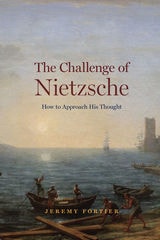
The Challenge of Nietzsche
How to Approach His ThoughtJeremy Fortier
University of Chicago Press, 2020
The Challenge of Nietzsche uses Nietzsche as a guide to Nietzsche, highlighting the fact that Nietzsche equipped his writings with retrospective self-commentaries and an autobiographical apparatus that clarify how he understood his development as an author, thinker, and human being. Fortier shows that Nietzsche used his writings to establish two major character types, the Free Spirit and Zarathustra, who represent two different approaches to the conduct and understanding of life: one that strives to be as independent and critical of the world as possible, and one that engages with, cares for, and aims to change the world. Nietzsche developed these characters at different moments of his life, in order to confront from contrasting perspectives such elemental experiences as the drive to independence, the feeling of love, and the assessment of one’s overall health or well-being. Understanding the tension between the Free Spirit and Zarathustra takes readers to the heart of what Nietzsche identified as the tensions central to his life, and to all human life.
The Challenges to Democracy
Consensus and Extremism in American PoliticsBy Murray Clark Havens
University of Texas Press, 1965
Threats to American unity are not unique to modern times. In the 1960s, the assassination of President Kennedy, the tension of racial strife, the political extremes of the Radical Right with its John Birchers and the Radical Left with its threat of Communism all raised critically urgent questions relative to our national unity, to our political stability, and to our vaunted respect for the rule of law. The Challenges to Democracy is an assessment of the foundations of political unity in the United States.
The American consensus, as Murray Clark Havens defines it, emphasizes a set of values and procedures that most Americans, since the adoption of the Constitution, have accepted in principle: religious tolerance, individual freedom in intellectual and cultural matters, the importance of education and intellectual effort, settlement of internal conflict through peaceful and political processes, the supremacy of law, a high and generally rising standard of living, and, since the Civil War, racial compatibility.
Never in our history have the ideals of this consensus been fully achieved, but as long as the majority of our citizens accept the validity of those ideals and the democratic procedures for realizing them, the basic American political unity is not threatened. However, when citizens who cannot accept the elements of the American consensus become influential enough to block the democratic process, then that consensus is threatened.
Havens shows how such threats have come to us all through our history—the Civil War, racial and religious bigotry, the Ku Klux Klan, Huey Long, Father Coughlin and other extremists of the desperate thirties, McCarthyism. He discusses contemporary dangers to American unity such as those connected with the acceptance of the African American, religious friction in politics and government, the Radical Right and the Radical Left, and our foreign policy as an expression of the American consensus.
The broad conclusions of this study are that our national unity is continuously in jeopardy, with frequent recurrences of serious questions as to the permanence of some of the patterns we have always associated with American government, but that our democracy is possessed of considerable potential for survival because of our deep national commitment to democracy and because of our even deeper nationalism.
The Change Election
Money, Mobilization, and Persuasion in the 2008 Federal ElectionsEdited by David Magleby
Temple University Press, 2010
The 2008 election was an extraordinary event that represented change at many levels. The candidates’ innovative campaigns changed how funds were raised, how voters were mobilized, and how messages were communicated through advertising and the internet. Parties and interest groups played their own important role in this historic election. In The Change Election, David Magleby assembles a team of accomplished political scientists to provide an in-depth analysis of this groundbreaking presidential election. These scholars through a set of compelling case studies examine the competition for votes in a dozen competitive House and Senate contests and for the White House in five states: Ohio, North Carolina, New Hampshire, Colorado, and New Mexico.
Backed by a wealth of data, and extensive interviews, the contributors offer an up-close look at the interactions of candidates' individual skills and personalities with the larger political forces at work in the election year. The book offers insights into the rapidly evolving organizational and technical aspects of campaigning. The dramatic success Obama and other candidates had in raising money—especially from small donors—is addressed along with how money was raised and spent by the candidates, party committees, and interest groups competing for votes.
Building on a tested methodology, The Change Election explores the interplay of money and electioneering. Magleby builds on more than a decade of prior studies to show the ways participants in our electoral process have adapted to statutory and judicial decisions and how the 2008 election has the potential to transform American electoral politics.
The Changing American Mind
How and Why American Public Opinion Changed Between 1960 and 1988William G. Mayer
University of Michigan Press, 1992
Have Americans become more or less tolerant of racial discrimination? More or less supportive of abortion? Is a new tax revolt underway? Did a "new conservative mood" dominate elections and policy discussions in the early 1980s? Popular and academic discussions about the past and future of American politics often turn on the question of whether and how public opinion has changed. Yet for all the talk about such matters, observes political scientist William G. Mayer, there is surprisingly little hard evidence on many of these questions. The Changing American Mind is designed to fill that gap, by presenting a comprehensive history of American public opinion over the last three decades: how it changed, why it changed, and what difference that makes for American politics. The Changing American Mind is important reading for all who are interested in American politics and public opinion. Its appendices, which include the results of more than 250 survey questions that have been asked regularly of national samples over the last three decades, make it an indispensable reference source for everyone who studies or participates in American politics.
The Changing Face of Economics
Conversations with Cutting Edge EconomistsDavid Colander, Richard P. F. Holt, and J. Barkley Rosser, Jr.
University of Michigan Press, 2004
The interviews and commentary together demonstrate that economics is currently undergoing a fundamental shift in method and is moving away from traditional neoclassical economics into a dynamic set of new methods and approaches. These new approaches include work in behavioral economics, experimental economics, evolutionary game theory and ecological approaches, complexity and nonlinear dynamics, methodological analysis, and agent-based modeling.
David E. Colander is Professor of Economics, Middlebury College.
J. Barkley Rosser, Jr., is Professor of Economics and Kirby L. Kramer Jr. Professor of Business Administration, James Madison University.
Richard P. F. Holt is Professor of Churchill Honors and Economics, Southern Oregon University.
The Changing Face of Representation
The Gender of U.S. Senators and Constituent CommunicationsKim L. Fridkin and Patrick J. Kenney
University of Michigan Press, 2015
As the number of women in the U.S. Senate grows, so does the number of citizens represented by women senators. At the same time, gender remains a key factor in senators’ communications to constituents as well as in news media portrayals of senators. Focusing on 32 male and female senators during the 2006 congressional election year, Kim L. Fridkin and Patrick J. Kenney examine in detail senators’ official websites, several thousand press releases and local news stories, and surveys of 18,000 citizens to discern constituents’ attitudes about their senators.
The authors conclude that gender role expectations and stereotypes do indeed constrain representational and campaign messages and influence news coverage of both candidates and elected senators. Further, while citizens appear to be less influenced by entrenched stereotypes, they pay more attention to female senators’ messages and become more knowledgeable about them, in comparison to male senators.
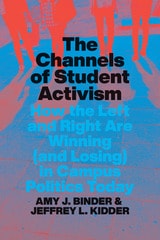
The Channels of Student Activism
How the Left and Right Are Winning (and Losing) in Campus Politics TodayAmy J. Binder and Jeffrey L. Kidder
University of Chicago Press, 2022
The past six years have been marked by a contentious political atmosphere that has touched every arena of public life, including higher education. Though most college campuses are considered ideologically progressive, how can it be that the right has been so successful in mobilizing young people even in these environments?
As Amy J. Binder and Jeffrey L. Kidder show in this surprising analysis of the relationship between political activism on college campuses and the broader US political landscape, while liberal students often outnumber conservatives on college campuses, liberal campus organizing remains removed from national institutions that effectively engage students after graduation. And though they are usually in the minority, conservative student groups have strong ties to national right-leaning organizations, which provide funds and expertise, as well as job opportunities and avenues for involvement after graduation. Though the left is more prominent on campus, the right has built a much more effective system for mobilizing ongoing engagement. What’s more, the conservative college ecosystem has worked to increase the number of political provocations on campus and lower the public’s trust in higher education.
In analyzing collegiate activism from the left, right, and center, The Channels of Student Activism shows exactly how politically engaged college students are channeled into two distinct forms of mobilization and why that has profound consequences for the future of American politics.

The Channels of Student Activism
How the Left and Right Are Winning (and Losing) in Campus Politics TodayAmy J. Binder and Jeffrey L. Kidder
University of Chicago Press, 2022
This is an auto-narrated audiobook edition of this book.
An eye-opening analysis of collegiate activism and its effects on the divisions in contemporary American politics.
The past six years have been marked by a contentious political atmosphere that has touched every arena of public life, including higher education. Though most college campuses are considered ideologically progressive, how can it be that the right has been so successful in mobilizing young people even in these environments?
As Amy J. Binder and Jeffrey L. Kidder show in this surprising analysis of the relationship between political activism on college campuses and the broader US political landscape, while liberal students often outnumber conservatives on college campuses, liberal campus organizing remains removed from national institutions that effectively engage students after graduation. And though they are usually in the minority, conservative student groups have strong ties to national right-leaning organizations, which provide funds and expertise, as well as job opportunities and avenues for involvement after graduation. Though the left is more prominent on campus, the right has built a much more effective system for mobilizing ongoing engagement. What’s more, the conservative college ecosystem has worked to increase the number of political provocations on campus and lower the public’s trust in higher education.
In analyzing collegiate activism from the left, right, and center, The Channels of Student Activism shows exactly how politically engaged college students are channeled into two distinct forms of mobilization and why that has profound consequences for the future of American politics.
The Chicago Canon on Free Inquiry and Expression
Edited by Tony Banout and Tom Ginsburg
University of Chicago Press, 2024
Free inquiry and expression are hotly contested, both on campus and in social and political life. Since its founding in the late nineteenth century, the University of Chicago has been at the forefront of conversations around free speech and academic freedom in higher education. The University’s approach to free expression grew from a sterling reputation as a research university as well as a commitment to American pragmatism and democratic progress, all of which depended on what its first president referred to as the “complete freedom of speech on all subjects.” In 2015, more than 100 years later, then University provost and president J. D. Isaacs and Robert Zimmer echoed this commitment, releasing a statement by a faculty committee led by law professor Geoffrey R. Stone that has come to be known as the Chicago Principles, now adopted or endorsed by one hundred US colleges and universities. These principles are just a part of the long-standing dialogue at the University of Chicago around freedom of expression—its meaning and limits. The Chicago Canon on Free Inquiry and Expression brings together exemplary documents – some published for the first time here – that explain and situate this ongoing conversation with an introductory essay that brings the tradition to light.
Throughout waves of historical and societal challenges, this first principle of free expression has required rearticulation and new interpretations. The documents gathered here include, among others, William Rainey Harper’s “Freedom of Speech” (1900), the Kalven Committee’s report on the University’s role in political and social action (1967), and Geoffrey R. Stone’s “Free Speech on Campus: A Challenge of Our Times” (2016). Together, the writings of the canon reveal how the Chicago tradition is neither static nor stagnant, but a vibrant experiment; a lively struggle to understand, practice, and advance free inquiry and expression.
At a time of nationwide campus speech debates, engaging with these texts and the questions they raise is essential to sustaining an environment of broad intellectual and ideological diversity. This book offers a blueprint for the future of higher education’s vital work and points to the civic value of free expression.
The Chicago Canon on Free Inquiry and Expression
Edited by Tony Banout and Tom Ginsburg
University of Chicago Press, 2024
A collection of texts that provide the foundation for the University of Chicago’s longstanding tradition of free expression, principles that are at the center of current debates within higher education and society more broadly.
Free inquiry and expression are hotly contested, both on campus and in social and political life. Since its founding in the late nineteenth century, the University of Chicago has been at the forefront of conversations around free speech and academic freedom in higher education. The University’s approach to free expression grew from a sterling reputation as a research university as well as a commitment to American pragmatism and democratic progress, all of which depended on what its first president referred to as the “complete freedom of speech on all subjects.” In 2015, more than 100 years later, then University provost and president J. D. Isaacs and Robert Zimmer echoed this commitment, releasing a statement by a faculty committee led by law professor Geoffrey R. Stone that has come to be known as the Chicago Principles, now adopted or endorsed by one hundred US colleges and universities. These principles are just a part of the long-standing dialogue at the University of Chicago around freedom of expression—its meaning and limits. The Chicago Canon on Free Inquiry and Expression brings together exemplary documents – some published for the first time here – that explain and situate this ongoing conversation with an introductory essay that brings the tradition to light.
Throughout waves of historical and societal challenges, this first principle of free expression has required rearticulation and new interpretations. The documents gathered here include, among others, William Rainey Harper’s “Freedom of Speech” (1900), the Kalven Committee’s report on the University’s role in political and social action (1967), and Geoffrey R. Stone’s “Free Speech on Campus: A Challenge of Our Times” (2016). Together, the writings of the canon reveal how the Chicago tradition is neither static nor stagnant, but a vibrant experiment; a lively struggle to understand, practice, and advance free inquiry and expression.
At a time of nationwide campus speech debates, engaging with these texts and the questions they raise is essential to sustaining an environment of broad intellectual and ideological diversity. This book offers a blueprint for the future of higher education’s vital work and points to the civic value of free expression.
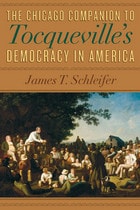
The Chicago Companion to Tocqueville's Democracy in America
James T. Schleifer
University of Chicago Press, 2012
An compact, accessible, authoritative companion to Tocqueville's classic work
One of the greatest books ever to be written on the United States, Democracy in America continues to find new readers who marvel at the lasting insights Alexis de Tocqueville had into our nation and its political culture. The work is, however, as challenging as it is important; its arguments can be complex and subtle, and its sheer length can make it difficult for any reader, especially one coming to it for the first time, to grasp Tocqueville’s meaning. The Chicago Companion to Tocqueville’s “Democracy in America” is the first book written expressly to help general readers and students alike get the most out of this seminal work.
Now James T. Schleifer, an expert on Tocqueville, has provided the background and information readers need in order to understand Tocqueville’s masterwork. In clear and engaging prose, Schleifer explains why Democracy in America is so important, how it came to be written, and how different generations of Americans have interpreted it since its publication. He also presents indispensable insight on who Tocqueville was, his trip to America, and what he meant by equality, democracy, and liberty.
Drawing upon his intimate knowledge of Tocqueville’s papers and manuscripts, Schleifer reveals how Tocqueville’s ideas took shape and changed even in the course of writing the book. At the same time, Schleifer provides a detailed glossary of key terms and key passages, all accompanied by generous citations to the relevant pages in the University of Chicago Press Mansfield/Winthrop translation. The Chicago Companion will serve generations of readers as an essential guide to both the man and his work.

The Chicago Food Encyclopedia
Edited by Carol Mighton Haddix, Bruce Kraig, and Colleen Taylor Sen: Foreword by Russell Lewis
University of Illinois Press, 2017
The Chief Executive In Texas
A Study in Gubernatorial LeadershipBy Fred Gantt, Jr.
University of Texas Press, 1964
"A Texas governor has only two happy days: the day he is inaugurated and the day he retires."
So spoke Joseph D. Sayers at the beginning of the twentieth century. Now, in an analysis of the Texas governorship by Fred Gantt, Jr., the reader learns why Governor Sayers' remark remains true many years after it was uttered: the office has come to be so demanding that the reader may ask why anyone would want it. Price Daniel described a typical day: "The governor's job is a night-and-day job; I usually get up in the morning about seven and start answering the telephone, and then look over the mail that has come in late the day before. I sign mail before going over to the office and then have interviews most of the day. . . . In the evening at the Mansion I take calls and messages until late in the night."
The Chief Executive in Texas is much more than a book full of interesting facts: It is a discerning political commentary built on a broad historical foundation that places events and persons in a perspective perhaps not previously considered by the reader.
The office of chief executive in other states also is explored, as well as the decline and rise of executive power as it has been limited in various constitutions in Texas and as it has developed through custom. The account of the governor's relationship with the Legislature is historically valuable. Especially interesting to many readers will be the discussions of the political roles of individual Texas governors, whose ranks include "Ma" and "Pa" Ferguson and "Pappy" O'Daniel. These studies are personally revealing, and they attest that polities in Texas apparently can never be dull.
The Chief Justice
Appointment and InfluenceDavid J. Danelski and Artemus Ward, editors
University of Michigan Press, 2016

The Child Savers
The Invention of DelinquencyPlatt, Anthony M
Rutgers University Press, 2009
Focusing on social reformers of the late nineteenth and early twentieth centuries, Platt's principal argument is that the "child savers" movement was not an effort to liberate and dignify youth but, instead, a punitive and intrusive attempt to control the lives of working-class urban adolescents. This expanded edition provides a renewed and distinguished contribution by placing it in historical context through insightful commentaries from cross-disciplinary academics, along with an essay by Miroslava Chávez-García examining how Platt's influential study has impacted many of the central arguments social scientists and historians face today.

The Children in Child Health
Negotiating Young Lives and Health in New ZealandJulie Spray
Rutgers University Press, 2020
In the unique context of indigenous Māori and migrant Pacific children in postcolonial New Zealand, Julie Spray explores the intertwining issues of epidemic disease, malnutrition, stress, violence, self-harm, and death to address the problem of how scholars and policy-makers alike can recognize and respond to children as social actors in their health. The Children in Child Health innovatively combines perspectives from childhood studies, medical anthropology, and public health and policy together with evocative ethnography to show how a deep understanding of children’s worlds can change our approach to their care.

The Children of Light and the Children of Darkness
A Vindication of Democracy and a Critique of Its Traditional DefenseReinhold Niebuhr
University of Chicago Press, 2011
The Children of Light and the Children of Darkness, first published in 1944, is considered one of the most profound and relevant works by the influential theologian Reinhold Niebuhr, and certainly the fullest statement of his political philosophy. Written and first read during the prolonged, tragic world war between totalitarian and democratic forces, Niebuhr’s book took up the timely question of how democracy as a political system could best be defended.
Most proponents of democracy, Niebuhr claimed, were “children of light,” who had optimistic but naïve ideas about how society could be rid of evil and governed by enlightened reason. They needed, he believed, to absorb some of the wisdom and strength of the “children of darkness,” whose ruthless cynicism and corrupt, anti-democratic politics should otherwise be repudiated. He argued for a prudent, liberal understanding of human society that took the measure of every group’s self-interest and was chastened by a realistic understanding of the limits of power. It is in the foreword to this book that he wrote, “Man’s capacity for justice makes democracy possible; but man’s inclination to injustice makes democracy necessary.”
The Children’s Republic of Gaudiopolis
The History and Memory of a Children’s Home for Holocaust and War Orphans (1945–1950)Gergely Kunt
Central European University Press, 2022
Gaudiopolis (The City of Joy) was a pedagogical experiment that operated in a post–World War II orphanage in Budapest. This book tells the story of this children’s republic that sought to heal the wounds of wartime trauma, address prejudice and expose the children to a firsthand experience of democracy. The children were educated in freely voicing their opinions, questioning authority, and debating ideas.
The account begins with the saving of hundreds of Jewish children during the Siege of Budapest by the Lutheran minister Gábor Sztehlo together with the International Red Cross. After describing the everyday life and practices of self-rule in the orphanage that emerged from this rescue operation, the book tells how the operation of the independent children’s home was stifled after the communist takeover and how Gaudiopolis was disbanded in 1950.
The book then discusses how this attempt of democratization was erased from collective memory. The erasure began with the banning of a film inspired by Gaudiopolis. The Communist Party financed Somewhere in Europe in 1947 as propaganda about the construction of a new society, but the film’s director conveyed a message of democracy and tolerance instead of adhering to the tenets of socialist realism. The book breaks the subsequent silence on “The City of Joy,” which lasted until the fall of the Iron Curtain and beyond.
The Chilean Senate
Internal Distribution of InfluenceBy Weston H. Agor
University of Texas Press, 1971
Weston Agor’s carefully documented analysis of the organization and workings of the Chilean Senate is the first of its kind and fills a long-standing need in the comparative study of the internal structure of legislative bodies.
Making eclectic use of role, power, and exchange theories, Agor bases his discussion on personal interviews with senators and staff as well as on extensive observation of the Senate in action during 1967–1968. He also analyzes in detail relevant documents, committee reports, and floor debates. Focused primarily on the formal decision-making structure within the Senate and on internal norms, both formal and informal, that hold that structure together, Agor’s study fruitfully compares the Chilean Senate with its peers, including the United States Senate, to which it bears surprising resemblance in form and function.
Agor examines the role of compromise and informal rules of the game in achieving a majority vote in the Senate, the power of committees and committee presidents, and political party control over Senate members. The influence of the executive, particularly in the passage of executive legislation, and its effect on the Senate’s internal system of checks and balances—both stated and understood—are examined in terms of their effect on the political strength of the Senate.
The Chilean Senate, unlike its counterparts in most other “developing countries,” has exercised genuine and effective influence in the national political system. In an epilogue to this study, Agor views events since 1968, including the election of Allende, that affected the future role of the Senate in Chilean politics.