Results by title
1787 books match the query 'Literary Collections' and 471 start with t
The New Anthology of American Poetry
Traditions and Revolutions, Beginnings to 1900Edited by Steven Gould Axelrod, Camille Roman, and Thomas Travisano
Rutgers University Press, 2002
Volume I begins with a generous selection of Native American materials, then spans the years from the establishment of the American colonies to about 1900, a world on the brink of World War I and the modern era. Part One focuses on poetry from the very beginnings through the end of the eighteenth century. The expansion and development of a newly forged nation engendered new kinds of poetry. Part Two includes works from the early nineteenth century through the time of the Civil War. The poems in Part Three reflect the many issues affecting a nation undergoing tumultuous change: the Civil War, immigration, urbanization, industrialization, and cultural diversification.
Such well-recognized names as Anne Bradstreet, Edward Taylor, Phillis Wheatley, Edgar Allan Poe, Herman Melville, Walt Whitman, Emily Dickinson, and Stephen Crane appear in this anthology alongside such less frequently anthologized poets as George Horton, Sarah Helen Whitman, Elizabeth Oakes-Smith, Frances Harper, Rose Terry Cooke, Helen Hunt Jackson, Adah Menken, Sarah Piatt, Ina Coolbrith, Emma Lazarus, Albery Whitman, Owl Woman (Juana Manwell) Sadakichi Hartmann, Ernest Fenollosa, James Weldon Johnson, Paul Laurence Dunbar, and—virtually unknown as a poet—Abraham Lincoln. It also includes poems and songs reflecting the experiences of a variety of racial and ethnic groups.
The New Babel
Toward a Poetics of the Mid-East CrisesLeonard Schwartz
University of Arkansas Press, 2016
The New Babel: Toward a Poetics of the Mid-East Crises evokes and investigates—from a Jewish American perspective and in the forms of poetry, essays, and interviews—the Israeli-Palestinian conflict, America’s involvement as both perpetrator and victim of events in the Middle East and Afghanistan, and the multiple ways that poetics can respond to political imperatives.
The poems range from the immediately lyrical to the experimental forms of the “Apple Anyone Sonnets” series, which relies heavily on the Arabic but has Shakespeare as its scaffolding.
In the essays, Schwartz calls on the power of poetry—and of some of the great poets in the Arabic, Jewish, and American traditions—to help rethink the battle lines of the contemporary Mid-East, with the Jewish philosopher Martin Buber looming large.
The interviews provide Schwartz’s discussions with Israeli poet and activist Aharon Shabtai, political philosopher Michael Hardt, and the late, great American poet Amiri Baraka.
In these creative, analytical, and conversational moments, Leonard Schwartz rethinks the battle lines of the contemporary Middle East and calls on the power of language as the essence of our humanity, endlessly fluid, but also the source of an intentional confusion there is a necessity to counter.
The New Desert Reader
Wild, Peter
University of Utah Press, 2006
A slow change in outlook dominates the book, as attitudes shift from viewing the desert as a place to be despised or exploited to an appreciation of it as a special place, an arena of highly complex natural communities, and a wild refuge for the human body and soul. Comprehensive and brightly informative, The New Desert Reader will be invaluable to anyone interested in the history, literature, and beauty of North America’s treasured desert places.

The New Short Story Theories
Charles E. May
Ohio University Press, 1994
The first edition of May’s Short Story Theories (1976) opened with an essay entitled “The Short Story: An Underrated Art.” Almost two decades later, the short story suffers no such slight. Publishers and critics have become increasingly interested in the form, which has enjoyed a renaissance led by such writers as Raymond Carver, Tobias Wolff, Ann Beattie, Bobbie Ann Mason, and Mary Robison. An important part of this revival of interest, Short Story Theories has continued to attract a strong and loyal audience among students and teachers.
The New Short Story Theories includes a few basic pieces from the earlier volume—Poe’s Hawthorne review, Brander Matthew’s extension and formalization of Poe’s theories, and essays by Randall Jarrell, Elizabeth Bowen, and Nadine Gordimer—but most of the essays are new to the collection.
Addressing problems of definition, historical considerations, issues of technique, and cognitive approaches, essays include:
“The Tale as Genre in Short Story Fiction,” by W. S. Penn
“O. Henry and the Theory of the Short Story,” by Suzanne C. Ferguson
“On Writing,” by Raymond Carver
“From Tale to Short Story,” by Robert F. Marler
“A Cognitive Approach to Storyness,” by Susan Lohafer
May’s new collection will continue to highlight the short story, to provoke debate, and to enrich our experience of a demanding and rewarding literary form.
The Northern Stories of Charles W. Chesnutt
Charles W. Chesnutt
Ohio University Press, 2004
The first African American fiction writer to earn a national reputation, Charles W. Chesnutt remains best known for his depictions of Southern life before and after the Civil War. But he also produced a large body of what might best be called his “Northern” writings, and those works, taken together, describe the intriguing ways in which America was reshaping itself at the turn of the last century.
The Northern Stories of Charles W. Chesnutt collects for the first time eighteen Chesnutt stories—several of them first appearing in Northern magazines or newspapers—that portray life in the North in the period between the Civil War and World War I. Living in Ohio from 1883 until his death in 1932, Chesnutt witnessed and wrote about the social, cultural, and racial upheavals taking place in the North during a crucial period of American history. His Northern stories thus reflect his vision of a newly reconstituted America, one recommitted to the ideals of freedom and economic opportunity inherent in our national heritage.
The stories, compiled and edited with critical introductions to each by Professor Charles Duncan, offer a new Chesnutt, one fascinated by the evolution of America into an urban, multiracial, economically driven democracy.
The Northern Stories of Charles W. Chesnutt presents richly imagined characters, both black and white, working to make better lives for themselves in the turbulent and stimulating universe of the turn-of-the-century North. Indeed, Chesnutt stands virtually alone as the first African American chronicler of Northern culture, anticipating such figures as James Weldon Johnson, Langston Hughes, Ralph Ellison, James Baldwin, and Toni Morrison. This critical edition of The Northern Stories of Charles W. Chesnutt is a significant addition to the body of African American literature.
The Novel of the Future
Anaïs Nin
Ohio University Press, 2014
In The Novel of the Future, Anaïs Nin explores the act of creation—in film, art, and dance as well as literature—to chart a new direction for the young artist struggling against what she perceived as the sterility, formlessness, and spiritual bankruptcy afflicting much of mid-twentieth-century fiction. Nin offers, instead, an argument for and synthesis of the poetic novel and discusses her own efforts in this genre as well as its influence on the development of such writers as D. H. Lawrence, Henry Miller, Lawrence Durrell, Marguerite Young, and Djuna Barnes. In chapters devoted to the pursuit of the hidden self, the genesis of fiction, and the relationship between the diary and fiction, she addresses the materials, techniques, and nourishment of the arts, and the functions of art itself.
Originally published in 1968, The Novel of the Future remains a classic among both creative writers and literary scholars. This new Swallow Press edition includes an introduction by Nin biographer Deirdre Bair.
The Objectivist Nexus
Essays in Cultural PoeticsPeter Quartermain
University of Alabama Press, 1999
Outstanding poets and critics present cultural readings of the Objectivist poets, a group whose works have been largely unexamined.
"Objectivist" writers, conjoined through a variety of personal, ideological, and literary-historical links, have, from the late 1920s to the present, attracted emulation and suspicion. Representing a nonsymbolist, postimagist poetics and characterized by a historical, realist, antimythological worldview, Objectivists have retained their outsider status. Despite such status, however, the formal, intellectual, ideological, and ethical concerns of the Objectivist nexus have increasingly influenced poetry and poetics in the United States.
Thus, argue editors Rachel Blau DuPlessis and Peter Quartermain, the time has come for an anthology that unites essential works on Objectivist practices and presents Objectivist writing as an enlargement of the possibilities of poetry rather than as a determinable and definable literary movement. The authors' collective aim is to bring attention to this group of poets and to exemplify and specify cultural readings for poetic texts--readings alert to the material world, politics, society, and history, and readings concerned with the production, dissemination, and reception of poetic texts.
The contributors consider Basil Bunting, Lorine Niedecker, George Oppen, Carl Rakosi, Charles Reznikoff, and Louis Zukofsky within both their historical milieu and our own. The essays insist on poetry as a mode of thought; analyze and evaluate Objectivist politics; focus on the ethical, spiritual, and religious issues raised by certain Objectivist affiliations with Judaism; and explore the dissemination of poetic texts and the vagaries of Objectivist reception. Running throughout the book are two related threads: Objectivist writing as generally a practice aware of its own historical and social contingency and Objectivist writing as a site of complexity, contestation, interrogation, and disagreement.
The Odyssey
Homer
University of Chicago Press, 2025
The most accurate and poetic translation of the world's greatest epic, which is now a film by Academy Award winner Christopher Nolan!
“This may be the best translation of The Odyssey yet."—Edith Hall, The Telegraph
A magnificent feat of translation, hailed by classicists and poets alike as a “momentous achievement”: “thrilling,” “rich and rhythmical,” “superb,” “mesmerizing,” “searingly faithful—yet absolutely original.”
With this edition of Homer’s Odyssey, the celebrated author, critic, and classicist Daniel Mendelsohn brings the great epic to vividly poetic new life. Widely known for his essays on classical literature and culture in The New Yorker and many other publications, Mendelsohn gives us a line-for-line rendering of The Odyssey that is both engrossing as poetry and true to its source. Rejecting the streamlining and modernizing approach of many recent translations, he artfully reproduces the epic’s formal qualities—meter, enjambment, alliteration, assonance—and in so doing restores to Homer’s masterwork its archaic grandeur. Mendelsohn’s expansive six-beat line, far closer to the original than that of other recent translations, allows him to capture each of Homer’s dense verses without sacrificing the amplitude and shadings of the original.
The result is the richest, most ample, most precise, and most musical Odyssey in English, conveying the beauty of its poetry, the excitement of its hero’s adventures, and the profundity of its insights. Supported by an extensive introduction and the fullest notes and commentary currently available, Daniel Mendelsohn’s Odyssey is poised to become the authoritative version of this magnificent and enduringly influential masterpiece.
The Odyssey
Homer
University of Chicago Press, 2025
The most accurate and poetic translation of the world's greatest epic, which is now a film by Academy Award winner Christopher Nolan!
“This may be the best translation of The Odyssey yet."—Edith Hall, The Telegraph
A magnificent feat of translation, hailed by classicists and poets alike as a “momentous achievement”: “thrilling,” “rich and rhythmical,” “superb,” “mesmerizing,” “searingly faithful—yet absolutely original.”
With this edition of Homer’s Odyssey, the celebrated author, critic, and classicist Daniel Mendelsohn brings the great epic to vividly poetic new life. Widely known for his essays on classical literature and culture in The New Yorker and many other publications, Mendelsohn gives us a line-for-line rendering of The Odyssey that is both engrossing as poetry and true to its source. Rejecting the streamlining and modernizing approach of many recent translations, he artfully reproduces the epic’s formal qualities—meter, enjambment, alliteration, assonance—and in so doing restores to Homer’s masterwork its archaic grandeur. Mendelsohn’s expansive six-beat line, far closer to the original than that of other recent translations, allows him to capture each of Homer’s dense verses without sacrificing the amplitude and shadings of the original.
The result is the richest, most ample, most precise, and most musical Odyssey in English, conveying the beauty of its poetry, the excitement of its hero’s adventures, and the profundity of its insights. Supported by an extensive introduction and the fullest notes and commentary currently available, Daniel Mendelsohn’s Odyssey is poised to become the authoritative version of this magnificent and enduringly influential masterpiece.
The Oedipus Casebook
Reading Sophocles' Oedipus the KingMark R. Anspach
Michigan State University Press, 2019
The Offbeat
Collecting GlancesKristen DeMay
Michigan State University Press, 2005
The Offbeat is an independent literary series devoted to publishing a diverse collection of voices,and to promoting contactand discussion among Michigan writers. The Offbeat is run entirely by Michigan State University undergraduates, and is centered in East Lansing. Student editors encourage contributions by all individuals with a Michigan connection, past and present, visitor and resident, urban and rural, student and non-student alike. The Offbeat’s goal is to provide an alternative literary outlet for all Michigan writers.
The Offbeat
Eschew ObfuscationTheresa Mlinarcik
Michigan State University Press, 2003
The Offbeat literary collection series is devoted to publishing a diverse selection of voices and to promoting contact and discussion among writers. The Offbeat is run entirely by Michigan State University students, with the goal of providing an alternative literary outlet for Michigan writers.
This edition features an interview with noted author, W. S. Penn, plus a selection of original fiction, prose, and poetry from a variety of authors, including Daniel Klass, Timothy Carmody, Joshua Moon, Robert Brady, Mark Geralds, Andrew Hungerford, Jeremy Campbell, Gavin Craig, Ashley Honeysett, Andy McGashen, Colleen Farrow, Crystal Passmore, Jogn Garcia, De'Juan McDuell, Gregory Wright, Bailey Follette, and Brandon Connell.
The Offbeat
Fully ClothedKristen DeMay
Michigan State University Press, 2006
The Offbeat is an independent literary series devoted to publishing a diverse collection of voices, and to promoting contact and discussion among Michigan writers. The Offbeat is run entirely by Michigan State University undergraduates, and is centered in East Lansing. Student editors encourage contributions by all individuals with a Michigan connection, past and present, visitor and resident, urban and rural, student and non student alike. The Offbeat’s goal is to provide an alternative literary outlet for all Michigan writers.
The Offbeat
I Have Been Sometimes True to NothingTheresa Mlinarcik
Michigan State University Press, 2003
The Offbeat is an independent literary series devoted to publishing a diverse collection of voices, and to promoting contact and discussion among Michigan writers. The Offbeat is run entirely by Michigan State University undergraduates, and is centered in East Lansing. Student editors encourage contributions by all individuals with a Michigan connection, past and present, visitor and resident, urban and rural, student and non-student alike. The Offbeat' goal is to provide an alternative literary outlet for all Michigan writers. The Offbeat presents, encourages, and explores creative works in fiction, poetry, drama, essay, criticism, image, and that which defies categorization. Its purpose is to call attention to voices both emerging and established, including those that have been previously overlooked.
The Offbeat
Noise from Typewriter KeysGoldie Currie
Michigan State University Press, 2010
Noise from Typewriter Keys is the tenth volume in the independent literary series, The Offbeat, devoted to publishing a diverse collection of voices, and to promoting contact and discussion among writers. The Offbeat is run entirely by Michigan State Undergraduates, and is centered in East Lansing. The mission of The Offbeat is to provide an alternative literary outlet for writers from Michigan and beyond, and to call attention to voices both emerging and established.
The Offbeat: Noise from Typewriter Keys is an ensemble of voices and eruptions heard from the inside and out. This volume includes a wide variety of writers and focuses on the ambition of new creation. This part of the series seeks to capture movement of a writer while exploring the varied sounds that come from imagination.
The Offbeat
Tell Me EverythingKristen DeMay
Michigan State University Press, 2007
The Offbeat is an independent literary series devoted to publishing a diverse collection of voices, and to promoting contactand discussion among Michigan writers. The Offbeat is run entirely by Michigan State University undergraduates, and is centered in East Lansing. Student editors encourage contributions by all individuals with a Michigan connection, past and present, visitor and resident, urban and rural, student and non-student alike. The Offbeat's goal is to provide an alternative literary outlet for all Michigan writers.
The Offbeat
The Silver LiningChelsea Beck
Michigan State University Press, 2013
The Offbeat
Unvarnished VoicesKristen DeMay
Michigan State University Press, 2004
The Offbeat is a literary collection series devoted to publishing a diverse selection of voices and to promoting contact and discussion among writers. The Offbeat is run entirely by Michigan State University students, with the goal of providing an alternative literary outlet for Michigan writers.
This edition contains work by Steven Rajewski, Erin Ashmore, Neil Kennedy, Victoria Henderson, Mary Helmic, Rebecca Klein, Jamie Miller, Ken Sleight, Laura Tisdel, and many others.
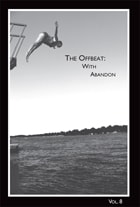
The Offbeat
With AbandonChris Cobb
Michigan State University Press, 2008
With Abandon is the eighth volume in the independent literary series, The Offbeat, devoted to publishing a diverse collection of voices, and to promoting contact and discussion among writers. The Offbeat is run entirely by Michigan State Undergraduates, and is centered in East Lansing. The mission of The Offbeat is to provide an alternative literary outlet for writers from Michigan and beyond, and to call attention to voices both emerging and established.
The Offbeat: With Abandon features a wide array of writing that cuts across genres, highlighting the best work by authors ranging from professional journalists to undergraduate writers. Thrown into the mix are voices from professors of literature, graduate students in creative writing, and even a few of our editorial staff. In this volume, writing is an act of faith, a documentation of the joy and terror of life, and above all, an act of witness.
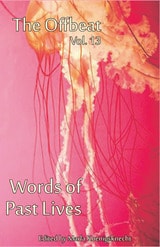
The Offbeat
Words of Past LivesMarla Koenigsknecht
Michigan State University Press, 2013
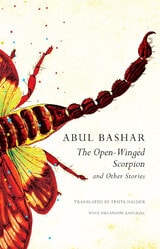
The Open-Winged Scorpion
And Other StoriesAbul Bashar
Seagull Books, 2018

The Optics of Ibn al-Haytham Books IV–V
On Reflection and Images Seen by ReflectionAbdelhamid I. Sabra
University of London Press, 2023
Ibn al-Haytham was perhaps the greatest mathematician and physicist of the medieval Arabic/Islamic world. The most famous book in which he applied his scientific method is his Optics, through which he dealt with both the mathematics of rays of light and the physical aspects of the eye in seven comprehensive books. His rethinking of the entire science of optics set the scene for the whole of the subsequent development of the subject, influencing figures such as William of Ockham, Kepler, Descartes, and Christaan Huygens. The immense work of editing, translating into English, and commenting on this work was undertaken by Abdelhamid I. Sabra. This English translation of Books IV–V was completed by Sabra just before his death in 2013 with an introduction and critical analysis. It has been extensively revised by Jan Hogendijk.
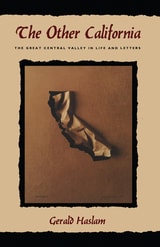
The Other California
The Great Central Valley In Life And LettersGerald W. Haslam
University of Nevada Press, 1993
Oildale native, Gerald Haslam, doesn’t like it when folks dismiss the Central Valley as boring and flat. In this collection of essays, he argues that it is California’s heartland and economic hub. In addition, the valley has produced a crop of gifted writers. These nineteen essays range from reminiscences of childhood and adolescence to a portrait of Mexican-Americans and their position in the Valley’s society to a moving essay about having the author’s aging father come to live with the family. Even if you have never lived in the Valley, reading this book will give you an entirely new perspective the next time you drive into it.
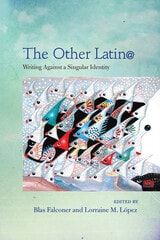
The Other Latin@
Writing Against a Singular IdentityEdited by Blas Falconer and Lorraine M. López
University of Arizona Press, 2011
The sheer number of different ethnic groups and cultures in the United States makes it tempting to classify them according to broad stereotypes, ignoring their unique and changing identities. Because of their growing diversity within the United States, Latinas and Latinos face this problem in their everyday lives. With cultural roots in Mexico, Puerto Rico, Cuba, the Dominican Republic, or a variety of other locales, Hispanic-origin people in the United States are too often consigned to a single category. With this book Blas Falconer and Lorraine M. López set out to change this.
The Other Latin@ is a diverse collection of essays written by some of the best emerging and established contemporary writers of Latin origin to help answer the question: How can we treat U.S. Latina and Latino literature as a definable whole while acknowledging the many shifting identities within their cultures? By telling their own stories, these authors illuminate the richness of their cultural backgrounds while adding a unique perspective to Latina and Latino literature.
This book sheds light on the dangers of abandoning identity by accepting cultural stereotypes and ignoring diversity within diversity. These contributors caution against judging literature based on the race of the author and lament the use of the term Hispanic to erase individuality. Honestly addressing difficult issues, this book will greatly contribute to a better understanding of Latina and Latino literature and identity.

The Panarion of Epiphanius of Salamis
Book I (Sects 1–46)Frank Williams
SBL Press, 2016
Now in Paperback!
Epiphanius, monastic founder and bishop of Salamis on Cyprus for almost forty years of the fourth century, threw heart and soul into the controversies of the time and produced the Panario or Medicine Chest, a historical encyclopedia of sects and heresies and their refutations. Book I deals with material that is also found in Nag Hammadi, other Gnostic writings, and in such patristic authors as Irenaeus and Hippolytus. Students of Nag Hammadi and Gnosticism, patrologists, historians of religion, church historians, and Judaism have found this translation useful.
Features:
- Paperback format of an essential Brill reference set
- Coverage of Gnostic and Jewish Christian groups
- Documents not available elsewhere in paperback
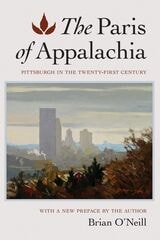
The Paris of Appalachia
Pittsburgh in the Twenty-First CenturyBrian O'Neill
Carnegie Mellon University Press, 2026
Maybe you never wondered if any metro area nearly straddles the borders of three major regions of the country, but The Paris of Appalachia: Pittsburgh in the Twenty-First Century tells us why this city is a place apart. It’s not East Coast, Midwest, or Southern, but the rest of America can fret about how to label Pittsburgh. It’s just fine being a walkable town that plays a big city on TV. Brian O'Neill, who walked its streets for more than three decades as a newspaper columnist, fell in love with the place from the moment he arrived. And when you read what he found, odds are better than even that you will, too. This reissue of the book includes a new introduction.
The Passport That Does Not Pass Ports
African Literature of Travel in the Twenty-First CenturyIsabel Balseiro
Michigan State University Press, 2020
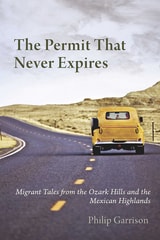
The Permit that Never Expires
Migrant Tales from the Ozark Hills and the Mexican HighlandsBy Philip Garrison
University of Arizona Press, 2010
There is a river, Garrison writes, that runs from Oaxaca to British Columbia. El flujo migratorio, he calls it. The migratory flow. But it isn’t a conventional sort of river. “It is made of neither rock nor water nor wind but only of motion, of momentum. And yet . . . it is the most compelling feature in the entire U.S. West,” he claims. Garrison has his feet planted firmly in the middle of this river of humanity, wondering why America is trying to build a wall along an actual river, the Rio Grande, to keep us separated from the mexicanos. All borders, he writes, exist mostly in the imagination—a point he proves decisively in this delightful book.
Garrison is an award-winning writer and this book shows why. Warm, witty, self-deprecating, and charming (the list could go on), this collection illuminates the lives of these migrants, whether at the local food bank in Ellensburg, Washington, in the streets of Michoacán, or everywhere in between.
The Perversity of Things
Hugo Gernsback on Media, Tinkering, and ScientifictionHugo Gernsback
University of Minnesota Press, 2016
In 1905, a young Jewish immigrant from Luxembourg founded an electrical supply shop in New York. This inventor, writer, and publisher Hugo Gernsback would later become famous for launching the first science fiction magazine, Amazing Stories, in 1926. But while science fiction’s annual Hugo Awards were named in his honor, there has been surprisingly little understanding of how the genre began among a community of tinkerers all drawn to Gernsback’s vision of comprehending the future of media through making. In The Perversity of Things, Grant Wythoff makes available texts by Hugo Gernsback that were foundational both for science fiction and the emergence of media studies.
Wythoff argues that Gernsback developed a means of describing and assessing the cultural impact of emerging media long before media studies became an academic discipline. From editorials and blueprints to media histories, critical essays, and short fiction, Wythoff has collected a wide range of Gernsback’s writings that have been out of print since their magazine debut in the early 1900s. These articles cover such topics as television; the regulation of wireless/radio; war and technology; speculative futures; media-archaeological curiosities like the dynamophone and hypnobioscope; and more. All together, this collection shows how Gernsback’s publications evolved from an electrical parts catalog to a full-fledged literary genre.
The Perversity of Things aims to reverse the widespread misunderstanding of Gernsback within the history of science fiction criticism. Through painstaking research and extensive annotations and commentary, Wythoff reintroduces us to Gernsback and the origins of science fiction.
The Pillows
Benny Andersen
Northwestern University Press, 1995
A collection of 16 uniquely funny short stories by acclaimed Danish poet Benny Andersen.
The Pleasant Nights
Giovan Straparola
Iter Press, 2015
In Giovan Francesco Straparola’s The Pleasant Nights, a group of men and women gather together in a villa on the Venetian island of Murano during Carnival to sing songs, tell tales, and solve riddles. A sixteenth-century bestseller, The Pleasant Nights is today a fundamental text for European folk and fairy tale studies, for alongside triumphal and tragic love stories, comical tales of practical jokes, and accounts of witty retorts, Straparola (1480? – 1557?) placed some of the first fairy tales printed in Europe. Straparola’s eloquent female narrators and the fairy tales they recount became a model for a generation of French women writers in Parisian salons, who used the fairy tale to interrogate the gender norms of their day. This book presents the first new and complete English translation of Straparola’s tales and riddles to be published since the nineteenth century.
The Pocket Epicurean
John Sellars
University of Chicago Press, 2021
As long as there has been human life, we’ve searched for what it means to be happy. More than two thousand years ago, the Greek philosopher Epicurus came to his own conclusion: all we really want in life is pleasure. Though today we tend to associate the word “Epicurean” with indulgence in the form of food and wine, the philosophy of Epicurus was about a life well lived even in the hardest of times. As John Sellars shows in this concise, approachable guide, the ideal life envisioned by Epicurus and his followers was a life much more concerned with mental pleasures and the avoidance of pain. Their goal, in short, was a life of tranquility or contentment.
In The Pocket Epicurean Sellars walks us through the history of Epicureanism, starting with the private garden on the edge of ancient Athens where Epicurus and his students lived in the fourth century BC, and where women were as welcome as men. Sellars then moves on to ancient Rome, where Epicurean influence flourished thanks to the poet Lucretius and his cohort. Throughout the book, Sellars draws on the ideas of Epicurus to offer a constructive way of thinking about the pleasures of friendship and our place in the world.
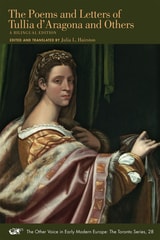
The Poems and Letters of Tullia d'Aragona and Others
A Bilingual EditionTullia d'Aragona and Others, Edited by Julia L. Hairston, Translated by Julia L. Hairston
Iter Press, 2014
Hairston has constructed a full personal, cultural and literary biography for d’Aragona, using newly discovered letters, archival material of other kinds, and contemporary theory about gender in women’s writing. Footnotes establish the intricacy of Tullia’s intellectual networks and her courting of intellectuals in rhyme. Hairston includes poems written to d’Aragona, including Girolamo Muzio’s long pastoral, Tirrhenia. She addresses with tact the question of how sexual Tullia’s relationships were with her various interlocutors. At times, as she says, one just can’t know, but that the issue is much less important than the poems themselves. I agree wholeheartedly. This is the editor Tullia has been waiting for: an indefatigable researcher, a creative biographer, and a precise and appreciative literary critic.
—Ann Rosalind Jones
Esther Cloudman Dunn Professor of Comparative Literature, Smith College
The figure of Tullia d’Aragona has long fascinated readers as the prototype of the “honest courtesan”, a woman who successfully exploited her physical and intellectual charms to win the adoration and respect of the Italian cultural elite. With Julia Hairston’s richly annotated edition of her collected verse, the product of more than a decade of scholarship, d’Aragona finally comes into focus also as poet. She emerges in this volume as one of the most distinctive protagonists in a key transitional moment in Italian literary history, when the aristocratic tradition of Petrarchist lyric began to be reshaped and democratized by its encounter with print.
—Virginia Cox
Professor of Italian, New York University
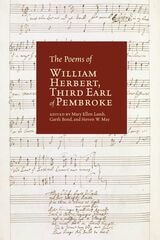
The Poems of William Herbert, Third Earl of Pembroke
William Herbert
Iter Press, 2023
William Herbert, Third Earl of Pembroke, was a pivotal figure in the literary and political cultures of Stuart England. He wrote poetry primarily for social occasions: A debate with a friend, seductions or apologies to beloveds, or support for a deceased political ally. This volume collects his work along with an introduction, detailed notes, and other apparatus that explore the networks in which the poems circulated, the interpretive contexts suggested in miscellanies, and alternative readings revealed through scribal variants. The book also features five contemporary musical settings.
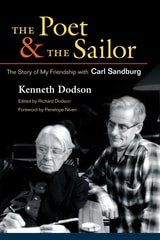
The Poet and the Sailor
The Story of My Friendship with Carl SandburgKenneth Dodson. Edited by Richard Dodson. Foreword by Penelope Niven
University of Illinois Press, 2006
Carl Sandburg first encountered Kenneth Dodson through a letter written at sea during World War II. Though Dodson wrote the letter to his wife, Letha, Sandburg read it in tears and told her, "I've got to meet this man." Composed primarily of their correspondence that continued until Sandburg's death in 1967, The Poet and the Sailor is a chronicle of the deep friendship that followed. Ranging over anything they found important, from writing to health and humor, the letters are arranged by Richard Dodson and are accompanied by a foreword from Sandburg's noted biographer, Penelope Niven.

The Poetic Edda
Translated by Lee M. Hollander
University of Texas Press, 1962
The Poetic Edda comprises a treasure trove of mythic and spiritual verse holding an important place in Nordic culture, literature, and heritage. Its tales of strife and death form a repository, in poetic form, of Norse mythology and heroic lore, embodying both the ethical views and the cultural life of the North during the late heathen and early Christian times.
Collected by an unidentified Icelander, probably during the twelfth or thirteenth century, The Poetic Edda was rediscovered in Iceland in the seventeenth century by Danish scholars. Even then its value as poetry, as a source of historical information, and as a collection of entertaining stories was recognized. This meticulous translation succeeds in reproducing the verse patterns, the rhythm, the mood, and the dignity of the original in a revision that Scandinavian Studies says "may well grace anyone's bookshelf."
The Poetics of Indeterminacy
Rimbaud to CageMarjorie Perloff
Northwestern University Press, 1999

The Political Arrays of American Indian Literary History
James H. Cox
University of Minnesota Press, 2019
Bringing fresh insight to a century of writing by Native Americans
The Political Arrays of American Indian Literary History challenges conventional views of the past one hundred years of Native American writing, bringing Native American Renaissance and post-Renaissance writers into conversation with their predecessors. Addressing the political positions such writers have adopted, explored, and debated in their work, James H. Cox counters what he considers a “flattening” of the politics of American Indian literary expression and sets forth a new method of reading Native literature in a vexingly politicized context.
Examining both canonical and lesser-known writers, Cox proposes that scholars approach these texts as “political arrays”: confounding but also generative collisions of conservative, moderate, and progressive ideas that together constitute the rich political landscape of American Indian literary history. Reviewing a broad range of genres including journalism, short fiction, drama, screenplays, personal letters, and detective fiction—by Lynn Riggs, Will Rogers, Sherman Alexie, Thomas King, Leslie Marmon Silko, Louise Erdrich, Winona LaDuke, Carole laFavor, and N. Scott Momaday—he demonstrates that Native texts resist efforts to be read as advocating a particular set of politics
Meticulously researched, The Political Arrays of American Indian Literary History represents a compelling case for reconceptualizing the Native American Renaissance as a literary–historical constellation. By focusing on post-1968 Native writers and texts, argues Cox, critics have often missed how earlier writers were similarly entangled, hopeful, frustrated, contradictory, and unpredictable in their political engagements.
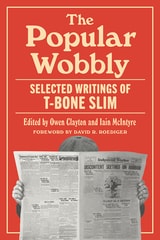
The Popular Wobbly
Selected Writings of T-Bone SlimT-Bone Slim
University of Minnesota Press, 2025
The first critical edition of the writings of the prolific radical workers’ newspaper columnist and musician who rode the rails during the Great Depression
The Popular Wobbly brings together a wide selection of writings by T-Bone Slim, the most popular and talented writer belonging to the Industrial Workers of the World (IWW). Slim wrote humorous, polemical pieces, engaging with topics like labor and class injustice, which were mostly published in IWW publications from 1920 until his death in 1942. Although relatively little is known about Slim, editors Owen Clayton and Iain McIntyre coalesce the latest research on this enigmatic character to create a vivid portrait that adds valuable context for the array of writings assembled here.
Known as “the laureate of the logging camps,” Slim also composed numerous songs that have been performed and recorded by Pete Seeger, Utah Phillips, and Candie Carawan, who in 1960 updated Slim’s song “The Popular Wobbly” with Civil Rights–era lyrics. Slim’s witticisms, sayings, and exhortations (“Wherever you find injustice, the proper form of politeness is attack”; “Only the poor break laws—the rich evade them”) were widely discussed among fellow hobos across the “jungle” campfires that dotted the railways, and some even transcribed his commentary on boxcars that traveled the country. Yet despite Slim’s importance and fame during his lifetime, his work disappeared from public view almost immediately after his death.
The Popular Wobbly is the first critical edition of Slim’s work and also a significant contribution to literature about working-class writers, the radical labor movement, and the history and culture of nomadism and precarity. With this publication, Slim’s rediscovered writings can once again inspire artists and activists to march and agitate for a more just and equitable world.
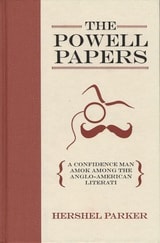
The Powell Papers
A Confidence Man Amok Among the Anglo-American LiteratiHershel Parker
Northwestern University Press, 2011
In 1849—months before the term “confidence man” was coined to identify a New York crook—Thomas Powell (1809–1887), a spherical, monocled, English poetaster, dramatist, journalist, embezzler, and forger, landed in Manhattan. Powell in London had capped a career of grand theft and literary peccadilloes by feigning a suicide attempt and having himself committed to a madhouse, after which he fled England. He had been an intimate of William Wordsworth, Elizabeth Barrett, Robert Browning, Charles Dickens, and a crowd of lesser literary folk.
Thoughtfully bearing what he presented as a volume of Tennyson with a few trifling revisions in the hand of the poet, Powell was embraced by the slavishly Anglophile New York literary establishment, including a young Herman Melville. In two pot-boilers—The Living Authors of England (1849) and The Living Authors of America (1850)—Powell denounced the most revered American author, Washington Irving, for plagiarism; provoked Charles Dickens to vengeful trans-Atlantic outrage and then panic; and capped his insolence by identifying Irving and Melville as the two worst “enemies of the American mind.” For almost four more decades he sniped at Dickens, put words in Melville’s mouth, and survived even the most conscientious efforts to expose him. Long fascinated by this incorrigible rogue, Hershel Parker in The Powell Papers uses a few familiar documents and a mass of freshly discovered material (including a devastating portrait of Powell in a serialized novel) to unfold a captivating tale of skullduggery through the words of great artists and then-admired journalists alike.
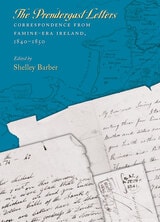
The Prendergast Letters
Correspondence from Famine-Era Ireland, 1840–1850Shelley Barber
University of Massachusetts Press, 2006
Most important, the letters offer a rare contemporary, firsthand account of Ireland's an Gorta Mor, the Great Famine that began with the failure of the potato crop in 1845. Letters written in the months and years following the announcement of the first crop failure provide insight into not only the sufferings of one family but also the response of the community and nation as this crisis transformed Ireland.
James and Elizabeth Prendergast were the parents of six children. Their letters from Milltown, County Kerry, dictated to a scrivener, were posted to sons Thomas and Jeffrey and daughter Julia Riordan and her husband Cornelius, all of whom had emigrated in search of employment to Boston, Massachusetts—a city that would itself be transformed by the famine-era influx of Irish immigrants.
In addition to transcriptions of the forty-eight letters in the collection, this volume includes contextual essays by historian Ruth-Ann Harris and genealogist Marie Daly. The evidence of the letters themselves, along with the contributions of Harris and Daly, demonstrate the ways in which the family of James Prendergast was at once exceptional and typical.
The Price of Three Stories
Rare Folktales from JapanHiroko Fujita & Fran Stallings
Parkhurst Brothers, Inc., 2015
“This delightful compendium of short, savory, and highly tellable tales embodies the beliefs and folkways of rural Japan—specifically the area most impacted by the recent tsunami and nuclear disaster. It adds immeasurably to our insight into that endangered world.”
—Joseph Sobol, Ph.D., director, ETSU Storytelling Graduate Program
The Prophetess and the Patriarch
The Visions of an Anti-Regicide in Seventeenth-Century EnglandElizabeth Poole
Iter Press, 2023
In 1649, a seamstress named Elizabeth Poole appeared at the Whitehall debates in London to prophesy in front of Parliament’s army shortly after it had defeated the crown in the English civil wars. Invited to help deliberate the fate of Charles I, Poole advised the army to spare the king’s life but to put him on trial for tyranny and to enter into a new compact with the people. After her visions proved controversial, she was defamed as a prostitute and a witch. She retaliated by printing her prophecies, along with two new defenses of her original revelations. This collection publishes Poole’s pamphlets in full for the first time.
The Quarry
PoemsDan Lechay
Ohio University Press, 2004
Once or twice in a generation a poet comes along who captures the essential spirit of the American Midwest and gives name to the peculiar nature that persists there. Like James Wright, Robert Bly, Ted Kooser, and Jared Carter before him, Dan Lechay reshapes our imagination to include his distinct and profound vision of this undersung region.
The poetry of Dan Lechay, collected in The Quarry, constructs a myth of the Midwest that is at once embodied in the permanence of the landscape, the fleeting nature of the seasons, and the eternal flow of the river. Lechay writes of memory and the mutability of memory, of the change brought on a person by the years lived and lost, and of the stoic attempts made by those around him to elicit an order and rationale to their lives.
The Quarry is the first full-length collection from this seasoned poet. Final judge Alan Shapiro in writing about The Quarry said: “If Dan Lechay’s poems often begin with the ordinary details and circumstances of life in a small Midwestern town or city, they always end by reminding us that no moment of life is ever ordinary, that ‘Nothing is more mysterious than the way things are.’
The Quarry is a marvelous, disquieting, extraordinarily beautiful book that meditates on fundamental questions of time and change in and through a clear-eyed yet loving evocation of everyday existence. Under Lechay’s soulful gaze, the backyards, neighborhoods, animals, and landscapes he describes dramatize the often wrenching connection between beauty and loss, evanescence and memory. The Quarry is a thoroughly mature and accomplished book.”
The Quick-Change Artist
StoriesCary Holladay
Ohio University Press, 2006
In these stories of magic and memory, clustered around a resort hotel in a small Virginia community, Cary Holladay takes the reader on an excursion through the changes wrought by time on the community and its visitors. From the quiet of a rural forest to the rhythms of rock and roll, The Quick-Change Artist is at once whimsical and hard-edged, dizzying in its matter-of-fact delivery of the fantastic.
Romance, a sense of place and belonging, and the supernatural—especially in the lives of children coming of age—offer windows into worlds beyond the ordinary throughout The Quick-Change Artist. In the title story, a young chambermaid is in love with a foreign magician who performs at the hotel where she works. In “Heaven,” set during the 1918 flu epidemic, a struggling mother and son rely on the support of their fortune-telling plow horse. The narrator of “Jane’s Hat” recalls a childhood enlivened by an unusual school principal and a friend who starts finding beauty everywhere.
Horses and the people who love them, wanderers and those who feed them, creatures that disappear and those who search for them: these are stories with a constant heart.
The Quotable Voltaire
Garry Apgar
Bucknell University Press, 2021
Drawing from a wide range of his publications, private letters, and remarks recorded by his contemporaries, The Quotable Voltaire includes material never before gathered in a single volume. English translations appear alongside the original French, and each quote is thoroughly indexed and referenced, with page numbers for both the first known publication edition of each entry and the most recent edition of Voltaire’s works. The book also features over 400 quotes about Voltaire, including commentary by eighteenth-century luminaries like Samuel Johnson, Catherine the Great, Casanova, and John Adams, as well as an eclectic assortment of modern-day personages ranging from Winston Churchill and Jorge Luis Borges to Mae West and Mike Tyson.
Lavishly illustrated with nearly three dozen images of Voltaire-related art, this collection opens with a scholarly essay that recounts the great man’s life and reflects on his outsized influence on Western culture. Whether you are a Voltaire scholar or a neophyte, The Quotable Voltaire is the perfect introduction to a brilliant mind.
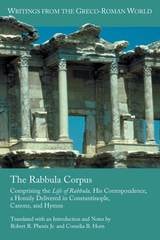
The Rabbula Corpus
Comprising the Life of Rabbula, His Correspondence, a Homily Delivered in ConstanRobert R. Phenix Jr.
SBL Press, 2017
A significant new study of Rabbula and Christianity in Edessa
This volume makes available for the first time both the Syriac text and an English translation of every available original composition by Rabbula, the controversial bishop of Edessa (ca. 411–435 CE). It includes a new edition of the Life of Rabbula and other biographical traditions about him, including his conversion from paganism to Christianity. The texts collected in the volume are a valuable source for studying the reception history of biblical themes. In addition, the corpus offers insights into the beginnings of ecclesiastical legislation in the East, charitable work, pilgrimage, ascetic ideals, and church administration. Horn and Phenix examine Rabbula’s contribution to the Christological controversies of the fifth and sixth centuries, including his influence on Cyril of Alexandria in his debate with Theodoret of Cyrrhus and Theodore of Mopsuestia.
Features
- A critical study of the theological, cultural, and historical development of Syriac Christianity
- Thorough historical, theological, and socio-cultural analysis provided for each text
- A previously unidentified Christian Palestinian Aramaic fragment
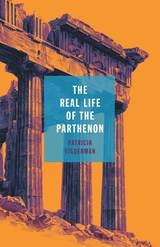
The Real Life of the Parthenon
Patricia Vigderman
The Ohio State University Press, 2018
Ownership battles over the marbles removed from the Parthenon by Lord Elgin have been rumbling into invective, pleading, and counterclaims for two centuries. The emotional temperature around them is high, and steering across the vast past to safe anchor in a brilliant heritage is tricky. The stories around antiquities become distorted by the pull of ownership, and it is these stories that urge Patricia Vigderman into her own exploration of their inspiring legacy in her compelling extended essay, The Real Life of the Parthenon.
Vigderman’s own journey began at the Parthenon, but curiosity edged her further onto the sea between antiquity and the present. She set out to seek the broken temples and amphorae, the mysterious smiles of archaic sculpture, and the finely hammered gold of a funeral wreath among the jumbled streets of modern Athens, the fertile fields of Sicily, the mozzarella buffalo of Paestum. Guided along the way toward the enduring landscapes and fractured history by archeologists, classicists, historians, and artists—and by the desire they inspire—she was caught by ongoing, contemporary local life among the ruins. Gathering present meaning and resonance for the once and future remains of vanished glory, The Real Life of the Parthenon illuminates an important but shadowy element of our common cultural life: the living dynamic between loss and delight.
The Religion of Hands
Prose Poems and Flash FictionsRay Gonzalez
University of Arizona Press, 2005
The Religion of Hands does not foster sleep. Look quickly and you will catch the hint of a fox streaking in front of your car’s headlights at night. Look more carefully out your bedroom window and you may see your life going by, lost loved ones waving hello.
"Who were you when the stars were misinterpreted as the fingertips of God?"
Ray Gonzalez blends symbolic play with lyrical beauty as he works from a vast and complex palette to infuse popular culture with myth. The Religion of Hands is imbued with magical realism: a suffocating dream of tamales, mysterious reptilian allusions, a man who "finds God walking down the stairs to hand him an old, tattered phonebook from the year he was born." It offers strange prophecies: "A steady vegetation will grow across the empire as more homeboys are killed in drive-bys. . . . Microscopic scratches on an old vinyl record will form a message discovered in twenty more years when the album is bought at a garage sale." And in 14 flash fictions, it tells of a tiny old man kept in a glass jar, an accordion stored in an old family trunk, tales of sharks and bandits. The religion of hands has its own unspoken sacraments. "The fingers take over, teaching whoever holds the moment that the rapid weight of the open hands is a dangerous way to live."
Seamlessly, effortlessly, multi-dexterously, Ray Gonzalez spins words that speak our very dreams.
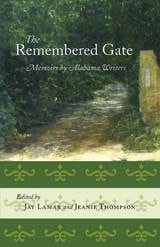
The Remembered Gate
Memoirs by Alabama WritersJay Lamar
University of Alabama Press, 2002
Nineteen acclaimed writers reflect on the Alabama landscapes, memories, and experiences that shaped their voices.
In The Remembered Gate, nationally prominent fiction writers, essayists, and poets recall how their formative years in Alabama shaped them as people and as writers. The essays range in tone from the pained and sorrowful to the wistful and playful, in class from the privileged to the poverty-stricken, in geography from the rural to the urban, and in time from the first years of the 20th century to the height of the Civil Rights era and beyond.
In all the essays we see how the individual artists came to understand something central about themselves and their art from a changing Alabama landscape. Whether from the perspective of C. Eric Lincoln, beaten for his presumption as a young black man asking for pay for his labors, or of Judith Hillman Paterson, floundering in her unresolved relationship with her troubled family, these personal renderings are intensely realized visions of a writer's sense of being a writer and a human being. Robert Inman tells of exploring his grandmother's attic, and how the artifacts he found there fired his literary imagination. William Cobb profiles the lasting influence of the town bully, the diabolical Cletus Hickey. And in “Growing up in Alabama: A Meal in Four Courses, Beginning with Dessert,” Charles Gaines chronicles his upbringing through the metaphor of southern cooking.
What emerges overall is a complex, richly textured portrait of men and women struggling with, and within, Alabama’s economic and cultural evolution to become major voices of our time.