Results by title
8113 books match the query 'Literary Criticism' and 1818 start with t
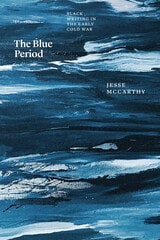
The Blue Period
Black Writing in the Early Cold WarJesse McCarthy
University of Chicago Press, 2024
In the years after World War II, to be a black writer was to face a stark predicament. The contest between the Soviet Union and the United States was a global one—an ideological battle that dominated almost every aspect of the cultural agenda. On the one hand was the Soviet Union, espousing revolutionary communism that promised egalitarianism while being hostile to conceptions of personal freedom. On the other hand was the United States, a country steeped in racial prejudice and the policies of Jim Crow.
Black writers of this time were equally alienated from the left and the right, Jesse McCarthy argues, and they channeled that alienation into remarkable experiments in literary form. Embracing racial affect and interiority, they forged an aesthetic resistance premised on fierce dissent from both US racial liberalism and Soviet communism. From the end of World War II to the rise of the Black Power movement in the 1960s, authors such as Richard Wright, James Baldwin, Gwendolyn Brooks, and Paule Marshall defined a distinctive moment in American literary culture that McCarthy terms the Blue Period.
In McCarthy’s hands, this notion of the Blue Period provides a fresh critical framework that challenges long-held disciplinary and archival assumptions. Black writers in the early Cold War went underground, McCarthy argues, not to depoliticize or liberalize their work, but to make it more radical—keeping alive affective commitments for a future time.
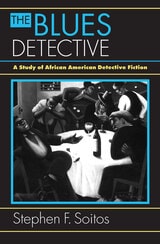
The Blues Detective
A Study of African American Detective FictionStephen Soitos
University of Massachusetts Press, 1996
This illuminating book makes the case for a tradition of African American detective fiction—novels written by black Americans about black detectives and incorporating distinctly African American tropes and themes. Beginning with Pauline Hopkins in 1901, black authors consciously altered and subverted the formulas of detective fiction in significant ways. Such writers as J. E. Bruce, Rudolph Fisher, Chester Himes, Ishmael Reed, and Clarence Major created a new genre that responded to the social and political concerns of the black community.
Examining the work of these authors, Stephen Soitos frames his analysis in terms of four uniquely African American tropes: altered detective personas, double-consciousness detection, black vernaculars, and hoodoo. He argues that black writers created sleuths who were in fact “blues detectives,” engaged not only in solving crimes, but also in exploring the mysteries of black life and culture.
Soitos grounds his study in African American literary theory, particularly the work of Houston Baker, Bernard Bell, and Henry Louis Gates, Jr. He offers both a new way of conceiving black detective fiction and a series of insightful readings of books in this genre.
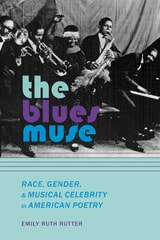
The Blues Muse
Race, Gender, and Musical Celebrity in American PoetryEmily Ruth Rutter
University of Alabama Press, 2018
A critical analysis of the poetic representations and legacies of five landmark blues artists
The Blues Muse: Race, Gender, and Musical Celebrity in American Poetry focuses on five key blues musicians and singers—Gertrude “Ma” Rainey, Bessie Smith, Billie Holiday, Robert Johnson, and Lead Belly—and traces the ways in which these artists and their personas have been invoked and developed throughout American poetry. This study spans nearly one hundred years of literary and musical history, from the New Negro Renaissance to the present.
Emily Ruth Rutter not only examines blues musicians as literary touchstones or poetic devices, but also investigates the relationship between poetic constructions of blues icons and shifting discourses of race and gender. Rutter’s nuanced analysis is clear, compelling, and rich in critical assessments of these writers’ portraits of the musical artists, attending to their strategies and oversights.
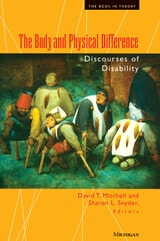
The Body and Physical Difference
Discourses of DisabilityDavid T. Mitchell and Sharon L. Snyder, Editors
University of Michigan Press, 1997
The book provides a provocative range of topics and perspectives: the absence of physical "otherness" in Ancient Greece, the depiction of the female invalid in Victorian literature, the production of tragic innocence in British and American telethons, the reconstruction of Civil War amputees, and disability as the aesthetic basis for definitions of expendable life within the modern eugenics movement. With this new, secure anchoring in the humanities, disability studies now emerges as a significant strain in contemporary theories of identity and social marginality.
Moving beyond the oversimplication that disabled people are marginalized and made invisible by able-ist assumptions and practices, the contributors demonstrate that representation is founded upon the perpetual exhibition of human anomalies. In this sense, all art can be said to migrate toward the "freakish" and the "grotesque." Such a project paradoxically makes disability the exception and the rule of the desire to represent that which has been traditionally out-of-bounds in polite discourse.
The Body and Physical Difference has relevance across a wide range of academic specialties such as cultural studies, the sociology of medicine, history, literature and medicine, the allied health professions, rehabilitation, aesthetics, philosophical discourses of the body, literary and film studies, and narrative theory.
David T. Mitchell is Assistant Professor of English, Northern Michigan University. Sharon L. Snyder teaches film and literature at Northern Michigan University.

The Body and the Song
Elizabeth Bishop's PoeticsMarilyn May Lombardi
Southern Illinois University Press, 1995
In this original contribution to Elizabeth Bishop studies, Marilyn May Lombardi uses previously unpublished materials (letters, diaries, notebooks, and unfinished poems) to shed new light on the poet’s published work. She explores the ways Bishop’s lesbianism, alcoholism, allergic illnesses, and fear of mental instability affected her poetry—the ways she translated her bodily experiences into poetic form.
A cornerstone of The Body and the Song is the poet’s thirty-year correspondence with her physician, Dr. Anny Baumann, who was both friend and surrogate mother to Bishop. The letters reveal Bishop’s struggles to understand the relation between her physical and creative drives. "Dr. Anny" also helped Bishop unravel the connections in her life between psychosomatic illness and early maternal deprivation—her mother was declared incurably insane and institutionalized in 1916, when Bishop was five years old. Effectively an orphan, she spent the rest of her childhood with relatives.
In addition to these letters, Lombardi uses Bishop’s unpublished notebooks to demonstrate the poet’s resolve to "face the facts"—to confront her own emotional, intellectual, and physical frailties—and translate them into poetry that is clear-eyed and economical in its form.
Lombardi argues that in her subtle way, Bishop explores the same issues that preoccupy the current generation of women writers. A deeply private artist, Bishop never directly refers to her homosexuality in her published work, but the metaphors she draws from her carnal desires and aversions confront stifling cultural prescriptions for personal and erotic expression. In choosing restraint over confession, Bishop parted company with her friend Robert Lowell, but Lombardi shows that her reticence becomes a powerful artistic strategy resulting in poetry remarkable for its hermeneutic potential.
Informed by recent gender criticism, Lombardi’s lucid argument advances our understanding of the ways the material circumstances of life can be transformed into art.
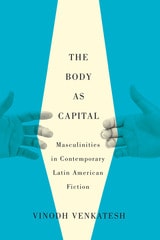
The Body as Capital
Masculinities in Contemporary Latin American FictionVinodh Venkatesh
University of Arizona Press, 2015
Addressing this, Vinodh Venkatesh uses contemporary Latin American literature to examine how masculinity is constructed and conceived. The Body as Capital centers socioeconomic and political concerns, anxieties, and paradigms on the male anatomy and on the matrices of masculinities presented in fiction. Developing concepts such as the “market of masculinities” and the “transnational theater of masculinities,” the author explains how contemporary fiction centers the male body and masculine expressions as key components in the relationship between culture, space, and global tensile forces.
Venkatesh includes novels by canonical and newer writers from Mexico, Central America, the Caribbean, Peru, and Chile. He focuses on texts produced after 1990, coinciding with what has popularly been termed the neoliberal experiment. In addition to probing well-known novels such as La fiesta del Chivo and La mujer habitada and their accompanying body of criticism, The Body as Capital defines and examines several masculine tropes that will be of interest to scholars of contemporary Latin American literature and gender studies. Ultimately, Venkatesh argues for a more holistic approximation of discursive gender that will feed into other angles of criticism, forging a new path in the critical debates over gender and sexuality in Latin American writing.
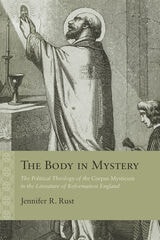
The Body in Mystery
The Political Theology of the Corpus Mysticum in the Literature of Reformation EnglandJennifer R. Rust
Northwestern University Press, 2013
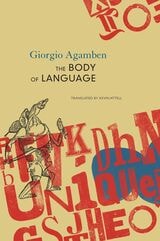
The Body of Language
esperruquancluzelubelouzerireluGiorgio Agamben
Seagull Books, 2025
An erudite exploration of transgressive language from the Renaissance by one of Europe’s greatest living philosophers.
This book explores how early modern authors broke linguistic boundaries, creating new words and languages that challenged traditional grammar and lexicon, providing historical insight into today’s debates on the politics of language. Through a scholarly analysis by Giorgio Agamben, the text delves into the boundary-shifting language of the Renaissance, exemplified by giants like Pantagruel and Gargantua, whose outsized bodies mirror the vastness of their speech. The macaronic language invented by Teofilo Folengo, blending Latin and vernacular, embodies a linguistic rebellion that transforms language into a tangible, unruly force. Featuring illustrations from the Songes drolatiques de Pantagruel and Folengo’s Baldo, this volume offers a vivid portrayal of language as a physical, dynamic entity that defies grammatical norms.
The Body of Poetry
Essays on Women, Form, and the Poetic SelfAnnie Finch
University of Michigan Press, 2005
The Body of Writing
An Erotics of Contemporary American FictionFlore Chevaillier
The Ohio State University Press, 2013
The Bohemian Body
Gender and Sexuality in Modern Czech CultureAlfred Thomas
University of Wisconsin Press, 2007
By re-examining the work of key Czech male and female writers and poets from the National Revival to the Velvet Revolution, Alfred Thomas exposes the tendency of Czech literary criticism to separate the political and the personal in modern Czech culture. He points instead to the complex interplay of the political and the personal across ethnic, cultural, and intellectual lines and within the works of such individual writers as Karel Hynek Mácha, Bozena Nemcová, and Rainer Maria Rilke, resulting in the emergence and evolution of a protean modern identity. The product is a seemingly paradoxical yet nuanced understanding of Czech culture (including literature, opera, and film), long overlooked or misunderstood by Western scholars.
The Bond of the Furthest Apart
Essays on Tolstoy, Dostoevsky, Bresson, and KafkaSharon Cameron
University of Chicago Press, 2017
Whether exploring Bresson’s efforts to reassess the limits of human reason and will, Dostoevsky’s subversions of Christian conventions, Tolstoy’s incompatible beliefs about death, or Kafka’s focus on creatures neither human nor animal, Cameron illuminates how the repeated juxtaposition of disparate, even antithetical, phenomena carves out new approaches to defining the essence of being, one where the very nature of fixed categories is brought into question. An innovative look at a classic French auteur and three giants of European literature, The Bond of the Furthest Apart will interest scholars of literature, film, ethics, aesthetics, and anyone drawn to an experimental venture in critical thought.
The Book as Instrument
Stéphane Mallarmé, the Artist's Book, and the Transformation of Print CultureAnna Sigrídur Arnar
University of Chicago Press, 2011
Stéphane Mallarmé (1842–98) was a French Symbolist poet, theorist, and teacher whose ideas and legendary salons set the stage for twentieth-century experimentation in poetry, music, theater and art. A canonical figure in the legacy of modernism, Mallarmé was also a lifelong champion of the book as both a literary endeavor and a carefully crafted material object.
In The Book as Instrument, Anna Sigrídur Arnar explores how this object functioned for Mallarmé and his artistic circle, arguing that the book became a strategic site for encouraging a modern public to actively partake in the creative act, an idea that informed later twentieth-century developments such as conceptual and performance art. Arnar demonstrates that Mallarmé was invested in creating radically empowering reading experiences, and the diverse modalities he proposed for both reading and looking anticipate interactive media prevalent in today’s culture. In describing the world of books, visual culture, and mass media of the late nineteenth century, Arnar touches upon an array of themes that continues to preoccupy us in our own moment, including speculations on the future of the book. Enhanced by gorgeous illustrations, The Book as Instrument is sure to fascinate anyone interested in the ever-vibrant experiment between word and image that makes the page and the multi-sensory pleasures of reading.
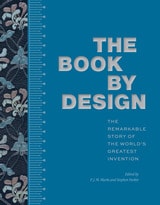
The Book by Design
The Remarkable Story of the World's Greatest InventionEdited by P.J.M. Marks and Stephen Parkin
University of Chicago Press, 2023
For centuries across the world, books have been created as objects of beauty, with bookmakers lavishing great care on their paper, binding materials, illustrations, and lettering.
The Book by Design, featuring an array of books from the British Library's collection, focuses on the sensory experience of holding and reading these objects. Each selection represents a specific moment in the development of what we know today as the book—from scrolls and bound illuminated manuscripts to paperbacks and formatted digital information. These range from the seventh century to the present and include examples from China, Japan, Southeast Asia, the Middle East, Europe, and North America, in addition to a look at book traditions in Africa and Oceania. John James Audubon’s Birds of America, the works of Chaucer, Russian Futurist books, limited editions, historic copies of the Qur’an and the Bible, mass-market paperbacks, and more come together to tell the visual, tactile, artistic, and cultural history of books.
Expert curators and specialists explore these books from the perspective of design and manufacturing, original art photographs offer vivid representations of their textures and materials, and graphics detail the size and specifications of each book. Offering a wide-ranging look at the creation and use of books, illustrated with hundreds of color images, this volume is itself an object of beauty.
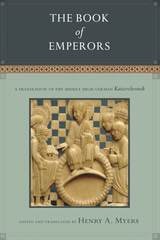
The Book of Emperors
A Translation of the Middle High German KaiserchronikHenry A. Myers
West Virginia University Press, 2013
The Kaiserchronik (c.1152–1165) is the first verse chronicle to have been written in a language other than Latin. This story recounts the exploits of the Roman, Byzantine, Carolingian, and Holy Roman kings and rulers, from the establishment of Rome to the start of the Second Crusade. As an early example of popular history, it was written for a non-monastic audience who would have preferred to read, or may only have been able to read, in German. As a rhymed chronicle, its combined use of the styles of language found within a vernacular epic and a factual treaty was a German innovation. The Book of Emperors is the first complete translation of the Kaiserchronik from Middle High German to English. It is a rich resource not only for medieval German scholars and students, but also for those working in early cultural studies. It brings together an understanding of the conception of kingship in the German Middle Ages, from the relationship between emperor and king, to the moral, theological, and legal foundations of claims and legitimacy and the medieval epistemological approaches to historiography. This translation includes a substantial introduction that discusses the historical and philological context of the work, as well as the themes of power and kingship. Each chapter begins with a brief introduction that distinguishes historical truths from the epic fiction found within the original text.
The Book of Korean Poetry
Songs of Shilla and KoryoKevin O'Rourke
University of Iowa Press, 2006
The Book of Margins
Edmond Jabès
University of Chicago Press, 1993
In The Book of Margins, his most critical as well as most accessible book, Jabès is again concerned with the questions that inform all of his work: the nature of writing, of silence, of God and the Book. Jabès considers the work of several of his contemporaries, including Georges Bataille, Maurice Blanchot, Roger Caillois, Paul Celan, Jacques Derrida, Michel Leiris, Emmanuel Lévinas, Pier Paolo Pasolini, and his translator, Rosmarie Waldrop. This book will be important reading for students of Jewish literature, French literature, and literature of the modern and postmodern ages.
Born in Cairo in 1912, Edmond Jabès lived in France from 1956 until his death in 1991. His extensively translated and widely honored works include The Book of Questions and The Book of Shares. Both of these were translated into English by Rosmarie Waldrop, who is also a poet.
Religion and Postmodernism series
The Book of Minor Perverts
Sexology, Etiology, and the Emergences of SexualityBenjamin Kahan
University of Chicago Press, 2019
Statue-fondlers, wanderlusters, sex magicians, and nymphomaniacs: the story of these forgotten sexualities—what Michel Foucault deemed “minor perverts”—has never before been told. In The Book of Minor Perverts, Benjamin Kahan sets out to chart the proliferation of sexual classification that arose with the advent of nineteenth-century sexology. The book narrates the shift from Foucault’s “thousand aberrant sexualities” to one: homosexuality. The focus here is less on the effects of queer identity and more on the lines of causation behind a surprising array of minor perverts who refuse to fit neatly into our familiar sexual frameworks. The result stands at the intersection of history, queer studies, and the medical humanities to offer us a new way of feeling our way into the past.
The Book of Samuel
Essays on Poetry and ImaginationMark Rudman
Northwestern University Press, 2009
Crisis, breakdown, rejuvenation: this is the territory of poetry that Rudman takes readers into with this set of essays. Constructed as a series of character studies, the essays are rooted in autobiographical material with biographical counterpoints, tying the poets distinctly to places. Even as they are placed, however, they are displaced: Rudman's subjects, from D.H. Lawrence to Czeslaw Milosz to T. S. Eliot, are almost all exiles, either geographically or within themselves. This exile spins anger into energy, transmuting emotion into imagination the same way that Passaic Falls, known to William Carlos Williams, turns water into power.
The mosaic style of the essays touches on nerve after nerve, avoiding the snags of academic jargon to ease towards an illuminating truth about the artists' shifting work and worlds. Some of the Samuels—Beckett and Fuller—were able to navigate these shifts, while others--Coleridge and Johnson--are shown to be less able to transmute their energy into motion.

The Book of Shares
Edmond Jabès
University of Chicago Press, 1989
Balance sheet of a life ratified by death.
Whatever exists has no existence unless shared.
Possessions under seal are lost possessions.
At first sight, giving, offering yourself in order to receive an equivalent gift in return, would seem to be ideal sharing.
But can All be divided?
Can a feeling, a book, a life be shared entirely?
On the other hand, if we cannot share all, what remains and will always remain outside sharing? What has never, at the heart of our possessions, been ours?
And what if we can share the vital desire to share, our only means of escape from solitude, from nothingness?
The Book of Sleep
Haytham El Wardany
Seagull Books, 2020
What is sleep? How can this most unproductive of human states—metaphorically called death’s shadow or considered the very pinnacle of indolence—be envisioned as action and agency? And what do we become in sleep? What happens to the waking selves we understand ourselves to be?
Written in the spring of 2013, as the Egyptian government of President Mohammed Morsi was unraveling in the face of widespread protests, The Book of Sleep is a landmark in contemporary Arabic literature. Drawing on the devices and forms of poetry, philosophical reflection, political analysis, and storytelling, this genre-defying work presents us with an assemblage of fragments that combine and recombine, circling around their central theme but refusing to fall into its gravity.
“My concern was not to create a literary product in the conventional sense, but to try and use literature as a methodology for thinking,” El Wardany explains. In this volume, sleep shapes sentences and distorts conventions. Its protean instability throws out memoir and memory, dreams and hallucinatory reverie, Sufi fables and capitalist parables, in the quest to shape a question. The Book of Sleep is a generous and generative attempt to reimagine possibility and hope in a world of stifling dualities and constrictions.
The Book of the Heart
Eric Jager
University of Chicago Press, 2000
Eric Jager traces the history and psychology of the self-as-text concept from antiquity to the modern day. He focuses especially on the Middle Ages, when the metaphor of a "book of the heart" modeled on the manuscript codex attained its most vivid expressions in literature and art. For instance, medieval saints' legends tell of martyrs whose hearts recorded divine inscriptions; lyrics and romances feature lovers whose hearts are inscribed with their passion; paintings depict hearts as books; and medieval scribes even produced manuscript codices shaped like hearts.
"The Book of the Heart provides a fresh perspective on the influence of the book as artifact on our language and culture. Reading this book broadens our appreciation of the relationship between things and ideas."—Henry Petroski, author of The Book on the Bookshelf
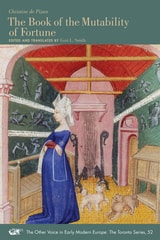
The Book of the Mutability of Fortune
Christine de Pizan
Iter Press, 2017
Christine de Pizan (ca. 1364–ca. 1431) has long been recognized as France’s first professional woman of letters, and interest in her voluminous and wide-ranging corpus has been steadily rising for decades. During the tumultuous later years of the Hundred Years’ War, Christine’s lone but strong feminine voice could be heard defending women, expounding the highest ideals for good governance, and lamenting France’s troubled times alongside her own personal trials. In The Mutability of Fortune, Christine fuses world history with autobiography to demonstrate mankind’s subjugation to the ceaselessly changing, and often cruel, whims of Fortune. Now, for the first time, this poem is accessible to an English-speaking audience, further expanding our appreciation of this ground-breaking woman author and her extraordinary body of work.
The Book of the Play
Playwrights, Stationers, and Readers in Early Modern EnglandMarta Straznicky
University of Massachusetts Press, 2006
The Book of the Play is a collection of essays that examines early modern drama in the context of book history. Focusing on the publication, marketing, and readership of plays opens fresh perspectives on the relationship between the cultures of print and performance and more broadly between drama and the public sphere. Marta Straznicky's introduction offers a survey of approaches to the history of play reading in this period, and the collection as a whole consolidates recent work in textual, bibliographic, and cultural studies of printed drama.
Individually, the essays advance our understanding of play reading as a practice with distinct material forms, discourses, social settings, and institutional affiliation. Part One, “Real and Imagined Communities,” includes four essays on play-reading communities and the terms in which they are distinguished from the reading public at large. Cyndia Clegg surveys the construction of readers in prefaces to published plays; Lucy Munro traces three separate readings of a single play, Edward Sharpham's The Fleer; Marta Straznicky studies women as readers of printed drama; and Elizabeth Sauer describes how play reading was mobilized for political purposes in the period of the Civil War.
In Part Two, “Play Reading and the Book Trade,” five essays consider the impact of play reading on the public sphere through the lens of publishing practices. Zachary Lesser offers a revisionist account of black-letter typeface and the extent to which it may be understood as an index of popular culture; Alan Farmer examines how the emerging news trade of the 1620s and 1630s affected the marketing of printed drama; Peter Berek traces the use of generic terms on title pages of plays to reveal their intersection with the broader culture of reading; Lauren Shohet demonstrates that the Stuart masque had a parallel existence in the culture of print; and Douglas Brooks traces the impact print had on eclipsing performance as the medium in which the dramatist could legitimately lay claim to having authored his text.
The individual essays focus on selected communities of readers, publication histories, and ideologies and practices of reading; the collection as a whole demonstrates the importance of textual production and reception to understanding the place of drama in the early modern public sphere.
The Boom in Contemporary Israeli Fiction
Edited by Alan Mintz
Brandeis University Press, 1997
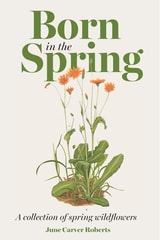
The Born in the Spring
A Collection of Spring WildflowersJune Carver Roberts
Ohio University Press, 2024
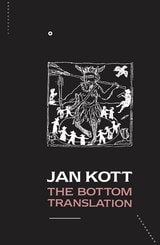
The Bottom Translation
Marlowe and Shakespeare and the Carnival TraditionJan Kott
Northwestern University Press, 1987
The Bow and the Lyre
The Poem, The Poetic Revelation, Poetry and HistoryBy Octavio Paz
University of Texas Press, 1973
In The Bow and the Lyre Octavio Paz, one of the most important poets writing in Spanish, presents his sustained reflections on the poetic phenomenon and on the place of poetry in history and in our personal lives. It is written in the same prose style that distinguishes The Labyrinth of Solitude. The Bow and the Lyre will serve as an important complement to Paz's poetry.
Paz's discussions of the different aspects of the poetic phenomenon are not limited to Spanish and Spanish American literature. He is almost as apt to choose an example from Homer, Vergil, Blake, Whitman, Rimbaud as he is from Lope de Vega, Jiménez, Darío, Neruda. In writing these essays, he draws on his vast storehouse of knowledge, revealing a world outlook of ample proportions. In reading these essays, we share the observations of a searching, original, highly cultivated mind.
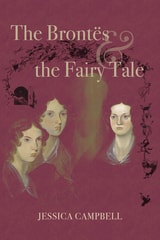
The Brontës and the Fairy Tale
Jessica Campbell
Ohio University Press, 2024
Scholars have long characterized the fairy tale as a form with tremendous power to influence cultures and individuals. The late twentieth century saw important critical work revealing the sinister aspects of that power, particularly its negative effects on female readers. But such an approach can inadvertently reduce the history of the fairy tale to a linear development from the “traditional” tale (pure, straight, patriarchal, and didactic) to the “postmodern” tale (playful, sophisticated, feminist, and radical). Campbell joins other contemporary scholars in arguing that the fairy tale has always been a remarkably elastic form, allowing writers and storytellers of all types to reshape it according to their purposes.
The Brontës are most famous today for Jane Eyre and Wuthering Heights, haunting novels that clearly repurpose fairy tales and folklore. Campbell’s book, however, reveals similar repurposing throughout the entire Brontë oeuvre. The Brontës and the Fairy Tale is recursive: in demonstrating the ubiquity and multiplicity of uses of fairy tales in the works of the Brontës, Campbell enhances not only our understanding of the Brontës’ works but also the status of fairy tales in the Victorian period.
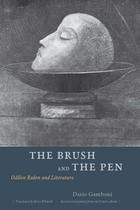
The Brush and the Pen
Odilon Redon and LiteratureDario Gamboni
University of Chicago Press, 2011
French symbolist artist Odilon Redon (1840–1916) seemed to thrive at the intersection of literature and art. Known as “the painter-writer,” he drew on the works of Poe, Baudelaire, Flaubert, and Mallarmé for his subject matter. And yet he concluded that visual art has nothing to do with literature. Examining this apparent contradiction, The Brush and the Pen transforms the way we understand Redon’s career and brings to life the interaction between writers and artists in fin-de-siècle Paris.
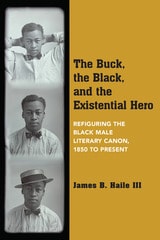
The Buck, the Black, and the Existential Hero
Refiguring the Black Male Literary Canon, 1850 to PresentJames B. Haile III
Northwestern University Press, 2020
The Buck, the Black, and the Existential Hero: Refiguring the Black Male Literary Canon, 1850 to Present combines philosophy, literary theory, and jazz studies with Africana studies to develop a theory of the black male literary imagination. In doing so, it seeks to answer fundamental aesthetic and existential questions: How does the experience of being black and male in the modern West affect the telling of a narrative, the shape or structure of a novel, the development of characters and plot lines, and the nature of criticism itself?
James B. Haile argues that, since black male identity is largely fluid and open to interpretation, reinterpretation, and misinterpretation, the literature of black men has developed flexibility and improvisation, termed the “jazz of life.” Our reading of this literature requires the same kind of flexibility and improvisation to understand what is being said and why, as well as what is not being said and why. Finally, the book attempts to offer this new reading experience by placing texts by well-known authors, such as Frederick Douglass, Ralph Ellison, and Colson Whitehead, in conversation with texts by those who are less well known and those who have, for the most part, been forgotten, in particular, Cecil Brown. Doing so challenges the reader to visit and revisit these novels with a new perspective about the social, political, historical, and psychic realities of black men.
The Burden of Responsibility
Blum, Camus, Aron, and the French Twentieth CenturyTony Judt
University of Chicago Press, 1998
Through the prism of the lives of Leon Blum, Albert Camus, and Raymond Aron, Judt examines pivotal issues in the history of contemporary French society—antisemitism and the dilemma of Jewish identity, political and moral idealism in public life, the Marxist moment in French thought, the traumas of decolonization, the disaffection of the intelligentsia, and the insidious quarrels rending Right and Left. Judt focuses particularly on Blum's leadership of the Popular Front and his stern defiance of the Vichy governments, on Camus's part in the Resistance and Algerian War, and on Aron's cultural commentary and opposition to the facile acceptance by many French intellectuals of communism's utopian promise. Severely maligned by powerful critics and rivals, each of these exemplary figures stood fast in their principles and eventually won some measure of personal and public redemption.
Judt constructs a compelling portrait of modern French intellectual life and politics. He challenges the conventional account of the role of intellectuals precisely because they mattered in France, because they could shape public opinion and influence policy. In Blum, Camus, and Aron, Judt finds three very different men who did not simply play the role, but evinced a courage and a responsibility in public life that far outshone their contemporaries.
"An eloquent and instructive study of intellectual courage in the face of what the author persuasively describes as intellectual irresponsibility."—Richard Bernstein, New York Times
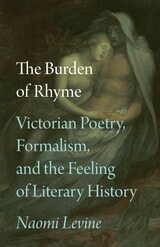
The Burden of Rhyme
Victorian Poetry, Formalism, and the Feeling of Literary HistoryNaomi Levine
University of Chicago Press, 2024
The Burden of Rhyme shows how the nineteenth-century search for the origin of rhyme shaped the theory and practice of poetry. For Victorians, rhyme was not (as it was for the New Critics, and as it still is for us) a mere technique or ahistorical form. Instead, it carried vivid historical fantasies derived from early studies of world literature. Naomi Levine argues that rhyme’s association with the advent of literary modernity and with a repertoire of medievalist, Italophilic, and orientalist myths about love, loss, and poetic longing made it a sensitive historiographic instrument. Victorian poets used rhyme to theorize both literary history and the most elusive effects of aesthetic form. This Victorian formalism, which insisted on the significance of origins, was a precursor to and a challenge for twentieth-century methods. In uncovering the rich relationship between Victorian poetic forms and a forgotten style of literary-historical thought, The Burden of Rhyme reveals the unacknowledged influence of Victorian poetics—and its repudiation—on the development of modern literary criticism.
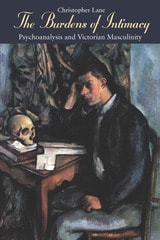
The Burdens of Intimacy
Psychoanalysis and Victorian MasculinityChristopher Lane
University of Chicago Press, 1998
Lane discredits the conservative notion that Victorian literature expresses only a demand for repression and moral restraint. But he also refutes historicist and Foucauldian approaches, arguing that they dismiss the very idea of repression and end up denouncing psychoanalysis as complicit in various kinds of oppression. These approaches, Lane argues, reduce Victorian literature to a drama about politics, power, and the ego. Striving instead to reinvigorate discussions of fantasy and the unconscious, Lane offers a clear, often startling account of writers who grapple with the genuine complexities of love, desire, and friendship.

The Business of America
The Cultural Production of a Post-War NationGraham Thompson
Pluto Press, 2004
The first part of the book examines how white male literary culture has been largely hostile to business during this period and how it has represented transnational shifts in the nature of business as threats to supposedly American values like the individual, the family, or freedom. The book charts the way that such an uneasiness towards business relies upon a discourse about America, business and empire that is increasingly untenable in the post-war world.
By way of comparison, The Business of America looks at how literature by women and by writers from different racial, ethnic and sexual groups often deals with business from the more localised angle of work. Graham Thompson shows how this attention to work provides a less abstract and more oppositional approach to the connection between business and America.
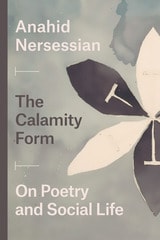
The Calamity Form
On Poetry and Social LifeAnahid Nersessian
University of Chicago Press, 2020
Anahid Nersessian explores works by Friedrich Hölderlin, William Wordsworth, John Keats, and others to argue that as the human and ecological costs of industry became clear, Romantic poetry adopted formal strategies—among them parataxis, the setting of elements side by side in a manner suggestive of postindustrial dissonance, and apostrophe, here an address to an absent or vanishing natural environment—as it tried and failed to narrate the calamities of capitalism. These tropes reflect how Romantic authors took their bewilderment and turned it into a poetics: a theory of writing, reading, and understanding poetry as an eminently critical act. Throughout, Nersessian pushes back against recent attempts to see literature as a source of information on par with historical or scientific data, arguing instead for an irreducibility of poetic knowledge. Revealing the ways in which these Romantic works are of their time but not about it, The Calamity Form ultimately exposes the nature of poetry’s relationship to capital—and capital’s ability to hide how it works.
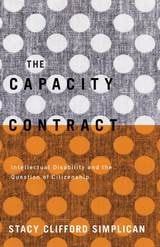
The Capacity Contract
Intellectual Disability and the Question of CitizenshipStacy Clifford Simplican
University of Minnesota Press, 2015
In the first sustained examination of disability through the lens of political theory, The Capacity Contract shows how the exclusion of disabled people has shaped democratic politics. Stacy Clifford Simplican demonstrates how disability buttresses systems of domination based on race, sex, and gender. She exposes how democratic theory and politics have long blocked from political citizenship anyone whose cognitive capacity falls below a threshold level⎯marginalization with real-world repercussions on the implementation of disability rights today.
Simplican’s compelling ethnographic analysis of the self-advocacy movement describes the obstacles it faces. From the outside, the movement must confront stiff budget cuts and dwindling memberships; internally, self-advocates must find ways to demand political standing without reinforcing entrenched stigma against people with profound cognitive disabilities. And yet Simplican’s investigation also offers democratic theorists and disability activists a more emancipatory vision of democracy as it relates to disability⎯one that focuses on enabling people to engage in public and spontaneous action to disrupt exclusion and stigma.
Taking seriously democratic promises of equality and inclusion, The Capacity Contract rejects conceptions of political citizenship that privilege cognitive capacity and, instead, centers such citizenship on action that is accessible to all people.
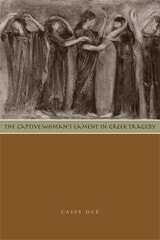
The Captive Woman's Lament in Greek Tragedy
By Casey Dué
University of Texas Press, 2006
The laments of captive women found in extant Athenian tragedy constitute a fundamentally subversive aspect of Greek drama. In performances supported by and intended for the male citizens of Athens, the songs of the captive women at the Dionysia gave a voice to classes who otherwise would have been marginalized and silenced in Athenian society: women, foreigners, and the enslaved. The Captive Woman's Lament in Greek Tragedy addresses the possible meanings ancient audiences might have attached to these songs. Casey Dué challenges long-held assumptions about the opposition between Greeks and barbarians in Greek thought by suggesting that, in viewing the plight of the captive women, Athenian audiences extended pity to those least like themselves. Dué asserts that tragic playwrights often used the lament to create an empathetic link that blurred the line between Greek and barbarian.
After a brief overview of the role of lamentation in both modern and classical traditions, Dué focuses on the dramatic portrayal of women captured in the Trojan War, tracing their portrayal through time from the Homeric epics to Euripides' Athenian stage. The author shows how these laments evolved in their significance with the growth of the Athenian Empire. She concludes that while the Athenian polis may have created a merciless empire outside the theater, inside the theater they found themselves confronted by the essential similarities between themselves and those they sought to conquer.
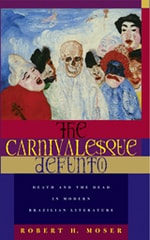
The Carnivalesque Defunto
Death and the Dead in Modern Brazilian LiteratureRobert H. Moser
Ohio University Press, 2008
Robert H. Moser details the emergence of a prominent motif in modern Brazilian literature, namely the carnivalesque defunto (the dead) that, in the form of a protagonist or narrator, returns to beseech, instruct, chastise, or even seduce the living. Drawing upon the works of esteemed Brazilian writers such as Machado de Assis, Érico Veríssimo, and Jorge Amado, Moser demonstrates how the defunto, through its mocking laughter and Dionysian resurrection, simultaneously subverts and inverts the status quo, thereby exposing underlying points of tension within Brazilian social and political history.
Incorporating elements of both a celestial advocate and an untrustworthy specter, the defunto also serves as a metaphor for one of modern Brazil’s greatest dilemmas: reconciling the past with the present.
The Carnivalesque Defunto offers a comparative framework by juxtaposing the Brazilian literary ghost with other Latin American, Caribbean, and North American examples. It also presents a cross-disciplinary approach toward understanding the complex relationship forged between Brazil’s spiritual traditions and literary expressions.
The Cast of Character
Style in Greek LiteratureBy Nancy Worman
University of Texas Press, 2003
Well before Aristotle's Rhetoric elucidated the elements of verbal style that give writing its persuasive power, Greek poets and prose authors understood the importance of style in creating compelling characters to engage an audience. And because their works were composed in predominantly oral settings, their sense of style included not only the characters' manner of speaking, but also their appearance and deportment. From Homeric epic to classical tragedy and oratory, verbal and visual cues work hand-in-hand to create distinctive styles for literary characters.
In this book, Nancy Worman investigates the development and evolution of ideas about style in archaic and classical literature through a study of representations of Odysseus and Helen. She demonstrates that, as liars and imitators, pleasing storytellers, and adept users of costume, these two figures are especially skillful manipulators of style. In tracing the way literary representations of them changed through time—from Homer's positive portrayal of their subtle self-presentations to the sharply polarized portrayals of these same subtleties in classical tragedy and oratory—Worman also uncovers a nascent awareness among the Greek writers that style may be used not only to persuade but also to distract and deceive.
The Cat and the Human Imagination
Feline Images from Bast to GarfieldKatharine M. Rogers
University of Michigan Press, 2001
Western literature and visual art have reflected this change, developing from bare sketches to richly varied expressions of feline personality and human interaction with cats. Katharine M. Rogers seeks out the cats who make appearances in an impressive range of literary and artistic works, providing the first critical look at the symbolic functioning of cat characters in Poe's "The Black Cat," Dickens's Bleak House, and Zola's Therese Raquin, among other literary works. The historical and artistic range covered is impressive, creating a rich compendium that is the ideal book for the cat lover seeking a refreshingly substantial and scholarly work about this fascinating animal.
"This book is a classic-- something every cat-loving intellectual will have to own. (No one, of course, ever really owns a cat--but everyone should own this book.) It's the kind of book you want to quote from at the vet's, or cocktail parties, or whenever you get the urge to convert a dog lover to the true faith." --Emily Toth, Louisiana State University
Katharine M. Rogers is Professor Emerita of English, City University of New York. Her previous books include Feminism in Eighteenth-Century England and Frances Burney: The World of "Female Difficulties."
The Celebration of Death in Contemporary Culture
Dina Khapaeva
University of Michigan Press, 2017
This book links the mounting demand for images of violent death with dramatic changes in death-related social rituals. It offers a conceptual framework that connects observations of fictional worlds—including The Twilight Saga, The Vampire Diaries, and the Harry Potter series—with real-world sociocultural practices, analyzing the aesthetic, intellectual, and historical underpinnings of the cult of death. It also places the celebration of death in the context of a longstanding critique of humanism and investigates the role played by 20th-century French theory, posthumanism, transhumanism, and the animal rights movement in shaping the current antihumanist atmosphere.
This timely, thought-provoking book will appeal to scholars of culture, film, literature, anthropology, and American and Russian studies, as well as general readers seeking to understand a defining phenomenon of our age.
The Centenary Edition of the Works of Nathaniel Hawthorne
MISCELLANEOUS PROSE AND VERSENathaniel Hawthorne
The Ohio State University Press, 1995
The Centenary Edition of the Works of Nathaniel Hawthorne
VOL. II, THE HOUSE OF THE SEVEN GABLESNathaniel Hawthorne
The Ohio State University Press, 1965

The Centenary Edition of the Works of Nathaniel Hawthorne
VOL. IV, THE MARBLE FAUNNathaniel Hawthorne
The Ohio State University Press, 1969
Hawthorne's 'International Novel' dramatizes the confrontation of the Old World and the New and the uncertain relationship between the 'authentic' and the 'fake' in life as in art. The author's evocative descriptions of classic sites made The Marble Faun a favorite guidebook to Rome for Victorian tourists, but this richly ambiguous symbolic romance is also the story of a murder, and a parable of the Fall of Man. As the characters find their civilized existence disrupted by the awful consequences of impulse, Hawthorne leads his readers to question the value of Art and Culture and addresses the great evolutionary debate which was beginning to shake Victorian society.
The Centenary Edition of the Works of Nathaniel Hawthorne
Vol. III, The Blithedale Romance and FanshaweNathaniel Hawthorne
The Ohio State University Press, 1965
The Centenary Edition of the Works of Nathaniel Hawthorne
Vol. VI, True Stories From History and BiographyNathaniel Hawthorne
The Ohio State University Press, 1972
The Centenary Edition of the Works of Nathaniel Hawthorne
Vol. XII, The American Claimant ManuscriptsNathaniel Hawthorne
The Ohio State University Press, 1977
The Centenary Edition of the Works of Nathaniel Hawthorne
Vol. XIII, The Elixir of Life ManuscriptsNathaniel Hawthorne
The Ohio State University Press, 1978
The Centenary Edition of the Works of Nathaniel Hawthorne
Vol. XIX, The Consular Letters, 1853–1855Nathaniel Hawthorne
The Ohio State University Press, 1988