Results by title
8113 books match the query 'Literary Criticism' and 1818 start with t

The Centenary Edition of the Works of Nathaniel Hawthorne
Vol. XV, The Letters, 1813-1843Nathaniel Hawthorne
The Ohio State University Press, 1985
The Centenary Edition of the Works of Nathaniel Hawthorne
Vol. XVI, The Letters, 1843–1853Nathaniel Hawthorne
The Ohio State University Press, 1985
The Centenary Edition of the Works of Nathaniel Hawthorne
Vol. XVII, The Letters, 1853–1856Nathaniel Hawthorne
The Ohio State University Press, 1988
The Centenary Edition of the Works of Nathaniel Hawthorne
Vol. XVIII, The Letters, 1857–1864Nathaniel Hawthorne
The Ohio State University Press, 1987
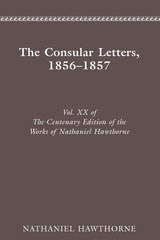
The Centenary Edition of the Works of Nathaniel Hawthorne
Vol. XX, The Consular Letters, 1856–1857Nathaniel Hawthorne
The Ohio State University Press, 1988
The Centenary Edition of the Works of Nathaniel Hawthorne
Vol. XXII, The English Notebooks, 1856–1860Nathaniel Hawthorne
The Ohio State University Press, 1997

The Changing Fictions of Masculinity
David Rosen
University of Illinois Press, 1993
study of six great works of British literature, David Rosen traces the evolution
of masculinity, inviting readers to contemplate the shifting joys and sorrows
men have experienced throughout the last millennium, and the changing but constant
tensions between their lives and ideals. Focusing on Beowulf, Sir Gawain
and the Green Knight, Hamlet, Paradise Lost, Hard Times, and Sons and
Lovers, Rosen shows how the actions of heroes fail to resolve tensions between
masculine ideals and male experiences.
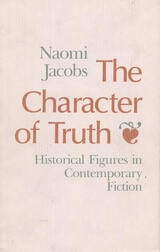
The Character of Truth
Historical Figures in Contemporary FictionNaomi Jacobs
Southern Illinois University Press, 1990
Can the novel survive in an age when tales of historical figures and contemporary personalities dominate the reading lists of the book-buying public?
Naomi Jacobs addresses this question in a study of writers such as William Styron, E. L. Doctorow, and Robert Coover, who challenge the dominance of nonfiction by populating their fictions with real people, living and dead. Jacobs explores the genesis, varieties, and implications of this trend in a prose as lively as that of the writers she critiques.
Using as a case study Robert Coover’s portrait of Richard Nixon in The Public Burning, Jacobs addresses the important legal and ethical questions raised by this trend and applies contemporary libel law to the fictionalization of living people, such as Richard Nixon. She closes her study by speculating on the future of this device and of the novel.
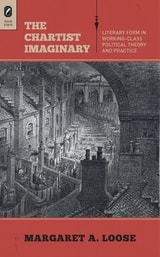
The Chartist Imaginary
Literary Form in Working-Class Political Theory and PracticeMargaret A. Loose
The Ohio State University Press, 2014
The Chartist Imaginary offers close readings of poems and fiction by Chartist figures from Ernest Jones and Thomas Cooper to W. J. Linton, Thomas Martin Wheeler, and Gerald Massey. It also draws on extensive archival research to examine, for the first time, working-class female Chartist poets Mary Hutton, E. L. E., and Elizabeth La Mont. Focusing on the literary form of these works, Loose strongly argues for the political power of the aesthetic in working-class literature.
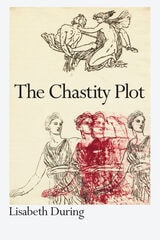
The Chastity Plot
Lisabeth During
University of Chicago Press, 2021
Examining literature, religion, psychoanalysis, and cultural history from antiquity through the middle ages and into modernity, During provides a sweeping history of chastity and insight into its subversive potential. Instead of simply asking what chastity is, During considers what chastity can do, why we should care, and how it might provide a productive disruption, generating new ways of thinking about sex, integrity, and freedom.
The Chekhovian Intertext
Dialogue with a ClassicLyudmila Parts
The Ohio State University Press, 2008
In The Chekhovian Intertext Lyudmila Parts explores contemporary Russian writers’ intertextual engagement with Chekhov and his myth. She offers a new interpretative framework to explain the role Chekhov and other classics play in constructing and maintaining Russian national identity and the reasons for the surge in the number of intertextual engagements with the classical authors during the cultural crisis in post-perestroika Russia.
The book highlights the intersection of three distinct concepts: cultural memory, cultural myth, and intertextuality. It is precisely their interrelation that explains how intertextuality came to function as a defense mechanism of culture, a reaction of cultural memory to the threat of its disintegration.
In addition to offering close readings of some of the most significant short stories by contemporary Russian authors and by Chekhov, as a theoretical case study the book sheds light on important processes in contemporary literature: it explores the function of intertextuality in the development of Russian literature, especially post-Soviet literature; it singles out the main themes in contemporary literature, and explains their ties to national cultural myths and to cultural memory. The Chekhovian Intertext may serve as a theoretical model and impetus for examinations of other national literatures from the point of view of the relationship between intertextuality and cultural memory.
The Chief Concern of Medicine
The Integration of the Medical Humanities and Narrative Knowledge into Medical PracticesRonald Schleifer and Jerry B. Vannatta
University of Michigan Press, 2013
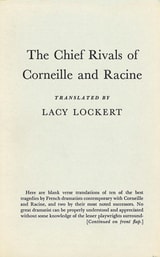
The Chief Rivals of Corneille and Racine
Lacy Lockert
Vanderbilt University Press, 0
No play by any of these dramatists, except Voltaire, has ever before been translated into English. The faithfulness and literary qualities of Dr. Lockert's translations are avouched by his two previous volumes in this field, The Chief Plays of Corneille and The Best Plays of Racine.
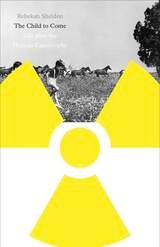
The Child to Come
Life after the Human CatastropheRebekah Sheldon
University of Minnesota Press, 2016
Generation Anthropocene. Storms of My Grandchildren. Our Children’s Trust. Why do these and other attempts to imagine the planet’s uncertain future return us—again and again—to the image of the child? In The Child to Come, Rebekah Sheldon demonstrates the pervasive conjunction of the imperiled child and the threatened Earth and blisteringly critiques the logic of catastrophe that serves as its motive and its method.
Sheldon explores representations of this perilous future and the new figurations of the child that have arisen in response to it. Analyzing catastrophe discourse from the 1960s to the present—books by Joanna Russ, Margaret Atwood, and Cormac McCarthy; films and television series including Southland Tales, Battlestar Galactica, and Children of Men; and popular environmentalism—Sheldon finds the child standing in the place of the human species, coordinating its safe passage into the future through the promise of one more generation. Yet, she contends, the child figure emerges bound to the very forces of nonhuman vitality he was forged to contain.
Bringing together queer theory, ecocriticism, and science studies, The Child to Come draws on and extends arguments in childhood studies about the interweaving of the child with the life sciences. Sheldon reveals that neither life nor the child are what they used to be. Under pressure from ecological change, artificial reproductive technology, genetic engineering, and the neoliberalization of the economy, the queerly human child signals something new: the biopolitics of reproduction. By promising the pliability of the body’s vitality, the pregnant woman and the sacred child have become the paradigmatic figures for twenty-first century biopolitics.
The Children of 1965
On Writing, and Not Writing, as an Asian AmericanMin Hyoung Song
Duke University Press, 2013
The Chinese Garden as Lyric Enclave
A Generic Study of <em>The Story of the Stone</em>Chi Xiao
University of Michigan Press, 2012
The Chippewa Landscape of Louise Erdrich
Allan Chavkin
University of Alabama Press, 1999
Louise Erdrich is arguably the most prolific and prominent contemporary writer of American Indian descent in North America today. Her novels and short stories have won great critical acclaim and are widely taught in American and world literature courses.
This collection of original ssays focuses on Erdrich's writings rooted in the Chippewa experience. Premier scholars of Native American literature investigate narrative structure, signs of ethnicity, the notions of luck and chance in Erdrich's narrative cosmology, her use of hunting metaphors, her efforts to counter stereotypes of American Indian women, her use of comedy in exploring American Indians' tragic past, her intentions underlying the process of revision in Love Medicine, and other subjects.
Including a variety of theoretical approaches, this book provides a comprehensive examination of Erdrich's work, making it more accessible to new readers and richer to those already familiar with her work.
The Chreia and Ancient Rhetoric
Commentaries on Aphthonius's ProgymnasmataRonald F. Hock
SBL Press, 2012
The Chronicles of Panchita Villa and Other Guerrilleras
Essays on Chicana/Latina Literature and CriticismBy Tey Diana Rebolledo
University of Texas Press, 2006
Although there have been substantial contributions to Chicana literature and criticism over the past few decades, Chicanas are still underrepresented and underappreciated in the mainstream literary world and virtually nonexistent in the canon. Writers like Sandra Cisneros, Ana Castillo, and Gloria Anzaldúa have managed to find larger audiences and critical respect, but there are legions of Chicana writers and artists who have been marginalized and ignored despite their talent. Even in Chicano anthologies, the focus has tended to be more on male writers. Chicanas have often found themselves without a real home in the academic world.
Tey Diana Rebolledo has been writing about Chicana/Latina identity, literature, discrimination, and feminism for more than two decades. In this collection of essays, she brings together both old and new works to give a state-of-the-moment look at the still largely unanswered questions raised by vigilant women of color throughout the last half of the twentieth century. An intimate introductory essay about Rebolledo's personal experiences as the daughter of a Mexican mother and a Peruvian father serves to lay the groundwork for the rest of the volume. The essays delve into the historical development of Chicana writing and its early narratives, the representation of Chicanas as seen on book covers, Chicana feminism, being a Chicana critic in the academy, Chicana art history, and Chicana creativity. Rebolledo encourages "guerrillera" warfare against academia in order to open up the literary canon to Chicana/Latina writers who deserve validation.
The Circuit of Apollo
Eighteenth-Century Women’s Tributes to WomenLaura Runge
University of Delaware Press, 2019
Published by University of Delaware Press. Distributed worldwide by Rutgers University Press.
The Claremont Run
Subverting Gender in the X-MenJ. Andrew Deman; Foreword by Jay Edidin
University of Texas Press, 2023
Winner — 2024 Will Eisner Comic Industry Awards in Best Academic/Scholarly Work, announced at San Diego Comic-Con International (2024)
A data-driven deep dive into a legendary comics author’s subversion of gender norms within the bestselling comic of its time.
By the time Chris Claremont’s run as author of Uncanny X-Men ended in 1991, he had changed comic books forever. During his sixteen years writing the series, Claremont revitalized a franchise on the verge of collapse, shaping the X-Men who appear in today’s Hollywood blockbusters. But, more than that, he told a new kind of story, using his growing platform to articulate transgressive ideas about gender nonconformity, toxic masculinity, and female empowerment.
J. Andrew Deman’s investigation pairs close reading and quantitative analysis to examine gender representation, content, characters, and story structure. The Claremont Run compares several hundred issues of Uncanny X-Men with a thousand other Marvel comics to provide a comprehensive account of Claremont’s sophisticated and progressive gender politics. Claremont’s X-Men upended gender norms: where female characters historically served as mere eye candy, Claremont’s had leading roles and complex, evolving personalities. Perhaps more surprisingly, his male superheroes defied and complicated standards of masculinity. Groundbreaking in their time, Claremont’s comics challenged readers to see the real world differently and transformed pop culture in the process.

The Climate of History in a Planetary Age
Dipesh Chakrabarty
University of Chicago Press, 2021
Chakrabarty argues that we must see ourselves from two perspectives at once: the planetary and the global. This distinction is central to Chakrabarty’s work—the globe is a human-centric construction, while a planetary perspective intentionally decenters the human. Featuring wide-ranging excursions into historical and philosophical literatures, The Climate of History in a Planetary Age boldly considers how to frame the human condition in troubled times. As we open ourselves to the implications of the Anthropocene, few writers are as likely as Chakrabarty to shape our understanding of the best way forward.
The Collaborative Artist's Book
Evolving Ideas in Contemporary Poetry and ArtAlexandra J. Gold
University of Iowa Press, 2023
The Collaborative Artist’s Book offers a rare glimpse into collaborations between poets and painters from 1945 to the present, and highlights how the artist’s book became a critical form for experimental American artists in the twentieth and twenty-first centuries. Alexandra Gold provides a broad overview of the artist’s book form and the many ongoing debates and challenges, from the disciplinary to the institutional, that these forms continue to pose.
Gold presents five case studies and details not only how each individual collaboration came to be but how all five together engage and challenge conventional ideals about art, subjectivity, poetry, and interpersonal relations, as well as complex social questions related to gender and race. Taking several of these books out of special collections libraries and museum archives and making them available to a broad readership, Gold brings to light a whole genre that has been largely forgotten or neglected.

The Collected Letters of Thomas and Jane Welsh Carlyle
April–December 1849: April–December 1849, Volume 24Clyde de L. Ryals and Kenneth J. Fielding
Duke University Press, 0
The Collected Letters of Thomas and Jane Welsh Carlyle
July 1836–December 1837, Volume 9Charles Richard Sanders
Duke University Press, 0
The Collected Letters of Thomas and Jane Welsh Carlyle
July 1847–March 1848, Volume 22Clyde de L. Ryals and Kenneth J. Fielding
Duke University Press, 0
The Collected Letters of Thomas and Jane Welsh Carlyle
October 1833–December 1834, Volume 7Charles Richard Sanders
Duke University Press, 0
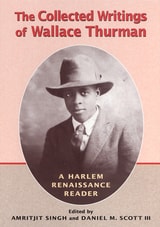
The Collected Writings of Wallace Thurman
A Harlem Renaissance ReaderSingh, Amritjit
Rutgers University Press, 2003
This book is the definitive collection of the writings of Wallace Thurman (1902-1934), providing a comprehensive anthology of both the published and unpublished works of this bohemian, bisexual writer. Widely regarded as the enfant terrible of the Harlem Renaissance scene, Thurman was a leader among a group of young artists and intellectuals that included, among others, Langston Hughes, Zora Neale Hurston, Richard Bruce Nugent, Gwendolyn Bennett, and Aaron Douglas. Through the publication of magazines such as FIRE!! and Harlem: A Forum of Negro Life, Thurman tried to organize the opposition of the younger generation against the programmatic and promotional ideologies of the older generation of black leaders and intellectuals such as W.E.B. Du Bois and Benjamin Brawley. Thurman also left a permanent mark on the period through his prolific work as a novelist, playwright, short story writer, and literary critic, as well as by claiming for himself a voice as a public intellectual.
The Collected Writings of Wallace Thurman is divided into eight sections to highlight the variety of genres and styles Thurman practiced as he courageously pursued controversial subjects throughout his short and brilliant career. It includes Essays on Harlem, Social Essays and Journalism, Correspondence, Literary Essays and Reviews, Poetry and Short Fiction, Plays, and Excerpts from Novel.
Filling an important gap in Harlem Renaissance literature, this collection brings together all of Thurman’s essays, nearly all of his letters to major black and white figures of the 1920s, and three previously unpublished major works. These books are Aunt Hagar’s Children, which is a collection of essays and two full-length plays, Harlem, and Jeremiah the Magnificent. The introduction to the volume, along with the carefully researched introductory notes to each of the eight sections, provides a challenging new reevaluation of Thurman and the Harlem Renaissance for both the general reader and scholar.
The Collected Writings of Zelda Fitzgerald
Zelda Fitzgerald
University of Alabama Press, 1997
The voice behind the legend—Zelda Fitzgerald in her own words.
Zelda Sayre Fitzgerald has long been perceived as the tragic "other half" of the Scott and Zelda legend. Born in Montgomery, Alabama, the high-spirited tomboy turned flapper was talented in dance, painting, and writing but lived in the shadow of her husband's success. Her writing can be experienced on its own terms in Matthew Bruccoli's meticulously edited The Collected Writings of Zelda Fitzgerald.
The collection includes Zelda's only published novel, Save Me the Waltz, an autobiographical account of the Fitzgeralds' adventures in Paris and on the Riviera; her celebrated farce, Scandalabra; eleven short stories; twelve articles; and a selection of letters to her husband, written over the span of their marriage, that reveals the couple's loving and turbulent relationship.
Zelda Sayre Fitzgerald has long been an American cultural icon. The Collected Writings affirms her place as a writer and as a symbol not only of the Lost Generation but of all generations as she struggled to define herself through her art.
The Colombian Novel, 1844-1987
By Raymond Leslie Williams
University of Texas Press, 1991
Novels such as One Hundred Years of Solitude have awakened English-language readers to the existence of Colombian literature in recent years, but Colombia has a well-established literary tradition that far predates the Latin American "boom." In this pathfinding study, Raymond Leslie Williams provides an overview of seventeen major authors and more than one hundred works spanning the years 1844 to 1987.
After an introductory discussion of Colombian regionalism and novelistic development, Williams considers the novels produced in Colombia's four semi-autonomous regions. The Interior Highland Region is represented by novels ranging from Eugenio Díaz' Manuela to Eduardo Caballero Calderón's El buen salvaje. The Costa Region is represented by Juan José Nieto's Ingermina to Alvaro Cepeda Samudio's La casa grande and Gabriel García Márquez' Cien años de soledad; the Greater Antioquian Region by Tomás Carrasquilla's Frutos de mi tierra to Manuel Mejía Vallejo's El día señalado; and the Greater Cauca Region by Jorge Isaacs' Maria to Gustavo Alvarez Gardeazábal's El bazar de los idiotas. A discussion of the modern and postmodern novel concludes the study, with special consideration given to the works of García Márquez and Moreno-Durán.Written in a style accessible to a wide audience, The Colombian Novel will be a foundational work for all students of Colombian culture and Latin American literature.

The Colonel's Dream
Charles W. Chesnutt
West Virginia University Press, 2014
Charles Waddell Chesnutt (1858-1932) was an African American writer, essayist, Civil Rights activist, legal-stenography businessman, and lawyer whose novels and short stories explore race, racism, and the problematic contours of African Americans’ social and cultural identities in post-Civil War South. He was the first African American to be published by a major American publishing house and served as a beacon-point for future African American writers.
The Colonel’s Dream, written in 1905, is a compelling tale of the post-Civil War South’s degeneration into a region awash with virulent racist practices against African Americans: segregation, lynchings, disenfranchisement, convict-labor exploitation, and endemic violent repression. The events in this novel are powerfully depicted from the point of view of a philanthropic but unreliable southern white colonel. Upon his return to the South, the colonel learns to abhor this southern world, as a tale of vicious racism unfolds. Throughout this narrative, Chesnutt confronts the deteriorating position of African Americans in an increasingly hostile South. Upon its publication The Colonel’s Dream was considered too controversial and unpalatable because of its bitter criticisms of southern white prejudice and northern indifference, and so this groundbreaking story failed to gain public attention and acclaim.
This is the first scholarly edition of The Colonel’s Dream. It includes an introduction and notes by R. J. Ellis and works to reestablish this great novel’s reputation.
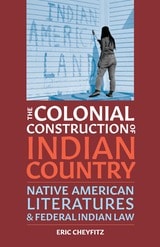
The Colonial Construction of Indian Country
Native American Literatures and Federal Indian LawEric Cheyfitz
University of Minnesota Press, 2024
A guide to the colonization and projected decolonization of Native America
In The Colonial Construction of Indian Country, Eric Cheyfitz mounts a pointed historical critique of colonialism through careful analysis of the dialogue between Native American literatures and federal Indian law. Illuminating how these literatures indict colonial practices, he argues that if the decolonization of Indian country is to be achieved, then federal Indian law must be erased and replaced with independent Native nation sovereignty—because subordinate sovereignty, the historical regime, is not sovereignty at all.
At the same time, Cheyfitz argues that Native American literatures, specifically U.S. American Indian literatures, cannot be fully understood without a knowledge of U.S. federal Indian law: the matrix of colonialism in Indian country. Providing intersectional readings of a range of literary and legal texts, he discusses such authors as Louise Erdrich, Frances Washburn, James Welch, Gerald Vizenor, Simon Ortiz, Leslie Marmon Silko, and others. Cheyfitz examines how American Indian writers and critics have responded to the impact of law on Native life, revealing recent trends in Native writing that build upon traditional modes of storytelling and governance.
With a focus on resistance to the colonial regime of federal Indian law, The Colonial Construction of Indian Country not only elucidates how Native American literatures and federal Indian law are each crucial to any reading of the other, it also guides readers to better understand the genocidal assault on Indigenous peoples by Western structures of literacy, politics, and law.
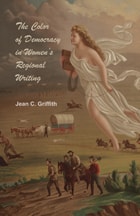
The Color of Democracy in Women's Regional Writing
Jean Carol Griffith
University of Alabama Press, 2009
Exploring how women writers used regional fiction to reimagine democracy, identity, and belonging in America.
American regionalism has become a contested subject in literary studies alongside the ubiquitous triad of race, class, and gender. The Color of Democracy in Women's Regional Writing enters into the heart of an ongoing debate in the field about the significance of regional fiction at the end of the 19th century. Jean Griffith presents the innovative view that regional writing provided Edith Wharton, Ellen Glasgow, and Willa Cather with the means to explore social transformation in a form of fiction already closely associated with women readers and writers.
Griffith provides new readings of texts by these authors; she places them alongside the works of their contemporaries, including William Faulkner and Langston Hughes, to show regionalism's responses to the debate over who was capable of democratic participation and reading regionalism's changing mediations between natives and strangers as reflections of the changing face of democracy.
This insightful work enriches the current debate about whether regionalism critiques hierarchies or participates in nationalist and racist agendas and will be of great interest to those invested in regional writing or the works of these significant authors.
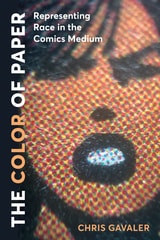
The Color of Paper
Representing Race in the Comics MediumChris Gavaler
The Ohio State University Press, 2026
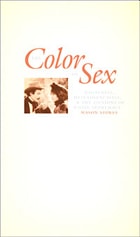
The Color of Sex
Whiteness, Heterosexuality, and the Fictions of White SupremacyMason Stokes
Duke University Press, 2001
The Color of Sex reveals what happens when race and sexuality meet, when white desire encounters its own ambivalence. As Stokes argues, whiteness and heterosexuality exist in anxious relation to one another. Mutually invested in “the normal,” they support each other in their desperate insistence on the cultural logic of exclusion. At the same time, however, they threaten one another in their attempt to create and sustain a white future, since reproducing whiteness necessarily involves the risk of contamination
Charting the curious movements of this “white heterosexuality,” The Color of Sex inaugurates a new moment in our ongoing attempt to understand the frenzied interplay of race and sexuality in America. As such, it will appeal to scholars interested in race theory, sexuality studies, and American history, culture, and literature.
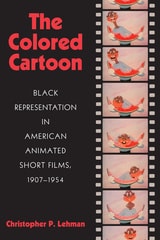
The Colored Cartoon
Black Presentation in American Animated Short Films, 1907-1954Christopher P. Lehman
University of Massachusetts Press, 2007
From the introduction of animated film in the early 1900s to the 1950s, ethnic humor was a staple of American-made cartoons. Yet as Christopher Lehman shows in this revealing study, the depiction of African Americans in particular became so inextricably linked to the cartoon medium as to influence its evolution through those five decades. He argues that what is in many ways most distinctive about American animation reflects white animators' visual interpretations of African American cultural expression.
The first American animators drew on popular black representations, many of which were caricatures rooted in the culture of southern slavery. During the 1920s, the advent of the sound-synchronized cartoon inspired animators to blend antebellum-era black stereotypes with the modern black cultural expressions of jazz musicians and Hollywood actors. When the film industry set out to desexualize movies through the imposition of the Hays Code in the early 1930s, it regulated the portrayal of African Americans largely by segregating black characters from others, especially white females. At the same time, animators found new ways to exploit the popularity of African American culture by creating animal characters like Bugs Bunny who exhibited characteristics associated with African Americans without being identifiably black.
By the 1950s, protests from civil rights activists and the growing popularity of white cartoon characters led animators away from much of the black representation on which they had built the medium. Even so, animated films today continue to portray African American characters and culture, and not necessarily in a favorable light.
Drawing on a wide range of sources, including interviews with former animators, archived scripts for cartoons, and the films themselves, Lehman illustrates the intimate and unmistakable connection between African Americans and animation.
The Comic Self
Toward DispossessionTimothy C. Campbell
University of Minnesota Press, 2023
A provocative and unconventional call to dispossess the self of itself
Challenging the contemporary notion of “self-care” and the Western mania for “self-possession,” The Comic Self deploys philosophical discourse and literary expression to propose an alternate and less toxic model for human aspiration: a comic self. Timothy Campbell and Grant Farred argue that the problem with the “care of the self,” from Foucault onward, is that it reinforces identity, strengthening the relation between I and mine. This assertion of self-possession raises a question vital for understanding how we are to live with each other and ourselves: How can you care for something that is truly not yours?
The answer lies in the unrepresentable comic self. Campbell and Farred range across philosophy, literature, and contemporary comedy—engaging with Socrates, Burke, Hume, Hegel, Marx, Nietzsche, Heidegger, Derrida, Deleuze, and Levinas; Shakespeare, Cervantes, Woolf, Kafka, and Pasolini; and Stephen Colbert, David Chappelle, and the cast of Saturday Night Live. They uncover spaces where the dispossession of self and, with it, the dismantling of the regime of self-care are possible. Arguing that the comic self always keeps a precarious closeness to the tragic self, while opposing the machinations of capital endemic to the logic of self-possession, they provide a powerful and provocative antidote to the tragic self that so dominates the tenor of our times.
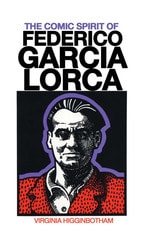
The Comic Spirit of Federico Garcia Lorca
By Virginia Higginbotham
University of Texas Press, 1976
During the years since his death, Federico García Lorca, Spain's best-known twentieth-century poet and playwright, has generally been considered a writer of tragedy. Three of his major plays are fatalistic stories of suffering and death, and his poetry is filled with dread. Yet most of Lorca's dramatic production consists of comedies and farces. Throughout his poetry and prose, as well as in his most somber plays, runs an undercurrent of humor—dark irony and satire—that is in no way contradictory to his tragic view of life. On the contrary, as Virginia Higginbotham demonstrates, through humor Lorca defines, intensifies, and tries to come to terms with what he sees as the essentially hopeless condition of humankind.
Although Lorca's comic moments and techniques have been discussed in isolated articles, the importance of humor has largely been ignored in the fundamental studies of his work. Higginbotham is concerned with Lorca's total output: lyric poetry, tragicomedies and farces, avant-garde prose and plays, puppet farces, and master plays. She describes Lorca's place in the mainstream of the Spanish theater and shows his relationship to some relevant non-Spanish dramatists. Furthermore, she discusses ways in which Lorca's work anticipates the modern theater of the absurd. The result is a comprehensive study of an important, but previously ignored, aspect of Lorca's work.
The Comic Spirit of Federico García Lorca includes a Lorca chronology and an extensive bibliography.
The Commerce of War
Exchange and Social Order in Latin EpicNeil Coffee
University of Chicago Press, 2009
Latin epics such as Virgil’s Aeneid, Lucan’s Civil War, and Statius’s Thebaid addressed Roman aristocrats whose dealings in gifts, favors, and payments defined their conceptions of social order. In The Commerce of War, Neil Coffee argues that these exchanges play a central yet overlooked role in epic depictions of Roman society.
Tracing the collapse of an aristocratic worldview across all three poems, Coffee highlights the distinction they draw between reciprocal gift giving among elites and the more problematic behaviors of buying and selling. In the Aeneid, customary gift and favor exchanges are undermined by characters who view human interaction as short-term and commodity-driven. The Civil War takes the next logical step, illuminating how Romans cope once commercial greed has supplanted traditional values. Concluding with the Thebaid, which focuses on the problems of excessive consumption rather than exchange, Coffee closes his powerful case that these poems constitute far-reaching critiques of Roman society during its transition from republic to empire.

The Common Pot
The Recovery of Native Space in the NortheastLisa Brooks
University of Minnesota Press, 2008
Illuminates the significance of writing to colonial-era Native American resistance
Literary critics frequently portray early Native American writers either as individuals caught between two worlds or as subjects who, even as they defied the colonial world, struggled to exist within it. In striking counterpoint to these analyses, Lisa Brooks demonstrates the ways in which Native leaders—including Samson Occom, Joseph Brant, Hendrick Aupaumut, and William Apess—adopted writing as a tool to reclaim rights and land in the Native networks of what is now the northeastern United States.
“The Common Pot,” a metaphor that appears in Native writings during the eighteenth and nineteenth centuries, embodies land, community, and the shared space of sustenance among relations. Far from being corrupted by forms of writing introduced by European colonizers, Brooks contends, Native people frequently rejected the roles intended for them by their missionary teachers and used the skills they acquired to compose petitions, political tracts, and speeches; to record community councils and histories; and most important, to imagine collectively the routes through which the Common Pot could survive.Reframing the historical landscape of the region, Brooks constructs a provocative new picture of Native space before and after colonization. By recovering and reexamining Algonquian and Iroquoian texts, she shows that writing was not a foreign technology but rather a crucial weapon in the Native Americans’ arsenal as they resisted—and today continue to oppose—colonial domination.
The Community of St. Cuthbert in the Late Tenth Century
The Chester-le-Street Additions to Durham Cathedral Library A.IV.19Karen Louise Jolly
The Ohio State University Press, 2012
The Community of St. Cuthbert in the Late Tenth Century: The Chester-le-Street Additions to Durham Cathedral Library A.IV.19 reveals the dynamic role a seemingly marginalized community played during a defining period for the emergence of English religious identity. Based on her new critical edition of additions made to Durham Cathedral Library A.IV.19 and by questioning the purpose of those late tenth-century additions, Karen Louise Jolly is able to uncover much about the Chester-le-Street scribes and their tumultuous time, rife as it was with various political tensions, from Vikings and local Northumbrian nobles to an increasingly dominant West Saxon monarchy.
Why, for instance, would a priest laboriously insert an Old English gloss above every Latin word in a collection of prayers intended to be performed in Latin? What motivated the same English scribe to include Irish-derived Christian materials in the manuscript, including prayers invoking the archangel Panchiel to clear birds from a field?
The Complete Danteworlds
A Reader's Guide to the Divine ComedyGuy P. Raffa
University of Chicago Press, 2009
Dante Alighieri’s Divine Comedy has, despite its enormous popularity and importance, often stymied readers with its multitudinous characters, references, and themes. But until the publication in 2007 of Guy Raffa’s guide to the Inferno, students lacked a suitable resource to help them navigate Dante’s underworld. With this new guide to the entire Divine Comedy, Raffa provides readers—experts in the Middle Ages and Renaissance, Dante neophytes, and everyone in between—with a map of the entire poem, from the lowest circle of Hell to the highest sphere of Paradise.
Based on Raffa’s original research and his many years of teaching the poem to undergraduates, The CompleteDanteworlds charts a simultaneously geographical and textual journey, canto by canto, region by region, adhering closely to the path taken by Dante himself through Hell, Purgatory, and Paradise. This invaluable reference also features study questions, illustrations of the realms, and regional summaries. Interpreting Dante’s poem and his sources, Raffa fashions detailed entries on each character encountered as well as on many significant historical, religious, and cultural allusions.
The Complete Fables of Jean de La Fontaine
Jean de La Fontaine
University of Illinois Press, 2007
Told in an elegant style, Jean de la Fontaine's (1621-95) charming animal fables depict sly foxes and scheming cats, vain birds and greedy wolves, all of which subtly express his penetrating insights into French society and the beasts found in all of us. Norman R. Shapiro has been translating La Fontaine's fables for over twenty years, capturing the original work's lively mix of plain and archaic language. This newly complete translation is destined to set the English standard for this work.
Awarded the Lewis Galantière Prize by the American Translators Association, 2008.
The Complete Fables of Jean de la Fontaine
Jean de la Fontaine, edited and with a rhymed verse translation by Norman B. Spector
Northwestern University Press, 1988
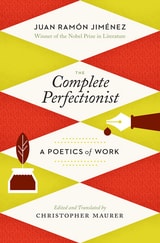
The Complete Perfectionist
A Poetics of WorkJuan Ramón Jiménez
Swan Isle Press, 2011
Few have written more memorably about the work of poetry and the poetics of work than Juan Ramón Jiménez, winner of a Nobel Prize and discerning teacher of an entire generation of Spanish poets. In this series of aphorisms, Jiménez brings together the elements of perfect work, both in writing and in other realms. Among these elements—the wellsprings of any kind of creation—are instinct and inspiration, memory and forgetting, silence and noise, love and regret.
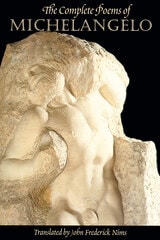
The Complete Poems of Michelangelo
Michelangelo
University of Chicago Press, 1998
"Wonderful. . . . Nims gives us Michelangelo whole: the polymorphous love sonneteer, the political allegorist, and the solitary singer of madrigals."—Kirkus Reviews
"A splendid, fresh and eloquent translation. . . . Nims, an eminent poet and among the best translators of our time, conveys the full meaning and message of Michelangelo's love sonnets and religious poems in fluently rhymed, metrical forms."—St. Louis Post-Dispatch
"The best so far. . . . Nims is best at capturing the sound and sense of Michelangelo's poetic vocabulary."—Choice
"Surely the most compelling translations of Michelangelo currently available in English."—Ronald L. Martinez, Washington Times
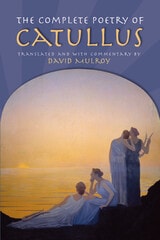
The Complete Poetry of Catullus
Catullus; Translated and with commentary by David Mulroy
University of Wisconsin Press, 2002
Catullus’ life was akin to pulp fiction. In Julius Caesar’s Rome, he engages in a stormy affair with a consul’s wife. He writes her passionate poems of love, hate, and jealousy. The consul, a vehement opponent of Caesar, dies under suspicious circumstances. The merry widow romances numerous young men. Catullus is drawn into politics and becomes a cocky critic of Caesar, writing poems that dub Julius a low-life pig and a pervert. Not surprisingly, soon after, no more is heard of Catullus.
David Mulroy brings to life the witty, poignant, and brutally direct voice of a flesh-and-blood man, a young provincial in the Eternal City, reacting to real people and events in a Rome full of violent conflict among individuals marked by genius and megalomaniacal passions. Mulroy’s lively, rhythmic translations of the poems are enhanced by an introduction and commentary that provide biographical and bibliographical information about Catullus, a history of his times, a discussion of the translations, and definitions and notes that ease the way for anyone who is not a Latin scholar.
The Complete Prose Works of Matthew Arnold
Volume XI. The Last WordMatthew Arnold
University of Michigan Press, 1977

The Complete Works of Robert Browning, Volume XVI
With Variant Readings and AnnotationsRobert Browning
Ohio University Press, 1998
In seventeen volumes, copublished with Baylor University, this acclaimed series features annotated texts of all of Robert Browning’s known writing. The series encompasses autobiography as well as influences bearing on Browning’s life and career and aspects of Victorian thought and culture.
Robert Browning wrote Parleyings with Certain People of Importance in Their Day in his seventy-third year. The work is a capstone to the poet’s long career, encompassing autobiography as well as influences bearing on the poet’s life and career and on Victorian thought and culture in general. One of Browning’s most complex works, Parleyings is also a work essential to understanding his genius and career as a whole. The Ohio/Baylor Browning edition offers keys to the complexity and interest of Parleyings through a definitive, emended text, full annotations for allusions both explicit and implicit in the text, and variant readings for the manuscript and all editions revised by Browning during his lifetime.
In form and structure, Parleyings is a series of seven poems written in Browning’s own voice and addressed to figures influential in his development. The series is framed by a prologue and an epilogue, the whole amounting to some 3,500 lines. The poems are a formal contrast and a pendant to the great series of linked dramatic monologues in The Ring and the Book. They demonstrate the zest for innovation possessed by the master of the dramatic monologue in his ripe maturity. Interested readers as well as students and scholars of Browning will find a rich field of poetry and a critical mass of resources in Volume XVI of the Ohio/Baylor Browning edition.
As always in this acclaimed series, a complete record of textual variants is provided, as well as extensive explanatory notes.
The Conflagration of Community
Fiction before and after AuschwitzJ. Hillis Miller
University of Chicago Press, 2011
“After Auschwitz to write even a single poem is barbaric.” The Conflagration of Community challenges Theodor Adorno’s famous statement about aesthetic production after the Holocaust, arguing for the possibility of literature to bear witness to extreme collective and personal experiences. J. Hillis Miller masterfully considers how novels about the Holocaust relate to fictions written before and after it, and uses theories of community from Jean-Luc Nancy and Derrida to explore the dissolution of community bonds in its wake.