Results by title
1427 books match the query 'Politics' and 382 start with t
The Powers that Punish
Prison and Politics in the Era of the "Big House", 1920-1955Charles Bright
University of Michigan Press, 1996
In a pathbreaking study of a major state prison, Michigan's Jackson State Penitentiary during the middle years of this century, Charles Bright addresses several aspects of the history and theory of punishment. The study is an institutional history of an American penitentiary, concerned with how a carceral regime was organized and maintained, how prisoners were treated and involved in the creation of a regime of order and how penal practices were explained and defended in public. In addition, it is a meditation upon punishment in modern society and a critical engagement with prevailing theories of punishment coming out of liberal, Marxist and post structuralist traditions. Deploying theory critically in a historic narrative, it applies new, relational theories of power to political institutions and practices. Finally, in studying the history of the Jackson prison, Bright provides a rich account, full of villains and a few heroes, of state politics in Michigan during a period of rapid transition between the 1920s to the 1950s.
The book will be of direct relevance to criminologists and scholars of punishment, and to historians concerned with the history of punishment and prisons in the United States. It will also be useful to political scientists and historians concerned with exploring new approaches to the study of power and with the transformation of state politics in the 1930s and 1940s. Finally Bright tells a story which will fascinate students of modern Michigan history.
Charles Bright is a historian and Lecturer at the Residential College of the University of Michigan.
The Practical Past
Hayden White
Northwestern University Press, 2014
Hayden White borrows the title for The Practical Past from philosopher Michael Oakeshott, who used the term to describe the accessible material and literary-artistic artifacts that individuals and institutions draw on for guidance in quotidian affairs. The Practical Past, then, forms both a summa of White’s work to be drawn upon and a new direction in his thinking about the writing of history.
White’s monumental Metahistory: The Historical Imagination in Nineteenth-Century Europe (1973) challenged many of the commonplaces of professional historical writing and wider assumptions about the ontology of history itself. It formed the basis of his argument that we can never recover “what actually happened”in the past and cannot really access even material culture in context. Forty years on, White sees “professional history" as falling prey to narrow specialization, and he calls upon historians to take seriously the practical past of explicitly “artistic” works, such as novels and dramas, and literary theorists likewise to engage historians.
The President Electric
Ronald Reagan and the Politics of PerformanceTimothy Raphael
University of Michigan Press, 2011
"In this illuminating, multi-pronged cultural and performance history of such phenomena as Chautauqua and radio, movies, and electrical technology, Timothy Raphael puts together a compelling and sometimes revelatory narrative of how commandingly Reagan mastered the matrix of performance, technology, media, celebrity, and the 'republic of consumption' he came of age in."
---Dana Nelson, Vanderbilt University
"Garry Wills and others have written well on the phenomenon of Ronald Reagan, the actor-president, but this is the first book by a real authority---trained in performance and fully reflective about it from the inside . . . unquestionably an important contribution to the disciplinary fields of American studies and performance studies, and an important contribution to public affairs."
---Joseph Roach, Yale University
When Ronald Reagan first entered politics in 1965, his public profile as a performer in radio, film, television, and advertising and his experience in public relations proved invaluable political assets. By the time he left office in 1989, the media in which he trained had become the primary source for generating and wielding political power. The President Electric: Ronald Reagan and the Politics of Performance reveals how the systematic employment of the techniques and technologies of mass-media performance contributed to Reagan’s rise to power and defined his style of governance.
The President Electric stands out among books on Reagan as the first to bring the rich insights of the field of performance studies to an understanding of the Reagan phenomenon, connecting Reagan's training in electronic media to the nineteenth-century notion of the "fiat of electricity"---the emerging sociopolitical power of three entities (mechanical science, corporate capitalism, and mass culture) that electric technology made possible. The book describes how this new regime of cultural and political representation shaped the development of the electronic mass media that transformed American culture and politics and educated Ronald Reagan for his future role as president.
Timothy Raphael is Assistant Professor of Visual and Performing Arts and Director of the Center for Immigration at Rutgers University, Newark.
Photo: © David H. Wells/Corbis
The Primacy of Perception
And Other Essays on Phenomenological Psychology, the Philosophy of Art, History and PoliticsMaurice Merleau-Ponty
Northwestern University Press, 1964
The Primacy of Persons in Politics
John von Heyking
Catholic University of America Press, 2013
The Prism of Race
The Politics and Ideology of Affirmative Action in BrazilDavid Lehmann
University of Michigan Press, 2018
Brazil has developed a distinctive response to the injustices inflicted by the country’s race relations regime. Despite the mixed racial background of most Brazilians, the state recognizes people’s racial classification according to a simple official scheme in which those self-assigned as black, together with “brown” and “indigenous” (preto-pardo-indigena), can qualify for specially allocated resources, most controversially quota places at public universities. Although this quota system has been somewhat successful, many other issues that disproportionately affect the country’s black population remain unresolved, and systemic policies to reduce structural inequality remain off the agenda.
In The Prism of Race, David Lehmann explores, theoretically and practically, issues of race, the state, social movements, and civil society, and then goes beyond these themes to ask whether Brazilian politics will forever circumvent the severe problems facing the society by co-optation and by tinkering with unjust structures. Lehmann disrupts the paradigm of current scholarly thought on Brazil, placing affirmative action disputes in their political and class context, bringing back the concept of state corporatism, and questioning the strength and independence of Brazilian civil society.
The Production of Local Knowledge
History and Politics in the Work of René Zavaleta MercadoLuis Tapia Mealla
Seagull Books, 2016
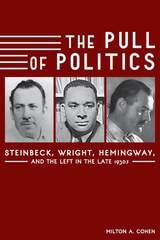
The Pull of Politics
Steinbeck, Wright, Hemingway, and the Left in the Late 1930sMilton A. Cohen
University of Missouri Press, 2018
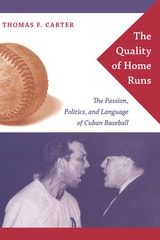
The Quality of Home Runs
The Passion, Politics, and Language of Cuban BaseballThomas F. Carter
Duke University Press, 2008
As an avid baseball fan, Carter draws on his experiences listening to and participating in discussions of baseball in Cuba (particularly in Havana) and among Cubans living abroad to describe how baseball provides the ground for negotiations of national, masculine, and class identities wherever Cubans gather. He considers the elaborate spectacle of Cuban baseball as well as the relationship between the socialist state and the enormously popular sport. Carter provides a detailed history of baseball in Cuba, analyzing players, policies, rivalries, and fans, and he describes how the sport has forged connections (or reinforced divisions) between Cuba and other nations. Drawing on insights from cultural studies, political theory, and anthropology, he maintains that sport and other forms of play should be taken seriously as crucibles of social and cultural experience.
The Quest for Sexual Health
How an Elusive Ideal Has Transformed Science, Politics, and Everyday LifeSteven Epstein
University of Chicago Press, 2022
Since the 1970s, health professionals, researchers, governments, advocacy groups, and commercial interests have invested in the pursuit of something called "sexual health." Under this expansive banner, a wide array of programs have been launched, organizations founded, initiatives funded, products sold—and yet, no book before this one asks: What does it mean to be sexually healthy? When did people conceive of a form of health called sexual health? And how did it become the gateway to addressing a host of social harms and the reimagining of private desires and public dreams?
Conjoining "sexual" with "health" changes both terms: it alters how we conceive of sexuality and transforms what it means to be healthy, prompting new expectations of what medicine can provide. Yet the ideal of achieving sexual health remains elusive and open-ended, and the benefits and costs of promoting it are unevenly distributed across genders, races, and sexual identities. Rather than a thing apart, sexual health is intertwined with nearly every conceivable topical debate—from sexual dysfunction to sexual violence, from reproductive freedom to the practicalities of sexual contact in a pandemic. In this book Steven Epstein analyzes the rise, proliferation, uptake, and sprawling consequences of sexual health activities, offering critical tools to assess those consequences, expand capacities for collective decision making, and identify pathways that promote social justice.
The Racial Logic of Politics
Asian Americans and Party CompetitionThomas P. Kim
Temple University Press, 2006
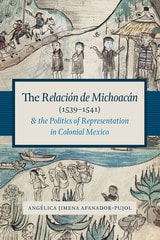
The Relación de Michoacán (1539-1541) and the Politics of Representation in Colonial Mexico
By Angélica Jimena Afanador-Pujol
University of Texas Press, 2015
Through close readings of the painted images in a major sixteenth-century illustrated manuscript, this book demonstrates the critical role that images played in ethnic identity formation and politics in colonial Mexico.
The Relación de Michoacán (1539–1541) is one of the earliest surviving illustrated manuscripts from colonial Mexico. Commissioned by the Spanish viceroy Antonio de Mendoza, the Relación was produced by a Franciscan friar together with indigenous noble informants and anonymous native artists who created its forty-four illustrations. To this day, the Relación remains the primary source for studying the pre-Columbian practices and history of the people known as Tarascans or P’urhépecha. However, much remains to be said about how the Relación’s colonial setting shaped its final form.
By looking at the Relación in its colonial context, this study reveals how it presented the indigenous collaborators a unique opportunity to shape European perceptions of them while settling conflicting agendas, outshining competing ethnic groups, and carving a place for themselves in the new colonial society. Through archival research and careful visual analysis, Angélica Afanador-Pujol provides a new and fascinating account that situates the manuscript’s images within the colonial conflicts that engulfed the indigenous collaborators. These conflicts ranged from disputes over political posts among indigenous factions to labor and land disputes against Spanish newcomers. Afanador-Pujol explores how these tensions are physically expressed in the manuscript’s production and in its many contradictions between text and images, as well as in numerous emendations to the images. By studying representations of justice, landscape, conquest narratives, and genealogy within the Relación, Afanador-Pujol clearly demonstrates the visual construction of identity, its malleability, and its political possibilities.
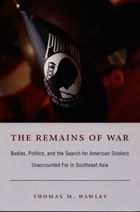
The Remains of War
Bodies, Politics, and the Search for American Soldiers Unaccounted For in Southeast AsiaThomas M. Hawley
Duke University Press, 2005
Hawley combines the theoretical insights of Judith Butler, Michel Foucault, and Emmanuel Levinas with detailed research into the history of the movement to recover the remains of soldiers missing in Vietnam. He examines the practices that constitute the Defense Department’s accounting protocol: the archival research, archaeological excavation, and forensic identification of recovered remains. He considers the role of the American public and the families of missing soldiers in demanding the release of pows and encouraging the recovery of the missing; the place of the body of the Vietnam veteran within the war’s legacy; and the ways that memorials link individual bodies to the body politic. Highlighting the contradictions inherent in the recovery effort, Hawley reflects on the ethical implications of the massive endeavor of the American government and many officials in Vietnam to account for the remains of American soldiers.
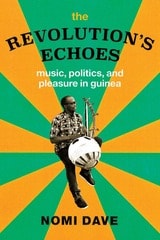
The Revolution’s Echoes
Music, Politics, and Pleasure in GuineaNomi Dave
University of Chicago Press, 2019
Dave introduces readers to the music supporting the authoritarian regime of former Guinean president Sékou Touré, and the musicians who, even long after his death, have continued to praise dictators and avoid dissent. Dave shows that this isn’t just the result of state manipulation; even in the absence of coercion, musicians and their audiences take real pleasure in musical praise of leaders. Time and again, whether in traditional music or in newer genres such as rap, Guinean musicians have celebrated state power and authority. With The Revolution’s Echoes, Dave insists that we must grapple with the uncomfortable truth that some forms of music choose to support authoritarianism, generating new pleasures and new politics in the process.
The Sagebrush State, 3d Edition
Nevada's History, Government, and PoliticsMichael W. Bowers
University of Nevada Press, 2006
The Sagebrush State, 4th Ed
Nevada’s History, Government, and PoliticsMichael W. Bowers
University of Nevada Press, 2013
The Sagebrush State, 5th Edition
Nevada's History, Government, and PoliticsMichael W. Bowers
University of Nevada Press, 2018
This comprehensive and insightful explanation discusses how Nevada’s history has shaped its political culture, and how its government operates today. The Sagebrush State serves as a highly readable and accessible text for the study of Nevada’s political history and constitution, which is a graduation requirement at the state’s colleges and universities. The fifth edition is updated through 2017 and includes the full text of the state constitution with extensive annotations of all amendments to the original 1864 document.
The Sagebrush State, 6th Edition
Nevada's History, Government, and PoliticsMichael W. Bowers
University of Nevada Press, 2021
The Sagebrush State, 7th Edition
Nevada's History, Government, and PoliticsMichael W. Bowers
University of Nevada Press, 2025
A dynamic study of Nevada’s government and politics from the state’s inception to the present day.
Starting with Michael W. Bowers’s first edition published in 1996, this concise volume explains the unique dynamics of Nevada’s formation and its political and economic development. David F. Damore continues this legacy in the book’s seventh edition by describing how even today, Nevada is unlike the other states in its politics and culture: economically conservative and averse to strong state government, yet socially libertarian and home to widespread gaming anchored by a 24/7 industry. Nevada has the highest percentage of federally owned lands and one of the highest rates of urbanization in the United States, yet it has often been dominated by rural legislators.
This comprehensive and insightful volume examines how Nevada’s history and founding have shaped its political culture and how its government operates today. The Sagebrush State serves as a highly readable and accessible text for the study of Nevada’s political history and constitution. The seventh edition is updated through 2023 and includes the results of the 2022 elections, policies advanced during the 2023 legislative session, and Nevada’s continuing recovery from the impacts of the COVID-19 recession. The full text of the state constitution with extensive annotations of all amendments to the original 1864 document is provided as an appendix.

The Science and Politics of Racial Research
William H. Tucker
University of Illinois Press, 1994
The Scientific Journal
Authorship and the Politics of Knowledge in the Nineteenth CenturyAlex Csiszar
University of Chicago Press, 2018
The Scientific Journal tells the story of how that changed. Alex Csiszar takes readers deep into nineteenth-century London and Paris, where savants struggled to reshape scientific life in the light of rapidly changing political mores and the growing importance of the press in public life. The scientific journal did not arise as a natural solution to the problem of communicating scientific discoveries. Rather, as Csiszar shows, its dominance was a hard-won compromise born of political exigencies, shifting epistemic values, intellectual property debates, and the demands of commerce. Many of the tensions and problems that plague scholarly publishing today are rooted in these tangled beginnings. As we seek to make sense of our own moment of intense experimentation in publishing platforms, peer review, and information curation, Csiszar argues powerfully that a better understanding of the journal’s past will be crucial to imagining future forms for the expression and organization of knowledge.
The Search for World Democracy
W. E. B. Du Bois and the Politics of SpaceAdam Dahl
University of Chicago Press, 2026
An incisive conceptual history of global democracy in the transnational political thought of W.E.B. Du Bois.
The Search for World Democracy traces the language of “world democracy” in W. E. B. Du Bois’s oeuvre, stretching from his early sociological writings to his later work on world peace and anticolonialism with and against the United Nations. Drawing on original archival research, several lesser-known writings, and most centrally Du Bois’s unpublished 1937 manuscript A World Search for Democracy, Adam Dahl places his unique approach to democratic theory within the transatlantic debates about the transformation of European imperial order in the twentieth century. Dahl shows how Du Bois’s vision of the spatial scale of democracy situated struggles for popular control, decolonization, industrial democracy, and racial enfranchisement in their shifting, multidimensional geographic contexts. Less a specific model of global governance than a radical politics of space and scale, Du Bois’s idea of world democracy challenges the boundaries between domestic and international politics by linking local sites of democratic struggle within and against the global color line. The Search for World Democracy shows how, for Du Bois, the radical transformation of the United States into a multiracial democracy would require an equally dramatic transformation of the imperial lineages of world politics.

The Senses of Democracy
Perception, Politics, and Culture in Latin AmericaBy Francine R. Masiello
University of Texas Press, 2018
In The Senses of Democracy, Francine R. Masiello traces a history of perceptions expressed in literature, the visual arts, politics, and history from the start of the nineteenth century to the present day. A wide transnational landscape frames the book along with an original and provocative thesis: when the discourse on democracy is altered—when nations fall into crisis or the increased weight of modernity tests minds and nerves—the representation of our sensing bodies plays a crucial role in explaining order and rebellion, cultural innovation, and social change.
Taking a wide arc of materials—periodicals, memoirs, political proclamations, and travel logs, along with art installations and fiction—and focusing on the technologies that supplement and enhance human perception, Masiello looks at the evolution of what she calls “sense work” in cultural texts, mainly from Latin America, that wend from the heights of romantic thought to the startling innovations of modernism in the early twentieth century and then to times of posthuman experience when cyber bodies hurtle through globalized space and human senses are reproduced by machines. Tracing the shifting debates on perceptions, The Senses of Democracy offers a new paradigm with which to speak of Latin American cultural history and launches a field for the comparative study of bodies, experience, pleasure, and pain over the continental divide. In the end, sense work helps us to understand how culture finds its location.

The Slow Food Story
Politics and PleasureGeoff Andrews
Pluto Press, 2008
The Slow Food movement was set up in Italy as a response to the dominance of fast food chains, supermarkets and large-scale agribusiness. It seeks to defend what it calls 'the universal right to pleasure' and promotes an alternative approach to food production and consumption based on the promotion of 'good, clean and fair' local products.
This is the first in-depth study of the fascinating politics of Slow Food, which in twenty years has grown into an international organisation with more than 80,000 members in over 100 countries. With its roots in the 1960s and 1970s counter-culture, Slow Food's distinctive politics lie in the unity between gastronomic pleasure and environmental responsibility. The movement crosses the left-right divide to embrace both the conservative desire to preserve traditional rural communities and an alternative 'virtuous' idea of globalisation.
Geoff Andrews shows that the alternative future embodied in Slow Food extends to all aspects of modern life. The Slow Food Story presents an extensive new critique of fast-moving, work-obsessed contemporary capitalist culture.
The Social Life of Indianism
Politics and Indigeneity in Twenty-First-Century BoliviaTathagatan Ravindran
University of Texas Press, 2025
A sophisticated analysis of an influential Indigenous political ideology.
When the political ideology known as “Indianism” developed in Bolivia in the 1960s, it was premised on a rejection of Bolivian nationalism. Over the ensuing decades, however, it underwent several mutations as it moved out of a close circle of intellectuals to grip the urban masses that brought Evo Morales—the first Indigenous president—to power in 2006.
The Social Life of Indianism offers a fresh perspective by examining Bolivian Indigenous politics through the lens of political ideology. Through an ethnographic study of Indianism in the city of El Alto, Tathagatan Ravindran shows how canonical Indianism—the original ideology that rejects Bolivia as enslaver of the Indian nation—provided philosophical ballast for exponents of a more popular folk Indianism that accommodates the Bolivian state and pursues Indigenous empowerment within it. Synthesizing approaches from several disciplines, Ravindran demonstrates how canonical Indianism was not refuted or supplanted; it refracted, in the broader public, into a new common sense. A sophisticated analysis of a complex political landscape, The Social Life of Indianism brings much-needed nuance to one of the most prominent forms of Indigenous ideology and offers a unique framework for analyzing political ideologies across the contemporary world.
The Social Sciences Go to Washington
The Politics of Knowledge in the Postmodern AgeEdited by Hamilton Cravens
Rutgers University Press, 2003
What happens when the allegedly value-free social sciences enter the national political arena? In The Social Sciences Go to Washington, scholars examine the effects of the massive influx of sociologists, demographers, economists, educators, and others to the federal advisory process in the postwar period. Essays look at how these social scientists sought to change existing policies in welfare, public health, urban policy, national defense, environmental policy, and science and technology policy, and the ways they tried to influence future policies.
Policymakers have been troubled that followers of postmodernism have questioned the legitimacy of scientific and political authority to speak for the desires of social groups. As the social sciences increasingly become expressions of individual preferences, the contributors ask, how can they continue to be used to set public policy for us all?
This collection is a useful resource for anyone studying the relationship between science and the government in the postwar years.
The Song Is You
Musical Theatre and the Politics of Bursting into Song and DanceBradley Rogers
University of Iowa Press, 2020
Musicals, it is often said, burst into song and dance when mere words can no longer convey the emotion. This book argues that musicals burst into song and dance when one body can no longer convey the emotion. Rogers shows how the musical’s episodes of burlesque and minstrelsy model the kinds of radical relationships that the genre works to create across the different bodies of its performers, spectators, and creators every time the musical bursts into song. These radical relationships—borne of the musical’s obsessions with “bad” performances of gender and race—are the root of the genre’s progressive play with identity, and thus the source of its subcultural power. However, this leads to an ethical dilemma: Are the musical’s progressive politics thus rooted in its embrace of regressive entertainments like burlesque and minstrelsy?
The Song Is You shows how musicals return again and again to this question, and grapple with a guilt that its joyous pleasures are based on exploiting the laboring bodies of its performers. Rogers argues that the discourse of “integration”—which claims that songs should advance the plot—has functioned to deny the radical work that the musical undertakes every time it transitions into song and dance. Looking at musicals from The Black Crook to Hamilton, Rogers confronts the gendered and racial dynamics that have always under-girded the genre, and asks how we move forward.
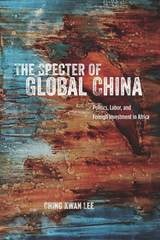
The Specter of Global China
Politics, Labor, and Foreign Investment in AfricaChing Kwan Lee
University of Chicago Press, 2017
Offering the clearest look yet at China’s state-driven investment in Africa, this book is rooted in six years of extensive fieldwork in copper mines and construction sites in Zambia, Africa’s copper giant. Lee shadowed Chinese, Indian, and South African managers in underground mines, interviewed Zambian miners and construction workers, and worked with Zambian officials. Distinguishing carefully between Chinese state capital and global private capital in terms of their business objectives, labor practices, managerial ethos, and political engagement with the Zambian state and society, she concludes that Chinese state investment presents unique potential and perils for African development. The Specter of Global China will be a must-read for anyone interested in the future of China, Africa, and capitalism worldwide.
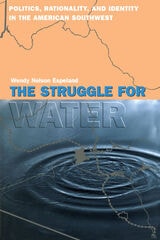
The Struggle for Water
Politics, Rationality, and Identity in the American SouthwestWendy Nelson Espeland
University of Chicago Press, 1998
In the 1970s, the three groups most intimately involved in the Orme Dam—younger Bureau of Reclamation employees committed to "rational choice" decision making, older Bureau engineers committed to the dam, and the Yavapai community—all found themselves and their values transformed by their struggles. Wendy Nelson Espeland lays bare the relations between interests and identities that emerged during the conflict, creating a contemporary tale of power and colonization, bureaucracies and democratic practice, that asks the crucial question of what it means to be "rational."
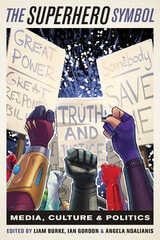
The Superhero Symbol
Media, Culture, and PoliticsLiam Burke
Rutgers University Press, 2020
It is hard to imagine a time when superheroes have been more pervasive in our culture. Today, superheroes are intellectual property jealously guarded by media conglomerates, icons co-opted by grassroots groups as a four-color rebuttal to social inequities, masks people wear to more confidently walk convention floors and city streets, and bulletproof banners that embody regional and national identities. From activism to cosplay, this collection unmasks the symbolic function of superheroes.
Bringing together superhero scholars from a range of disciplines, alongside key industry figures such as Harley Quinn co-creator Paul Dini, The Superhero Symbol provides fresh perspectives on how characters like Captain America, Iron Man, and Wonder Woman have engaged with media, culture, and politics, to become the “everlasting” symbols to which a young Bruce Wayne once aspired.
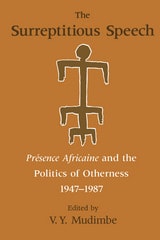
The Surreptitious Speech
Presence Africaine and the Politics of Otherness 1947-1987Edited by V. Y. Mudimbe
University of Chicago Press, 1992
The Symbolic Uses of Politics
Murray Edelman
University of Illinois Press, 1985
Unlike the conventional study of politics that deals with how people get the things they want through government, this book concentrates on how politics influence what they want, what they fear, and what they regard as possible. In examining politics as a symbolic form, it looks at man and politics as reflections of each other.
The Syrian Revolution
Between the Politics of Life and the Geopolitics of DeathYasser Munif
Pluto Press, 2020
Having lived in Syria for over fifteen years, Yasser Munif is expert in exploring the micropolitics of revolutionary forces. He uncovers how cities are managed, how precious food is distributed and how underground resistance thrives in regions controlled by regime forces. In contrast, the macropolitics of the elite Syrian regime are undemocratic, destructive and counter-revolutionary. Regional powers, Western elites, as well as international institutions choose this macropolitical lens to apprehend the Syrian conflict. By doing so, they also choose to ignore the revolutionaries' struggles.
By looking at the interplay between the two sides, case studies of Aleppo and Manbij and numerous firsthand interviews, Yasser Munif shows us that this macro and geopolitical authoritarianism only brings death, and that by looking at the smaller picture - the local, the grassroots, the revolutionaries - we can see the politics of life emerge.
The Taste for Civilization
Food, Politics, and Civil SocietyJanet A. Flammang
University of Illinois Press, 2009
This book explores the idea that table activities--the mealtime rituals of food preparation, serving, and dining--lay the foundation for a proper education on the value of civility, the importance of the common good, and what it means to be a good citizen. The arts of conversation and diplomatic speech are learned and practiced at tables, and a political history of food practices recasts thoughtfulness and generosity as virtues that enhance civil society and democracy. In our industrialized and profit-centered culture, however, foodwork is devalued and civility is eroding.
Looking at the field of American civility, Janet A. Flammang addresses the gendered responsibilities for foodwork's civilizing functions and argues that any formulation of "civil society" must consider food practices and the household. To allow space for practicing civility, generosity, and thoughtfulness through everyday foodwork, Americans must challenge the norms of unbridled consumerism, work-life balance, and domesticity and caregiving. Connecting political theory with the quotidian activities of the dinner table, Flammang discusses practical ideas from the "delicious revolution" and Slow Food movement to illustrate how civic activities are linked to foodwork, and she points to farmers' markets and gardens in communities, schools, and jails as sites for strengthening civil society and degendering foodwork.
The Theater Is in the Street
Politics and Public Performance in 1960s AmericaBradford D. Martin
University of Massachusetts Press, 2004
During the 1960s, the SNCC Freedom Singers, The Living Theatre, the Diggers, the Art Workers Coalition, and the Guerrilla Art Action Group fused art and politics by staging unexpected and uninvited performances in public spaces. Through their activism and the response it provoked, art, theater, and politics began to converge and assume a new visibility in everyday life. While their specific political visions varied, these groups shared the impulse to stage performances and actions publicly—"in the streets"—eschewing museums, theaters, and other conventional halls of culture. Bradford D. Martin offers detailed portraits of each of these groups and examines why they embraced public performance as a vehicle to express and advance their politics.
At a time when the New Left and the counterculture were on the rise, these artists reflected the decade's political and cultural radicalism and helped to define a new aesthetic. Civil rights activists mobilized singing in the struggle for desegregation, introducing a vibrant musical form into the public space. The Living Theatre culminated an arduous quest to mesh artistic and political goals, leading audiences from theaters into the streets to begin the “beautiful nonviolent anarchist revolution.” The Diggers playfully engaged San Francisco's counterculture in politics with their carnivalesque public actions. The Art Workers Coalition and the Guerrilla Action Art Group sought to disrupt the conventional art world, mounting protests in and around New York City museums.
By questioning the values and assumptions that separated art from politics, these groups not only established public performance as a legitimate aesthetic but also provided a new creative vocabulary for future generations of artists. Their continued involvement with the women's liberation movement, rural communes, and political street theater into the 1970s and beyond challenges the popular myth that activists disengaged from politics after the 1960s.

The Transformation of Old Age Security
Class and Politics in the American Welfare StateJill Quadagno
University of Chicago Press, 1988
The Truman Scandals and the Politics of Morality
Andrew J. Dunar
University of Missouri Press, 1997
The Truman Scandals and the Politics of Morality is a thoroughly researched effort offering an excellent historical narrative of the scandals and accusations of scandal that bedeviled Harry Truman throughout his political career. The book is particularly significant in light of the connections the author establishes between Truman's early political experiences and his subsequent difficulties as president.
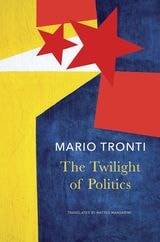
The Twilight of Politics
Mario Tronti
Seagull Books, 2024
Italian political thinker Mario Tronti is most famous for being the author of Workers and Capital, which became the central theoretical formulation of Italian operaismo or workerism, a current of political thought emerging in the 1960s that revolutionized the institutional and extra-parliamentary Left in Italy and beyond. In The Twilight of Politics, written originally in 1998, Tronti argues that modern politics, which reached its apogee in the twentieth century, has ended.
Realism and Utopia, Tronti explains, were the foundational qualities of modern politics, which it always tried to clasp together. But behind this highwater mark of politics was a history over the longue durée, encompassing the wars of religion, Hobbes’ Leviathan, revolution, great individuals, and popular movements, as well as innovations such as the nation-state and the party-form. Historically, the modern period is also a coming together of the categories of the political and the laws of political economy. At the heart of this book is Tronti’s attempt to hold together a view of the course of political history with a critique of the “dictatorship of the present” to help us escape being “chained to the bars of an eternal present . . . which deprives us both of the freedom to look back and to see ahead.”
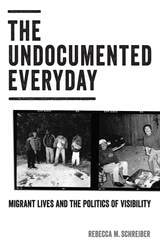
The Undocumented Everyday
Migrant Lives and the Politics of VisibilityRebecca M. Schreiber
University of Minnesota Press, 2018
Examining how undocumented migrants are using film, video, and other documentary media to challenge surveillance, detention, and deportation
As debates over immigration increasingly become flashpoints of political contention in the United States, a variety of advocacy groups, social service organizations, filmmakers, and artists have provided undocumented migrants with the tools and training to document their experiences.
In The Undocumented Everyday, Rebecca M. Schreiber examines the significance of self-representation by undocumented Mexican and Central American migrants, arguing that by centering their own subjectivity and presence through their use of documentary media, these migrants are effectively challenging intensified regimes of state surveillance and liberal strategies that emphasize visibility as a form of empowerment and inclusion. Schreiber explores documentation as both an aesthetic practice based on the visual conventions of social realism and a state-administered means of identification and control.
As Schreiber shows, by visualizing new ways of belonging not necessarily defined by citizenship, these migrants are remaking documentary media, combining formal visual strategies with those of amateur photography and performative elements to create a mixed-genre aesthetic. In doing so, they make political claims and create new forms of protection for migrant communities experiencing increased surveillance, detention, and deportation.
The Unrealizable
Towards a Politics of OntologyGiorgio Agamben
Seagull Books, 2024
We are so used to distinguishing between the possible and the real, between essence and existence that we do not realize that these distinctions, which seem so obvious to us, are the result of a long and laborious process that has led to the splitting of being—the “matter” of thought—into two fragments that are both conflicting and intimately intertwined.
This book argues that the ontological-political machine of the West is based on the splitting of this “matter,” without which neither science nor politics would be possible. Without the partition of reality into essence and existence and into possibility and actuality, neither scientific knowledge nor the ability to control human action—which characterizes the historical power of the West—would have been possible.
If we could not suspend the exclusive concentration of our attention on what immediately exists (as animals seem to do), to think and define its essence, Western science and technology would not have experienced the advances that characterize them. And if the dimension of possibility disappeared entirely, neither plans nor projects would be thinkable, and human actions could be neither directed nor controlled. The incomparable power of the West has one of its essential presuppositions in this ontological machine.

The Vietnam War in American Memory
Veterans, Memorials, and the Politics of HealingPatrick Hagopian
University of Massachusetts Press, 2009
A study of American attempts to come to terms with the legacy of the Vietnam War, this book highlights the central role played by Vietnam veterans in shaping public memory of the war.
Tracing the evolution of the image of the Vietnam veteran from alienated dissenter to traumatized victim to noble warrior, Patrick Hagopian describes how efforts to commemorate the war increasingly downplayed the political divisions it spawned in favor of a more unifying emphasis on honoring veterans and promoting national “healing.”
The Virtual Point of Freedom
Essays on Politics, Aesthetics, and ReligionLorenzo Chiesa
Northwestern University Press, 2016
The Visual Guillotine
The Cinematic Cut and Politics in Latin AmericaThomas Matusiak
University of Minnesota Press, 2026
The violence of the cinematic cut in twentieth-century Latin American film
Splice, montage, close-up: modern cinema routinely presents bodies in pieces. Not unlike the guillotine, argues Thomas Matusiak, these techniques have served both overt and symbolic political ends as they accomplish and project the efficient production of severed bodies. In The Visual Guillotine, Matusiak traces the use of cinematic tools of dismemberment in twentieth-century Latin American film to theorize the symbolic and material violence of the cut.
A robust genealogy of Latin American cinematic politics, The Visual Guillotine encompasses national filmmaking traditions; radical and reactionary political registers; and the proliferated aesthetics of narrative, documentary, experimental, and expanded cinema through an innovative critical viewing practice. From the national cinemas of the 1930s to the decapitation videos produced in the Mexican narco-conflict and beyond, Matusiak shows how the cinematic cut has been employed to inspire terror as well as invoke and critique a range of political programs.
A refreshing dialogue between film theory and Latin American cultural studies, The Visual Guillotine offers a new way for film to conceptualize politics. In our present political moment, with rapidly generated and circulated visual media central to a resurgent leftist-populist battle against oligarchy and authoritarianism, this book calls for readers to reassess their viewing position when confronted with violent imagery.
Retail e-book files for this title are screen-reader friendly with images accompanied by short alt text and/or extended descriptions.
The Whitman Revolution
Sex, Poetry, and PoliticsBetsy Erkkila
University of Iowa Press, 2020
The Whitman Revolution brings together a rich collection of Betsy Erkkila’s phenomenally influential essays that have been published over the years, along with two powerful new essays. Erkkila offers a moving account of the inseparable mix of the spiritual-sexual-political in Whitman and the absolute centrality of male-male connection to his work and thinking. Her work has been at the forefront of scholarship positing that Whitman’s songs are songs not only of workers and occupations but of sex and the body, homoeroticism, and liberation. What is more, Erkkila’s writing demonstrates that this sexuality and communal impulse is central to Whitman’s revolutionary poetry and his conception of democracy itself—an insight that was all but suppressed during the mid-twentieth century emergence of American literature as a field of study.
Highlights of this collection include Erkkila’s essays on pairings such as Marx and Whitman, Dickinson and Whitman, and Melville and Whitman. Across the volume, she demonstrates an international vision that highlights the place of Leaves of Grass within a global struggle for democracy. The Whitman Revolution is evidence of Erkkila’s remarkable ability to lead critical discussions, and marks an exciting event in Whitman studies.
The Will to Improve
Governmentality, Development, and the Practice of PoliticsTania Murray Li
Duke University Press, 2007
Demonstrating that the “will to improve” has a long and troubled history, Li identifies enduring continuities from the colonial period to the present. She explores the tools experts have used to set the conditions for reform—tools that combine the reshaping of desires with applications of force. Attending in detail to the highlands of Sulawesi, she shows how a series of interventions entangled with one another and tracks their results, ranging from wealth to famine, from compliance to political mobilization, and from new solidarities to oppositional identities and violent attack. The Will to Improve is an engaging read—conceptually innovative, empirically rich, and alive with the actions and reflections of the targets of improvement, people with their own critical analyses of the problems that beset them.
The Women's Joint Congressional Committee and the Politics of Maternalism, 1920-30
Jan Doolittle Wilson
University of Illinois Press, 2006
Jan Doolittle Wilson offers the first comprehensive history of the umbrella organization founded by former suffrage leaders in order to coordinate activities around women's reform. Encompassing nearly every major national women's organization of its time, the Women's Joint Congressional Committee (WJCC) evolved into a powerful lobbying force for the legislative agendas of more than twelve million women. Critics and supporters alike came to recognize it as "the most powerful lobby in Washington."
Examining the WJCC's most consequential and contentious campaigns, Wilson traces how the group's strategies, rhetoric, and success generated congressional and grassroots support for their far-reaching, progressive reforms. But the committee's early achievements sparked a reaction by big business that challenged and ultimately limited the programs these women envisioned. Using the WJCC as a lens, Wilson analyzes women's political culture during the 1920s. She also sheds new light on the initially successful ways women lobbied for social legislation, the limitations of that process for pursuing class-based reforms, and the enormous difficulties the women soon faced in trying to expand public responsibility for social welfare.
A volume in the series Women in American History, edited by Anne Firor Scott, Susan Armitage, Susan K. Cahn, and Deborah Gray White
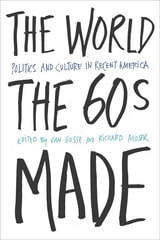
The World Sixties Made
Politics And Culture In Recent Americaedited by Van Gosse and Richard Moser
Temple University Press, 2003
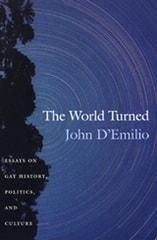
The World Turned
Essays on Gay History, Politics, and CultureJohn D Emilio
Duke University Press, 2002
In this collection of essays, D’Emilio brings his historian’s eye to bear on these profound changes in American society, culture, and politics. He explores the career of Bayard Rustin, a civil rights leader and pacifist who was openly gay a generation before almost everyone else; the legacy of radical gay and lesbian liberation; the influence of AIDS activist and writer Larry Kramer; the scapegoating of gays and lesbians by the Christian Right; the gay-gene controversy and the debate over whether people are "born gay"; and the explosion of attention focused on queer families. He illuminates the historical roots of contemporary debates over identity politics and explains why the gay community has become, over the last decade, such a visible part of American life.
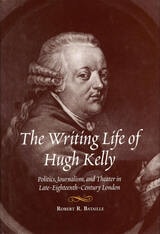
The Writing Life of Hugh Kelly
Politics, Journalism, and Theatre in Late-Eighteenth-Century LondonRobert R. Bataille
Southern Illinois University Press, 2000
Robert R. Bataille demonstrates convincingly that between 1767 and 1777, Anglo-Irish writer Hugh Kelly made major contributions in three areas of British culture: politics, journalism, and theater. Bataille shows how all three activities were integrated in Kelly’s life, suggesting that such interrelationships often existed in the rough and ready London culture during the early reign of King George III.
When he discovered several newspaper campaigns that Kelly orchestrated as a paid political propagandist for George III and his ministers, Bataille understood in part how important Kelly was to his era. In his capacity as propagandist, Kelly defended Hanoverian colonial policies on the eve of the American Revolution, served as a key opponent of the radical Wilkites, and promoted the acceptance of the 1774 Quebec Bill, which established, among other things, the right of the recently defeated French citizens of Quebec to maintain the French language.
A belletristic journalist, Kelly published theater reviews and essays that played a major role in shaping the taste of his era. He wrote in defense of the controversial sentimental drama, and whenever he could, he promoted the major theatrical figure of the age, David Garrick. Under his editorship, the newspaper Public Ledger became a leading source of theater information. Seeking to raise the status of the profession of journalism, he wrote essays and articles that provided his middle-class readers with an insider’s view of the operations of the journalist.
Assessing Kelly’s contributions to the novel and drama, Bataille argues that this powerful journalist stands in the vanguard in the larger struggle against traditional attitudes supporting male superiority and aristocratic privilege. Kelly wrote in favor of gender equality and middle-class respectability, striving to inculcate what modern scholars refer to as the values of sensibility. Bataille also argues, however, that Kelly knew his audience. Instrumental in the rise of professional writing and popular culture, he understood that he had to observe the needs of his audience, detecting cultural trends and using the skills of the rhetorician.
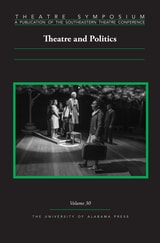
Theatre Symposium, Vol. 30
Theatre and Politicsedited by Chase Bringardner
University of Alabama Press, 2023
Illustrates how theatre’s engagement with politics changes over time
For the thirtieth volume of Theatre Symposium, the editors return to a topic first proposed over twenty years ago in volume 9 (theatre and politics in the twentieth century), reimaged for a broader, more comprehensive time frame. In this volume on theater and politics, scholars explore what constitutes the political, how the political is performed, and how theatre engages with politics over time, drawing on the following framing questions: What is the historical and ongoing role of theatre in framing our ideas and conversations about politics? How do politics and theatre engage one another in an increasingly mediated landscape? From theatrical analysis of the political arena to political analysis of the theatrical stage, discussions of theatre and politics can challenge ethical, theoretical, and artistic considerations of our world.
The current moment presents a compelling opportunity to revisit, revise, and reengage. Certainly, in the twenty-one volumes since volume 9, the political landscape both nationally and internationally has shifted dramatically. The past two years specifically have seen an increase in the already prevalent presence of the political in our daily discourse. The COVID-19 global pandemic and ongoing racial reckonings have further unmoored many systems and structures, requiring action and change. Rather than a moment of pause or passivity, pandemic times have seen an increase in political activity and political discourse on the local, national, and global levels. Within the theatre and performance communities, these calls to action have resulted in movements like #weseeyouWAT and other calls to break down old systems and create new ones, to privilege access for those of the global majority, and to explicitly demand advocacy and activism. Organizations like the Southeastern Theatre Conference (SETC) itself crafted new ethos statements and engaged in the necessary work of boldly foregrounding equity, diversity, inclusion, and accessibility at the center of all its efforts.
The editors and contributors to this volume respond to the immediacy of this moment and the clarion call for change. From Shakespeare to new productions like Alabama Love Stories, presented at Auburn University, contributors grapple with a range of examples, contemporary and historical, and argue with renewed urgency for the importance of intentionally interrogating the interplay of performance and politics. The essays in this volume demonstrate that theatre and performance cannot rise to this moment or even begin to address it without doing that substantial work to clean its own house and create accessible new spaces.
Contributors
Chase Bringardner / Tessa Carr / Lily Climenhaga / Abena Foreman-Trice / Emma Givens / TK Manwill / Boomie Pederson / Royal Shirée / Teresa Simone / Tony Tambasco / Jonathon W. Taylor / Justice von Maur / Patricia Ybarra