Results by title
18284 books match the query 'United States' and 3764 start with t
Tracks on the Trail
Popular Music, Race, and the US PresidencyDana Gorzelany-Mostak
University of Michigan Press, 2023
From Bill Clinton playing his saxophone on The Arsenio Hall Show to Barack Obama referencing Jay-Z’s song “Dirt Off Your Shoulder,” politicians have used music not only to construct their personal presidential identities but to create the broader identity of the American presidency. Through music, candidates can appear relatable, show cultural competency, communicate values and ideas, or connect with a specific constituency. On a less explicit level, episodes such as Clinton’s sax-playing and Obama’s shoulder brush operate as aural and visual articulations of race and racial identity. But why do candidates choose to engage with race in this manner? And why do supporters and detractors on YouTube and the Twittersphere similarly engage with race when they create music videos or remixes in homage to their favorite candidates?
With Barack Obama, Ben Carson, Kamala Harris, and Donald Trump as case studies, Tracks on the Trail: Popular Music, Race, and the US Presidency sheds light on the factors that motivate candidates and constituents alike to articulate race through music on the campaign trail and shows how the racialization of sound intersects with other markers of difference and ultimately shapes the public discourse surrounding candidates, popular music, and the meanings attached to race in the 21st century. Gorzelany-Mostak explores musical engagement broadly, including official music in the form of candidate playlists and launch event setlists, as well as unofficial music in the form of newly composed campaign songs, mashups, parodies, and remixes.
Trade Policies for International Competitiveness
Edited by Robert C. Feenstra
University of Chicago Press, 1989
In Trade Policies for International Competitiveness, Robert C. Feenstra collects seven papers from the conference, each accompanied by discussants' comments, and adds a helpful introduction. Some of the issues considered by contributors are effects of macroeconomic and strategic foreign policies on competitiveness; the recent influx of foreign direct investment in the United States, primarily from Japan; the extent to which Japanese trade patterns are a reflection of underlying factor and endowments rather than trade barriers; and the market structure of Canadian industries, including applications for ongoing U.S.-Canadian free trade negotiations. Topical and provocative, these papers will be of value to economists, policymakers, and those in the business world.
Trade Threats, Trade Wars
Bargaining, Retaliation, and American Coercive DiplomacyKa Zeng
University of Michigan Press, 2004

Trade and Investment Relations among the United States, Canada, and Japan
Edited by Robert M. Stern
University of Chicago Press, 1989
The papers in this volume were developed from a conference that addressed the need to discover which structural determinants and policies shape the close economic ties among these nations. Leading experts on trade and macroeconomics from all three countries examine disproportionate saving rates, exchange rate volatility, varying industrial policies and levels of financial innovation, the effects of present tax policies and proposed reforms, and the dynamism of major Pacific nations and the leadership role Japan may play in U.S. relations with that region. Several important conclusions are reached by the contributors. They assert that Japan's trade barriers are relatively low overall and are comparable to those maintained by the United States and Canada, and that divergent fiscal policies have been the major source of macroeconomic imbalances between the United States and other major countries in the 1980s. They also conclude that current trade imbalances may persist for some time. The analyses offered here are likely to prove influential in future policymaking and will be of interest to a wide audience, including academic economists, government officials, and students of theoretical and policy issues of international trade, investment, and finance.
Trade and Privateering in Spanish Florida, 1732–1763
Joyce Elizabeth Harman, With a New Introduction by Carl E. Swanson
University of Alabama Press, 2004
A groundbreaking study of commerce, conflict, and survival in colonial Spanish Florida.
Trade and Privateering examines the illegal yet highly profitable and mutually beneficial trade between Spanish Florida and the English colonies on the eastern seaboard in the mid-18th century. In St. Augustine, the arrival of subsidies from Spain was erratic, causing shortages of food and supplies, so authorities ignored the restrictions on trade with foreign colonies and welcomed British goods. Likewise, the British colonists sought Spanish products from Florida, especially oranges.
But when England and Spain became declared enemies in the War of Jenkins’ Ear and the French and Indian Wars, this tacit trade arrangement was threatened, and the result was a rise of privateering in the region. Rather than do without Spanish goods, the English began to attack and capture Spanish vessels with their cargoes at sea. Likewise, the Spaniards resorted to privateering as a means of steadily supplying the Florida colony. Harman concludes that, both willingly and unwillingly, the English colonies helped their Spanish neighbor to sustain its position in the Southeast.
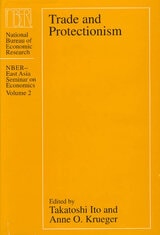
Trade and Protectionism
Edited by Takatoshi Ito and Anne O. Krueger
University of Chicago Press, 1993
The authors look at the current global trading system and at the potential threats to East Asian economies from possible regional arrangements, such as separate trading blocks in the Western Hemisphere and Europe. They cover trade between the United States and Japan, Korea and Japan, and Japanese-East Asian trade policies; trade in agriculture and semiconductors and the frictions that have jeopardized this trade; and direct foreign investment. The contributors round out the work with discussions of the political economy of protection in Korea and Taiwan and political economy considerations as they affect trade policy in general.
This is the second volume of the National Bureau of Economic Research-East Asia Seminar on Economics. The first volume, The Political Economy of Tax Reform, also edited by Takatoshi Ito and Anne O. Krueger, addresses tax reform in the global economy.
Trade with Japan
Has the Door Opened Wider?Edited by Paul Krugman
University of Chicago Press, 1991
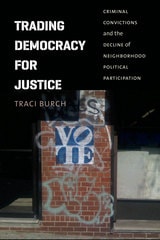
Trading Democracy for Justice
Criminal Convictions and the Decline of Neighborhood Political ParticipationTraci Burch
University of Chicago Press, 2013
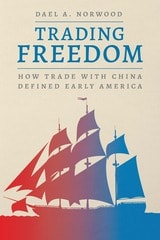
Trading Freedom
How Trade with China Defined Early AmericaDael A. Norwood
University of Chicago Press, 2022
The economic and geographic development of the early United States is usually thought of in trans-Atlantic terms, defined by entanglements with Europe and Africa. In Trading Freedom, Dael A. Norwood recasts these common conceptions by looking to Asia, making clear that from its earliest days, the United States has been closely intertwined with China—monetarily, politically, and psychologically.
Norwood details US trade with China from the late eighteenth through the late nineteenth centuries—a critical period in America’s self-definition as a capitalist nation—and shows how global commerce was central to the articulation of that national identity. Trading Freedom illuminates how debates over political economy and trade policy, the building of the transcontinental railroad, and the looming sectional struggle over slavery were all influenced by Sino-American relations. Deftly weaving together interdisciplinary threads from the worlds of commerce, foreign policy, and immigration, Trading Freedom thoroughly dismantles the idea that American engagement with China is anything new.
Trading Spaces
The Colonial Marketplace and the Foundations of American CapitalismEmma Hart
University of Chicago Press, 2019
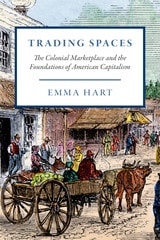
When we talk about the economy, “the market” is often just an abstraction. While the exchange of goods was historically tied to a particular place, capitalism has gradually eroded this connection to create our current global trading systems. In Trading Spaces, Emma Hart argues that Britain’s colonization of North America was a key moment in the market’s shift from place to idea, with major consequences for the character of the American economy.
Hart’s book takes in the shops, auction sites, wharves, taverns, fairs, and homes of seventeenth- and eighteenth-century America—places where new mechanisms and conventions of trade arose as Europeans re-created or adapted continental methods to new surroundings. Since those earlier conventions tended to rely on regulation more than their colonial offspring did, what emerged in early America was a less-fettered brand of capitalism. By the nineteenth century, this had evolved into a market economy that would not look too foreign to contemporary Americans. To tell this complex transnational story of how our markets came to be, Hart looks back farther than most historians of US capitalism, rooting these markets in the norms of seventeenth- and eighteenth-century Britain. Perhaps most important, this is not a story of specific commodity markets over time but rather is a history of the trading spaces themselves: the physical sites in which the grubby work of commerce occurred and where the market itself was born.
Trading with the Enemy
The Covert Economy During the American Civil WarPhilip Leigh
Westholme Publishing, 2022
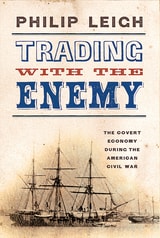
While Confederate blockade runners famously carried the seaborne trade for the South during the American Civil War, the amount of Southern cotton exported to Europe was only half of that shipped illicitly to the North. Most went to New England textile mills where business “was better than ever,” according to textile mogul Amos Lawrence. Rhode Island senator William Sprague, a mill owner and son-in-law to Treasury Secretary Salmon P. Chase, was a member of a partnership supplying weapons to the Confederacy in exchange for cotton. The trade in contraband was not confined to New England. Union General William T. Sherman claimed Confederates were supplied with weapons from Cincinnati, while General Ulysses S. Grant captured Rebel cavalry armed with carbines purchased in Union-occupied Memphis. During the last months of the war, supplies entering the Union-controlled port of Norfolk, Virginia, were one of the principal factors enabling Robert E. Lee’s Confederate army to avoid starvation. Indeed, many of the supplies that passed through the Union blockade into the Confederacy originated in Northern states, instead of Europe as is commonly supposed. Merchants were not the only ones who profited; Union officers General Benjamin Butler and Admiral David Dixon Porter benefited from this black market. President Lincoln admitted that numerous military leaders and public officials were involved, but refused to stop the trade.
In Trading with the Enemy: The Covert Economy During the American Civil War, New York Times Disunion contributor Philip Leigh recounts the little-known story of clandestine commerce between the North and South. Cotton was so important to the Northern economy that Yankees began growing it on the captured Sea Islands of South Carolina. Soon the neutral port of Matamoras, Mexico, became a major trading center, where nearly all the munitions shipped to the port—much of it from Northern armories—went to the Confederacy. After the fall of New Orleans and Vicksburg, a frenzy of contraband-for-cotton swept across the vast trans-Mississippi Confederacy, with Northerners sometimes buying the cotton directly from the Confederate government. A fascinating study, Trading with the Enemy adds another layer to our understanding of the Civil War.
Traditions and Reminiscences of Concord, Massachusetts, 1779-1878
Edward Jarvis
University of Massachusetts Press, 1993
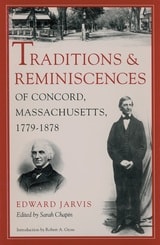
A statistician and pioneer in the treatment of the mentally ill, Edward Jarvis (1803–1884) decided late in life to record his recollections of Concord, Massachusetts, the town in which he was raised. Using Lemuel Shattuck's History of Concord as the springboard for his thoughts, Jarvis produced a remarkable document. Traditions and Reminiscences is encyclopedic in scope but intimate in style; it provides an astonishingly detailed account of life in early nineteenth-century Concord. Jarvis escorts us through the family home, making certain we understand the function and value of each item in the domestic scene. Then he is off to the neighbors' houses, to the schoolhouse, the church, the social clubs, the library, the post office, the town hall, and even the tavern, where he unabashedly counts patrons' drinks. Along the way we learn about neighborly cooperation—quiltings, husking bees, and barn raisings—about social manners and respectability, and about local vices. The result is a vast storehouse of information and a vivid portrait of life in an early nineteenth-century preindustrial community. The memoir also provides a first-hand witness to the crusade for moral reform that transformed mid-nineteenth-century New England.
Trafficked Children and Youth in the United States
Reimagining SurvivorsElzbieta M. Gozdziak
Rutgers University Press, 2016
Breaking new ground, Trafficked Children in the United States offers a fresh take on what matters most to these young people as they rebuild their lives in America.
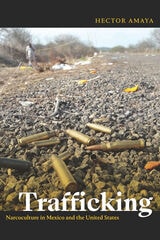
Trafficking
Narcoculture in Mexico and the United StatesHector Amaya
Duke University Press, 2020
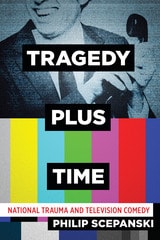
Tragedy Plus Time
National Trauma and Television ComedyBy Philip Scepanski
University of Texas Press, 2021
Following the most solemn moments in recent American history, comedians have tested the limits of how soon is “too soon” to joke about tragedy. Comics confront the horrifying events and shocking moments that capture national attention and probe the acceptable, or “sayable,” boundaries of expression that shape our cultural memory. In Tragedy Plus Time, Philip Scepanski examines the role of humor, particularly televised comedy, in constructing and policing group identity and memory in the wake of large-scale events.
Tragedy Plus Time is the first comprehensive work to investigate tragedy-driven comedy in the aftermaths of such traumas as the JFK assassination and 9/11, as well as during the administration of Donald Trump. Focusing on the mass publicization of television comedy, Scepanski considers issues of censorship and memory construction in the ways comedians negotiate emotions, politics, war, race, and Islamophobia. Amid the media frenzy and conflicting expressions of grief following a public tragedy, comedians provoke or risk controversy to grapple publicly with national traumas that all Americans are trying to understand for themselves.
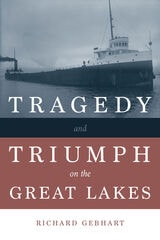
Tragedy and Triumph on the Great Lakes
Richard Gebhart
Michigan State University Press, 2024
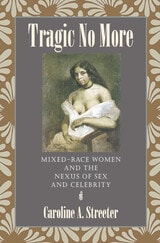
Tragic No More
Mixed-Race Women and the Nexus of Sex and CelebrityCaroline A. Streeter
University of Massachusetts Press, 2012
Streeter's subjects include concert pianist Philippa Schuyler, Dorothy West's novel The Wedding (in print and on screen), Danzy Senna's novels Caucasia and Symptomatic, and celebrity performing artists Mariah Carey, Alicia Keys, and Halle Berry. She opens with a chapter that examines the layered media response to Essie Mae Washington-Williams, Senator Strom Thurmond's biracial daughter. Throughout the book, Streeter engages the work of feminist critics and others who have written on interracial sexuality and marriage, biracial identity, the multiracial movement, and mixed race in cultural studies.

Trail Running Eastern Massachusetts
Ben Kimball
University of Massachusetts Press, 2022
Eastern Massachusetts offers incredible trail-running opportunities, ranging from popular long-distance routes like the Bay Circuit Trail to lesser-known loops that run through the mountains and forests of the Quabbin watershed and Merrimack Valley region, and trails that pass alongside the shores of Cape Cod. All over the Bay State, there are trails suitable for runners of all levels waiting to be discovered and explored.
Avid trail runner Ben Kimball offers a selection of fifty-one of eastern Massachusetts’s most spectacular trail sites, including detailed trail descriptions, topographic maps, directions, parking information, safety tips, and much more. Both experienced and novice trail runners will find Trail Running Eastern Massachusetts to be an invaluable resource for exploring nature and getting a good workout, in the Boston area and beyond.

Trail Running Southern Vermont
Ben Kimball
University of Massachusetts Press, 2024
The wild and rural landscape of southern Vermont offers a true bounty of great trail-running opportunities, from out-and-back (or pointtopoint) runs on popular long-distance routes, such as segments of the Long Trail or Appalachian Trail, to quiet, little-known loops hidden away in the woods. This helpful guide is just the resource needed for trip planning or for a spontaneous run in a beautiful place.
Local expert trail runner Ben Kimball offers a range of suggested route options, sometimes even several at the same site, for runners of all skill levels. He also provides important practical information, such as the full distance of the suggested route; a difficulty rating; the trail style and type; the total ascent; and directions, along with a detailed description of the trail itself. There are also scannable codes for downloading trail maps to your smartphone. The trails included vary in difficulty and terrain type, and range from low elevations in the Connecticut River Valley to as high as 4,000 feet at Killington Peak in the Green Mountains. This indispensable book is the perfect companion for adventurous runners and hikers interested in exploring southern Vermont.

Trail Running Western Massachusetts
Ben Kimball
University Press of New England, 2015
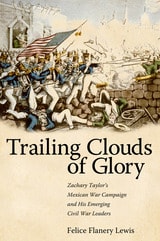
Trailing Clouds of Glory
Zachary Taylor's Mexican War Campaign and His Emerging Civil War LeadersFelice Flanery Lewis
University of Alabama Press, 2010
Trailing Clouds of Glory is the first examination of the roles played in the Mexican War by the large number of men who served with Taylor and who would be prominent in the next war, both as volunteer and regular army officers, and it provides fresh information, even on such subjects as Robert E. Lee and Ulysses S. Grant. Particularly interesting for the student of the Civil War are largely unknown aspects of the Mexican War service of Daniel Harvey Hill, Braxton Bragg, and Thomas W. Sherman.
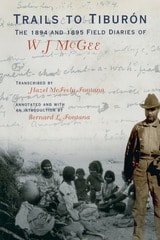
Trails to Tiburón
The 1894 and 1895 Field Diaries of W J McGeeW. J. McGee; Transcribed by Hazel McFeely Fontana; Annotated and with an Introduction by Bernard L. Fontana
University of Arizona Press, 2000
A self-taught scientist in the newly forming field of anthropology, McGee led two expeditions through southern Arizona and northern Sonora for the Bureau of American Ethnology. There he conducted ethnographic research among the Papagos (Tohono O'odham) and the Seris, and his subsequent publication The Seri Indians helped secure his place in the anthropological community.
McGee's complete journals of the expeditions, kept in small field notebooks and preserved in the Library of Congress, are published here for the first time. These journals contain detailed descriptions of the country and people McGee encountered and convey the adventure of traveling through wild and unfamiliar places—including a voyage to Isla Tiburón, or Shark Island, in the Gulf of California—and being plagued by foul weather, a shortage of supplies, and fear of attack from hostile Indians.
Trails to Tiburón features 57 historical photographs taken on the expedition, capturing the places McGee saw and the people he encountered. Fontana's notes to the diary provide useful botanical, geological, and ethnographic information, while his introduction places McGee and his field work in the context of late-nineteenth-century anthropology and science.
Trails to Tiburón reveals McGee's versatility as a field worker and shows his methods, often questioned today, to be the reasonable response of a man caught up in the intellectual fervor of his time. For anyone wanting to share in the spirit of adventure, these journals are a landmark in the annals of exploration.

Training Paraprofessionals for Reference Service
Pamela J. Morgan
American Library Association, 2009
Training and the Private Sector
International ComparisonsEdited by Lisa M. Lynch
University of Chicago Press, 1994
The authors focus on Germany's widespread, formal apprenticeship programs; the U.S. system of learning-by-doing; Japan's low employee turnover and extensive company training; and Britain's government-led and school-based training schemes. The evidence shows that, overall, training in the workplace is more effective than training in schools. Moreover, even when U.S. firms spend as much on training as other countries do, their employees may still be less skilled than workers in Europe or Japan.
Training and the Private Sector points to training programs in Germany, Japan, and other developed countries as models for creating a workforce in the United States that can compete more successfully in today's economy.
Training for Catastrophe
Fictions of National Security after 9/11Lindsay Thomas
University of Minnesota Press, 2021
A timely, politically savvy examination of how impossible disasters shape the very real possibilities of our world
Why would the normally buttoned-down national security state imagine lurid future scenarios like a zombie apocalypse? In Training for Catastrophe, author Lindsay Thomas shows how our security regime reimagines plausibility to focus on unlikely and even unreal events rather than probable ones. With an in-depth focus on preparedness (a pivotal, emergent national security paradigm since 9/11) she explores how fiction shapes national security.
Thomas finds fiction at work in unexpected settings, from policy documents and workplace training manuals to comics and video games. Through these texts—as well as plenty of science fiction—she examines the philosophy of preparedness, interrogating the roots of why it asks us to treat explicitly fictional events as real. Thomas connects this philosophical underpinning to how preparedness plays out in contemporary politics, emphasizing how it uses aesthetic elements like realism, genre, character, and plot to train people both to regard some disasters as normal and to ignore others.
Training for Catastrophe makes an important case for how these documents elicit consent and compliance. Thomas draws from a huge archive of texts—including a Centers for Disease Control comic about a zombie apocalypse, the work of Audre Lorde, and the political thrillers of former national security advisor Richard Clarke—to ask difficult questions about the uses and values of fiction. A major statement on how national security intrudes into questions of art and life, Training for Catastrophe is a timely intervention into how we confront disasters.
Traitors and True Poles
Narrating a Polish-American Identity, 1880–1939Karen Majewski
Ohio University Press, 2003
During Poland’s century-long partition and in the interwar period of Poland’s reemergence as a state, Polish writers on both sides of the ocean shared a preoccupation with national identity. Polish-American immigrant writers revealed their persistent, passionate engagement with these issues, as they used their work to define and consolidate an essentially transnational ethnic identity that was both tied to Poland and independent of it.
By introducing these varied and forgotten works into the scholarly discussion, Traitors and True Poles recasts the literary landscape to include the immigrant community’s own competing visions of itself. The conversation between Polonia’s creative voices illustrates how immigrants manipulated often difficult economic, social, and political realities to provide a place for and a sense of themselves. What emerges is a fuller picture of American literature, one vital to the creation of an ethnic consciousness.
This is the first extended look at Polish-language fiction written by turn-of-the-century immigrants, a forgotten body of American ethnic literature. Addressing a blind spot in our understanding of immigrant and ethnic identity and culture, Traitors and True Poles challenges perceptions of a silent and passive Polish immigration by giving back its literary voice.
Trams or Tailfins?
Public and Private Prosperity in Postwar West Germany and the United StatesJan L. Logemann
University of Chicago Press, 2012
Trans-Indigenous
Methodologies for Global Native Literary StudiesChadwick Allen
University of Minnesota Press, 2012
What might be gained from reading Native literatures from global rather than exclusively local perspectives of Indigenous struggle? In Trans-Indigenous, Chadwick Allen proposes methodologies for a global Native literary studies based on focused comparisons of diverse texts, contexts, and traditions in order to foreground the richness of Indigenous self-representation and the complexity of Indigenous agency.
Through demonstrations of distinct forms of juxtaposition—across historical periods and geographical borders, across tribes and nations, across the Indigenous–settler binary, across genre and media—Allen reclaims aspects of the Indigenous archive from North America, Hawaii, Aotearoa New Zealand, and Australia that have been largely left out of the scholarly conversation. He engages systems of Indigenous aesthetics—such as the pictographic discourse of Plains Indian winter counts, the semiotics of Navajo weaving, and Maori carving traditions, as well as Indigenous technologies like large-scale North American earthworks and Polynesian ocean-voyaging waka—for the interpretation of contemporary Indigenous texts. The result is a provocative reorienting of the call for Native intellectual, artistic, and literary sovereignty that fully prioritizes the global Indigenous.
Transatlantic Connections
Whitman U.S., Whitman U.K.Thomas, M. Wynn
University of Iowa Press, 2005
The book’s contrasting sections reflect the two locations studied: the first shows Whitman in his time and place, while the second repositions him within the cultures of England and Wales from the late 19th to the late 20th century. In the opening chapter he is placed against the vivid, outrageous background of the New York of his time; the second finds evidence in his poetry of a critique of the new urban politics of the emerging city boss; the third radically redefines Whitman's relationship to his famous contemporary Longfellow. Other chapters deal with the Civil War poet, exploring the ways in which his poetic responses were in part shaped by his relationship to his soldier brother George, and his use of the meteorological discoveries of his day to fashion metaphors for imaging the different phases of the conflict.
The second section ponders the paradox that this Whitman, who was so much the product of his specific time and limited “local” culture, should come to be accepted as an international visionary. The United Kingdom is taken as offering striking instances of this phenomenon, and his transatlantic admirers are shown to have been engaged in an unconscious process of “translating” Whitman into the terms of their own culturally specific social, political, and sexual preoccupations. Some of the connections explored are those between Whitman and Edward Carpenter, the so-called English Whitman; between Whitman and perhaps his greatest English critic, D. H. Lawrence; and between Whitman and the Welsh poets Ernest Rhys, Amanwy (David Rees Griffiths), Niclas y Glais (T. E. Nicholas), Waldo Williams, Glyn Jones, Dylan Thomas, and R. S. Thomas.
This bold and original study, offering new points of entry into understanding Whitman as the product of his time and place as well as understanding the reception of Whitman in the U.K. as a process of cultural translation, should fascinate scholars of Whitman and students of comparative literature.

Transatlantic Conversations
Nineteenth-Century American Women’s Encounters with Italy and the Atlantic WorldBeth L. Lueck
University of New Hampshire Press, 2017
This unique interdisciplinary essay collection offers a fresh perspective on the active involvement of American women authors in the nineteenth-century transatlantic world. Internationally diverse contributors explore topics ranging from women's social and political mobility to their authorship and activism. While a number of essays focus on such well-known writers as Margaret Fuller, Catharine Maria Sedgwick, Harriet Beecher Stowe, George Eliot, Louisa May Alcott, and Charlotte Perkins Gilman, other, perhaps lesser-known authors are also included, such as E. D. E. N. Southworth, Elizabeth Stuart Phelps, Elizabeth Peabody, Jeannette Hart, and Laura Richards.
These essays show the spectrum of interests and activities in which nineteenth-century women were involved as they moved, geographically and metaphorically, toward gaining their independence and the right to control their lives. Traveling far and wide—to Italy, France, Great Britain, and the Bahamas—these writers came into contact with realities far different from their own. On topics ranging from homeopathy and literary endeavors to politics and revolution, they conversed with others, reaching and inspiring transnational audiences with their words and deeds, and creating a space for self-expression in the rapidly changing transatlantic world.
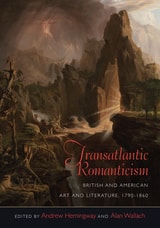
Transatlantic Romanticism
British and American Art and Literature, 1790-1860Andrew Hemingway
University of Massachusetts Press, 2014
In the book's introduction, Andrew Hemingway—building on the theoretical work of Michael Lowy and Robert Sayre—proposes that we need to remobilize the concept of Weltanschauung, or comprehensive worldview, in order to develop the kind of synthetic history of arts and ideas the phenomenon of Romanticism demands. The essays that follow focus on the London and New York art worlds and such key figures as Benjamin West, Thomas Bewick, John Vanderlyn, Washington Allston, John Martin, J. M. W. Turner, Thomas Cole, James Fenimore Cooper, George Catlin, Edgar Allan Poe, Harriet Beecher Stowe, and Herman Melville. Taken together, these essays plot the rise of a romantic anti-capitalist Weltanschauung as well as the dialectic between Romanticism's national and international manifestations.
In addition to the volume editors, contributors include Matthew Beaumont, David Bindman, Leo Costello, Nicholas Grindle, Wayne Franklin, Janet Koenig, William Pressly, Robert Sayre, William Truettner, Dell Upton, and William Vaughan.
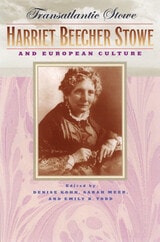
Transatlantic Stowe
Harriet Beecher Stowe and European CultureDenise Kohn
University of Iowa Press, 2006
Transatlantic Subjects
Acts of Migration and Cultures of Transnationalism between Greece and AmericaIoanna Laliotou
University of Chicago Press, 2004
According to Ioanna Laliotou, cultural institutions and practices played an important role in the formation of migrant subjectivities. Reconstructing the cultural history of migration, her book points out the relationship between subjectivity formation and cultural practices and performances, such as publishing, reading, acting, storytelling, consuming, imitating, parading, and traveling. Transatlantic Subjects then locates the development of these practices within key sites and institutions of cultural formation, such as migrant and fraternal associations, educational institutions, state agencies and nongovernmental organizations, mental institutions, coffee shops, the church, steamship companies, banks, migration services, and chambers of commerce.
Ultimately, Laliotou explores the complex and situational entanglements of migrancy, cultural nationalism, and the politics of self. Reading against the grain of hegemonic narratives of cultural and migration histories, she reveals how migrancy produced distinctive forms of sociality during the first half of the twentieth century.
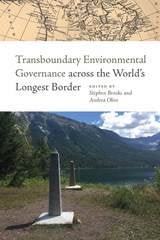
Transboundary Environmental Governance across the World's Longest Border
Stephen Brooks
Michigan State University Press, 2018
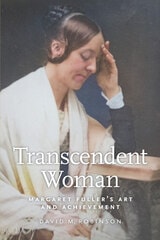
Transcendent Woman
Margaret Fuller’s Art and AchievementDavid M. Robinson
University of Massachusetts Press, 2025
Journalist, editor, critic, translator, and women’s rights advocate, Margaret Fuller was America’s first major female intellectual. Throughout much of the late-19th and 20th centuries, however, critics and scholars largely saw her as a minor figure in the transcendentalist movement with which she is associated, and her work was considered secondary to that of male figures like Emerson and Hawthorne. While her biography—including her marriage to an Italian noble and her dramatic death in a shipwreck—was often the focus, her skill as a writer was generally overlooked, and her intellectual development largely ignored.
In the early 1980s, David M. Robinson was one of the first scholars to publish an article that focused on Fuller’s mind and art. Now Transcendent Woman completes and extends this early work. Outlining the development of her philosophy, which Robinson defines as a “purpose-oriented form of thinking, tailored to the commitment and assets of each individual,” he traces Fuller’s intellectual journey, first in relation to her family and the people around her in New England and later in her travels in the midwestern United States and, more importantly, through Europe and her residency in Italy. He focuses first and foremost on what Fuller was reading (Goethe was key), what she was thinking as revealed in her letters and journals, and what she was writing, including seminal works such as Summer on the Lakes and Woman in the Nineteenth Century as well as lesser-known essays, translations, and short stories. Drawing extensively on primary sources, Robinson charts Fuller’s development and achievement as an original thinker and fearless advocate of democracy.
Transcendental Heresies
Harvard and the Modern American Practice of UnbeliefDavid Faflik
University of Massachusetts Press, 2020
At a moment when the requirements of belief and unbelief were being negotiated in unexpected ways, transcendentalism allowed for a more creative approach to spiritual questions. Interrogating the movement's alleged atheistic underpinnings, David Faflik contends that transcendentalism reconstituted the religious sensibilities of 1830s and 1840s New England, producing a dynamic and complex array of beliefs and behaviors that cannot be categorized as either religious or nonreligious. Rather than “the latest form of infidelity,” as one contemporary described it, adherents viewed their unconventional and distinct spiritual practices as a modern religion.
Transcendental Heresies draws on an expansive antebellum archive of period commentary and writings by transcendentalism's practitioners, including Ralph Waldo Emerson, Henry David Thoreau, Theodore Parker, Margaret Fuller, and the women of transcendentalism's second and third waves. From Boston to Concord to the heady environs of Harvard, the species of unbelief they practiced multiplied the religious possibilities of the era, expressing misgivings about traditional notions of divinity, flouting religion's customary forms, and ultimately encouraging spiritual questioning.
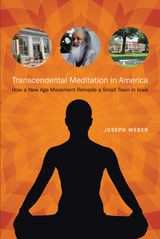
Transcendental Meditation in America
How a New Age Movement Remade a Small Town in IowaJoseph Weber
University of Iowa Press, 2014
The Indian spiritual entrepreneur Maharishi Mahesh Yogi took the West by storm in the 1960s and ’70s, charming Baby Boomers fed up with war and social upheaval with his message of meditation and peace. Heeding his call, two thousand followers moved to tiny Fairfield, Iowa, to set up their own university on the campus of a failed denominational college. Soon, they started a school for prekindergarten through high school, allowing followers to immerse themselves in Transcendental Meditation from toddlerhood through PhDs.
Although Fairfield’s longtime residents were relieved to see that their new neighbors were clean-cut and respectably dressed—not the wild-haired, drug-using hippies they had feared—the newcomers nevertheless quickly began to remake the town. Stores selling exotic goods popped up, TM followers built odd-looking homes that modeled the guru’s rules for peace-inspiring architecture, and the new university knocked down a historic chapel, even as it erected massive golden-domed buildings for meditators. Some newcomers got elected—and others were defeated—when they ran for local and statewide offices. At times, thousands from across the globe visited the small town.
Yet Transcendental Meditation did not always achieve its aims of personal and social tranquility. Suicides and a murder unsettled the meditating community over the years, and some followers were fleeced by con men from their own ranks. Some battled a local farmer over land use and one another over doctrine. Notably, the world has not gotten more peaceful.
Today the guru is dead. His followers are graying, and few of their children are moving into leadership roles. The movement seems rudderless, its financial muscle withering, despite the efforts of high-profile supporters such as filmmaker David Lynch and media magnate Oprah Winfrey. Can TM reinvent itself? And what will be the future of Fairfield itself? By looking closely at the transformation of this small Iowa town, author Joseph Weber assesses the movement’s surprisingly potent effect on Western culture, sketches out its peculiar past, and explores its possible future.
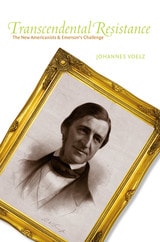
Transcendental Resistance
The New Americanists and Emerson's ChallengeJohannes Voelz
Dartmouth College Press, 2010

Transcendental Wordplay
America’s Romantic Punsters and the Search for the Language of NatureMichael West
Ohio University Press, 2000
Throughout the first half of the nineteenth century, America was captivated by a muddled notion of “etymology.” New England Transcendentalism was only one outcropping of a nationwide movement in which schoolmasters across small-town America taught students the roots of words in ways that dramatized religious issues and sparked wordplay.
Shaped by this ferment, our major romantic authors shared the sensibility that Friedrich Schlegel linked to punning and christened “romantic irony.” Notable punsters or etymologists all, they gleefully set up as sages, creating jocular masterpieces from their zest for oracular wordplay. Their search for a primal language lurking beneath all natural languages provided them with something like a secret language that encodes their meanings. To fathom their essentially comic masterpieces we must decipher it.
Interpreting Thoreau as an ironic moralist, satirist, and social critic rather than a nature-loving mystic, Transcendental Wordplay suggests that the major American Romantics shared a surprising conservatism. In this award-winning study, Professor West rescues the pun from critical contempt and allows readers to enjoy it as a serious form of American humor.
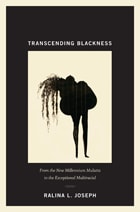
Transcending Blackness
From the New Millennium Mulatta to the Exceptional MultiracialRalina L. Joseph
Duke University Press, 2012
Analyzing emblematic representations of multiracial figures in popular culture—Jennifer Beals's character in the The L Word; the protagonist in Danny Senza's novel Caucasia; the title character in the independent film Mixing Nia; and contestants in a controversial episode of the reality show America's Next Top Model, who had to "switch ethnicities" for a photo shoot—Joseph identifies the persistence of two widespread stereotypes about mixed-race African Americans, those of "new millennium mulattas" and "exceptional multiracials." The former inscribes multiracial African Americans as tragic figures whose blackness predestines them for misfortune; the latter rewards mixed-race African Americans for successfully erasing their blackness. Addressing questions of authenticity, sexuality, and privilege, Transcending Blackness refutes the idea that race no longer matters in American society.
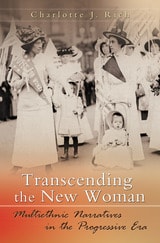
Transcending the New Woman
Multiethnic Narratives in the Progressive EraCharlotte J. Rich
University of Missouri Press, 2009
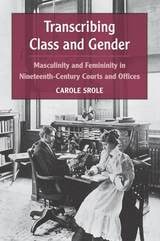
Transcribing Class and Gender
Masculinity and Femininity in Nineteenth-Century Courts and OfficesCarole Srole
University of Michigan Press, 2012
"Drawing upon census data, trade periodicals devoted to stenography and court reporting, the writings of educational reformers, and fiction, Srole allows us to better understand the roles that gender and work played in the formation of middle-class identity. Clearly written and thoroughly researched, her book reminds us of the contradictions that both men and women faced as they navigated changes in the labor market and sought to realize a modern professional identity."
---Thomas Augst, New York University
Transcribing Class and Gender explores the changing meanings of clerical work in nineteenth-century America, focusing on the discourse surrounding that work. At a time when shorthand transcription was the primary method of documenting business and legal communications and transactions, most stenographers were men, but changing technology saw the emergence of women in the once male-dominated field. Carole Srole argues that this shift placed stenographers in a unique position to construct a new image of the professional man and woman and, in doing so, to redefine middle- and working-class identities.
Many male court reporters emphasized their professionalism, portraying themselves as educated language experts as a way to elevate themselves above the growing numbers of female and working-class stenographers and typewriter operators. Meanwhile, women in the courts and offices were confronting the derogatory image of the so-called Typewriter Girl who cared more about her looks, clothing, and marriage prospects than her job. Like males in the field, women responded by fashioning a gendered professional image---one that served to combat this new version of degraded female labor while also maintaining traditional ideals of femininity.The study is unique in the way it reads and analyzes popular fiction, stenography trade magazines, the archives of professional associations, and writings by educational reformers to provide new perspectives on this history. The author challenges the common assumption that men and women clerks had separate work cultures and demonstrates how each had to balance elements of manhood and womanhood in the drive toward professionalism and the construction of a new middle-class image. Transcribing Class and Gender joins the recent scholarship that employs cultural studies approaches to class and gender without abandoning the social history valuation of workers' experiences.
Carole Srole is Professor of History at California State University, Los Angeles.
Photo: A female stenographer working for an actuary in 1897. Courtesy Metlife Archives.
Transfer Student Success
Academic Library Outreach and EngagementNancy Fawley
American Library Association, 2021
Transfiguring America
Myth, Ideology, and Mourning in Margaret Fuller's WritingJeffrey Steele
University of Missouri Press, 2001
Transfiguring America is the product of more than ten years of research and numerous published articles on Margaret Fuller, arguably America's first feminist theorist and one of the most important woman writers in the nineteenth century. Focusing on Fuller's development of a powerful language that paired cultural critique with mythmaking, Steele shows why her writing had such a vital impact on the woman's rights movement and modern conceptions of gender.
This groundbreaking study pays special attention to the ways in which Fuller's feminist consciousness and social theory emerged out of her mourning for herself and others, her dialogue with Emersonian Transcendentalism, and her eclectic reading in occult and mythical sources. Transfiguring America is the first book to provide detailed analyses of all of Fuller's major texts, including her mystical Dial essays, correspondence with Emerson, Summer on the Lakes, 1844 poetry, Woman in the Nineteenth Century, and New York Tribune essays written both in New York and Europe.
Starting from her own profound sense of loss as a marginalized woman, Fuller eventually recognized the ways in which the foundational myths of American society, buttressed by conservative religious ideologies, replicated dysfunctional images of manhood and womanhood. With Woman in the Nineteenth Century, after exploring the roots of oppression in her essays and poetry, Fuller advanced the cause of woman's rights by conceptualizing a more fluid and equitable model of gender founded upon the mythical reconfiguration of human potential. But as her horizons expanded, Fuller demanded not only political equality for women, but also emotional, intellectual, and spiritual freedom for all victims of social oppression.
By the end of her career, Steele shows, Fuller had blended personal experience and cultural critique into the imaginative reconstruction of American society. Beginning with a fervent belief in personal reform, she ended her career with the apocalyptic conviction that the dominant myths both of selfhood and national identity must be transfigured. Out of the ashes of personal turmoil and political revolution, she looked for the phoenix of a revitalized society founded upon the ideal of political justice.
Transformation Now!
Toward a Post-Oppositional Politics of ChangeAnaLouise Keating
University of Illinois Press, 2013
Transformation of American Catholic Sisters
Lora Quinonez
Temple University Press, 1993
Transformation of the Mormon Culture Region
Ethan R. Yorgason
University of Illinois Press, 2010
Transformations of Warfare in the Contemporary World
John C. Torpey
Temple University Press, 2016
Today’s warfare has moved away from being an event between massed national populations and toward small numbers of combatants using high-tech weaponry. The editors of and contributors to the timely collection Transformations of Warfare in the Contemporary World show that this shift reflects changes in the technological, strategic, ideological, and ethical realms.
The essays in this volume discuss:
·the waning connection between citizenship and soldiering;
·the shift toward more reconstructive than destructive activities by militaries;
·the ethics of irregular or asymmetrical warfare;
·the role of novel techniques of identification in military settings;
·the stress on precision associated with targeted killings and kidnappings;
·the uses of the social sciences in contemporary warfare.
In his concluding remarks, David Jacobson explores the extent to which the contemporary transformation of warfare is a product of a shift in the character of the combatants themselves.
Contributors include: Ariel Colonomos, Roberto J. González, Travis R. Hall, Saskia Hooiveld, Rob Johnson, Colonel C. Anthony Pfaff, Ian Roxborough, and the editors
Transformations
Change Work across Writing Programs, Pedagogies, and PracticesHolly Hassel
Utah State University Press, 2021
The collection includes chapters from multiple award-winning writing programs, including the recipients of the Two-Year College Association’s Outstanding Programs in English Award and the Conference on College Composition and Communication’s Writing Program Certificate of Excellence. These authors offer perspectives that demonstrate the deep work of transformation in writing programs and practices writ large, confirm the ways in which writing programs are connected to and situated within larger institutional and disciplinary contexts, and outline successful methods for navigating these contexts in order to transform the work.
In using the prism of transformation as the organizing principle for the collection, Transformations offers a range of strategies for adapting writing programs so that they meet the needs of students and teachers in service of creating equitable, ethical literacy instruction in a range of postsecondary contexts.
Contributors: Leah Anderst, Cynthia Baer, Ruth Benander, Mwangi Alex Chege, Jaclyn Fiscus-Cannaday, Joanne Giordano, Rachel Hall Buck, Sarah Henderson Lee, Allison Hutchinson, Lynee Lewis Gaillet, Jennifer Maloy, Neil Meyer, Susan Miller-Cochran, Ruth Osorio, Lori Ostergaard, Shyam Pandey, Cassie Phillips, Brenda Refaei, Heather Robinson, Shelley Rodrigo, Julia Romberger, Tiffany Rousculp, Megan Schoen, Paulette Stevenson
Transforming Cities and Minds through the Scholarship of Engagement
Economy, Equity, and EnvironmentLorlene Hoyt
Vanderbilt University Press, 2013
Across the country from Camden to Oakland, the contributors engaged with community partners--hospitals, churches, community development corporations, community foundations, and other rooted institutions--to help restore old cities to life. Their collaborative thesis project engaged them with one another and university staff; it may offer a new paradigm for graduate education.