Results by title
3576 books match the query 'American' and 50 start with u
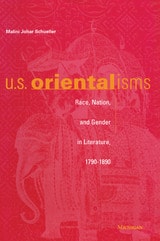
U.S. Orientalisms
Race, Nation, and Gender in Literature, 1790-1890Malini Johar Schueller
University of Michigan Press, 2001
This book begins with an examination of the literature of the "Barbary" Orient generated by the U.S. Algerian conflict in the late eighteenth century in the works of such writers as Royall Tyler, Susanna Rowson, and Washington Irving. It then moves on to the Near East Orientalist literature of the nineteenth century in light of Egyptology, theories of race, and the growth of missionary fervor in writers such as John DeForest, Maria Susanna Cummins, Herman Melville, Edgar Allan Poe, and Harriet Prescott Spofford. Finally, Schueller considers the Indic Orientalism of the period in the context of Indology, British colonialism, and the push for Asian trade in the United States, focusing particularly on Emerson and Whitman. U.S. Orientalisms demonstrates how these writers strove to create an Orientalism premised on the idea of civilization and empire moving West, from Asia, through Europe, and culminating in the New World.
Schueller draws on the work of Michel Foucault, Edward Said, Homi Bhabha, Rey Chow, and Judith Butler and compellingly demonstrates how a raced, compensatory "Orientalist" discourse of empire was both contested and evoked in the literary works of a wide variety of writers. The book will be of interest to readers in American history, postcolonial studies, gender studies, and literary theory.
Malini Johar Schueller is Associate Professor, Department of English, University of Florida. She is the author of The Politics of Voice: Liberalism and Social Criticism from Franklin to Kingston.

UMass Rising
The University of Massachusetts Amherst at 150Katharine Greider
University of Massachusetts Press, 2013
The principles that undergirded Mass Aggie's founding continue to form the basis for UMass Amherst's mission of preparing young people to make their way in life by stretching boundaries in all disciplines, from the physical and social sciences to the liberal arts. UMass Rising looks at the school over the course of its first 150 years and mines that history to reveal not only how these principles have been fostered, but also the whys and whos.
The engaging text is enhanced by features on all aspects of life at this unique university. The reader encounters a cavalcade of notable people, as well as many little-known anecdotes, from the humorous to the touching. All are anchored by a gathering of contemporary and archival images, some published here for the first time.
Distributed for the University of Massachusetts Amherst by University of Massachusetts Press.
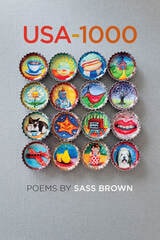
USA-1000
Sass Brown
Southern Illinois University Press, 2016
Sass Brown’s darkly funny debut collection of poems explores both the isolation and the absurdity of twenty-something apartment living. The world Brown creates in USA-1000 overflows with infomercials, classic Hollywood films, billboard messages, strip clubs, and fortune-tellers, illuminating our complex relationship with consumerism. In the absence of personal intimacy, everyday objects take on unexpected importance: the clothing of a would-be couple mingles in a washing machine; a father watches pornography in a hotel room with his wife and daughter; a woman searches a shopping mall to put on hold items she’ll never buy; a broken hair dryer prompts a complaint letter to the Better Business Bureau. Brown’s dazzling poems probe the disappointment of domestic reality in the face of America’s glossy facade, abundance and emptiness hand in hand. Ultimately, the book finds beauty in the deliciously artificial and resurrects “the missing world” with words and memory.
Ugly White People
Writing Whiteness in Contemporary AmericaStephanie Li
University of Minnesota Press, 2023
Whiteness revealed: an analysis of the destructive complacency of white self-consciousness
White Americans are confronting their whiteness more than ever before, with political and social shifts ushering in a newfound racial awareness. And with white people increasingly seeing themselves as distinctly racialized (not simply as American or human), white writers are exposing a self-awareness of white racialized behavior—from staunch antiracism to virulent forms of xenophobic nationalism. Ugly White People explores representations of whiteness from twenty-first-century white American authors, revealing white recognition of the ugly forms whiteness can take.
Stephanie Li argues that much of the twenty-first century has been defined by this rising consciousness of whiteness because of the imminent shift to a “majority minority” population and the growing diversification of America’s political, social, and cultural institutions. The result is literature that more directly grapples with whiteness as its own construct rather than a wrongly assumed norm. Li contextualizes a series of literary novels as collectively influenced by changes in racial and political attitudes. Turning to works by Dave Eggers, Sarah Smarsh, J. D. Vance, Claire Messud, Ben Lerner, and others, she traces the responses to white consciousness that breed shared manifestations of ugliness. The tension between acknowledging whiteness as an identity built on domination and the failure to remedy inequalities that have proliferated from this founding injustice is often the source of the ugly whiteness portrayed through these narratives.
The questions posed in Ugly White People about the nature and future of whiteness are vital to understanding contemporary race relations in America. From the election of Trump and the rise of white nationalism to Karen memes and the war against critical race theory to the pervasive pattern of behavior among largely liberal-leaning whites, Li elucidates truths about whiteness that challenge any hope of national unity and, most devastatingly, the basic humanity of others.
Retail e-book files for this title are screen-reader friendly.
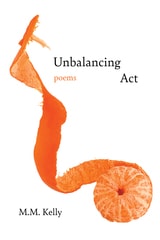
Unbalancing Act
M.M. Kelly
Four Way Books, 2026
Unbalancing Act is a haunting collection of poems about the particular physics of loving and losing—about the way grief, desire, memory, and awe can tip a life off its axis, and right it again. The speaker moves through fire and water, childhood, intimacy and abandonment, always with one eye on the natural world: bears, whales, rivers, storms, animals sleeping in impossible ways. The poems are lyric but narrative-driven, often darkly funny, and fascinated—bordering on obsessed—with the strange facts and small surrealities that make ordinary life feel mythic.
At its heart, the book is about imbalance as a kind of truth: the way trauma warps time, the way love can feel like weather, the way the body keeps trying to survive even when the mind wants to disappear. It's a collection for readers who like their beauty a little feral—poems that are tender but not precious, intelligent but not academic, and emotionally sharp without ever losing their sense of wonder.
Unbeknownst
Julie Hanson
University of Iowa Press, 2011
Julie Hanson’s award-winning collection, Unbeknownst, gives us plainspoken poems of unstoppable candor. They are astonished and sobered by the incoming data; they are funny; they are psychologically accurate and beautifully made. Hanson’s is a mind interested in human responsibility—to ourselves and to each other—and unhappy about the disappointments that are bound to transpire (“We’ve been like gods, our powers wasted”). These poems are lonely with spiritual longing and wise with remorse for all that cannot last.
“The Kindergartners” begins, “All their lives they’ve waited for / the yellow bus to come for them,” then moves directly to the present reality: “Now it’s February and the mat / is wet.” Settings and events are local and familiar, never more exotic than a yoga session at the Y, one of several instances where the body is central to the report and to the net result (“I slip in and fold / behind the wheel into the driver’s seat like a thin young thing: / My organs are surely glistening. This car was made for me.“). These poems are intimate revelations, thinking as they go, including the reader in the progress of their thoughts.
Uncertainty and Plenitude
Five Contemporary PoetsPeter Stitt
University of Iowa Press, 1997
Stitt's interest in these five poets is intellectual and aesthetic. As he states, “I chose these particular writers because their work continues to interest me deeply, both intellectually and formally, even after years of familiarity.” He uses his understanding of the philosophical implications inherent in modern physics, as they apply to both content and form, as the basis for his close analysis.
Stitt attends to the poets' writerly strategies so that we may discover in their poetry where “surface form” intersects and complements meaning and thus becomes, in John Berryman's terms, “deep form.” He explains what these poets say and how they say it and what relationships lie between. He also shows how humor plays a part in some of their work.
Uncommon Weather
Alaska StoriesRichard Chiappone
University of Alaska Press, 2024
Richard Chiappone’s characters hail from a wide range of socioeconomic strata, each one attempting to figure out the difficult question of how best to live among others. Odd connections abound. In the seriocomic title story, a lonely middle-aged woman, weary of her austere Alaskan life and her crumbling marriage, picks up a hockey stick and a younger man and tries to brawl her way to some better future. A man diagnosed with an apparently terminal illness is caught up in a catastrophic criminal undertaking masterminded by a precocious seventeen-year-old girl. A young boy, determined to fit in with his edgier peers, goes through a metamorphosis, becoming a strange new creature he’s never seen before. With sometimes hilarious missteps, each character stumbles in and out of predicaments that are by turns tender, heartbreaking, dangerous, and even violent.
Told with great empathy and often deeply ironic, wry, and sardonic humor, these stories are a counterpoint to the usual mythos, illuminating an Alaska not usually portrayed in books, on TV, or in movies.
Uncommon Women
Gender and Representation in Nineteenth-Century U.S. Women's WritingLaura Laffrado
The Ohio State University Press, 2009
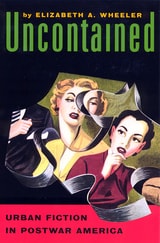
Uncontained
Urban Fiction in Postwar AmericaWheeler, Elizabeth A.
Rutgers University Press, 2001
In the postwar era, American urban fiction is dominated by the imagery of containment. Across the fictional landscape, the city is divided into segregated zones, marked by the threat of inevitable violence, and set off from the safety of equally contained suburbs. Mean and dangerous, the city can only be navigated by a solitary expert, alienated and male. In Uncontained, Elizabeth A. Wheeler offers a critique of this familiar story-evident in the noir. narratives of James M. Cain and in work by Ellison, Roth, Salinger, Percy, Capote, and others —and challenges its link to the postwar city.
Discussing film, short stories, and novels from a cross-section of American cities, Wheeler integrates these stories of containment into a shared pattern and reads them across a broad spectrum of famous and forgotten works by men and women of various ethnic and literary traditions to reveal a larger vision of postwar America. Knowing that containment is never the entire story, that diversity or trauma always shows itself, she shows how the uncontained has shaped the historical moment. Aware that liberating counterstories do get told, she places them in dialogue with those of the alienated man, the war veteran, Beat hipster, noir detective, and ironic suburbanite — in historical context — and revives the idea of urban space as a place of openness, thereby challenging a literary containment of racial difference, gender, and sexuality. By reading Paule Marshall in tandem with Philip Roth, Wheeler explores the relationships between adjacent neighborhoods and reconnects separate literary and geographic areas. By bringing Ann Bannon's lesbian pulp fiction, Hubert Selby's cult novels, or the work of John Okada, Hisaye Yamamoto, Chester Himes, Gwendolyn Brooks's, Jo Sinclair, and many others to bear on more canonical texts, she offers a more complete understanding of this period of American fiction — one that points toward a city that is open and inclusive.
Uncontained suggests that while decline, division, and decay form a major part of the story of mid-century urban America, the postwar city also represents much of what is best about American life. Rather than reproducing the containment of culture, Wheeler places together the wildly disparate to show how we move beyond containment.
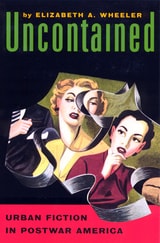
Uncontained
Urban Fiction in Postwar AmericaWheeler, Elizabeth A.
Rutgers University Press, 2001
In the postwar era, American urban fiction is dominated by the imagery of containment. Across the fictional landscape, the city is divided into segregated zones, marked by the threat of inevitable violence, and set off from the safety of equally contained suburbs. Mean and dangerous, the city can only be navigated by a solitary expert, alienated and male. In Uncontained, Elizabeth A. Wheeler offers a critique of this familiar story-evident in the noir. narratives of James M. Cain and in work by Ellison, Roth, Salinger, Percy, Capote, and others —and challenges its link to the postwar city.
Discussing film, short stories, and novels from a cross-section of American cities, Wheeler integrates these stories of containment into a shared pattern and reads them across a broad spectrum of famous and forgotten works by men and women of various ethnic and literary traditions to reveal a larger vision of postwar America. Knowing that containment is never the entire story, that diversity or trauma always shows itself, she shows how the uncontained has shaped the historical moment. Aware that liberating counterstories do get told, she places them in dialogue with those of the alienated man, the war veteran, Beat hipster, noir detective, and ironic suburbanite — in historical context — and revives the idea of urban space as a place of openness, thereby challenging a literary containment of racial difference, gender, and sexuality. By reading Paule Marshall in tandem with Philip Roth, Wheeler explores the relationships between adjacent neighborhoods and reconnects separate literary and geographic areas. By bringing Ann Bannon's lesbian pulp fiction, Hubert Selby's cult novels, or the work of John Okada, Hisaye Yamamoto, Chester Himes, Gwendolyn Brooks's, Jo Sinclair, and many others to bear on more canonical texts, she offers a more complete understanding of this period of American fiction — one that points toward a city that is open and inclusive.
Uncontained suggests that while decline, division, and decay form a major part of the story of mid-century urban America, the postwar city also represents much of what is best about American life. Rather than reproducing the containment of culture, Wheeler places together the wildly disparate to show how we move beyond containment.
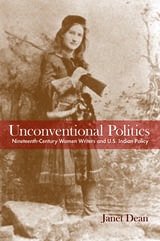
Unconventional Politics
Nineteenth-Century Women Writers and U.S. Indian PolicyJanet Dean
University of Massachusetts Press, 2016
Dean argues that in protesting U.S. Indian policy through popular genres, Wakefield, Sigourney, Callahan, and Eddleman also critiqued cultural protocols and stretched the contours of accepted modes of feminine discourse. Their acts of improvisation and reinvention tell a new story about the development of American women's writing and political expression.
Under Sleep
Daniel Hall
University of Chicago Press, 2007
Then
You looked up vaguely
or you didn’t—even the memory
is dying. Then you whole body
breathed out, and the argument ended.
Heaven surfaced about you
like a glass tabletop, hard
and cold. Whatever you do
don’t turn me into poetry. Sorry:
I am done crying about it
but I am not done crying.
An extended meditation on how death affects those left behind, Under Sleep is a skillfully understated, beautifully rendered elegy for the poet’s partner. Formally inventive and technically sophisticated, Daniel Hall attends to the power of death to haunt every perception. The poet’s voice registers as though he were walking on the bottom of the ocean, in a state of mind somewhere “under sleep,” in a kind of waking dream. In Hall’s hands, isolated moments of perception bloom into truly touching love elegies.
The poems in Under Sleep were written over a period of ten years and, as a result, are densely interconnected, with lines and entire stanzas transplanted between different poems. Using styles ranging from free verse to sonnets, Sapphics, and rhymed haikus, Hall populates the book with literary and historical figures—Baudelaire, Pound, and Casanova—in poems set in China, the Middle East, Death Valley, and Italy. Throughout, the poetry is propelled by tension as the speaker struggles with his own better judgment—and against his lover’s wishes—to turn the loss of the beloved into art.
Praise for Daniel Hall
“Daniel Hall’s work reminds us that a poet’s sharp-sightedness, the whole business of ‘getting things right,’ is a matter of far more than accuracy. It’s a matter of—inescapably—thanksgiving.”—Brad Leithauser, New York Review of Books

Under a Glass Bell
Anaïs Nin
Ohio University Press, 2013
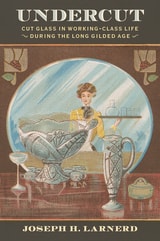
Undercut
Cut Glass in Working-Class Life During the Long Gilded AgeJoseph Larnerd
University of Delaware Press, 0
How did workers experience cut glass during its cultural heyday? Rather than privilege the stories of factory owners or wealthy consumers, Undercut: Cut Glass in Working-Class Life During the Long Gilded Age refracts the medium’s history through the labors required to make and maintain these dazzling artifacts as well as popular representations of this work, from demonstrations at world's fairs to images of domestic workers with finished pieces in their charge. Cut glass and the many manifestations of public interest in its labors offered working people, too, occasions for self-reflection and, perhaps, self-realization. Foregrounding their lives, Undercut offers a multifaceted social art history of a once-popular genre of decorative art that cuts across class, gender, and race.
Underscore
Julie Carr
Omnidawn, 2024
Julie Carr’s most intimate book to date, Underscore, is dedicated to two of Carr’s foundational teachers, the dancer Nancy Stark Smith and the poet Jean Valentine, both of whom died in 2020. Elegiac and tender—at times erotic at other times bitter—these poems remain deeply invested in human relationships amid a life whose backdrop is human suffering.
Reaching toward the “ghost companions in the thicket” and to the beloveds who still “pulse with activity,” Underscore’s sonically intricate poems express a longing for dynamic forces of intra-action, a sense of expanded encounter, and what Stark Smith called “overlapping kinespheres.”
Understanding Nationalism
On Narrative, Cognitive Science, and IdentityPatrick Colm Hogan
The Ohio State University Press, 2009
Undress, She Said
Doug Anderson
Four Way Books, 2022
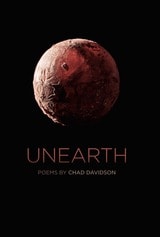
Unearth
Chad Davidson
Southern Illinois University Press, 2020
“What if the end were as colorless as real / estate?” the speaker asks in Unearth. Poet Chad Davidson’s latest collection takes a hard look at our world as it collapses under numerous trials and tribulations. Fashioned mostly of elegiac poems, Unearth charts the way in which personal grief ripples out to meet and mirror larger systems of loss. The first section deals with local traumas and bereavements—the loss of pets, the disintegration of a friends’ marriage. These tragedies combine with more ominous, larger breakdowns in the second section until, in the final section, grief roils over into historical wickedness, institutionalized violence, and state-sanctioned wrath. Ultimately, “Even the mouth / of a volcano, from far away, / is beautiful.”
The poetry itself offers us vessels into which we can pour out our despair. To understand the failing earth, Davidson’s speaker cajoles us to see the pain at its roots. From the opening poem—a reluctant elegy for a mother—to the final eschatological survey, an ode to maddening violence and destruction on a global scale, this collection imagines a world in which private and public terrors feed on each other, ultimately growing to a fever pitch. An act of resistance, this collection gives voice to our deep-seated emotional pain and offers us constructive ways to deal with it.
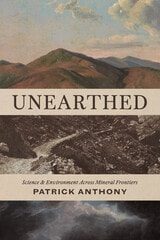
Unearthed
Science and Environment Across Mineral FrontiersPatrick Anthony
University of Chicago Press, 2026
Unearthed depicts a pivotal moment during the nineteenth century: As European and settler schemes to govern ever larger territories intensified, the earth and atmospheric sciences were also becoming more global in scope, assembling models of the planet while making use of militarized or highly industrialized systems. These efforts were informed by the physique du monde, or global physics, of Alexander von Humboldt (1769–1859), a program of vast data collection that spanned four hemispheres that aimed to determine general, scientific laws about the planet and its environments.
Using Humboldt’s itineraries as a frame, Unearthed traces an information order that linked far-flung industrial sites and frontier stations, from Prussian provinces to the Spanish and Russian empires. Humboldt intersected with Saxon miners, Mexican cartographers, and Siberian surveyors, among other itinerant Germans who mobilized the labor and resources of widespread mining operations for global surveys of earth and air. Interweaving the histories of capital and climate, Patrick Anthony takes readers from mines to mountains to show how the sciences of Humboldt’s circuits both measured and made modern natures. These sciences of the mineral frontier, he argues, ultimately laid the groundwork for carbon-intensive economics and a logic of unending extraction. Wide-ranging and ambitious, Unearthed will interest scholars working in the history of science, global history, and the environmental humanities.
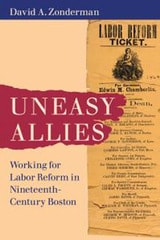
Uneasy Allies
Working for Labor Reform in Nineteenth-Century BostonDavid A. Zonderman
University of Massachusetts Press, 2011
In addition to analyzing what motivated these workers and reformers to create cross-class organizations, David Zonderman examines the internal tactical debates and external political pressures that fractured them, even as new alliances were formed, and shows how these influences changed over time. He describes what workers and reformers learned about politics and social change within these complex and volatile alliances, and speculates as to whether those lessons have relevance for activists and reformers today.
What emerges from this investigation is a narrative of progress and decline that spans nearly three-quarters of a century, as an ever-shifting constellation of associations debated the meaning of labor reform and the best strategy to secure justice for workers. But the quest for ideological consistency and organizational coherence was not easily achieved. By century's end, not only did Boston look dramatically different from its antebellum ancestor, but its labor reform alliances had lost some of their earlier openhearted optimism and stubborn resilience.
Unfathoming
Andrea Cohen
Four Way Books, 2017
Unfollowers
Leigh Ann Ruggiero
University of Massachusetts Press, 2022
Winner of the 2023 National Indie Excellence Award in Multicultural Fiction
Winner of the 2022 Forward INDIES Silver Award for Literary Fiction
Finalist of the 2023 National Indie Excellence Award in New Fiction
Finalist of the 2023 Eric Hoffer Book Award
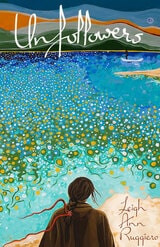
Barb Matheson doesn’t fit in: not on the Standing Rock Reservation where her mother was born; not at the mission in rural Ethiopia where she grew up; and certainly not at the Pennsylvania church where her husband preaches. Expansive and lyrical, Unfollowers is a tale of religious angst, unrequited love, and the upheaval of racial and economic privilege. Equally adrift on both sides of the Atlantic, Barb must negotiate the distance between white America and Africa, between the spirituality of her ancestors and the straight tones of evangelicalism, and between rules and grace. When a former lover crashes her daughter’s third birthday party, she’s offered the chance to find her way home to Ethiopia, leaving her to choose between a rote life in America and an improvised life abroad.
Unguessed Kinships
Naturalism and the Geography of Hope in Cormac McCarthySteven Frye
University of Alabama Press, 2023
Literary naturalism at play in one of America’s most visionary novelists: Cormac McCarthy
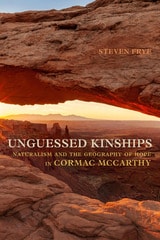
It took six novels and nearly thirty years for Cormac McCarthy to find commercial success with the National Book Award–winning All the Pretty Horses, followed by major prizes, more best sellers, and Hollywood adaptations of his work. Those successes, though, have obscured McCarthy’s commitment to an older form of literary expression: naturalism.
It is hardly a secret that McCarthy’s work tends to darker themes: violence, brutality, the cruel indifference of nature, themes which would not be out of place in the writing of Jack London or Stephen Crane. But literary naturalism is more than the oversimplified Darwinism that many think of. Nature may be red in tooth and claw, and humans are part of nature, but the humanity depicted in naturalist literature is capable of love, selflessness, and spirituality, as well.
In Unguessed Kinships, Steven Frye illuminates all these dimensions of McCarthy’s work. In his novels and plays, McCarthy engages both explicitly and obliquely with the project of manifest destiny, in the western drama Blood Meridian, the Tennessee Valley Authority-era Tennessee novels, and the atomic frontier of Alamogordo in Cities of the Plain. McCarthy’s concerns are deeply religious and philosophical, drawing on ancient Greek philosophy, Gnosticism, and Nietzsche, among other sources. Frye argues for McCarthy not merely as a naturalist writer but as a naturalist in the most expansive sense. Unguessed Kinships includes biographical and historical context in each chapter, widening the appeal of the text to not just naturalists or McCarthy scholars but anyone studying the literature of the South or the West.
Universes without Us
Posthuman Cosmologies in American LiteratureMatthew A. Taylor
University of Minnesota Press, 2013
During the nineteenth and early twentieth centuries, a wide variety of American writers proposed the existence of energies connecting human beings to cosmic processes. From varying points of view—scientific, philosophical, religious, and literary—they suggested that such energies would eventually result in the perfection of individual and collective bodies, assuming that assimilation into larger networks of being meant the expansion of humanity’s powers and potentialities—a belief that continues to inform much posthumanist theory today.
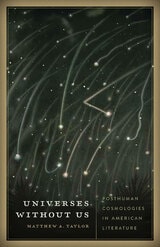
Universes without Us explores a lesser-known countertradition in American literature. As Matthew A. Taylor’s incisive readings reveal, the heterodox cosmologies of Edgar Allan Poe, Henry Adams, Charles Chesnutt, and Zora Neale Hurston reject the anthropocentric fantasy that sees the universe as a kind of reservoir of self-realization. For these authors, the world can be made neither “other” nor “mirror.” Instead, humans are enmeshed with “alien” processes that are both constitutive and destructive of “us.” By envisioning universes no longer our own, these cosmologies picture a form of interconnectedness that denies any human ability to master it.
Universes without Us demonstrates how the questions, possibilities, and dangers raised by the posthuman appeared nearly two centuries ago. Taylor finds in these works an untimely engagement with posthumanism, particularly in their imagining of universes in which humans are only one category of heterogeneous thing in a vast array of species, objects, and forces. He shows how posthumanist theory can illuminate American literary texts and how those texts might, in turn, prompt a reassessment of posthumanist theory. By understanding the posthuman as a materialist cosmology rather than a technological innovation, Taylor extends the range of thinkers who can be included in contemporary conversations about the posthuman.

Unknown Waters
A First-Hand Account of the Historic Under-Ice Survey of the Siberian Continental Shelf by USS Queenfish (SSN-651)Alfred S. McLaren
University of Alabama Press, 2008
“A first-person view of submarine under-ice operations that appears in very few other works.” —Gary E. Weir, author of Rising Tide: The Untold Story of the Russian Submarines that Fought the Cold War
Unknown Waters tells the story of the brave officers and men of the nuclear attack submarine USS Queenfish (SSN-651), who made the first survey of an extremely important and remote region of the Arctic Ocean. The unpredictability of deep-draft sea ice, shallow water, and possible Soviet discovery, all played a dramatic part in this engrossing 1970 voyage.
Covering 3,100 miles over a period of some 20 days at a laborious average speed of 6.5 knots or less, the attack submarine carefully threaded its way through innumerable underwater canyons of ice and over irregular seafloors, at one point becoming entrapped in an “ice garage.” Only cool thinking and skillful maneuvering of the nearly 5,000-ton vessel enabled a successful exit.
Unlikely Designs
Katie Willingham
University of Chicago Press, 2017
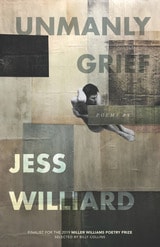
Unmanly Grief
PoemsJess Williard
University of Arkansas Press, 2019
Finalist, 2019 Miller Williams Poetry Prize
“Poems that lead us to striking insights and strange destinations.”
—Billy Collins
The men who recur as characters throughout Jess Williard’s Unmanly Grief perform their masculinity in a variety of ways: boxing, theater, brotherhood, labor, and familial and romantic love. Marked by a sharp nostalgia, Williard’s poems move from Wisconsin to New York City and back, tracing the geographic movement of the speaker and his family: a teenage sister who disappears and returns, changed irrevocably; an older brother dismantled in adulthood; an ever-sacrificing father. Woven through the musculature of this varied and exciting collection, music appears as readily in dexterous formal verse as in lean, scrappy storytelling. What results is a crooning celebration of struggle and tenderness in this world, “where to be small and furious is enough.”
Finalist, 2020 Milt Kessler Poetry Book Award from the Binghamton Center for Writers
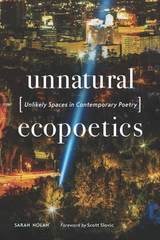
Unnatural Ecopoetics
Unlikely Spaces in Contemporary PoetrySarah Nolan
University of Nevada Press, 2017
By approaching environments in a new way, Nolan closes this gap and recognizes how contemporary poets employ self-reflexive commentary and formal experimentation in order to create new natural/cultural environments on the page. She proposes a radical new direction for ecopoetics and deploys it in relation to four major American poets. Working from literal to textual spaces through the contemporary poetry of A.R. Ammons’s Garbage, Lyn Hejinian’s My Life, Susan Howe’s The Midnight, and Kenneth Goldsmith’s Seven American Deaths and Disasters, the book presents applications of unnatural ecopoetics in poetic environments, ones that do not engage with traditional ideas of nature and would otherwise remain outside the scope of ecocritical and ecopoetic studies.
Nolan proposes a new practical approach for reading poetic language. Ecocriticism is a very fluid and evolving discipline, and Nolan’s pioneering new book pushes the boundaries of second-wave ecopoetics—the fundamental issue being what is nature/natural, and how does poetic language, particularly self-conscious contemporary poetic agency, contribute to and complicate that question.
Unnatural Narratology
Extensions, Revisions, and ChallengesEdited by Jan Alber and Brian Richardson
The Ohio State University Press, 2020
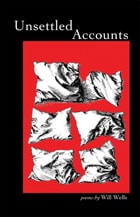
Unsettled Accounts
PoemsWill Wells
Ohio University Press, 2010
To take the mess of life and make meaning from it is what all poets seek to do. For Will Wells, recipient of the thirteenth annual Hollis Summers Poetry Prize, this includes reaching across centuries and continents, into the minds and hearts of disparate individuals—Albert Einstein, Andrea Yates, the traveler from Porlock, Dante, or Holocaust survivors, including his own grandmother—to extract the personal value embedded there for him.
By turns funny, shocking, gentle, and musing, the poems of Unsettled Accounts reflect Will Wells’s constant attention to his environment and to his past—and to our environment and our past—and his persistent effort to keep them real and whole by turning them into art.
Ping-Pong with the Nazis
Bored couriers have kicked off boots and set
their pipes aside, a Dutch interior.
The slapped ball clacks over the table
like a telegraphic code, then trickles
like faint hope across the marble floor.
How quickly he bends to retrieve it
and puts it back in play, the Jewish boy
living with false papers in a villa
owned by his mother’s Gentile friends, and now
commandeered by retreating Germans
as divisional headquarters. The young
blond soldiers, deferential to a social
better, muss his blond locks like the kid
brothers back in the fatherland, like big
brothers steeped in genial menace.
He begs another game, so they relent.
As the ball resumes its chatter across
the no-man’s-land strung with a net,
he calculates the risk that each shot brings.
And so do they. He holds his pee and serves.
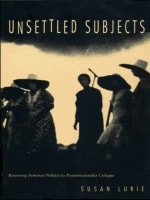
Unsettled Subjects
Restoring Feminist Politics to Poststructuralist CritiqueSusan Lurie
Duke University Press, 1997
In her analysis, Lurie traces each author’s strategies for revealing and challenging the ways that patriarchal gender ideology profits from what is always plural and contested female subjectivity. Only such an inquiry, Lurie demonstrates, can explain the impasses that have steered poststructuralist feminism away from gender as a category of analysis and can point toward the models necessary for a more complete feminist critique of patriarchal power.
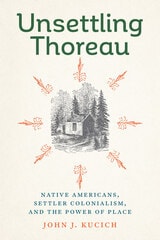
Unsettling Thoreau
Native Americans, Settler Colonialism, and the Power of PlaceJohn J. Kucich
University of Massachusetts Press, 2024
A CHOICE 2025 Outstanding Academic Title
Finalist for the 2025 New England Society Book Awards
Henry David Thoreau’s life-long fascination with Native Americans is widely known and a recurring topic of interest, and it is also a source of modern debate. This is a figure who both had a deep interest in Native American history and culture and was seen by many of his contemporaries, including Ralph Waldo Emerson and Nathaniel Hawthorne, as “more like an Indian” than his white neighbors. At the same time, Thoreau did little to protest the systematic dispossession of Indigenous people across the country in his lifetime. John J. Kucich charges into this contradiction, considering how Thoreau could demonstrate deep respect for Native American beliefs on one hand and remain largely silent about their genocide, actively happening throughout his life, on the other. Thoreau’s long study of Native peoples, as reflected in so much of his writing, allowed him to glimpse an Indigenous worldview, but it never fully freed him from the blind spots of settler colonialism.
Drawing on Indigenous studies and critiques of settler colonialism, as well as new materialist approaches that illustrate Thoreau’s radical reimagining of the relationship between humans and the natural world, Unsettling Thoreau explores the stakes of Thoreau’s effort to live mindfully and ethically in place when living alongside, or replacing marginalized peoples. By examining the whole scope of his writings, including the unpublished Indian Notebooks, and placing them alongside Native writers and communities in and beyond New England, this book gauges Thoreau’s effort to use Indigenous knowledge to reimagine a settler colonial world, without removing him from its trappings.
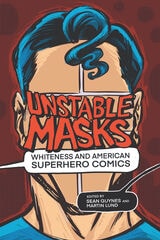
Unstable Masks
Whiteness and American Superhero ComicsEdited by Sean Guynes and Martin Lund
The Ohio State University Press, 2020
In Unstable Masks: Whiteness and American Superhero Comics, Sean Guynes and Martin Lund bring together a series of essays that contextualize the histories and stakes of whiteness studies, superhero comics, and superhero studies for academics, fans, and media-makers alike. The volume illustrates how the American comic book superhero is fundamentally a figure of white power and white supremacy and ultimately calls for diversity in superhero comics as well as a democratized media culture.
Contributors not only examine superhero narratives but also delve into the production, distribution, audience, and reception of those narratives, highlighting the imbrication of forces that have helped to create, normalize, question, and sometimes even subvert American beliefs about whiteness and race. Unstable Masks considers the co-constitutive nature of identity, representation, narrative, production and consumption, and historical and cultural contexts in forging the stereotypes that decide who gets to be a superhero and who gets to be American on the four-color pages of comic books.
Until Choice Do Us Part
Marriage Reform in the Progressive EraClare Virginia Eby
University of Chicago Press, 2013
For centuries, people have been thinking and writing—and fiercely debating—about the meaning of marriage. Just a hundred years ago, Progressive era reformers embraced marriage not as a time-honored repository for conservative values, but as a tool for social change.
In Until Choice Do Us Part, Clare Virginia Eby offers a new account of marriage as it appeared in fiction, journalism, legal decisions, scholarly work, and private correspondence at the turn into the twentieth century. She begins with reformers like sexologist Havelock Ellis, anthropologist Elsie Clews Parsons, and feminist Charlotte Perkins Gilman, who argued that spouses should be “class equals” joined by private affection, not public sanction. Then Eby guides us through the stories of three literary couples—Upton and Meta Fuller Sinclair, Theodore and Sara White Dreiser, and Neith Boyce and Hutchins Hapgood—who sought to reform marriage in their lives and in their writings, with mixed results. With this focus on the intimate side of married life, Eby views a historical moment that changed the nature of American marriage—and that continues to shape marital norms today.
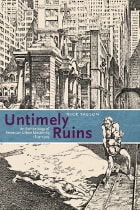
Untimely Ruins
An Archaeology of American Urban Modernity, 1819-1919Nick Yablon
University of Chicago Press, 2009
American ruins have become increasingly prominent, whether in discussions of “urban blight” and home foreclosures, in commemorations of 9/11, or in postapocalyptic movies. In this highly original book, Nick Yablon argues that the association between American cities and ruins dates back to a much earlier period in the nation’s history. Recovering numerous scenes of urban desolation—from failed banks, abandoned towns, and dilapidated tenements to the crumbling skyscrapers and bridges envisioned in science fiction and cartoons—Untimely Ruins challenges the myth that ruins were absent or insignificant objects in nineteenth-century America.
The first book to document an American cult of the ruin, Untimely Ruins traces its deviations as well as derivations from European conventions. Unlike classical and Gothic ruins, which decayed gracefully over centuries and inspired philosophical meditations about the fate of civilizations, America’s ruins were often “untimely,” appearing unpredictably and disappearing before they could accrue an aura of age. As modern ruins of steel and iron, they stimulated critical reflections about contemporary cities, and the unfamiliar kinds of experience they enabled. Unearthing evocative sources everywhere from the archives of amateur photographers to the contents of time-capsules, Untimely Ruins exposes crucial debates about the economic, technological, and cultural transformations known as urban modernity. The result is a fascinating cultural history that uncovers fresh perspectives on the American city.
Up Against the Real
Black Mask from Art to ActionNadja Millner-Larsen
University of Chicago Press, 2023
With Up Against the Real, Nadja Millner-Larsen offers the first comprehensive study of the group Black Mask and its acrimonious relationship to the New York art world of the 1960s. Cited as pioneers of now-common protest aesthetics, the group’s members employed incendiary modes of direct action against racism, colonialism, and the museum system. They shut down the Museum of Modern Art, fired blanks during a poetry reading, stormed the Pentagon in an antiwar protest, sprayed cow’s blood at the secretary of state, and dumped garbage into the fountain at Lincoln Center. Black Mask published a Dadaist broadside until 1968, when it changed its name to Up Against the Wall Motherfucker (after line in a poem by Amiri Baraka) and came to classify itself as “a street gang with analysis.” American activist Abbie Hoffman described the group as “the middle-class nightmare . . . an anti-media phenomenon simply because their name could not be printed.”
Up Against the Real examines how and why the group ultimately rejected art in favor of what its members deemed “real” political action. Exploring this notorious example of cultural activism that rose from the ruins of the avant-garde, Millner-Larsen makes a critical intervention in our understanding of political art.
Up Jump the Boogie
John Murillo
Four Way Books, 2020
"The feel of now lives in John Murillo's UP JUMP THE BOOGIE, but it's tempered by bows to the tradition of soulful music and oral poetry. The lived dimensions embodied in this collection say that here's an earned street knowledge and a measured intellectual inquiry that dare to live side by side, in one unique voice. The pages of UP JUMP THE BOOGIE breathe and sing; the tributes and cultural nods are heartfelt, and in these honest poems no one gets off the hook."—Yusef Komunyakaa
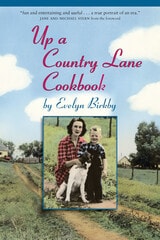
Up a Country Lane Cookbook
Evelyn Birkby
University of Iowa Press, 1993
What can Evelyn Birkby possibly do to follow up the success of Neighboring on the Air: Cooking with the KMA Radio Homemakers? She can do what she has done in writing Up a Country Lane Cookbook. For forty-three years she has written a column entitled "Up a Country Lane" for the Shenandoah Evening Sentinel. Now she has chosen the best recipes from her column and interspersed them with a wealth of stories of rural life in the 1940s and 1950s, supplemented by a generous offering of vintage photographs. She has created a book that encompasses lost time.
With chapters on "The Garden," "Grocery Stores and Lockers," "Planting," and "Saturday Night in Town," to name a few, Up a Country Lane Cookbook recalls the noble simplicity of a life that has all but vanished. This is not to say that farm life in the forties and fifties was idyllic. As Birkby writes, "Underneath the pastoral exterior were threats of storms, droughts, ruined crops, low prices, sickness, and accidents."
Following the Second World War, many soldiers returned to mid-America and a life of farming. From her vantage point as a farm wife living in Mill Creek Valley in southwestern Iowa, Birkby observed the changes that accompanied improved roads, telephone service, and the easy availability of electricity. Her observations have been carefully recorded in her newspaper column, read by thousands of rural Iowans.
Up a Country Lane Cookbook is, then, much more than a cookbook. It is an evocation of a time in all its wonder and complexity which should be read by everyone from Evelyn Birkby's nearest neighbor in Mill Creek Valley to the city slicker seeking an education. Cook a meal of Plum-Glazed Baked Chicken, Elegant Peas, Creamed Cabbage, and Seven-Grain Bread, then finish it off with Frosted Ginger Creams with Fluffy Frosting. While the chicken is baking, read Evelyn's stories and think about the world the way it was.
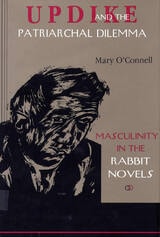
Updike and the Patriarchal Dilemma
Masculinity in the Rabbit NovelsMary O'Connell
Southern Illinois University Press, 1996
Mary O’Connell examines the role of socially constructed masculinity in John Updike’s Rabbit tetralogy—Rabbit Run, Rabbit Redux, Rabbit Is Rich, and Rabbit at Rest—which comprises the longest and most comprehensive representation of masculinity in American literature and places Updike firmly with the precursors of the contemporary movement among men to reevaluate their cultural inheritance.
A disturbing element exists, O’Connell determines, in both the texts of the Rabbit novels and in the critical community that examines them. In the novels, O’Connell finds substantial evidence to demonstrate patterns of psychological and physical abuse toward women, citing as the culminating example the mounting toll of literally or metaphorically dead women in the texts. Critics who characterize Updike as a nonviolent writer who strangely overlooks Rabbit’s repressive and violent behaviors avoid a discomforting but crucial aspect of Updike’s portrait.
Because the critical verdict of nonviolence in Updike’s novels contrasts sharply with the string of female corpses, O’Connell deems that something within the text or culture—or both—is seriously amiss.
Although she examines negative aspects of Rabbit’s behavior, O’Connell avoids the oversimplification of labeling Updike a misogynist. Instead, she looks closely at the forces shaping Rabbit’s gender identity as well as at the ways he experiences masculinity and the ways his gender identity affects his personal and spiritual development, his relationships, and, ultimately, his society. She shows how Updike challenges stereotypical masculinity, revealing its limitations and proscriptions as the source of much unhappiness for both men and women. Further, she substantiates the relation between gender, form, structure, perspective, and language use in the novels, alerting the reader to the ambivalence arising from the male author’s examination of masculinity.
O’Connell maintains that Updike does more than write Rabbit as a stereotypical male; he instead explores in depth his character’s habitually flawed ways of seeing and responding to the world. As she discusses these issues, O’Connell uses the term patriarchy in its broadest sense to refer to the practice of centralizing the male and marginalizing the female in all areas of human life. Patriarchal ideology—the assumptions, values, ideas, and patterns of thought that perpetuate the arrangement—is written as hidden text, permeating every aspect of culture, particularly language, from which it spreads to other signifying systems.
Contrary to conventional critical wisdom, Updike is not a straightforward writer; the Rabbit novels create meaning by challenging, undermining, and qualifying their own explicit content. Updike claims that his novels are "moral debates with the reader," and according to O’Connell, the resisting reader, active and skeptical, is the one most likely to discover what Rabbit conceals and to register the nuances of layered discourse.
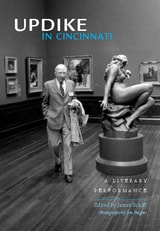
Updike in Cincinnati
A Literary PerformanceJames Schiff
Ohio University Press, 2007
For two spring days in 2001, John Updike visited Cincinnati, Ohio, engaging and charming his audiences, reading from his fiction, fielding questions, sitting for an interview, participating in a panel discussion, and touring the Queen City.
Successful writers typically spend a portion of their lives traveling the country to give readings and lectures. While a significant experience for author and audience alike, this public spectacle, once covered in detailed newspaper accounts, now is barely noticed by the media. Updike in Cincinnati—composed of a wealth of materials, including session transcripts, short stories discussed and read by the author, photographs, and anecdotal observations about Updike's performance and personal interactions--is unique in its comprehensive coverage of a literary visit by a major American author.
Updike's eloquence, intelligence, improvisational skills, and gift for comedy are all on display. With natural grace, he discusses a range of topics, including his novels and short stories, his mother and oldest son as writers, Pete Rose and Shoeless Joe Jackson, the Nobel Prize, his appearance on The Simpsons, the Cold War, and Hamlet.
Augmented with commentary by critics W. H. Pritchard and Donald Greiner, and an introduction and interview by James Schiff, Updike in Cincinnati provides an engaging and detailed portrait of one of America's contemporary literary giants.

Updike
America's Man of LettersWilliam H. Pritchard
University of Massachusetts Press, 2005
Upkeep
Sara London
Four Way Books, 2019
Upriver
Carolyn Kremers
University of Alaska Press, 2013
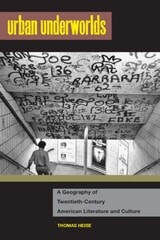
Urban Underworlds
A Geography of Twentieth-Century American Literature and CultureHeise, Thomas
Rutgers University Press, 2010
The quarantining of minority cultures helped to promote white, middle-class privilege. Following a diverse array of literary figures who differ with the assessment of the underworld as the space of the monstrous Other, Heise contends that it is a place where besieged and neglected communities are actively trying to take possession of their own neighborhoods.
Use Trouble
Michael Harper
University of Illinois Press, 2008
Utopia and Cosmopolis
Globalization in the Era of American Literary RealismThomas Peyser
Duke University Press, 1998
Applying current theoretical work on globalization to the writing of authors as diverse as Edward Bellamy, Charlotte Perkins Gilman, William Dean Howells, and Henry James, Peyser reveals the ways in which turn-of-the-century American writers struggled to understand the future in a newly emerging global community. Because the pressures of globalization at once fostered the formation of an American national culture and made national culture less viable as a source of identity, authors grappled to find a form of fiction that could accommodate the contradictions of their condition. Utopia and Cosmopolis unites utopian and realist narratives in subtle, startling ways through an examination of these writers’ aspirations and anxieties. Whether exploring the first vision of a world brought together by the power of consumer culture, or showing how different cultures could be managed when reconceived as specimens in a museum, this book steadily extends the horizons within which late nineteenth- and early twentieth-century American literature and culture can be understood.
Ranging widely over history, politics, philosophy, and literature, Utopia and Cosmopolis is an important contribution to debates about utopian thought, globalization, and American literature.
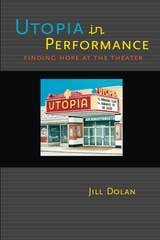
Utopia in Performance
Finding Hope at the TheaterJill Dolan
University of Michigan Press, 2005
---David Román, University of Southern California
What is it about performance that draws people to sit and listen attentively in a theater, hoping to be moved and provoked, challenged and comforted? In Utopia in Performance, Jill Dolan traces the sense of visceral, emotional, and social connection that we experience at such times, connections that allow us to feel for a moment not what a better world might look like, but what it might feel like, and how that hopeful utopic sentiment might become motivation for social change.
She traces these "utopian performatives" in a range of performances, including the solo performances of feminist artists Holly Hughes, Deb Margolin, and Peggy Shaw; multicharacter solo performances by Lily Tomlin, Danny Hoch, and Anna Deavere Smith; the slam poetry event Def Poetry Jam; The Laramie Project; Blanket, a performance by postmodern choreographer Ann Carlson; Metamorphoses by Mary Zimmerman; and Deborah Warner's production of Medea starring Fiona Shaw. While the book richly captures moments of "feeling utopia" found within specific performances, it also celebrates the broad potential that performance has to provide a forum for being human together; for feeling love, hope, and commonality in particular and historical (rather than universal and transcendent) ways.
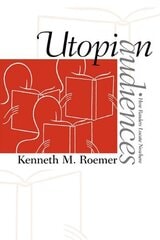
Utopian Audiences
How Readers Locate NowhereKenneth M. Roemer
University of Massachusetts Press, 2009
In the first part of the book, Kenneth M. Roemer establishes why utopian literature offers an attractive arena for reader-response criticism. He focuses on the literature's diversity, its provocative and multi-genre character, and the availability of documented responses as different as book illustrations and intentional communities. In the second part, he concentrates on late nineteenth-century America, which witnessed a grand outpouring of utopian literature, and in particular on Edward Bellamy's Looking Backward, the most popular and influential American utopian novel.
The study progresses from broad cultural constructs to specific modern responses; from the perceptual systems and reading conventions allowing readers to "see" utopias to text-based models of implied readers and to documented readings of actual people, including Bellamy himself, reviewers, and 733 late twentieth-century readers. A fictional gathering of all the readers concludes the book.

u&i
Cassandra Smith
Omnidawn, 2015