Results by title
4030 books match the query 'Language Arts & Disciplines' and 51 start with u
Ubiquitous Learning
Edited by Bill Cope and Mary Kalantzis
University of Illinois Press, 2009
This collection seeks to define the emerging field of "ubiquitous learning," an educational paradigm made possible in part by the omnipresence of digital media, supporting new modes of knowledge creation, communication, and access. As new media empower practically anyone to produce and disseminate knowledge, learning can now occur at any time and any place. The essays in this volume present key concepts, contextual factors, and current practices in this new field.
Contributors are Simon J. Appleford, Patrick Berry, Jack Brighton, Bertram C. Bruce, Amber Buck, Nicholas C. Burbules, Orville Vernon Burton, Timothy Cash, Bill Cope, Alan Craig, Lisa Bouillion Diaz, Elizabeth M. Delacruz, Steve Downey, Guy Garnett, Steven E. Gump, Gail E. Hawisher, Caroline Haythornthwaite, Cory Holding, Wenhao David Huang, Eric Jakobsson, Tristan E. Johnson, Mary Kalantzis, Samuel Kamin, Karrie G. Karahalios, Joycelyn Landrum-Brown, Hannah Lee, Faye L. Lesht, Maria Lovett, Cheryl McFadden, Robert E. McGrath, James D. Myers, Christa Olson, James Onderdonk, Michael A. Peters, Evangeline S. Pianfetti, Paul Prior, Fazal Rizvi, Mei-Li Shih, Janine Solberg, Joseph Squier, Kona Taylor, Sharon Tettegah, Michael Twidale, Edee Norman Wiziecki, and Hanna Zhong.
Uncommon Quotes for Library Lovers
ALA Editions
American Library Association, 2021
Included are 100 of the most insightful, thought-provoking, and uplifting aphorisms about books, the joy of reading, intellectual freedom, and librarianship. You’ll find quotes from authors such as Celeste Ng, Suheir Hammad, Azar Nafisi, Junot Díaz, and Ta-Nehisi Coates; entertainers like Ziggy Marley and Stephen Colbert; and leaders such as Malala Yousafzai—all highlighting the impact of libraries and librarians.
This diverse and delightful collection makes a perfect gift for showing your appreciation to valued colleagues, volunteers, board members, and bibliophiles. And your purchase funds advocacy, awareness, and accreditation programs for library and information professionals worldwide!
Under Construction
edited by Christine Farris & Chris M. Anson
Utah State University Press, 1998
Few composition scholars two decades ago would have imagined the rate at which their field is now developing, expanding beyond its boundaries, creating new alliances, and locating new sites for research and generation of knowledge. In their introduction to this volume, Farris and Anson argue that, faced with a welter of competing models, compositionists too quickly dichotomize and dismiss.
The contributors to Under Construction, therefore, address themselves to the need for commerce among competing visions of the field. They represent diverse settings and distinct points of view, but their over-riding interest is in promoting a view of the field that values interaction and mutual development above dogmatics and isolation.
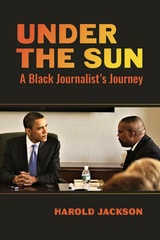
Under the Sun
A Black Journalist's JourneyHarold Jackson
University of Alabama Press, 2025
A determined journalist’s account of rising to Pulitzer Prize–winning heights
Under the Sun: A Black Journalist’s Journey is Harold Jackson’s powerful memoir that chronicles his path from a Birmingham, Alabama, housing project in the 1950s and ’60s to becoming a Pulitzer Prize–winning journalist. Growing up in the segregated South, Jackson didn’t see a writing career as feasible, especially with the financial struggles his family faced after his father’s death. However, his freshman English teacher’s encouragement set him on a course that would change his life.
Jackson’s journey began in high school, where he became one of the first Black students in the University of Alabama’s summer journalism workshop. It was there that he discovered his unique voice as a writer, setting the stage for a remarkable forty-five-year career as a newspaper writer and editor. Despite the pervasive racial prejudices of the time, Jackson learned to navigate the complexities of being Black in a predominantly white profession. He reflects on the duality of living as a Black person in America, a concept W. E. B. Du Bois described as “double consciousness,” and the ways journalism allowed Jackson to connect with people from all walks of life.
Through his work at prominent news venues such as the Birmingham Post-Herald, United Press International, the Philadelphia Inquirer, the Birmingham News, the Baltimore Sun, and the Houston Chronicle, Jackson’s story is not just one of professional success but also of personal growth and understanding. Under the Sun is a testament to his resilience, his ability to see past racial barriers, and his unwavering commitment to giving a voice to those who need it most.
Undergraduate Research & the Academic Librarian
Case Studies and Best Practices, Volume 2Merinda Kaye Hensley
Assoc of College & Research Libraries, 2023
—From the Foreword by Janice DeCosmo
Undergraduate research is a specific pedagogical practice with an impact on teaching and learning, and the definition of what counts as research continues to expand to include different types of projects, mentors, and institutions. Diversity, equity, and inclusion in librarians’ work with students and faculty are present and growing. Collaborations between faculty, librarians, and students are furthering student knowledge in new ways. This community and an awareness of students’ non-academic challenges demonstrate the library’s contribution to students’ overall sense of belonging within their institutions.
This second volume of Undergraduate Research & the Academic Librarian—following 2017’s first volume—contains 22 new chapters that explore these expanded definitions of research and the changes wrought in the profession and the world in the intervening years. Five sections examine:
- First-Year Undergraduate Research Models
- Cohort-Based Models
- Tutorials, Learning Objects, Services, and Institutional Repositories
- Course-Based Undergraduate Research Collaborations
- Building and Sustaining Programs

Undergraduate Research And The Academic Librarian
CaseMerinda K. Hensley
Assoc of College & Research Libraries, 2017
Understanding Archives and Manuscripts
James M. O'Toole
Society of American Archivists, 2006

Understanding Data and Information Systems for Recordkeeping
Philip C. Bantin
American Library Association, 2008
Understanding International Sign
A Sociolinguistic StudyLori A. Whynot
Gallaudet University Press, 2016
International Sign is regarded as a lingua franca that is employed by deaf people to communicate with other deaf people who do not share the same conventionalized local sign language. Contrary to widely-held belief, sign languages are not composed of a unified system of universal gestures—rather, they are distinctly different, and most are mutually unintelligible from one another. The phenomenon of IS has emerged through increased global interaction during recent decades, driven by a rise in the number of international conferences and events and by new technologies that allow for enhanced global communication. IS is gaining acceptance for providing communicative access to conference audience members who do not have knowledge of the designated conference languages, and it is being recruited for use due to the prohibitive expense of providing interpreting services in numerous different sign languages. However, it is not known how well audience members understand IS, and it may actually limit equal access to the interpreted information.
Whynot compares IS to native sign languages and analyzes the distribution of linguistic elements in the IS lexicon and their combined effect on comprehension. Her findings indicate that audiences with diverse sign languages understand much less of IS presentations than has been previously assumed. Whynot’s research has crucial implications for expository IS usage, training, and interpreting, and it sheds light on the strengths and weaknesses inherent in cross-linguistic, signed contact settings.

Understanding Language Structure, Interaction, and Variation
An Introduction to Applied Linguistics and Sociolinguistics for NonspecialistsSalvatore Attardo and Steven Brown
University of Michigan Press, 2027
In the age of Artificial Intelligence hallucinations and slop, the need for a clear, accessible, uncluttered, and authoritative textbook is more important than ever. The fourth edition of Understanding Language Structure, Interaction, and Variation retains the informal and reader-friendly style of previous editions and has been substantively updated and rewritten to incorporate recent scholarship throughout. Language is important for a number of fields, including teaching, psychology, sociology, and anthropology. The wide coverage of language structure, sociolinguistics, language acquisition, and grammar makes this book suitable for pre-service teachers, undergraduates, and graduate students who need some exposure to linguistics, but do not need highly technical training in formal linguistics.
This extensively classroom-tested book is organized for use in a semester or can be customized for shorter terms by omitting chapters after the foundational core provided by chapters 1–3. The encyclopedic nature of the book, which includes a glossary and an index, make it appropriate for self-study and any reader who is interested in the study of language.
Readers of the fourth edition of Understanding Language Structure, Interaction, and Variation will find:
- Expanded coverage of Prosody, the phonetic alphabet, African American Language, neurodiversity and language, English as a world language, and English as a lingua franca;
- New content on biolinguistics, translanguaging, enregisterment, indexicality, the semiotic turn in sociolinguistics, code-meshing, complex dynamic systems theory, and personality theory in SLA;
- A thorough overview of the basics of English grammar.
Understanding the Courses We Teach
Local Perspectives on English Language TeachingJohn Murphy and Patricia Byrd, Editors
University of Michigan Press, 2001
Individual chapters are rich in descriptive details and resonate with the contributor-teachers' personal investment in teaching. John Murphy and Patricia Byrd have arranged these chapters in four thematic clusters, the first dealing with general purposes instruction, including workplace literacy, community-based ESL, and courses designed for rich recent immigrants; the second with the teaching of English as a foreign language; the third with university credit-bearing courses focused on the teaching of English for academic purposes; and the fourth with noncredit university-affiliated courses offered through intensive English programs.
The contributors represent a variety of educational settings and many different countries and include many of the most well-known researchers in the field.
.
Understanding the Language of Science
By Steven Darian
University of Texas Press, 2003
2004 — A Choice Outstanding Academic Book
From astronomy to zoology, the practice of science proceeds from scientific ways of thinking. These patterns of thought, such as defining and classifying, hypothesizing and experimenting, form the building blocks of all scientific endeavor. Understanding how they work is therefore an essential foundation for everyone involved in scientific study or teaching, from elementary school students to classroom teachers and professional scientists.
In this book, Steven Darian examines the language of science in order to analyze the patterns of thinking that underlie scientific endeavor. He draws examples from university science textbooks in a variety of disciplines, since these offer a common, even canonical, language for scientific expression. Darian identifies and focuses in depth on nine patterns—defining, classifying, using figurative language, determining cause and effect, hypothesizing, experimenting, visualizing, quantifying, and comparing—and shows how they interact in practice. He also traces how these thought modes developed historically from Pythagoras through Newton.
Unending Conversations
New Writings by and about Kenneth BurkeEdited by Greig Henderson and David Cratis Williams
Southern Illinois University Press, 2001
Previously unpublished writings by and about Kenneth Burke plus essays by such Burkean luminaries as Wayne C. Booth, William H. Rueckert, Robert Wess, Thomas Carmichael, and Michael Feehan make the publication of Unending Conversations a significant event in the field of Burke studies and in the wider field of literary criticism and theory.
Editors Greig Henderson and David Cratis Williams have divided their material into three parts: “Dialectics of Expression, Communication, and Transcendence,” “Criticism, Symbolicity, and Tropology,” and “Transcendence and the Theological Motive.”
In the first part, Williams’s textual introduction and Rueckert’s essay analyze the genesis and composition of Burke’s A Symbolic of Motives and Poetics, Dramatistically Considered. Henderson opens part two by showing how these two essays’ concerns with literary form hearken back to Burke’s first book of criticism, Counter-Statement.
Thomas Carmichael discusses Burke’s relationship to thinkers such as Paul de Man, Jacques Derrida, Stanley Fish, Fredric Jameson, Jean-François Lyotard, and Richard Rorty. Wess analyzes the relation between Burke’s dramatistic pentad of act, agent, scene, agency, and purpose and his four master tropes—metaphor, metonymy, synecdoche, and irony.
In the third part, Booth mines his unpublished correspondence with Burke to demonstrate that Burke is a coy theologian. Michael Feehan discusses Burke’s revelation in a 1983 interview that rather than rebounding from a naive kind of Marxism in Permanence and Change, he was rebounding from what he had “learned as a Christian Scientist.”
Unfinished Business
Thoughts on the Past, Present, Future, and Nurturing of Homo ScribensCharles Bazerman
University Press of Colorado, 2024
Unfracked
The Struggle to Ban Fracking in New YorkRichard Buttny
University of Massachusetts Press, 2024
Since fracking emerged as a way of extracting natural gas, through intense deep drilling and the use of millions of gallons of water and chemicals to fracture shale, it has been controversial. It is perceived in different ways by different people—by some as an opportunity for increased resources and possibly jobs and other income; by others as a public health and environmental threat; and for many, an unknown. Richard Buttny, a scholar who works on rhetoric and discursive practices, read a story in his local paper in New York about hydrofracking coming to his area and had to research what it was, and what it could mean for his community. Soon he joined neighbors in fighting to have the practice banned state-wide. At the same time, he turned his scholarly eye to the messaging from both sides of the fight, using first-person accounts, interviews, and media coverage.
The activists fighting fracking won. New York is now the only state in the US with sizable deposits of natural gas that has banned hydraulic fracturing, or fracking. Unfracked explains the competing rhetoric and discourses on fracking among New York-based advocates, experts, the grassroots, and political officials. Buttny examines how these positions evolved over time and how eventually the state arrived at a decision to ban this extractive technology. His accessible approach provides both a historical recounting of the key events of this seven-year conflict, along with four in-depth case studies: a grassroots citizen group, a public hearing with medical physicians, a key intergovernmental hearing, and a formal debate among experts. The result is a look at a very recent, important historical moment and a useful examination of environmental activist and fossil fuel advocate rhetoric around an issue that continues to cause debate nationwide.
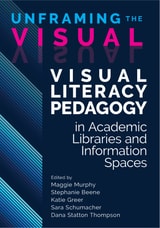
Unframing the Visual
Visual Literacy Pedagogy in Academic Libraries and Information SpacesMaggie Murphy
Assoc of College & Research Libraries, 2023
In four parts, Unframing the Visual: Visual Literacy Pedagogy in Academic Libraries and Information Spaces explores:
- Participating in a Changing Visual Information Landscape
- Perceiving Visuals as Communicating Information
- Practicing Visual Discernment and Criticality
- Pursuing Social Justice through Visual Practice
Twenty-four full color chapters present a range of theoretical and practical approaches to visual literacy pedagogy that illustrate, connect with, extend, and criticize concepts from the Framework for Visual Literacy in Higher Education: Companion Document to the Framework for Information Literacy for Higher Education. Topics include using TikTok to begin a conversation on academic honesty and marginalization; supporting disciplines to move to multimodal public communication assignments; critical data visualization; and exclusionary practices in visual media.
In exploring the discussions and engaging with the activities in Unframing the Visual, you will find new inspiration for how to unframe, adapt, and apply visual literacy pedagogy and praxis in your work.
United States Since 1865
Foster Rhea Dulles
University of Michigan Press, 1969
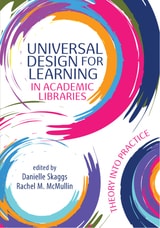
Universal Design for Learning in Academic Libraries
Theory into PracticeDanielle Skaggs
Assoc of College & Research Libraries, 2024
In four parts, Universal Design for Learning in Academic Libraries: Theory into Practice explores UDL:
- Theory and Background
- In Instruction and Reference
- Behind the Scenes
- Beyond the Library
Universal Design for Learning in Academic Libraries can make learning about UDL and implementing it into your work quicker and easier, and provides ways to become an advocate for UDL inside your library and across campus.

Universal Grammar and Narrative Form
David Herman
Duke University Press, 1995
Following an extensive historical overview of theories about universal grammar, Herman examines Joyce’s Ulysses, Kafka’s The Trial, and Woolf’s Between the Acts as case studies of modernist literary narratives that encode grammatical principles which were (re)fashioned in logic, linguistics, and philosophy during the same period. Herman then uses the interpretation of universal grammar developed via these modernist texts to explore later twentieth-century cultural phenomena. The problem of citation in the discourses of postmodernism, for example, is discussed with reference to syntactic theory. An analysis of Peter Greenaway’s The Cook, The Thief, His Wife, and Her Lover raises the question of cinematic meaning and draws on semantic theory. In each case, Herman shows how postmodern narratives encode ideas at work in current theories about the nature and function of language.
Outlining new directions for the study of language in literature, Universal Grammar and Narrative Form provides a wealth of information about key literary, linguistic, and philosophical trends in the twentieth century.

Universals
Studies in Indian Logic and LinguisticsFrits Staal
University of Chicago Press, 1988
Frits Staal is concerned with four basic questions: Are there universals of logic that transcend culture and time? Are there universals of language and linguistics? What is the nature of Indian logic? And what is the nature of Indian linguistics? By addressing these questions, Staal demonstrates that, contrary to the general assumption among Western philosophers, the classical philosophers of India were rationalists, attentive to arguments. They were in this respect unlike contemporary Western thinkers inspired by existentialism or hermeneutics, and like the ancient Chinese, Greeks, and many medieval European schoolmen, only—as Staal says—more so. Universals establishes that Asia's contributions are not only compatible with what has been produced in the West, but a necessary ingredient and an essential component of any future human science.
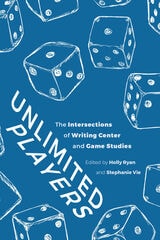
Unlimited Players
The Intersections of Writing Center and Game StudiesHolly Ryan
Utah State University Press, 2021
The collection opens with theoretically driven chapters that approach writing center work through the lens of games and play. These chapters cover a range of topics, including considerations of identity, empathy, and power; productive language play during tutoring sessions; and writing center heuristics. The last section of the book includes games, written in the form of tabletop game directions, that directors can use for staff development or tutors can play with writers to help them develop their skills and practices.
No other text offers a theoretical and practical approach to theorizing and using games in the writing center. Unlimited Players provides a new perspective on the long-standing challenges facing writing center scholars and offers insight into the complex questions raised in issues of multimodality, emerging technologies, tutor education, identity construction, and many more. It will be significant to writing center directors and administrators and those who teach tutor training courses.
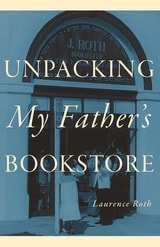
Unpacking My Father's Bookstore
Laurence Roth
Rutgers University Press, 2025
2026 Independent Publisher Book Awards (IPPY) Silver Medal in the West – Pacific Non-Fiction category
Unpacking My Father’s Bookstore brings to life the history of J. Roth / Bookseller of Fine & Scholarly Judaica, which was a microcosm of the Los Angeles Jewish community from 1966 to 1994 and one of the premier Jewish bookstores in the United States. Blending critical analysis with a personal account of growing up in his father’s bookstore, and connecting both to larger forces that helped shape Jewish and American book retailing in the twentieth-century, Laurence Roth crafts a richly felt narrative about his family’s Jewish experience in America. It is a reminder, too, that while most independent bookstores like J. Roth Bookseller disappear from history, these retailers often had outsized effects on their communities. Breaking with conventional modes of scholarship, Unpacking My Father’s Bookstore tells a unique and troubled story that rarely gets told, one that is both personal and analytical, theoretical but rooted in the everyday.
Unquiet Tropes
Form, Race, and Asian American LiteratureElda E Tsou
Temple University Press, 2015
In Unquiet Tropes, Tsou reconceptualizes the literature as a set of highly particular classical rhetorical tropes including antanaclasis, rhetorical question, apophasis, catachresis, and allegory. Looking at five canonical works—Aiiieeeee!, No-No Boy, China Men, Blu’s Hanging, and Native Speaker—Tsou shows how these texts use figurative means to confront the problem of race. She also explores how traces of Asian American history live on through these figures.
Each case study in Unquiet Tropes considers a different scenario—defiance, coercion, necessity, error, and deceit—to show how literary representation from the 1950s through 1997 has responded to a specific political condition.
Unsafe Words
Queering Consent in the #MeToo EraShantel Gabrieal Buggs
Rutgers University Press, 2023
Telling a queerer side of the #MeToo story, Unsafe Words dares to challenge dogmatic assumptions about sex and consent while developing tools and language to promote more ethical and more pleasurable sex for everyone.
Unspoken
A Rhetoric of SilenceCheryl Glenn
Southern Illinois University Press, 2004
In our talkative Western culture, speech is synonymous with authority and influence while silence is frequently misheard as passive agreement when it often signifies much more. In her groundbreaking exploration of silence as a significant rhetorical art, Cheryl Glenn articulates the ways in which tactical silence can be as expressive and strategic an instrument of human communication as speech itself.
Drawing from linguistics, phenomenology, feminist studies, anthropology, ethnic studies, and literary analysis, Unspoken: A Rhetoric of Silence theorizes both a cartography and grammar of silence. By mapping the range of spaces silence inhabits, Glenn offers a new interpretation of its complex variations and uses.
Glenn contextualizes the rhetoric of silence by focusing on selected contemporary examples. Listening to silence and voice as gendered positions, she analyzes the highly politicized silences and words of a procession of figures she refers to as “all the President’s women,” including Anita Hill, Lani Guiner, Gennifer Flowers, and Chelsea Clinton. She also turns an investigative ear to the cultural taciturnity attributed to various Native American groups—Navajo, Apache, Hopi, and Pueblo—and its true meaning. Through these examples, Glenn reinforces the rhetorical contributions of the unspoken, codifying silence as a rhetorical device with the potential to deploy, defer, and defeat power.
Unspoken concludes by suggesting opportunities for further research into silence and silencing, including music, religion, deaf communities, cross-cultural communication, and the circulation of silence as a creative resource within the college classroom and for college writers.
Untimely Women
Radically Recasting Feminist Rhetorical HistoryJason Barrett-Fox
The Ohio State University Press, 2022
Untimely Women recovers the work of three early-twentieth-century working women, none of whom history has understood as feminists or rhetors: cinema icon and memoirist, Mae West; silent film screenwriter and novelist, Anita Loos; and journalist and mega-publisher, Marcet Haldeman-Julius. While contemporary scholarship tends to highlight and recover women who most resemble academic feminists in their uses of propositional rhetoric, Jason Barrett-Fox uses what he terms a medio-materialist historiography to emphasize the different kinds of political and ontological gender-power that emerged from the inscriptional strategies these women employed to navigate and critique male gatekeepers––from movie stars to directors to editors to abusive husbands.
In recasting the work of West, Loos, and Haldeman-Julius in this way, Barrett-Fox reveals the material and ontological ramifications of their forms of invention, particularly their ability to tell trauma in ways that reach beyond their time to raise the consciousness of audiences unavailable to them in their lifetimes. Untimely Women thus accomplishes important historical and rhetorical work that not only brings together feminist historiography, rhetorical materialism, and posthumanism but also redefines what counts as feminist rhetoric.
Untold Stories
Tyler Clementi's Death and Crisis Leadership in Higher EducationJudy Farmer Jarvis
Rutgers University Press, 2027
Untold Stories: Tyler Clementi’s Death and Crisis Leadership in Higher Education delves into the well-known but poorly understood death of gay first-year Rutgers student Tyler Clementi in 2010 and explains how social identities shaped the responses to his tragic death, the media firestorm, Rutgers University’s actions, and the legacy of his life and death. It offers insights for higher education crisis responders and anyone who wants to learn more about this well-known but poorly understood case.
Unweaving The Odyssey
Barbara Köhler’s Niemands FrauRebecca May Johnson
University of London Press, 2019
Unwell Writing Centers
Searching for Wellness in Neoliberal Educational Institutions and Beyondby Genie Nicole Giaim, foreword by Elizabeth Boquet
Utah State University Press, 2022
The book is broken into sections based on journeying: searching for wellness, finding wellness, and imagining a “well” future that includes a sustainable model of writing center work. Each chapter begins with a personal narrative about wellness issues in writing centers, including the author’s experiences in and responses to local emergencies. She shares findings from a longitudinal assessment study on non-institutional interventions in writing centers and provides resources for administrators to create more ethical "well" writing centers. The book also includes an appendix of training documents, emergency planning documents, and several wellness-specific interventions developed from anti-racist, anti-neoliberal, and organizational theories.
Establishing the need for a field-specific response to the austerity-minded eruption of wellness-focused interventions in higher education, Unwell Writing Centers is a critical text for graduate students and new directors that can easily be applied in workplaces in and outside of higher education.
Update Culture and the Afterlife of Digital Writing
John R Gallagher
Utah State University Press, 2019
With the advent of easy-to-use websites, ordinary people have become internet writers, disseminating their texts to large audiences. Social media sites enable writers’ audiences to communicate back to the them, instantly and often. Even professional writers work within interfaces that place comments adjacent to their text, privileging the audience’s voice. Thus, writers face the prospect of attending to their writing after they deliver their initial arguments. Update Culture and the Afterlife of Digital Writing describes the conditions that encourage “published” texts to be revisited. It demonstrates—through forty case studies of Amazon reviewers, redditors, and established journalists—how writers consider the timing, attention, and management of their writing under these ever-evolving conditions.
Online culture, from social media to blog posts, requires a responsiveness to readers that is rarely duplicated in print and requires writers to consistently reread, edit, and update texts, a process often invisible to readers. This book takes questions of circulation online and shows, via interviews with both writers and participatory audience members, that writing studies must contend with writing’s afterlife. It will be of interest to researchers, scholars, and students of writing studies and the fields of rhetoric, communication, education, technical communication, digital writing, and social media, as well as all content creators interested in learning how to create more effective posts, comments, replies, and reviews.
Upon the Ruins of Liberty
Slavery, the President's House at Independence National Historical Park, and Public MemoryRoger C. Aden
Temple University Press, 2014
In Upon the Ruins of Liberty, Roger Aden offers a compelling account that explores the development of this important historic site and how history, space, and public memory intersected with contemporary racial politics. Aden constructs this engrossing tale by drawing on archival material and interviews with principal figures in the controversy-including historian Ed Lawler, site activist Michael Coard, and site designer Emanuel Kelly.
Upon the Ruins of Liberty chronicles the politically-charged efforts to create a fitting tribute to the place where George Washington (and later, John Adams) shaped the presidency while denying freedom to the nine enslaved Africans in his household. From design to execution, the plans prompted advocates to embrace stories informed by race, and address difficulties that included how to handle the results of the site excavation. As such, this landmark project raised concerns and provided lessons about the role of public memory and how places are made to shape the nation's identity.
Uprising
How Women Used the US West to Win the Right to VoteTiffany Lewis
Michigan State University Press, 2021
Upsetting Composition Commonplaces
Ian Barnard
Utah State University Press, 2014
In Upsetting Composition Commonplaces, Ian Barnard argues that composition still retains the bulk of instructional practices that were used in the decades before poststructuralist theory discredited them. While acknowledging that some of the foundational insights of poststructuralist theory can be difficult to translate to the classroom, Barnard upends several especially intransigent tenets that continue to influence the teaching of writing and how students are encouraged to understand writing.
Using six major principles of writing classrooms and textbooks—clarity, intent, voice, ethnography, audience, and objectivity—Barnard looks at the implications of poststructuralist theory for pedagogy. While suggesting some evocative poststructuralist pedagogical practices, the author focuses on diagnosing the fault lines of composition's refusal of poststructuralism rather than on providing "solutions” in the form of teaching templates.
Upsetting Composition Commonplaces addresses the need to more effectively engage in poststructuralist concepts in composition in an accessible and engaging voice that will advance the conversation about relations between the theory and teaching of writing.
Urban Teens in the Library
Research and PracticeDenise E. Agosto
American Library Association, 2010
Usability Testing for Library Web Sites
A Hands-On GuideElaina Norlin
American Library Association, 2002
Usability and the Mobile Web
A LITA GuideAmerican Library Association, 2015
Usage Based Models of Language
Edited by Michael Barlow and Suzanne Kemmer
CSLI, 2000
Deviating from traditional methods, the contributions presented in this volume are among the first works to approach linguistic theory by developing and utilizing usage-based models. The contributing authors were among the principal leaders in their fields to leave behind rule-based linguistic representations in favor of constraint-based systems whose structural properties actually emerge from usage. The volume begins with an introductory chapter that defines contributors' interpretations of usage-based models and theories of language. The reason for the shift from formal linguistic theories to the gradual acceptance of usage-based models is also examined. Using methods such as Cognitive Grammar, the Lexical Network Model, Competition Model, Relational Network Theory, and Accessibility Theory, the selected works demonstrate how usage-based models evince far greater cognitive and neurological plausibility than algorithmic, generative models.
Useful, Usable, Desirable
Aaron Schmidt
American Library Association, 2014
User Experience (UX) Design For Libraries
Aaron Schmidt
American Library Association, 2012
User Experience as Innovative Academic Practice
Kate Crane
University Press of Colorado, 2022
Using Context in Information Literacy Instruction
Beyond Basic SkillsAllison Hosier
American Library Association, 2022
Librarians know that information literacy is much more complex and nuanced than the basic library research skill that it's often portrayed as; in fact, as outlined by the ACRL Framework, research is a contextual activity. But the settings in which we teach often constrain our ability to take a more layered approach. This book not only shows you how to teach information literacy as something other than a basic skill, but also how to do it in whatever mode of teaching you’re most often engaged in, whether that's a credit-bearing course, a one-shot session, a tutorial, a reference desk interaction, or a library program. Taking you through each step of the research process, this book shares ideas for adding context while exploring topics such as
- how conversations about context can be integrated into lessons on common information literacy topics;
- examples of the six genres of research and suggested course outlines for each;
- ensuring that context strategies fit within the ACRL Framework;
- questions for reflection in teaching each step of the research process;
- four different roles that sources can play when researching a topic;
- helping students refine a topic that is drawing too many or too few sources;
- cultivating students to become good decision-makers for the best type of research sources to use depending on their need; and
- how to address the shortcomings of checklist tools like the CRAAP test.
Using Digital Analytics for Smart Assessment
Tabatha Farney
American Library Association, 2017
Using Libguides to Enhance Library Services
Aaron Dobbs
American Library Association, 2013
Using Massive Digital Libraries
Andrew Weiss
American Library Association, 2014
Using Qualitative Methods In Action Research
Douglas Cook
Assoc of College & Research Libraries, 2011
Using Qualitative Methods in Action Research
How Librarians Can Get to the Why of DataDouglas Cook
Assoc of College & Research Libraries, 2011
Using Technology to Teach Information Literacy
American Library Association, 2008
Using Web 2.0 and Social Networking Tools in the K-12 Classroom
Beverley Crane
American Library Association, 2012
Utah English
David Ellingson Eddington
University of Utah Press, 2023
Is English in Utah truly unique? If so, what makes it different? Which stereotypes about how Utahns speak are completely off base and which are accurate? To answer these questions, linguist David Eddington surveyed more than 1,700 Utahns in an effort to better understand and systematize the peculiarities of English spoken in the Beehive State. This resulting book is a sophisticated data analysis that presents results in an accessible and often humorous fashion.
Utah is linguistically interesting for a variety of reasons. The massive numbers of immigrants who flocked there in the first years of European settlement, its relative isolation until completion of the transcontinental railroad, and its large Latter-day Saint population signaled greater linguistic commonality than is often the case in other western states. The book argues that religious affiliation, or lack thereof, might particularly play a role in the features that make up Utah English.
An accessible study of dialect in Utah, this book explores how social and geographic factors influence the pronunciations and regional expressions that characterize Utah English. Reflecting years of dealing with misconceptions about dialect both in and out of the classroom, Eddington covers vocabulary, individual words, syntax, vowels, and consonants, blending a serious and sometimes humorous approach to his research.
Utopian Genderscapes
Rhetorics of Women's Work in the Early Industrial AgeMichelle C. Smith
Southern Illinois University Press, 2021
A necessary rhetorical history of women’s work in utopian communities
Utopian Genderscapes focuses on three prominent yet understudied intentional communities—Brook Farm, Harmony Society, and the Oneida Community—who in response to industrialization experimented with radical social reform in the antebellum United States. Foremost among the avenues of reform was the place and substance of women’s work. Author Michelle C. Smith seeks in the communities’ rhetorics of teleology, choice, and exceptionalism the lived consequences of the communities' lofty goals for women members.
This feminist history captures the utopian reconfiguration of women’s bodies, spaces, objects, and discourses and delivers a needed intervention into how rhetorical gendering interacts with other race and class identities. The attention to each community’s material practices reveals a gendered ecology, which in many ways squared unevenly with utopian claims. Nevertheless, this volume argues that this utopian moment inaugurated many of the norms and practices of labor that continue to structure women’s lives and opportunities today: the rise of the factory, the shift of labor from home spaces to workplaces, the invention of housework, the role of birth control and childcare, the question of wages, and the feminization of particular kinds of labor.
An impressive and diverse array of archival and material research grounds each chapter’s examination of women’s professional, domestic, or reproductive labor in a particular community. Fleeting though they may seem, the practices and lives of those intentional women, Smith argues, pattern contemporary divisions of work along the vibrant and contentious lines of gender, race, and class and stage the continued search for what is possible.