Results by title
1761 books match the query 'Public Policy' and 36 start with u
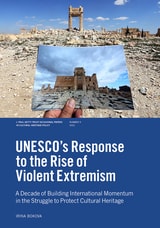
UNESCO’S Response to the Rise of Violent Extremism
A Decade of Building International Momentum in the Struggle to Protect Cultural HeritageIrina Bokova
J. Paul Getty Trust, The, 2021
The fifth issue of this series, written by Irina Bokova, former director-general of UNESCO, focuses on the value that UNESCO can bring to the fight to protect cultural heritage. During her two terms at UNESCO, Bokova worked to promote international peace and cooperation by raising awareness of the value of cultural heritage and partnering with local communities to rebuild and revitalize their damaged heritage—and themselves. One of Bokova’s most successful campaigns, #Unite4Heritage, has created a global social network of people who are sharing stories, knowledge, and personal experiences about their heritage in an effort to challenge the hate-filled narratives put forward by extremists and keep threatened cultures alive and vital.

Unaffordable
American Healthcare from Johnson to TrumpJonathan Engel
University of Wisconsin Press, 2018
Unaffordable covers, in a conversational style punctuated by apt examples, topics ranging from health insurance, pharmaceutical pricing, and physician training to health maintenance organizations and hospital networks. Along the way, Engel introduces approaches that other nations have taken in organizing and paying for healthcare and offers insights on ethical quandaries around end-of-life decisions, neonatal care, life-sustaining treatments, and the limits of our ability to define death. While describing the political origins of many of the federal and state laws that govern our healthcare system today, he never loses sight of the impact that healthcare delivery has on our wallets and on the balance sheets of hospitals, doctors' offices, government agencies, and private companies.

Unbordering Migration Studies in the Caribbean and Latin America
Patsy Lewis
Rutgers University Press, 2026
Unbordering Migration Studies in the Caribbean and Latin America brings together scholars and artists across regions, generations, disciplines, and modes of expression to decenter the US-Mexico border as both a site and a concept. Calling for renewed attention to the spaces, identities, and conflicts that remain understudied and excluded from our hemispheric knowledge of forced movement, the volume reveals a wider diversity of migratory realities and considers race, ethnicity, and class beyond the hegemonic formations that eclipse non-US histories. Through multidisciplinary and geographically expansive essays that draw from history, social anthropology, environmental studies, feminist studies, and lived experience, the volume examines diverse migratory flows from Chile and Argentina in the South to Georgia and New York in the North. Individually and collectively, the essays remap migratory movements other than through the most studied South-to-North trajectories and remove the US and US-based racial formations from the center of analysis. By tracking East-West flows, intraregional mobilities, and changing conceptions of racial identity, Unbordering Migration Studies in the Caribbean and Latin America complicates the concepts of forced mobility and border crossing by highlighting alternative liminalities in sites of transit, destination, and return. Demanding engagement with the submerged histories of racism and the production of ethnoracial categories beyond the Black/white binary, the collection brings into focus identities, sites, and forces that have not yet occupied the foreground of global migration study.

Unbroken Ties
The State, Interest Associations, and Corporatism in Post-Soviet UkrainePaul Kubicek
University of Michigan Press, 2000
Since the collapse of communism in Eastern Europe and the former Soviet Union, there has been a spate of books--optimistic at first--highlighting the transitions to democracy in these countries and the leading role of "civil society" in pushing forward political and economic reform. This study explains why this transition did not take place as anticipated. In essence, organized labor in Ukraine is weak and has been co-opted by the state; in the meantime, leading groups of industrialists and agricultural collectives have strong political influence and shape policies in accordance with their interests. This is very similar to the situation in Russia.
In contrast to works that implicitly assume a pluralist model of development for state-society relations, Unbroken Ties employs corporatism as the basic organizing structure for the study of state-interest group relations in post-Soviet Ukraine. Finding that much of the Soviet "residue" still functions in Ukraine, it argues that a form of state corporatism, which envisions a major role for the state in structuring and controlling interest associations, captures much of the post-Soviet Ukrainian reality. Old groups persist and prosper due to a variety of ties with state elites, whereas new and independent groups find themselves marginalized.
This book will appeal to political scientists, economists, and sociologists studying the transformation of post-communist societies, as well as those interested in the broader, more comparative aspects of democratization and economic reform.
Paul Kubicek is Kenneth Boulding Post-Doctoral Fellow, University of Colorado, Boulder.
Uncharitable
How Restraints on Nonprofits Undermine Their PotentialDan Pallotta
Brandeis University Press, 2022
Uncharitable goes where no other book on the nonprofit sector has dared to tread. Where other texts suggest ways to optimize performance inside the existing charity paradigm, Uncharitable suggests that the paradigm itself is the problem and calls into question our fundamental canons about charity. Dan Pallotta argues that society’s nonprofit ethic creates an inequality that denies the nonprofit sector critical tools and permissions that the for-profit sector is allowed to use without restraint. These double standards place the nonprofit sector at an extreme disadvantage. While the for-profit sector is permitted to use all the tools of capitalism, the nonprofit sector is prohibited from using any of them. Capitalism is blamed for creating inequities in our society, but charity is prohibited from using the tools of capitalism to rectify them—and ironically, this is all done in the name of charity. This irrational system, Pallotta explains, has its roots in four-hundred-year-old Puritan ethics that banished self-interest from the realm of charity. The ideology is policed today by watchdog agencies and the use of so-called efficiency measures, which Pallotta argues are flawed, unjust, and should be abandoned. By declaring our independence from these obsolete ideas, Pallotta theorizes, we can dramatically accelerate progress on the most urgent social issues of our time. Uncharitable is an important, provocative, timely, and accessible book—a manifesto about equal economic rights for charity. This edition has a new, updated introduction by the author.

Understanding Capitalism
Critical Analysis From Karl Marx to Amartya SenDouglas Dowd
Pluto Press, 2002
Major economists and economic schools of thought are discussed in a chapter-by-chapter guide that covers Marx, Veblen, Gramsci, post-Keynesian theory, US institutionalists, Sweezy and the Monopoly Capital school, and recent Nobel Prize winner Amartya Sen. Contributors include Michael Lebowitz, Carl Boggs, Michael Keaney, Frederic Lee, John Bellamy Foster and Robin Hahnel, with an introduction by the editor, Douglas Dowd.
UndocuAsians
Lived Experiences and Social Movement Activism Across the DiasporaKevin Escudero
Rutgers University Press, 2026
Undocumented Fears
Immigration and the Politics of Divide and Conquer in Hazleton, PennsylvaniaJamie Longazel
Temple University Press, 2016
The Illegal Immigration Relief Act (IIRA), passed in the small Rustbelt city of Hazleton, Pennsylvania in 2006, was a local ordinance that laid out penalties for renting to or hiring undocumented immigrants and declared English the city’s official language. The notorious IIRA gained national prominence and kicked off a parade of local and state-level legislative initiatives designed to crack down on undocumented immigrants.
In his cogent and timely book, UndocumentedFears, Jamie Longazel uses the debate around Hazleton’s controversial ordinance as a case study that reveals the mechanics of contemporary divide and conquer politics. He shows how neoliberal ideology, misconceptions about Latina/o immigrants, and nostalgic imagery of “Small Town, America” led to a racialized account of an undocumented immigrant “invasion,” masking the real story of a city beset by large-scale loss of manufacturing jobs.
Offering an up-close look at how the local debate unfolded in the city that set off this broader trend, Undocumented Fears makes an important connection between immigration politics and the perpetuation of racial and economic inequality.
Undocumented
Great Lakes Poets Laureate on Social JusticeRonald Riekki
Michigan State University Press, 2019
Undoing the Revolution
Comparing Elite Subversion of Peasant RebellionsVasabjit Banerjee
Temple University Press, 2019
Undoing the Revolution looks at the way rural underclasses ally with out-of-power elites to overthrow their governments—only to be shut out of power when the new regime assumes control. Vasabjit Banerjee first examines why peasants need to ally with dissenting elites in order to rebel. He then shows how conflict resolution and subsequent bargains to form new state institutions re-empower allied elites and re-marginalize peasants.
Banerjee evaluates three different agrarian societies during distinct time periods spanning the twentieth century: revolutionary Mexico from 1910 to 1930; late-colonial India from 1920 until 1947; and White-dominated Zimbabwe (Rhodesia) from the mid-1960s to 1980. This comparative approach also allows examination of both the underclass need for elite participation and the variety of causes that elites use to incentivize peasant classes to participate, extending from religious-ethnic identity and common political targets to the peasants’ and elites’ own economic grievances.
Undoing the Revolution demonstrates that both international and domestic investors in cash crops, natural resources, and finance can ally with peasant rebels; and, after threatened or actual state collapse, they can bargain with each other to select new state institutions.
Unequal Higher Education
Wealth, Status, and Student OpportunityBarrett J. Taylor
Rutgers University Press, 2019
Unequal Thailand
Aspects of Income, Wealth and PowerEdited by Pasuk Phongpaichit and Chris Baker
National University of Singapore Press, 2015
The contributors to this important study—Thai scholars, reformers and civil servants—shed light on the many dimensions of inequality in Thailand, looking beyond simple income measures to consider land ownership, education, finance, business structures and politics. The contributors propose a series of reforms in taxation, spending and institutional reform that can address growing inequality.
Inequality is among the biggest threats to social stability in Southeast Asia, and this close study of a key Southeast Asian country will be relevant to regional policy-makers, economists and business decision-makers, as well as students of oligarchy and inequality more generally.
Uneven Tides
Rising Inequality in AmericaSheldon H. Danziger
Russell Sage Foundation, 1993
United Tastes
The Making of the First American CookbookKeith Stavely
University of Massachusetts Press, 2017
Winner of the 2017 Bruce Fraser Award from the Association for the Study of Connecticut History
The Library of Congress has designated American Cookery (1796) by Amelia Simmons one of the eighty-eight “Books That Shaped America.” Its recognition as “the first American cookbook” has attracted an enthusiastic modern audience of historians, food journalists, and general readers, yet until now American Cookery has not received the sustained scholarly attention it deserves. Keith Stavely and Kathleen Fitzgerald's United Tastes fills this gap by providing a detailed examination of the social circumstances and culinary tradition that produced this American classic.
Situating American Cookery within the post-Revolutionary effort to develop a distinct national identity, Stavely and Fitzgerald demonstrate the book's significance in cultural as well as culinary terms. Ultimately the separation between these categories dissolves as the authors show that the formation of “taste,” in matters of food as well as other material expressions, was essential to building a consensus on what it was to be American. United Tastes explores multiple histories—of food, cookbooks, printing, material and literary culture, and region—to illuminate the meaning and affirm the importance of America's first cookbook.
Unmasked
COVID, Community, and the Case of OkobojiEmily Mendenhall
Vanderbilt University Press, 2022
The story is both personal and political. Author Emily Mendenhall, an anthropologist at Georgetown University, grew up in Okoboji, and her family still lives there. As the events unfolded, Mendenhall was in Okoboji, where she spoke formally with over 100 people and observed a community that rejected public health guidance, revealing deep-seated mistrust in outsiders and strong commitments to local thinking. Unmasked is a fascinating and heartbreaking account of where people put their trust, and how isolationist popular beliefs can be in America's small communities.
This book is the recipient of the 2022 Norman L. and Roselea J. Goldberg Prize from Vanderbilt University Press for the best book in the area of art or medicine.
Unmasked
COVID, Community, and the Case of OkobojiEmily Mendenhall
Vanderbilt University Press, 2022
The story is both personal and political. Author Emily Mendenhall, an anthropologist at Georgetown University, grew up in Okoboji, and her family still lives there. As the events unfolded, Mendenhall was in Okoboji, where she spoke formally with over 100 people and observed a community that rejected public health guidance, revealing deep-seated mistrust in outsiders and strong commitments to local thinking. Unmasked is a fascinating and heartbreaking account of where people put their trust, and how isolationist popular beliefs can be in America's small communities.
This book is the recipient of the 2022 Norman L. and Roselea J. Goldberg Prize from Vanderbilt University Press for the best book in the area of art or medicine.
Unsettling 'Sensation'
Arts Policy Lessons from the Brooklyn Museum of Art ControversyRothfield, Lawrence
Rutgers University Press, 2001
Unsettling 'Sensation'
Arts-Policy Lessons from the Brooklyn Museum of Art ControversyRothfield, Lawrence
Rutgers University Press, 2001
In September 1999, Sensation, an exhibition at the Brooklyn Museum, opened its doors, igniting a controversy still burning in the art world. This collection of cutting-edge art from the Saatchi collection in England, and the museum’s arrangements with Charles Saatchi to finance the show, so offended New York City mayor Rudolph Giuliani that he attempted to shut the museum down by withholding city funds that are crucially needed by that institution. Only a legal ruling prevented him from doing so. Like the Robert Mapplethorpe exhibition before it, Sensation once again raises questions about public spending for “controversial” art, but with the added dimension of religious conflict and charges of commercialization.
The contributors to this volume use the Sensation exhibition as a stepping-stone to analyze larger questions such as the authority the government has to withhold funds, various interpretations of the First Amendment, how to respect divergent cultural and religious values; and the economic stake of museums and dealers in art. In their articles—written expressly for this volume, and spanning the disciplines of law, cultural studies, public policy, and art—the contributors consider issues at the center of arts policy. They propose various legal strategies, curatorial practices, and standards of doing business intended to serve the public interest in the arts.

Untapped
Exploring the Cultural Dimensions of Craft BeerNathaniel G. Chapman
West Virginia University Press, 2017
In the United States, the United Kingdom, and Western Europe there has been exponential growth in the number of small independent breweries over the past thirty years – a reversal of the corporate consolidation and narrowing of consumer choice that characterized much of the twentieth century. While there are legal and policy components involved in this shift, the contributors to Untapped ask broader questions. How does the growth of craft beer connect to trends like the farm-to-table movement, gentrification, the rise of the “creative class,” and changing attitudes toward both cities and farms? How do craft beers conjure history, place, and authenticity? At perhaps the most fundamental level, how does the rise of craft beer call into being new communities that may challenge or reinscribe hierarchies based on gender, class, and race?
Unwritten Rule
How to Fix the British ConstitutionStephen Green, Thomas Legg, and Martin Donnelly
Haus Publishing, 2021
Not since Ireland broke away from the United Kingdom has the British state been so fragile. Northern Ireland now operates under trading rules that are legally separate from the rest of the nation. In Wales, support for independence is running at a historical high, and Scotland is more conscious than ever of its individual identity and has aspirations for a European future. With public trust and confidence in government at record lows, the United Kingdom faces a crisis that can only be repaired by a new constitutional settlement. Unwritten Rule calls for a radical realignment, embracing a federal approach that would accommodate devolution as the best way of bringing about a successful and diverse national life, increasing democratic control over local and national decision-making, and modernizing national political structures.
Up Against The Sprawl
Public Policy And The Making Of Southern CaliforniaJennifer Wolch
University of Minnesota Press, 2004
Los Angeles's experience in managing urban growth and change
America's first truly twenty-first-century metropolis, Los Angeles is often depicted as diverse, fragmented, polarized, and ungovernable, a city without a unifying geographic center or civic culture. The sprawling evolution of the city and its infamous problems—traffic, pollution, growing inequality—are usually attributed to a Wild West version of capitalism—the triumph of an unregulated free market over comprehensive urban planning. But market choices and lack of planning did not set the terrain of Southern California: Los Angeles has been profoundly shaped by a wide range of local, state, and federal public policies and programs.
Up Against the Sprawl details how governmental policies and public agencies have dictated many aspects of the region’s growth: infrastructure, transportation, housing, immigration, finances, civic and regional administration, the environment. The authors also argue that since public policy set the landscape, it can help forge the future. They explore countermovements by progressive activists to use innovative policies—from smart growth initiatives to the actions of living wage advocates—for greater social, economic, and environmental justice. This book is a major contribution to our understanding of past and present urban processes and policy, and highlights practical lessons for urban and regional policy makers and activists in Los Angeles and beyond.Contributors: Carolyn B. Aldana, California State U, San Bernadino; Carol S. Armstrong; Michael Dear, U of Southern California; Gary Dymski, U of California Riverside; Steven P. Erie, USC; Gregory Freeman; William Fulton; Elizabeth Gearin, USC; Genevieve Giuliano, USC; Pascale Joassart-Marcelli, U of Massachusetts, Boston; Enrico A. Marcelli; Myra A. Marks, Loyola Marymount U; Juliet Musso, USC; Stephanie Pincetl, USC; Laura Pulido; Christine M. Ryan; John P. Wilson.
Up in the Air?
The Future of Public Service Media in the Western BalkansTarik Jusic
Central European University Press, 2021
The agenda for transition after the demise of communism in the Western Balkans made the conversion of state radio and television into public service broadcasters a priority, converting mouthpieces of the regime into public forums in which various interests and standpoints could be shared and deliberated. There is general agreement that this endeavor has not been a success. Formally, the countries adopted the legal and institutional requirements of public service media according to European standards. The ruling political elites, however, retained their control over the public media by various means.
Can this trend be reversed? Instead of being marginalized or totally manipulated, can public service media become vehicles of genuine democratization?
A comparison of public service media in seven countries (Albania, Bosnia & Herzegovina, Croatia, Kosovo, Montenegro, North Macedonia, and Serbia) addresses these important questions.
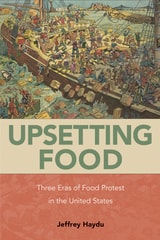
Upsetting Food
Three Eras of Food Protests in the United StatesJeffrey Haydu
Temple University Press, 2021
Battle lines have long been drawn over how food is produced, what food is made available to whom, and how best to protect consumers from risky or unhealthy food. Jeffrey Haydu resurrects the history of food reform and protest in Upsetting Food, showing how activists defined food problems, articulated solutions, and mobilized for change in the United States.
Haydu’s sociological history starts in the 1830s with diet reformer Sylvester Graham, who blamed alcohol and store-bought bread—signs of a commercializing urban society—for poor health and moral decline. His successors at the turn of the twentieth century rallied against impure food and pushed for women to be schooled in scientific food preparation and nutrition. Decades later, in the 1960s and ’70s, a grassroots movement for organic food battled commercial food production in favor of food grown ecologically, by small farmers, and without artificial chemicals.
Each campaign raised doubts about food safety, health, and transparency, reflecting how a capitalist system can undermine trust in food. But Haydu also considers how each movement reflects the politics, inequalities, and gender relations of its time. And he traces how outcomes of each campaign laid the groundwork for the next. The three eras thus come together as parts of a single, recurring food movement.
Upsetting Food offers readers a historical background to better understand contemporary and contentious food politics.
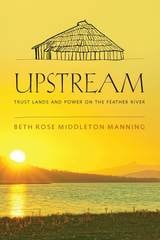
Upstream
Trust Lands and Power on the Feather RiverBeth Rose Middleton Manning
University of Arizona Press, 2018
Upstream documents the significance of the Allotment Era to a long and ongoing history of cultural and community disruption. It also details Indigenous resistance to both hydropower and disruptive conservation efforts. With a focus on northeastern California, this book highlights points of intervention to increase justice for Indigenous peoples in contemporary natural resource policy making.
Author Beth Rose Middleton Manning relates the history behind the nation’s largest state-built water and power conveyance system, California’s State Water Project, with a focus on Indigenous resistance and activism. She illustrates how Indigenous history should inform contemporary conservation measures and reveals institutionalized injustices in natural resource planning and the persistent need for advocacy for Indigenous restitution and recognition.
Upstream uses a multidisciplinary and multitemporal approach, weaving together compelling stories with a study of placemaking and land development. It offers a vision of policy reform that will lead to improved Indigenous futures at sites of Indigenous land and water divestiture around the nation.
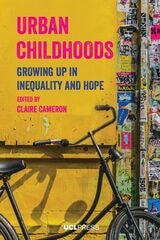
Urban Childhoods
Growing up in Inequality and HopeEdited by Claire Cameron
University College London, 2025
Bringing together insights from critical childhood studies, urban studies, and child public health, Urban Childhoods examines the distinct experiences of children growing up in English cities with an emphasis on centering the voices of children and their families. The volume explores how to prioritize children’s wellbeing in urban planning, focusing primarily on children’s definitions of what they need to thrive: stable relationships, access to engaging activities, and having a voice in decisions that affect their lives. Alongside the more theoretical literature on urban childhood, authors regularly reference strategies from a major prevention program conducted in two English cities between 2019 and 2025.
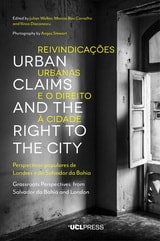
Urban Claims and the Right to the City
Grassroots Perspectives from Salvador da Bahia and LondonEdited by Julian Walker, Marcos Bau Carvalho, and Ilinca Diaconescu
University College London, 2020
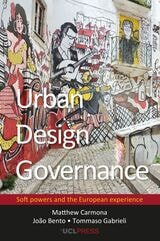
Urban Design Governance
Soft Powers and the European ExperienceMatthew Carmona, João Bento, and Tommaso Gabrieli
University College London, 2023
Urban Design Governance takes a deep dive into the governance of urban design around Europe. It examines interventions in the means and processes of designing the built environment as devised by public authorities and other stakeholders across the continent, paying particular attention to the use of soft powers and allied financial mechanisms to influence design quality in the public interest. In doing so, the book traces the scope, use, and effectiveness of the range of informal, non-regulatory urban design governance tools that governments, municipalities, and others have at their disposal.
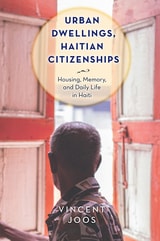
Urban Dwellings, Haitian Citizenships
Housing, Memory, and Daily Life in HaitiVincent Joos
Rutgers University Press, 2022
Urban Inequality
Evidence From Four CitiesAlice O'Connor
Russell Sage Foundation, 2001
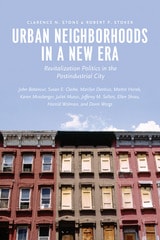
Urban Neighborhoods in a New Era
Revitalization Politics in the Postindustrial CityClarence N. Stone and Robert P. Stoker
University of Chicago Press, 2015
While not denying the hurdles that community revitalization still faces, the contributors ultimately put forth a strong case that a more hospitable local milieu can be created for making neighborhood policy. In examining the course of experiences from an earlier period of redevelopment to the present postindustrial city, this book opens a window on a complex process of political change and possibility for reform.
Urban Planning in the Nordic World
Ellen Braae
University of Wisconsin Press, 2022
Urban planning is a keystone in the materialization of the Nordic welfare states. That is not to say that there is one particular city form or planning practice that is synonymous with the emerging welfare city, as welfare per se is far from normative. On the contrary, welfare is a highly ambiguous and contested notion that has changed over the postwar decades, which is also reflected in the development of the welfare city.
However, welfare in urban planning has mainly been associated with ideas of “the good life” and egalitarianism. In a Nordic context, the state has taken the lead in providing the social engineering “hardware” for advancing this universal aim. Social demographic welfare is economically based on full employment, and in this regard housing and caregiving support are key components. Yet education, infrastructure, and leisure facilities are also basic features in the distribution of universal welfare services for citizens’ entire lives. The results, ideally, are green and spacious welfare cities.
This book outlines the origins, development, challenges, and lived realities of the changing welfare city, focusing primarily on Denmark. Strategies have changed over the decades as models of development have shifted and as the needs of society and a warming planet have come into focus. The current welfare city can be described as an urban landscape characterized by, on the one hand, a division of functions and, on the other, mutual competition. The role of the state has been minimized, turning municipalities into the new major agents in attracting taxpayers and providing goods—both by means of urban planning.

Urban Policy In 20th Century
Hirsch, Arnold
Rutgers University Press, 1992
The recent riots in Los Angeles brought the urban crisis back to the center of public policy debates in Washington, D.C., and in urban areas throughout the United States. The contributors to this volume examine the major policy issues--race, housing, transportation, poverty, the changing environment, the effects of the global economy--confronting contemporary American cities.
Raymond A. Mohl begins with an extended discussion of the origins, evolution, and current state of Federal involvement in urban centers. Michael B. Katz follows with an insightful look at poverty in turn-of-the-century New York and the attempts to ameliorate the desperate plight of the poor during this period of rapid economic growth. Arnold R. Hirsch, Mohl, and David R. Goldfield then pursue different facets of the racial dilemma confronting American cities. Hirsch discusses historical dimensions of residential segregation and public policy, while Mohl uses Overtown, Miami, as a case study of the social impact of the construction of interstate highways in urban communities. David Goldfield explores the political ramifications and incongruities of contemporary urban race relations.
Finally, Carl Abbott and Sam Bass Warner, Jr., examine the impact of global economic developments and the environmental implications of past policy choices. Collectively, the authors show us where we have been, some of the needs that must be addressed, and the urban policy alternatives we face.
Urban Policy in the Time of Obama
James DeFilippis
University of Minnesota Press, 2016
With his background as a community organizer and as a state legislator representing Chicago’s South Side, Barack Obama became America’s most “urban” president since Teddy Roosevelt. But what has been his record in dealing with the issues most impacting our metropolitan areas today? Looking past the current administration, what are the future prospects of the nation’s cities, and how have they been shaped by our policies in this century? Seeking to answer these questions, the contributors to Urban Policy in the Time of Obama explore a broad range of policy arenas that shape, both directly and indirectly, metropolitan areas and urbanization processes.
This volume reveals the Obama administration’s surprisingly limited impact on cities, through direct policy initiatives such as Strong Cities, Strong Communities, Promise Neighborhoods, and Choice Neighborhood Initiatives. There has been greater impact with broader policies that shape urban life and governance, including immigration reform, education, and health care.
Closing with Cedric Johnson’s afterword illuminating the Black Lives Matter movement and what its broader social context says about city governance in our times, Urban Policy in the Time of Obama finds that most of the dominant policies and policy regimes of recent years have fallen short of easing the ills of America’s cities, and calls for a more equitable and just urban policy regime.
Contributors: Rachel G. Bratt, Tufts University; Christine Thurlow Brenner, University of Massachusetts Boston; Karen Chapple, University of California, Berkeley; James Fraser, Vanderbilt University; Edward G. Goetz, University of Minnesota; Dan Immergluck, Georgia Tech; Amy T. Khare, University of Chicago; Robert W. Lake, Rutgers University; Pauline Lipman, University of Illinois at Chicago; Lorraine C. Minnite, Rutgers University–Camden; Kathe Newman, Rutgers University; Deirdre Oakley, Georgia State; Frances Fox Piven, City University of New York; Hilary Silver, Brown University; Janet Smith, University of Illinois at Chicago; Preston H. Smith II, Mount Holyoke College; Todd Swanstrom, University of Missouri–St. Louis; Nik Theodore, University of Illinois at Chicago; J. Phillip Thompson, MIT.
Urban Sustainability
A Global PerspectiveIgor Vojnovic
Michigan State University Press, 2012
More than half the world’s population currently lives in urban areas, and virtually all of the world’s population growth over the next three decades is expected to be in cities. What impact will this growth have on the environment? What can we do now to pave the way for resource longevity? Sustainability has received considerable attention in recent years, though conceptions of the term remain vague. Using a wide array of cities around the globe as case studies, this timely book explores the varying nature of global urban-environmental stresses and the complexities involved in defining sustainability policies. Working with six core themes, the editor examines the past, present, and future of urban sustainability within local, national, and global contexts.
Urbanism without Guarantees
The Everyday Life of a Gentrifying West Side NeighborhoodChristian M. Anderson
University of Minnesota Press, 2020
A unique more-than-capitalist take on urban dynamics
Vigilante action. Renegades. Human intrigue and the future at stake in New York City. In Urbanism without Guarantees, Christian M. Anderson offers a new perspective on urban dynamics and urban structural inequality based on an intimate ethnography of on-the-ground gentrification.
The book is centered on ethnographic work undertaken on a single street in Clinton/Hell’s Kitchen in New York City—once a site of disinvestment, but now rapidly gentrifying. Anderson examines the everyday strategies of residents to preserve the quality of life of their neighborhood and to define and maintain their values of urban living—from picking up litter and reporting minor concerns on the 311 hotline to hiring a private security firm to monitor the local public park. Anderson demonstrates how processes such as investment and gentrification are constructed out of the collective actions of ordinary people, and challenges prevalent understandings of how place-based civic actions connect with dominant forms of political economy and repressive governance in urban space.
Examining how residents are pulled into these systems of gentrification, Anderson proposes new ways to think and act critically and organize for transformation of a place—in actions that local residents can start to do wherever they are.
Utopia and Modernity in China
Contradictions in TransitionDavid Margolies
Pluto Press, 2022
Utopia and Modernity in China examines the conflicts inherent in China's attempt to achieve a 'utopia' by advancing production and technology. Through the lenses of literature, arts, law, the press and the environment, the contributors interrogate the contradictions of modernization in Chinese society and its fundamental challenges.
By unpicking both China's vision of utopia and its realities and the increasing tension between traditional Chinese values and those of the West, this book offers a unique insight into the cultural forces that are part of reshaping today's China.