Results by title
18284 books match the query 'United States' and 234 start with u
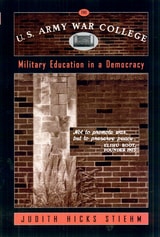
U.S. Army War College
Military Education In A DemocracyJudith Hicks Stiehm
Temple University Press, 2002
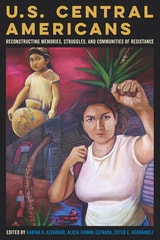
U.S. Central Americans
Reconstructing Memories, Struggles, and Communities of ResistanceEdited by Karina O. Alvarado, Alicia Ivonne Estrada, and Ester E. Hernández
University of Arizona Press, 2017
In summer 2014, a surge of unaccompanied child migrants from Central America to the United States gained mainstream visibility—yet migration from Central America has been happening for decades. U.S. Central Americans explores the shared yet distinctive experiences, histories, and cultures of 1.5-and second-generation Central Americans in the United States.
While much has been written about U.S. and Central American military, economic, and political relations, this is the first book to articulate the rich and dynamic cultures, stories, and historical memories of Central American communities in the United States. Contributors to this anthology—often writing from their own experiences as members of this community—articulate U.S. Central Americans’ unique identities as they also explore the contradictions found within this multivocal group.
Working from within Guatemalan, Salvadoran, and Maya communities, contributors to this critical study engage histories and transnational memories of Central Americans in public and intimate spaces through ethnographic, in-depth, semistructured, qualitative interviews, as well as literary and cultural analysis. The volume’s generational, spatial, urban, indigenous, women’s, migrant, and public and cultural memory foci contribute to the development of U.S. Central American thought, theory, and methods. Woven throughout the analysis, migrants’ own oral histories offer witness to the struggles of displacement, travel, navigation, and settlement of new terrain. This timely work addresses demographic changes both at universities and in cities throughout the United States.
U.S. Central Americans draws connections to fields of study such as history, political science, anthropology, ethnic studies, sociology, cultural studies, and literature, as well as diaspora and border studies. The volume is also accessible in size, scope, and language to educators and community and service workers wanting to know about their U.S. Central American families, neighbors, friends, students, employees, and clients.
Contributors:
Leisy Abrego
Karina O. Alvarado
Maritza E. Cárdenas
Alicia Ivonne Estrada
Ester E. Hernández
Floridalma Boj Lopez
Steven Osuna
Yajaira Padilla
Ana Patricia Rodríguez
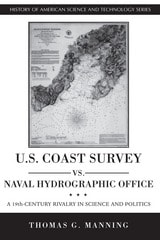
U.S. Coast Survey vs. Naval Hydrographic Office
A 19th-Century Rivalry in Science and PoliticsThomas G. Manning
University of Alabama Press, 1988

U.S. Engineering in a Global Economy
Edited by Richard B. Freeman and Hal Salzman
University of Chicago Press, 2018
The volume provides insights on engineering education, practice, and careers that can inform educational institutions, funding agencies, and policy makers about the challenges facing the United States in developing its engineering workforce in the global economy.

U.S. Foreign Policy in the Middle East
The Role of Lobbies and Special Interest GroupsJanice J. Terry
Pluto Press, 2005
Israel is America's key ally in the Middle East, and helps maintain U.S. dominance in the region. This book shows how pro-Israeli lobbyists and domestic interest groups have been hugely successful in creating government and financial support for Israel. By contrast, Arab-American groups and Arab governments have had less success putting forward their agencies.
Janice J. Terry shows how special interest groups work, and why certain lobbying techniques are more effective than others. She sets this within the wider cultural context, showing how the U.S. media -- and the general public -- view the Middle East.
To explain how lobbies work, Terry draws on case studies including the Sinai accords and Camp David under Presidents Ford and Carter, the Conflict between Green and Turkish lobbies over Cyprus, and the major campaign against the Arab boycott.
Making use of primary sources, and unpublished material from various presidential libraries, this is a fascinating exposé of the role that lobby groups really play in determining U.S. foreign policy in the Middle East. It will be of interest to students of American politics and Middle East studies.
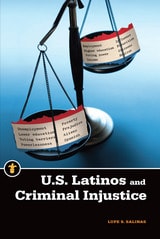
U.S. Latinos and Criminal Injustice
Lupe S. Salinas
Michigan State University Press, 2015
U.S. Power in International Higher Education
Jenny J. Lee
Rutgers University Press, 2021
U.S. Power in International Higher Education explores how internationalization in higher education is not just an educational endeavor, but also a geopolitical one. By centering and making explicit the role of power, the book demonstrates the United States’s advantage in international education as well as the changing geopolitical realities that will shape the field in the future. The chapter authors are leading critical scholars of international higher education, with diverse scholarly ties and professional experiences within the country and abroad. Taken together, the chapters provide broad trends as well as in-depth accounts about how power is evident across a range of key international activities. This book is intended for higher education scholars and practitioners with the aim of raising greater awareness on the unequal power dynamics in internationalization activities and for the purposes of promoting more just practices in higher education globally.
U.S. Women's History
Untangling the Threads of SisterhoodBrown, Leslie
Rutgers University Press, 2017
U.S.- China Educational Exchange
State, Society, and Intercultural Relations, 1905-1950Li, Hongshan
Rutgers University Press, 2007
U.S.-China relations became increasingly important and complex in the twentieth century. While economic, political, and military interactions all grew over time, the most dramatic expansion took place in educational exchange, turning it into the strongest tie between the two nations. By the end of the 1940s, tens of thousands of Chinese and American students and scholars had crisscrossed the Pacific, leaving indelible marks on both societies. Although all exchange programs were terminated during the cold war, the two nations reemerged as top partners within a decade after the reestablishment of diplomatic relations.
Approaching U.S.-China relations from a unique and usually overlooked perspective, Hongshan Li reveals that both the drastic expansion and complete termination of educational ties between the two nations in the first half of the twentieth century were largely the results of direct and deep intervention from the American and Chinese governments. Benefiting from government support and collaboration, educational exchange succeeded in diffusing knowledge and improving mutual understanding between the two peoples across the divide of civilizations. However, the visible hand of government also proved to be most destructive to the development of healthy intercultural relations when educational interactions were treated merely as an instrument for crisis management.

UNDER THE FLAG OF THE NATION
DIARIES AND LETTERS OF OWEN JOHNSTON HOPKINS, A YANKEE VOLUNTEER IN THE CIVIL WAROwen Johnston Hopkins
The Ohio State University Press, 1998
Owen Hopkins was a young man brought to maturity by the agony of war, but in spite of the horror of battle and the tedium of life in camp, he maintained a lively sense of humor and a constant devotion to the ideals for which he fought. The Civil War in these pages is a savage, vindictive conflict fought with canister, "minnie balls," grapeshot, the Enfield rifle, and the bayonet. Only seventeen when he enlisted in 1861, Hopkins was a foot soldier and a witness to the action that took place on the field of battle.
A vital part of Hopkins's life in the army was his correspondence with Julia Allison, who lived in his hometown of Bellefontaine. They began writing each other in 1863, and their friendship deepened into love. Each was a fervent patriot, and their shared devotion to their country was a significant fact of their relationship. They were married in 1865.
An epilogue tells what happened to Hopkins after June of 1865: his career, his family, and his death in 1902. Originally published in1961, this work is now available for the first time in paperback.

UNITED STATES EUROPEAN RIGHT
1945-1955DEBORAH KISATSKY
The Ohio State University Press, 2005
UNLIKELY ENTREPRENEURS
Catholic Sisters & the Hospital Marketplace, 1865–1925Barbra Mann Wall
The Ohio State University Press, 2005
In Unlikely Entrepreneurs, Barbra Mann Wall looks at the development of religious hospitals in the late nineteenth and early twentieth centuries and the entrepreneurial influence Catholic sisters held in this process. When immigrant nuns came to the United States in the late nineteenth century, they encountered a market economy that structured the way they developed their hospitals. Sisters enthusiastically engaged in the market as entrepreneurs, but they used a set of tools and understanding that were counter to the market. Their entrepreneurship was not to expand earnings but rather to advance Catholic spirituality.
Wall places the development of Catholic hospital systems (located in Illinois, Indiana, Minnesota, Texas, and Utah) owned and operated by Catholic sisters within the larger social, economic, and medical history of the time. In the modern health care climate, with the influences of corporations, federal laws, spiraling costs, managed care, and medical practices that rely less on human judgments and more on technological innovations, the “modern” hospital reflects a dim memory of the past. This book will inform future debates on who will provide health care as the sisters depart, how costs will be met, who will receive care, and who will be denied access to health services.
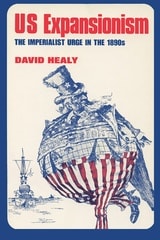
US Expansionism
The Imperialist Urge in the 1890sDavid Healy
University of Wisconsin Press, 1976
Americans, in viewing the globe in 1897, saw a world of empires that were dynamic and fast-growing. Western powers such as Germany, France, and particularly Great Britain were making colonial imperialism fashionable, and the United States, eager to flex its muscles as an emerging world power, was swept along with the European tide. One year later, the United States had truly established itself as a contender in the global game, victorious in a war with Spain and committed to imperialism.
In US Expansionism, David Healy examines this brief but important chapter in American history. Analyzing the various intellectual, cultural, and economic forces that engendered and shaped America’s imperialist drive, Healy also illustrates the key personalities involved, including the soon-to-be president, Theodore Roosevelt. A final section of the book examines the anti-imperialist opposition inspired by the new policy, and the ensuing debates about the proper role of American power.
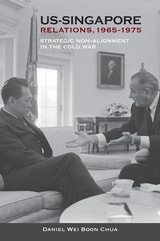
US-Singapore Relations, 1965-1975
Strategic Non-alignment in the Cold WarDaniel Wei Boon Chua
National University of Singapore Press, 2017
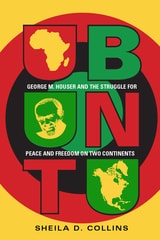
Ubuntu
George M. Houser and the Struggle for Peace and Freedom on Two ContinentsSheila D. Collins
Ohio University Press, 2020
This remarkable biography features a white American pacifist minister whose tireless work for justice and human rights helped reshape Black civil rights in the U.S. and Africa.
George M. Houser (1916–2015) was one of the most important civil rights and antiwar activists of the twentieth century. A conscientious objector during World War II, in 1942 Houser cofounded and led the Congress of Racial Equality (CORE), whose embrace of nonviolent protest strategies and tactics characterized the modern American Civil Rights Movement. Beginning in the 1950s, Houser played a critical role in pan-Africanist anticolonial movements, and his more than thirty-year dedication to the cause of human rights and self-determination helped prepare the ground for the toppling of the South African apartheid regime.
Throughout his life, Houser shunned publicity, preferring to let his actions speak his faith. Sheila Collins’s well-researched biography recounts the events that informed Houser’s life of activism—from his childhood experiences as the son of missionaries in the Philippines to his early grounding in the Social Gospel and the teachings of Mohandas Gandhi. In light of the corruption the U.S. and the world face today, Houser’s story of faith and decisive action for human rights and social justice is one for our time.
Ugly Freedoms
Elisabeth R. Anker
Duke University Press, 2022

Ukrainian Bishop, American Church
Martha Bohachevsky-Chomiak
Catholic University of America Press, 2018
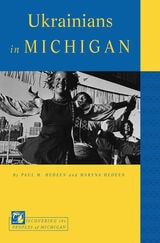
Ukrainians in Michigan
Paul M. Hedeen
Michigan State University Press, 2023

Ulysses S. Grant
A Photographic HistoryJames Bultema, with a Foreword by Frank J. Willilams
Southern Illinois University Press, 2022
As Grant battled relentlessly down the Tennessee River and across Tennessee, defending Shiloh, he was followed by an enterprising group of studio photographers hoping to profit from the public’s demand for images of the rising general from the West. They never stopped because Grant never stopped. Thus far, 307 distinct photographs have been found of Ulysses S. Grant, revealing him to be the most photographed American of the nineteenth century.
Readers of Ulysses S. Grant: A Photographic History travel alongside Grant through the Civil War and his two terms as president, on his unusual two-year journey around the world, and to his final days on Mount McGregor. The sheer volume of exposure shows the toll of duty, war, and command. From every angle, this collection captures Grant’s regard for soldier and family, his disregard of uniform, and his disheveled appearance that reflected his resilience. The reader will look into the eyes of a man who saw the worst and labored for the best.
This curated volume opens the largest collection of Grant photos to the public for the first time. Excerpts from Grant’s personal writings divulge his candid thoughts about the people he posed with and the situations he faced around the time the photographs were taken. An extraordinary addition to Grant scholarship, Ulysses S. Grant: A Photographic History will be the photographic reference work on Grant for decades to come as the simple man from Ohio continues to astonish the world.
Un-American Womanhood
Antiradicalism, Antifeminism, and the First Red ScareKim Nielsen
The Ohio State University Press, 2001
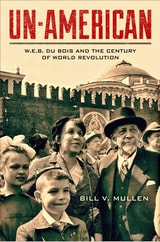
Un-American
W.E.B. Du Bois and the Century of World RevolutionBill V Mullen
Temple University Press, 2015
Un-American is Bill Mullen’s revisionist account of renowned author and activist W.E.B. Du Bois’s political thought toward the end of his life, a period largely dismissed and neglected by scholars. He describes Du Bois’s support for what the Communist International called “world revolution” as the primary objective of this aged radical’s activism. Du Bois was a champion of the world’s laboring millions and critic of the Cold War, a man dedicated to animating global political revolution.
Mullen argues that Du Bois believed that the Cold War stalemate could create the conditions in which the world powers could achieve not only peace but workers’ democracy. Un-American shows Du Bois to be deeply engaged in international networks and personal relationships with revolutionaries in India, China, and Africa. Mullen explores how thinkers like Karl Marx, Jawaharlal Nehru, Mohandas Gandhi, and C.L.R. James helped him develop a theory of world revolution at a stage in his life when most commentators regard him as marginalized. This original political biography also challenges assessments of Du Bois as an American “race man.”

Unaffordable
American Healthcare from Johnson to TrumpJonathan Engel
University of Wisconsin Press, 2018
Unaffordable covers, in a conversational style punctuated by apt examples, topics ranging from health insurance, pharmaceutical pricing, and physician training to health maintenance organizations and hospital networks. Along the way, Engel introduces approaches that other nations have taken in organizing and paying for healthcare and offers insights on ethical quandaries around end-of-life decisions, neonatal care, life-sustaining treatments, and the limits of our ability to define death. While describing the political origins of many of the federal and state laws that govern our healthcare system today, he never loses sight of the impact that healthcare delivery has on our wallets and on the balance sheets of hospitals, doctors' offices, government agencies, and private companies.

Unbelievable Happiness and Final Sorrow
The Hemingway-Pfeiffer MarriageRuth A. Hawkins
University of Arkansas Press, 2012

Unbinding Gentility
Women Making Music in the Nineteenth-Century SouthCandace Bailey
University of Illinois Press, 2021
Hearing southern women in the pauses of history
Southern women of all classes, races, and walks of life practiced music during and after the Civil War. Candace L. Bailey examines the history of southern women through the lens of these musical pursuits, uncovering the ways that music's transmission, education, circulation, and repertory help us understand its meaning in the women's culture of the time. Bailey pays particular attention to the space between music as an ideal accomplishment—part of how people expected women to perform gentility—and a real practice—what women actually did. At the same time, her ethnographic reading of binder’s volumes, letters and diaries, and a wealth of other archival material informs new and vital interpretations of women’s place in southern culture.
A fascinating collective portrait of women's artistic and personal lives, Unbinding Gentility challenges entrenched assumptions about nineteenth century music and the experiences of the southern women who made it.

Unbound Spirit
Letters of Flora Belle JanFlora Belle Jan. Edited by Fleur Yano and Saralyn Daly. Introduction by Judy Wu.
University of Illinois Press, 2008
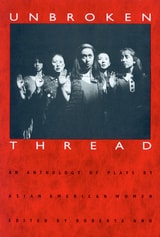
Unbroken Thread
An Anthology of Plays by Asian American WomenRoberta Uno
University of Massachusetts Press, 1993
This book contains plays by Genny Lim (Paper Angels), Wakako Yamauchi (The MusicLessons), Momoko Iko (Gold Watch),Velina Hasu Houston (Tea), Jeannie Barroga (Walls), and Elizabeth Wong (Letters to a Student Revolutionary). The volume includes an extended introduction, a profile of each playwright, and an appendix. The six plays of this anthology represent some of the best dramatic literature written by Asian American women since the 1970s. Each is a groundbreaking work and addresses in its own way the experiences of Asians in America. All six playwrights are American-born daughters of Asian immigrants, and their voices span the genres of naturalism, impressionism, ritual drama, postmodern collage, and media-influenced episodic drama.
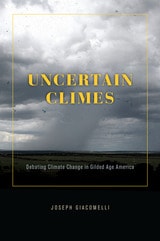
Uncertain Climes
Debating Climate Change in Gilded Age AmericaJoseph Giacomelli
University of Chicago Press, 2023
Even people who still refuse to accept the reality of human-induced climate change would have to agree that the topic has become inescapable in the United States in recent decades. But as Joseph Giacomelli shows in Uncertain Climes, this is actually nothing new: as far back as Gilded Age America, climate uncertainty has infused major debates on economic growth and national development.
In this ambitious examination of late-nineteenth-century understandings of climate, Giacomelli draws on the work of scientists, foresters, surveyors, and settlers to demonstrate how central the subject was to the emergence of American modernity. Amid constant concerns about volatile weather patterns and the use of natural resources, nineteenth-century Americans developed a multilayered discourse on climate and what it might mean for the nation’s future. Although climate science was still in its nascent stages during the Gilded Age, fears and hopes about climate change animated the overarching political struggles of the time, including expansion into the American West. Giacomelli makes clear that uncertainty was the common theme linking concerns about human-induced climate change with cultural worries about the sustainability of capitalist expansionism in an era remarkably similar to the United States’ unsettled present.
Uncertain Climes
Debating Climate Change in Gilded Age AmericaJoseph Giacomelli
University of Chicago Press, 2023
Uncertain Climes looks to the late nineteenth century to reveal how climate anxiety was a crucial element in the emergence of American modernity.
Even people who still refuse to accept the reality of human-induced climate change would have to agree that the topic has become inescapable in the United States in recent decades. But as Joseph Giacomelli shows in Uncertain Climes, this is actually nothing new: as far back as Gilded Age America, climate uncertainty has infused major debates on economic growth and national development.
In this ambitious examination of late-nineteenth-century understandings of climate, Giacomelli draws on the work of scientists, foresters, surveyors, and settlers to demonstrate how central the subject was to the emergence of American modernity. Amid constant concerns about volatile weather patterns and the use of natural resources, nineteenth-century Americans developed a multilayered discourse on climate and what it might mean for the nation’s future. Although climate science was still in its nascent stages during the Gilded Age, fears and hopes about climate change animated the overarching political struggles of the time, including expansion into the American West. Giacomelli makes clear that uncertainty was the common theme linking concerns about human-induced climate change with cultural worries about the sustainability of capitalist expansionism in an era remarkably similar to the United States’ unsettled present.
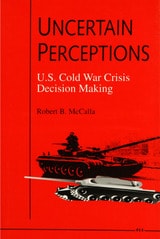
Uncertain Perceptions
U.S. Cold War Crisis Decision MakingRobert B. McCalla
University of Michigan Press, 1992
Uncertain Times
Kenneth Arrow and the Changing Economics of Health CarePeter J. Hammer, Deborah Haas-Wilson, Mark A. Peterson, and William M. Sage, eds.
Duke University Press, 2003
Coming from diverse backgrounds—economics, law, political science, and the health care industry itself—the contributors use Arrow’s article to address a range of present-day health-policy questions. They examine everything from health insurance and technological innovation to the roles of charity, nonprofit institutions, and self-regulation in addressing medical needs. The collection concludes with a new essay by Arrow, in which he reflects on the health care markets of the new millennium. At a time when medical costs continue to rise, the ranks of the uninsured grow, and uncertainty reigns even among those with health insurance, this volume looks back at a seminal work of scholarship to provide critical guidance for the years ahead.
Contributors
Linda H. Aiken
Kenneth J. Arrow
Gloria J. Bazzoli
M. Gregg Bloche
Lawrence Casalino
Michael Chernew
Richard A. Cooper
Victor R. Fuchs
Annetine C. Gelijns
Sherry A. Glied
Deborah Haas-Wilson
Mark A. Hall
Peter J. Hammer
Clark C. Havighurst
Peter D. Jacobson
Richard Kronick
Michael L. Millenson
Jack Needleman
Richard R. Nelson
Mark V. Pauly
Mark A. Peterson
Uwe E. Reinhardt
James C. Robinson
William M. Sage
J. B. Silvers
Frank A. Sloan
Joshua Graff Zivin
Uncharted Terrains
New Directions in Border Research Methodology, Ethics, and PracticeEdited by Anna Ochoa O’Leary, Colin M. Deeds, and Scott Whiteford
University of Arizona Press, 2013
Each chapter raises methodological and ethical questions relevant to conducting research in transnational contexts, which can frequently be unpredictable or even volatile. The volume addresses the central question of how can scholars work with vulnerable migrant populations along the perilous US–Mexico border and maintain ethical and methodological standards, while also providing useful knowledge to stakeholders? Not only may immigrants be afraid to provide information that could be incriminating, but researchers may also be reluctant to allow their findings to become the basis of harsher law enforcement, unjustly penalize the subjects of their research, and inhibit the formulation of humane and effective immigration policy based on scholarly research.
All of these concerns, which are perfectly legitimate from the social scientists’ point of view, can put researchers into conflict with legal authorities. Contributors acknowledge their quandaries and explain how they have dealt with them. They use specific topics—reproductive health issues and sexually transmitted diseases among immigrant women, a study of undocumented business owners, and the administration of the Mexican Household Survey in Phoenix, among others—to outline research methodology that will be useful for generations of border researchers.
Uncharted Territory
The American Catholic Church at the United Nations, 1946-1972Joseph S. Rossi S.J.
Catholic University of America Press, 2006
Uncivil Agreement
How Politics Became Our IdentityLilliana Mason
University of Chicago Press, 2018
Political polarization in America is at an all-time high, and the conflict has moved beyond disagreements about matters of policy. For the first time in more than twenty years, research has shown that members of both parties hold strongly unfavorable views of their opponents. This is polarization rooted in social identity, and it is growing. The campaign and election of Donald Trump laid bare this fact of the American electorate, its successful rhetoric of “us versus them” tapping into a powerful current of anger and resentment.
With Uncivil Agreement, Lilliana Mason looks at the growing social gulf across racial, religious, and cultural lines, which have recently come to divide neatly between the two major political parties. She argues that group identifications have changed the way we think and feel about ourselves and our opponents. Even when Democrats and Republicans can agree on policy outcomes, they tend to view one other with distrust and to work for party victory over all else. Although the polarizing effects of social divisions have simplified our electoral choices and increased political engagement, they have not been a force that is, on balance, helpful for American democracy. Bringing together theory from political science and social psychology, Uncivil Agreement clearly describes this increasingly “social” type of polarization in American politics and will add much to our understanding of contemporary politics.
Uncivil Rights
Teachers, Unions, and Race in the Battle for School EquityJonna Perrillo
University of Chicago Press, 2012
Uncivil Youth
Race, Activism, and Affirmative GovernmentalitySoo Ah Kwon
Duke University Press, 2013

Uncle Tom's Cabin and the Reading Revolution
Hochman Barbara
University of Massachusetts Press, 2011
Unclenching Our Fists
Abusive Men on the Journey to NonviolenceSara Elinoff Acker
Vanderbilt University Press, 2013
Surrounding this material are chapters that provide context about the disputes among researchers about whether batterer intervention programs work (only a small number of batterers renounce their abuse) and chapters that address the reactions of partners to these stories. "When the Man You Love is Abusive" is designed to caution women not to be manipulated by accounts of change and to outline the stages men need to pass through in the long process of becoming accountable. "The Last Word: Voices of Survivors" ends the book with a focus group discussion in which former abuse victims and advocates respond candidly to the men's stories.
Uncomfortable Television
Hunter Hargraves
Duke University Press, 2023
Uncommon Women
Gender and Representation in Nineteenth-Century U.S. Women's WritingLaura Laffrado
The Ohio State University Press, 2009
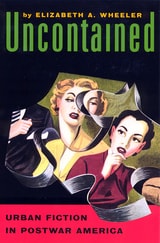
Uncontained
Urban Fiction in Postwar AmericaWheeler, Elizabeth A.
Rutgers University Press, 2001
In the postwar era, American urban fiction is dominated by the imagery of containment. Across the fictional landscape, the city is divided into segregated zones, marked by the threat of inevitable violence, and set off from the safety of equally contained suburbs. Mean and dangerous, the city can only be navigated by a solitary expert, alienated and male. In Uncontained, Elizabeth A. Wheeler offers a critique of this familiar story-evident in the noir. narratives of James M. Cain and in work by Ellison, Roth, Salinger, Percy, Capote, and others —and challenges its link to the postwar city.
Discussing film, short stories, and novels from a cross-section of American cities, Wheeler integrates these stories of containment into a shared pattern and reads them across a broad spectrum of famous and forgotten works by men and women of various ethnic and literary traditions to reveal a larger vision of postwar America. Knowing that containment is never the entire story, that diversity or trauma always shows itself, she shows how the uncontained has shaped the historical moment. Aware that liberating counterstories do get told, she places them in dialogue with those of the alienated man, the war veteran, Beat hipster, noir detective, and ironic suburbanite — in historical context — and revives the idea of urban space as a place of openness, thereby challenging a literary containment of racial difference, gender, and sexuality. By reading Paule Marshall in tandem with Philip Roth, Wheeler explores the relationships between adjacent neighborhoods and reconnects separate literary and geographic areas. By bringing Ann Bannon's lesbian pulp fiction, Hubert Selby's cult novels, or the work of John Okada, Hisaye Yamamoto, Chester Himes, Gwendolyn Brooks's, Jo Sinclair, and many others to bear on more canonical texts, she offers a more complete understanding of this period of American fiction — one that points toward a city that is open and inclusive.
Uncontained suggests that while decline, division, and decay form a major part of the story of mid-century urban America, the postwar city also represents much of what is best about American life. Rather than reproducing the containment of culture, Wheeler places together the wildly disparate to show how we move beyond containment.
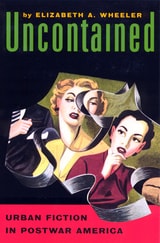
Uncontained
Urban Fiction in Postwar AmericaWheeler, Elizabeth A.
Rutgers University Press, 2001
In the postwar era, American urban fiction is dominated by the imagery of containment. Across the fictional landscape, the city is divided into segregated zones, marked by the threat of inevitable violence, and set off from the safety of equally contained suburbs. Mean and dangerous, the city can only be navigated by a solitary expert, alienated and male. In Uncontained, Elizabeth A. Wheeler offers a critique of this familiar story-evident in the noir. narratives of James M. Cain and in work by Ellison, Roth, Salinger, Percy, Capote, and others —and challenges its link to the postwar city.
Discussing film, short stories, and novels from a cross-section of American cities, Wheeler integrates these stories of containment into a shared pattern and reads them across a broad spectrum of famous and forgotten works by men and women of various ethnic and literary traditions to reveal a larger vision of postwar America. Knowing that containment is never the entire story, that diversity or trauma always shows itself, she shows how the uncontained has shaped the historical moment. Aware that liberating counterstories do get told, she places them in dialogue with those of the alienated man, the war veteran, Beat hipster, noir detective, and ironic suburbanite — in historical context — and revives the idea of urban space as a place of openness, thereby challenging a literary containment of racial difference, gender, and sexuality. By reading Paule Marshall in tandem with Philip Roth, Wheeler explores the relationships between adjacent neighborhoods and reconnects separate literary and geographic areas. By bringing Ann Bannon's lesbian pulp fiction, Hubert Selby's cult novels, or the work of John Okada, Hisaye Yamamoto, Chester Himes, Gwendolyn Brooks's, Jo Sinclair, and many others to bear on more canonical texts, she offers a more complete understanding of this period of American fiction — one that points toward a city that is open and inclusive.
Uncontained suggests that while decline, division, and decay form a major part of the story of mid-century urban America, the postwar city also represents much of what is best about American life. Rather than reproducing the containment of culture, Wheeler places together the wildly disparate to show how we move beyond containment.
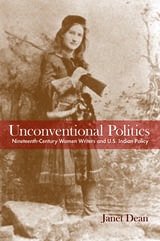
Unconventional Politics
Nineteenth-Century Women Writers and U.S. Indian PolicyJanet Dean
University of Massachusetts Press, 2016
Dean argues that in protesting U.S. Indian policy through popular genres, Wakefield, Sigourney, Callahan, and Eddleman also critiqued cultural protocols and stretched the contours of accepted modes of feminine discourse. Their acts of improvisation and reinvention tell a new story about the development of American women's writing and political expression.
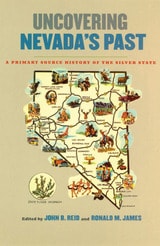
Uncovering Nevada's Past
A Primary Source History of the Silver StateJohn B. Reid
University of Nevada Press, 2004

Uncovering Our History
American Library Association, 2004
Uncovering the Constitution's Moral Design
Paul R. DeHart
University of Missouri Press, 2007
In critiquing previous attempts at describing and evaluating the Constitution’s normative framework, DeHart demonstrates that the Constitution’s moral framework corresponds largely to classical moral theory. Using the method of Inference to the Best Explanation to ascertain our Constitution’s moral meaning, he challenges the logical coherency of modern moral philosophy, normative positivism, and other theories that the Constitution has been argued to embody, offering instead an innovative methodology that can be applied to uncovering the normative framework of other constitutions as well.

Undead Ends
Stories of ApocalypseS. Trimble
Rutgers University Press, 2019
Under Construction
Making Homeland Security at the Local LevelKerry B. Fosher
University of Chicago Press, 2008
Under Cover of Science
American Legal-Economic Theory and the Quest for ObjectivityJames R. Hackney Jr.
Duke University Press, 2007
Hackney demonstrates how legal-economic thought has been affected by the prevailing philosophical ideas about objectivity, which have in turn evolved in response to groundbreaking scientific discoveries. Thus Hackney’s narrative is a history not only of law and economics but also of select strands of philosophy and science. He traces forward from the seventeenth-century the interaction of legal thinking and economic analysis with ideas about the attainability of certitude. The principal legal-economic theories Hackney examines are those that emerged from classical legal thought, legal realism, law and neoclassical economics, and critical legal studies. He links these theories respectively to formalism, pragmatism, the analytic turn, and neopragmatism/postmodernism, and he explains how each of these schools of philosophical thought was influenced by specific scientific discoveries: Newtonian physics, Darwin’s theory of evolution, Einstein’s theories of relativity, and quantum mechanics. Under Cover of Science challenges claims that the contemporary law and economics movement is an objective endeavor by historicizing ideas about certitude and empiricism and their relation to legal-economic thought.
Under Fire
The Nra and the Battle for Gun ControlOsha Gray Davidson
University of Iowa Press, 1998
Under New Management
Universities, Administrative Labor, and the Professional TurnAuthored by Randy Martin
Temple University Press, 2012
Faculty members who care about the institutions of higher education where they work are often at odds with university management. In his forceful book, Under New Management, Randy Martin takes a novel, evenhanded approach to this gulf between professors, who feel a loss of autonomy, and administrators.
Martin imagines a political future for academic labor based on a critical understanding of the administrative work that faculty already undertake. He considers the differences between self-rule and specialized expertise and provides a case study of a New York City public school to show how kids and families respond to the demands of managerial productivity that is part of preparing students for college. Under New Management also considers changes faced by students, faculty, and administrators in light of this reworked social compact of professionals.