Results by title
18284 books match the query 'United States' and 234 start with u
Urban Disorder and the Shape of Belief
The Great Chicago Fire, the Haymarket Bomb, and the Model Town of PullmanCarl Smith
University of Chicago Press, 1994
Urban Disorder and the Shape of Belief
The Great Chicago Fire, the Haymarket Bomb, and the Model Town of Pullman, Second EditionCarl Smith
University of Chicago Press, 2007
In Urban Disorder and the Shape of Belief, Carl Smith explores the imaginative dimensions of these events as he traces the evolution of interconnected beliefs and actions that increasingly linked city, disorder, and social reality in the minds of Americans. Examining a remarkable range of writings and illustrations, as well as protests, public gatherings, trials, hearings, and urban reform and construction efforts, Smith argues that these three events—and the public awareness of them—not only informed one another, but collectively shaped how Americans understood, and continue to understand, Chicago and modern urban life.
This classic of urban cultural history is updated with a foreword by the author that expands our understanding of urban disorder to encompass such recent examples as Hurricane Katrina, the Oklahoma City Bombing, and 9/11.
“Cultural history at its finest. By utilizing questions and methodologies of urban studies, social history, and literary history, Smith creates a sophisticated account of changing visions of urban America.”—Robin F. Bachin, Journal of Interdisciplinary History
Urban Dreams, Rural Commonwealth
The Rise of Plantation Society in the ChesapeakePaul Musselwhite
University of Chicago Press, 2018
Paul Musselwhite details the unsuccessful urban development that defined the region from the seventeenth century through the Civil War, showing how places like Jamestown and Annapolis—despite their small size—were the products of ambitious and cutting-edge experiments in urbanization comparable to those in the largest port cities of the Atlantic world. These experiments, though, stoked ongoing debate about commerce, taxation, and self-government. Chesapeake planters responded to this debate by reinforcing the political, economic, and cultural authority of their private plantation estates, with profound consequences for the region’s laborers and the political ideology of the southern United States. As Musselwhite makes clear, the antebellum economy around this well-known waterway was built not in the absence of cities, but upon their aspirational wreckage.
Urban Encounters
Helen Liggett
University of Minnesota Press, 2003
In words and photographs, reimagining the city as lived space
In contrast to Walter Benjamin, Henri Lefebvre, and other European thinkers engaged with the concept of the urban, American intellectuals tend to envision the modern city as a dystopia, their perception of urban life influenced by negative stereotypes and fictional depictions in popular culture. In Urban Encounters, Helen Liggett challenges this fatalism by approaching the city as a vibrant, lived space. Combining a sophisticated critique of the urban with striking, street-level images, Liggett reclaims the human experience of the city.
Liggett’s “encounters” with the urban are sequences of images and text that combine the joy of observing with the pleasure of making connections. For Liggett, this entails recognizing both beauty and danger. Alternately complementing and complicating her text, Liggett’s photographs capture the small details—the gestures, glances, and reflections—that together compose the urban experience. As a whole, Urban Encounters reimagines the city as a site of profound engagement with life.
Urban Farming in the West
A New Deal Experiment in Subsistence HomesteadsRobert Carriker
University of Arizona Press, 2010
Robert Carriker examines for the first time the intricate histories of these subsistence homestead projects, which have long been buried in bureaucratic records and clouded by misunderstanding, showing that in many ways they were among the agency’s most successful efforts. He provides case studies of the projects, rescuing their obscure histories using archival documents and rare photographs. He also reveals the machinations of civic groups and private citizens across the West who jockeyed for access to the funds being allotted for New Deal community building.
By describing what took place on these western homesteads, Carriker shows that the DSH’s agenda was not as far-fetched as some have reported. The tendency to condemn the Division and its projects, he argues, has failed to appreciate the good that came from some of the individual homestead communities—particularly those in the Far West.
Although overshadowed by the larger undertakings of the New Deal, some of these western communities remain thriving neighborhoods—living legacies to FDR’s efforts that show how the country once chose to deal with economic hardship. Too often the DSH is noted for its failures; Carriker’s study shows that its western homesteads were instead qualified accomplishments.
Urban Housing Segregation of Minorities in Western Europe and the United States
Elizabeth Huttman, Juliet Saltman and Wim Blauw, eds.
Duke University Press, 1991
The collection begins with a review of the historical development of housing segregation in these countries, describing current housing conditions, concentration of housing in each country’s leading cities, minority populations and the housing they occupy—specifically public, nonprofit, and owner-occupied dwellings. When focusing on the United States, the contributors assess housing segregation, antisegregation measures, and institutional racism toward blacks in the Midwest and South, and toward Mexican-Americans throughout American cities. Chapters dealing with Western Europe include housing segregation of South Asian and West Indian immigrants in Britain, immigrants in Sweden, Turkish, and Yugoslav “guest workers” in West Germany, and Algerian and other Arab groups in France. The book concludes with discussions of public housing policies; suburban desegregation, resegregation, and integration maintenance programs; specific integration stabilization programs; and desegregation efforts in one specific place.
Contributors. Elizabeth Huttman, Michal Arend, Cihan Arin, Maurice Blanc, Wim Blauw, Ger Mik, Clyde McDaniels, Jürgen Friedrichs, Hannes Alpheis, John M. Goering, Len Gordon, Albert Mayer, Rosemary Helper, Barry V. Johnston, Terry Jones, Valerie Karn, Göran Lindberg, Anna Lisa Lindén, Deborah Phillips, Dennis Keating, Juliet Saltman, Alan Murie
Urban Inequality
Evidence From Four CitiesAlice O'Connor
Russell Sage Foundation, 2001

Urban Land Use Planning, Fifth Edition
Philip R. Berke, David R. Godschalk, and Edward J. Kaiser, with Daniel A. Rodriguez
University of Illinois Press, 2006
Divided into three sections, this edition of Urban Land Use Planning deftly balances an authoritative, up-to-date discussion of current practices with a vision of what land use planning should become. It explores the societal context of land use planning and proposes a model for understanding and reconciling the divergent priorities among competing stakeholders; it explains how to build planning support systems to assess future conditions, evaluate policy choices, create visions, and compare scenarios; and it sets forth a methodology for creating plans that will influence future land use change.
Discussions new to the fifth edition include how to incorporate the three Es of sustainable development (economy, environment, and equity) into sustainable communities, methods for including livability objectives and techniques, the integration of transportation and land use, the use of digital media in planning support systems, and collective urban design based on analysis and public participation.
Urban Lowlands
A History of Neighborhoods, Poverty, and PlanningSteven T. Moga
University of Chicago Press, 2020
In Urban Lowlands, Steven T. Moga looks closely at the Harlem Flats in New York City, Black Bottom in Nashville, Swede Hollow in Saint Paul, and the Flats in Los Angeles, to interrogate the connections between a city’s actual landscape and the poverty and social problems that are often concentrated at its literal lowest points. Taking an interdisciplinary perspective on the history of US urban development from the nineteenth to the mid-twentieth century, Moga reveals patterns of inequitable land use, economic dispossession, and social discrimination against immigrants and minorities. In attending to the landscapes of neighborhoods typically considered slums, Moga shows how physical and policy-driven containment has shaped the lives of the urban poor, while wealth and access to resources have been historically concentrated in elevated areas—truly “the heights.” Moga’s innovative framework expands our understanding of how planning and economic segregation alike have molded the American city.
Urban Lowlands
A History of Neighborhoods, Poverty, and PlanningSteven T. Moga
University of Chicago Press, 2020
Interrogates the connections between a city’s physical landscape and the poverty and social problems that are often concentrated at its literal lowest points.
In Urban Lowlands, Steven T. Moga looks closely at the Harlem Flats in New York City, Black Bottom in Nashville, Swede Hollow in Saint Paul, and the Flats in Los Angeles, to interrogate the connections between a city’s actual landscape and the poverty and social problems that are often concentrated at its literal lowest points. Taking an interdisciplinary perspective on the history of US urban development from the nineteenth to the mid-twentieth century, Moga reveals patterns of inequitable land use, economic dispossession, and social discrimination against immigrants and minorities. In attending to the landscapes of neighborhoods typically considered slums, Moga shows how physical and policy-driven containment has shaped the lives of the urban poor, while wealth and access to resources have been historically concentrated in elevated areas—truly “the heights.” Moga’s innovative framework expands our understanding of how planning and economic segregation alike have molded the American city.
Urban Neighborhoods in a New Era
Revitalization Politics in the Postindustrial CityClarence N. Stone and Robert P. Stoker
University of Chicago Press, 2015
While not denying the hurdles that community revitalization still faces, the contributors ultimately put forth a strong case that a more hospitable local milieu can be created for making neighborhood policy. In examining the course of experiences from an earlier period of redevelopment to the present postindustrial city, this book opens a window on a complex process of political change and possibility for reform.
Urban Nightlife
Entertaining Race, Class, and Culture in Public SpaceMay, Reuben A. Buford
Rutgers University Press, 2014
Watch video now. (http://www.youtube.com/watch?v=VCs1xExStPw).
Urban Nightmares
The Media, The Right, And The Moral Panic Over The CitySteve Macek
University of Minnesota Press, 2006
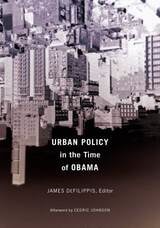
Urban Policy in the Time of Obama
James DeFilippis
University of Minnesota Press, 2016
With his background as a community organizer and as a state legislator representing Chicago’s South Side, Barack Obama became America’s most “urban” president since Teddy Roosevelt. But what has been his record in dealing with the issues most impacting our metropolitan areas today? Looking past the current administration, what are the future prospects of the nation’s cities, and how have they been shaped by our policies in this century? Seeking to answer these questions, the contributors to Urban Policy in the Time of Obama explore a broad range of policy arenas that shape, both directly and indirectly, metropolitan areas and urbanization processes.
This volume reveals the Obama administration’s surprisingly limited impact on cities, through direct policy initiatives such as Strong Cities, Strong Communities, Promise Neighborhoods, and Choice Neighborhood Initiatives. There has been greater impact with broader policies that shape urban life and governance, including immigration reform, education, and health care.
Closing with Cedric Johnson’s afterword illuminating the Black Lives Matter movement and what its broader social context says about city governance in our times, Urban Policy in the Time of Obama finds that most of the dominant policies and policy regimes of recent years have fallen short of easing the ills of America’s cities, and calls for a more equitable and just urban policy regime.
Contributors: Rachel G. Bratt, Tufts University; Christine Thurlow Brenner, University of Massachusetts Boston; Karen Chapple, University of California, Berkeley; James Fraser, Vanderbilt University; Edward G. Goetz, University of Minnesota; Dan Immergluck, Georgia Tech; Amy T. Khare, University of Chicago; Robert W. Lake, Rutgers University; Pauline Lipman, University of Illinois at Chicago; Lorraine C. Minnite, Rutgers University–Camden; Kathe Newman, Rutgers University; Deirdre Oakley, Georgia State; Frances Fox Piven, City University of New York; Hilary Silver, Brown University; Janet Smith, University of Illinois at Chicago; Preston H. Smith II, Mount Holyoke College; Todd Swanstrom, University of Missouri–St. Louis; Nik Theodore, University of Illinois at Chicago; J. Phillip Thompson, MIT.

Urban Reform and Its Consequences
A Study in RepresentationSusan Welch and Timothy Bledsoe
University of Chicago Press, 1988
Susan Welch and Timothy Bledsoe clarify a portion of the debate by investigating how election structures affect candidates and the nature of representation. They examine the different effects of district versus at-large elections and of partisan versus nonpartisan elections. Who gets elected? Are representatives' socioeconomic status and party affiliation related to election form? Are election structures related to how those who are elected approach their jobs? Do they see themselves as representatives concerned with the good of the city as a whole?
Urban Reform and Its Consequences reports an unprecedented wealth of data drawn from a sample of nearly 1,000 council members and communities with populations between 50,000 and 1 million across 42 states. The sample includes communities that use a variety of election procedures. This study is therefore the most comprehensive and accurate to date.
Welch and Bledsoe conclude that nonpartisan and at-large elections do give city councils a more middle- and upper-middle-class character and have changed the way representatives view their jobs. Reform measures have not, however, produced councils that are significantly more conservative or more prone to conflict. Overall, the authors conclude that partisan and district elections are more likely to represent the whole community and to make the council more accountable to the electorate.

Urban Teens in the Library
Research and PracticeDenise E. Agosto
American Library Association, 2010
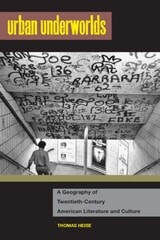
Urban Underworlds
A Geography of Twentieth-Century American Literature and CultureHeise, Thomas
Rutgers University Press, 2010
The quarantining of minority cultures helped to promote white, middle-class privilege. Following a diverse array of literary figures who differ with the assessment of the underworld as the space of the monstrous Other, Heise contends that it is a place where besieged and neglected communities are actively trying to take possession of their own neighborhoods.

Us Against Them
Ethnocentric Foundations of American OpinionDonald R. Kinder and Cindy D. Kam
University of Chicago Press, 2009
Ethnocentrism—our tendency to partition the human world into in-groups and out-groups—pervades societies around the world. Surprisingly, though, few scholars have explored its role in political life. Donald Kinder and Cindy Kam fill this gap with Us Against Them, their definitive explanation of how ethnocentrism shapes American public opinion.
Arguing that humans are broadly predisposed to ethnocentrism, Kinder and Kam explore its impact on our attitudes toward an array of issues, including the war on terror, humanitarian assistance, immigration, the sanctity of marriage, and the reform of social programs. The authors ground their study in previous theories from a wide range of disciplines, establishing a new framework for understanding what ethnocentrism is and how it becomes politically consequential. They also marshal a vast trove of survey evidence to identify the conditions under which ethnocentrism shapes public opinion. While ethnocentrism is widespread in the United States, the authors demonstrate that its political relevance depends on circumstance. Exploring the implications of these findings for political knowledge, cosmopolitanism, and societies outside the United States, Kinder and Kam add a new dimension to our understanding of how democracy functions.
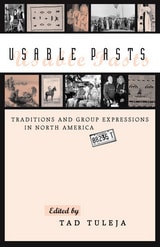
Usable Pasts
Traditions and Group Expressions in North AmericaTad Tuleja
Utah State University Press, 1997

Useful Cinema
Charles R. Acland and Haidee Wasson, eds.
Duke University Press, 2011
Contributors. Charles R. Acland, Joseph Clark, Zoë Druick, Ronald Walter Greene, Alison Griffiths, Stephen Groening, Jennifer Horne, Kirsten Ostherr, Eric Smoodin, Charles Tepperman, Gregory A. Waller, Haidee Wasson. Michael Zryd
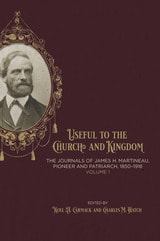
Useful to the Church and Kingdom
The Journals of James H. Martineau, Pioneer and Patriarch, 1850-1918, Volume: 1Noel A. Carmack
Signature Books, 2023
These journals document his exploration of virgin lands in southern Utah, his laying out of townsites and farmland in Cache Valley, his participation in canal building and water projects in Arizona, and his near-death experiences while surveying rough, mountainous areas. His work for the Union Pacific Railroad through Weber Canyon and across the Salt Lake Promontory and Humboldt Desert in 1868 is one of the very few complete records of its kind.
Useful to the Church and Kingdom
The Journals of James H. Martineau, Pioneer and Patriarch, 1850-1918, Volume: 2Noel A. Carmack
Signature Books, 2023
These journals document his exploration of virgin lands in southern Utah, his laying out of townsites and farmland in Cache Valley, his participation in canal building and water projects in Arizona, and his near-death experiences while surveying rough, mountainous areas. His work for the Union Pacific Railroad through Weber Canyon and across the Salt Lake Promontory and Humboldt Desert in 1868 is one of the very few complete records of its kind.
Ushering Civil Rights into Law
Judge Richard T. Rives and Desegregation in the Public SpherePat Arneson
University of Alabama Press, 2026
Illuminates the life and legacy of a federal jurist from Alabama, an unexpected but ardent defender of equal rights for all citizens under the law
Ushering Civil Rights into Law: Judge Richard T. Rives and Desegregation in the Public Sphere by Pat Arneson is a long-overdue exploration of one of the most consequential yet overlooked figures of the modern Civil Rights Movement. As debates over judicial philosophy and Civil Rights continue, Judge Richard T. Rives’s story serves as a powerful reminder of the judiciary’s role in shaping a more just society.
A native of Montgomery, Alabama, Judge Richard T. Rives served on the US Court of Appeals for the Fifth Circuit during the height of America’s battle over racial segregation. Once aligned with segregationist views, Rives underwent a profound evolution, emerging as a key legal architect of desegregation. His landmark ruling on behalf of the court in Browder v. Gayle ended segregation on Montgomery’s public buses and expanded the scope of Brown v. Board of Education beyond education. Rives’s decisions invalidated the legal underpinnings of Jim Crow laws and furthered equality in public education, voting rights, and jury selection. Writing for the court, Rives authored legal precedents that fundamentally reshaped the nation.
Through archival research, Arneson examines the cultural and political pressures Rives faced, the legal strategies he employed, and the lasting impact of his work. Constitutional rights remain a flashpoint in American discourse. Ushering Civil Rights into Law reveals how one judge’s principled stance helped define the legal landscape of modern Civil Rights and underscores the enduring significance of his legacy.

Using Digital Analytics for Smart Assessment
Tabatha Farney
American Library Association, 2017
Using Technology to Teach Information Literacy
American Library Association, 2008
Utah A People's History
Dean L May
University of Utah Press, 2002
History belongs to the people, Dean May reminds us, and must ultimately be accessible all. Based on his award-winning television series, Utah: A People's History provides a sweeping view of the state's past. From prehistory to present, May explains Utah as it is today and its promise for the future. The video series upon which this book is based is no longer available for sale.

Utah Place Names
A Geopgraphic Guide to the Origins of Geographic Names, a CompilationJohn Van Cott
University of Utah Press, 1991
John W. Van Cott has spend the better part of a lifetime searching out the answers to these questions. Now the fruits of his labor are recorded in this, the most extensive compilation of Utah place names ever published. Almost five thousand toponyms are listed alphabetically, marking the passage of peoples and cultures from earliest times. Specialists will appreciate the geographical precision of Section, Township, Range, and altitude. Generalists will recognize counties and relationships to know features. All will delight in the rich lore, often a mixture of myth and history, of the place and its name. Scholars will find useful the inclusion of synonyms, nicknames, previous names, all cross-referenced, and all tied to a bibliography of over five hundred entries.
The author concluded his work of over forty years with the observation that he hardly touched the surface of Utah’s place names, numbered at over twenty-two thousand by the U.S. Geological Survey.
Utah Politics
The Elephant in the RoomRod Decker
Signature Books, 2019
Some themes reoccur: governors become popular by fighting federal oversight— signaling a lingering distrust that Washington could alter the Mormon way of life—and liberals use the court system to circumvent conservative legislatures who see public morality as a defining feature of government. Through this lens, issues both deceptively innocuous and deeply complex underscore Utah’s dance with religious freedom and civil liberty.

Utah Thirteeners
David M. Rose
University of Utah Press, 2004
Most Utahns are familiar with the Uinta Mountains, but few realize that the range has twenty-one peaks above 13,000 feet, some of them still unnamed. The elevation, challenging terrain and weather, solitude, and beautiful setting in Utah’s largest wilderness area make climbing these peaks a particularly rewarding experience. Better yet, in the summer and early fall every one of them can be climbed by a reasonably fit hiker without rope or climbing gear.
This guide provides detailed topographical maps and information on trailheads, access and summit routes with difficulty ratings, camp locations, estimated hiking times, weather, advice, and brief facts about geology and the history of the wilderness area. It also includes over fifty photographs of this breathtaking country.
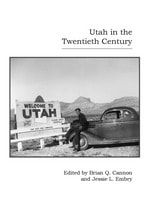
Utah in the Twentieth Century
Brian Q. Cannon and Jessie Embry
Utah State University Press, 2009
The twentieth century could easily be Utah's most interesting and complex. Utah in the Twentieth Century chronicles the social and cultural transitions of the time, offering a well-rounded perspective on the development and change the Beehive State went through during this period.
It was an era complicated by the push of economic development and pull of traditional culture, demand for natural resources from a fragile and scenic environment, questions of who governs and how, who gets a vote, and who controls what on contested public lands, during which outside trade and a tourist economy increasingly challenged and fed an insular society. Activists left and right declaimed constitutional liberties while Utah's Native Americans become the last enfranchised in the nation. Proud contributions to national wars contrasted with denial of deep dependence on federal money; the skepticism of provocative writers, boosters eager for growth; and reflexive patriotism somehow bonded to ingrained distrust of federal government.
A valuable resource for students and teachers, this work is also fruitful reading for anyone who desires to know more about key themes of Utah’s history in the twentieth century.
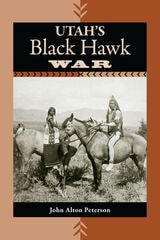
Utah'S Black Hawk War
John Alton Peterson
University of Utah Press, 1998
"On Sunday 9 April 1865, Ulysses S. Grant and Robert E. Lee met in the parlor of Wilmer McLean’s brick home in Appomattox Court House, Virginia, to negotiate the conclusion of the Civil War. That same day, far to the west, a handful of Mormons and northern Utes met in the central Utah town of Manti in an attempt to achieve a peace of their own. Unlike the negotiations at Appomattox, however, those in Manti failed, and the events that transpired there are viewed as the beginning of Utah’s Black Hawk War, the longest and most serious Indian-white conflict in Utah history."
—From the book
So begins the story of Black Hawk, Ute Indian warrior chief and brilliant strategist, and Brigham Young, sagacious religious and political leader of the Mormons. Two powerful and unyielding men forged by hardship and conviction, both revered and both reviled in their times. One, orchestrating a remarkable campaign to turn back the tide of white expansion and prevent the extinction of his people, the other, attempting to keep his exiled church and its thriving utopian society sovereign and intact. Two men of distinct races, beliefs, and cultures, but sharing a determination to keep U.S. soldiers out of their bloody conflict for control of land and other resources in the Utah territory.
From 1865 to 1867, the warrior Black Hawk, also known as Antonga, led a combined force of Utes, Navajos, and Paiutes in a series of intense stock raids on the Mormon settlements in Utah territory. Black Hawk astutely judged that political conflict between the federal government and Mormon Utah would keep U.S. soldiers from chastising his band. Moreover, the antagonism of Washington toward Utah’s polygamy, theocracy, and isolationism made Mormon leader Brigham Young wary of seeking federal help. In fact, to keep the government from using the war as a pretext for sending more troops to Utah, the Mormons withheld information, making the Black Hawk War an almost secret war as far as the rest of the nation was concerned. As directed by Brigham Young, Utah’s Latter-day Saint citizens mobilized a church militia, the Nauvoo Legion, to repel Indian attacks. Yet Black Hawk and others were able to carry on their activities for almost eight years without incurring the federal military reprisals that Indians on all four sides of the Mormon heartland experienced. Bloodshed on both sides plunged Mormons and Indians into a war of vengeance—years of killing and raiding that continued until federal troops stepped in 1872.
In this unprecedented volume, historian John Peterson provides the first comprehensive analysis of a unique and compelling chapter of western history and of the violent and protracted conflict it engendered. Utah’s Black Hawk War not only explores political intricacies and broader implications, scrutinizing the Mormons' Indian policies—most notably Brigham Young’s extraordinary "better to feed them than fight them" teachings—but also presents vivid narrative accounts of various raids and battles. The result is a masterfully researched and engagingly written account of Utah’s secret war, a war largely unknown among western history students, scholars, and enthusiasts—until now.
Winner of the Mormon History Association Francis M. and Emily S. Chipman Best First Book Award.
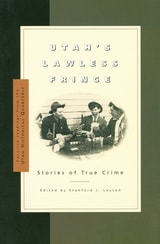
Utah's Lawless Fringe
Stories of True CrimeStanford J. Layton
Signature Books, 2001
So it went on the outskirts of Utah Territory. In this case it was the little town of Bluff where the Mormon bishop served for some ten years as de facto sheriff and his congregation as deputies. As elsewhere, law and order developed organically rather than by legislation.
In this anthology several aspects of the process are considered, including one of the worst manifestations of citizen action: vigilantism. Territorial Utah witnessed more lynchings than legal executions. Another citizen trait was an unexpected indifference to vice. In 1908 Salt Lake City had 148 registered prostitutes overseen by a madam who was recruited for the position by the mayor and city council. During Prohibition one of the largest distilleries in the West operated in a Salt Lake warehouse.
What is to be learned from this? The contributors to these fourteen articles leave moral considerations to the reader’s contemplation, while providing surprises along the way in an extremely engaging—dare we say arresting—read.

Utopia Limited
The Sixties and the Emergence of the PostmodernMarianne DeKoven
Duke University Press, 2004
DeKoven rigorously analyzes a broad array of cultural and political texts important in the sixties—from popular favorites such as William S. Burroughs’s Naked Lunch to political manifestoes including The Port Huron Statement, the founding document of SDS (Students for a Democratic Society). She examines texts that overtly discuss the conflict in Vietnam, Black Power, and second-wave feminism—including Frances FitzGerald’s Fire in the Lake, James Baldwin’s The Fire Next Time, and Shulamith Firestone’s The Dialectic of Sex; experimental pieces such as The Living Theatre’s Paradise Now; influential philosophical works including Roland Barthes’s Mythologies and Herbert Marcuse’s One-Dimensional Man; and explorations of Las Vegas, the prime location of postmodernity. Providing extensive annotated bibliographies on both the sixties and postmodernism, Utopia Limited is an invaluable resource for understanding the impact of that tumultuous decade on the present.
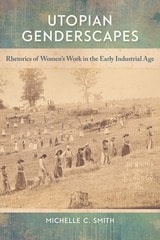
Utopian Genderscapes
Rhetorics of Women’s Work in the Early Industrial AgeMichelle C. Smith
Southern Illinois University Press, 2021
A necessary rhetorical history of women’s work in utopian communities
Utopian Genderscapes focuses on three prominent yet understudied intentional communities—Brook Farm, Harmony Society, and the Oneida Community—who in response to industrialization experimented with radical social reform in the antebellum United States. Foremost among the avenues of reform was the place and substance of women’s work. Author Michelle C. Smith seeks in the communities’ rhetorics of teleology, choice, and exceptionalism the lived consequences of the communities' lofty goals for women members.
This feminist history captures the utopian reconfiguration of women’s bodies, spaces, objects, and discourses and delivers a needed intervention into how rhetorical gendering interacts with other race and class identities. The attention to each community’s material practices reveals a gendered ecology, which in many ways squared unevenly with utopian claims. Nevertheless, this volume argues that this utopian moment inaugurated many of the norms and practices of labor that continue to structure women’s lives and opportunities today: the rise of the factory, the shift of labor from home spaces to workplaces, the invention of housework, the role of birth control and childcare, the question of wages, and the feminization of particular kinds of labor.
An impressive and diverse array of archival and material research grounds each chapter’s examination of women’s professional, domestic, or reproductive labor in a particular community. Fleeting though they may seem, the practices and lives of those intentional women, Smith argues, pattern contemporary divisions of work along the vibrant and contentious lines of gender, race, and class and stage the continued search for what is possible.