Results by title
28164 books match the query 'History' and 339 start with u
Urban Latin America
The Political Condition from Above and BelowBy Alejandro Portes and John Walton
University of Texas Press, 1976
Much research on the city in developing societies has focused mainly on one of three areas—planning, demography, or economics—and has emphasized either power elites or the masses, but not both. The published literature on Latin America has reflected these interests and has so far failed to provide a comprehensive view of Latin American urbanization. Urban Latin America is an attempt to integrate research on Latin American social organization within a single theoretical framework: development as fundamentally a political problem. Alejandro Portes and John Walton have included material on both elites and marginal populations and on the three major areas of research in order to formulate and address some of the key questions about the structure of urban politics in Latin America.
Following an introduction that delineates the scope of Latin American urban studies, Portes discusses the Latin American city as a creation of European colonialism. He goes on to examine political behavior among the poor, with central reference to system support and countersystem potential. Walton provides material for a comparative study of four cities: Monterrey and Guadalajara in Mexico and Medellín and Cali in Colombia. He also summarizes a large number of urban elite studies and develops a theoretical interpretation of their collective results, based on class structure and vertical integration. Material in each chapter is cross-referenced to other chapters, and the authors have used a common methodological approach in synthesizing and interpreting the research literature. In the final chapter they generalize current findings, elaborating on the interface between elite and mass politics in the urban situation. They make some observations on approaching changes and pinpoint possible research strategies for the future.
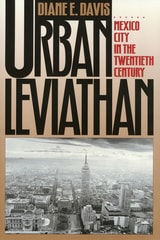
Urban Leviathan
Mexico City in the Twentieth CenturyDiane E. Davis
Temple University Press, 1994
Why, Diane Davis asks, has Mexico City, once known as the city of palaces, turned into a sea of people, poverty, and pollution? Through historical analysis of Mexico City, Davis identifies political actors responsible for the uncontrolled industrialization of Mexico's economic and social center, its capital city. This narrative biography takes a perspective rarely found in studies of third-world urban development: Davis demonstrates how and why local politics can run counter to rational politics, yet become enmeshed, spawning ineffective policies that are detrimental to the city and the nation.
The competing social and economic demand of the working poor and middle classes and the desires of Mexico's ruling Partido Revolucionario Institutional (PRI) have led to gravely diminished services, exorbitant infrastructural expenditures, and counter-productive use of geographic space. Though Mexico City's urban transport system has evolved over the past seven decades from trolley to bus to METRO (subway), it fails to meet the needs of the population, despite its costliness, and is indicative of the city's disastrous and ill-directed overdevelopment. Examining the political forces behind the thwarted attempts to provide transportation in the downtown and sprawling outer residential areas, Davis analyzes the maneuverings of local and national politicians, foreign investors, middle classes, agency bureaucrats, and various factions of the PRI.
Looking to Mexico's future, Davis concludes that growing popular dissatisfaction and frequent urban protests demanding both democratic reform and administrative autonomy in the capital city suggest an unstable future for corporatist politics and the PRI's centralized one-party government.
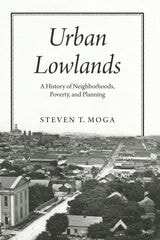
Urban Lowlands
A History of Neighborhoods, Poverty, and PlanningSteven T. Moga
University of Chicago Press, 2020
In Urban Lowlands, Steven T. Moga looks closely at the Harlem Flats in New York City, Black Bottom in Nashville, Swede Hollow in Saint Paul, and the Flats in Los Angeles, to interrogate the connections between a city’s actual landscape and the poverty and social problems that are often concentrated at its literal lowest points. Taking an interdisciplinary perspective on the history of US urban development from the nineteenth to the mid-twentieth century, Moga reveals patterns of inequitable land use, economic dispossession, and social discrimination against immigrants and minorities. In attending to the landscapes of neighborhoods typically considered slums, Moga shows how physical and policy-driven containment has shaped the lives of the urban poor, while wealth and access to resources have been historically concentrated in elevated areas—truly “the heights.” Moga’s innovative framework expands our understanding of how planning and economic segregation alike have molded the American city.
Urban Lowlands
A History of Neighborhoods, Poverty, and PlanningSteven T. Moga
University of Chicago Press, 2020
Interrogates the connections between a city’s physical landscape and the poverty and social problems that are often concentrated at its literal lowest points.
In Urban Lowlands, Steven T. Moga looks closely at the Harlem Flats in New York City, Black Bottom in Nashville, Swede Hollow in Saint Paul, and the Flats in Los Angeles, to interrogate the connections between a city’s actual landscape and the poverty and social problems that are often concentrated at its literal lowest points. Taking an interdisciplinary perspective on the history of US urban development from the nineteenth to the mid-twentieth century, Moga reveals patterns of inequitable land use, economic dispossession, and social discrimination against immigrants and minorities. In attending to the landscapes of neighborhoods typically considered slums, Moga shows how physical and policy-driven containment has shaped the lives of the urban poor, while wealth and access to resources have been historically concentrated in elevated areas—truly “the heights.” Moga’s innovative framework expands our understanding of how planning and economic segregation alike have molded the American city.
Urban Planning in the Nordic World
Ellen Braae
University of Wisconsin Press, 2022
Urban planning is a keystone in the materialization of the Nordic welfare states. That is not to say that there is one particular city form or planning practice that is synonymous with the emerging welfare city, as welfare per se is far from normative. On the contrary, welfare is a highly ambiguous and contested notion that has changed over the postwar decades, which is also reflected in the development of the welfare city.
However, welfare in urban planning has mainly been associated with ideas of “the good life” and egalitarianism. In a Nordic context, the state has taken the lead in providing the social engineering “hardware” for advancing this universal aim. Social demographic welfare is economically based on full employment, and in this regard housing and caregiving support are key components. Yet education, infrastructure, and leisure facilities are also basic features in the distribution of universal welfare services for citizens’ entire lives. The results, ideally, are green and spacious welfare cities.
This book outlines the origins, development, challenges, and lived realities of the changing welfare city, focusing primarily on Denmark. Strategies have changed over the decades as models of development have shifted and as the needs of society and a warming planet have come into focus. The current welfare city can be described as an urban landscape characterized by, on the one hand, a division of functions and, on the other, mutual competition. The role of the state has been minimized, turning municipalities into the new major agents in attracting taxpayers and providing goods—both by means of urban planning.

Urban Regimes and Strategies
Building Europe's Central Executive District in BrusselsAlex G. Papadopoulos
University of Chicago Press, 1996
In Brussels, Belgium—since 1957 home to the European Union—such change is taking place. Observing the change, Alexis G. Papadopoulos explores a new geographical concept, the Central Executive District. This urban form is significantly different from the Central Business District, its conventional counterpart. Drawing on game and rational choice theories, spatial analysis, and land economics, the author analyzes how the landscape of the city's center has evolved over the last three decades under the influence of successive coalitions of local and foreign elites. He describes how foreign diplomats, international corporate executives, and real-estate developers cooperate with one another to carry out major urban projects in the face of resistance from local neighborhood groups, conservationists, and political factions.
This study makes a substantial contribution to geography and urban studies both for its implications about the future of world cities like New York, London, and Paris and for its original application of the notion of cooperative regimes.
Urban Saniscapes
Slums, Housing and Everyday Sanitation in Accra and Nairobi, 1908–1963Waseem-Ahmed Bin-Kasim
Michigan State University Press, 2025

Urban Solidarity
Gender, Mobility, and the Unfinished Politics of Buen VivirJulie Gamble
University of Texas Press, 0
An exploration of how the citizens of Quito created community via transportation systems in spite of political crisis.
Between 2007 and 2017, Ecuadoreans breathed the air of revolution. Their national project, spearheaded by Democratic Socialist president Rafael Correa, was known as buen vivir—good living. Both a discourse and a development strategy, buen vivir promoted interdependence with and among working-class and marginalized people. And public investment shifted toward shared infrastructure, especially transit. Yet much work was still to be done when Correa left office, and Ecuador has since seen retrenchment.
Urban Solidarity explores and interprets buen vivir’s afterlife, as local organizers in the capital Quito sustain and build the interdependence agenda in the midst of state retreat. Since the IMF forced the government to cancel fuel subsidies, residents have responded by developing impressive carsharing (taxirutas) and shared-cycling resources. These efforts are markedly feminist as well, prioritizing women’s safety and independence as they travel about the city to earn money and care for their families. Gamble argues that buen vivir planted the seed of a new politics, that could once again inspire state action. For now, the people of Quito continue to foster the solidarity foundational to a good life.
Urban Space as Heritage in Late Colonial Cuba
Classicism and Dissonance on the Plaza de Armas of Havana, 1754-1828By Paul Niell
University of Texas Press, 2015
According to national legend, Havana, Cuba, was founded under the shade of a ceiba tree whose branches sheltered the island’s first Catholic mass and meeting of the town council (cabildo) in 1519. The founding site was first memorialized in 1754 by the erection of a baroque monument in Havana’s central Plaza de Armas, which was reconfigured in 1828 by the addition of a neoclassical work, El Templete. Viewing the transformation of the Plaza de Armas from the new perspective of heritage studies, this book investigates how late colonial Cuban society narrated Havana’s founding to valorize Spanish imperial power and used the monuments to underpin a local sense of place and cultural authenticity, civic achievement, and social order.
Paul Niell analyzes how Cubans produced heritage at the site of the symbolic ceiba tree by endowing the collective urban space of the plaza with a cultural authority that used the past to validate various place identities in the present. Niell’s close examination of the extant forms of the 1754 and 1828 civic monuments, which include academic history paintings, neoclassical architecture, and idealized sculpture in tandem with period documents and printed texts, reveals a “dissonance of heritage”—in other words, a lack of agreement as to the works’ significance and use. He considers the implications of this dissonance with respect to a wide array of interests in late colonial Havana, showing how heritage as a dominant cultural discourse was used to manage and even disinherit certain sectors of the colonial population.
Urban Transformations in Sierra Leone
Knowledge Co-Production and Partnerships for a Just CityEdited by Joseph M. Macarthy, Braima Koroma, Andrea Rigon, Alexandre Apsan Frediani, and Andrea Klingel
University College London, 2024
With a population of over one million, Freetown, Sierra Leone faces serious challenges with service provisions, housing, infrastructure, employment, and climate change. In 2015, the Sierra Leone Urban Research Centre (SLURC) was established to address these challenges through research, capacity building, and advocacy. Urban Transformations in Sierra Leone shares SLURC’s progress, articulating its key findings and reflections on the partnerships it helped enable.
Urban Underworlds
A Geography of Twentieth-Century American Literature and CultureHeise, Thomas
Rutgers University Press, 2010
The quarantining of minority cultures helped to promote white, middle-class privilege. Following a diverse array of literary figures who differ with the assessment of the underworld as the space of the monstrous Other, Heise contends that it is a place where besieged and neglected communities are actively trying to take possession of their own neighborhoods.
Urban Voices
The Bay Area American Indian CommunitySusan Lobo, Coordinating Editor, Community History Project; Forewords by Wilma Mankiller and Simon J. Ortiz
University of Arizona Press, 2002
Urbanism and Empire in Roman Sicily
By Laura Pfuntner
University of Texas Press, 2019
Sicily has been the fulcrum of the Mediterranean throughout history. The island’s central geographical position and its status as ancient Rome’s first overseas province make it key to understanding the development of the Roman Empire. Yet Sicily’s crucial role in the empire has been largely overlooked by scholars of classical antiquity, apart from a small number of specialists in its archaeology and material culture.
Urbanism and Empire in Roman Sicily offers the first comprehensive English-language overview of the history and archaeology of Roman Sicily since R. J. A. Wilson’s Sicily under the Roman Empire (1990). Laura Pfuntner traces the development of cities and settlement networks in Sicily in order to understand the island’s political, economic, social, and cultural role in Rome’s evolving Mediterranean hegemony. She identifies and examines three main processes traceable in the archaeological record of settlement in Roman Sicily: urban disintegration, urban adaptation, and the development of alternatives to urban settlement. By expanding the scope of research on Roman Sicily beyond the bounds of the island itself, through comparative analysis of the settlement landscapes of Greece and southern Italy, and by utilizing exciting evidence from recent excavations and surveys, Pfuntner establishes a new empirical foundation for research on Roman Sicily and demonstrates the necessity of including Sicily in broader historical and archaeological studies of the Roman Empire.
Urbanism in the Preindustrial World
Cross-Cultural ApproachesEdited by Glenn R. Storey
University of Alabama Press, 2006
This work employs a subset of preindustrial cities on many continents to answer questions archaeologists grapple with concerning the populating and growth of cities before industrialization. It further explores how scholars differently conceive and execute their research on the population of cities. The subject cities are in Greece, Mesoamerica, the Andes, Italy, Egypt, Africa, United States, Denmark, and China. This broad sample provides a useful framework for answers to such questions as “Why did people agglomerate into cities?” and “What population size and what age of endurance constitute a city?”
The study covers more than population magnitude and population makeup, the two major frameworks of urban demography. The contributors combine their archaeological and historical expertise to reveal commonalities, as well as theoretical extrapolations and methodological approaches, at work here and outside the sample.
Urbanism in the Preindustrial World is a unique study revealing the variety of factors involved in the coalescing and dispersal of populations in preindustrial times.
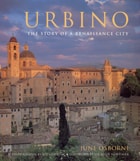
Urbino
The Story of a Renaissance CityJune Osborne
University of Chicago Press, 2003
With Urbino: The Story of a Renaissance City, art historian June Osborne brings to life not only the great city and its art but also its turbulent history and the intrigue surrounding its ruling family. First settled by the ancient Umbrians, Urbino reached its zenith during the fifteenth century under the rule of Duke Federico da Montefeltro and his son Guidobaldo. Federico may have been a usurper and a fierce, opportunistic warlord, but his lust for power was more than matched by his passion for great art. Indeed it was under his direct guidance that the magnificent Ducal Palace was built—its perfectly proportioned courtyard a wonder of early Renaissance architecture.
Today the Ducal Palace hosts the National Gallery of the Marches, one of the most important art galleries in Italy, featuring works by no lesser lights than Raphael, Uccello, Piero della Francesca, and Titian. Exploring such sites as the fourteenth-century Oratorio di San Giovanni Battista and the Gothic Church of San Domenico, Osborne captures not only the startling beauty of Urbino and the Apennine foothills but also the tumultuous legacy of Frederico and his son (and their many wives and courtiers).
With over a hundred lavish color photographs, many by renowned landscape photographer Joe Cornish, Urbino is the best—and the only—guide to this gem of the Italian Marches.
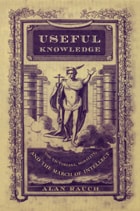
Useful Knowledge
The Victorians, Morality, and the March of IntellectAlan Rauch
Duke University Press, 2001
Rauch discusses both the influence and the ideology of knowledge in terms of how it affected nineteenth-century anxieties about moral responsibility and religious beliefs. Drawing on a wide array of literary, scientific, and popular works of the period, the book focusses on the growing importance of scientific knowledge and its impact on Victorian culture. From discussions of Jane Webb Loudon’s The Mummy! and Mary Shelley’s Frankenstein, to Charlotte Brontë’s The Professor, Charles Kingsley’s Alton Locke, and George Eliot’s Mill on the Floss, Rauch paints a fascinating picture of nineteenth-century culture and addresses issues related to the proliferation of knowledge and the moral issues of this time period. Useful Knowledge touches on social and cultural anxieties that offer both historical and contemporary insights on our ongoing preoccupation with knowledge.
Useful Knowledge will appeal to readers interested in nineteenth century history, literature, culture, the mediation of knowledge, and the history of science.
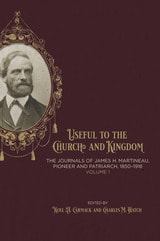
Useful to the Church and Kingdom
The Journals of James H. Martineau, Pioneer and Patriarch, 1850-1918, Volume: 1Noel A. Carmack
Signature Books, 2023
These journals document his exploration of virgin lands in southern Utah, his laying out of townsites and farmland in Cache Valley, his participation in canal building and water projects in Arizona, and his near-death experiences while surveying rough, mountainous areas. His work for the Union Pacific Railroad through Weber Canyon and across the Salt Lake Promontory and Humboldt Desert in 1868 is one of the very few complete records of its kind.
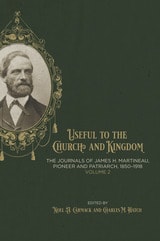
Useful to the Church and Kingdom
The Journals of James H. Martineau, Pioneer and Patriarch, 1850-1918, Volume: 2Noel A. Carmack
Signature Books, 2023
These journals document his exploration of virgin lands in southern Utah, his laying out of townsites and farmland in Cache Valley, his participation in canal building and water projects in Arizona, and his near-death experiences while surveying rough, mountainous areas. His work for the Union Pacific Railroad through Weber Canyon and across the Salt Lake Promontory and Humboldt Desert in 1868 is one of the very few complete records of its kind.
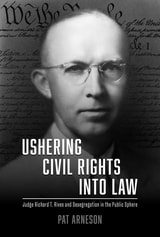
Ushering Civil Rights into Law
Judge Richard T. Rives and Desegregation in the Public SpherePat Arneson
University of Alabama Press, 2026
Illuminates the life and legacy of a federal jurist from Alabama, an unexpected but ardent defender of equal rights for all citizens under the law
Ushering Civil Rights into Law: Judge Richard T. Rives and Desegregation in the Public Sphere by Pat Arneson is a long-overdue exploration of one of the most consequential yet overlooked figures of the modern Civil Rights Movement. As debates over judicial philosophy and Civil Rights continue, Judge Richard T. Rives’s story serves as a powerful reminder of the judiciary’s role in shaping a more just society.
A native of Montgomery, Alabama, Judge Richard T. Rives served on the US Court of Appeals for the Fifth Circuit during the height of America’s battle over racial segregation. Once aligned with segregationist views, Rives underwent a profound evolution, emerging as a key legal architect of desegregation. His landmark ruling on behalf of the court in Browder v. Gayle ended segregation on Montgomery’s public buses and expanded the scope of Brown v. Board of Education beyond education. Rives’s decisions invalidated the legal underpinnings of Jim Crow laws and furthered equality in public education, voting rights, and jury selection. Writing for the court, Rives authored legal precedents that fundamentally reshaped the nation.
Through archival research, Arneson examines the cultural and political pressures Rives faced, the legal strategies he employed, and the lasting impact of his work. Constitutional rights remain a flashpoint in American discourse. Ushering Civil Rights into Law reveals how one judge’s principled stance helped define the legal landscape of modern Civil Rights and underscores the enduring significance of his legacy.
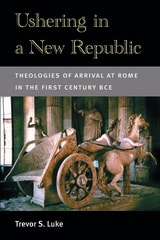
Ushering in a New Republic
Theologies of Arrival at Rome in the First Century BCETrevor S. Luke
University of Michigan Press, 2014

Using Life
By Ahmed Naji, Illustrations by Ayman Al Zorkany, Translated by Benjamin Koerber
University of Texas Press, 2017
Upon its initial release in Arabic in the fall of 2014, Using Life received acclaim in Egypt and the wider Arab world. But in 2016, Ahmed Naji was sentenced to two years in prison after a reader complained that an excerpt published in a literary journal harmed public morality. His imprisonment marks the first time in modern Egypt that an author has been jailed for a work of literature. Writers and literary organizations around the world rallied to support Naji, and he was released in December 2016. His original conviction was overturned in May 2017 but, at the time of printing, he is awaiting retrial and banned from leaving Egypt.
Set in modern-day Cairo, Using Life follows a young filmmaker, Bassam Bahgat, after a secret society hires him to create a series of documentary films about the urban planning and architecture of Cairo. The plot in which Bassam finds himself ensnared unfolds in the novel’s unique mix of text and black-and-white illustrations.
The Society of Urbanists, Bassam discovers, is responsible for centuries of world-wide conspiracies that have shaped political regimes, geographical boundaries, reigning ideologies, and religions. It is responsible for today’s Cairo, and for everywhere else, too. Yet its methods are subtle and indirect: it operates primarily through manipulating urban architecture, rather than brute force. As Bassam immerses himself in the Society and its shadowy figures, he finds Cairo on the brink of a planned apocalypse, designed to wipe out the whole city and rebuild anew.
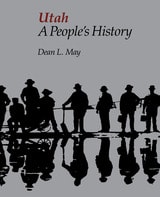
Utah A People's History
Dean L May
University of Utah Press, 2002
History belongs to the people, Dean May reminds us, and must ultimately be accessible all. Based on his award-winning television series, Utah: A People's History provides a sweeping view of the state's past. From prehistory to present, May explains Utah as it is today and its promise for the future. The video series upon which this book is based is no longer available for sale.

Utah Place Names
A Geopgraphic Guide to the Origins of Geographic Names, a CompilationJohn Van Cott
University of Utah Press, 1991
John W. Van Cott has spend the better part of a lifetime searching out the answers to these questions. Now the fruits of his labor are recorded in this, the most extensive compilation of Utah place names ever published. Almost five thousand toponyms are listed alphabetically, marking the passage of peoples and cultures from earliest times. Specialists will appreciate the geographical precision of Section, Township, Range, and altitude. Generalists will recognize counties and relationships to know features. All will delight in the rich lore, often a mixture of myth and history, of the place and its name. Scholars will find useful the inclusion of synonyms, nicknames, previous names, all cross-referenced, and all tied to a bibliography of over five hundred entries.
The author concluded his work of over forty years with the observation that he hardly touched the surface of Utah’s place names, numbered at over twenty-two thousand by the U.S. Geological Survey.
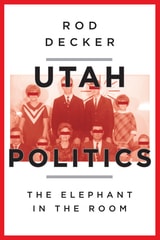
Utah Politics
The Elephant in the RoomRod Decker
Signature Books, 2019
Some themes reoccur: governors become popular by fighting federal oversight— signaling a lingering distrust that Washington could alter the Mormon way of life—and liberals use the court system to circumvent conservative legislatures who see public morality as a defining feature of government. Through this lens, issues both deceptively innocuous and deeply complex underscore Utah’s dance with religious freedom and civil liberty.
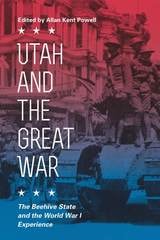
Utah and the Great War
The Beehive State and the World War I ExperienceEdited by Allan Kent Powell
University of Utah Press, 2016
Copublished with the Utah State Historical Society. Affiliated with the Utah Division of State History, Utah Department of Heritage & Arts.
In time for the centennial of the United States’s entry into World War I, this collection of seventeen essays explores the war experience in Utah through multiple perspectives, from those of soldiers, nurses and ambulance drivers who experienced the horror of the conflict firsthand to those on the home front who were transformed by the war. Citizens supported the war financially, through service on councils of defense, with victory gardens, and by other means. Some of Utah’s Native Americans and at least one Episcopal bishop resisted the war. The terrible 1918–1919 flu pandemic impacted Utah and killed more victims around the world than those who died on the battlefields. There was a Red Scare and fight over United States participation in a League of Nations. These topics and more are explored, helping us understand the nature and complexity of the conflict and its impact on Utahns.
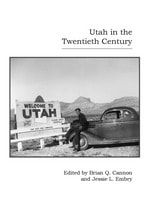
Utah in the Twentieth Century
Brian Q. Cannon and Jessie Embry
Utah State University Press, 2009
The twentieth century could easily be Utah's most interesting and complex. Utah in the Twentieth Century chronicles the social and cultural transitions of the time, offering a well-rounded perspective on the development and change the Beehive State went through during this period.
It was an era complicated by the push of economic development and pull of traditional culture, demand for natural resources from a fragile and scenic environment, questions of who governs and how, who gets a vote, and who controls what on contested public lands, during which outside trade and a tourist economy increasingly challenged and fed an insular society. Activists left and right declaimed constitutional liberties while Utah's Native Americans become the last enfranchised in the nation. Proud contributions to national wars contrasted with denial of deep dependence on federal money; the skepticism of provocative writers, boosters eager for growth; and reflexive patriotism somehow bonded to ingrained distrust of federal government.
A valuable resource for students and teachers, this work is also fruitful reading for anyone who desires to know more about key themes of Utah’s history in the twentieth century.
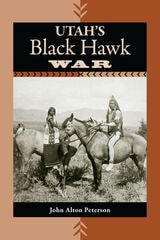
Utah'S Black Hawk War
John Alton Peterson
University of Utah Press, 1998
"On Sunday 9 April 1865, Ulysses S. Grant and Robert E. Lee met in the parlor of Wilmer McLean’s brick home in Appomattox Court House, Virginia, to negotiate the conclusion of the Civil War. That same day, far to the west, a handful of Mormons and northern Utes met in the central Utah town of Manti in an attempt to achieve a peace of their own. Unlike the negotiations at Appomattox, however, those in Manti failed, and the events that transpired there are viewed as the beginning of Utah’s Black Hawk War, the longest and most serious Indian-white conflict in Utah history."
—From the book
So begins the story of Black Hawk, Ute Indian warrior chief and brilliant strategist, and Brigham Young, sagacious religious and political leader of the Mormons. Two powerful and unyielding men forged by hardship and conviction, both revered and both reviled in their times. One, orchestrating a remarkable campaign to turn back the tide of white expansion and prevent the extinction of his people, the other, attempting to keep his exiled church and its thriving utopian society sovereign and intact. Two men of distinct races, beliefs, and cultures, but sharing a determination to keep U.S. soldiers out of their bloody conflict for control of land and other resources in the Utah territory.
From 1865 to 1867, the warrior Black Hawk, also known as Antonga, led a combined force of Utes, Navajos, and Paiutes in a series of intense stock raids on the Mormon settlements in Utah territory. Black Hawk astutely judged that political conflict between the federal government and Mormon Utah would keep U.S. soldiers from chastising his band. Moreover, the antagonism of Washington toward Utah’s polygamy, theocracy, and isolationism made Mormon leader Brigham Young wary of seeking federal help. In fact, to keep the government from using the war as a pretext for sending more troops to Utah, the Mormons withheld information, making the Black Hawk War an almost secret war as far as the rest of the nation was concerned. As directed by Brigham Young, Utah’s Latter-day Saint citizens mobilized a church militia, the Nauvoo Legion, to repel Indian attacks. Yet Black Hawk and others were able to carry on their activities for almost eight years without incurring the federal military reprisals that Indians on all four sides of the Mormon heartland experienced. Bloodshed on both sides plunged Mormons and Indians into a war of vengeance—years of killing and raiding that continued until federal troops stepped in 1872.
In this unprecedented volume, historian John Peterson provides the first comprehensive analysis of a unique and compelling chapter of western history and of the violent and protracted conflict it engendered. Utah’s Black Hawk War not only explores political intricacies and broader implications, scrutinizing the Mormons' Indian policies—most notably Brigham Young’s extraordinary "better to feed them than fight them" teachings—but also presents vivid narrative accounts of various raids and battles. The result is a masterfully researched and engagingly written account of Utah’s secret war, a war largely unknown among western history students, scholars, and enthusiasts—until now.
Winner of the Mormon History Association Francis M. and Emily S. Chipman Best First Book Award.
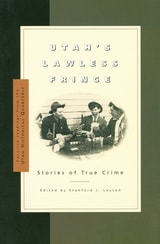
Utah's Lawless Fringe
Stories of True CrimeStanford J. Layton
Signature Books, 2001
So it went on the outskirts of Utah Territory. In this case it was the little town of Bluff where the Mormon bishop served for some ten years as de facto sheriff and his congregation as deputies. As elsewhere, law and order developed organically rather than by legislation.
In this anthology several aspects of the process are considered, including one of the worst manifestations of citizen action: vigilantism. Territorial Utah witnessed more lynchings than legal executions. Another citizen trait was an unexpected indifference to vice. In 1908 Salt Lake City had 148 registered prostitutes overseen by a madam who was recruited for the position by the mayor and city council. During Prohibition one of the largest distilleries in the West operated in a Salt Lake warehouse.
What is to be learned from this? The contributors to these fourteen articles leave moral considerations to the reader’s contemplation, while providing surprises along the way in an extremely engaging—dare we say arresting—read.
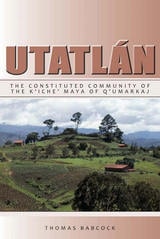
Utatlán
The Constituted Community of the K'iche' Maya of Q'umarkajThomas F. Babcock
University Press of Colorado, 2012
Most information available on Utatlán focuses on the ceremonial center and ignores the city of the commoners. Using the archaeological data, Utatlán attempts to determine the boundaries of the community and to characterize subdivisions within it. Evidence of indigenous nonelite houses, rich burials, and grave goods unlike those found in contemporary sites reveals information about the supporting residence zone. In addition, Babcock applies the concept of "constituted community," interpreting the archaeological data from a prehistoric context, and proposes a theoretical framework for interpreting prehistoric sites with respect to urbanism and political complexity.
Utatlán: The Constituted Community of the K'iche' Maya of Q'umarkaj will be of interest to students and scholars of Mesoamerican anthropology, archaeology, and ethnohistory.
Ute Indians of Utah, Colorado, and New Mexico
Virginia McConnell Simmons
University Press of Colorado, 2000
Utopia Limited
The Sixties and the Emergence of the PostmodernMarianne DeKoven
Duke University Press, 2004
DeKoven rigorously analyzes a broad array of cultural and political texts important in the sixties—from popular favorites such as William S. Burroughs’s Naked Lunch to political manifestoes including The Port Huron Statement, the founding document of SDS (Students for a Democratic Society). She examines texts that overtly discuss the conflict in Vietnam, Black Power, and second-wave feminism—including Frances FitzGerald’s Fire in the Lake, James Baldwin’s The Fire Next Time, and Shulamith Firestone’s The Dialectic of Sex; experimental pieces such as The Living Theatre’s Paradise Now; influential philosophical works including Roland Barthes’s Mythologies and Herbert Marcuse’s One-Dimensional Man; and explorations of Las Vegas, the prime location of postmodernity. Providing extensive annotated bibliographies on both the sixties and postmodernism, Utopia Limited is an invaluable resource for understanding the impact of that tumultuous decade on the present.
Utopia of the Uniform
Affective Afterlives of the Yugoslav People's ArmyTanja Petrovic
Duke University Press, 2024
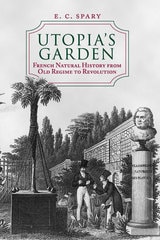
Utopia's Garden
French Natural History from Old Regime to RevolutionE. C. Spary
University of Chicago Press, 2000
E. C. Spary traces the scientific, administrative, and political strategies that enabled the foundation of the Muséum, arguing that agriculture and animal breeding rank alongside classification and collections in explaining why natural history was important for French rulers. But the Muséum's success was also a consequence of its employees' Revolutionary rhetoric: by displaying the natural order, they suggested, the institution could assist in fashioning a self-educating, self-policing Republican people. Natural history was presented as an indispensable source of national prosperity and individual virtue.
Spary's fascinating account opens a new chapter in the history of France, science, and the Enlightenment.
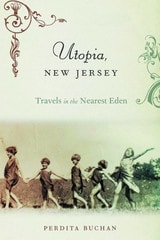
Utopia, New Jersey
Travels in the Nearest EdenBuchan, Perdita
Rutgers University Press, 2007
Winner of the 2008 Honor Book by the New Jersey Council for the Humanities
Utopia. New Jersey. For most people—even the most satisfied New Jersey residents—these words hardly belong in the same sentence. Yet, unbeknown to many, history shows that the state has been a favorite location for utopian experiments for more than a century. Thanks to its location between New York and Philadelphia and its affordable land, it became an ideal proving ground where philosophical and philanthropical organizations and individuals could test their utopian theories.
In this intriguing look at this little-known side of New Jersey, Perdita Buchan explores eight of these communities. Adopting a wide definition of the term utopia—broadening it to include experimental living arrangements with a variety of missions—Buchan explains that what the founders of each of these colonies had in common was the goal of improving life, at least as they saw it.
In every other way, the communities varied greatly, ranging from a cooperative colony in Englewood founded by Upton Sinclair, to an anarchist village in Piscataway centered on an educational experiment, to the fascinating Physical Culture City in Spotswood, where drugs, tobacco, and corsets were banned, but where nudity was widespread.
Despite their grand intentions, all but one of the utopias—a single-tax colony in Berkeley Heights—failed to survive. But Buchan shows how each of them left a legacy of much more than the buildings or street names that remain today—legacies that are inspiring, surprising, and often outright quirky.
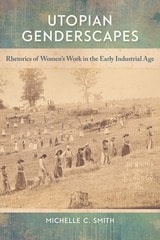
Utopian Genderscapes
Rhetorics of Women’s Work in the Early Industrial AgeMichelle C. Smith
Southern Illinois University Press, 2021
A necessary rhetorical history of women’s work in utopian communities
Utopian Genderscapes focuses on three prominent yet understudied intentional communities—Brook Farm, Harmony Society, and the Oneida Community—who in response to industrialization experimented with radical social reform in the antebellum United States. Foremost among the avenues of reform was the place and substance of women’s work. Author Michelle C. Smith seeks in the communities’ rhetorics of teleology, choice, and exceptionalism the lived consequences of the communities' lofty goals for women members.
This feminist history captures the utopian reconfiguration of women’s bodies, spaces, objects, and discourses and delivers a needed intervention into how rhetorical gendering interacts with other race and class identities. The attention to each community’s material practices reveals a gendered ecology, which in many ways squared unevenly with utopian claims. Nevertheless, this volume argues that this utopian moment inaugurated many of the norms and practices of labor that continue to structure women’s lives and opportunities today: the rise of the factory, the shift of labor from home spaces to workplaces, the invention of housework, the role of birth control and childcare, the question of wages, and the feminization of particular kinds of labor.
An impressive and diverse array of archival and material research grounds each chapter’s examination of women’s professional, domestic, or reproductive labor in a particular community. Fleeting though they may seem, the practices and lives of those intentional women, Smith argues, pattern contemporary divisions of work along the vibrant and contentious lines of gender, race, and class and stage the continued search for what is possible.
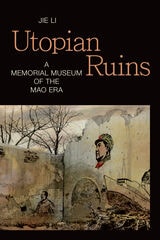
Utopian Ruins
A Memorial Museum of the Mao EraJie Li
Duke University Press, 2020
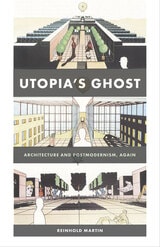
Utopia’s Ghost
Architecture and Postmodernism, AgainReinhold Martin
University of Minnesota Press, 2010
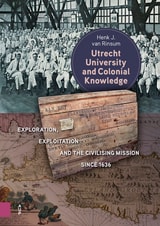
Utrecht University and Colonial Knowledge
Exploration, Exploitation and the Civilising Mission since 1636Henk van Rinsum
Amsterdam University Press, 2025
Henk van Rinsum shows how the knowledge acquired in the colony also contributed significantly to the scientific development of the university, especially towards the end of the nineteenth century. Utrecht University and Colonial Knowledge is therefore an important contribution to both colonial and intellectual history.

Utter Antiquity
Perceptions of Prehistory in Renaissance EnglandArthur B. Ferguson
Duke University Press, 1993
Since the Bible left little room for speculation on prehistory—in fact no room at all for the concept itself—Utter Antiquity concentrates on myth and legend outside of the biblical context and on those who conjured prehistory out of these sources. A subtle conflict between belief and skepticism emerges from these pages, as Ferguson reveals how some Renaissance writers struggled with ancient explanations that flouted reason and experience, while others sidestepped such doubts by relating prehistory to man's social evolution. By isolating and analyzing topics such as skepticism, rationalism, and poetic history, Ferguson illuminates the development of historical consciousness in early modern England. His accessible and eloquent study contributes significantly to an understanding of the Renaissance mind and intellectual history in general.