Results by title
1993 books match the query 'Latin America' and 28 start with v
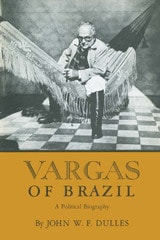
Vargas of Brazil
A Political BiographyBy John W. F. Dulles
University of Texas Press, 1967
The dominant public figure in Brazil from 1930 until 1954 was a highly contradictory and controversial personality. Getúlio Vargas, from the pampas of the southern frontier state of Rio Grande do Sul, became the dictator who ruled without ever forgetting the lower classes.
Vargas was a consummate artist at politics. He climbed the political ladder through seats in the state and national legislatures to the post of federal Finance Minister and to the governorship of Rio Grande do Sul. His career then took him to the National Palace as Provisional President and as Constitutional President, and later as the dictator of his "New State." After his deposition in 1945 and a period of semiretirement, his continuing widespread popularity resulted in his successful come-back campaign in 1950 for the Presidency on the Labor Party ticket.
Vargas' contributions to Brazilian political and economic life were many and important. Taking advantage of the power which his political magic provided him, he brought Brazil from a loose confederacy of semifeudal states to a strongly centralized nation. He was a great eclectic, welding into his social, political, and economic policies what he found good in various programs. He was also a great opportunist in the sense that he adroitly took advantage of conditions and circumstances to effect his ends. He was intimately related to the revolutionary changes in Brazilian life after 1930.
Vargas, "Father of the Brazilians," attributed achievements such as these to power in his own hands. His foes, however, still feared the political wizard, and they cheered the military when it deposed him. After his return, "on the arms of the people," Vargas saw that the armed forces were determined to repeat history, and in 1954 he chose another path—suicide.
All of these exciting events are related in John W. F. Dulles's Vargas of Brazil: A Political Biography. Despite its emphasis on Vargas the politician and statesman, the reader comes to know Vargas the man.
For this portrait of Vargas and of Brazil the author has drawn much material from State Department papers in the National Archives and from other public sources, and from interviews with numerous persons who were participants in the events he describes or observers of them. The result is an interesting, revealing, valid account of an important people. Many illustrations supplement the text.
Varieties of Liberalism in Central America
Nation-States as Works in ProgressBy Forrest D. Colburn and Arturo Cruz S.
University of Texas Press, 2007
Why do some countries progress while others stagnate? Why does adversity strengthen some countries and weaken others? Indeed, in this era of unprecedented movement of people, goods, and ideas, just what constitutes a nation-state? Forrest Colburn and Arturo Cruz suggest how fundamental these questions are through an exploration of the evolution of Guatemala, El Salvador, Honduras, Nicaragua, and Costa Rica over the last quarter of a century, a period of intriguing, often confounding, paradoxes in Central America's development.
Offering an elegant defense of empiricism, Colburn and Cruz explore the roles of geography and political choice in constructing nations and states. Countries are shown to be unique: there are a daunting number of variables. There is causality, but not the kind that can be revealed in the laboratory or on the blackboard. Liberalism—today defined as democracy and unfettered markets—may be in vogue, but it has no inherent determinants. Democracy and market economies, when welded to the messy realities of individual countries, are compatible with many different outcomes. The world is more pluralistic in both causes and effects than either academic theories or political rhetoric suggest.
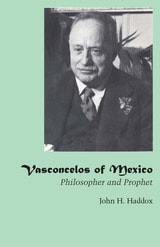
Vasconcelos of Mexico
Philosopher and ProphetBy John H. Haddox
University of Texas Press, 1967
José Vasconcelos—lawyer, politician, writer, educator, philosopher, prophet, and mystic—was one of the most influential and controversial figures in the intellectual life of twentieth-century Mexico.
Vasconcelos was driven by the desire to gain a complete and comprehensive vision of reality, employing his own aesthetic-emotive method and a poetic mode of expression. The complex philosophical system that resulted is what he called “aesthetic monism.” But this is only one side of the man. Vasconcelos was also vitally interested in both the proximate realities and remote possibilities of Mexico, in the character of the “cosmic race” of his homeland, and in the relations between his own country and the others of this hemisphere.
Soon after Vasconcelos’s death in 1959, Eduardo García Máynez spoke of him, in a moving tribute, as “without question the most inspiring intellectual and human figure that Mexico has produced.” Unhappily—and perhaps disgracefully—he has remained almost unknown outside the Spanish-speaking world. Histories of Mexico published in English usually give passing mention to his role as Minister of Public Education or his unsuccessful campaign for the presidency, but his aesthetic system and his socio-political ideas have been ignored by philosophers in the United States.
Here, for the first time, is a unified, inclusive, and occasionally critical presentation of the entire range of Vasconcelos’s thought, from his metaphysics and theory of knowledge through his aesthetics and ethics to his social and political philosophy. It is enriched by an appendix in which the most significant passages from Vasconcelos’s own philosophical writings are presented in English translations.
Venezuela's Bolivarian Democracy
Participation, Politics, and Culture under ChávezDavid Smilde and Daniel Hellinger, eds.
Duke University Press, 2011
Contributors
Carolina Acosta-Alzuru
Julia Buxton
Luis Duno Gottberg
Sujatha Fernandes
María Pilar García-Guadilla
Kirk A. Hawkins
Daniel Hellinger
Michael E. Johnson
Luis E. Lander
Margarita López-Maya
Elizabeth Gackstetter Nichols
Coraly Pagan
Guillermo Rosas
Naomi Schiller
David Smilde
Alejandro Velasco
Venezuela's Movimiento al Socialismo
From Guerrilla Defeat to Innovative PoliticsSteve Ellner
Duke University Press, 1988
The author places MAS in its international national, and historical contexts in order to determine the extent to which it is a unique communist party, as it claims to be. He traces the theory of "national democratic revolution, " which MAS rejects, back to Lenin, and discusses the Latin American left's reevaluation of that thesis. Ellner examines the guerrilla movement in Venezuela, the student movement of the late 1960s, and the emergence of the "New Left" in other countries, especially noting their influence on the formation of MAS. He also discusses the group's role in Venezuelan elections and it's relations with the other parties.
Vertical Empire
The General Resettlement of Indians in the Colonial AndesJeremy Ravi Mumford
Duke University Press, 2012

Victims and Warriors
Violence, History, and Memory in AmazoniaCasey High
University of Illinois Press, 2015
Victims and Warriors examines contemporary violence in the context of political and economic processes that transcend local events. Casey High explores how popular imagery of Amazonian violence has become part of Waorani social memory in oral histories, folklore performances, and indigenous political activism. As Amazonian forms of social memory merge with constructions of masculinity and other intercultural processes, the Waorani absorb missionaries, oil development, and logging depredations into their legacy of revenge killings and narratives of victimhood. High shows that these memories of past violence form sites of negotiation and cultural innovation, and thus violence comes to constitute a central part of Amazonian sociality, identity, and memory.
Victims of the Chilean Miracle
Workers and Neoliberalism in the Pinochet Era, 1973–2002Peter Winn, ed.
Duke University Press, 2004
Implemented in the 1970s at the point of the bayonet and in the shadow of the torture chamber, the neoliberal policies of Augusto Pinochet’s dictatorship reversed many of the gains in wages, benefits, and working conditions that Chile’s workers had won during decades of struggle and triggered a severe economic crisis. Later refined and softened, Pinochet’s neoliberal model began, finally, to promote economic growth in the mid-1980s, and it was maintained by the center-left governments that followed the restoration of democracy in 1990. Yet, despite significant increases in worker productivity, real wages stagnated, the expected restoration of labor rights faltered, and gaps in income distribution continued to widen. To shed light on this history and these ongoing problems, the contributors look at industries long part of the Chilean economy—including textiles and copper—and industries that have expanded more recently—including fishing, forestry, and agriculture. They not only show how neoliberalism has affected Chile’s labor force in general but also how it has damaged the environment and imposed special burdens on women. Painting a sobering picture of the two Chiles—one increasingly rich, the other still mired in poverty—these essays suggest that the Chilean miracle may not be as miraculous as it seems.
Contributors.
Paul Drake
Volker Frank
Thomas Klubock
Rachel Schurman
Joel Stillerman
Heidi Tinsman
Peter Winn

Vida Zoo-cial
The Buenos Aires Zoo and the Making of Argentine Society, 1875–1924Ashley Elizabeth Kerr
Vanderbilt University Press, 2025
Premio al Mejor Libro en Humanidades, Latin American Studies Association, Nineteenth-Century Section, 2026
In late nineteenth- and early twentieth‑century Buenos Aires, elites attempted to tackle growing poverty and social problems with a suite of social, educational, and medical reforms, hoping to make the city and larger nation more “modern” and “progressive” on the world stage. Known as the “social question,” this turn-of-the-century preoccupation with the future of the city and nation was undergirded by a larger set of social Darwinist beliefs about the biological and racial inferiority of immigrants and the working class, linking them to higher susceptibility to alcoholism, sexual deviancy, insanity, and disease.
In Vida Zoo-cial, Ashley Elizabeth Kerr argues that the Buenos Aires Zoo and its many animal species were an important tool in attempts to remake Argentinian society. Elites used the zoo’s physical spaces, programming, and visual and literary representations of its animals to try to educate and “improve” the masses, especially immigrants and the poor, but stopped short of supporting more radical social transformations. Drawing upon extensive archival research from the zoo’s archive, including correspondence, municipal reports, receipts, and employment records, as well as a range of literary and popular culture sources, Kerr records these efforts, which included enlisting lionesses as object lessons in proper motherhood and elephants as model immigrants. Although some projects were successful, Kerr also documents the many ways others went awry when the zoo's animals and the humans who came to see them failed to cooperate.
Vida Zoo-cial is not only a story about how the poor and working class resisted elite efforts for social reform founded upon racialized beliefs and pseudoscience, but also one that challenges readers to rethink the relationship between humans and non‑humans.
Village of the Ghost Bells
A NovelBy Edla Van Steen
University of Texas Press, 1991
In the village of the ghost bells, the church chimes ring—even though the church has no bells. One of the neighbors wants to buy dreams—or is she a dream that someone else is dreaming? Where and why do dreams become nightmares?
These are only some of the fascinating questions raised in Village of the Ghost Bells, Edla Van Steen’s second novel. First published in 1983 as Coraçôes mordidos, the novel tells the story of the would-be utopian community built on an old plantation of the outskirts of São Paulo, Brazil. Its atmosphere is dreamlike, often verging on the supernatural, and strange events signal the transformation of the utopian dream into a nightmare. Ultimately destroyed by greed, corruption, and exploitation, the community becomes a microcosm of the Brazilian socioeconomic system, in which it takes all of a person’s warmth, idealism, passion, and humor to survive the bleak environment.

Vintage Moquegua
History, Wine, and Archaeology on a Colonial Peruvian PeripheryBy Prudence M. Rice
University of Texas Press, 2011
The microhistory of the wine industry in colonial Moquegua, Peru, during the colonial period stretches from the sixteenth through nineteenth centuries, yielding a wealth of information about a broad range of fields, including early modern industry and labor, viniculture practices, the cultural symbolism of alcohol consumption, and the social history of an indigenous population. Uniting these perspectives, Vintage Moquegua draws on a trove of field research from more than 130 wineries in the Moquegua Valley.
As Prudence Rice walked the remnants of wine haciendas and interviewed Peruvians about preservation, she saw that numerous colonial structures were being razed for development, making her documentary work all the more crucial. Lying far from imperial centers in pre-Hispanic and colonial times, the area was a nearly forgotten administrative periphery on an agricultural frontier. Spain was unable to supply the Peruvian viceroyalty with sufficient wine for religious and secular purposes, leading colonists to import and plant grapevines. The viniculture that flourished produced millions of liters, most of it distilled into pisco brandy. Summarizing archaeological data and interpreting it through a variety of frameworks, Rice has created a three-hundred-year story that speaks to a lost world and its inhabitants.

Violence and Activism at the Border
Gender, Fear, and Everyday Life in Ciudad JuarezBy Kathleen Staudt
University of Texas Press, 2008
Between 1993 and 2003, more than 370 girls and women were murdered and their often-mutilated bodies dumped outside Ciudad Juárez in Chihuahua, Mexico. The murders have continued at a rate of approximately thirty per year, yet law enforcement officials have made no breakthroughs in finding the perpetrator(s). Drawing on in-depth surveys, workshops, and interviews of Juárez women and border activists, Violence and Activism at the Border provides crucial links between these disturbing crimes and a broader history of violence against women in Mexico. In addition, the ways in which local feminist activists used the Juárez murders to create international publicity and expose police impunity provides a unique case study of social movements in the borderlands, especially as statistics reveal that the rates of femicide in Juárez are actually similar to other regions of Mexico.
Also examining how non-governmental organizations have responded in the face of Mexican law enforcement's "normalization" of domestic violence, Staudt's study is a landmark development in the realm of global human rights.
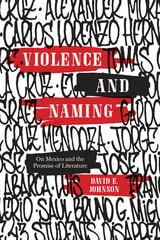
Violence and Naming
On Mexico and the Promise of LiteratureBy David E. Johnson
University of Texas Press, 2019
Reclaiming the notion of literature as an institution essential for reflecting on the violence of culture, history, and politics, Violence and Naming exposes the tension between the irreducible, constitutive violence of language and the reducible, empirical violation of others. Focusing on an array of literary artifacts, from works by journalists such as Elena Poniatowska and Sergio González Rodríguez to the Zapatista communiqués to Roberto Bolaño's The Savage Detectives and 2666, this examination demonstrates that Mexican culture takes place as a struggle over naming—with severe implications for the rights and lives of women and indigenous persons.
Through rereadings of the Conquest of Mexico, the northern Mexican feminicide, the Zapatista uprising in Chiapas, the disappearance of the forty-three students at Iguala in 2014, and the 1999 abortion-rights scandal centering on “Paulina,” which revealed the tenuousness of women’s constitutionally protected reproductive rights in Mexico, Violence and Naming asks how societies can respond to violence without violating the other. This essential question is relevant not only to contemporary Mexico but to all struggles for democracy that promise equality but instead perpetuate incessant cycles of repression.
Violent Democracies in Latin America
Enrique Desmond Arias and Daniel M. Goldstein, eds.
Duke University Press, 2010
The contributors—anthropologists, political scientists, sociologists, and historians—explore how individuals and institutions in Latin American democracies, from the rural regions of Colombia and the Dominican Republic to the urban centers of Brazil and Mexico, use violence to impose and contest notions of order, rights, citizenship, and justice. They describe the lived realities of citizens and reveal the historical foundations of the violence that Latin America suffers today. One contributor examines the tightly woven relationship between violent individuals and state officials in Colombia, while another contextualizes violence in Rio de Janeiro within the transnational political economy of drug trafficking. By advancing the discussion of democratic Latin American regimes beyond the usual binary of success and failure, this collection suggests more sophisticated ways of understanding the challenges posed by violence, and of developing new frameworks for guaranteeing human rights in Latin America.
Contributors: Enrique Desmond Arias, Javier Auyero, Lilian Bobea, Diane E. Davis, Robert Gay, Daniel M. Goldstein, Mary Roldán, Todd Landman, Ruth Stanley, María Clemencia Ramírez
Visible Borders, Invisible Economies
Living Death in Latinx NarrativesKristy L. Ulibarri
University of Texas Press, 2022
2023 Outstanding Book Award, National Association for Ethnic Studies
A thorough examination of the political and economic exploitation of Latinx subjects, migrants, and workers through the lens of Latinx literature, photography, and film.
Globalization in the United States can seem paradoxical: free trade coincides with fortification of the southern border, while immigration is reimagined as a national-security threat. US politics turn aggressively against Latinx migrants and subjects even as post-NAFTA markets become thoroughly reliant on migrant and racialized workers. But in fact, there is no incongruity here. Rather, anti-immigrant politics reflect a strategy whereby capital uses specialized forms of violence to create a reserve army of the living, laboring dead.
Visible Borders, Invisible Economies turns to Latinx literature, photography, and films that render this unseen scheme shockingly vivid. Works such as Valeria Luiselli’s Tell Me How It Ends and Alex Rivera’s Sleep Dealer crystallize the experience of Latinx subjects and migrants subjugated to social death, their political existence erased by disenfranchisement and racist violence while their bodies still toil in behalf of corporate profits. In Kristy L. Ulibarri’s telling, art clarifies what power obscures: the national-security state performs anti-immigrant and xenophobic politics that substitute cathartic nationalism for protections from the free market while ensuring maximal corporate profits through the manufacture of disposable migrant labor.
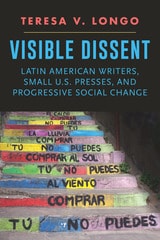
Visible Dissent
Latin American Writers, Small U.S. Presses, and Progressive Social ChangeTeresa V. Longo
University of Iowa Press, 2018
As Teresa Longo’s groundbreaking examination reveals, North America’s dissident literature has its roots in the Latin American literary tradition. From Pablo Neruda’s Canto General to Eduardo Galeano’s Open Veins of Latin America to Gabriel García Márquez’s One Hundred Years of Solitude—among others—contemporary writers throughout the Americas have forced us to reconsider the United States’s relationship with Latin America, and more broadly with the Global South. Highlighting the importance of reading and re-reading the Latin American canon in the United States, Longo finds that literature can be an instrument of progressive social change, and argues that small literary presses—City Lights, Curbstone, and Seven Stories—have made that dissent visible in the United States. In the book’s final two chapters on the Robert F. Kennedy Center’s Speak Truth to Power initiative and the publication of Marc Falkoff’s Poems from Guantánamo, the author turns our attention further outward, probing the role poetry, theater, and photography play in global human rights work.
Locating the work of artists and writers alongside that of scholars and legal advocates, Visible Dissent not only unveils the staying-power of committed writing, it honors the cross-currents and the on-the-ground implications of humane political engagement.
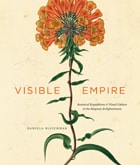
Visible Empire
Botanical Expeditions and Visual Culture in the Hispanic EnlightenmentDaniela Bleichmar
University of Chicago Press, 2012
Between 1777 and 1816, botanical expeditions crisscrossed the vast Spanish empire in an ambitious project to survey the flora of much of the Americas, the Caribbean, and the Philippines. While these voyages produced written texts and compiled collections of specimens, they dedicated an overwhelming proportion of their resources and energy to the creation of visual materials. European and American naturalists and artists collaborated to manufacture a staggering total of more than 12,000 botanical illustrations. Yet these images have remained largely overlooked—until now.
In this lavishly illustrated volume, Daniela Bleichmar gives this archive its due, finding in these botanical images a window into the worlds of Enlightenment science, visual culture, and empire. Through innovative interdisciplinary scholarship that bridges the histories of science, visual culture, and the Hispanic world, Bleichmar uses these images to trace two related histories: the little-known history of scientific expeditions in the Hispanic Enlightenment and the history of visual evidence in both science and administration in the early modern Spanish empire. As Bleichmar shows, in the Spanish empire visual epistemology operated not only in scientific contexts but also as part of an imperial apparatus that had a long-established tradition of deploying visual evidence for administrative purposes.
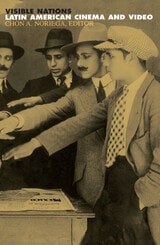
Visible Nations
Latin American Cinema and VideoChon A. Noriega
University of Minnesota Press, 2000
Rewrites Latin American film from the perspective of nationhood.
In the current "global" moment, the study of Latin American cinema has become insistently national—a phenomenon fully explored in this collection of essays by some of the most interesting and innovative scholars of media and Latin American culture working today.
The contributors to Visible Nations consider different national film and video histories in Latin America since the silent period. From the perspectives of feminism, psychoanalysis, new historicism, and reception theory, among others, they consider the styles through which—and the ends toward which—the nation has been represented, desired, and contested in films, film industries, and alternative video work in Mexico, Chile, Venezuela, Brazil, Colombia, and Cuba. The result is nothing less than a rewriting of Latin American film history. Contributors: Patricia Aufderheide, American U; Charles Ramírez Berg, U of Texas at Austin; Gilberto Moises Blasini; Julianne Burton-Carvajal, U of California, Santa Cruz; Seth Fein, Georgia State U; Claire F. Fox, Stanford U; Brian Goldfarb, U of Rochester; Ilene S. Goldman; Monica Hulsbus; Ana M. López, Tulane U; Kathleen Newman, U of Iowa; Laura Podalsky, Bowling Green State U; Harmony H. Wu.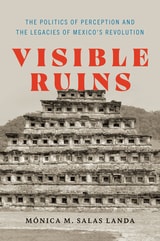
Visible Ruins
The Politics of Perception and the Legacies of Mexico's RevolutionMónica M. Salas Landa
University of Texas Press, 2024
2026 Honorable Mention, Mejor Libro, Historia Reciente y Memoria Section of the Latin American Studies Association
An examination of the failures of the Mexican Revolution through the visual and material records.
The Mexican Revolution (1910–1920) introduced a series of state-led initiatives promising modernity, progress, national grandeur, and stability; state surveyors assessed land for agrarian reform, engineers used nationalized oil for industrialization, archaeologists reconstructed pre-Hispanic monuments for tourism, and anthropologists studied and photographed Indigenous populations to achieve their acculturation. Far from accomplishing their stated goals, however, these initiatives concealed violence, and permitted land invasions, forced displacement, environmental damage, loss of democratic freedom, and mass killings. Mónica M. Salas Landa uses the history of northern Veracruz to demonstrate how these state-led efforts reshaped the region's social and material landscapes, affecting what was and is visible. Relying on archival sources and ethnography, she uncovers a visual order of ongoing significance that was established through postrevolutionary projects and that perpetuates inequality based on imperceptibility.
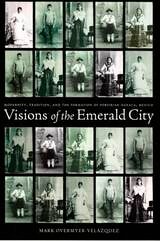
Visions of the Emerald City
Modernity, Tradition, and the Formation of Porfirian Oaxaca, MexicoMark Overmyer-Velázquez
Duke University Press, 2006
Incorporating a nuanced understanding of visual culture into his analysis, Overmyer-Velázquez shows how ideas of modernity figured in Oaxacans’ ideologies of class, race, gender, sexuality, and religion and how they were expressed in Oaxaca City’s streets, plazas, buildings, newspapers, and public rituals. He pays particular attention to the roles of national and regional elites, the Catholic church, and popular groups—such as Oaxaca City’s madams and prostitutes—in shaping the discourses and practices of modernity. At the same time, he illuminates the dynamic interplay between these groups. Ultimately, this well-illustrated history provides insight into provincial life in pre-Revolutionary Mexico and challenges any easy distinctions between the center and the periphery or modernity and tradition.

Vital Enemies
Slavery, Predation, and the Amerindian Political Economy of LifeBy Fernando Santos-Granero
University of Texas Press, 2009
Analyzing slavery and other forms of servitude in six non-state indigenous societies of tropical America at the time of European contact, Vital Enemies offers a fascinating new approach to the study of slavery based on the notion of "political economy of life." Fernando Santos-Granero draws on the earliest available historical sources to provide novel information on Amerindian regimes of servitude, sociologies of submission, and ideologies of capture.
Estimating that captive slaves represented up to 20 percent of the total population and up to 40 percent when combined with other forms of servitude, Santos-Granero argues that native forms of servitude fulfill the modern understandings of slavery, though Amerindian contexts provide crucial distinctions with slavery as it developed in the American South. The Amerindian understanding of life forces as being finite, scarce, unequally distributed, and in constant circulation yields a concept of all living beings as competing for vital energy. The capture of human beings is an extreme manifestation of this understanding, but it marks an important element in the ways Amerindian "captive slavery" was misconstrued by European conquistadors.
Illuminating a cultural facet that has been widely overlooked or miscast for centuries, Vital Enemies makes possible new dialogues regarding hierarchies in the field of native studies, as well as a provocative re-framing of pre- and post-contact America.
Vital Voids
Cavities and Holes in Mesoamerican Material CultureBy Andrew Finegold
University of Texas Press, 2021
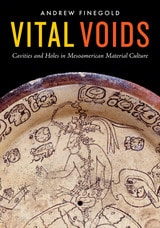
The Resurrection Plate, a Late Classic Maya dish, is decorated with an arresting scene. The Maize God, assisted by two other deities, emerges reborn from a turtle shell. At the center of the plate, in the middle of the god’s body and aligned with the point of emergence, there is a curious sight: a small, neatly drilled hole.
Art historian Andrew Finegold explores the meanings attributed to this and other holes in Mesoamerican material culture, arguing that such spaces were broadly understood as conduits of vital forces and material abundance, prerequisites for the emergence of life. Beginning with, and repeatedly returning to, the Resurrection Plate, this study explores the generative potential attributed to a wide variety of cavities and holes in Mesoamerica, ranging from the perforated dishes placed in Classic Maya burials, to caves and architectural voids, to the piercing of human flesh. Holes are also discussed in relation to fire, based on the common means through which both were produced: drilling. Ultimately, by attending to what is not there, Vital Voids offers a fascinating approach to Mesoamerican cosmology and material culture.

Viva Baseball!
Latin Major Leaguers and Their Special HungerSamuel O. Regalado
University of Illinois Press, 2007
Lively and filled with vivid anecdotes, Viva Baseball! chronicles the struggles of Latin American professional baseball players in the United States from the late 1800s to the present.
As Latino players, managers, and owners continue to blossom into baseball's biggest stars, they have benefited from a growing Spanish-language media, a group identity, an increase in financial leverage and attention, and a burgeoning Latino culture in the United States. Although there have been several positive developments in the treatment of Latin American players, many, such as Albert Pujols, Pedro Martinez, Alex Rodriguez, and Ozzie Guillen, still face shocking racism. Samuel O. Regalado draws upon archives and rich interviews with Latin baseball stars like Felipe Alou, Orlando Cepeda, and Minnie Minoso to show the changing tenor of discrimination in the twenty-first-century game.
Viva Cristo Rey!
The Cristero Rebellion and the Church-State Conflict in MexicoBy David C. Bailey
University of Texas Press, 1974
Between 1926 and 1929, thousands of Mexicans fought and died in an attempt to overthrow the government of their country. They were the Cristeros, so called because of their battle cry, ¡Viva Cristo Rey!—Long Live Christ the King! The Cristero rebellion and the church-state conflict remain one of the most controversial subjects in Mexican history, and much of the writing on it is emotional polemic. David C. Bailey, basing his study on the most important published and unpublished sources available, strikes a balance between objective reporting and analysis. This book depicts a national calamity in which sincere people followed their convictions to often tragic ends.
The Cristero rebellion climaxed a century of animosity between the Catholic church and the Mexican state, and this background is briefly summarized here. With the coming of the 1910 revolution the hostility intensified. The revolutionists sought to impose severe limitations on the Church, and Catholic anti-revolutionary militancy grew apace. When the government in 1926 decreed strict enforcement of anticlerical legislation, matters reached a crisis. Church authorities suspended public worship throughout Mexico, and Catholics in various parts of the country rose up in arms. There followed almost three years of indecisive guerrilla warfare marked by brutal excesses on both sides. Bailey describes the armed struggle in broad outline but concentrates on the political and diplomatic maneuvering that ultimately decided the issue.
A de facto settlement was brought about in 1929, based on the government’s pledge to allow the Church to perform its spiritual offices under its own internal discipline. The pact was arranged mainly through the intercession of U.S. Ambassador Dwight Morrow. His role in the conflict, as well as that of other Americans who decisively influenced the course of events, receives detailed attention in the study. The position of the Vatican during the conflict and its role in the settlement are also examined in detail.
With the 1929 settlement the clergy returned to the churches, whereupon the Cristeros lost public support and the rebellion collapsed. The spirit of the settlement soon evaporated, more strife followed, and only after another decade did permanent religious peace come to Mexico.
Voices in Aerosol
Youth Culture, Institutional Attunement, and Graffiti in Urban MexicoCaitlin Frances Bruce
University of Texas Press, 2024
2024 Visual Communication Division Award, National Communication Association
2025 Philosophy of Communication, Theory, and Critique Division Distinguished Book Award, National Communication Association
2025 Winans-Wichelns Memorial Award for Distinguished Scholarship in Rhetoric and Public Address, National Communication Association
How a city government in central Mexico evolved from waging war on graffiti in the early 2000s to sanctioning its creation a decade later, and how youth navigated these changing conditions for producing art.
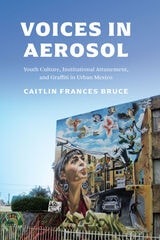
The local government, residents, and media outlets in León, Mexico, treated graffiti as a disease until the state began sponsoring artistic graffiti through a program of its own. In Voices in Aerosol, the first book-length study of state-sponsored graffiti, Caitlin Frances Bruce considers the changing perceptions and recognition of graffiti artists, their right to the city, and the use of public space over the span of eighteen years (2000–2018). Focusing on the midsized city of León, Bruce offers readers a look at the way negotiations with the neoliberal state unfolded at different levels and across decades.
Issues brought to light in this case study, such as graffiti as a threat and graffiti as a sign of gentrification, resonate powerfully with those germane to other urban landscapes throughout the Western Hemisphere and beyond. Combining archival work, interviews, considerations of urban planning, local politics in Mexico, and insights gained by observing graffiti events and other informal artistic encounters, Bruce offers a new lens through which to understand the interplay between sanctioned and unsanctioned forms of cultural expression. Ultimately, Voices in Aerosol builds a strong case for graffiti as a contested tool for "voicing" public demands.
Voices of Crime
Constructing and Contesting Social Control in Modern Latin AmericaEdited by Luz E. Huertas, Bonnie A. Lucero, and Gregory J. Swedberg
University of Arizona Press, 2016
Voices of Crime examines these official and unofficial perceptions of deviancy, justice, and social control in modern Latin America. As a collection of essays exploring histories of crime and justice, the book focuses on both cultural and social history and the interactions among state institutions, the press, and a variety of elite and non-elite social groups. Arguing that crime in Latin America is best understood as a product of ongoing negotiation between “top-down” and “bottom up” ideas (not just as the exercise of power from the state), the authors seek to document and illustrate the everyday experiences of crime in particular settings, emphasizing underresearched historical actors such as criminals, victims, and police officers.
The book examines how these social groups constructed, contested, navigated, and negotiated notions of crime, criminality, and justice. This reorientation—in contrast to much of the existing historical literature that focuses on elite and state actors—prompts the authors to critically examine the very definition of crime and its perpetrators, suggesting that “not only the actions of the poor and racial others but also the state can be termed as criminal.”
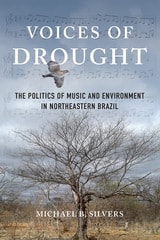
Voices of Drought
The Politics of Music and Environment in Northeastern BrazilMichael B. Silvers
University of Illinois Press, 2018
Silvers offers case studies focused on the sertão that range from the Brazilian wax harvested in Ceará for use in early wax cylinder sound recordings to the drought- and austerity-related cancellation of Carnival celebrations in 2014-16. Unearthing links between music and the environmental and social costs of drought, his daring synthesis explores ecological exile, poverty, and unequal access to water resources alongside issues like corruption, prejudice, unbridled capitalism, and expanding neoliberalism.

Von Balthasar & the Option for the Poor
Theodramatics in the Light of Liberation TheologyTodd Walatka
Catholic University of America Press, 2017