Results by title
264 books match the query 'Composition' and 27 start with w
WPAing in a Pandemic and Beyond
Revision, Innovation, and AdvocacyTodd Ruecker
Utah State University Press, 2025
The chapters in this collection include a variety of voices who have been involved in writing program administration in recent years to reflect on the work done in this moment of crisis. Through both short vignettes and longer chapters, this book explores the complicated interactions between WPA work and navigating times of crisis to provide insights for moving forward. Authors explore a variety of topics including professional development, curricular change, advocating in the face of intransigent administrations and others, caring for students, and taking time for self-care. Pointing to specific actions for continued advocacy, WPAing in a Pandemic and Beyond will be of great interest to WPAs and writing studies scholars.
Weathering the Storm
Independent Writing Programs in the Age of Fiscal AusterityRichard N. Matzen Jr.
Utah State University Press, 2019
Leading writing specialists at the University of Texas at Austin, Syracuse University, the University of Minnesota, and many other institutions document and think carefully about the on-the-ground obstacles that have made the creation of IWPs unique. From institutional naysayers in English departments to skeptical administrators, IWPs and the faculty within them have surmounted not only negative economics but also negative rhetorics. This collection charts the story of this journey as writing faculty continually make the case for the importance of writing in the university curriculum.
Independence has, for the most part, allowed IWPs to better respond to the Great Recession, but to do so they have had to define writing studies in relation to other disciplines and departments. Weathering the Storm will be of great interest to faculty and graduate students in rhetoric and composition, writing program administrators, and writing studies and English department faculty.
Contributors: Linda Adler-Kassner, Lois Agnew, Alice Batt, David Beard, Davida Charney, Amy Clements, Diane Davis, Frank Gaughan, Heidi Skurat Harris, George H. Jensen, Rodger LeGrand, Drew M. Loewe, Mark Garrett Longaker, Cindy Moore, Peggy O’Neill, Chongwon Park, Louise Wetherbee Phelps, Mary Rist, Valerie Ross, John J Ruszkiewicz, Eileen E. Schell, Madeleine Sorapure, Chris Thaiss, Patrick Wehner, Jamie White-Farnham, Carl Whithaus, Traci A. Zimmerman
Women's Professional Lives in Rhetoric and Composition
Choice, Chance, and SerendipityEdited by Elizabeth A. Flynn and Tiffany Bourelle
The Ohio State University Press, 2018
This collection, edited by Elizabeth A. Flynn and Tiffany Bourelle, contributes to the valuable work of chronicling the professional and personal lives of women in academia. Through its line-up of contributors from diverse backgrounds, locations, and career paths, Women’s Professional Lives in Rhetoric and Composition showcases the voices of multiple scholars occupying a multitude of different roles in the profession: from prestigious professors emeritae and endowed chairs to assistant professors starting their careers to an independent scholar to part-time faculty.
The collection sets itself apart from other volumes not just in its diversity of perspectives but also by speaking against linear stories of success in the profession—sharing moments of shame and failure, showing how the personal and professional often intertwine and influence one another, and ultimately revealing how choice, chance, serendipity, and kairos have all played a role in the lives of its contributors. In focusing on this convergence, Women’s Professional Lives in Rhetoric and Composition offers a more nuanced picture of the professional and intellectual trajectories of women in rhetoric and composition.
Work of Teaching Writing
Learning from Fiction, Film, and DramaJoseph Harris
Utah State University Press, 2020
Each chapter examines a fictional representation of writing classes—as portrayed in Dead Poets Society, Up the Down Staircase, Educating Rita, Push, and more—and shifts the conversation from how these works portray teachers to how they dramatize the actual work of teaching. Harris considers scenes of instruction from different stages of the writing process and depictions of students and teachers at work together to highlight the everyday aspects of teaching writing.
In the writing classroom the ideas of teachers come to life in the work of their students. The Work of Teaching Writing shows what fiction, film, and drama can convey about the moment of exchange between teacher and student as they work together to create new insights into writing. It will interest both high school and undergraduate English teachers, as well as graduate students and scholars in composition and rhetoric, literary studies, and film studies.
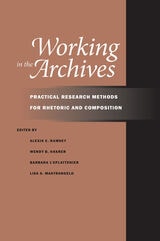
Working in the Archives
Practical Research Methods for Rhetoric and CompositionEdited by Alexis E. Ramsey, Wendy B. Sharer, Barbara L'Eplattenier, Lisa S. Mastrangelo
Southern Illinois University Press, 2010
Archival research of any magnitude can be daunting. With this in mind, Alexis E. Ramsey, Wendy B. Sharer, Barbara L’Eplattenier, and Lisa Mastrangelo have developed an indispensable volume for the first-time researcher as well as the seasoned scholar. Working in the Archives is a guide to the world of rhetoric and composition archives, from locating an archival source and its materials to establishing one’s own collection of archival materials. This practical volume provides insightful information on a variety of helpful topics, such as basic archival theory, processes, and principles; the use of hidden or digital archives; the intricacies of searching for and using letters and photographs; strategies for addressing the dilemmas of archival organization without damaging the provenance of materials; the benefits of seeking sources outside academia; and the difficult (yet often rewarding) aspects of research on the Internet.
Working in the Archives moves beyond the basics to discuss the more personal and emotional aspects of archival work through the inclusion of interviews with experienced researchers such as Lynée Lewis Gaillet, Peter Mortensen, Kathryn Fitzgerald, Kenneth Lindblom, and David Gold. Each shares his or her personal stories of the joys and challenges that face today’s researchers.
Packed with useful recommendations, this volume draws on the knowledge and experiences of experts to present a well-rounded guidebook to the often winding paths of academic archival investigation. These in-depth yet user-friendly essays provide crucial answers to the myriad questions facing both fledgling and practiced researchers, making Working in the Archives an essential resource.
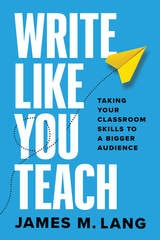
Write Like You Teach
Taking Your Classroom Skills to a Bigger AudienceJames M. Lang
University of Chicago Press, 2025
After years spent cultivating their expertise and passion for a subject, scholars are uniquely positioned to write great books. Yet, accustomed to writing for an audience of their peers, many scholars find it challenging to adapt their writing to a style that is accessible and engaging to the general public. James M. Lang argues that academics are regularly called on to pitch their research to a general audience: their undergraduates. If only there were a way to translate the skills they use in the classroom into their writing. . . .
In Write Like You Teach, Lang—a veteran writer and teacher—distills the elements of good classroom teaching into guidelines for writing for a general audience. He encourages authors to pay attention to how their readers learn and to embrace exploration, experimentation, and creativity in their writing. Lang asks his readers to consider the questions that all great teachers ask themselves: How will I get the attention of my students? How do I make them curious about the subject? What stories or examples will illustrate the more difficult concepts or theories in the course? When will I pause in the class and give students a break from hard thinking? What will I do at the end of the class to remind students about my key messages and leave them wanting to know more?
Write Like You Teach includes examples from successful writers and useful anecdotes from Lang’s own classroom and writing career. Indeed, Lang takes his own advice to heart: like a good teacher, he varies the form of each chapter, making sure to introduce some surprises to keep the reader engaged. Each chapter ends with writing prompts to help readers practice their newly acquired skills, and an appendix provides additional advice on publishing and promoting one’s work. Teachers who follow Lang’s suggestions will find new ways to connect with their readers—and like any good student, they will never approach writing the same way again.
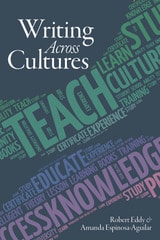
Writing Across Cultures
Robert Eddy
Utah State University Press, 2019
Robert Eddy and Amanda Espinosa-Aguilar offer a new framework for teaching that acknowledges the changing demographics of US college classrooms as the field of writing studies moves toward real equity and expanding diversity. Writing Across Cultures utilizes a streamlined cross-racial and interculturally tested method of introducing students to academic writing via sequenced assignments that are not confined by traditional and static approaches. They focus on helping students become engaged members of a new culture—namely, the rapidly changing collegiate discourse community. The book is based on a multi-racial rhetoric that assumes that writing is inherently a social activity. Students benefit most from seeing composing as an act of engaged communication, and this text uses student samples, not professionally authored ones, to demonstrate this framework in action.
Writing Across Cultures will be a significant contribution to the field, aiding teachers, students, and administrators in navigating the real challenges and wonderful opportunities of multi-racial learning spaces.
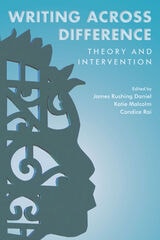
Writing Across Difference
Theory and InterventionJames Rushing Daniel
Utah State University Press, 2021
No text in composition has made such a sweeping attempt to place the multiple areas of translingualism, anti-racism, anticolonialism, interdisciplinarity, and disability into conversation or to represent the field as broadly unified around the concept of difference. The chapters in this book specifically explore how monolingual ideology is maintained in institutions and how translingual strategies can (re)include difference; how narrative-based interventions can promote writing across difference in classrooms and institutions by complicating dominant discourses; and how challenging dominant logics of class, race, ability, and disciplinarity can present opportunities for countering divisiveness.
Writing Across Difference offers writing scholars a sustained intellectual encounter with the crisis of difference and foregrounds the possibilities such an encounter offers for collective action toward a more inclusive and equitable society. It presents a variety of approaches for intervening in classrooms and institutions in the interest of focalizing, understanding, negotiating, and bridging difference. The book will be a valuable resource to those disturbed by the bigotry, violence, and fanaticism that mark our political culture and who are seeking inspiration, models, and methods for collective response.
Contributors: Anis Bawarshi, Jonathan Benda, Megan Callow, James Rushing Daniel, Cherice Escobar Jones, Laura Gonzales, Juan Guerra, Stephanie Kerschbaum, Katie Malcolm, Nadya Pittendrigh, Mya Poe, Candice Rai, Iris Ruiz, Ann Shivers-McNair, Neil Simpkins, Alison Y. L. Stephens, Sumyat Thu, Katherine Xue, Shui-yin Sharon Yam
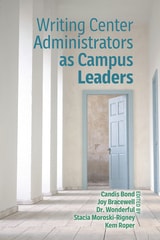
Writing Center Administrators as Campus Leaders
Candis Bond
Utah State University Press, 2026
Writing Center Administrators as Campus Leaders challenges the current erasure of the WCA role within discourse on campus leadership by highlighting the various ways these leaders have had transformative impacts on their institutions, emphasizing the wide range of knowledge, skills, and added value that WCAs bring to the university ecosystem.
Contributors from diverse institutions, institutional contexts, identity formations, and career paths theorize different forms of leadership from within and beyond writing centers. The first section brings together perspectives on leadership theory and practice, focusing on the practical gains offered and challenges afforded via writing center professional pathways. The second section emphasizes partnerships and networks forged through intentional and creative leadership models. In the final section, contributors consider the emotional and affective dimensions of WCA labor, offering multiple roadmaps for WCAs to transition their experiences into more recognition, resources, and broader administrative roles while underscoring the potential of inclusive, community-focused leadership for current and aspiring WCAs.
Providing key insights and practical examples, Writing Center Administrators as Campus Leaders validates and inspires current and future WCAs and informs university administrators on the ways that WCAs can and do impact higher education as true campus leaders.
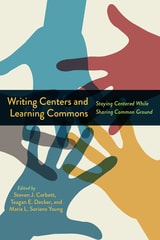
Writing Centers and Learning Commons
Staying Centered While Sharing Common GroundSteven J. Corbett
Utah State University Press, 2022
The chapters comprehensively examine the ways writing centers make the most of sharing common ground. Directors, coordinators, administrators, and stakeholders draw on past and present attention to writing center studies to help shape the future of the learning commons and narrate their substantial collective experience with collaborative efforts to stay centered while empowering colleagues and student writers at their institutions. The contributors explore what is gained and lost by affiliating writing centers with learning commons, how to create sound pedagogical foundations that include writing center philosophies, how writing center practices evolved or have been altered by learning center affiliations, and more.
Writing Centers and Learning Commons is for all stakeholders of writing in and across campuses collaborating on (by choice or edict), or wishing to explore the possibilities of, a learning commons enterprise.
Contributors: Alice Batt, Cassandra Book, Charles A. Braman, Elizabeth Busekrus Blackmon, Virginia Crank, Celeste Del Russo, Patricia Egbert, Christopher Giroux, Alexis Hart, Suzanne Julian, Kristen Miller, Robby Nadler, Michele Ostrow, Helen Raica-Klotz, Kathleen Richards, Robyn Rohde, Nathalie Singh-Corcoran, David Stock
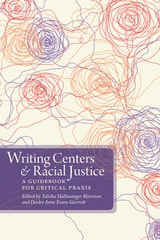
Writing Centers and Racial Justice
A Guidebook for Critical PraxisTalisha Haltiwanger Morrison
Utah State University Press, 2023
In five thematically organized sections—Countering Racism and Colonialism in Higher Education; Recruitment, Hiring, and Retention; Tutor Education and Professional Development; Engaging with Campus and Community; and Holding Our Professional Organizations Accountable—scholars from a variety of institutions, both large and small, public and private, present critical reflection and concrete guidance on anti-racist writing center administrative policies and practices. Several chapters include sample materials, such as course syllabi, consultant education activities, and recruitment materials, to help current and aspiring writing center administrators implement changes in their own contexts.
Writing Centers and Racial Justice is the first book to offer clear and actionable advice on how writing centers and their staff can take up racial or social justice work that will result in real sustainable change. Writing center directors, professionals, and tutors, as well as administrators and decision makers at the institutional level, will benefit from this thoughtful and effective text.
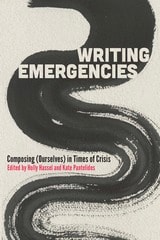
Writing Emergencies
Composing (Ourselves) in Times of CrisisHolly Hassel
Utah State University Press, 2026
Despite the adage “there are no writing emergencies,” at times situations invite or require immediate written response. In a modern era of social media and with the constancy of “crisis,” knowing when, how, and why to respond quickly is increasingly important. In Writing Emergencies, a diverse group of authors contribute scholarly, narrative-based discussions of writing emergencies, descriptions of more and less successful strategies, and a reflective conclusion that offers implications for writing studies praxis and theory.
In this collection, contributors demonstrate the reality of writing emergencies—in their own writing lives, classrooms, and programs—and they offer both self- and community-focused approaches for response. Chapters focus on discernment and prioritization, recognizing that all stressors are not necessarily emergencies. Instead, expanding our vocabulary for (and subsequent understanding) of the kinds of difficulties we come across can build our professional capacity and support greater career sustainability. The volume also illustrates the role of coalitions in navigating writing emergencies and how purposefully building and activating these coalitions subverts some challenges before they become emergencies, particularly those that are recurrent or manufactured.
Writing Emergencies both names and grapples with writing emergencies and offers insights for capacity-building in the acts of filtering and prioritizing competing urgent demands. The findings are meaningful for all leaders, students, and teachers who center care in their relationships with others.
Writing Expertise
A Research-Based Approach to Writing and Learning Across DisciplinesLinda Adler-Kassner
University Press of Colorado, 2023
In Writing Expertise, Linda Adler-Kassner and Elizabeth Wardle address the question, “How can instructors across disciplines best help students write well?” Drawing on research about how disciplines use writing to engage in shared ways of thinking, practicing, and demonstrating knowledge, the authors offer an approach that helps faculty across the disciplines invite students to bring new ideas and identities to their work. Throughout the book, Adler-Kassner and Wardle help instructors explore what it means to write well in their courses, fields, or disciplines and offer strategies and activities that can help them improve their assignments by infusing research-based writing activities into their courses.
Writing Expertise provides an innovative, equity- and research-based approach to writing in the disciplines that will enrich instructor and student thinking. Thoughtful discussions and well-designed activities provide the support needed to help instructors put disciplinary thinking into written form, develop systematic aways of learning about the students who write in their courses, and ultimately develop more effective, inclusive courses.
Writing Groups in the Writing Center
Negotiating Authority and Expertise in Collaborative LearningSara Wilder
Utah State University Press, 2025
As many higher education institutions strive to create spaces and systems that increase equity, accessibility, and diversity, they recognize the need for improved mentorship across academic levels. This book analyzes the significant benefits as well as the challenges faced by writing groups in providing such support. Wilder presents a nuanced account of how facilitators scaffold group practice, how members use and build genre knowledge across disciplines, and how institutional contexts shape emotional labor requirements.
For educators and tutors, the book provides an in-depth examination of the facilitator role, describing essential logistical, emotional, and intellectual practices, and addresses common conflicts and challenges. Administrators can find valuable material for training tutor-facilitators and frameworks for conceptualizing writing group functions on campus. For researchers, the book extends scholarship on writing groups, writing transfer, and collaborative learning, bridging writing center and broader writing studies research.
In an era of concern about generative AI’s role in writing education, Writing Groups in the Writing Center extends research on group facilitation, collaborative learning, and authority negotiation in writing center communities of practice and emphasizes the human connections that make collaborative writing meaningful and valuable for student writers.
Writing New Media
Theory and Applications for Expanding the Teaching of CompositionAnne Frances Wysocki, Johndan Johnson-Eilola, Cynthia L. Selfe, & Geoffrey Sirc
Utah State University Press, 2004
As new media mature, the changes they bring to writing in college are many and suggest implications not only for the tools of writing, but also for the contexts, personae, and conventions of writing. An especially visible change has been the increase of visual elements-from typographic flexibility to the easy use and manipulation of color and images. Another would be in the scenes of writing-web sites, presentation "slides," email, online conferencing and coursework, even help files, all reflect non-traditional venues that new media have brought to writing. By one logic, we must reconsider traditional views even of what counts as writing; a database, for example, could be a new form of written work.
The authors of Writing New Media bring these ideas and the changes they imply for writing instruction to the audience of rhetoric/composition scholars. Their aim is to expand the college writing teacher's understanding of new media and to help teachers prepare students to write effectively with new media beyond the classroom. Each chapter in the volume includes a lengthy discussion of rhetorical and technological background, and then follows with classroom-tested assignments from the authors' own teaching.
Writing Opportunities
Writing, Learning, and Rightful Presence in College TransitionsBrad Jacobson
Utah State University Press, 2026
Writing Opportunities presents in-depth text histories illustrating the interrelationship of writing, identities, and belonging in college writing transitions. Drawing on more than two years of research with three Latinx/a/o students transitioning from the same high school class to the local university, Brad Jacobson brings together analyses of interview transcripts, student writing, classroom genres, and institutional policies to foreground a sense of belonging as central to writing development and learning.
Including interviews with students and their instructors, Jacobson traces writing opportunities that Hercules, Jain, and Lucy were afforded as they transitioned from high school to college writing, particularly in general education courses. Chapters attend to multiple levels of interaction to show how policies, practices, and social histories can impact opportunities for learning. With attention to dominant discourses of writing that narrow what counts as good writing as well as positive opportunity structures that extend possibilities for identification, engagement, and deep learning, Jacobson also posits writing as an opportunity for writers to explore possibilities for who we are and who we may become.
Jacobson’s humanizing research invites readers to consider opportunity from multiple perspectives and shows how subtle shifts in relationships among students, instructors, and institutions can increase meaningful learning and provide a sense of belonging in educational contexts.
Writing Placement in Two-Year Colleges
The Pursuit of Equity in Postsecondary EducationJessica Nastal
University Press of Colorado, 2023
Writing Science in Plain English
Anne E. Greene
University of Chicago Press, 2013
Writing Science in Plain English, Second Edition
Anne E. Greene
University of Chicago Press, 2025
Scientific writing is often dry, wordy, and difficult to understand. But, as biologist and experienced teacher of scientific writing Anne E. Greene shows in Writing Science in Plain English, writers from all scientific disciplines can learn to produce clear, concise prose by mastering just a few simple principles. This short, focused guide presents roughly a dozen such principles based on what readers need to understand complex information, including concrete subjects, strong verbs, consistent terms, organized paragraphs, and correct sentence structure. Greene illustrates each principle with real-life examples of both good and bad writing and shows how bad writing might be improved. She ends each chapter with revision exercises (and provides suggested answers in a separate key) so that readers can come away with new writing skills after just one sitting. To help readers understand the grammatical terms used in the book, an appendix offers a refresher course on basic grammar.
For this second edition, Greene has incorporated the latest research on what makes writing effective and engaging and has revised or replaced exercises and exercise keys where needed. She has also added new features that make it easier to navigate the book. A new resource for instructors who use Writing Science in Plain English in their classes is a free, online teacher’s guide. Drawn from Greene’s long experience teaching students how to write science clearly, the teacher’s guide provides additional lectures, assignments, and activities that will inform and enliven any class.
Writing Studies in Latin America
Seminal WorksFederico Navarro
University Press of Colorado, 2026
This edited collection arises from the belief that the field of writing studies, with its deep engagement in the power of language, is uniquely positioned to open new pathways for international scholarly dialogue in writing studies and beyond. Integrating diverse theoretical traditions—including discourse studies, language pedagogy, educational psychology, educational management, and critical sociolinguistics—the editors have brought together work from key Latin American scholars published over the past two decades. The result is a book that points to future directions for the increasingly global field of writing studies. The collection includes work by Natalia Ávila Reyes, Charles Bazerman, Paula Carlino, Valentina Fahler, Ivone Inés Jakob, Judith Kalman, Angela B. Kleiman, Vera Lúcia Lopes Cristovão, Anna Rachel Machado, Jonathan Marine, Juan David Martínez Hincapié, Paulina Meza, Violate Molina Natera, Désirée Motta-Roth, Estela I. Moyano, Elvira Narvaja de Arnoux, Lucía Natale, Federico Navarro, Giovanni Parodi, Luisa Pelizza, María Cecilia Pereira, Pablo Rosales, Daniela Paula Stagnaro, Alicia Vázquez, René Venegas, and Virginia Zavala.
Writing across Contexts
Transfer, Composition, and Sites of WritingKathleen Yancey
Utah State University Press, 2014
Addressing how composers transfer both knowledge about and practices of writing, Writing across Contexts explores the grounding theory behind a specific composition curriculum called Teaching for Transfer (TFT) and analyzes the efficacy of the approach. Finding that TFT courses aid students in transfer in ways that other kinds of composition courses do not, the authors demonstrate that the content of this curriculum, including its reflective practice, provides a unique set of resources for students to call on and repurpose for new writing tasks.
The authors provide a brief historical review, give attention to current curricular efforts designed to promote such transfer, and develop new insights into the role of prior knowledge in students' ability to transfer writing knowledge and practice, presenting three models of how students respond to and use new knowledge—assemblage, remix, and critical incident.
A timely and significant contribution to the field, Writing across Contexts will be of interest to graduate students, composition scholars, WAC and writing-in-the-disciplines scholars, and writing program administrators.
Writing as a Human Activity
Implications and Applications of the Work of Charles BazermanPaul M. Rogers
University Press of Colorado, 2023
Writing in and about the Performing and Visual Arts
Creating, Performing, and TeachingSteven J. Corbett
University Press of Colorado, 2020
Writing on the Social Network
Digital Literacy Practices in Social Media's First DecadeAmber M. Buck
Utah State University Press, 2023
Through qualitative case study research, Buck explores how literate activities on social network sites coalesced around three areas crucial for writing in digital environments: (1) a heightened awareness of audience and an ability to tailor messages to specific audiences; (2) an understanding of how personal data is collected and circulated in online spaces; and (3) a means through which to use the first two skills for self-promotion and self-presentation in both personal and professional settings. She identifies several distinct literacy practices and strategies used by participants to communicate effectively and addresses how these strategies can help writing researchers and internet scholars understand the impact of social media’s first decade and can inform the ways they will research and understand social media’s second decade.
Social media platforms represent important locations where the different influences on writing become visible. Writing on the Social Network is a close study of the rich literate practices individuals have engaged in on social network sites over the last ten years that allows for a better understanding of the role social media plays in shaping digital literacy.
Writing on the Wall
Writing Education and Resistance to Isolationismedited by David S. Martins, Brooke R. Schreiber & Xiaoye You
Utah State University Press, 2022
The collection extends existing scholarship and research about the ways racist and colonial rhetorics impact writing education; the impact of translingual, transnational, and cosmopolitan ideologies on student learning and student writing; and the role international educational partnerships play in pushing back against isolationist ideologies. Established and early-career scholars who work in a broad range of institutional contexts highlight the historical connections among monolingualism, racism, and white nationalism and introduce community- and classroom-based practices that writing teachers use to resist isolationist beliefs and tendencies.
“Writing on the wall” serves as a metaphor for the creative, direct action writing education can provide and invokes border spaces as sites of identity expression, belonging, and resistance. The book connects transnational writing education with the fight for racial justice in the US and around the world and will be of significance to secondary and postsecondary writing teachers and graduate students in English, linguistics, composition, and literacy studies.
Contributors: Olga Aksakalova, Sara P. Alvarez, Brody Bluemel, Tuli Chatterji, Keith Gilyard, Joleen Hanson, Florianne Jimenez Perzan, Rebecca Lorimer Leonard, Layli Maria Miron, Tony D. Scott, Kate Vieira, Amy J. Wan
Writing the Classroom
Pedagogical Documents as Rhetorical Genresedited by Stephen E. Neaderhiser
Utah State University Press, 2022
The contributors to this unique collection employ a wide range of methodological frameworks to demonstrate how pedagogical genres—even ones as seemingly straightforward as the class syllabus—have lives extending well beyond the classroom as they become part of how college teachers represent their own academic identities, advocate for pedagogical values, and negotiate the many external forces that influence the act of teaching. Writing the Classroom shines a light on genres that are often treated as two-dimensional, with purely functional purposes, arguing instead that genres like assignment prompts, course proposals, teaching statements, and policy documents play a fundamental role in constructing the classroom and the broader pedagogical enterprise within academia.
Writing the Classroom calls on experienced teachers and faculty administrators to critically consider their own engagement with pedagogical genres and offers graduate students and newer faculty insight into the genres that they may only now be learning to inhabit as they seek to establish their personal teacherly identities. It showcases the rhetorical complexity of the genres written in the service of pedagogy not only for students but also for the many other audiences within academia that have a role in shaping the experience of teaching.
Contributors: Michael Albright, Lora Arduser, Lesley Erin Bartlett, Logan Bearden, Lindsay Clark, Dana Comi, Zack K. De Piero, Matt Dowell, Amy Ferdinandt Stolley, Mark A. Hannah, Megan Knight, Laura R. Micciche, Cindy Mooty, Dustin Morris, Kate Navickas, Kate Nesbit, Jim Nugent, Lori A. Ostergaard, Cynthia Pengilly, Jessica Rivera-Mueller, Christina Saidy, Megan Schoen, Virginia Schwarz, Christopher Toth
Writing-Enriched Curricula
Models of Faculty-Driven and Departmental Transformationedited by Chris M. Anson, and Pamela Flash
University Press of Colorado, 2022