4743 books match the query 'Religion' and 139 start with w
cover of Waiting for the Dawn: Mircea Eliade in Perspective

Waiting for the Dawn

Mircea Eliade in Perspective

Davíd Carrasco

University Press of Colorado, 1991

First published in 1991, Waiting for the Dawn is the result of a year-long interdisciplinary study of Mircea Eliade’s scholarly, literary, and autobiographical works which took place at the University of Colorado in 1982. With a preface by Davíd Carrasco that takes into account recent developments in Eliade scholarship, this important work is back in print after renewed interest in Eliade thanks to Francis Ford Coppola’s screen adaptation Youth without Youth (2007).
[more]
cover of Walk in the Good Way: Classical Natural Law and Civic Friendship

Walk in the Good Way

Classical Natural Law and Civic Friendship

Michael Pakaluk

Catholic University of America Press, 2027
What holds a free society together? Not law alone, and not self-interest — but something older and deeper that the classical tradition called civic friendship: the bonds of genuine goodwill and common purpose that bind citizens to one another and make a republic possible. This book recovers that idea, and argues that without it, neither natural law theory nor political life can be adequately understood. Michael Pakaluk brings together more than two decades of scholarship on Aristotle, Aquinas, and the American Founding to show that the classical conception of natural law is fundamentally different in kind from the modern theories that have displaced it. Where contemporary natural law and liberal political theory — in their best-known versions — begin from abstract principles of practical reason, the classical tradition begins from human nature itself: from our constitution as social beings, equipped by nature and Providence to live together, and oriented toward civic friendship as the proper realization of that nature. The argument moves across three great traditions. In Aristotle, civic friendship is the telos of political life — not an ornament added to justice, but its consummation, the common good understood as a shared form of life. In Aquinas, natural law is the rational creature's participation in divine providence, its precepts providing not a checklist of obligations but starting-points for the cultivation of virtue and the perfection of character. In the American Founders — above all in John Adams, whose Aristotelian convictions Pakaluk examines with care — the ideals of natural sociability were neither decorative nor derivative, but the animating principles of the republican experiment itself. The result is a vision at once ancient and urgently contemporary. At a moment of deepening civic fracture, Walk in the Good Way makes the case that the path to a stable and vigorous free society runs through the recovery of something we have nearly forgotten: that we are, by nature, made for life together — and that nature itself shows us how
[more]
cover of Walking with Jesus Christ: Catholic and Evangelical Visions of the Moral Life

Walking with Jesus Christ

Catholic and Evangelical Visions of the Moral Life

Steven Hoskins

Saint Paul Seminary Press, 2023
Walking with Jesus Christ: Catholic and Evangelical Visions of the Moral Life is the collected essays and consensus statements of the second round of the National Evangelical-Catholic Dialogue. In 2021 the National Evangelical-Catholic Dialogue completed its four-year round of discussion on the moral life, at the University of St. Thomas in St. Paul, MN. Sessions were held each year on the following topics. In 2017, the dialogue discussed the norms governing the moral life. In 2018, the dialogue discussed sexual ethics. In 2019, the dialogue discussed social ethics. Finally, in 2021 the dialogue discussed the relationship of the moral life to eschatology. At each of the annual meetings, members presented background papers that formed the basis of that meeting’s discussion and became starting points for constructing a common statement. These common statements and background papers make up this book. The members of the dialogue hope this book will provide a fruitful starting point for future conversations between evangelicals and Catholics. The Catholic essays begin with the contributions of Catholic theologians Daniel Keating, William Stevenson and Christian Washburn, who examine the various norms for Catholic moral theology including the role of Scripture, tradition, magisterium, and natural law (2017). David Fleischacker, Daniel Keating, and Christian Washburn examine the morality of marriage, contraception, abortion, and homosexual acts (2018). Daniel Keating and William Stevenson discuss social ethics, including Catholic social teaching and socialism (2019). David Fleischacker and Christian Washburn discuss the relationship of the moral life to our final beatific end (2020). The Evangelical essays begin with the contribution of Evangelical theologians Bruce Cromwell and Dennis Jowers who explore the norms of Protestant Ethics (2017). David Van Drunen and Luke Geraty discuss sexual ethics from different ends of the Evangelical perspective (2018). Glen Menzies and Steve Hoskins evaluate approaches to evangelical social ethics from Pentecostal and Wesleyan points of view (2019). Bruce Cromwell and Steve Hoskins discuss the notions of eschatology and ethics from a Wesleyan viewpoint (2020).
[more]
cover of War on Error: Real Stories of American Muslims

War on Error

Real Stories of American Muslims

Melody Moezzi

University of Arkansas Press, 2007
War on Error brings together the stories of twelve young people, all vastly different but all American, and all Muslim. Their approaches to religion couldn’t be more diverse: from a rapper of Korean and Egyptian descent to a bisexual Sudanese American to a converted white woman from Colorado living in Cairo and wearing the hijab. These individuals, whether they were born to the religion or came to it on their own, have made their own decisions about how observant they’ll be, whether or not to fast, how often to pray, and what to wear. Though each story is unique, each is also seen through the searching eyes of Melody Moezzi, herself an American Muslim of Iranian descent. She finds that the people she interviews are horrified that, in a post-9/11 world, they have seen their religion come to be represented, in the minds of many Americans, by terrorism. These thoughtful and articulate individuals represent the truth about the faith and its adherents who are drawn to the logic, compassion, and tolerance they find in Muslim teachings. Moezzi, ever comfortable with contradiction and nuance, is a likable narrator whose underlying assumption that “faith is greater than dogma” is strengthened as she learns more about her religion and faces her own biases and blind spots. This fresh new voice, combined with the perceptions and experiences of her fellow American Muslims, make for a read that is both illuminating and enjoyable.
[more]
cover of War, Peace, and Prosperity in the Name of God: The Ottoman Role in Europe's Socioeconomic Evolution

War, Peace, and Prosperity in the Name of God

The Ottoman Role in Europe's Socioeconomic Evolution

Murat Iyigun

University of Chicago Press, 2015

Differences among religious communities have motivated—and continue to motivate—many of the deadliest conflicts in human history. But how did political power and organized religion become so thoroughly intertwined? And how have religion and religiously motivated conflicts affected the evolution of societies throughout history, from demographic and sociopolitical change to economic growth?

War, Peace, and Prosperity in the Name of God turns the focus on the “big three monotheisms”—Judaism, Islam, and Christianity—to consider these questions. Chronicling the relatively rapid spread of the Abrahamic religions among the Old World, Murat Iyigun shows that societies that adhered to a monotheistic belief in that era lasted longer, suggesting that monotheism brought some sociopolitical advantages. While the inherent belief in one true god meant that these religious communities had sooner or later to contend with one another, Iyigun shows that differences among them were typically strong enough to trump disagreements within. The book concludes by documenting the long-term repercussions of these dynamics for the organization of societies and their politics in Europe and the Middle East.
[more]
cover of War, Women, and Druids: Eyewitness Reports and Early Accounts of the Ancient Celts

War, Women, and Druids

Eyewitness Reports and Early Accounts of the Ancient Celts

By Philip Freeman

University of Texas Press, 2002

"The ancient Celts capture the modern imagination as do few other people of classical times. Naked barbarians charging the Roman legions, Druids performing sacrifices of unspeakable horror, women fighting beside their men and even leading armies—these, along with stunning works of art, are the images most of us call to mind when we think of the Celts," observes Philip Freeman. "And for the most part, these images are firmly based in the descriptions handed down to us by the Greek and Roman writers."

This book draws on the firsthand observations and early accounts of classical writers to piece together a detailed portrait of the ancient Celtic peoples of Europe and the British Isles. Philip Freeman groups the selections (ranging from short statements to longer treatises) by themes—war, feasting, poetry, religion, women, and the Western Isles. He also presents inscriptions written by the ancient Celts themselves. This wealth of material, introduced and translated by Freeman to be especially accessible to students and general readers, makes this book essential reading for everyone fascinated by the ancient Celts.
[more]
cover of Warfare, Ritual, and Symbol in Biblical and Modern Contexts

Warfare, Ritual, and Symbol in Biblical and Modern Contexts

Brad E. Kelle

SBL Press, 2014

New perspectives on Israelite warfare for biblical studies, military studies, and social theory

Contributors investigate what constituted a symbol in war, what rituals were performed and their purpose, how symbols and rituals functioned in and between wars and battles, what effects symbols and rituals had on insiders and outsiders, what ways symbols and rituals functioned as instruments of war, and what roles rituals and symbols played in the production and use of texts.

Features:

  • Thirteen essays examine war in textual, historical, and social contexts
  • Texts from the Hebrew Bible are read in light of ancient Near Eastern texts and archaeology
  • Interdisciplinary studies make use of contemporary ritual and social theory
[more]
cover of Was There a Wisdom Tradition: New Prospects in Israelite Wisdom Studies

Was There a Wisdom Tradition

New Prospects in Israelite Wisdom Studies

Mark R. Sneed

SBL Press, 2015

Essential reading for scholars and students in wisdom studies

This collection of essays explores questions that challenge the traditional notion of a wisdom tradition among the Israelite literati, such as: Is the wisdom literature a genre or mode of literature or do we need new terminology? Who were the tradents? Is there such a thing as a “wisdom scribe” and what would that look like? Did the scribes who composed wisdom literature also have a hand in producing the other “traditions,” such as the priestly, prophetic, and apocalyptic, as well as other non-sapiential works? Were Israelite sages open to non-sapiential forms of knowledge in their conceptualization of wisdom?

Features:

  • Recent genre theory in distinction from traditional form criticism
  • Ancient Near Eastern comparative material
  • A balanced collection that includes essays that seriously challenge and affirm the consensus view, as well as those that reconfigure it
[more]
cover of Washington Gladden: Prophet of the Social Gospel

Washington Gladden

Prophet of the Social Gospel

Jacob H. Dorn

The Ohio State University Press, 1966

It has long been recognized that the much loved and widely revered Congregational minister, the Reverend Washington Gladden, pursued a career that embodied the salient features of what was probably the most dynamic period in the history of religion in America. For Gladden was one of the principal actors in those episodes that constitute the often violent but always exhilarating transition from orthodoxy to a more flexible faith based on principles of social justice and service to mankind that took place between the Civil War and World War I.

Gladden was one of the first among clergymen to respond to the intellectual and social currents that arose to challenge traditional modes of Protestant thought and social action. By the end of the nineteenth century, when both liberal theology and the Social Gospel had, in a sense, triumphed as the dominant forces in American Protestantism, he had achieved recognition as one of the earliest, most constant, and most influential exponents of both movements. He was, in addition, one of their chief popularizers; and his copious writings—some forty books and hundreds of articles—represent classic examples of the liberal, socially-conscious Protestantism that distinguished his age.

Mr. Dorn has provided the first comprehensive study of Gladden’s spectacular career. He traces his life and its influences from his birth in Pennsylvania to his long and successful pastorate at the First Congregational Church in Columbus, Ohio, where he gained national fame in stormy encounters with such prominent figures as the redoubtable Billy Sunday and his wife “Ma,” and for his lucid and vigorous positions on national issues such as the “tainted money” controversy that brought him into conflict with Standard Oil.
 
[more]
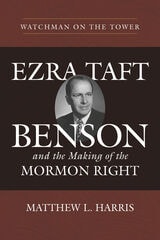
cover of Watchman on the Tower: Ezra Taft Benson and the Making of the Mormon Right

Watchman on the Tower

Ezra Taft Benson and the Making of the Mormon Right

Matthew L. Harris

University of Utah Press, 2020
Ezra Taft Benson is perhaps the most controversial apostle-president in the history of the Church of Jesus Christ of Latter-day Saints. For nearly fifty years he delivered impassioned sermons in Utah and elsewhere, mixing religion with ultraconservative right-wing political views and conspiracy theories. His teachings inspired Mormon extremists to stockpile weapons, predict the end of the world, and commit acts of violence against their government. The First Presidency rebuked him, his fellow apostles wanted him disciplined, and grassroots Mormons called for his removal from the Quorum of the Twelve. Yet Benson was beloved by millions of Latter-day Saints, who praised him for his stances against communism, socialism, and the welfare state, and admired his service as secretary of agriculture under President Dwight D. Eisenhower. Using previously restricted documents from archives across the United States, Matthew L. Harris breaks new ground as the first to evaluate why Benson embraced a radical form of conservatism, and how under his leadership Mormons became the most reliable supporters of the Republican Party of any religious group in America.
[more]
cover of Wayward Distractions: Ornament, Emotion, Zombies and  the Study of Buddhism in Thailand

Wayward Distractions

Ornament, Emotion, Zombies and the Study of Buddhism in Thailand

Justin Thomas McDaniel

National University of Singapore Press, 2021

A collection of essays engaging with Buddhism in Thailand and the virtues of distraction and variety within the materialist turn in studies of religion. 

In Thailand, Buddhism is deeply integrated into national institutions and ideologies, making it tempting to think of Buddhism in Thailand as a textual, institutional, cultural, and conceptual whole. At the same time, religious expression in the country reflects anything but a single order. Often gaudy, cacophonous, variegated, and jumbled, diversity and apparent contradiction abound. A more open engagement with Buddhism in Thailand requires a willingness to be distracted, to step away from received hierarchies and follow the intriguing detail in the ornate design, the odd textual reference, and to prefer "thin description" over a search for meaning. Justin McDaniel's well-known book-length writings in Buddhist and Theravada studies cannot be fully understood without taking into account his shorter writings, what he calls his wayward distractions. Collected together for the first time, these essays cover subjects ranging from ornamental art to marriage and emotion, the role of Hinduism, neglected gender and ethnic diversity, Buddhist inflections in contemporary art practice, and the boundaries between the living, dead, and undead. These writings will be of importance to students of Theravada and Thailand, of religion in Southeast Asia and more generally, of the materialist turn in studies of religion. 
 
[more]
cover of We Called Him Rabbi Abraham: Lincoln and American Jewry, a Documentary History

We Called Him Rabbi Abraham

Lincoln and American Jewry, a Documentary History

Gary Phillip Zola

Southern Illinois University Press, 2014

Over the course of American history, Jews have held many American leaders in high esteem, but they maintain a unique emotional bond with Abraham Lincoln. From the time of his presidency to the present day, American Jews have persistently viewed Lincoln as one of their own, casting him as a Jewish sojourner and, in certain respects, a Jewish role model. This pioneering compendium— The first volume of annotated documents to focus on the history of Lincoln’s image, influence, and reputation among American Jews— considers how Lincoln acquired his exceptional status and how, over the past century and a half, this fascinating relationship has evolved.

Organized into twelve chronological and thematic chapters, these little-known primary source documents—many never before published and some translated into English for the first time—consist of newspaper clippings, journal articles, letters, poems, and sermons, and provide insight into a wide variety of issues relating to Lincoln’s Jewish connection. Topics include Lincoln’s early encounters with Central European Jewish immigrants living in the Old Northwest; Lincoln’s Jewish political allies; his encounters with Jews and the Jewish community as President; Lincoln’s response to the Jewish chaplain controversy; General U. S. Grant’s General Orders No. 11 expelling “Jews, as a class” from the Military Department of Tennessee; the question of amending the U.S. Constitution to legislate the country’s so-called Christian national character; and Jewish eulogies after Lincoln’s assassination. Other chapters consider the crisis of conscience that arose when President Andrew Johnson proclaimed a national day of mourning for Lincoln on the festival of Shavuot (the Feast of Weeks), a day when Jewish law enjoins Jews to rejoice and not to mourn; Lincoln’s Jewish detractors contrasted to his boosters; how American Jews have intentionally “Judaized” Lincoln ever since his death; the leading role that American Jews have played in in crafting Lincoln’s image and in preserving his memory for the American nation; American Jewish reflections on the question “What Would Lincoln Do?”; and how Lincoln, for America’s Jewish citizenry, became the avatar of America’s highest moral aspirations.

With thoughtful chapter introductions that provide readers with a context for the annotated documents that follow, this volume provides a fascinating chronicle of American Jewry’s unfolding historical encounter with the life and symbolic image of Abraham Lincoln, shedding light on how the cultural interchange between American ideals and Jewish traditions influences the dynamics of the American Jewish experience.

Finalist, 2014 National Jewish Book Award
Finalist, 2015 Ohioana Book Award

[more]
cover of We Catholics Don't Die Like Them: Living with Death Before Vatican II

We Catholics Don't Die Like Them

Living with Death Before Vatican II

Sarah Nytroe

Catholic University of America Press, 2026
We Catholics Don’t Die Like Them is the study of a minimally explored topic in American religious history, that of the Catholic approach to death and dying in the first half of the 20th century. Moreover, it advances scholarly understanding of three interrelated themes: cultural and social views of death and practices of dying; the Catholic religious culture and experience before the Second Vatican Council; and the relationship between Catholicism and modernity. While historians and scholars have explored these themes independently, this study seeks to draw them together in a manner that has yet to be fully considered. Finally, the study is grounded in a rich body of primary sources, the everyday religious literature produced to sustain the good death among Catholics. First, scholars from various disciplinary backgrounds, including history, have studied sociocultural attitudes about death and experiences of dying, those of both the past and the present. Those historical studies that examine death and dying do so through the lens of the Protestant religious culture and experience, giving limited to no attention to American Catholicism. Studies that have examined the Catholic approach to death and dying primarily focus on beliefs and practices in the medieval to early modern Church. Rarely have scholars extended the narrative into the modern period, especially the 20th century United States. This scholarly silence is surprising considering that historians have increasingly examined multiple dimensions of American Catholicism and the dynamic relationship between the institution and the "people in the pews." This study seeks to draw attention to this feature of the American Catholic religious culture and how it paralleled other aspects of the pre-Vatican II Catholic culture. Lastly, historians have long studied the relationship between Catholicism and modernity. Numerous studies have examined the ambivalence that existed in the Church towards the ideas, values, and structures of modernity in the pre-conciliar American context. Institutional anxiousness about the influence of modernity permeated the religious culture and the everyday lives of practicing Catholics. Church authorities remained apprehensive about how modern ideas influenced the faithful’s thoughts about death, how they died, how the living supported the dying in their last hour, and how they remembered the dead. This sense of anxiousness emerges in the content and tone of the religious literature produced for Catholics, and yet, historians have yet to fully explore this feature of the relationship.
[more]
cover of We Gon’ Be Alright: Resistance and Healing in Black Movement Spaces, 2012­–2021

We Gon’ Be Alright

Resistance and Healing in Black Movement Spaces, 2012­–2021

Stephanie M. Crumpton

University of Arizona Press, 2025

We Gon’ Be Alright: Resistance and Healing in Black Movement Spaces, 2012–2021 is a profound exploration of Black activism and organizing during a pivotal decade in American history. Rev. Dr. Stephanie M. Crumpton explores the practices of care, reflection, and creativity that Black activists employed to heal and resist amidst the sociopolitical turbulence from the Obama era through the first Trump presidency. This period, marked by the myth of a “post-racial” America, saw a resurgence in racial violence and hate crimes, culminating in the 2021 Capitol insurrection. Against this backdrop, Crumpton captures the resilience and ingenuity of Black movement workers as they navigated these challenges.

Drawing on oral histories and personal narratives, Crumpton provides an intimate look at the lived experiences of thirty-seven full-time community organizers. These activists and organizers share their strategies for maintaining an ethic of care that sustains them while fighting against both external oppression and internal community struggles. The book highlights how contemporary Black resisters have leveraged a growing understanding of trauma and healing to enhance their activism. This blend of historical knowledge and modern therapeutic practices has equipped them with a broader array of tools to support their communities.

Rooted in womanist practical theology, We Gon’ Be Alright emphasizes the interconnectedness of white supremacy with other forms of oppression such as sexism, homophobia, and classism. Crumpton’s work underscores the necessity of “deep, deep healing” to address these multifaceted threats to Black life. This book is an essential resource for scholars, activists, and anyone interested in understanding the dynamics of Black resistance and healing in contemporary America. Through its detailed examination of the past decade, it offers valuable insights into the ongoing struggle for Black humanity, dignity, and a thriving future.
[more]
cover of We Shall Build Anew: Stephen S. Wise, the Jewish Institute of Religion, and the Reinvention of American Liberal Judaism

We Shall Build Anew

Stephen S. Wise, the Jewish Institute of Religion, and the Reinvention of American Liberal Judaism

Shirley Idelson

University of Alabama Press, 2022

Charting the reinvention of American Liberal Judaism through visionary leadership.

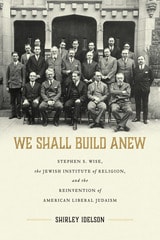
In 1922, Rabbi Stephen S. Wise, a leader of the Zionist movement, established the Jewish Institute of Religion (JIR), a nondenominational rabbinical seminary in New York City. Having already founded the thriving Free Synagogue movement and the American Jewish Congress, he intended to revolutionize American liberal Judaism. Wise believed mainstream American Jewish institutions had become outdated, and he championed a progressive Jewish nationalism that would fight alongside America’s leading proponents of social and economic justice.

We Shall Build Anew tells the little-known story of how Wise changed the trajectory of American Judaism for the next century. Through JIR, he trained a new cadre of young rabbis who shared his outlook, charged them with invigorating and reshaping Jewish life, and launched them into positions of leadership across the country. While Wise earned the ire of many mainstream Jewish leaders through his disregard for denominational distinctions, JIR became home to faculty and students of widely divergent religious and political viewpoints.

We Shall Build Anew is the first book dedicated exclusively to the history of the Jewish Institute of Religion. The story of Wise’s vision for American liberal Judaism is now more important than ever. As American Jewry becomes increasingly polarized around debates concerning religious doctrine as well as Zionism and Israel, the JIR model offers hope that progressives and conservatives, Zionists and non-Zionists, and Jews representing the full spectrum of religious life cannot only coexist but also work together in the name of a vibrant Judaism and a just and peaceful world.
 

[more]
cover of We Take Care of Our Own: Faith, Class, and Politics in the Art of Bruce Springsteen

We Take Care of Our Own

Faith, Class, and Politics in the Art of Bruce Springsteen

June Skinner Sawyers

Rutgers University Press, 2024
We Take Care of Our Own traces the evolution of Bruce Springsteen’s beliefs, beginning with his New Jersey childhood and ending with his most recent works from Springsteen on Broadway to Letter to You. The author follows the singer’s life, examining his albums and a variety of influences (both musical and nonmusical), especially his Catholic upbringing and his family life, to show how he became an outspoken icon for working-class America—indeed for working-class life throughout the world. In this way, the author emphasizes the universality of Springsteen’s canon and depicts how a working-class sensibility can apply to anyone anywhere who believes in fairness and respect. In addition, the author places Springsteen in the historical context not only of literature (especially John Steinbeck) but also of the art world (specifically the work of Thomas Hart Benton and Edward Hopper). Among the themes explored in the book include community, a sense of place, America as the Promised Land, the myth of the West, and, ultimately, mortality.
 
[more]
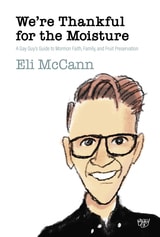
cover of We're Thankful for the Moisture: A Gay Guy's Guide to Mormon Faith, Family, and Fruit Preservation

We're Thankful for the Moisture

A Gay Guy's Guide to Mormon Faith, Family, and Fruit Preservation

McCann, Eli

Signature Books, 2026

We’re Thankful for the Moisture contains personal essays by award-winning humor columnist Eli McCann for The Salt Lake Tribune, along with corresponding cartoons by the Tribune’s Pat Bagley. McCann explores cultural Mormonism and his experiences growing up in Utah as a member of the Church of Jesus Christ of Latter-day Saints in the 1990s, coming out as gay in adulthood, leaving his faith, and navigating life in Salt Lake City with his husband and their young child. Known for his observational humor, nostalgia, and compassion for those in his community who span the religious spectrum, McCann weaves together the silliness that often comes out of communal traditions with the humanity of those who hold those traditions dear. “I still think there’s no better sound than the background noise of neighbors being neighbors,” he writes, ”the simple hum of a people gathered.” While there is much humor to be found in baffling cultural entreaties, like McCann’s grandmother sincerely claiming that nineteenth-century Mormon pioneers wouldn’t trade places with those who live in 2025, or parents justifying a curfew time by insisting “the Holy Ghost goes to bed at midnight,” there is also beauty in what prompts a person to believe such things. McCann’s writings seek to prove just that.
[more]
cover of Webs of Reality: Social Perspectives on Science and Religion

Webs of Reality

Social Perspectives on Science and Religion

Stahl, William

Rutgers University Press, 2002

Science and religion are often thought to be advancing irreconcilable goals and thus to be mutually antagonistic. Yet in the often acrimonious debates between the scientific and religions communities, it is easy to lose sight of the fact that both science and religion are systems of thought and knowledge that aim to understand the world and our place in it.

Webs of Reality
is a rare examination of the interrelationship between religion and science from a social science perspective, offering a broader view of the relationship, and posing practical questions regarding technology and ethics. Emphasizing how science and religion are practiced instead of highlighting the differences between them, the authors look for the subtle connections, tacit understandings, common history, symbols, and implicit myths that tie them together. How can the practice of science be understood from a religious point of view? What contributions can science make to religious understanding of the world? What contributions can the social sciences make to understanding both knowledge systems? Looking at religion and science as fields of inquiry and habits of mind, the authors discover not only similarities between them but also a wide number of ways in which they complement each other.
[more]
cover of What Binds Marriage Forever?

What Binds Marriage Forever?

Ida Friederike Gorres

Catholic University of America Press, 2025

What Binds Marriage Forever is a collection of texts written from 1956 to 1971 by Ida Friederike Görres, herself a married lay woman. Her main focus is the indissolubility of marriage. n the Preface, Görres observes the emergence of a marriage crisis in the West. “Each passing day,” she writes, “the conversation about marriage grows in gravity and urgency.” She wrote this in 1956; she could have written this and the other parts of this book in 2023. The centerpiece of the book is Chapter 1, written in 1971. She argues against Catholics who are trying to reframe marriage a mere love-bond that ceases when love ceases. She mounts a defense of the Catholic teaching on marriage against her counterparts’ calls to allow divorce and remarriage. She exposes the central role modern individualism plays in their arguments. She demon­strates how their arguments are ahistorical, a recipe for relational instability, and harmful to those who suffer when their spouses are adulterous, especially when the adulterous spouse is cheered on for acting out of “love.” Her core argument is that what binds marriage forever is a combination of “covenant, law, and grace, that is, sacrament.” Chapters 2 and 3 explore the topic of marriages between Catholics and bap­tized non-Catholics or non-Christians. Görres discusses the difficulties that such marriages can generate, not least of all the decision of which faith the children should be raised in. Chapter 4 is an overview of the sacramentality of marriage. She explains how marriage relates to the indissoluble bond between God and creation and she explains how the three traditional goods of marriage (fidelity, sacrament, off­spring) are reflected in the marriage liturgy.
[more]
cover of What Brings a Marriage into Existence?: An Historical Re-examination of the Canon Law of the Latin Church

What Brings a Marriage into Existence?

An Historical Re-examination of the Canon Law of the Latin Church

Brendan Killeen

University of Scranton Press, 2010

Of the seven sacraments of the Roman Catholic Church, matrimony is the most discussed, debated, disputed, and adjudicated in all of canon law. In this book, Brendan Killeen employs the fundamental question “What brings a marriage into existence?” as the legal and scholarly means to explore the very nature of marriage within the framework of the canon law of the Catholic Church.

            Killeen conducts his exploration in two phases. First he scrutinizes the canon law’s primary sources—texts dating as far back as the Roman Empire—and gives readers a fresh perspective of the law’s historical progression. He then examines the papers from the Second Vatican Council and offers both an objective evaluation of the law at present and some possible amendments for its future.

            Noteworthy for its diligent research and in-depth analysis, What Brings a Marriage into Existence? will be useful to both newcomers to the canon law of marriage as well as seasoned scholars.
[more]
cover of What Do I Say?: Talking with Patients about Spirituality

What Do I Say?

Talking with Patients about Spirituality

Elizabeth Johnston-Taylor

Templeton Press, 2007

Health care professionals, clergy, chaplains, social workers, and others who counsel people in medical crisis often find themselves faced with deeply painful questions: Why is this happening to me? Am I dying? Why should I live? I'm just a burden to others.
Here is a workbook that suggests healing verbal responses to such expressions of spiritual pain. The author, an internationally recognized expert in spiritual caregiving, points out that wanting to help is one motivation for learning these skills, but there are also evidence-based reasons: helping patients express their innermost feelings promotes spiritual healing; spiritual health is related to physical and emotional health; spiritual coping helps patients accept and deal with their illness; and patients tend to want their health care professionals to know about their spirituality.
Lessons, tips, and exercises teach how to listen effectively, with guidelines for detecting and understanding the spiritual needs embedded in patients' conversations. Suggestions are provided for verbal responses to patients who express spiritual distress, including tips for building rapport, using self-disclosure, and praying with patients. A FAQ section deals with frequently asked questions and miscellaneous information, such as:
•What do I do when a patient talks on and on and I have to leave?
•How do I answer a "why" question?
•What do I say to a patient who believes a miracle will happen to cure them?
•What if I'm not religious? How can I talk about it?
By practicing and using these healing techniques, Taylor explains, healthcare professionals will be able to provide patients responses to their questions that allow them to become intellectually, emotionally, and physically aware of their spirituality so they can experience life more fully.
[more]
cover of What Does It Mean to be a Christian?: A Debate

What Does It Mean to be a Christian?

A Debate

John F. Crosby

St. Augustine's Press, 2016

This book presents a correspondence between two friends who disagree about how to answer the question, “What does it mean to be a Christian?” Crosby argues that Christians understand themselves as hearing a definitive word of revelation spoken by God and intended for all human beings. But Betty sees Christianity as one of several options, usually the preferred way for those born in the faith, but no more unique or special than Hinduism or Buddhism. It is a debate over the kind of initiative the Christian God takes, or does not take, toward human beings. Throughout the debate Crosby alleges that Betty’s God is a very finite god, an all-too-human god, and for that very reason is something different from the God venerated by Christians, while Betty maintains that his theism remains within the Christian orbit and is a much needed corrective to a religion with exclusivist tendencies.

The debate between the two friends is presented here in the form of a correspondence they conducted over a period of two years (and did not originally intend for publication). It has undergone very little editing and revision; the authors have wanted to preserve the spontaneous give and take of their exchange. Together they have produced a work of philosophical dialogue that is unusually fruitful in its ability to clarify some fundamental issues of religion.

[more]
cover of What Does the Lord Require?: How American Christians Think about Economic Justice

What Does the Lord Require?

How American Christians Think about Economic Justice

Hart, Stephen

Rutgers University Press, 1996
In this engaging and lively book, Stephen Hart paints a rich portrait of how everyday Christians connect their faith to political issues like economic equality, government intervention, and the rights of private enterprise. Drawing on interviews with forty-seven "ordinary" Christians--Roman Catholics, Evangelical and Pentecostal Protestants, mainline Protestants, and others--Hart argues that Christians do not always learn a conservative political perspective from their religion, as is often the stereotype. Rather, Christian traditions provide a reservoir of resources that supports such varied values as equality, community, individuality, and freedom. Hart profiles these individuals and allows them to explain in their own words how they use these values to formulate views on social justice issues, supporting political positions ranging from left to right. Hart also provides a new way of understanding how religion affects public discourse. This first paperback edition includes a new analysis of recent trends in religious politics, including the religious right and religiously-based movements for peace and justice.
[more]
cover of What Holds Europe Together?

What Holds Europe Together?

Krzysztof Michalski

Central European University Press, 2006
The book addresses contemporary developments in European identity politics as part of a larger historical trajectory of a common European identity based on the idea of 'solidarity.' The authors explain the special sense in which Europeans perceive their obligations to their less fortunate compatriots, to the new East European members, and to the world at large. An understanding of this notion of 'solidarity' is critical to understanding the specific European commitment to social justice and equality. The specificity of this term helps to distinguish between what the Germans call "social state" from the Anglo-Saxon, and particularly American, political and social system focused on capitalism and economic liberalism. This collection is the result of the work of an extremely distinguished group of scholars and politicians, invited by the previous President of the European Union, Romano Prodi, to reflect on some of the most important subjects affecting the future of Europe.
[more]
cover of What John Knows: Storytelling in the Fourth Gospel

What John Knows

Storytelling in the Fourth Gospel

Douglas Estes

SBL Press, 2025

The Gospel of John is a story that claims to speak about the past; however, in order to say something about the past, storytellers must know something of that past. In this follow-up to How John Works: Storytelling in the Fourth Gospel, a team of international scholars moves beyond genre, style, and character to examine the types of knowledge the Fourth Evangelist drew upon to write his gospel. Contributors Paul N. Anderson, Richard Bauckham, Jo-Ann A. Brant, Andrew J. Byers, Douglas Estes, Edward H. Gerber, Stan Harstine, Wendy E. S. North, George L. Parsenios, Christopher A. Porter, Tyler Smith, and Catrin H. Williams focus on a range of topics, including memory, tradition, spirit, rhetoric, imagination, and more. Together the twelve essays build a narrative epistemology that establishes what a writer must know in order to craft a narrative about the past. This collection is sure to become an essential textbook for students of the gospels in general and John in particular.
[more]
cover of What Makes a Carmelite a Carmelite: Exploring Carmel's Charism

What Makes a Carmelite a Carmelite

Exploring Carmel's Charism

Keith J. Egan

Catholic University of America Press, 2022
Vatican II initiated lively conversations about the identity of religious orders and congregations when the council pointed out that these religious communities are divine gifts in and to the church. Keith Egan examines the nature of these charisms including, not only the original or founders’ charism, but how charisms evolve over the centuries. Special theological attention to these charisms show that they are not something but, in fact, are the dynamic presence of the Holy Spirit. This volume offers a case study the original charism of the Carmelites. The first Carmelites originated when various hermits were displaced by the armies of Saladin. These dislodged hermits sought refuge on Mount Carmel in a ravine facing the Mediterranean Sea. There, these hermits, now Carmelites, sought from Saint Albert, Patriarch of Jerusalem, a description of their life of solitude. Albert’s Formula of Life describes the original Carmelite charism as a life of prayer and contemplation. This Formula eventually became a Rule that made possible a transformation of hermits into friars. Egan is at work on a sequel that examines this radical transformation.
[more]
cover of What We Hold in Trust: Rediscovering the Purpose of Catholic Higher Education

What We Hold in Trust

Rediscovering the Purpose of Catholic Higher Education

Don Briel

Catholic University of America Press, 2021
The specific concern in What We Hold in Trust comes to this: the Catholic university that sees its principal purpose in terms of the active life, of career, and of changing the world, undermines the contemplative and more deep-rooted purpose of the university. If a university adopts the language of technical and social change as its main and exclusive purpose, it will weaken the deeper roots of the university’s liberal arts and Catholic mission. The language of the activist, of changing the world through social justice, equality and inclusion, or of the technician through market-oriented incentives, plays an important role in university life. We need to change the world for the better and universities play an important role, but both the activist and technician will be co-opted by our age of hyper-activity and technocratic organizations if there is not first a contemplative outlook on the world that receives reality rather than constructs it. To address this need for roots What We Hold in Trust unfolds in four chapters that will demonstrate how essential it is for the faculty, administrators, and trustees of Catholic universities to think philosophically and theologically (Chapter One), historically (Chapter Two) and institutionally (Chapters Three and Four). What we desperately need today are leaders in Catholic universities who understand the roots of the institutions they serve, who can wisely order the goods of the university, who know what is primary and what is secondary, and who can distinguish fads and slogans from authentic reform. We need leaders who are in touch with their history and have a love for tradition, and in particular for the Catholic tradition. Without this vision, our universities may grow in size, but shrink in purpose. They may be richer but not wiser.
[more]
cover of What is Modern Israel?

What is Modern Israel?

Yakov M. Rabkin

Pluto Press, 2016

Few countries provoke as much passion and controversy as Israel. What is Modern Israel? convincingly demonstrates that its founding ideology - Zionism - is anything but a simple reaction to antisemitism. Dispelling the notion that every Jew is a Zionist and therefore a natural advocate for the state of Israel, Yakov Rabkin points to the Protestant roots of Zionism, in order to explain the particular support Israel musters in the United States. 

Drawing on many overlooked pages of history, including English, French, Hebrew, Yiddish and Russian sources, Yakov Rabkin shows that Zionism was conceived as a sharp break with Judaism and Jewish continuity. Israel’s past and present must be seen in the context of European ethnic nationalism, colonial expansion and geopolitical interests, rather than as an incarnation of Biblical prophecies or a culmination of Jewish history.
[more]
cover of What's True in Mormon Folklore?: The Contribution of Folklore to Mormon Studies

What's True in Mormon Folklore?

The Contribution of Folklore to Mormon Studies

William Wilson

Utah State University Press, 2008

13th volume in the Leonard J. Arrington Lecture Series
[more]
cover of Whatever Happened to Antisemitism?: Redefinition and the Myth of the 'Collective Jew'

Whatever Happened to Antisemitism?

Redefinition and the Myth of the 'Collective Jew'

Antony Lerman

Pluto Press, 2020

'This elegantly written, erudite book is essential reading for all of us, whatever our identifications' - Lynne Segal

Antisemitism is one of the most controversial topics of our time. The public, academics, journalists, activists and Jewish people themselves are divided over its meaning. Antony Lerman shows that this is a result of a 30-year process of redefinition of the phenomenon, casting Israel, problematically defined as the ‘persecuted collective Jew’, as one of its main targets.

This political project has taken the notion of the ‘new antisemitism’ and codified it in the flawed International Holocaust Remembrance Alliance’s ‘working definition’ of antisemitism. This text is the glue holding together an international network comprising the Israeli government, pro-Israel advocacy groups, Zionist organizations, Jewish communal defence bodies and sympathetic governments fighting a war against those who would criticize Israel.

The consequences of this redefinition have been alarming, supressing free speech on Palestine/Israel, legitimizing Islamophobic right-wing forces, and politicizing principled opposition to antisemitism.
[more]
cover of Whatever Happened to Sherlock Holmes?: Detective Fiction, Popular Theology, and Society

Whatever Happened to Sherlock Holmes?

Detective Fiction, Popular Theology, and Society

Robert S. Paul

Southern Illinois University Press, 1991

Robert S. Paul suggests that the reason detective fiction has won legions of readers may be that "the writer of detective fiction, without conscious intent, appeals directly to those moral and spiritual roots of society unconsciously affirmed and endorsed by the readers."

Because detective stories deal with crime and punishment they cannot help dealing implicitly with theological issues, such as the reality of good and evil, the recognition that humankind has the potential for both, the nature of evidence (truth and error), the significance of our existence in a rational order and hence the reality of truth, and the value of the individual in a civilized society.

Paul argues that the genre traces its true beginning to the Enlightenment and documents two related but different reactions to the theological issues involved: first, a line of writers who are generally positive in relation to their cultural setting, such as Edgar Allan Poe, Wilkie Collins, Conan Doyle; and second, a reactionary strain, critical of the prevailing culture, that begins in William Godwin’s Caleb Williams and continues through the anti-heroic writers like Arsène Lupin to Raymond Chandler, Dashiell Hammett, and John MacDonald.
[more]
cover of Wheat Flour Messiah: Eric Jansson of Bishop Hill

Wheat Flour Messiah

Eric Jansson of Bishop Hill

Paul Elmen

Southern Illinois University Press, 1997

Wheat Flour Messiah follows the career of Eric Jansson from his boyhood on a farm near Biskopskulla (Bishop’s Hill) in Sweden until his murder in Illinois by a crazed follower in 1850. He was an untutored but brilliant charismatic leader, who by sheer insolence and self-confidence defied both the Swedish state church and the secular government and persuaded some twelve hundred of his wheat flour customers to throw in their lot with him. The essence of his teaching was that anyone who so desired could receive the grace of God in such rich measure that he would instantly be freed of sin and live in angelic innocence from then on. This doctrine was an imperfectly understood version of Methodist perfectionism, held without Wesleyan safeguards, and it doomed his followers to civil war against the Lutheran church.

Jansson went north to Hälsingland in Sweden to sell wheat flour, but his deeper intention was to hold large religious services in the farmyards of followers. On three occasions he and his followers burned all the allegedly heretical books written by such men as Luther, Nohrborg, and Arndt, singing hymns while the flames "destroyed the works of the Devil." Jansson was jailed six times, and six times he was freed. After his last trial, as he was being escorted to jail, he escaped and later arranged passage to America. His disciples followed him in a series of Atlantic crossings during 1847–49 and settled the utopian colony of Bishop Hill, 150 miles west of Chicago. They built impressive buildings, plowed the virgin prairie, and began some successful industry making wagons and weaving rugs.

Two fateful events spelled the doom of this utopian dream. The first, the cholera epidemic of 1849,killed over two hundred of the colonists. The other was the arrival of John Root, who subsequently married Jansson’s cousin, Charlotte, and who, after a series of altercations with Jansson over Charlotte, shot him to death in Cambridge, Illinois. The colony did not long survive without its Prophet, and ten years later the utopian dream ended. Today Bishop Hill remains little changed from a century ago—a colorful memory of American beginnings, a vivid reminder of its fascinating past.

Dr. Elmen’s book tells for the first time the life story of a folk hero, Eric Jansson. The Bishop Hill Colony was clearly the lengthened shadow of this extraordinary man. Students of utopian colonies, teachers and students of American history and religious movements will find here a definitive account of this piece of the American past. Any reader interested in the American Dream will enjoy this account of a vanished people who thought they could find somewhere on earth a great, good place, and who had to learn after much suffering that one cannot express in waking reality the character of man in his dreams.
[more]
cover of When Diversity Drops: Race, Religion, and Affirmative Action in Higher Education

When Diversity Drops

Race, Religion, and Affirmative Action in Higher Education

Park, Julie J.

Rutgers University Press, 2013

Julie J. Park examines how losing racial diversity in a university affects the everyday lives of its students. She uses a student organization, the InterVarsity Christian Fellowship (IVCF) at “California University,” as a case study to show how reductions in racial diversity impact the ability of students to sustain multiethnic communities.

The story documents IVCF’s evolution from a predominantly white group that rarely addressed race to the most racially diverse campus fellowship at the university. However, its ability to maintain its multiethnic membership was severely hampered by the drop in black enrollment at California University following the passage of Proposition 209, a statewide affirmative action ban.

Park demonstrates how the friendships that students have—or do not have—across racial lines are not just a matter of personal preference or choice; they take place in the contexts that are inevitably shaped by the demographic conditions of the university. She contends that a strong organizational commitment to diversity, while essential, cannot sustain racially diverse student subcultures. Her work makes a critical contribution to our understanding of race and inequality in collegiate life and is a valuable resource for educators and researchers interested in the influence of racial politics on students’ lives.
[more]
cover of When Night Fell: An Anthology of Holocaust Short Stories

When Night Fell

An Anthology of Holocaust Short Stories

Linda Schermer Raphael and Marc Lee Raphael

Rutgers University Press, 1999

Both survivors of the Holocaust and those who were not there agree that it is impossible to tell what happened as the Nazi Final Solution was put into effect. No writing can adequately imagine the concentration camps, ghettos, and death camps. And that is precisely why writers must tell-and retell-what happened there.

In When Night Fell: An Anthology of Holocaust Short Stories, Linda Schermer Raphael and Marc Lee Raphael have collected twenty-six short stories that tell of the human toll of the Holocaust on those who survived its horrors, as well as later generations touched by its memory. The stories are framed by discussion of the current debate about who owns the Holocaust and who is entitled to speak about it.

Some of the stories included here are by internationally acclaimed authors. Others may be new to many readers. When Night Fell is a fitting memorial to this genocidal horror, putting eloquent voice to human endurance that is-almost-beyond words.
[more]
cover of When Peace Is Not Enough: How the Israeli Peace Camp Thinks about Religion, Nationalism, and Justice

When Peace Is Not Enough

How the Israeli Peace Camp Thinks about Religion, Nationalism, and Justice

Atalia Omer

University of Chicago Press, 2013
The state of Israel is often spoken of as a haven for the Jewish people, a place rooted in the story of a nation dispersed, wandering the earth in search of their homeland. Born in adversity but purportedly nurtured by liberal ideals, Israel has never known peace, experiencing instead a state of constant war that has divided its population along the stark and seemingly unbreachable lines of dissent around the relationship between unrestricted citizenship and Jewish identity.
 
By focusing on the perceptions and histories of Israel’s most marginalized stakeholders—Palestinian Israelis, Arab Jews, and non-Israeli Jews—Atalia Omer cuts to the heart of the Israeli-Arab conflict, demonstrating how these voices provide urgently needed resources for conflict analysis and peacebuilding. Navigating a complex set of arguments about ethnicity, boundaries, and peace, and offering a different approach to the renegotiation and reimagination of national identity and citizenship, Omer pushes the conversation beyond the bounds of the single narrative and toward a new and dynamic concept of justice—one that offers the prospect of building a lasting peace.

[more]
cover of When Science and Christianity Meet

When Science and Christianity Meet

Edited by David C. Lindberg and Ronald L. Numbers

University of Chicago Press, 2003
This book, in language accessible to the general reader, investigates twelve of the most notorious, most interesting, and most instructive episodes involving the interaction between science and Christianity, aiming to tell each story in its historical specificity and local particularity.
 
Among the events treated in When Science and Christianity Meet are the Galileo affair, the seventeenth-century clockwork universe, Noah's ark and flood in the development of natural history, struggles over Darwinian evolution, debates about the origin of the human species, and the Scopes trial. Readers will be introduced to St. Augustine, Roger Bacon, Pope Urban VIII, Isaac Newton, Pierre-Simon de Laplace, Carl Linnaeus, Charles Darwin, T. H. Huxley, Sigmund Freud, and many other participants in the historical drama of science and Christianity.
 
“Taken together, these papers provide a comprehensive survey of current thinking on key issues in the relationships between science and religion, pitched—as the editors intended—at just the right level to appeal to students.”—Peter J. Bowler, Isis
 
[more]
cover of When Sickness Heals: The Place of Religious Belief in Healthcare

When Sickness Heals

The Place of Religious Belief in Healthcare

Siroj Sorajjakool

Templeton Press, 2006


In When Sickness Heals, Dr. Siroj Sorajjakool draws on more than ten years of studies on health benefits in relation to spirituality, especially focusing on the function of "meaning." He expounds on his theory that healing is primarily the function of meaning, and meaning transcends sickness and even death itself. He concludes that what people ultimately seek in life is the healing of their souls. 


Sorajjakool brings many Eastern and Western resources to his conversation on health, meaning, and healing. He incorporates the perspectives of theologians and philosophers like Paul Tillich, Carl Jung, Søren Kierkegaard, Raimundo Panikkar, Dietrich Bonhoeffer, and John Macquarrie; as well as references to religious texts, including yin and yang, and alchemy.


A clear, distinct understanding of spirituality in clinical contexts is presented, with an argument for the role of meaning in the healing process, based on evidence that there may be healing even in the face of death. Sorajjakool identifies the transitional processes people may go through as they seek to make sense of their experiences during a health crisis. He suggests an alternative approach to spiritual assessment and provides methods of spiritual care that speak to the soul.


[more]
cover of When Texts Are Canonized

When Texts Are Canonized

Timothy H. Lim

SBL Press, 2017

How did canonization take place, and what difference does it make?

Essays in this collection probe the canonical process: Why were certain books, but not others, included in the canon? What criteria were used to select the books of the canon? Was canonization a divine fiat or human act? What was the nature of the authority of the laws and narratives of the Torah? How did prophecy come to be included in the canon? Others reflect on the consequences of canonization: What are the effects in elevating certain writings to the status of “Holy Scriptures”? What happens when a text is included in an official list? What theological and hermeneutical questions are at stake in the fact of the canon? Should the canon be unsealed or reopened to include other writings?

Features:

  • Essays that contribute to our understanding of the complex processes of canonization
  • Exploration of early concepts of canonicity
  • Discussion of reopening the New Testament canon
[more]
cover of When These Things Begin: Conversations with Michel Treguer

When These Things Begin

Conversations with Michel Treguer

René Girard (Translated by Trevor Cribben Merrill)

Michigan State University Press, 2014
In this lively series of conversations with writer Michel Treguer, René Girard revisits the major concepts of mimetic theory and explores science, democracy, and the nature of God and freedom. Girard affirms that “our unprecedented present is incomprehensible without Christianity.” Globalization has unified the world, yet civil war and terrorism persist despite free trade and economic growth. Because of mimetic desire and the rivalry it generates, asserts Girard, “whether we’re talking about marriage, friendship, professional relationships, issues with neighbors or matters of national unity, human relations are always under threat.” Literary masters including Marivaux, Dostoevsky, and Joyce understood this, as did archaic religion, which warded off violence with blood sacrifice. Christianity brought a new understanding of sacrifice, giving rise not only to modern rationality and science but also to a fragile system that is, in Girard’s words, “always teetering between a new golden age and a destructive apocalypse.” Treguer, a skeptic of mimetic theory, wonders: “Is what he’s telling me true...or is it just a nice story, a way of looking at things?” In response, Girard makes a compelling case for his theory.
[more]
cover of When the Bones Speak: The Living, the Dead, and the Sacrifice of Contemporary Okinawa

When the Bones Speak

The Living, the Dead, and the Sacrifice of Contemporary Okinawa

Christopher T. Nelson

Duke University Press, 2025
Haunted by the past, ordinary Okinawans struggle to live with the unbearable legacies of war, Japanese nationalism, and American imperialism. They are caught up in a web of people and practices—living and dead, visible and immaterial—that exert powerful forces often beyond their control. In When the Bones Speak, Christopher T. Nelson examines the myriad ways contemporary Okinawans experience, remember, and contest sacrifice. He attends to the voices of those who find their vocation in service to others, from shamans, fortune tellers, laborers, and artists to dead soldiers, war survivors, antiwar activists, and Christian missionaries. Nelson shows how the memories of past sacrifices, atrocities, and exploitation as well as residual trauma shape modern life in Okinawa and the possibility and hope for creative action grounded in the everyday. Offering new understandings of colonial transformation, wartime violence, and military occupation, Nelson writes from the intersection of temporalities and possibilities, where the hard finality of the past may be broken open to reveal a “not yet” that has always remained just beyond reach.
[more]
cover of When the Good Life Goes Bad: The US and Its Seven Deadly Sins

When the Good Life Goes Bad

The US and Its Seven Deadly Sins

Stacey M. Floyd-Thomas Foreword by Michael Eric Dyson

University of Illinois Press, 2026

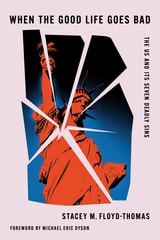
The Seven Deadly Sins have become the seven markers of success in America. Lust, pride, greed, sloth, envy, gluttony, wrath—these once-condemned principles now guide people’s pursuit of the good life.

Stacey M. Floyd-Thomas examines how the Seven Deadly Sins have shaped the moral strivings and sociopolitical condition of American society and culture in the twenty-first century. Drawing on a multidimensional approach, Floyd-Thomas uses race, gender, class, and other lenses to break down the moral crises that define the American Dream. Her critique exposes the harm done by individual and collective practices of sexual objectification, capitalist materialism, wealth inequality, and technological hubris before pivoting to the rise of right-wing populism, white Christian nationalism, and the politics of cruelty. But Floyd-Thomas also proposes an ethic that emphasizes truth-telling, community engagement, and values rooted in humility, justice, and mercy—a new path for the US to overcome systemic oppression and create a more just society.

Evocative and ambitious, When the Good Life Goes Bad takes readers on a wide-ranging journey through US life and culture to explain what corrupted the American dream.
[more]
cover of Where Shall Wisdom be Found?: Calvin's Exegesis of Job from Medieval and Modern Perspectives

Where Shall Wisdom be Found?

Calvin's Exegesis of Job from Medieval and Modern Perspectives

Susan E. Schreiner

University of Chicago Press, 1994

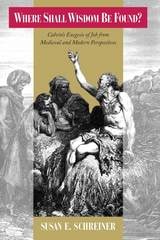
Through countless retellings, from the Talmud to Archibald MacLeish and since, the story of Job has become a fixture in the cultural imagination of the West. In this study, Susan E. Schreiner analyzes interpretations of the Book of Job by Gregory the Great, Maimonides, Thomas Aquinas, and particularly John Calvin. Reading Calvin's interpretation of Job against the background of his most important medieval predecessors, Schreiner shows how central Job is to Calvin's struggles with issues of creation, the problem of evil, the meaning of history, and the doctrine of providence.

For Calvin and his predecessors, Schreiner argues, the concept of intellectual perception is the key to an understanding of Job. The texts she examines constantly raise questions about the human capacity for knowledge: What can the sufferer who stands within history perceive about the self, God, and reality? Can humans truly perceive the workings of providence in their personal lives or in the tumult of history? Are evil and injustice a reality that we must confront before finding wisdom?

In her final chapter, Schreiner turns to the wide array of twentieth-century interpretations of Job, including modern biblical commentaries, the work of Carl Jung, and literary transfigurations by Wells, MacLeish, Wiesel, and Kafka. The result is a compelling demonstration of how the history of exegesis can yield vital insights for contemporary culture.
[more]
cover of Where We Belong: Chemehuevi and Caxcan Preservation of Sacred Mountains

Where We Belong

Chemehuevi and Caxcan Preservation of Sacred Mountains

Daisy Ocampo

University of Arizona Press, 2023

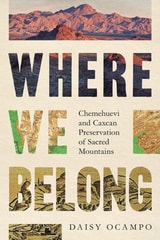
This comparative work dispels the harmful myth that Native people are unfit stewards of their sacred places. This work establishes Indigenous preservation practices as sustaining approaches to the caretaking of the land that embody ecological sustainability, spiritual landscapes, and community well-being.

The author brings together the history and experiences of the Chemehuevi people and their ties with Mamapukaib, or the Old Woman Mountains in the East Mojave Desert, and the Caxcan people and their relationship with Tlachialoyantepec, or Cerro de las Ventanas, in Zacatecas, Mexico. Through a trans-Indigenous approach, Daisy Ocampo weaves historical methodologies (oral histories, archival research, ethnography) with Native studies and historic preservation to reveal why Native communities are the most knowledgeable and transformational caretakers of their sacred places.

This work transcends national borders to reveal how settler structures are sustained through time and space in the Americas. Challenging these structures, traditions such as the Chemehuevi Salt Songs and Caxcan Xuchitl Dance provide both an old and a fresh look at how Indigenous people are reimagining worlds that promote Indigenous-to-Indigenous futures through preservation.

Ultimately, the stories of these two peoples and places in North America illuminate Indigenous sovereignty within the field of public history, which is closely tied to governmental policies, museums, archives, and agencies involved in historic preservation.
[more]
cover of White Metropolis: Race, Ethnicity, and Religion in Dallas, 1841-2001

White Metropolis

Race, Ethnicity, and Religion in Dallas, 1841-2001

By Michael Phillips

University of Texas Press, 2006

Winner, T. R. Fehrenbach Award, Texas Historical Commission, 2007

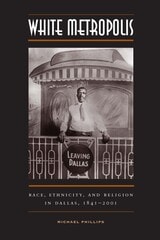
From the nineteenth century until today, the power brokers of Dallas have always portrayed their city as a progressive, pro-business, racially harmonious community that has avoided the racial, ethnic, and class strife that roiled other Southern cities. But does this image of Dallas match the historical reality? In this book, Michael Phillips delves deeply into Dallas's racial and religious past and uncovers a complicated history of resistance, collaboration, and assimilation between the city's African American, Mexican American, and Jewish communities and its white power elite.

Exploring more than 150 years of Dallas history, Phillips reveals how white business leaders created both a white racial identity and a Southwestern regional identity that excluded African Americans from power and required Mexican Americans and Jews to adopt Anglo-Saxon norms to achieve what limited positions of power they held. He also demonstrates how the concept of whiteness kept these groups from allying with each other, and with working- and middle-class whites, to build a greater power base and end elite control of the city. Comparing the Dallas racial experience with that of Houston and Atlanta, Phillips identifies how Dallas fits into regional patterns of race relations and illuminates the unique forces that have kept its racial history hidden until the publication of this book.
[more]
cover of Who Is Mary?: Three Early Modern Women on the Idea of the Virgin Mary

Who Is Mary?

Three Early Modern Women on the Idea of the Virgin Mary

Vittoria Colonna, Chiara Matraini, and Lucrezia Marinella

University of Chicago Press, 2009

For women of the Italian Renaissance, the Virgin Mary was one of the most important role models. Who Is Mary? presents devotional works written by three women better known for their secular writings: Vittoria Colonna, famed for her Petrarchan lyric verse; Chiara Matraini, one of the most original poets of her generation; and the wide-ranging, intellectually ambitious polemicist Lucrezia Marinella. At a time when the cult of the Virgin was undergoing a substantial process of redefinition, these texts cast fascinating light on the beliefs  of Catholic women in the Renaissance, and also, in the cases of Matraini and Marinella, on contemporaneous women’s social behavior, prescribed for them by male writers in books on female decorum.  
            Who Is Mary? testifies to the emotional and spiritual relationships that women had with the figure of Mary, whom they were required to emulate as the epitome of femininity. Now available for the first time in English-language translation, these writings suggest new possibilities for women in both religious and civil culture and provide a window to women’s spirituality, concerning the most important icon set before them, as wives, mothers, and Christians.
 
 
[more]
cover of Who Owns Religion?: Scholars and Their Publics in the Late Twentieth Century

Who Owns Religion?

Scholars and Their Publics in the Late Twentieth Century

Laurie L. Patton

University of Chicago Press, 2019

Who Owns Religion? focuses on a period—the late 1980s through the 1990s—when scholars of religion were accused of scandalizing or denigrating the very communities they had imagined themselves honoring through their work. While controversies involving scholarly claims about religion are nothing new, this period saw an increase in vitriol that remains with us today. Authors of seemingly arcane studies on subjects like the origins of the idea of Mother Earth or the sexual dynamics of mysticism have been targets of hate mail and book-banning campaigns. As a result, scholars of religion have struggled to describe their own work to their various publics, and even to themselves.

Taking the reader through several compelling case studies, Patton identifies two trends of the ’80s and ’90s that fueled that rise: the growth of multicultural identity politics, which enabled a form of volatile public debate she terms “eruptive public space,” and the advent of the internet, which offered new ways for religious groups to read scholarship and respond publicly. These controversies, she shows, were also fundamentally about something new: the very rights of secular, Western scholarship to interpret religions at all.

Patton’s book holds out hope that scholars can find a space for their work between the university and the communities they study. Scholars of religion, she argues, have multiple masters and must move between them while writing histories and speaking about realities that not everyone may be interested in hearing.
 
[more]
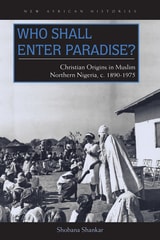
cover of Who Shall Enter Paradise?: Christian Origins in Muslim Northern Nigeria, c. 1890–1975

Who Shall Enter Paradise?

Christian Origins in Muslim Northern Nigeria, c. 1890–1975

Shobana Shankar

Ohio University Press, 2014
Who Shall Enter Paradise? recounts in detail the history of Christian-Muslim engagement in a core area of sub-Saharan Africa’s most populous nation, home to roughly equal numbers of Christians and Muslims. It is a region today beset by religious violence, in the course of which history has often been told in overly simplified or highly partisan terms. This book reexamines conversion and religious identification not as fixed phenomena, but as experiences shaped through cross-cultural encounters, experimentation, collaboration, protest, and sympathy. Shobana Shankar relates how Christian missions and African converts transformed religious practices and politics in Muslim Northern Nigeria during the colonial and early postcolonial periods. Although the British colonial authorities prohibited Christian evangelism in Muslim areas and circumscribed missionary activities, a combination of factors—including Mahdist insurrection, the abolition of slavery, migrant labor, and women’s evangelism—brought new converts to the faith. By the 1930s, however, this organic growth of Christianity in the north had given way to an institutionalized culture based around medical facilities established in the Hausa emirates. The end of World War II brought an influx of demobilized soldiers, who integrated themselves into the local Christian communities and reinvigorated the practice of lay evangelism. In the era of independence, Muslim politicians consolidated their power by adopting many of the methods of missionaries and evangelists. In the process, many Christian men and formerly non-Muslim communities converted to Islam. A vital part of Northern Nigerian Christianity all but vanished, becoming a religion of “outsiders.”
[more]
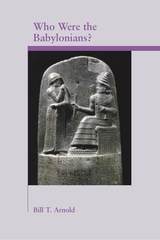
cover of Who Were the Babylonians?

Who Were the Babylonians?

Bill T. Arnold

SBL Press, 2004
This engaging and informative introduction to the the Babylonians were important not only because of their many historical contacts with ancient Israel but because they and their predecessors, the Sumerians, established the philosophical and social infrastructure for most of Western Asia for nearly two millennia. Beginning and advanced students as well as biblical scholars and interested nonspecialists will read this introduction to the history and culture of the Babylonians with interest and profit.
[more]
cover of Whole Faith: The Catholic Ideal of Emilia Pardo Bazan

Whole Faith

The Catholic Ideal of Emilia Pardo Bazan

Denise DuPont

Catholic University of America Press, 2018

Emilia Pardo Bazán (1851-1921), the most important female author of Spain’s nineteenth century, was a prolific writer of novels, short stories, critical articles, chronicles of modern life, and plays. Active in the age of Catholic social teaching inaugura
[more]