Results by title
424 books match the query 'Russian & Soviet' and 18 start with w
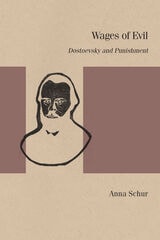
Wages of Evil
Dostoevsky and PunishmentAnna Schur
Northwestern University Press, 2012
As Dostoevsky attempts to balance the various ethical and cultural imperatives, he displays ambivalence both about punishment and about mercy. This ambivalence, Schur argues, is further complicated by what Dostoevsky sees as the unfathomable quality of the self, which hinders every attempt to match crimes with punishments. The one certainty he holds is that a proper response to wrongdoing must include a concern for the wrongdoer’s moral improvement.
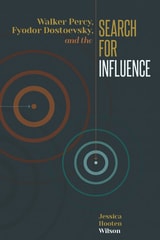
Walker Percy, Fyodor Dostoevsky, and the Search for Influence
Jessica Hooten Wilson
The Ohio State University Press, 2017
From Dostoevsky, Percy learned how to captivate his non-Christian readership with fiction saturated by a Christian vision of reality. Not only was his method of imitation in line with this Christian faith but also the aesthetic mode and very content of his narratives centered on his knowledge of Christ. The influence of Dostoevsky on Percy, then, becomes significant as a modern case study for showing the illusion of artistic autonomy and long-held, Romantic assumptions about artistic originality. Ultimately, Wilson suggests, only by studying the good that came before can one translate it in a new voice for the here and now.
War with the Newts
Karel Capek
Northwestern University Press, 1996
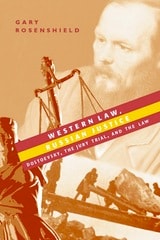
Western Law, Russian Justice
Dostoevsky, the Jury Trial, and the LawGary Rosenshield
University of Wisconsin Press, 2005
What Does It Mean to Be Post-Soviet?
Decolonial Art from the Ruins of the Soviet EmpireMadina Tiostanova
Duke University Press, 2018
When Informal Institutions Change
Institutional Reforms and Informal Practices in the Former Soviet UnionHuseyn Aliyev
University of Michigan Press, 2017
When Informal Institutions Change engages with a growing body of literature on informal practices and institutions in political science, economics, sociology, and beyond. Aliyev proposes expanding the analysis of the impact of institutional reforms on informal institutions beyond disciplinary boundaries, and combines theoretical insights from comparative politics with economic and social theories on informal relations. In addition, Aliyev offers insights that are relevant to democratization, institutionalism, and human geography. Detailed case studies of three transitional post-Soviet regimes—Georgia, Moldova, and Ukraine—illustrate the contentious relationship between democratic institutional reforms and informality in the broader post-Soviet context.
Aliyev shows that in order for institutional reform to succeed in strengthening, democratizing, and formalizing institutions, it is important to approach informal practices and institutions as instrumental for its effectiveness. These findings have implications not only for hybrid regimes, but also for other post-Soviet or post-communist countries.
When Russia Learned to Read
Literacy and Popular Literature, 1861-1917Jeffrey Brooks
Northwestern University Press, 2003
With a new introduction that underscores its relevance to a post-Soviet Russia, When Russia Learned to Read addresses the question of Russia's common heritage with the liberal democratic market societies of Western Europe and the United States. This prize-winning book also exposes the unsuspected complexities of a mass culture little known and less understood in the West. Jeffrey Brooks brings out the characteristically Russian aspect of the nation's popular writing as he ranges through chapbooks, detective stories, newspaper serials, and women's fiction, tracing the emergence of secular, rational, and cosmopolitan values along with newly minted notions of individual initiative and talent. He shows how crude popular tales and serials of the era find their echoes in the literary themes of Dostoevsky, Tolstoy, and other great Russian writers, as well as in the current renaissance of Russian detective stories and thrillers.
Where Currents Meet
Frontiers of Memory in Post-Soviet Fiction of Kharkiv, UkraineTanya Zaharchenko
Central European University Press, 2016
Where Currents Meet, Tanya Zaharchenko’s path-breaking study of literature and cultural memory, moves decisively beyond the simplistic view of a post-Soviet Ukraine divided between east and west. It positions the Ukrainian and Russian components of cultural experience in the country’s east as elements of a complex continuum. Combining insights from memory studies and border studies, Zaharchenko analyzes a generation of younger riters in the city of Kharkiv—a “doubletake generation” that came of age at the time of the Soviet Union’s collapse and now revisits this experience through fiction. In the works of Serhiy Zhadan, Andreĭ Krasniashchikh, Yuri Tsaplin, Oleh Kotsarev, and others the author reveals how borderlands and frontiers, both geographical and conceptual, acquire zonal qualities of their own as these writers navigate the historical legacy they have inherited.
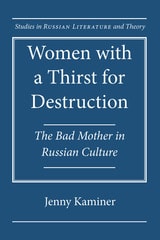
Women with a Thirst for Destruction
The Bad Mother in Russian CultureJenny Kaminer
Northwestern University Press, 2014
Winner, 2014 AWSS Best Book in Slavic/East European/Eurasian Women's Studies
In Russian culture, the archetypal mother is noble and self-sacrificing. In Women with a Thirst for Destruction, however, Jenny Kaminer shows how this image is destabilized during periods of dramatic rupture in Russian society, examining in detail the aftermath of three key moments in the country’s history: the emancipation of the serfs in 1861, the Russian Revolution of 1917, and the fall of the Communist regime in 1991. She explores works both familiar and relatively unexamined: Leo Tolstoy’s Anna Karenina, Mikhail Saltykov-Shchedrin’s The Golovlev Family, Fyodor Gladkov’s Cement, and Liudmila Petrushevskaia’s The Time: Night, as well as a late Soviet film (Vyacheslav Krishtofovich’s Adam’s Rib, 1990) and media coverage of the Chechen conflict. Kaminer’s book speaks broadly to the mutability of seemingly established cultural norms in the face of political and social upheaval.
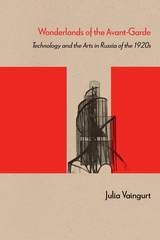
Wonderlands of the Avant-Garde
Technology and the Arts in Russia of the 1920sJulia Vaingurt
Northwestern University Press, 2013
In postrevolutionary Russia, as the Soviet government pursued rapid industrialization, avant-garde artists declared their intent to serve the nascent state and to transform life in accordance with their aesthetic designs. Despite their utilitarian intentions, however, most avant-gardists rarely created works regarded as practical instruments of societal transformation. Exploring this paradox, Vaingurt claims that the artists’ fusion of technology and aesthetics prevented their creations from being fully conscripted into the arsenal of political hegemony. The purposes of avant-garde technologies, she contends, are contemplative rather than constructive. Looking at Meyerhold’s theater, Tatlin’s and Khlebnikov’s architectural designs, Mayakovsky’s writings, and other works from the period, Vaingurt offers an innovative reading of an exceptionally complex moment in the formation of Soviet culture.
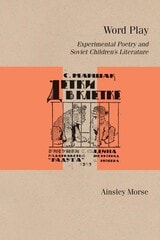
Word Play
Experimental Poetry and Soviet Children’s LiteratureAinsley Morse
Northwestern University Press, 2021
Word Play traces the history of the relationship between experimental aesthetics and Soviet children’s books, a relationship that persisted over the seventy years of the Soviet Union’s existence. From the earliest days of the Soviet project, children’s literature was taken unusually seriously—its quality and subject matter were issues of grave political significance. Yet, it was often written and illustrated by experimental writers and artists who found the childlike aesthetic congenial to their experiments in primitivism, minimalism, and other avant‑garde trends. In the more repressive environment following Stalin’s rise to power, experimental aesthetics were largely relegated to unofficial and underground literature, but unofficial writers continued to author children’s books, which were often more appealing than adult literature of the time.
Word Play focuses on poetry as the primary genre for both children’s and unofficial literature throughout the Soviet period. Five case studies feature poets‑cum‑children’s writers—Leonid Aronzon, Oleg Grigoriev, Igor Kholin, Vsevolod Nekrasov, and Dmitri Prigov—whose unpublished work was not written for children but features lexical and formal elements, abundant humor, and childlike lyric speakers that are aspects of the childlike aesthetic. The book concludes with an exploration of the legacy of this aesthetic in Russian poetry today. Drawing on rich primary sources, Word Play joins a growing literature on Russian children’s books, connecting them to avant-garde poetics in fresh, surprising ways.
Words Are Something Else
David Albahari
Northwestern University Press, 1996
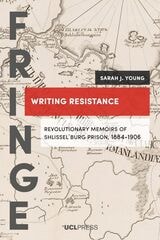
Writing Resistance
Revolutionary Memoirs of Shlissel´burg Prison, 1884-1906Sarah J. Young
University College London, 2021
In 1884, sixty-eight prisoners convicted of terrorism and revolutionary activity were transferred to a new maximum-security prison at Shlissel´burg Fortress near St. Petersburg. Inhuman conditions in the prison caused severe mental and physical deterioration among the prisoners, and over half died. However, the survivors fought back to reform the prison and improve the inmates’ living conditions. Their memoirs enshrined their experience in revolutionary mythology and served as an indictment of the Tsarist autocracy’s loss of moral authority. This book features three of these memoirs—translated into English for the first time—as well as an introductory essay that analyzes the memoirs’ construction of a collective narrative of resilience, resistance, and renewal. The first extended study of these memoirs in English, this book uncovers an important episode in the history of political imprisonment. It will be of interest to scholars and students of the Russian revolution, carceral history, penal practice and behaviors, and prison and life writing.
Writing a Usable Past
Russian Literary Culture, 1917-1937Angela Brintlinger
Northwestern University Press, 2008
In <i>Writing a Usable Past</i>, Brintlinger considers the interactions of post-Revolutionary Russian and emigre culture with the genre of biography in its various permutations, arguing that in the years after the Revolution, Russian writers looked to the great literary figures of the past to help them construct a post-Revolutionary present. In detailed looks at the biographical writing of Yuri Tynianov, Vladislav Khodasevich, and Mikhail Bulgakov, Brintlinger follows each author's successful biography/ies and their failed attempts at biographies of Alexander Pushkin on the centennial anniversary of his death. Brintlinger compares the Pushkin biographies to the other biographies examined, and in a concluding chapter she considers other, more successful commemorations of the great poet's death. She argues that popular commemorations--exhibits, concerts, special issues of journals--were a more fitting biography than the genre of the "usable past." For post-revolutionary cultural actors, including Tynianov, Khodasevich, and Bulgakov, Pushkin was a symbol rather than a model for constructing that usable past.
Writing as Exorcism
The Personal Codes of Pushkin, Lermontov, and GogolIlya Kutik
Northwestern University Press, 2005
A remarkable literary performance in its own right, this interpretive essay brings a highly original poetic sensibility to bear on the lives and works of three major Russian writers. It is Ilya Kutik's contention that many writers are tormented by secret fears and desires that only writing—in particular, the use of certain words and images—can exorcise. Making this biographical approach peculiarly his own—and susceptible to the nuances of comedy, tragedy, and critical equanimity—Kutik reads works of Alexander Pushkin, Mikhail Lermontov, and Nikolai Gogol, three Russian writers who were demonstrably subject to the whims, superstitions, and talismans that Kutik identifies. Exposing the conjunction of literary effort and private act in writings such as "The Queen of Spades," Dead Souls, and A Hero of Our Time, Kutik's work gives us a new way of understanding these masterpieces of Russian literature and their authors, and a new way of reading the mysteries of life and literature as mutually enriching.
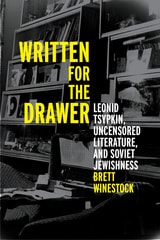
Written for the Drawer
Leonid Tsypkin, Uncensored Literature, and Soviet JewishnessBrett Winestock
University of Wisconsin Press, 2024
Tsypkin’s autobiographical writing explored the impossibility of being both a Russian writer and a Soviet Jew, employing indirection and referentiality. In the first book-length appraisal of Tsypkin and his work, Brett Winestock considers Tsypkin’s fiction as part of a transnational literary response to the horrors of the twentieth century, a reception that helps explain his much-belated international readership. Through close readings of Tsypkin’s work in the context of late-Soviet cultural worlds, Winestock makes an important contribution to studies of Jewish Soviet writing and identity.
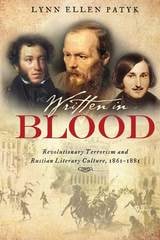
Written in Blood
Revolutionary Terrorism and Russian Literary Culture, 1861–1881Lynn Ellen Patyk
University of Wisconsin Press, 2017
Lynn Ellen Patyk contends that the prototype for the terrorist was the Russian writer, whose seditious word was interpreted as an audacious deed—and a violent assault on autocratic authority. The interplay and interchangeability of word and deed, Patyk argues, laid the semiotic groundwork for the symbolic act of violence at the center of revolutionary terrorism. While demonstrating how literary culture fostered the ethos, pathos, and image of the revolutionary terrorist and terrorism, she spotlights Fyodor Dostoevsky and his "terrorism trilogy"—Crime and Punishment (1866), Demons (1870–73), and The Brothers Karamazov (1878–80)—as novels that uniquely illuminate terrorism's methods and trajectory. Deftly combining riveting historical narrative with penetrating literary analysis of major and minor works, Patyk's groundbreaking book reveals the power of the word to spawn deeds and the power of literature to usher new realities into the world.
Written in Blood
Revolutionary Terrorism and Russian Literary Culture, 1861–1881Lynn Ellen Patyk
University of Wisconsin Press, 2020