Results by title
991 books match the query 'Writing' and 149 start with w
WPAing in a Pandemic and Beyond
Revision, Innovation, and AdvocacyTodd Ruecker
Utah State University Press, 2025
The chapters in this collection include a variety of voices who have been involved in writing program administration in recent years to reflect on the work done in this moment of crisis. Through both short vignettes and longer chapters, this book explores the complicated interactions between WPA work and navigating times of crisis to provide insights for moving forward. Authors explore a variety of topics including professional development, curricular change, advocating in the face of intransigent administrations and others, caring for students, and taking time for self-care. Pointing to specific actions for continued advocacy, WPAing in a Pandemic and Beyond will be of great interest to WPAs and writing studies scholars.
Walking on Fire
The Shaping Force of Emotion in Writing DramaJim Linnell
Southern Illinois University Press, 2011
Walking on Fire opens up new conversations about content and emotion for writers and offers exciting answers to the questions of why we make drama and why we connect to it. Linnell’s userfriendly theory and passionate approach create a framework for understanding the links between the writer’s work in creating the text, the text itself, and the audience’s engagement.

Walking, Writing and Performance
Autobiographical Texts by Deirdre Heddon, Carl Lavery and Phil SmithEdited by Roberta Mock
Intellect Books, 2009
This collection charts three projects by performers who generate autobiographical writing by walking through inspirational landscapes. Included in the book are the full texts of The Crab Walks and Crab Steps Aside by Phil Smith, Mourning Walk by Carl Lavery, and Tree by Deirdre Heddon, each accompanied by photographs and contextual essays. Taken together or separately, the work of all three artist-scholars raises important issues about memory, the ethics of autobiographical performance, ritual, life writing, and site-specific performance.
Water Drops from Women Writers
A Temperance ReaderEdited by Carol Mattingly
Southern Illinois University Press, 2001
The temperance movement was the largest single organizing force for women in American history, uniting and empowering women seeking to enact social change. By the end of the century, more than two hundred thousand women had become members of the Woman’s Christian Temperance Union (WCTU), and numerous others belonged to smaller temperance organizations. Despite the impact of the movement, its literature has been largely neglected.
In this collection of nineteen temperance tales, Carol Mattingly has recovered and revalued previously unavailable writing by women. Mattingly’s introduction provides a context for these stories, locating the pieces within the temperance movement as well as within larger issues in women’s studies.
The temperance movement was essential to women’s awareness of and efforts to change gender inequalities in the United States during the nineteenth and early twentieth centuries. In their fiction, temperance writers protested physical and emotional abuse at the hands of men, argued for women’s rights, addressed legal concerns, such as divorce and child custody, and denounced gender-biased decisions affecting the care and rights of children. Temperance fiction by women broadens our understanding of the connections between women’s rights and temperance, while shedding light on women’s thinking and behavior in the nineteenth century.
Water Drops from Women Writers features biographical sketches of each writer as well as thirteen illustrations.
Water's Edge
Writing on WaterEdited by Lenore Manderson and Forrest Gander
Northwestern University Press, 2023
A wide-ranging consideration of water’s plenitude and paucity—and of our relationship to its many forms
Water is quotidian, ubiquitous, precious, and precarious. With their roots in this element, the authors of Water’s Edge reflect on our natural environment: its forms, textures, and stewardship. Born from a colloquium organized by the editors at the Institute at Brown for Environment and Society, the anthology features a diverse group of writers and artists from half a dozen countries, from different fields of scholarship and practice: artists, biologists, geologists, poets, ecocritics, actors, and anthropologists. The contributors explore and celebrate water while reflecting on its disturbances and pollution, and their texts and art play with the boundaries by which we differentiate literary forms.
In the creative nonfiction, poetry, and visual art collected here, water moves from backdrop to subject. Ashley Dawson examines the effects of industrial farming on the health of local ecosystems and economies. Painter Kulvinder Kaur Dhew captures water’s brilliance and multifaceted reflections through a series of charcoal pieces that interlace the collection. Poet Arthur Sze describes the responsibility involved in the careful management of irrigation ditches in New Mexico. Rather than concentrating their thoughts into a singular, overwhelming argument, the authors circulate moments of apprehension, intimation, and felt experience. They are like tributaries, each carrying, in a distinctive style, exigent and often intimate reports concerning a substance upon which all living organisms depend.
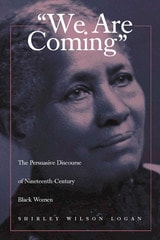
We Are Coming
The Persuasive Discourse of Nineteenth-Century Black WomenShirley Wilson Logan
Southern Illinois University Press, 1999
Shirley Wilson Logan analyzes the distinctive rhetorical features in the persuasive discourse of nineteenth-century black women, concentrating on the public discourse of club and church women from 1880 until 1900.
Logan develops each chapter in this illustrated study around a feature of public address as best exemplified in the oratory of a particular woman speaker of the era. She analyzes not only speeches but also editorials, essays, and letters.
Logan first focuses on the prophetic oratory of Maria Stewart, the first American-born black woman to speak publicly. Turning to Frances Harper, she considers speeches that argue for common interests between divergent communities. And she demonstrates that central to the antilynching rhetoric of Ida Wells is the concept of "presence," or the tactic of enhancing certain selected elements of the presentation.
In her discussion of Fannie Barrier Williams and Anna Cooper, Logan shows that when speaking to white club women and black clergymen, both Williams and Cooper employ what Kenneth Burke called identification. To analyze the rhetoric of Victoria Matthews, she applies Carolyn Miller's modification of Lloyd Bitzer's concept of the rhetorical situation.
Logan also examines the discourse of women associated with the black Baptist women's movement and those participating in college-affiliated conferences.
The book includes an appendix with little-known speeches and essays by Anna Julia Cooper, Selena Sloan Butler, Lucy Wilmot Smith, Mary V. Cook, Adella Hunt Logan, Victoria Earle Matthews, Lucy C. Laney, and Georgia Swift King.
We Are Three Sisters
Self and Family in the Writing of the BrontësDrew Lamonica
University of Missouri Press, 2003
We Share Our Matters
Two Centuries of Writing and Resistance at Six Nations of the Grand RiverRick Monture
University of Manitoba Press, 2014
Weathering the Storm
Independent Writing Programs in the Age of Fiscal AusterityRichard N. Matzen Jr.
Utah State University Press, 2019
Leading writing specialists at the University of Texas at Austin, Syracuse University, the University of Minnesota, and many other institutions document and think carefully about the on-the-ground obstacles that have made the creation of IWPs unique. From institutional naysayers in English departments to skeptical administrators, IWPs and the faculty within them have surmounted not only negative economics but also negative rhetorics. This collection charts the story of this journey as writing faculty continually make the case for the importance of writing in the university curriculum.
Independence has, for the most part, allowed IWPs to better respond to the Great Recession, but to do so they have had to define writing studies in relation to other disciplines and departments. Weathering the Storm will be of great interest to faculty and graduate students in rhetoric and composition, writing program administrators, and writing studies and English department faculty.
Contributors: Linda Adler-Kassner, Lois Agnew, Alice Batt, David Beard, Davida Charney, Amy Clements, Diane Davis, Frank Gaughan, Heidi Skurat Harris, George H. Jensen, Rodger LeGrand, Drew M. Loewe, Mark Garrett Longaker, Cindy Moore, Peggy O’Neill, Chongwon Park, Louise Wetherbee Phelps, Mary Rist, Valerie Ross, John J Ruszkiewicz, Eileen E. Schell, Madeleine Sorapure, Chris Thaiss, Patrick Wehner, Jamie White-Farnham, Carl Whithaus, Traci A. Zimmerman
West of 98
Living and Writing the New American WestEdited by Lynn Stegner and Russell Rowland
University of Texas Press, 2011
What does it mean to be a westerner? With all the mythology that has grown up about the American West, is it even possible to describe "how it was, how it is, here, in the West—just that," in the words of Lynn Stegner? Starting with that challenge, Stegner and Russell Rowland invited several dozen members of the western literary tribe to write about living in the West and being a western writer in particular. West of 98 gathers sixty-six literary testimonies, in essays and poetry, from a stellar collection of writers who represent every state west of the 98th parallel—a kind of Greek chorus of the most prominent voices in western literature today, who seek to "characterize the West as each of us grew to know it, and, equally important, the West that is still becoming."
In West of 98, western writers speak to the ways in which the West imprints itself on the people who live there, as well as how the people of the West create the personality of the region. The writers explore the western landscape—how it has been revered and abused across centuries—and the inescapable limitations its aridity puts on all dreams of conquest and development. They dismantle the boosterism of manifest destiny and the cowboy and mountain man ethos of every-man-for-himself, and show instead how we must create new narratives of cooperation if we are to survive in this spare and beautiful country. The writers seek to define the essence of both actual and metaphoric wilderness as they journey toward a West that might honestly be called home.
A collective declaration not of our independence but of our interdependence with the land and with each other, West of 98 opens up a whole new panorama of the western experience.
What Error Correction Can(not) Accomplish for Second Language Writers
Dispelling Myths, Discussing OptionsDana R. Ferris
University of Michigan Press, 2018
What Is College Reading?
Alice S. Horning
University Press of Colorado, 2017
What We Are Becoming
Developments in Undergraduate Writing MajorsGreg Giberson and Thomas A. Moriarty
Utah State University Press, 2010
Contributors to the volume address a range of vital questions for undergraduate programs, including such issues as the competition for majors within departments, the job market for undergraduates, varying focuses and curricula of such majors, and the formation of them in departments separate from English. Other chapters discuss the importance of flexibility, consider arguments for a rhetorical or civic discourse core for the writing major, address the relationship between rhetoric and composition majors, and review the role of multiliteracies in the major.
The field of composition has not come to a consensus on the shape, content, or focus of the undergradutate major. But as individual programs develop and refine their curricula, one thing has become clear: we must think about them in ways that go beyond our particular circumstances, theorize them in ways that secure their place on our campuses and in our discipline for years to come. What We Are Becoming is an effort to do just that.
What We Really Value
Beyond Rubrics in Teaching and Assessing WritingBob Broad
Utah State University Press, 2003
What We Really Value traces the origins of traditional rubrics within the theoretical and historical circumstances out of which they emerged, then holds rubrics up for critical scrutiny in the context of contemporary developments in the field. As an alternative to the generic character and decontextualized function of scoring guides, he offers dynamic criteria mapping, a form of qualitative inquiry by which writing programs (as well as individual instructors) can portray their rhetorical values with more ethical integrity and more pedagogical utility than rubrics allow.
To illustrate the complex and indispensable insights this method can provide, Broad details findings from his study of eighty-nine distinct and substantial criteria for evaluation at work in the introductory composition program at "City University." These chapters are filled with the voices of composition instructors debating and reflecting on the nature, interplay, and relative importance of the many criteria by which they judged students' texts. Broad concludes his book with specific strategies that can help writing instructors and programs to discover, negotiate, map, and express a more robust truth about what they value in their students' rhetorical performances.
When Our Words Return
Writing, Hearing, and Remembering Oral Traditions from Alasak and the Yukonedited by Phyllis Morrow & William Schneider
Utah State University Press, 1995
The title to this interdisciplinary collection draws on the Yupik Eskimo belief that seals, fish, and other game are precious gifts that, when treated with respect and care, will return to be hunted again. Just so, if oral traditions are told faithfully and respectfully, they will return to benefit future generations. The contributors to this volume are concerned with the interpretation and representation of oral narrative and how it is shaped by its audience and the time, place, and cultural context of the narration. Thus, oral traditions are understood as a series of dialogues between tradition bearers and their listeners, including those who record, write, and interpret.
When Tutor Meets Student
Martha Maxwell, Editor
University of Michigan Press, 1994

Where Is the Light Coming From
Essays on Art and Regular PeopleDan Kois
Duke University Press, 2027
Where Research Begins
Choosing a Research Project That Matters to You (and the World)Thomas S. Mullaney and Christopher Rea
University of Chicago Press, 2022
Plenty of books tell you how to do research. This book helps you figure out WHAT to research in the first place, and why it matters.
The hardest part of research isn't answering a question. It's knowing what to do before you know what your question is. Where Research Begins tackles the two challenges every researcher faces with every new project: How do I find a compelling problem to investigate—one that truly matters to me, deeply and personally? How do I then design my research project so that the results will matter to anyone else?
This book will help you start your new research project the right way for you with a series of simple yet ingenious exercises. Written in a conversational style and packed with real-world examples, this easy-to-follow workbook offers an engaging guide to finding research inspiration within yourself, and in the broader world of ideas.
Read this book if you (or your students):
- have difficulty choosing a research topic
- know your topic, but are unsure how to turn it into a research project
- feel intimidated by or unqualified to do research
- worry that you’re asking the wrong questions about your research topic
- have plenty of good ideas, but aren’t sure which one to commit to
- feel like your research topic was imposed by someone else
- want to learn new ways to think about how to do research.
Under the expert guidance of award-winning researchers Thomas S. Mullaney and Christopher Rea, you will find yourself on the path to a compelling and meaningful research project, one that matters to you—and the world.
Where Writing Begins
A Postmodern ReconstructionMichael Carter
Southern Illinois University Press, 2003
Where Writing Begins: A Postmodern Reconstruction is an innovative approach to the postmodern dilemma in rhetoric and composition thatoffers a positive and postmodern pedagogy that redefines and revalues writing and the teaching of writing through reconstructive, postmodern thought. The result is a fresh understanding of both the field of composition and writing instruction.
Drawing on the rich potential of “beginning” as a philosophical concept, Michael Carter asks the simple question: Where does writing begin? His findings take readers first to a new view of what it means to begin, and then to a new understanding of writing and teaching writing based on the redefined beginning. Challenging conventional notions that posit “beginning” as a chronological and temporal concept, he instead advocates an ontological and philosophical approach, in which “beginning” embodies both deconstruction and reconstruction—and the very possibility of newness.
Adding to a growing body of rhetorical scholarship in postmodern reconstruction, Where Writing Begins illustrates that writing must be understood within the framework of deconstruction and reconstruction. Writing, then, may be newly defined and valued as beginning. Weaving together conceptual, structural, and methodological patterns, Carter’s study is also a journey through the history of philosophy and rhetoric that will leave readers feeling refreshed and teachers eager to return to their classes.
Where the Southern Cross the Yellow Dog
On Writers and WritingLouis D. Rubin, Jr.
University of Missouri Press, 2005
White Space
Essays on Culture, Race, & WritingJennifer De Leon
University of Massachusetts Press, 2021
Alternately honest, funny, and visceral, this powerful collection follows De Leon as she comes of age as a Guatemalan-American woman and learns to navigate the space between two worlds. Never rich or white enough for her posh college, she finds herself equally adrift in her first weeks in her parents' home country. During the years to follow, she would return to Guatemala again and again, meet ex-guerrillera and genocide survivors, get married in the old cobblestoned capital of Antigua, and teach her newborn son about his roots.
Who Owns This Text?
Plagiarism, Authorship, and Disciplinary CulturesCarol Peterson Haviland and Joan A. Mullin
Utah State University Press, 2008
Less a research report than a conversation, the book offers a wide range of ideas, and the chapters here will provoke discussion on scholarly practice relating to intellectual property, plagiarism, and authorship---and to how these matters are conveyed to students. Although these authors find a good deal of consensus in regard to the ethical issues of plagiarism, they document a surprising variety of practice on the subject of what ownership looks like from one discipline to another. And they discover that students are not often instructed in the conventions of their major field.
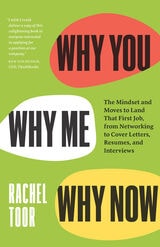
Why You, Why Me, Why Now
The Mindset and Moves to Land That First Job, from Networking to Cover Letters, Resumes, and InterviewsRachel Toor
University of Chicago Press, 2024
Searching for a job can be hard and demoralizing work. In Why You, Why Me, Why Now, Rachel Toor delivers some good news. The most important thing is within your control—a mindset that shows you know the goals of the organization you want to work for and that you’re ready and eager to contribute. Toor provides, with compassion and enthusiasm, strategies to make it easy for hiring managers to say “yes.” Through useful and funny anecdotes, she offers advice from professionals across industries and focuses on the attitude applicants can adopt to find success. Revealing traits employers seek, Toor shows how to craft winning cover letters, ways to tailor resumes for each job, and practical tips to get past AI screening. She also explains how to use LinkedIn and gives tips on preparing for interviews. Throughout, the book features Toor’s notes on writing well to help in landing a first job and beyond. Encouraging, entertaining, and blunt, this is a job-search guide like no other.
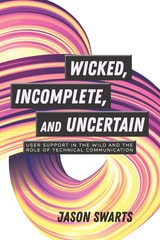
Wicked, Incomplete, and Uncertain
User Support in the Wild and the Role of Technical CommunicationJason Swarts
Utah State University Press, 2018
Technical writers traditionally create large volumes of idealized tasks and procedures in help documentation, but this is no longer the only approach, or even the best approach. Shifting responsibility for user support to users via crowdsourcing is a risky alternative. Just as with other mass-collaborative enterprises, contributors to a forum may not be aware of the kind of knowledge they are creating or how their contributions connect with those made by others. Wicked, Incomplete, and Uncertain describes the kinds of writing and help practices in which user forums engage, why users seem to find these forums credible and appealing, and what companies can learn about building user communities to support this form of assistance.
Through investigation of user-forum activities, Swarts identifies a new set of contributions that technical communicators can make—not only by creating content but also by curating content, shaping conversations, feeding information back into the user community, and opening channels of discovery and knowledge creation that can speak to users and software developers alike
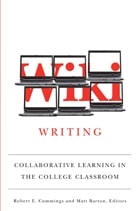
Wiki Writing
Collaborative Learning in the College ClassroomRobert E. Cummings and Matt Barton, Editors
University of Michigan Press, 2008
When most people think of wikis, the first---and usually the only---thing that comes to mind is Wikipedia. The editors of Wiki Writing: Collaborative Learning in the College Classroom, Robert E. Cummings and Matt Barton, have assembled a collection of essays that challenges this common misconception, providing an engaging and helpful array of perspectives on the many pressing theoretical and practical issues that wikis raise. Written in an engaging and accessible manner that will appeal to specialists and novices alike, Wiki Writing draws on a wealth of practical classroom experiences with wikis to offer a series of richly detailed and concrete suggestions to help educators realize the potential of these new writing environments.
Robert E. Cummings began work at Columbus State University in August 2006 as Assistant Professor of English and Director of First-Year Composition. Currently he also serves as the Writing Specialist for CSU's Quality Enhancement Plan, assisting teachers across campus in their efforts to maximize student writing in their curriculum. He recently concluded a three-year research study with the Inter/National Coalition for Electronic Portfolio Research and continues to research in the fields of computers and writing, writing across the curriculum, writing in the disciplines, and curricular reform in higher education.
Matt Barton is Assistant Professor, St. Cloud State University, Department of English-Rhetoric and Applied Writing Program. His research interests are rhetoric, new media, and computers and writing. He is the author of Dungeons and Desktops: A History of Computer Role-Playing Games and has published in the journals Text and Technology, Computers and Composition, Game Studies, and Kairos. He is currently serving as Associate Editor of Kairosnews and Managing Editor of Armchair Arcade.
"Wiki Writing will quickly become the standard resource for using wikis in the classroom."
---Jim Kalmbach, Illinois State University
digitalculturebooks is an imprint of the University of Michigan Press and the Scholarly Publishing Office of the University of Michigan Library dedicated to publishing innovative and accessible work exploring new media and their impact on society, culture, and scholarly communication. Visit the website at www.digitalculture.org.
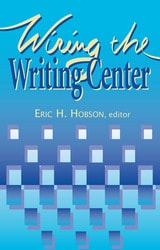
Wiring The Writing Center
Eric Hobson
Utah State University Press, 1998
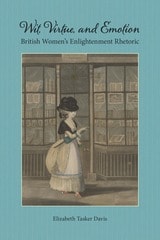
Wit, Virtue, and Emotion
British Women's Enlightenment RhetoricElizabeth Tasker Davis
Southern Illinois University Press, 2022
Women’s persuasion and performance in the Age of Enlightenment
Over a century before first-wave feminism, British women’s Enlightenment rhetoric prefigured nineteenth-century feminist arguments for gender equality, women’s civil rights, professional opportunities, and standardized education. Author Elizabeth Tasker Davis rereads accepted histories of seventeenth- and eighteenth-century British rhetoric, claiming a greater variety and power of women’s rhetoric. This recovery of British women’s performative and written roles as speakers, spectators, authors, and readers in diverse venues counters the traditional masculine model of European Enlightenment rhetoric. Davis broadens women’s Enlightenment rhetorics to include highly public venues such as theaters, clubs, salons, and debating societies, as well as the mediated sites of the periodical essay, the treatise on rhetorical theory, and women’s written proposals, plans, defenses and arguments for education. Through these sites, women’s rhetorical postures diverged from patriarchal prescriptions rather to deliver protofeminist persuasive performances of wit, virtue, and emotion.
Davis examines context, the effects of memory and gendering, and the cultural sites and media of women’s rhetoric to reveal a fuller ecology of British Enlightenment rhetoric. Each chapter covers a cultural site of women’s rhetorical practice—the court, the stage, the salon, and the printed page. Applying feminist rhetorical theory, Davis documents how women grasped their rhetorical ability in this historical moment and staged a large-scale transformation of British women from subalterns to a vocal counterpublic in British society.
Women Writing the Academy
Audience, Authority, and TransformationGesa E. Kirsch. Foreword by John Trimbur
Southern Illinois University Press, 1993
Women Writing the Academy is based on an extensive interview study by Gesa E. Kirsch that investigates how women in different academic disciplines perceive and describe their experiences as writers in the university.
Kirsch’s study focuses on the writing strategies of successful women writers, their ways of establishing authority, and the kinds of audiences they address in different disciplinary settings. Based on multiple interviews with thirty-five women from five different disciplines (anthropology, education, history, nursing, and psychology) and four academic ranks (seniors, graduate students, and faculty before and after tenure), this is the first book to systematically explore the academic context in which women write and publish.
While there are many studies in literary criticism on women as writers of fiction, there has not been parallel scholarship on women as writers of professional discourse, be it inside or outside the academy. Through her research, for example, Kirsch found that women were less likely than their male counterparts to think of their work as sufficiently significant to write up and submit for publication, tended to hold on to their work longer than men before sending it out, and were less likely than men to revise and resubmit manuscripts that had been initially rejected.
This book is significant in that it investigates a new area of research— gender and writing—and in doing so brings together findings on audience, authority, and gender.
Wordcraft
The Complete Guide to Clear, Powerful WritingJack Hart
University of Chicago Press, 2021
Originally published in 2006 as A Writer’s Coach, the book has been updated to address the needs of writers well beyond print journalists. Hart breaks the writing process into a series of manageable steps, from idea to polishing. Filled with real-world examples, both good and bad, Wordcraft shows how to bring such characteristics as force, brevity, clarity, rhythm, and color to any kind of writing.
Wordcraft now functions as a set with the second edition of Hart’s book Storycraft, on the art of storytelling, also available from Chicago.
Words Matter
Writing to Make a DifferenceEdited by Amanda Dahling and Mary Kay Blakely
University of Missouri Press, 2016
Newspapers and magazines have been steadily shrinking, and more and more former subscribers have gone to digital and internet sources for the news. Yet it has become increasingly clear that “short takes” don’t satisfy many readers, who still long for nuanced, long form journalism. By providing examples of classic magazine articles by professional writers, all of whom are graduates of the Missouri School of Journalism, this book fulfills the need for more sophisticated, thought-provoking essays that will resonate with both the general reader and students.
The book is divided into three broad categories: profiles, first person journalism, and personal memoirs, and includes the original articles as well as a “postscript” by the writers in which they discuss what they’ve learned about writing, journalism, and the business of getting published. Useful for students and instructors in writing programs, the book also appeals to writers interested in both the art and the craft of successful writing.
Words at Play
Creative Writing and DramaturgyFelicia Hardison Londre. Forewords by Dakin Williams and Barry Kyle
Southern Illinois University Press, 2005
In this encompassing and accessible introduction to dramaturgy, Felicia Hardison Londré promotes the dramaturgical essay as both an art form and as a method for improving creative writing skills. Words at Play: Creative Writing and Dramaturgy includes Londré’s essays on plays produced at several regional professional theatre companies interspersed with instructive examples for writing more clearly, economically, and compellingly.
Beginning with an introduction that outlines the purpose of the dramaturgical essay as well as its usefulness as a tool for teaching how to write for the theatre, Londré provides numerous examples of this specialized literary genre culled from program essays she has written for Missouri Repertory Theatre, Nebraska Shakespeare Festival, Heart of America Shakespeare Festival, American Heartland Theatre, and Cincinnati Playhouse in the Park. Words at Play: Creative Writing and Dramaturgy contains more than sixty complete essays and pertinent selections from twenty others.
Drawing on personal and professional experiences as a teacher and dramaturg, Londré considers plays from timeless classics, including those of Shakespeare and Chekhov, to contemporary favorites and a few unusual and largely unknown pieces. Words at Play: Creative Writing and Dramaturgy furthermore incorporates introductory paragraphs that are informal and personal yet cogent and critical, providing readers with object lessons in both writing style and analysis. Taking the reader into her confidence, Londré also shows how a dramaturg develops a print relationship with other theatre artists and the community. A foreword by Royal Shakespeare Company associate artist Barry Kyle addresses the evolving role of the dramaturg in Britain and America. Dakin Williams, brother of playwright Tennessee Williams, provides a letter.
Work of Teaching Writing
Learning from Fiction, Film, and DramaJoseph Harris
Utah State University Press, 2020
Each chapter examines a fictional representation of writing classes—as portrayed in Dead Poets Society, Up the Down Staircase, Educating Rita, Push, and more—and shifts the conversation from how these works portray teachers to how they dramatize the actual work of teaching. Harris considers scenes of instruction from different stages of the writing process and depictions of students and teachers at work together to highlight the everyday aspects of teaching writing.
In the writing classroom the ideas of teachers come to life in the work of their students. The Work of Teaching Writing shows what fiction, film, and drama can convey about the moment of exchange between teacher and student as they work together to create new insights into writing. It will interest both high school and undergraduate English teachers, as well as graduate students and scholars in composition and rhetoric, literary studies, and film studies.
Workbook for The ESL Writer's Handbook, 2nd Edition
Janine Carlock, Maeve Eberhardt, Jaime Horst, and Lionel Menasche
University of Michigan Press, 2018
The new edition of the Workbook includes 85 exercises to facilitate students’ understanding of some of the most complex or troublesome writing areas discussed in the Handbook. Exercises have been revised, and new exercises have been added to Sections 4 (Research Paper) and 5 (Grammar and Style).
Working Lives of New Writing Center Directors
Nicole I. Caswell
Utah State University Press, 2016
The first book-length empirical investigation of writing center directors’ labor, The Working Lives of New Writing Center Directors presents a longitudinal qualitative study of the individual professional lives of nine new directors. Inspired by Kinkead and Harris’s Writing Centers in Context (1993), the authors adopt a case study approach to examine the labor these directors performed and the varied motivations for their labor, as well as the labor they ignored, deferred, or sidelined temporarily, whether or not they wanted to.
The study shows directors engaged in various types of labor—everyday, disciplinary, and emotional—and reveals that labor is never restricted to a list of job responsibilities, although those play a role. Instead, labor is motivated and shaped by complex and unique combinations of requirements, expectations, values, perceived strengths, interests and desires, identities, and knowledge. The cases collectively distill how different institutions define writing and appropriate resources to writing instruction and support, informing the ongoing wider cultural debates about skills (writing and otherwise), the preparation of educators, the renewal/tenuring of educators, and administrative “bloat” in academe.
The nine new directors discuss more than just their labor; they address their motivations, their sense of self, and their own thoughts about the work they do, facets of writing center director labor that other types of research or scholarship have up to now left invisible. The Working Lives of New Writing Center Directors strikes a new path in scholarship on writing center administration and is essential reading for present and future writing center administrators and those who mentor them.
Working Text (Student Workbook)
X-Word Grammar and Writing Activities for StudentsSue Livingston
Gallaudet University Press, 2010
Working Test: X-Word Grammar and Writing Activities for Students features 86 X-Word Grammar reading and writing exercises divided into five parts of increasing complexity. Deaf, second-language, and other students experiencing difficulty with English composition can perform these exercises as homework or as in-class activities. Through these exercises, they can master English grammar, improve their facility with language constructions, and meet the challenges of becoming better writers.
Working Text (Teacher's Guide)
Teaching Deaf and Second-Language Students to Be Better WritersSue Livingston
Gallaudet University Press, 2010
After teaching developmental writing to deaf students for may years, Sue Livingston found that students who can read and analyze written texts become better writers. They achieve their improvement by reading, then writing about what they have read. Livingston has embodied her successful approach in Working Text: Teaching Deaf and Second-Language Students to Be Better Writers.
In this straightforward instructional book, Livingston first explains what is involved and why her methods work with deaf students, second-language students, and other students who need to improve their writing ability. Upon this foundation, Working Text delineates how to teach students to write through reading and writing exercises. These exercises have been carefully crafted using the X-Word Grammar approach to help students discover common language constructions that they can apply to their own writing. As the students progress, their understanding of the elements of good writing will grow.
Working Text also includes all of the exercises and appendices featured in the Working Test: X-Word Grammar and Writing Activities for Students workbook, both in print and on on a special CD. The answers for the exercises are included as well, as are sample quizzes, and the CD can be used in the classroom for interactive lessons in conjunction with the student workbook. Working Text: Teaching Deaf and Second-Language Students to Be Better Writers, in concert with its companion student workbook, will help deaf, second-language, and other students develop into markedly better, more confident writers.
Working in the Archives
Practical Research Methods for Rhetoric and CompositionEdited by Alexis E. Ramsey, Wendy B. Sharer, Barbara L'Eplattenier, Lisa S. Mastrangelo
Southern Illinois University Press, 2010
Archival research of any magnitude can be daunting. With this in mind, Alexis E. Ramsey, Wendy B. Sharer, Barbara L’Eplattenier, and Lisa Mastrangelo have developed an indispensable volume for the first-time researcher as well as the seasoned scholar. Working in the Archives is a guide to the world of rhetoric and composition archives, from locating an archival source and its materials to establishing one’s own collection of archival materials. This practical volume provides insightful information on a variety of helpful topics, such as basic archival theory, processes, and principles; the use of hidden or digital archives; the intricacies of searching for and using letters and photographs; strategies for addressing the dilemmas of archival organization without damaging the provenance of materials; the benefits of seeking sources outside academia; and the difficult (yet often rewarding) aspects of research on the Internet.
Working in the Archives moves beyond the basics to discuss the more personal and emotional aspects of archival work through the inclusion of interviews with experienced researchers such as Lynée Lewis Gaillet, Peter Mortensen, Kathryn Fitzgerald, Kenneth Lindblom, and David Gold. Each shares his or her personal stories of the joys and challenges that face today’s researchers.
Packed with useful recommendations, this volume draws on the knowledge and experiences of experts to present a well-rounded guidebook to the often winding paths of academic archival investigation. These in-depth yet user-friendly essays provide crucial answers to the myriad questions facing both fledgling and practiced researchers, making Working in the Archives an essential resource.
Working with Faculty Writers
Anne Ellen Geller and Michele Eodice
Utah State University Press, 2013
Contributors from a variety of institution types and perspectives consider who faculty writers are and who they may be in the future, reveal the range of locations and models of support for faculty writers, explore the ways these might be delivered and assessed, and consider the theoretical, philosophical, political, and pedagogical approaches to faculty writing support, as well as its relationship to student writing support.
With the pressure on faculty to be productive researchers and writers greater than ever, this is a must-read volume for administrators, faculty, and others involved in developing and assessing models of faculty writing support.
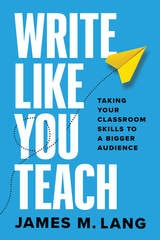
Write Like You Teach
Taking Your Classroom Skills to a Bigger AudienceJames M. Lang
University of Chicago Press, 2025
After years spent cultivating their expertise and passion for a subject, scholars are uniquely positioned to write great books. Yet, accustomed to writing for an audience of their peers, many scholars find it challenging to adapt their writing to a style that is accessible and engaging to the general public. James M. Lang argues that academics are regularly called on to pitch their research to a general audience: their undergraduates. If only there were a way to translate the skills they use in the classroom into their writing. . . .
In Write Like You Teach, Lang—a veteran writer and teacher—distills the elements of good classroom teaching into guidelines for writing for a general audience. He encourages authors to pay attention to how their readers learn and to embrace exploration, experimentation, and creativity in their writing. Lang asks his readers to consider the questions that all great teachers ask themselves: How will I get the attention of my students? How do I make them curious about the subject? What stories or examples will illustrate the more difficult concepts or theories in the course? When will I pause in the class and give students a break from hard thinking? What will I do at the end of the class to remind students about my key messages and leave them wanting to know more?
Write Like You Teach includes examples from successful writers and useful anecdotes from Lang’s own classroom and writing career. Indeed, Lang takes his own advice to heart: like a good teacher, he varies the form of each chapter, making sure to introduce some surprises to keep the reader engaged. Each chapter ends with writing prompts to help readers practice their newly acquired skills, and an appendix provides additional advice on publishing and promoting one’s work. Teachers who follow Lang’s suggestions will find new ways to connect with their readers—and like any good student, they will never approach writing the same way again.
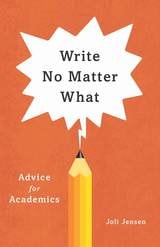
Write No Matter What
Advice for AcademicsJoli Jensen
University of Chicago Press, 2017
Jensen begins by busting the myth that universities are supportive writing environments. She points out that academia, an arena dedicated to scholarship, offers pressures that actually prevent scholarly writing. She shows how to acknowledge these less-than-ideal conditions, and how to keep these circumstances from draining writing time and energy. Jensen introduces tools and techniques that encourage frequent, low-stress writing. She points out common ways writers stall and offers workarounds that maintain productivity. Her focus is not on content, but on how to overcome whatever stands in the way of academic writing.
Write No Matter What draws on popular and scholarly insights into the writing process and stems from Jensen’s experience designing and directing a faculty writing program. With more than three decades as an academic writer, Jensen knows what really helps and hinders the scholarly writing process for scholars in the humanities, social sciences,and sciences.
Cut down the academic sword of Damocles, Jensen advises. Learn how to write often and effectively, without pressure or shame. With her encouragement, writers of all levels will find ways to create the writing support they need and deserve.
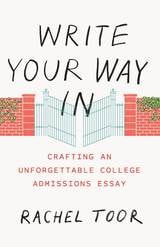
Write Your Way In
Crafting an Unforgettable College Admissions EssayRachel Toor
University of Chicago Press, 2017
The good news? You already have the “secret sauce” for crafting a compelling personal essay: your own experiences and your unique voice.
More than twenty million students apply to college every year; many of them look similar in terms of test scores, grades, courses taken, extracurricular activities. Admissions officers wade through piles of files. As an applicant, you need to think about what will interest an exhausted reader. What can you write that will make her argue to admit you instead of the thousands of other applicants?
A good essay will be conversational and rich in vivid details, and it could only be written by one person—you. This book will help you figure out how to find and present the best in yourself. You’ll acquire some useful tools for writing well—and may even have fun—in the process.
Writer's Block
The Cognitive DimensionMike Rose
Southern Illinois University Press, 1984
Writer’s block is more than a mere matter of discomfort and missed deadlines; sustained experiences of writer’s block may influence academic success and career choices. Writers in the business world, professional writers, and students all have known this most common and least studied problem with the composing process. Mike Rose, however, sees it as a limitable problem that can be precisely analyzed and remedied through instruction and tutorial programs.
Rose defines writer’s block as “an inability to begin or continue writing for reasons other than a lack of skill or commitment,” which is measured by “passage of time with limited productive involvement in the writing task.” He applies insights of cognitive psychology to reveal dimensions of the problem never before examined.
In his three-faceted approach, Rose develops and administers a questionnaire to identify writers experiencing both high and low degrees of blocking; through stimulated recall he examines the composing processes of these writers; and he proposes a cognitive conceptualization of writer’s block and of the composing process.
In drawing up his model, Rose delineates many cognitive errors that cause blocking, such as inflexible rules or conflicting planning strategies. He also discusses the practices and strategies that promote effective composition.
The reissue of this classic study of writer’s block includes a new preface by the author that advocates more mixed-methods research in rhetoric and composition, details how he conducted his writer’s block study, and discusses how his approach to a study like this would be different if conducted today.
Writer's Style
A Rhetorical Field GuidePaul Butler
Utah State University Press, 2018
In a departure from the deficiency model associated with other commonly used style guides, author Paul Butler encourages writers to see style as a malleable device to use for their own purposes, rather than a domain of rules or privilege. He encourages writing instructors to present style as a practical, accessible, and rhetorical tool, working with models that connect to a broad range of writing situations—including traditional texts like essays, newspaper articles, and creative nonfiction as well as digital texts in the form of tweets, Facebook postings, texts, email, visual rhetoric, YouTube, and others.
Though designed for use in first-year composition courses in which students are learning to write for various audiences, purposes, and contexts, The Writer’s Style is a richly layered work that will serve anyone considering how style applies to their professional, personal, creative, or academic writing.
Writing
Marguerite Duras
University of Minnesota Press, 2011
Writing, one of Marguerite Duras’s last works, is a meditation on the process of writing and on her need for solitude in order to do it. In the five short pieces collected in this volume, she explores experiences that had an emotional impact on her and that inspired her to write. These vary from the death of a pilot in World War II, to the death of a fly, to an art exhibition. Two of the pieces were made into documentary films, and one was originally a short film. Both autobiographical and fictional, like much of her work, Writing displays Duras’s unique worldview and sensitive insight in her simple and poetic prose.
Writing A Wider War
Rethinking Gender, Race, and Identity in the South African War, 1899–1902Greg Cuthbertson
Ohio University Press, 2002
Writing a Wider War presents a dramatically new interpretation of the role of Boer women in the conflict and profoundly changes how we look at the making of Afrikaner nationalism. African experiences of the war are also examined, highlighting racial subjugation in the context of colonial war and black participation, and showcasing important new research by African historians.
The collection includes a reassessment of British imperialism and probing essays on J. A. Hobson; the masculinist nature of life on commando among Boer soldiers; Anglo-Jewry; secularism; health and medicine; nursing, women, and disease in the concentration camps; and the rivalry between British politicians and generals. An examination of the importance of the South African War in contemporary British political economy, and the part played by imperial propaganda, rounds off a thoroughly groundbreaking reinterpretation of this formative event in South Africa's history.
Writing Abroad
A Guide for TravelersPeter Chilson and Joanne B. Mulcahy
University of Chicago Press, 2017
Writing Abroad is meant for travelers of all backgrounds and writing levels: a student embarking on overseas study; a retiree realizing a dream of seeing China; a Peace Corps worker in Kenya. All can benefit from documenting their adventures, whether on paper or online. Through practical advice and adaptable exercises, this guide will help travelers hone their observational skills, conduct research and interviews, choose an appropriate literary form, and incorporate photos and videos into their writing.
Writing about travel is more than just safeguarding memories—it can transform experiences and tease out new realizations. With Writing Abroad, travelers will be able to deepen their understanding of other cultures and write about that new awareness in clear and vivid prose.
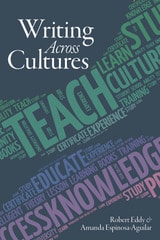
Writing Across Cultures
Robert Eddy
Utah State University Press, 2019
Robert Eddy and Amanda Espinosa-Aguilar offer a new framework for teaching that acknowledges the changing demographics of US college classrooms as the field of writing studies moves toward real equity and expanding diversity. Writing Across Cultures utilizes a streamlined cross-racial and interculturally tested method of introducing students to academic writing via sequenced assignments that are not confined by traditional and static approaches. They focus on helping students become engaged members of a new culture—namely, the rapidly changing collegiate discourse community. The book is based on a multi-racial rhetoric that assumes that writing is inherently a social activity. Students benefit most from seeing composing as an act of engaged communication, and this text uses student samples, not professionally authored ones, to demonstrate this framework in action.
Writing Across Cultures will be a significant contribution to the field, aiding teachers, students, and administrators in navigating the real challenges and wonderful opportunities of multi-racial learning spaces.
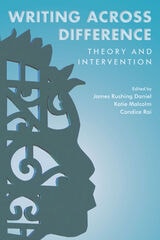
Writing Across Difference
Theory and InterventionJames Rushing Daniel
Utah State University Press, 2021
No text in composition has made such a sweeping attempt to place the multiple areas of translingualism, anti-racism, anticolonialism, interdisciplinarity, and disability into conversation or to represent the field as broadly unified around the concept of difference. The chapters in this book specifically explore how monolingual ideology is maintained in institutions and how translingual strategies can (re)include difference; how narrative-based interventions can promote writing across difference in classrooms and institutions by complicating dominant discourses; and how challenging dominant logics of class, race, ability, and disciplinarity can present opportunities for countering divisiveness.
Writing Across Difference offers writing scholars a sustained intellectual encounter with the crisis of difference and foregrounds the possibilities such an encounter offers for collective action toward a more inclusive and equitable society. It presents a variety of approaches for intervening in classrooms and institutions in the interest of focalizing, understanding, negotiating, and bridging difference. The book will be a valuable resource to those disturbed by the bigotry, violence, and fanaticism that mark our political culture and who are seeking inspiration, models, and methods for collective response.
Contributors: Anis Bawarshi, Jonathan Benda, Megan Callow, James Rushing Daniel, Cherice Escobar Jones, Laura Gonzales, Juan Guerra, Stephanie Kerschbaum, Katie Malcolm, Nadya Pittendrigh, Mya Poe, Candice Rai, Iris Ruiz, Ann Shivers-McNair, Neil Simpkins, Alison Y. L. Stephens, Sumyat Thu, Katherine Xue, Shui-yin Sharon Yam
Writing Assessment, Social Justice, and the Advancement of Opportunity
Mya Poe
University Press of Colorado, 2018
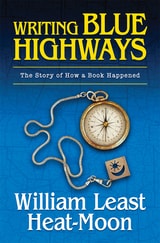
Writing BLUE HIGHWAYS
The Story of How a Book HappenedWillliam Least Heat-Moon
University of Missouri Press, 2023
Winner, Distinguished Literary Achievement, Missouri Humanities Council, 2015
The story behind the writing of the best-selling Blue Highways is as fascinating as the epic trip itself. More than thirty years after his 14,000-mile, 38-state journey, William Least Heat-Moon reflects on the four years he spent capturing the lessons of the road trip on paper—the stops and starts in his composition process, the numerous drafts and painstaking revisions, the depressing string of rejections by publishers, the strains on his personal relationships, and many other aspects of the toil that went into writing his first book. Along the way, he traces the hard lessons learned and offers guidance to aspiring and experienced writers alike. Far from being a technical manual, Writing Blue Highways: The Story of How a Book Happenedis an adventure story of its own, a journey of “exploration into the myriad routes of heart and mind that led to the making of a book from the first sorry and now vanished paragraph to the last words that came not from a graphite pencil but from a letterpress in Tennessee.”
Readers will not find a collection of abstract formulations and rules for writing; rather, this book gracefully incorporates examples from Heat-Moon’s own experience. As he explains, “This story might be termed an inadvertent autobiography written not by the traveler who took Ghost Dancing in 1978 over the byroads of America but by a man only listening to him. That blue-roadman hasn’t been seen in more than a third of a century, and over the last many weeks as I sketched in these pages, I’ve regretted his inevitable departure.” Filtered as the struggles of the “blue-roadman” are through the awareness of someone more than thirty years older with a half dozen subsequent books to his credit, the story of how his first book “happened” is all the more resonant for readers who may not themselves be writers but who are interested in the tricky balance of intuitive creation and self-discipline required for any artistic endeavor.