Results by title
18284 books match the query 'United States' and 882 start with w
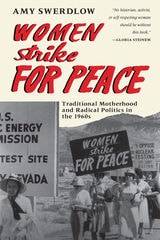
Women Strike for Peace
Traditional Motherhood and Radical Politics in the 1960sAmy Swerdlow
University of Chicago Press, 1993
Women Strike for Peace began on November 1, 1961, when thousands of white, middle-class women walked out of their kitchens and off their jobs in a one-day protest against Soviet and American nuclear policies. The protest led to a national organization of women who fought against nuclear arms and U.S. intervention in Vietnam. While maintaining traditional maternal and feminine roles, members of WSP effectively challenged national policies—defeating a proposal for a NATO nuclear fleet, withstanding an investigation by the House Committee on Un-American Activities, and sending one of its leaders to Congress as a peace candidate.
As a study of a dissident group grounded in prescribed female culture, and the struggle of its members to avoid being trapped within that culture, this book adds a crucial new dimension to women's studies. In addition, this account of WSP's success as a grass roots, nonhierarchical movement will be of great interest to historians, political scientists, and anyone interested in peace studies or conflict resolution.
"Swerdlow has re-created a unique piece of American political history, a chapter of the international peace movement, and an origin of the modern feminist movement. No historian, activist, or self-respecting woman should be without Women Strike for Peace. It shows not only how one group of women created change, but also how they inevitably changed themselves."—Gloria Steinem

Women Take Their Place in State Legislatures
The Creation of Women's CaucusesAnna Mitchell Mahoney
Temple University Press, 2019
How do women strategically make their mark on state legislatures? Anna Mitchell Mahoney’s book traces the development of women’s state legislative caucuses and the influence both gender and party have on women’s ability to organize collectively. She provides a comprehensive analysis of how and why women organize around their gender identity in state legislatures—or why they do not.
Women Take Their Place in State Legislatures includes a quantitative analysis of institutional-level variables and caucus existence in all 50 states. Case studies of caucus attempts in New Jersey, Colorado, Pennsylvania, and Iowa between 2006 and 2010 examine attempts at creating women’s caucuses that succeeded or failed, and why. Mahoney’s interviews with 180 state legislators and their staff explore the motivations of caucus creators and participants. Ultimately, she finds that women’s organizing is contextual; it demonstrates the dynamic nature of gender.
Mahoney also provides insights into broad questions regarding gendered institutions, collective action, and political party governance. Women Take Their Place in State Legislatures fills a lacuna in the evaluation of women in government.
Women Who Stay Behind
Pedagogies of Survival in Rural Transmigrant MexicoRuth Trinidad Galván
University of Arizona Press, 2015
The book studies women’s and families’ use of cultural knowledge, community activism, and teaching and learning spaces. Throughout, Trinidad Galván provides answers to these questions: How does the migration of loved ones alter community, familial, and gender dynamics? And what social relations (convivencia), cultural knowledge, and women-centered pedagogies sustain women’s survival (supervivencia)?
Researchers, educators, and students interested in migration studies, gender studies, education, Latin American studies, and Mexican American studies will benefit from the ethnographic approach and theoretical insight of this groundbreaking work.
Women Working Longer
Increased Employment at Older AgesEdited by Claudia Goldin and Lawrence F. Katz
University of Chicago Press, 2018
In Women Working Longer, editors Claudia Goldin and Lawrence F. Katz assemble new research that presents fresh insights on the phenomenon of working longer. Their findings suggest that education and work experience earlier in life are connected to women’s later-in-life work. Other contributors to the volume investigate additional factors that may play a role in late-life labor supply, such as marital disruption, household finances, and access to retirement benefits. A pioneering study of recent trends in older women’s labor force participation, this collection offers insights valuable to a wide array of social scientists, employers, and policy makers.

Women Writers of the American West, 1833-1927
Nina Baym
University of Illinois Press, 2012
Women Writing the Academy
Audience, Authority, and TransformationGesa E. Kirsch. Foreword by John Trimbur
Southern Illinois University Press, 1993
Women Writing the Academy is based on an extensive interview study by Gesa E. Kirsch that investigates how women in different academic disciplines perceive and describe their experiences as writers in the university.
Kirsch’s study focuses on the writing strategies of successful women writers, their ways of establishing authority, and the kinds of audiences they address in different disciplinary settings. Based on multiple interviews with thirty-five women from five different disciplines (anthropology, education, history, nursing, and psychology) and four academic ranks (seniors, graduate students, and faculty before and after tenure), this is the first book to systematically explore the academic context in which women write and publish.
While there are many studies in literary criticism on women as writers of fiction, there has not been parallel scholarship on women as writers of professional discourse, be it inside or outside the academy. Through her research, for example, Kirsch found that women were less likely than their male counterparts to think of their work as sufficiently significant to write up and submit for publication, tended to hold on to their work longer than men before sending it out, and were less likely than men to revise and resubmit manuscripts that had been initially rejected.
This book is significant in that it investigates a new area of research— gender and writing—and in doing so brings together findings on audience, authority, and gender.

Women against Abortion
Inside the Largest Moral Reform Movement of the Twentieth CenturyKarissa Haugeberg
University of Illinois Press, 2017
Women and American Socialism, 1870-1920
Mari Jo Buhle
University of Illinois Press, 1981
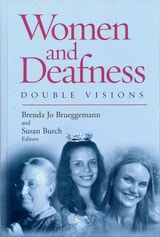
Women and Deafness
Double VisionsBrenda Jo Brueggemann
Gallaudet University Press, 2006
This new collection bridges two dynamic academic fields: Women’s Studies and Deaf Studies. The 14 contributors to this interdisciplinary volume apply research and methodological approaches from sociology, ethnography, literary/film studies, history, rhetoric, education, and public health to open heretofore unexplored territory.
Part One: In and Out of the Community addresses female dynamics within deaf schools; Helen Keller’s identity as a deaf woman; deaf women’s role in Deaf organizations; and whether or not the inequity in education and employment opportunities for deaf women is bias against gender or disability. Part Two: (Women’s) Authority and Shaping Deafness explores the life of 19th-century teacher Marcelina Ruis Y Fernandez; the influence of single, hearing female instructors in deaf education; the extent of women’s authority over oralist educational dictates during the 1900s; and a deaf daughter’s relationship with her hearing mother in the late 20th century.
Part Three: Reading Deaf Women considers two deaf sisters’ exceptional creative freedom from 1885 to 1920; the depictions of deaf or mute women in two popular films; a Deaf woman’s account of blending the public-private, deaf-hearing, and religious-secular worlds; how five Deaf female ASL teachers define “gender,” “feminism,” “sex,” and “patriarchy” in ASL and English; and 20th-century American Deaf beauty pageants that emphasize physicality while denying Deaf identity, yet also challenge mainstream notions of “the perfect body.”
Women and Health in America, 2nd Ed.
Historical ReadingsJudith W. Leavitt
University of Wisconsin Press, 1999

Women and Ideas in Engineering
Twelve Stories from IllinoisLaura D. Hahn, Angela S. Wolters
University of Illinois Press, 2018
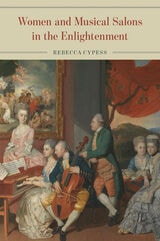
Women and Musical Salons in the Enlightenment
Rebecca Cypess
University of Chicago Press, 2022
In eighteenth-century Europe and America, musical salons—and the women who hosted and made music in them—played a crucial role in shaping their cultural environments. Musical salons served as a testing ground for new styles, genres, and aesthetic ideals, and they acted as a mediating force, bringing together professional musicians and their audiences of patrons, listeners, and performers. For the salonnière, the musical salon offered a space between the public and private spheres that allowed her to exercise cultural agency.
In this book, musicologist and historical keyboardist Rebecca Cypess offers a broad overview of musical salons between 1760 and 1800, placing the figure of the salonnière at its center. Cypess then presents a series of in-depth case studies that meet the salonnière on her own terms. Women such as Anne-Louise Brillon de Jouy in Paris, Marianna Martines in Vienna, Sara Levy in Berlin, Angelica Kauffman in Rome, and Elizabeth Graeme in Philadelphia come to life in multidimensional ways. Crucially, Cypess uses performance as a tool for research, and her interpretations draw on her experience with the instruments and performance practices used in eighteenth-century salons. In this accessible, interdisciplinary book, Cypess explores women’s agency and authorship, reason and sentiment, and the roles of performing, collecting, listening, and conversing in the formation of eighteenth-century musical life.
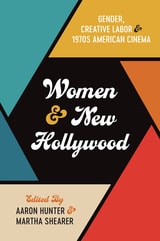
Women and New Hollywood
Gender, Creative Labor, and 1970s American CinemaAaron Hunter
Rutgers University Press, 2023
Women and New Hollywood revises our understanding of this important era in American film by examining the contributions that women made not only as directors, but also as screenwriters, editors, actors, producers, and critics. Including essays on film history, film texts, and the decade’s film theory and criticism, this collection showcases the rich and varied cinematic products of women’s creative labor, as well as the considerable barriers they faced. It considers both women working within and beyond the Hollywood film industry, reconceptualizing New Hollywood by bringing it into dialogue with other American cinemas of the 1970s. By valuing the many forms of creative labor involved in film production, this collection offers exciting alternatives to the auteurist model and new ways of appreciating the themes and aesthetics of 1970s American film.
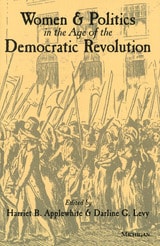
Women and Politics in the Age of the Democratic Revolution
Harriet B. Applewhite and Darline G. Levy, Editors
University of Michigan Press, 1993

Women and Politics
An International PerspectiveVicky Randall
University of Chicago Press, 1988
Women and Regulation
Challenging the Status QuoEdited by Sara R. Rinfret and Michelle C. Pautz
Temple University Press, 2026
Are female food safety inspectors treated differently than men? What do women contribute to the creation and implementation of public policy in the United States? The editors of and contributors to Women in Regulation, all experts in public policy and public administration, analyze the role women (and stakeholders) play in bureaucracies in environmental, budgetary, and other sectors of the U.S. federal, state, and local governments, plus relevant examples from around the world.
Women in Regulation examines the impact of regulatory policy delegation, as well as the actors and processes involved in administrative rulemaking, compliance, and implementation. The book considers representative bureaucracy, organizational stereotypes, emotional labor, and advancement barriers to argue why studying women and regulation is of value. Regulatory case studies focus on topics ranging from water and energy to executive leadership. Chapters also include reflective exercises and prompts for classroom engagement that challenge readers to consider implications for regulatory policy in the future.
Amplifying the underheard voices in policy and implementation, Women in Regulation provides a more holistic picture of regulatory practices.
Contributors: Saman Afshan, Ashley English, Katherine Hoener, Nicole Humphrey, Ekaterina Levintova, Li-Yin Liu, Sean McCandless, Bruce D. McDonald III, Denise Scheberle, Natalie L. Smith, Manuel P. Teodoro, and the editors

Women and Rhetoric between the Wars
Ann George, M. Elizabeth Weiser, and Janet Zepernick
Southern Illinois University Press, 2013
In Women and Rhetoric between the Wars, editors Ann George, M. Elizabeth Weiser, and Janet Zepernick have gathered together insightful essays from major scholars on women whose practices and theories helped shape the field of modern rhetoric. Examining the period between World War I and World War II, this volume sheds light on the forgotten rhetorical work done by the women of that time. It also goes beyond recovery to develop new methodologies for future research in the field.
Collected within are analyses of familiar figures such as Jane Addams, Amelia Earhart, Helen Keller, and Bessie Smith, as well as explorations of less well known, yet nevertheless influential, women such as Zitkala-Ša, Jovita González, and Florence Sabin. Contributors evaluate the forces in the civic, entertainment, and academic scenes that influenced the rhetorical praxis of these women. Each essay presents examples of women’s rhetoric that move us away from the “waves” model toward a more accurate understanding of women’s multiple, diverse rhetorical interventions in public discourse. The collection thus creates a new understanding of historiography, the rise of modern rhetorical theory, and the role of women professionals after suffrage. From celebrities to scientists, suffragettes to academics, the dynamic women of this volume speak eloquently to the field of rhetoric studies today.
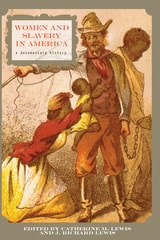
Women and Slavery in America
A Documentary HistoryCatherine M. Lewis
University of Arkansas Press, 2011

Women and Sports in the United States
A Documentary ReaderEdited by Jaime Schultz, Jean O’Reilly, and Susan K. Cahn
Dartmouth College Press, 2018

Women and Stepfamilies
Voices of Anger and Loveedited by Nan Bauer Maglin and Nancy Schniedewind
Temple University Press, 1990
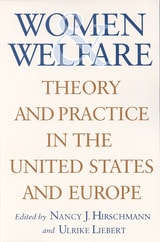
Women and Welfare
Theory and Practice in the United States and EuropeHirschmann, Nancy J
Rutgers University Press, 2001
The social welfare state is believed by many to be one of the great achievements of Western democracy in the twentieth century. It institutionalized for the first time a collective commitment to improving individual life chances and social well-being. However, as we move into a new century, the social welfare state everywhere has come under increasing pressure, raising serious doubts about its survival.
Featuring essays by experts from a variety of fields, including law, comparative politics, sociology, economics, cultural studies, philosophy, and political theory, Women and Welfare represents an interdisciplinary, multimethodological and multicultural feminist approach to recent changes in the welfare system of Western industrialized nations. The broad perspective, from the philosophical to the quantitative, provides an excellent overview of the subject and the most recent scholarly literature. The volume offers a crosscultural analysis of welfare “reform” in the 1990s, visions of what a “woman-friendly” welfare state requires, and an examination of theoretical and policy questions feminists and concerned others should be asking.
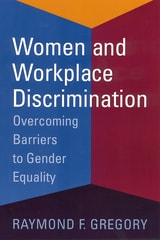
Women and Workplace Discrimination
Overcoming Barriers to Gender EqualityGregory, Raymond F
Rutgers University Press, 2002
Attorney Raymond F. Gregory addresses the millions of women who think they might be facing sexual discrimination and explains federal measures enacted to assist workers in contesting unlawful employer conduct. He presents actual court cases to demonstrate the ways that women have challenged their employers. The cases illustrate legal principles in real-life experiences. Many of the cases relate compelling stories of workers caught up in a web of employer discriminatory conduct. Gregory has eliminated legal jargon, ensuring that all concepts are clear to his readers. Individuals will turn to this book again and again to obtain authoritative background on this important topic.
Topics covered include:
- The increasing incidence of sexual harassment in the workplace
- Common forms of sex discrimination
- Discrimination against older women
- Discrimination against women of color
- Discrimination against women in the professions
- Discrimination against pregnant women
- Discrimination against women with children
- Sex discrimination in hiring, promotion, termination
- Employer liability for workplace sexual harassment
- Employer retaliation against workers
- Proving sex discrimination in the courtroom
- Compensatory and punitive damages
- Back pay, front pay, and other remedies
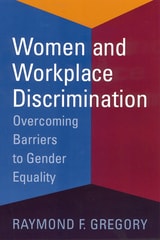
Women and Workplace Discrimination
Overcoming Barriers to Gender EqualityGregory, Raymond F
Rutgers University Press, 2002
Attorney Raymond F. Gregory addresses the millions of women who think they might be facing sexual discrimination and explains federal measures enacted to assist workers in contesting unlawful employer conduct. He presents actual court cases to demonstrate the ways that women have challenged their employers. The cases illustrate legal principles in real-life experiences. Many of the cases relate compelling stories of workers caught up in a web of employer discriminatory conduct. Gregory has eliminated legal jargon, ensuring that all concepts are clear to his readers. Individuals will turn to this book again and again to obtain authoritative background on this important topic.
Topics covered include:
- The increasing incidence of sexual harassment in the workplace
- Common forms of sex discrimination
- Discrimination against older women
- Discrimination against women of color
- Discrimination against women in the professions
- Discrimination against pregnant women
- Discrimination against women with children
- Sex discrimination in hiring, promotion, termination
- Employer liability for workplace sexual harassment
- Employer retaliation against workers
- Proving sex discrimination in the courtroom
- Compensatory and punitive damages
- Back pay, front pay, and other remedies
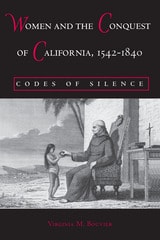
Women and the Conquest of California, 1542-1840
Codes of SilenceVirginia M. Bouvier
University of Arizona Press, 2001
Women and the Press
The Struggle for EqualityPatricia Bradley
Northwestern University Press, 2005
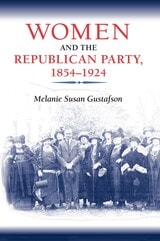
Women and the Republican Party, 1854-1924
Melanie Susan Gustafson
University of Illinois Press, 2001
Acclaimed as groundbreaking since its publication, Women and the Republican Party, 1854-1924 explores the forces that propelled women to partisan activism in an era of widespread disfranchisement and provides a new perspective on how women fashioned their political strategies and identities before and after 1920.
Melanie Susan Gustafson examines women's partisan history against the backdrop of women's political culture. Contesting the accepted notion that women were uninvolved in political parties before gaining the vote, Gustafson reveals the length and depth of women's partisan activism between the founding of the Republican Party, whose abolitionist agenda captured the loyalty of many women, and the passage of the Nineteenth Amendment. Her account also looks at the complex interplay of partisan and nonpartisan activity; the fierce debates among women about how to best use their influence; the ebb and flow of enthusiasm for women's participation; and the third parties that fused the civic world of reform organizations with the electoral world of voting and legislation.

Women for President
Media Bias in Eight CampaignsErika Falk
University of Illinois Press, 2007
When Hillary Clinton announced her 2008 bid for president she was the Democratic front-runner. Despite this, she received less coverage than Barack Obama, who trailed her in the polls. Such a disparity is indicative of the gender bias the media has demonstrated in covering women candidates since the first woman ran for America’s highest office in 1872. Tracing the campaigns of eight women who ran for president through 2004--Victoria Woodhull, Belva Lockwood, Margaret Chase Smith, Shirley Chisholm, Patricia Schroeder, Lenora Fulani, Elizabeth Dole, and Carol Moseley Braun--Erika Falk finds little progress in the fair treatment of women candidates. A thorough comparison of the women’s campaigns to those of their male opponents reveals a worrisome trend of sexism in press coverage--a trend that still persists today.
While women have been elected to the highest offices in countries such as England, Germany, and India, the idea that a woman could be president of the United States provokes scoffs and ridicule. The press portrays female candidates as unviable, unnatural, and incompetent, and often ignores or belittles women instead of reporting their ideas and intent. Since voters learn most details about presidential candidates through media outlets, Falk asserts that this prevailing bias calls into question the modern democratic assumption that men and women have comparable access to positions of power.
Women for President
Media Bias in Nine CampaignsErika Falk
University of Illinois Press, 2010
Newly updated to examine Hillary Clinton's formidable 2008 presidential campaign, Women for President analyzes the gender bias the media has demonstrated in covering women candidates since the first woman ran for America's highest office in 1872. Tracing the campaigns of nine women who ran for president through 2008--Victoria Woodhull, Belva Lockwood, Margaret Chase Smith, Shirley Chisholm, Patricia Schroeder, Lenora Fulani, Elizabeth Dole, Carol Moseley Braun, and Hillary Clinton--Erika Falk finds little progress in the fair treatment of women candidates. The press portrays female candidates as unviable, unnatural, and incompetent, and often ignores or belittles women instead of reporting their ideas and intent. This thorough comparison of men's and women's campaigns reveals a worrisome trend of sexism in press coverage--a trend that still persists today.
Women in 1900
Gateway to the Political Economy of the 20th CenturyChristine E. Bose
Temple University Press, 2001
Women in Academe
Progress and ProspectsMariam K. Chamberlain
Russell Sage Foundation, 1988
Women in American Journalism
A New HistoryJan Whitt
University of Illinois Press, 2007
Whitt explores the lives of women reporters who achieved significant historical recognition, such as Ida Tarbell and Ida Wells-Barnett. Investigating the often blurry boundary between journalism and literature, she explains how this fluid distinction has actually limited how many scholars perceive the contributions of authors such as Joan Didion and Susan Orlean. Whitt also highlights the work of important novelists, including Willa Cather, Katherine Anne Porter, and Eudora Welty, to shed light on how their work as journalists informed their highly successful fiction.
This study also offers a survey of contributions women have made to the alternative presses, including the environmental press and civil rights activism. Whitt examines important figures in the early feminist press such as Caroline Churchill, editor and reporter for Denver’s Queen Bee, and Betty Wilkins of Kansas City’s Call. Finally, through newsletters, newspapers, magazines, and journals, she traces the history of the lesbian press and points out the ways in which it indicates that the alternative press is thriving.
Women in Civil War Texas
Diversity and Dissidence in the Trans-MississippiDeborah M. Liles
University of North Texas Press, 2016
Women in Hollywood's Dream Factory
Tales of Inequality, Abuse, and ResistanceEdited by Karen McNally
University of Illinois Press, 2026
The #MeToo revelations put a twenty-first-century stamp on the age-old story of women’s mistreatment in Hollywood. Karen McNally edits a collection focused on examining and revising film history in the aftermath of the women’s stories, past and present, that have come to light.
The collection begins with essays on the interplay between reality and imagination in narratives and representations of women’s experiences of unequal treatment. In Part 2, contributors discuss how the gendered attitudes of the media’s stories enable inequality in Hollywood and look at the forces that arise whenever women resist these media assaults. The next section addresses the structures that built the inequalities and mistreatment while Part 4 revisits established narratives to challenge, renew, and expand upon our understanding of film history through women’s stories. Essays in the final section address the combination of inequality and resistance that defines women’s experiences in Hollywood.
Piercing and astute, Women in Hollywood’s Dream Factory confronts our perception of Hollywood as a mythological land of dreams.
Contributors: Alicia Byrnes, Anna M. Dempsey, Harriet Fletcher, Amanda Konkle, Tamar Jeffers McDonald, Kerry McElroy, Adrienne L. McLean, Karen McNally, Donna Peberdy, Melanie Piper, Victoria K. Pistivsek, Sarah Polley, Ina C. Seethaler, Gabrielle Stecher, and Jennifer Voss
Women in Missouri History
In Search of Power and InfluenceEdited by LeeAnn Whites, Mary C. Neth, & Gary R. Kremer
University of Missouri Press, 2004
Women in Missouri History is an exceptional collection of essays surveying the history of women in the state of Missouri from the period of colonial settlement through the mid-twentieth century. The women featured in these essays come from various ethnic, economic, and racial groups, from both urban and rural areas, and from all over the state. The authors effectively tell these women’s stories through biographies and through techniques of social history, allowing the reader to learn not only about the women’s lives individually, but also about how groups of “ordinary” women shaped the history of the state.
The essays in this collection address questions that are at the center of current developments in the field of women’s history but are written in a manner that makes them accessible to general readers. Providing an excellent general overview of the history of women in Missouri, this collection makes a valuable contribution to a better understanding of the state’s past.
Women in Politics in the American City
Myra Holman
Temple University Press, 2014
This book provides the first comprehensive evaluation of the influence of gender on the behavior of mayors and city council members in the United States. Holman considers the effects of gender in local, urban politics and analyzes how a leader's gender does-and does not-influence policy preferences, processes, behavior, and outcomes.
Holman effectively uses original survey data to evaluate policy attitudes, combined with observations of city council meetings and interviews with leaders and community members. In doing so, she demonstrates the importance of considering the gender of leaders in local office.
Women in Politics in the American City emphasizes that the involvement of women in local politics does matter and that it has significant consequences for urban policy as well as state and local democracy.
Women in Print
Essays on the Print Culture of American Women from the Nineteenth and Twentieth CenturiesEdited by James P. Danky and Wayne A. Wiegand
University of Wisconsin Press, 2006
Women readers, editors, librarians, authors, journalists, booksellers, and others are the subjects in this stimulating new collection on modern print culture. The essays feature women like Marie Mason Potts, editor of Smoke Signals, a mid-twentieth century periodical of the Federated Indians of California; Lois Waisbrooker, publisher of books and journals on female sexuality and women's rights in the decades after the Civil War; and Elizabeth Jordan, author of two novels and editor of Harper's Bazaar from 1900 to 1913. The volume presents a complex and engaging picture of print culture and of the forces that affected women's lives in the nineteenth and twentieth centuries.
Published in collaboration among the University of Wisconsin Press, the Center for the History of Print Culture in Modern America (a joint program of the University of Wisconsin–Madison and the Wisconsin Historical Society), and the University of Wisconsin–Madison General Library System Office of Scholarly Communication.
Women in Television News Revisited
Into the Twenty-first CenturyBy Judith Marlane
University of Texas Press, 1999
Women in television news have made great strides in the past twenty-five years. No longer limited to being the token pretty face on the nightly newscast, women have taken their places as working journalists in newsrooms, on the campaign trail, in war zones, and in the highest echelons of network news management. Barbara Walters and Connie Chung have even occupied the coveted network anchor's chair, if only briefly.
In this book, 70 of the foremost women in television news reflect on their professional successes, the personal and professional sacrifices that often bought those successes, and the barriers that still confront women in the news business. Weaving their interviews into a compelling text, Judith Marlane covers a wide range of issues, including looks versus ability and experience, sexual harassment, the resistance to women news anchors, the difficulties of balancing work and family life, women's and men's salaries, and the willingness of women to help other women in the business.
This book builds from Marlane's 1976 work, Women in Television News. Interviews with many of the same women highlight the gains that women have made in broadcast journalism. Simultaneously, Marlane has expanded her range of informants to include fifteen of America's most famous male anchors and correspondents to gather their assessments of the role of women in broadcasting today.
Women in the Club
Gender and Policy Making in the SenateMichele L. Swers
University of Chicago Press, 2013
In the run-up to the 2012 presidential election, Democrats and Republicans were locked in a fierce battle for the female vote. Democrats charged Republicans with waging a “war on women,” while Republicans countered that Democratic policies actually undermined women’s rights. The women of the Senate wielded particular power, planning press conferences, appearing on political programs, and taking to the Senate floor over gender-related issues such as workplace equality and reproductive rights.
The first book to examine the impact of gender differences in the Senate, Women in the Club is an eye-opening exploration of how women are influencing policy and politics in this erstwhile male bastion of power. Gender, Michele L. Swers shows, is a fundamental factor for women in the Senate, interacting with both party affiliation and individual ideology to shape priorities on policy. Women, for example, are more active proponents of social welfare and women’s rights. But the effects of gender extend beyond mere policy preferences. Senators also develop their priorities with an eye to managing voter expectations about their expertise and advancing their party’s position on a given issue. The election of women in increasing numbers has also coincided with the evolution of the Senate as a highly partisan institution. The stark differences between the parties on issues pertaining to gender have meant that Democratic and Republican senators often assume very different roles as they reconcile their policy views on gender issues with the desire to act as members of partisan teams championing or defending their party’s record in an effort to reach various groups of voters.

Women in the United States, 1830-1945
S.J. Kleinberg
Rutgers University Press, 1999
Women in the Vanishing Cloister
Organizational Decline in Catholic Religious Orders in the United StatesEbaugh, Helen Rose Fuchs
Rutgers University Press, 1993
To illustrate the problem, Ebaugh takes us into a declining order, here named the Sisters of Service. In 1990, only one candidate sought admission to the order, and the median age of members reached 70. While these demographic changes were occurring, the sisters adapted themselves to the reforms of Vatican II. The concept of a cloistered life faded. Nuns sought college degrees, gave up their habits, moved into apartments, and began to identify with the outside world. Vatican II further encouraged the nuns to democratize and decentralize. Many nuns accepted jobs that paid poorly but were consistent with their goal of social service. They identified with the feminist movement and in turn influenced it.
Ebaugh shows how declining orders have not followed the sociological model of organizational decline, one typically marked by centralized authority, a fear of risk taking, lack of direction, internal conflicts over turf, and low morale. Rather, they have established democratic structures, reduced internal positions in favor of committing resources to empowering the poor, abandoned security in favor of diversity in jobs and missions, minimized conflicts over scarce resources, and exhibited a sense of freedom rather than poor morale.
Although Ebaugh is convinced that Catholic orders in the U.S. will not continue for long, non-canonical communities of women and associate programs are growing. Dedicated women can perpetuate the mission and spirit of the order without becoming vowed members.
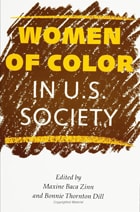
Women of Color in U.S. Society
edited by Maxine Baca Zinn and Bonnie Thornton Dill
Temple University Press, 1993
The theme of race, class, and gender as interlocking systems of oppression unites these original essays about the experience of women of color—African Americans, Latinas, Native Americans, and Asian Americans. The contributing scholars discuss the social conditions that simultaneously oppress women of color and provide sites for opposition.
Though diverse in their focus, the essays uncover similar experiences in the classroom, workplace, family, prison, and other settings. Working-class women, poor women, and professional women alike experience subordination, restricted participation in social institutions, and structural placement in roles with limited opportunities.
How do women survive, resist, and cope with these oppressive structures? Many articles tell how women of color draw upon resources from their culture, family, kin, and community. Others document defenses against cultural assaults by the dominant society—Native American mothers instilling tribal heritage in their children; African American women engaging in community work; and Asian American women opposing the patriarchy of their own communities and the stereotypes imposed by society at large.
These essays challenge some of our basic assumptions about society, revealing that experiences of inequality are not only diverse but relational.
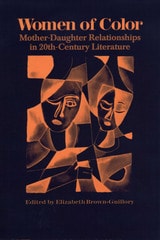
Women of Color
Mother-Daughter Relationships in 20th-Century LiteratureEdited by Elizabeth Brown-Guillory
University of Texas Press, 1996
Interest in the mother-daughter relationship has never been greater, yet there are few books specifically devoted to the relationships between daughters and mothers of color. To fill that gap, this collection of original essays explores the mother-daughter relationship as it appears in the works of African, African American, Asian American, Mexican American, Native American, Indian, and Australian Aboriginal women writers.
Prominent among the writers considered here are Toni Morrison, Alice Walker, Maxine Hong Kingston, Cherrie Moraga, Leslie Marmon Silko, and Amy Tan. Elizabeth Brown-Guillory and the other essayists examine the myths and reality surrounding the mother-daughter relationship in these writers' works. They show how women writers of color often portray the mother-daughter dyad as a love/hate relationship, in which the mother painstakingly tries to convey knowledge of how to survive in a racist, sexist, and classist world while the daughter rejects her mother's experiences as invalid in changing social times.
This book represents a further opening of the literary canon to twentieth-century women of color. Like the writings it surveys, it celebrates the joys of breaking silence and moving toward reconciliation and growth.
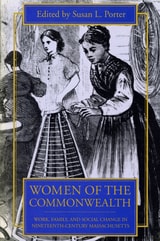
Women of the Commonwealth
Work, Family, and Social Change in Ninteenth-Century MassachusettsSusan L. Porter
University of Massachusetts Press, 1996
These essays reflect the complexity and richness of current scholarship in women's history. Informed by a variety of source materials and methodologies, the ten chapters break down a generalized construct of “womanhood” to explore the dynamics between gender, race, ethnicity, and class.
The first section of the book focuses on women's work, paid and unpaid, and the effects of class, ethnicity, and gender on the structure of the job market and on power relations within the family. The second section revisits the concept of “sisterhood” by looking at women in relation to their families, social and cultural networks, and civic and private institutions. The editor's introduction sets the essays in the current historiographical context of women's studies and provides a bibliographical essay for the nonspecialist reader.
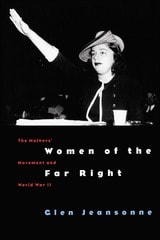
Women of the Far Right
The Mothers' Movement and World War IIGlen Jeansonne
University of Chicago Press, 1996
Unlike leftist antiwar movements, the mothers' movement was not pacifist; its members opposed the war on Germany because they regarded Hitler as an ally against the spread of atheistic communism. They also differed from leftist women in their endorsement of patriarchy and nationalism. God, they believed, wanted them to fight the New Deal liberalism that imperiled their values and the internationalists, communists, and Jews, whom they saw as subjugating Christian America.
Jeansonne examines the motivations of these women, the political and social impact of their movement, and their collaborations with men of the far right and also with mainstream isolationists such as Charles Lindbergh. Drawing on files kept by the FBI and other confidential documents, this book sheds light on the history of the war era and on women's place within the far right.

Women of the New Right
Rebecca E. Klatch
Temple University Press, 1988
Although an array of commentary and analyses focus on the New Right, little has been done to tell us who the women are on this side of the political spectrum. Are they social conservatives who call for the reassertion of traditional family values as promulgated by the federal government? Or do they align themselves with laissez-faire conservatives who abhor government intervention yet, like social conservatives, favor increased defense spending, and condemn communism and secular humanism. Rebecca E. Klatch provides the first coherent picture of who joins such movements and how they think.
This book draws upon a rich data source which includes in-depth interviews and field research at right-wing conferences and meetings. Rather than the image of right-wing women as a monolithic group of angry housewives who oppose feminism, the author finds a fundamental division among women of the New Right, with one constituency of women actually supporting part of the feminist vision. Analyzing varying perceptions of women of the New Right, the book examines their beliefs and values, their vision of America, their interpretations of Communism, big government, and feminism, as well as their view of themselves as women and as political actors.
In the series Women in the Political Economy, edited by Ronnie J. Steinberg.
Women of the Storm
Civic Activism after Hurricane KatrinaEmmanuel David
University of Illinois Press, 2017
Women of the Upper Class
Susan A. Ostrander
Temple University Press, 1986
In the series Women in the Political Economy, edited by Ronnie J. Steinberg.
Women's Activist Organizing in US History
A University of Illinois Press AnthologyCompiled by Dawn Durante; Introduction by Deborah Gray White
University of Illinois Press, 2022
Insightful and provocative, Women’s Activist Organizing in US History draws on both classic texts and recent bestsellers to reveal the breadth of activism by women in the United States in the nineteenth and twentieth centuries.
Contributors: Daina Ramey Berry, Melinda Chateauvert, Tiffany M. Gill, Nancy A. Hewitt, Treva B. Lindsey, Anne Firor Scott, Charissa J. Threat, Anne M. Valk, Lara Vapnek, and Deborah Gray White
Women's Camera Work
Self/Body/Other in American Visual CultureJudith Fryer Davidov
Duke University Press, 1998
Women’s Camera Work ranges from American women’s photographic practices during the nineteenth and early twentieth centuries to a study of landscape photography. Using contemporary cultural studies discourse to critique influential male-centered historiography and the male-dominated art world, Davidov exhibits the work of these women; tells their absorbing stories; and discusses representations of North American Indians, African Americans, Asian Americans, and the migrant poor. Evaluating these photographers’ distinct contributions to constructions of Americanness and otherness, she helps us to discover the power of reading images closely, and to learn to see through these women’s eyes.
In presenting one of the most important strands of American photography, this richly illustrated book will interest students of American visual culture, women’s studies, and general readers alike.

Women's Experimental Cinema
Critical FrameworksRobin Blaetz, ed.
Duke University Press, 2007
The contributors examine the work of Marie Menken, Joyce Wieland, Gunvor Nelson, Yvonne Rainer, Carolee Schneemann, Barbara Rubin, Amy Greenfield, Barbara Hammer, Chick Strand, Marjorie Keller, Leslie Thornton, Abigail Child, Peggy Ahwesh, Su Friedrich, and Cheryl Dunye. The essays highlight the diversity in these filmmakers’ forms and methods, covering topics such as how Menken used film as a way to rethink the transition from abstract expressionism to Pop Art in the 1950s and 1960s, how Rubin both objectified the body and investigated the filmic apparatus that enabled that objectification in her film Christmas on Earth (1963), and how Dunye uses film to explore her own identity as a black lesbian artist. At the same time, the essays reveal commonalities, including a tendency toward documentary rather than fiction and a commitment to nonhierarchical, collaborative production practices. The volume’s final essay focuses explicitly on teaching women’s experimental films, addressing logistical concerns (how to acquire the films and secure proper viewing spaces) and extending the range of the book by suggesting alternative films for classroom use.
Contributors. Paul Arthur, Robin Blaetz, Noël Carroll, Janet Cutler, Mary Ann Doane, Robert A. Haller, Chris Holmlund, Chuck Kleinhans, Scott MacDonald, Kathleen McHugh, Ara Osterweil, Maria Pramaggiore, Melissa Ragona, Kathryn Ramey, M. M. Serra, Maureen Turim, William C. Wees