Results by title
1882 books match the query 'Criticism and interpretation' and 91 start with w
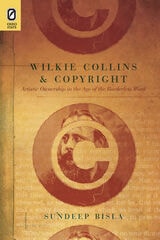
Wilkie Collins and Copyright
Sundeep Bisla
The Ohio State University Press, 2013
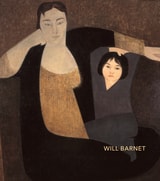
Will Barnet
Will Barnet
The Artist Book Foundation, 2024
The first monograph on Will Barnet in nearly 40 years, this title reflect's the artist's unique interpretation of the world's evolving genres.
Will Barnet’s artistic career as a painter and printmaker spanned nearly eight decades of continuous creativity. Few artists, other than perhaps Picasso or Monet, can claim such an extended period of uninterrupted and innovative art making. From the darkness of the Great Depression to the opening decade of the twenty-first century, his oeuvre reflects his unique interpretation of the art world’s evolving genres: Social Realism, Modernism, Abstract Expressionism, and ultimately representational Minimalism with the human figure as his primary subject.
This book is the first comprehensive monograph on Will Barnet in nearly 40 years. With scholarly essays by the four distinguished authors, an extensive plate section, a comprehensive chronology, lists of awards and exhibitions, and a detailed bibliography, this monograph is a thorough presentation of Barnet's iconic images and consistently evolving style while celebrating his unquenchable joie de vivre.
Barnet was devoted to making art every day and worked diligently even at the very end of his life. "The Old Masters are still alive after 400 years, and that's what I want to be," he once said. "At the age of 10 or 12, I discovered that being an artist would give me an ability to create something which would live on after death." Live on it does; in addition to his acclaimed body of work, he influenced a broad spectrum of artists such as Jackson Pollock, Mark Rothko, James Rosenquist, Cy Twombly, and Ethel Fisher.
Willa Cather and Material Culture
Real-World Writing, Writing the Real WorldEdited by Janis P. Stout
University of Alabama Press, 2004
Willa Cather and Material Culture is a collection of 11 new essays that tap into a recent and resurgent interest among Cather scholars in addressing her work and her career through the lens of cultural studies. One of the volume's primary purposes is to demonstrate the extent to which Cather did participate in her culture and to correct the commonplace view of her as a literary connoisseur set apart from her times.
The contributors explore both the objects among which Cather lived and the objects that appear in her writings, as well as the commercial constraints of the publishing industry in which her art was made and marketed. Essays address her relationship to quilts both personally and as symbols in her work; her contributions to domestic magazines such as Home Monthly and Woman's Home Companion; the problematic nature of Hollywood productions of her work; and her efforts and successes as a businesswoman. By establishing the centrality of material matters to her writing, these essays contribute to the reclaiming of Cather as a modernist and highlight the significance of material culture, in general, to the study of American literature.
Willa Cather and Others
Jonathan Goldberg
Duke University Press, 2001
The “others” referred to in the title are women, for the most part Cather’s contemporaries, whose artistic projects allow for points of comparison with Cather. They include the Wagnerian diva Olive Fremstad, renowned for her category-defying voice; Blair Niles, an ethnographer and novelist of jazz-age Harlem and the prisons of New Guinea; Laura Gilpin, photographer of the American Southwest; and Pat Barker, whose Regeneration trilogy places World War I writers—and questions of sexuality and gender—at its center. In the process of studying these women and their work, Goldberg forms innovative new insights into a wide range of Cather’s celebrated works, from O Pioneers! and My Ántonia to her later books The Song of the Lark, One of Ours, The Professor’s House, Death Comes for the Archbishop, and Sapphira and the Slave Girl.
By applying his unique talent to the study of Cather’s literary genius, Jonathan Goldberg makes a significant and new contribution to the study of American literature and queer studies.
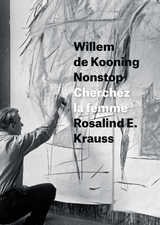
Willem de Kooning Nonstop
Cherchez la femmeRosalind E. Krauss
University of Chicago Press, 2016
Krauss demonstrates that contrary to popular conceptions of de Kooning as an artist who painted chaotically only to finish abruptly, he was in fact constantly reworking the same subject based on a compositional template. This template informed all of his art and included a three-part vertical structure; the projection of his male point of view into the painting or sculpture; and the near-universal inclusion of the female form, which was paired with her redoubled projection onto his work. Krauss identifies these elements throughout de Kooning’s oeuvre, even in his paintings of highways, boats, and landscapes: Woman is always there. A thought-provoking study by one of America’s greatest art critics, Willem de Kooning Nonstop revolutionizes our understanding of de Kooning and shows us what has always been hiding in plain sight in his work.
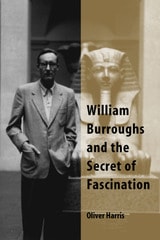
William Burroughs and the Secret of Fascination
Oliver Harris
Southern Illinois University Press, 2006
Unraveling the mysteries of Naked Lunch, exploring the allure of fascination
William Burroughs is both an object of widespread cultural fascination and one of America’s great writers. In this study, Oliver Harris elucidates the complex play of secrecy and revelation that defines the allure of fascination. Unraveling the mystifications of Burroughs the writer, Harris discovers what it means to be fascinated by a figure of major cultural influence and unearths a secret history behind the received story of one of America’s great original writers.
In William Burroughs and the Secret of Fascination, Harris examines the major works Burroughs produced in the 1950s—Junky, Queer, The Yage Letters, and Naked Lunch—to piece together an accurate, material record of his creative history during his germinal decade as a writer. Refuting the “junk paradigm” of addiction that has been used to categorize and characterize much of Burroughs’ oeuvre, Harris instead focuses on the significance of Burroughs’ letter writing and his remarkable and unsuspected use of the epistolary for his fiction. As Burroughs said to Allen Ginsberg about Naked Lunch, “the real novel is letters to you.” Drawing on rare access to manuscripts, the book suggests new ways of comprehending Burroughs’s unique politics and aesthetics and offers the first accurate account of the writing of Naked Lunch.
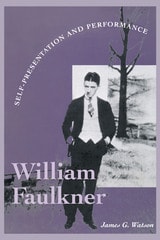
William Faulkner
Self-Presentation and PerformanceBy James G. Watson
University of Texas Press, 2000
In his life and writings, William Faulkner continually created and "performed" selves. Even in letters, he often played a part—gentleman dandy, soldier, farmer—while in his fictions these and other personae are counterpoised against one another to create a world of controlled chaos, made in Faulkner's own protean image and reflective of his own multiple sense of self.
In this groundbreaking book, James Watson draws on the entire Faulkner canon, including letters and photographs, to decipher the complicated ways in which Faulkner put himself forth as the artist he felt himself to be through written performances and displays based on the life he actually lived and the ones he imagined living. The topics Watson treats include the overtly performative aspects of The Sound and the Fury, self-presentation and performance in private records of Faulkner's life, the ways in which his complicated marriage and his relationships to male mentors underlie his fictions' recurring motifs of marriages and fatherhood, Faulkner's readings of Melville, Hawthorne, and Thoreau and the problematics of authorial sovereignty, his artist-as-God creation of a fictional cosmos, and the epistolary relationships with women that lie in the correspondence behind Requiem for a Nun.
William Faulkner
Six Decades of CriticismLinda Wagner-Martin
Michigan State University Press, 2002
Few twentieth-century writers are as revered as William Faulkner. This collection brings together the best literary criticism on Faulkner from the last six decades, detailing the imaginative and passionate responses to his still-controversial novels. By focusing on the criticism rather than the works, Linda Wagner-Martin shows the primary directions in Faulkner’s influence on critics, writers, and students of American literature today. This invaluable volume reveals the patterns of change in literary criticism over time, while exploring the various critical streams—language theory, feminism, deconstruction, and psychoanalysis—that have elevated Faulkner’s work to the highest rank of the American literary pantheon.
William Gibson
Gary Westfahl
University of Illinois Press, 2013
William Gibson and the Future of Contemporary Culture
Mitch R. Murray and Mathias Nilges
University of Iowa Press, 2021
In the 1970s and 80s, Gibson, the “Godfather of Cyberpunk,” rejuvenated science fiction. In groundbreaking works such as Neuromancer, which changed science fiction as we knew it, Gibson provided us with a language and imaginary through which it became possible to make sense of the newly emerging world of globalization and the digital and media age. Ever since, Gibson’s reformulation of science fiction has provided us not just with radically innovative visions of the future but indeed with trenchant analyses of our historical present and of the emergence and exhaustion of possible futures.
Contributors: Maria Alberto, Andrew M. Butler, Amy J. Elias, Christian Haines, Kylie Korsnack, Mathias Nilges, Malka Older, Aron Pease, Lisa Swanstrom, Takayuki Tatsumi, Sherryl Vint, Phillip E. Wegner, Roger Whitson, Charles Yu
William Kentridge
Being Led by the NoseJane Taylor
University of Chicago Press, 2017
Kentridge has long been admired for his unconventional use of conventional media to produce art that is stunning, evocative, and narratively powerful—and how he works is as important as what he creates. This book is more than just a simple record of The Nose. The opera serves as a springboard into a bracing conversation about how Kentridge’s methods serve his unique mode of expression as a narrative and political artist. Taylor draws on his etchings, sculptures, and drawings to render visible the communication that occurs between his mind and hand as he thinks through the activity of making. Beautifully illustrated in color, William Kentridge offers striking insights about one of the most innovative artists of our present moment.
William S. Burroughs At the Front
Critical Reception, 1959 - 1989Jennie Skerl
Southern Illinois University Press, 1991
Jennie Skerl and Robin Lydenberg have selected twenty-five critical essays on Burroughs that reflect the historical reception of his work, both positive and negative, decade by decade, and that represent the best essays written about him.
The essays cover Burroughs’ major novels—including the cut-up and new trilogies—the censorship issue, and his work in film and painting. The chronological organization brings into critical focus the shift from moral questions raised by the novels’ content, through examinations of Burroughs’ relationship to humanism and modernism, and finally to more focused literary and linguistic issues. In their introduction, the editors survey the progress of Burroughs’ critical reception and examine the reasons for the varied and intense responses to the work and the theoretical assumptions behind those responses.
The reviewers include prominent figures such as Mary McCarthy and Marshall McLuhan as well as major academic critics such as Cary Nelson, Tony Tanner, and Ihab Hassan.
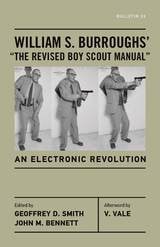
William S. Burroughs' "The Revised Boy Scout Manual"
An Electronic RevolutionEdited by Geoffrey D. Smith & John M. Bennett with an afterword by V. Vale
The Ohio State University Press, 2018
The Revised Boy Scout Manual was a work Burroughs revisited many times, but which has never before been published in its complete form. Based primarily on recordings of a performance of the complete piece found in the archives at the OSU libraries, as well as various incomplete versions of the typescript found at Arizona State University and the New York Public Library archives, this lost masterpiece of satiric subversion is finally available in its entirety.
Willing to Know God
Dreamers and Visionaries in the Later Middle AgesJessica Barr
The Ohio State University Press, 2010
Although authors of mystical treatises and dream visions shared a core set of assumptions about how visions are able to impart transcendent truths to their recipients, the modern divide between “religious” and “secular” has led scholars to study these genres in isolation. Willing to Know God addresses the simultaneous flowering of mystical and literary vision texts in the Middle Ages by questioning how the vision was thought to work. What preconditions must be met in these texts for the vision to transform the visionary? And when, as in poems such as Pearl, this change does not occur, what exactly has gone wrong?
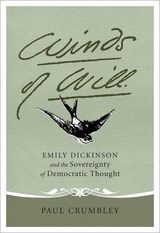
Winds of Will
Emily Dickinson and the Sovereignty of Democratic ThoughtPaul Crumbley
University of Alabama Press, 2010
A sophisticated literary analysis positioning Emily Dickinson’s poetry within the framework of democratic thought and individual sovereignty.
In this study, Paul Crumbley asserts that, contrary to popular opinion, Emily Dickinson consistently communicated political views through her poetry. Dickinson’s life of self-isolation—today her most notable personal characteristic—by no means extended into the political sphere, he argues. While she rarely addressed political issues directly and was curiously disengaged from the liberal causes and female reform movements of her time, Dickinson’s poems are deeply rooted both in matters of personal sovereignty and reader choice. The significant choices Dickinson extends to the reader underscore the democratic dimensions of reading her work, and of reading itself as a political act.
Crumbley employs close readings of Dickinson’s poems and letters, highlighting the many changing—and often contradictory—voices in her work, both throughout her oeuvre and in individual poems themselves. In Dickinson’s letters Crumbley finds just as many unique and conflicting voices; thus, both her personal correspondence and the poems make political demands by placing the burden of interpretation on the reader.
Rather than reflecting explicit political values, Dickinson’s work chronicles an ongoing decision-making process that magnifies the role of individual choice, not the advocacy of specific outcomes. In the end, Dickinson’s readers must either accept an isolated lyric subjectivity or invest that subjectivity with the substance necessary for engagement with the larger world.
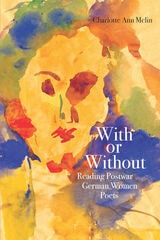
With or Without
Reading Postwar German Women PoetsCharlotte Ann Melin
Northwestern University Press, 2013
With or Without explores the role of German women’s poetry in the contemporary literary discourse of the latter half of the twentieth century. Melin highlights the significant role that women played in the shaping of postwar German poetry as a whole and also their deep engagement with the broader issues of modernism, postmodernism, and related discourses about the relationship between individual experience, communal ideals, and interpersonal expression. Melin shows that for German writers poetry became the genre that had the capacity to project subjectivity, voice, and authenticity.

Women Reading Women Writing
Ann Louise Keating
Temple University Press, 1996
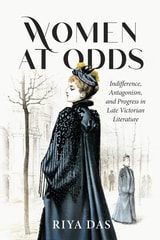
Women at Odds
Indifference, Antagonism, and Progress in Late Victorian LiteratureRiya Das
The Ohio State University Press, 2024
In Women at Odds, Riya Das demonstrates the limitations of female solidarity for the New Woman in Victorian society. On the one hand, feminist antagonism disrupts the status quo in unanticipated ways, and it helps open new domestic and professional pathways for women. On the other hand, the urban professional New Woman’s rhetoric recycles distinctly sexist, racist, and classist conventions, thereby bringing middle-class Englishwomen dialectically—what Das terms “retro-progressively”—into the labor pool of the British empire.
While foregrounding the figure of the New Woman as a white imperialist reformer, Das illustrates how the New Woman movement detaches itself from the domestic politics of female friendship. In works by George Eliot, George Gissing, Olive Schreiner, Bram Stoker, and others, antagonism and indifference enable the fin de siècle New Woman to transcend traditionally defined roles and fashion social progress for herself at the expense of femininities she excludes as “other.” By contesting the critical notion of solidarity as the only force that brings Victorian women’s narratives to fruition, Women at Odds reveals the troubled but effective role of antagonistic and indifferent reformist politics in loosening rigid social structures for privileged populations.
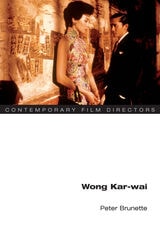
Wong Kar-wai
Peter Brunette
University of Illinois Press, 2005
Called the leading heir to the great directors of post-WWII Europe and lavished with awards, Wong Kar-wai has redefined perceptions of Hong Kong's film industry. Wong's visual brilliance and emphasis on atmosphere over action have set him apart from peers while earning him an admiring international audience. In the Mood for Love regularly appears on lists of the twenty-first century's greatest films while critics and filmgoers recognize works like Chungking Express and Happy Together as modern classics.
Peter Brunette describes the ways in which Wong's supremely haunting visual films create a new form of cinema by telling a story with stunning, suggestive visual images and audio tracks rather than character, dialogue, and plot. As he shows, Wong's early background in genre film offers fascinating insights on his more studied later works. He also delves into Wong's perennial themes of time, love, and loss and examines the political implications of his films, especially concerning the handover of former British colony Hong Kong to the People's Republic of China.
Woody on Rye
Jewishness in the Films and Plays of Woody AllenEdited by Vincent Brook and Marat Grinberg
Brandeis University Press, 2013
Word Images
New Perspectives on Canícula and Other Works by Norma Elia CantúEdited by Gabriella Gutiérrez y Muhs; Foreword by María Herrera-Sobek
University of Arizona Press, 2017
Contributors:
Steven W. Bender
Aurora Chang
Vanessa Fonseca
Gabriella Gutiérrez y Muhs
María Herrera-Sobek
Ellen McCracken
María Esther Quintana Millamoto
Aldo Ulisses Reséndiz Ramírez
Rose Rodríguez-Rabin
Jesús Rosales
Carlos Sibaja García
María Socorro Tabuenca
Juan Velasco
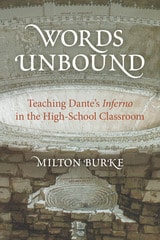
Words Unbound
Teaching Dante's Inferno in the High School ClassroomMilton Burke
University of Arkansas Press, 2017
Words Unbound draws on Milton Burke’s thirty years of teaching experience to help educators bring Inferno alive for today’s young reader. In a conversational, “colleague-to-colleague” style, Burke shares the interpretations, questions, and exercises he found effective in his high-school classroom, emphasizing group discussion to help students, no matter their religious or philosophical moorings, engage meaningfully with the notoriously difficult text.
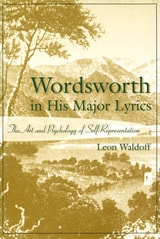
Wordsworth in His Major Lyrics
The Art and Psychology of Self-RepresentationLeon Waldoff
University of Missouri Press, 2001
Wordsworth in His Major Lyrics explores the identity, role, and subjectivity of the speaker in Wordsworth's finest and best-known longer lyrics—"Tintern Abbey," "Resolution and Independence," "Ode: Intimations of Immortality," and "Elegiac Stanzas." Because Wordsworth is the most autobiographical poet of the Romantic period, and perhaps in the English language, readers naturally take the speaker to be the poet himself or, as Wordsworth says in his prefaces and essays, "the poet in his own person."
Some readers allow for a fictional dimension in the characterization of the speaker and refer to him as a persona; others treat him as a biographical self, defined in literary, political, historical, or cultural terms. Leon Waldoff examines the critical issues posed by these different understandings of the speaker's identity and argues for a conception of Wordsworth's lyrical "I" that deals with the dramatic and psychological complexities of the speaker's act of self-representation.
Taking concepts from Freud and Winnicott, this book presents a psychoanalytic model for defining the speaker and conceptualizing his subjectivity. Waldoff suggests that the lyrical "I" in each poem is a transitional self of the poet. The poem offers, in the suspended moment and cultural space of lyrical form, a self-dramatization in which the speaker attempts to act out, in the sense of both performing and attempting to achieve, a reconstitution and transformation of the self.
In a series of close readings that provide formalistic and psychological analysis, the book shows that the major lyrics contain compelling evidence that Wordsworth devoted much of his poetic art to each speaker's act of self-dramatization. The various strategies that each speaker employs and the self- dramatizing character of his utterance are theorized and assimilated into an understanding of the subjectivity he represents.
Waldoff concludes that Wordsworth's lyrical "I" requires a conception of subjectivity that gives greater recognition to its individual, psychological dimensions and to the art of self-representation in each poem than recent Wordsworth criticism has provided. This important new work will be appreciated by anyone interested in Wordsworth or in Romantic poetry.
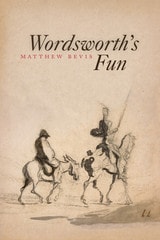
Wordsworth's Fun
Matthew Bevis
University of Chicago Press, 2019
Wordsworth’s Fun explores the writer’s debts to the ludic and the ludicrous in classical tradition; his reworkings of Ariosto, Erasmus, and Cervantes; his engagement with forms of English poetic humor; and his love of comic prose. Combining close reading with cultural analysis, Bevis travels many untrodden ways, studying Wordsworth’s interest in laughing gas, pantomime, the figure of the fool, and the value of play. Intrepid, immersive, and entertaining, Wordsworth’s Fun sheds fresh light on how one poet’s strange humor helped to shape modern literary experiment.
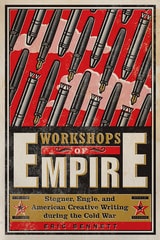
Workshops of Empire
Stegner, Engle, and American Creative Writing during the Cold WarEric Bennett
University of Iowa Press, 2015
Creative writing emerged as a graduate discipline in the United States amid this astonishing swirl of grand conceptions. The early workshops were formed not only at the time of, but in the image of, and under the tremendous urgency of, the postwar imperatives for the humanities. Vivid renderings of personal experience would preserve the liberal democratic soul—a soul menaced by the gathering leftwing totalitarianism of the USSR and the memory of fascism in Italy and Germany.
Workshops of Empire explores this history via the careers of Paul Engle at the University of Iowa and Wallace Stegner at Stanford. In the story of these founding fathers of the discipline, Eric Bennett discovers the cultural, political, literary, intellectual, and institutional underpinnings of creative writing programs within the university. He shows how the model of literary technique championed by the first writing programs—a model that values the interior and private life of the individual, whose experiences are not determined by any community, ideology, or political system—was born out of this Cold War context and continues to influence the way creative writing is taught, studied, read, and written into the twenty-first century.
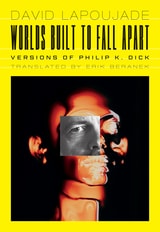
Worlds Built to Fall Apart
Versions of Philip K. DickDavid Lapoujade
University of Minnesota Press, 2024
Philosophically analyzing the work of one of the twentieth century’s most popular, and peculiar, science fiction authors
Despite his enduring popularity, Philip K. Dick (1928–1982)—whose short stories and novels were adapted into or influenced many major films and television shows, including Blade Runner, Total Recall, The Truman Show, and The Man in the High Castle—has long been a marginal figure in American literature, even in the science fiction genre he helped revolutionize. Here, an influential French philosopher offers a major new perspective on an author who was known as much for his eccentricities and excesses as for his writing. For David Lapoujade, it is precisely the many ways in which Dick’s works seem to hover on the brink of losing all touch with reality that make him such a singular figure, both as a sci-fi author and as a thinker of contemporary life.
In Worlds Built to Fall Apart, Lapoujade defines sci-fi as a way of thinking through the creation of worlds and argues that Dick does so by creating worlds that fall rapidly to pieces. Whatever his mechanism to bring this about (drugs or madness, alien satellite transmissions or encroaching parallel universes), the effect is always to reveal reality to be a construction, in which certain people determine what appears as real to the rest of us. Orienting Dick within philosophy and drawing connections to a wide variety of other thinkers and artists, this remarkable reading shows how he proposes unstable, fluctuating futures in which tinkering with reality has become the best means of resisting total control.
Engaging with most of Philip K. Dick’s published works, as well as with several of his essays and his notorious psychic autobiography The Exegesis, Lapoujade hones in on the “war of the psyches” that underlies Dick’s critique of reality. He puts Dick’s work in conversation with a vast array of subjects—from cybernetics to schizoanalysis, and from Pop art to David Lynch, J. G. Ballard, and William S. Burroughs—revealing Dick’s oeuvre to comprise a profound reality defined by artifice, precarity, and control.
Retail e-book files for this title are screen-reader friendly.
Writing Against the Family
Gender in Lawrence and JoyceCynthia Lewiecki-Wilson
Southern Illinois University Press, 1994
This first feminist book-length comparison of D. H. Lawrence and James Joyce offers striking new readings of a number of the novelists’ most important works, including Lawrence’s Man Who Died and Joyce’s Finnegans Wake.
Cynthia Lewiecki-Wilson argues that a feminist reader must necessarily read with and against theories of psychoanalysis to examine the assumptions about gender embedded within family relations and psychologies of gender found in the two authors’ works. She challenges the belief that Lawrence and Joyce are opposites, inhabiting contrary modernist camps; instead they are on a continuum, with both engaged in a reimagination of gender relations.
Lewiecki-Wilson demonstrates that both Lawrence and Joyce write against a background of family material using family plots and family settings. While previous discussions of family relations in literature have not questioned assumptions about the family and about sex roles within it, Lewiecki-Wilson submits the systems of meaning by which gender is construed to a feminist analysis. She reexamines Lawrence and Joyce from the point of view of feminist psychoanalysis, which, she argues, is not a set of beliefs or a single theory but a feminist practice that analyzes how systems of meaning construe gender and produce a psychology of gender.
Lewiecki-Wilson argues against a theory of representation based on gender, however, concluding that Lawrence’s and Joyce’s texts, in different ways, test the idea of a female aesthetic. She analyzes Lawrence’s portrait of family relations in Sonsand Lovers, The Rainbow, and Women in Love and compares Joyce’s Portrait of the Artist as a Young Man with Lawrence’s autobiographical text. She then shows that Portrait begins a deconstruction of systems of meaning that continues and increases in Joyce’s later work, including Ulysses.
Lewiecki-Wilson concludes by showing that Lawrence, Joyce, and Freud relate family material to Egyptian myth in their writings. She identifies Freud’s essay "Leonardo da Vinci and a Memory of Childhood" as an important source for Joyce’s Finnegans Wake, which portrays beneath the gendered individual a root androgyny and asserts an unfixed, evolutionary view of family relations.
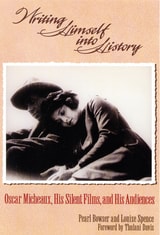
Writing Himself Into History
Oscar Micheaux, His Silent Films, and His AudiencesBowser, Pearl
Rutgers University Press, 2000
Winner of the 2001 Kraszna-Krausz Moving Image Book Awards | Winner of the Theatre Library Association Award
Writing Himself Into History is an eagerly anticipated analysis of the career and artistry surrounding the legendary Black filmmaker Oscar Micheaux. With the exception of Spike Lee, Micheaux is the most famous—and prolific—African American film director. Between 1918 and 1948 he made more than 40 “race pictures,” movies made for and about African Americans. A man of immense creativity, he also wrote seven novels.
Pearl Bowser and Louise Spence concentrate here on the first decade of Micheaux’s career, when Micheaux produced and directed more than twenty silent features and built a reputation as a controversial and maverick entrepreneur. Placing his work firmly within his social and cultural milieu, they also examine Micheaeux’s family and life. The authors provide a close textual analysis of his surviving films (including The Symbol of the Unconquered, Within Our Gates, and Body and Soul), and highlight the rivalry between studios, dilemmas of assimilation versus separatism, gender issues, and class. In Search of Oscar Micheaux also analyzes Micheaux’s career as a novelist in relation to his work as a filmmaker.
This is a much-awaited book that is especially timely as interest in Micheaux’s work increases.
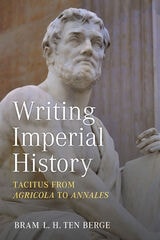
Writing Imperial History
Tacitus from Agricola to AnnalesBram L. H. ten Berge
University of Michigan Press, 2023
Writing Japonisme
Aesthetic Translation in Nineteenth-Century French ProsePamela A. Genova
Northwestern University Press, 2016
Writing Not Writing
Poetry, Crisis, and ResponsibilityTom Fisher
University of Iowa Press, 2017
Writing Not Writing both confirms this question into which crisis puts poetry and explores alternative modes of “response” and “responsibility” that poetry makes possible. Reading the silences of Oppen, Carl Rakosi, and Bob Kaufman, the renunciation of Laura Riding, and other more contemporary instances of poetic abnegation, Tom Fisher explores silence, refusal, and disavowal as political and ethical modes of response in a time of continuous crisis. Through a turn away from writing, these poets offer strategies of refusal and departure that leave anagrammatical hollows behind, activating the negational capacities of writing and aesthetics to disrupt the empire of sense, speech, and agency.
Fisher’s work is both an engaging and detailed analysis of four individual poets who left poetry behind and a theoretically provocative exploration of the political and ethical possibilities of silence, not-doing, and disavowal. In lucid but nuanced terms, Fisher makes the case that, from at least modernism forward, poetry is marked by refusals of speech and sense in order to open possibilities of response outside conventional forms of responsibility.

Writing Women in Central America
Gender and the Fictionalization of HistoryLaura Barbas-Rhoden
Ohio University Press, 2003
What is the relationship between history and fiction in a place with a contentious past? And of what concern is gender in the telling of stories about that past?
Writing Women in Central America explores these questions as it considers key Central American texts. This study analyzes how authors appropriate history to confront the rhetoric of the state, global economic powers, and even dissident groups within their own cultures. Laura Barbas-Rhoden winds a common thread in the literary imaginations of Claribel Alegría, Rosario Aguilar, Gioconda Belli, and Tatiana Lobo and shows how these writers offer provocative supplements to the historical record.
Writing Women in Central America considers more than a dozen narratives in which the authors craft their own interpretations of history to make room for women, indigenous peoples, and Afro-Latin Americans. Some of the texts reveal silences in the narratives of empire- and nation-building. Others reinterpret events to highlight the struggle of marginalized peoples for dignity and humanity in the face of oppression. All confront the ways in which stories have been told about the past.
Yet ultimately, Professor Barbas-Rhoden asserts, all concern the present and the future. As seen in Writing Women in Central America, though their fictions are historical, the writers direct their readers beyond the present toward a more just future for all who live in Central America.
Writing Wrongs
W.D. King
Temple University Press, 1997
Writing Wrongs: The Work of Wallace Shawn is a close and personal look into the life and literary work of the man whom Joseph Papp called "a dangerous writer." As the son of the late William Shawn, renowned editor of The New Yorker, Wallace Shawn was born into privilege and trained to thoroughly liberal values, but his plays relentlessly question the liberal faith in individualism and common decency. In an uncompromising way that is all his own, Shawn registers the shock of the new.
In works such as Aunt Dan and Lemon, My Dinner with Andre, and The Designated Mourner, he wrenches out of place all of the usual, comfortable mechanisms by which we operate as audiences. Perhaps our discomfort and struggle to understand a play might provoke some change in the way we see ourselves and behave in relation to others -- but Shawn offers little in the way of solace.
W.D. King's incisive critiques of the plays and inquiry into the life and times of their author develop a portrait of Shawn as a major figure in contemporary theater.
Writing and Renunciation in Medieval Japan
The Works of the Poet-Priest Kamo no ChomeiRajyashree Pandey
University of Michigan Press, 1998
Writing as Exorcism
The Personal Codes of Pushkin, Lermontov, and GogolIlya Kutik
Northwestern University Press, 2005
A remarkable literary performance in its own right, this interpretive essay brings a highly original poetic sensibility to bear on the lives and works of three major Russian writers. It is Ilya Kutik's contention that many writers are tormented by secret fears and desires that only writing—in particular, the use of certain words and images—can exorcise. Making this biographical approach peculiarly his own—and susceptible to the nuances of comedy, tragedy, and critical equanimity—Kutik reads works of Alexander Pushkin, Mikhail Lermontov, and Nikolai Gogol, three Russian writers who were demonstrably subject to the whims, superstitions, and talismans that Kutik identifies. Exposing the conjunction of literary effort and private act in writings such as "The Queen of Spades," Dead Souls, and A Hero of Our Time, Kutik's work gives us a new way of understanding these masterpieces of Russian literature and their authors, and a new way of reading the mysteries of life and literature as mutually enriching.
Writing in Dante's Cult of Truth
From Borges to BocaccioMaría Rosa Menocal
Duke University Press, 1991
Beginning with a reading of La vita nuova and the Commedia, this literary history of poetic literary histories explores the Dantean poetic experience as it has been limited and rewritten by later poets, particularly Petrarch, Boccaccio, Borges, Pound, Eliot, and the all but forgotten Silvio Pellico, author of Le mie prigioni. By blending discussions of Dante’s own marriage of literature and literary history with those investigations into the imitative qualities of later works, Writing in Dante’s Cult of Truth presents an intertextual literary history, one which seeks to maintain the uncanniness of literature, while imagining history to be neither linear nor clearly distinguishable from literature itself.
Writing in Time
Emily Dickinson's Master HoursMarta L. Werner
Amherst College Press, 2021
For more than half a century, the story of Emily Dickinson’s “Master” documents has been the largely biographical tale of three letters to an unidentified individual. Writing in Time seeks to tell a different story—the story of the documents themselves. Rather than presenting the “Master” documents as quarantined from Dickinson’s larger scene of textual production, Marta Werner’s innovative new edition proposes reading them next to Dickinson’s other major textual experiment in the years between ca. 1858–1861: the Fascicles. In both, Dickinson can be seen testing the limits of address and genre in order to escape bibliographical determination and the very coordinates of “mastery” itself. A major event in Dickinson scholarship, Writing in Time: Emily Dickinson’s Master Hours proposes new constellations of Dickinson’s work as well as exciting new methodologies for textual scholarship as an act of “intimate editorial investigation.”

Writing the World
Understanding William StaffordJudith Kitchen
Oregon State University Press, 1999
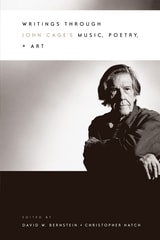
Writings through John Cage's Music, Poetry, and Art
Edited by David W. Bernstein and Christopher Hatch
University of Chicago Press, 2001
The essays in this collection grew out of a pivotal gathering during which a spectrum of participants including composers, music scholars, and visual artists, literary critics, poets, and filmmakers convened to examine Cage's extraordinary artistic legacy. Beginning with David Bernstein's introductory essay on the reception of Cage's music, the volume addresses topics ranging from Cage's reluctance to discuss his homosexuality, to his work as a performer and musician, and his forward-looking, provocative experimentation with electronic and other media. Several of the essays draw upon previously unseen sketches and other source materials. Also included are transcripts of lively panel discussions among some of Cage's former colleagues. Taken together, this collection is a much-needed contribution to the study of one of the most significant American artists of the twentieth century.
Written for the Drawer
Leonid Tsypkin, Uncensored Literature, and Soviet JewishnessBrett Winestock
University of Wisconsin Press, 2024
Tsypkin’s autobiographical writing explored the impossibility of being both a Russian writer and a Soviet Jew, employing indirection and referentiality. In the first book-length appraisal of Tsypkin and his work, Brett Winestock considers Tsypkin’s fiction as part of a transnational literary response to the horrors of the twentieth century, a reception that helps explain his much-belated international readership. Through close readings of Tsypkin’s work in the context of late-Soviet cultural worlds, Winestock makes an important contribution to studies of Jewish Soviet writing and identity.
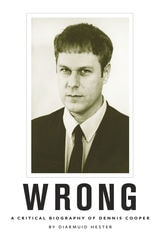
Wrong
A Critical Biography of Dennis CooperDiarmuid Hester
University of Iowa Press, 2020
Dennis Cooper is one of the most inventive and prolific artists of our time. Working in a variety of forms and media since he first exploded onto the scene in the early 1970s, he has been a punk poet, a queercore novelist, a transgressive blogger, an indie filmmaker—each successive incarnation more ingenious and surprising than the last. Cooper’s unflinching determination to probe the obscure, often violent recesses of the human psyche have seen him compared with literary outlaws like Rimbaud, Genet, and the Marquis de Sade.
In this, the first book-length study of Cooper’s life and work, Diarmuid Hester shows that such comparisons hardly scratch the surface. A lively retrospective appraisal of Cooper’s fifty-year career, Wrong tracks the emergence of Cooper’s singular style alongside his participation in a number of American subcultural movements like New York School poetry, punk rock, and radical queercore music and zines. Using extensive archival research, close readings of texts, and new interviews with Cooper and his contemporaries, Hester weaves a complex and often thrilling biographical narrative that attests to Cooper’s status as a leading figure of the American post–War avant-garde.