Results by title
4531 books match the query 'Cultural & Ethnic Studies' and 180 start with w
Wealth Accumulation and Communities of Color in the United States
Current IssuesJessica Gordon Nembhard and Ngina Chiteji, Editors
University of Michigan Press, 2010
--Kilolo Kijakazi, Ph.D., The Ford Foundation
"An important contribution to the economics literature on wealth and to our understanding of racial and ethnic inequality. This book adds to our knowledge and understanding of the wealth positions of Latinos, Asian Americans, Hawaiians, and Native Americans and places this information in the context of black-white wealth inequality."
--Cecilia A. Conrad, Department of Economics, Pomona College
--Patrick L. Mason, Department of Economics, Florida State University
"This edited volume takes up an important, indeed, fundamental, topic, bringing together leading scholars to assess wealth accumulation among people of color. No other book or research report covers as many groups of color as appear in this volume, devoting chapters to African Americans, Latinos, Native Americans, Asian Americans, and Native Hawaiians. The result is a noteworthy achievement." --Michael Sherraden, Benjamin E. Youngdahl Professor of Social Development, Washington University in St. Louis
Jessica Gordon Nembhard is Assistant Professor and Economist, African American Studies Department, and co-founder of the Democracy Collaborative at the University of Maryland, College Park. Her work on the history of black cooperatives is well known in progressive circles.
Ngina Chiteji is Associate Professor of Economics, Skidmore College. She was a Visiting Assistant Research Scholar at The Democracy Collaborative, University of Maryland, College Park.
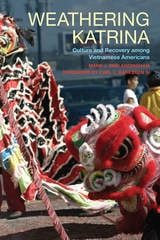
Weathering Katrina
Culture and Recovery among Vietnamese AmericansMark J. VanLandingham
Russell Sage Foundation, 2017
In 2005, Hurricane Katrina devastated New Orleans. The principal Vietnamese-American enclave was a remote, low-income area that flooded badly. Many residents arrived decades earlier as refugees from the Vietnam War and were marginally fluent in English. Yet, despite these poor odds of success, the Vietnamese made a surprisingly strong comeback in the wake of the flood. In Weathering Katrina, public health scholar Mark VanLandingham analyzes their path to recovery, and examines the extent to which culture helped them cope during this crisis.
Contrasting his longitudinal survey data and qualitative interviews of Vietnamese residents with the work of other research teams, VanLandingham finds that on the principal measures of disaster recovery—housing stability, economic stability, health, and social adaptation—the Vietnamese community fared better than other communities. By Katrina’s one-year anniversary, almost 90 percent of the Vietnamese had returned to their neighborhood, higher than the rate of return for either blacks or whites. They also showed much lower rates of post-traumatic stress disorder than other groups. And by the second year after the flood, the employment rate for the Vietnamese had returned to its pre-Katrina level.
While some commentators initially attributed this resilience to fairly simple explanations such as strong leadership or to a set of vague cultural strengths characteristic of the Vietnamese and other “model minorities”, VanLandingham shows that in fact it was a broad set of factors that fostered their rapid recovery. Many of these factors had little to do with culture. First, these immigrants were highly selected—those who settled in New Orleans enjoyed higher human capital than those who stayed in Vietnam. Also, as a small, tightly knit community, the New Orleans Vietnamese could efficiently pass on information about job leads, business prospects, and other opportunities to one another. Finally, they had access to a number of special programs that were intended to facilitate recovery among immigrants, and enjoyed a positive social image both in New Orleans and across the U.S., which motivated many people and charities to offer the community additional resources. But culture—which VanLandingham is careful to define and delimit—was important, too. A shared history of overcoming previous challenges—and a powerful set of narratives that describe these successes; a shared set of perspectives or frames for interpreting events; and a shared sense of symbolic boundaries that distinguish them from broader society are important elements of culture that provided the Vietnamese with some strong advantages in the post-Katrina environment.
By carefully defining and disentangling the elements that enabled the swift recovery of the Vietnamese in New Orleans, Weathering Katrina enriches our understanding of this understudied immigrant community and of why some groups fare better than others after a major catastrophe like Katrina.

Weaving the Threads of Life
The Khita Gyn-Eco-Logical Healing Cult among the YakaRené Devisch
University of Chicago Press, 1993
Drawing on many years among urban and rural Yaka, Devisch analyzes their understanding of existence as a fabric of firmly but delicately interwoven threads of nature, body, and society. The fertility healing ritual calls forth forces, feelings, and meanings that allow women to rejoin themselves to the complex pattern of social and cosmic life. These elaborate rites—whether simulating mortal agony and rebirth, gestation and delivery, or flowering and decay; using music and dance, steambath or massage, dream messages or scarification—are not based on symbols of traditional beliefs. Rather, Devisch shows, the rites themselves generate forces and meaning, creating and shaping the cosmic, physical, and social world of their participants.
In contrast to current theoretical methods such as postmodern or symbolical interpretation, Devisch's praxiological approach is unique in also using phenomenological insights into the intent and results of anthropological fieldwork. This innovative work will have ramifications beyond African studies, reaching into the anthropology of medicine and the body, comparative religious history, and women's studies.
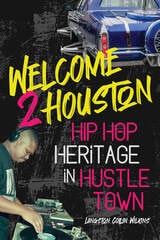
Welcome 2 Houston
Hip Hop Heritage in Hustle TownLangston Collin Wilkins
University of Illinois Press, 2023
A vivid journey through a southern hip hop bastion, Welcome 2 Houston offers readers an inside look at a unique musical culture.
Welcome to Our Hillbrow
A Novel of Postapartheid South AfricaPhaswane Mpe
Ohio University Press, 2011
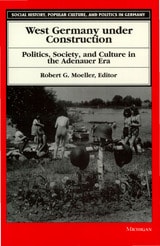
West Germany under Construction
Politics, Society, and Culture in the Adenauer EraRobert G. Moeller, Editor
University of Michigan Press, 1997
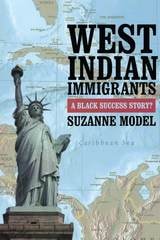
West Indian Immigrants
A Black Success Story?Suzanne Model
Russell Sage Foundation, 2008
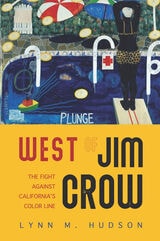
West of Jim Crow
The Fight against California's Color LineLynn M. Hudson
University of Illinois Press, 2020
Lynn M. Hudson deepens our understanding of the practices that African Americans in the West deployed to dismantle Jim Crow in the quest for civil rights prior to the 1960s. Faced with institutionalized racism, black Californians used both established and improvised tactics to resist and survive the state's color line. Hudson rediscovers forgotten stories like the experimental all-black community of Allensworth, the California Ku Klux Klan's campaign of terror against African Americans, the bitter struggle to integrate public swimming pools in Pasadena and elsewhere, and segregationists' preoccupation with gender and sexuality.
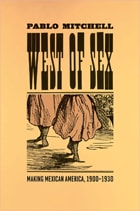
West of Sex
Making Mexican America, 1900-1930Pablo Mitchell
University of Chicago Press, 2012
Sex can be an oppressive force, a tool to shame, divide, and control a population. But it can also be a force for change, for the legal and physical challenge of inequity and injustice. In West of Sex, Pablo Mitchell uses court transcripts and criminal cases to provide the first coherent picture of Mexican-American sexuality at the turn of the twentieth century, and a truly revelatory look at sexual identity in the borderlands.
As Mexicans faced a rising tide of racial intolerance in the American West, some found cracks in the legal system that enabled them to assert their rights as full citizens, despite institutional hostility. In these chapters, Mitchell offers a rare glimpse into the inner workings of ethnicity and power in the United States, placing ordinary Mexican women and men at the center of the story of American sex, colonialism, and belonging.
Other chapters discuss topics like prostitution, same-sex intimacy, sexual violence, interracial romance, and marriage with an impressive level of detail and complexity. Written in vivid and accessible prose, West of Sex offers readers a new vision of sex and race in American history.
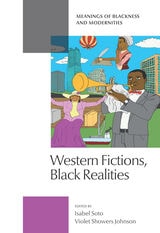
Western Fictions, Black Realities
Meanings of Blackness and ModernitiesIsabel Soto
Michigan State University Press, 2012
This anthology interrogates two salient concepts in studying the black experience. Ushered in with the age of New World encounters, modernity emerged as brutal and complex, from its very definition to its manifestations. Equally challenging is blackness, which is forever dangling between the range of uplifting articulations and insidious degradation. The essays in Western Fictions address the conflicting confluences of these two terms. Questioning Eurocentric and mainstream American interpretations, they reveal the diverse meanings of modernities and blackness from a wide range of milieus of the black experience. Interdisciplinary and wide-ranging in thematic and epochal scope, they use theoretical and empirical studies of a range of subjects to demonstrate that, indeed, blackness is relevant for understanding modernities and vice versa.
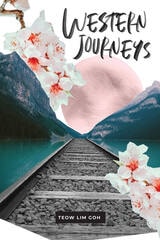
Western Journeys
Teow Lim Goh
University of Utah Press, 2022
In Western Journeys, Teow Lim Goh charts her journeys immigrating from Singapore and spending the last fifteen years living in and exploring the American West. Goh chronicles her lived experiences while building on the longer history of immigrants from Asia during the nineteenth and twentieth centuries, bringing new insights to places, the historical record, and memory. These vital essays consider how we access truth in the face of erasure. In exploring history, nature, politics, and art, Goh asks, “What does it mean for an immigrant to be at home?”
Looking beyond the captivating landscapes of the American West, Goh uncovers stories of the Chinese people who came to America during the era of Chinese Exclusion Act, as well as the stories of the Indigenous peoples who have been written out of popular narratives, and various others. She examines the links between the transcontinental railroad, the cowboy myth, and the anti-Chinese prejudice that persists today. These essays explore the early efforts to climb Colorado’s highest peaks, the massacre of Chinese miners in Rock Springs, Wyoming, and the increasingly destructive fire seasons in the West. Goh’s essays create a complex, varied, and sometimes contradictory story of people and landscapes, a tapestry of answers and questions.

What Drowns the Flowers in Your Mouth
A Memoir of BrotherhoodRigoberto González
University of Wisconsin Press, 2018
Descending into a dark emotional space that compromises their mental and physical health, the brothers eventually find hope in aiding each other. This is an honest and revealing window into the complexities of Latino masculinity, the private lives of men, and the ways they build strength under the weight of grief, loss, and despair.
What Had Happened Was
Therí Alyce Pickens
Duke University Press, 2025
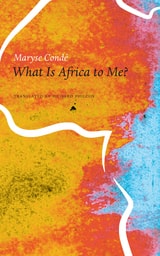
What Is Africa to Me?
Fragments of a True-to-Life AutobiographyMaryse Condé
Seagull Books, 2017
What Is Africa to Me? traces the late 1950s to 1968, chronicling Condé’s life in Sékou Touré’s Guinea to her time in Kwame N’Krumah’s Ghana, where she rubbed shoulders with Malcolm X, Che Guevara, Julius Nyerere, and Maya Angelou. Accusations of subversive activity resulted in Condé’s deportation from Ghana. Settling down in Sénégal, Condé ended her African years with close friends in Dakar, including filmmakers, activists, and Haitian exiles, before putting down more permanent roots in Paris.
Condé’s story is more than one of political upheaval, however; it is also the story of a mother raising four children as she battles steep obstacles, of a Guadeloupean seeking her identity in Africa, and of a young woman searching for her freedom and vocation as a writer. What Is Africa to Me? is a searing portrait of a literary genius—it should not be missed.
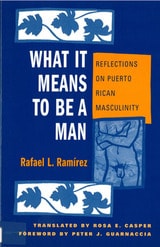
What It Means To Be A Man
Reflections on Puerto Rican MasculinityRafael L. Ramirez
Rutgers University Press, 1999
What It Means to Be a Man begins with a discussion of machismo set in the context of the social construction of masculinity. Ramírez presents his interpretation of what it means to be a Puerto Rican man, discussing the attributes and demands of masculinity, and pointing out the ways in which strength, competition, and sexuality are joined with power and pleasure. He examines the erotic relationships between men as part of the expressions of masculinity, and analyzes how the homosexual experience reproduces the dominant masculine ideology. Finally, Ramírez draws on the literature of the recent men's movements, offering Puerto Rican men the possibility of constructing a new masculinity, liberated from power games, to provide them with a chance to not only be better understood by others, but also to better understand themselves and their place in society.
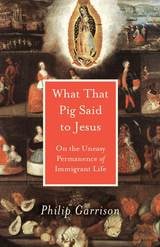
What That Pig Said to Jesus
On the Uneasy Permanence of Immigrant LifePhilip Garrison
University of Utah Press, 2017
Philip Garrison says his book of essays is “in praise of mixed feelings,” particularly the mixed feelings he and his neighbors have toward the places they came from. His neighborhood is the Columbia Plateau, one of many North American nodes of immigration. Following a meandering, though purposeful trail, Garrison catches hillbillies and newer Mexican arrivals in ambiguous, wary encounters on a set four hundred years in the making, built on a foundation of Native American displacement. Garrison is the product of the earlier surge of new arrivals: from the 1930s to the 1970s, those he calls hillbillies left such mid-nation states as Arkansas, Missouri, Oklahoma, Kansas, and the Dakotas for the West. The more recent wave, from 1990 to 2010, came mostly from the central plateau of Mexico. These are folks with whom Garrison communes in multiple ways. Anecdotes from sources as varied as pioneer diaries, railroad promotions, family Bibles, Wikipedia, and local gossip “portray the region's immigration as a kind of identity makeover, one that takes the form first of breakdown, then of reassembly, and finally of renewal.” Garrison’s mix of slangy memoir and anthropological field notes shines light on the human condition in today’s West.

What is European?
On Overcoming Colonial and Romantic Modes of ThoughtDag Nikolaus Hasse
Amsterdam University Press, 2025
The book promotes an inclusive vision of Europe that reflects its long history of multiethnic cities, offers a cultural home to a wider range of people across the continent, and extends attention and respect to other continents, thus laying a more respectful foundation for shaping the future together.
At the same time, Hasse demonstrates that overcoming colonial ways of thinking does not and should not result in anti-Europeanism. Criticising European arrogance may well go hand in hand with feeling culturally at home in other traditions of Europe. For this, it does not matter whether one is a resident of the European continent or not. There is no privileged access to European culture or to the culture of any other continent.
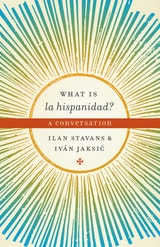
What is la hispanidad?
A conversationBy Ilan Stavans and Iván Jaksić
University of Texas Press, 2011
Natives of the Iberian Peninsula and the twenty countries of Latin America, as well as their kinsfolk who've immigrated to the United States and around the world, share a common quality or identity characterized as la hispanidad. Or do they?
In this lively, provocative book, two distinguished intellectuals, a cultural critic and a historian, engage in a series of probing conversations in which they try to discern the nature of la hispanidad and debate whether any such shared identity binds the world's nearly half billion people who are "Hispanic." Their conversations range from La Reconquista and Spanish monarchs Ferdinand and Isabella, who united the Spanish nation while expelling its remaining Moors and Jews, to the fervor for el fútbol (soccer) that has swept much of Latin America today. Along the way, they discuss a series of intriguing topics, including the complicated relationship between Latin America and the United States, Spanish language and the uses of Spanglish, complexities of race and ethnicity, nineteenth-century struggles for nationhood and twentieth-century identity politics, and popular culture from literary novels to telenovelas. Woven throughout are the authors' own enlightening experiences of crossing borders and cultures in Mexico and Chile and the United States.
Sure to provoke animated conversations among its readers, What is la hispanidad? makes a convincing case that "our hispanidad is rooted in a changing tradition, flexible enough to persist beyond boundaries and circumstances. Let us not fix it with a definition, but allow it instead to travel, always."
What's Love Got to Do with It?
Transnational Desires and Sex Tourism in the Dominican RepublicDenise Brennan
Duke University Press, 2004
Illuminating the complex world of Sosúa’s sex business in rich detail, Brennan draws on extensive interviews not only with sex workers and clients, but also with others who facilitate and benefit from the sex trade. She weaves these voices into an analysis of Dominican economic and migration histories to consider the opportunities—or lack thereof—available to poor Dominican women. She shows how these women, local actors caught in a web of global economic relations, try to take advantage of the foreign men who are in Sosúa to take advantage of them. Through her detailed study of the lives and working conditions of the women in Sosúa’s sex trade, Brennan raises important questions about women’s power, control, and opportunities in a globalized economy.

What's My Name
Black Vernacular IntellectualsGrant Farred
University of Minnesota Press, 2003
Whom does society consider an intellectual and on what grounds? Antonio Gramsci’s democratic vision of intelligence famously suggested that “all men are intellectuals,” yet within academic circles and among the general public, intellectuals continue to be defined by narrow, elite criteria.
In this study of four celebrated citizens of the African diaspora—American boxer Muhammad Ali, West Indian Marxist critic C. L. R. James, British cultural theorist Stuart Hall, and Jamaican musician Bob Marley—Grant Farred develops a new category of engaged thinker: the vernacular intellectual. Extending Gramsci’s concept of the organic intellectual, Farred conceives of vernacular intellectuals as individuals who challenge social injustice from inside and outside traditional academic or political spheres. Muhammad Ali, for example, is celebrated as much for his dazzling verbal skills and courageous political stands as for his pugilistic talents; Bob Marley’s messages of liberation are as central to his popularity as his lyrical and melodic sophistication. Neither man is described as an intellectual, yet both perform crucial intellectual functions: shaping how people see the world, oppose hegemony, and understand their own history. In contrast, the careers of C. L. R. James and Stuart Hall reflect a dynamic blend of the traditional and the vernacular. Conventionally trained and situated, James and Hall examine racism, history, and the lasting impact of colonialism in ways that draw on both established scholarship and more popular cultural experiences.
Challenging existing paradigms, What’s My Name offers an expansive and inclusive vision of intellectual activity that is as valid and meaningful in the boxing ring, the press conference, and the concert hall as in academia.

What's the Use?
On the Uses of UseSara Ahmed
Duke University Press, 2019

Whatever Happened to Antisemitism?
Redefinition and the Myth of the 'Collective Jew'Antony Lerman
Pluto Press, 2020
'This elegantly written, erudite book is essential reading for all of us, whatever our identifications' - Lynne Segal
Antisemitism is one of the most controversial topics of our time. The public, academics, journalists, activists and Jewish people themselves are divided over its meaning. Antony Lerman shows that this is a result of a 30-year process of redefinition of the phenomenon, casting Israel, problematically defined as the ‘persecuted collective Jew’, as one of its main targets.
This political project has taken the notion of the ‘new antisemitism’ and codified it in the flawed International Holocaust Remembrance Alliance’s ‘working definition’ of antisemitism. This text is the glue holding together an international network comprising the Israeli government, pro-Israel advocacy groups, Zionist organizations, Jewish communal defence bodies and sympathetic governments fighting a war against those who would criticize Israel.
The consequences of this redefinition have been alarming, supressing free speech on Palestine/Israel, legitimizing Islamophobic right-wing forces, and politicizing principled opposition to antisemitism.
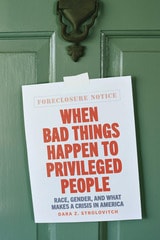
When Bad Things Happen to Privileged People
Race, Gender, and What Makes a Crisis in AmericaDara Z. Strolovitch
University of Chicago Press, 2023
A deep and thought-provoking examination of crisis politics and their implications for power and marginalization in the United States.
From the climate crisis to the opioid crisis to the Coronavirus crisis, the language of crisis is everywhere around us and ubiquitous in contemporary American politics and policymaking. But for every problem that political actors describe as a crisis, there are myriad other equally serious ones that are not described in this way. Why has the term crisis been associated with some problems but not others? What has crisis come to mean, and what work does it do?
In When Bad Things Happen to Privileged People, Dara Z. Strolovitch brings a critical eye to the taken-for-granted political vernacular of crisis. Using systematic analyses to trace the evolution of the use of the term crisis by both political elites and outsiders, Strolovitch unpacks the idea of “crisis” in contemporary politics and demonstrates that crisis is itself an operation of politics. She shows that racial justice activists innovated the language of crisis in an effort to transform racism from something understood as natural and intractable and to cast it instead as a policy problem that could be remedied. Dominant political actors later seized on the language of crisis to compel the use of state power, but often in ways that compounded rather than alleviated inequality and injustice. In this eye-opening and important book, Strolovitch demonstrates that understanding crisis politics is key to understanding the politics of racial, gender, and class inequalities in the early twenty-first century.
When Bad Things Happen to Privileged People
Race, Gender, and What Makes a Crisis in AmericaDara Z. Strolovitch
University of Chicago Press, 2023
A deep and thought-provoking examination of crisis politics and their implications for power and marginalization in the United States.
From the climate crisis to the opioid crisis to the Coronavirus crisis, the language of crisis is everywhere around us and ubiquitous in contemporary American politics and policymaking. But for every problem that political actors describe as a crisis, there are myriad other equally serious ones that are not described in this way. Why has the term crisis been associated with some problems but not others? What has crisis come to mean, and what work does it do?
In When Bad Things Happen to Privileged People, Dara Z. Strolovitch brings a critical eye to the taken-for-granted political vernacular of crisis. Using systematic analyses to trace the evolution of the use of the term crisis by both political elites and outsiders, Strolovitch unpacks the idea of “crisis” in contemporary politics and demonstrates that crisis is itself an operation of politics. She shows that racial justice activists innovated the language of crisis in an effort to transform racism from something understood as natural and intractable and to cast it instead as a policy problem that could be remedied. Dominant political actors later seized on the language of crisis to compel the use of state power, but often in ways that compounded rather than alleviated inequality and injustice. In this eye-opening and important book, Strolovitch demonstrates that understanding crisis politics is key to understanding the politics of racial, gender, and class inequalities in the early twenty-first century.
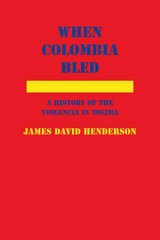
When Colombia Bled
A History of the Violencia in TolimaJames David Henderson
University of Alabama Press, 1985
This book focuses on the Colombian Violencia, the undeclared civil war between the Liberal and Conservative parties that raged from the late 1940s to early 1960s. It presents the information as a narrative history.
There is also an array of appendixes, maps, and photographs.
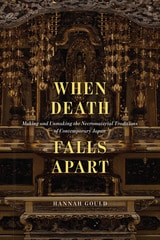
When Death Falls Apart
Making and Unmaking the Necromaterial Traditions of Contemporary JapanHannah Gould
University of Chicago Press, 2023
Deep in the Fukuyama mountainside, “the grave of the graves” (o-haka no haka) houses acres of unwanted headstones—the material remains of Japan’s discarded death rites. In the past, the Japanese dead became venerated ancestors through sustained ritual offerings at graves and at butsudan, Buddhist altars installed inside the home. But in twenty-first-century Japan, this intergenerational system of care is rapidly collapsing.
In noisy carpentry studios, flashy funeral-goods showrooms, neglected cemeteries, and cramped kitchens where women prepare memorial feasts, Hannah Gould analyzes the lifecycle of butsudan, illuminating how they are made, circulate through religious and funerary economies, mediate intimate exchanges between the living and the dead, and—as the population ages, families disperse, and fewer homes have space for large lacquer cabinets—eventually fall into disuse. What happens, she asks, when a funerary technology becomes obsolete? And what will take its place? Gould examines new products better suited to urban apartments: miniature urns and sleek altars inspired by Scandinavian design, even reliquary jewelry. She visits an automated columbarium and considers new ritual practices that embrace impermanence. At an industry expo, she takes on the role of “demonstration corpse.” Throughout, Gould invites us to rethink memorialization and describes a distinct form of Japanese necrosociality, one based on material exchanges that seek to both nurture the dead and disentangle them from the world of the living.
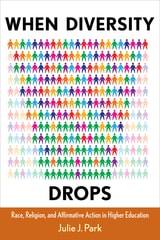
When Diversity Drops
Race, Religion, and Affirmative Action in Higher EducationPark, Julie J.
Rutgers University Press, 2013
The story documents IVCF’s evolution from a predominantly white group that rarely addressed race to the most racially diverse campus fellowship at the university. However, its ability to maintain its multiethnic membership was severely hampered by the drop in black enrollment at California University following the passage of Proposition 209, a statewide affirmative action ban.
Park demonstrates how the friendships that students have—or do not have—across racial lines are not just a matter of personal preference or choice; they take place in the contexts that are inevitably shaped by the demographic conditions of the university. She contends that a strong organizational commitment to diversity, while essential, cannot sustain racially diverse student subcultures. Her work makes a critical contribution to our understanding of race and inequality in collegiate life and is a valuable resource for educators and researchers interested in the influence of racial politics on students’ lives.
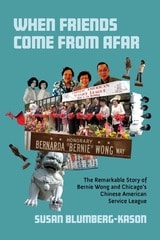
When Friends Come From Afar
The Remarkable Story of Bernie Wong and Chicago's Chinese American Service LeagueSusan Blumberg-Kason
University of Illinois Press, 2024
At once intimate and broad in scope, When Friends Come from Afar uses one woman’s life to illuminate a bedrock Chicago institution.

When Home Is a Photograph
Blackness and Belonging in the WorldLeigh Raiford
Duke University Press, 2026
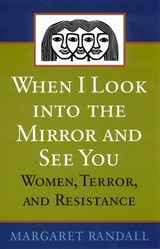
When I Look into the Mirror and See You
Women, Terror, and ResistanceMargaret Randall
Rutgers University Press, 2002
In the early 1980s, in the midst of Central America’s decades of dirty wars, Nora Miselem of Honduras and Maria Suárez Toro of Costa Rica were kidnapped and subjected to rape and other tortures. Of the nearly two hundred disappeared persons in Honduras in those years, they are, remarkably, two of only five survivors. Fourteen years after their ordeal, Suárez and Miselem’s chance meeting at a conference on human rights was witnessed by and is now retold in Margaret Randall’s When I Look into the Mirror andSee You.
Through direct testimony, vivid prose, and evocative photographs, Randall recounts the terror, resistance, and survival of Suárez and Miselem. The book details the abuses suffered by them, the ruses they used to foil their captors, the support that they gave each other while imprisoned, the means they used to escape, and their attempts to reconstruct their lives. For the first time, Suárez and Miselem explore the pain and trauma of their past and Randall has done the service of adding these remarkable voices to the global campaign to bring the world’s attention to women’s human rights.
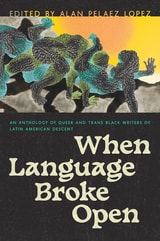
When Language Broke Open
An Anthology of Queer and Trans Black Writers of Latin American DescentEdited by Alan Pelaez Lopez
University of Arizona Press, 2023
By exploring themes of memory, care, and futurity, these contributions expand understandings of Blackness in Latin America, the Caribbean, and their U.S.-based diasporas. The volume offers up three central questions: How do queer and/or trans Black writers of Latin American descent address memory? What are the textures of caring, being cared for, and accepting care as Black queer and/or trans people of Latin American descent? And how do queer and trans embodiments help us understand and/or question the past and the present, and construct a Black, queer, and trans future?
The works collected in this anthology encompass a multitude of genres—including poetry, autobiography, short stories, diaries, visual art, and a graphic memoir—and feature the voices of established writers alongside emerging voices. Together, the contributors challenge everything we think we know about gender, sexuality, race, and what it means to experience a livable life.
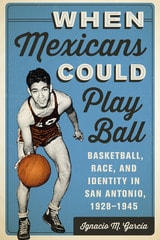
When Mexicans Could Play Ball
Basketball, Race, and Identity in San Antonio, 1928–1945By Ignacio M. García
University of Texas Press, 2014
Winner, Al Lowman Memorial Prize, Texas State Historical Association, 2014
In 1939, a team of short, scrappy kids from a vocational school established specifically for Mexican Americans became the high school basketball champions of San Antonio, Texas. Their win, and the ensuing riot it caused, took place against a backdrop of shifting and conflicted attitudes toward Mexican Americans and American nationalism in the WWII era. “Only when the Mexicans went from perennial runners-up to champs,” García writes, “did the emotions boil over.”
The first sports book to look at Mexican American basketball specifically, When Mexicans Could Play Ball is also a revealing study of racism and cultural identity formation in Texas. Using personal interviews, newspaper articles, and game statistics to create a compelling narrative, as well as drawing on his experience as a sports writer, García takes us into the world of San Antonio’s Sidney Lanier High School basketball team, the Voks, which became a two-time state championship team under head coach William Carson “Nemo” Herrera. An alumnus of the school himself, García investigates the school administrators’ project to Americanize the students, Herrera’s skillful coaching, and the team’s rise to victory despite discrimination and violence from other teams and the world outside of the school. Ultimately, García argues, through their participation and success in basketball at Lanier, the Voks players not only learned how to be American but also taught their white counterparts to question long-held assumptions about Mexican Americans.
When Race Becomes Real
Black and White Writers Confront Their Personal HistoriesEdited by Bernestine Singley
Southern Illinois University Press, 2002
When Race Becomes Real is a critically acclaimed collection that pushes the boundaries of current discussions about race. In these personal and evocative essays, thirty contemporary black and white writers describe their own intimate experiences with race and discrimination, taking an unflinching look at both society and themselves. The result is an incisive and powerful anthology that rethinks what it means to be black—and white—in the modern world.
Only through frank and tough conversation, Singley tells us, can America hope to realize its goals of justice and racial equality. This collection opens that much needed honest dialogue, exploring a wide range of racial experiences in relation to a myriad of topics: from crime and religion to humor, history, and desire. Readers will find within these pages examinations of the roots of racial beliefs and the origins of the language and rules that have heretofore governed discussion; analysis of the reasons behind our reticence to discuss the subject openly; and suggestions for solutions to the problems that plague open racial discourse. The writers of When Race Becomes Real demonstrate the progress that can be made when our ingrained wariness on the subject of race is abandoned, and we instead confront the issue openly and personally. Included are contributions by a variety of authors, from Pulitzer Prize winners such as Robert Coles, Leonard Pitts, and Natalie Angier to popular writers and emerging voices. In each essay the author sweeps aside the cautious rules that often dominate racial discussions to address what race really means in the twenty-first century.
When Race Becomes Real directly tackles one of our most taboo subjects with bravery, wit, and emotion. Sometimes shocking, sometimes amusing but always honest, this collection encourages readers to move beyond the ineffective reluctance and objectivity that hinder contemporary conversations and in doing so forge a new path in racial consciousness.
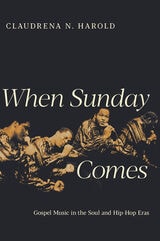
When Sunday Comes
Gospel Music in the Soul and Hip-Hop ErasClaudrena N. Harold
University of Illinois Press, 2020
Weaving insightful analysis into a collective biography of gospel icons, When Sunday Comes explores the music's essential place as an outlet for African Americans to express their spiritual and cultural selves.
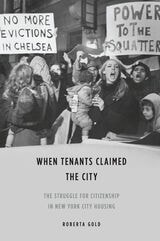
When Tenants Claimed the City
The Struggle for Citizenship in New York City HousingRoberta Gold
University of Illinois Press, 2014
In postwar America, not everyone wanted to move out of the city and into the suburbs. For decades before World War II, New York's tenants had organized to secure renters' rights. After the war, tenant activists raised the stakes by challenging the newly-dominant ideal of homeownership in racially segregated suburbs. They insisted that renters as well as owners had rights to stable, well-maintained homes, and they proposed that racially diverse urban communities held a right to remain in place--a right that outweighed owners' rights to raise rents, redevelop properties, or exclude tenants of color. Further, the activists asserted that women could participate fully in the political arenas where these matters were decided.
Grounded in archival research and oral history, When Tenants Claimed the City: The Struggle for Citizenship in New York City Housing shows that New York City's tenant movement made a significant claim to citizenship rights that came to accrue, both ideologically and legally, to homeownership in postwar America. Roberta Gold emphasizes the centrality of housing to the racial and class reorganization of the city after the war; the prominent role of women within the tenant movement; and their fostering of a concept of "community rights" grounded in their experience of living together in heterogeneous urban neighborhoods.
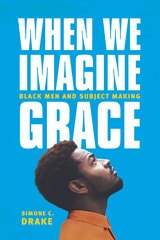
When We Imagine Grace
Black Men and Subject MakingSimone C. Drake
University of Chicago Press, 2016
In When We Imagine Grace, Drake borrows from Toni Morrison’s Beloved to bring imagination to the center of black masculinity studies—allowing individual black men to exempt themselves and their fates from a hateful, ignorant society and open themselves up as active agents at the center of their own stories. Against a backdrop of crisis, Drake brings forth the narratives of black men who have imagined grace for themselves. We meet African American cowboy, Nat Love, and Drake’s own grandfather, who served in the first black military unit to fight in World War II. Synthesizing black feminist and black masculinity studies, Drake analyzes black fathers and daughters, the valorization of black criminals, the black entrepreneurial pursuits of Marcus Garvey, Berry Gordy, and Jay-Z, and the denigration and celebration of gay black men: Cornelius Eady, Antoine Dodson, and Kehinde Wiley. With a powerful command of its subjects and a passionate dedication to hope, When We Imagine Grace gives us a new way of seeing and knowing black masculinity—sophisticated in concept and bracingly vivid in telling.

When We Say “Hiroshima”
Selected PoemsKurihara Sadako; Translated with an Introduction by Richard H. Minear
University of Michigan Press, 1999

When Women Rule the Court
Gender, Race, and Japanese American BasketballWillms, Nicole
Rutgers University Press, 2017
For nearly one hundred years, basketball has been an important part of Japanese American life. Women’s basketball holds a special place in the contemporary scene of highly organized and expansive Japanese American leagues in California, in part because these leagues have produced numerous talented female players. Using data from interviews and observations, Nicole Willms explores the interplay of social forces and community dynamics that have shaped this unique context of female athletic empowerment. As Japanese American women have excelled in mainstream basketball, they have emerged as local stars who have passed on the torch by becoming role models and building networks for others.
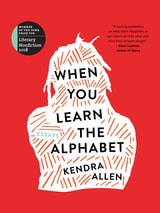
When You Learn the Alphabet
Kendra Allen
University of Iowa Press, 2019
These dynamics strive for some semblance of accountability, and the essays within this collection are used as displays of deep unlearning and restoring—balancing trauma and humor, poetics and reality, forgiveness and resentment.
When You Learn the Alphabet allots space for large moments of tenderness and empathy for all black bodies—but especially all black woman bodies—space for the underrepresented humanity and uncared for pain of black girls, and space to have the opportunity to be listened to in order to evolve past it.

When and Where They Enter
Black Women's Candidate Emergence at the State LevelJamil S. Scott-Cummings
University of Michigan Press, 2027
While Black women are often called the backbone of American democracy, their journeys to political office remain understudied. When and Where They Enter offers a way to develop our understanding of the women transforming American politics. By focusing on state-level elections, it explores what motivates Black women to run for public office, the biases they navigate in the public eye, and the structural factors that help or hinder their path to victory.
By deliberately departing from traditional, single-axis models of political ambition, Jamil Scott-Cummings frames candidate emergence through an explicit intersectional lens, treating Black women’s political agency as a dynamic interplay between psychological motivations, institutional factors, personal characteristics, and race-gender bias. She introduces a new conceptual model that challenges standard strategic entry theories: the intentional candidacy framework. Incorporating experiments, observational data, and elite interviews, When and Where They Enter offers robust empirical evidence of how race-gender identity shapes modern electoral supply. An essential read for voters, changemakers, and future leaders, the book offers a roadmap for understanding identity, power, and the future of political representation in America.
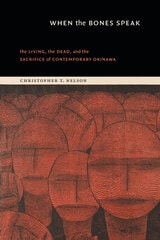
When the Bones Speak
The Living, the Dead, and the Sacrifice of Contemporary OkinawaChristopher T. Nelson
Duke University Press, 2025
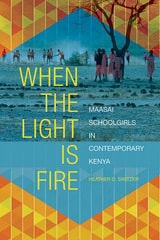
When the Light Is Fire
Maasai Schoolgirls in Contemporary KenyaHeather D. Switzer
University of Illinois Press, 2018
Heather D. Switzer's interviews with over one hundred Kenyan Maasai schoolgirls challenge the widespread view of education as a silver bullet solution to global poverty. In their own voices, the girls offer incisive insights into their commitments, aspirations, and desires. Switzer weaves this ethnographic material into an astute analysis of historical literature, education and development documents, and theoretical literature. Maasai schoolgirls express a particular knowledge about themselves and provocative hopes for their futures. Yet, as Switzer shows, new opportunities force them to face, and navigate, new vulnerabilities and insecurities within a society that is itself in flux.
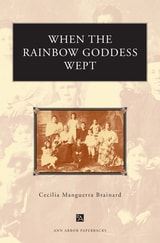
When the Rainbow Goddess Wept
Cecilia Manguerra Brainard
University of Michigan Press, 1999
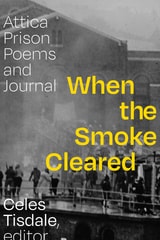
When the Smoke Cleared
Attica Prison Poems and JournalCeles Tisdale, editor
Duke University Press, 2022
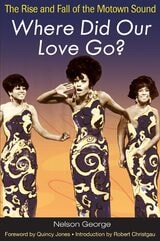
Where Did Our Love Go?
The Rise and Fall of the Motown SoundNelson George. Foreword by Quincy Jones, Introduction by Robert Christgau.
University of Illinois Press, 2007
Gordy's uncanny instinct for finding extraordinary talent--from performers and musicians to songwriters and producers—packed the label's roster with a who's who of historic artists and hitmakers. Here is the story of the Supremes and superstar Diana Ross, of the towering solo acts Marvin Gaye and Stevie Wonder, of vocal groups led by the Temptations and Four Tops, of the phenomenal Jackson Five and Michael Jackson, and of singer/songwriter and Motown executive Smokey Robinson. Up front about Gordy's manipulative and complex relationships with his artists, George reveals the inner workings of how Motown conducted its business. He also offers portraits of the Funk Brothers and other musicians who played the unforgettable songs.
George's preface shows how Motown influenced a later generation of young artists and music moguls, including R. Kelly, D'Angelo, Sean Combs, and Russell Simmons.
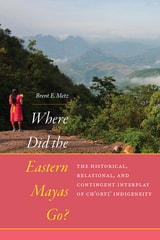
Where Did the Eastern Mayas Go?
The Historical, Relational, and Contingent Interplay of Ch’orti’ Indigeneityby Brent E. Metz
University Press of Colorado, 2022
Copublished with the Institute for Mesoamerican Studies, University of Albany
In Where Did the Eastern Mayas Go? Brent E. Metz explores the complicated issue of who is Indigenous by focusing on the sociohistorical transformations over the past two millennia of the population currently known as the Ch’orti’ Maya. Epigraphers agree that the language of elite writers in Classic Maya civilization was Proto-Ch’olan, the precursor of the Maya languages Ch’orti’, Ch’olti’, Ch’ol, and Chontal. When the Spanish invaded in the early 1500s, the eastern half of this area was dominated by people speaking various dialects of Ch’olti’ and closely related Apay (Ch’orti’), but by the end of the colonial period (1524–1821) only a few pockets of Ch’orti’ speakers remained.
From 2003 to 2018 Metz partnered with Indigenous leaders to conduct a historical and ethnographic survey of Ch’orti’ Maya identity in what was once the eastern side of the Classic period lowland Maya region and colonial period Ch’orti’-speaking region of eastern Guatemala, western Honduras, and northwestern El Salvador. Today only 15,000 Ch’orti’ speakers remain, concentrated in two municipalities in eastern Guatemala, but since the 1990s nearly 100,000 impoverished farmers have identified as Ch’orti’ in thirteen Guatemalan and Honduran municipalities, with signs of Indigenous revitalization in several Salvadoran municipalities as well. Indigenous movements have raised the ethnic consciousness of many non-Ch’orti’-speaking semi-subsistence farmers, or campesinos. The region’s inhabitants employ diverse measures to assess identity, referencing language, history, traditions, rurality, “blood,” lineage, discrimination, and more.
Where Did the Eastern Mayas Go? approaches Indigenous identity as being grounded in historical processes, contemporary politics, and distinctive senses of place. The book is an engaged, activist ethnography not on but, rather, in collaboration with a marginalized population that will be of interest to scholars of the eastern lowland Maya region, indigeneity generally, and ethnographic experimentation.
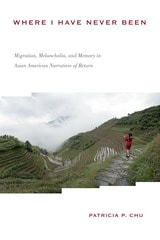
Where I Have Never Been
Migration, Melancholia, and Memory in Asian American Narratives of ReturnPatricia P. Chu
Temple University Press, 2019
In researching accounts of diasporic Chinese offspring who returned to their parents’ ancestral country, author Patricia Chu learned that she was not alone in the experience of growing up in America with an abstract affinity to an ancestral homeland and community. The bittersweet emotions she had are shared in Asian American literature that depicts migration-related melancholia, contests official histories, and portrays Asian American families as flexible and transpacific.
Where I Have Never Been explores the tropes of return, tracing both literal return visits by Asian emigrants and symbolic “returns”: first visits by diasporic offspring. Chu argues that these Asian American narratives seek to remedy widely held anxieties about cultural loss and the erasure of personal and family histories from public memory. In fiction, memoirs, and personal essays, the writers of return narratives—including novelists Lisa See, May-lee Chai, Lydia Minatoya, and Ruth Ozeki, and best-selling author Denise Chong, diplomat Yung Wing, scholar Winberg Chai, essayist Josephine Khu, and many others—register and respond to personal and family losses through acts of remembrance and countermemory.
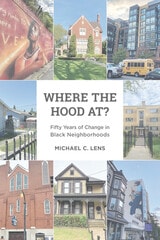
Where the Hood At?
Fifty Years of Change in Black NeighborhoodsMichael C. Lens
Russell Sage Foundation, 2024
Hip hop music was born out of Black neighborhoods in the 1970s and has evolved alongside them. In Where the Hood At? Lens uses rap’s growth and influence across the country to frame discussions about the development and conditions of Black neighborhoods. Lens finds that social and economic improvement in Black neighborhoods since the 1970s has been slow. However, how well Black neighborhoods are doing varies substantially by region. Overall, Black neighborhoods in the South are doing well and growing quickly. Washington D.C. and Atlanta, in particular, stand out as centers of Black affluence. Black neighborhoods in the Midwest and the Rust Belt, on the other hand, are particularly disadvantaged. The welfare of Black neighborhoods is related not only to factors within neighborhoods, such as the unemployment rate, but also to characteristics of the larger metropolitan area, such as overall income inequality. Lens finds that while gentrification is increasingly prevalent, it is growing slowly, and is not as pressing an issue as public discourse would make it seem. Instead, concentrated disadvantage is by far the most common and pressing problem in Black neighborhoods.
Lens argues that Black neighborhoods represent urban America’s greatest policy failures, and that recent housing policies have only had mild success. He provides several suggestions for policies with the goal of uplifting Black neighborhoods. One radical proposal is enacting policies and programs, such as tax breaks for entrepreneurs or other small business owners, that would encourage Black Americans to move back to the South. Black Americans migrating South would have a better chance at moving to an advantaged Black neighborhood as improving neighborhood location is higher when moving across regions. It would also help Black Americans expand their political and economic power. He also suggests a regional focus for economic development policies, particularly in the Midwest where Black neighborhoods are struggling the most. One way to boost economic development would be to move federal agencies to the area. He also calls for building more affordable housing in Black suburbs. Black poverty is lower in suburbs than in central cities, so increasing housing in Black suburbs would allow Black households to relocate to more advantaged neighborhoods, which research has shown leads to improved life outcomes.
Where the Hood At? is a remarkable and comprehensive account of Black neighborhoods that helps us to better understand the places and conditions that allow them flourish or impedes their advancement.
Whispered Consolations
Law and Narrative in African American LifeJon-Christian Suggs
University of Michigan Press, 2000
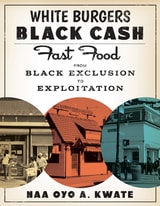
White Burgers, Black Cash
Fast Food from Black Exclusion to ExploitationNaa Oyo A. Kwate
University of Minnesota Press, 2023
The long and pernicious relationship between fast food restaurants and the African American community
- James Beard Foundation: James Beard Media Award for Reference, History, and Scholarship — Winner
- Urban Affairs Association Best Book in Urban Affairs — Winner
- Association for Humanist Sociology Betty and McClung Lee Book Award — Winner
- Black Caucus of the American Library Association — Honor, Nonfiction category
- Museum of African American History Stone Book Award — Shortlist
- Business History Conference: Hagley Prize — Finalist
- Association for the Study of Food and Society: ASFS Book Award — Winner
- Society for the Study of Social Problems: Eduardo Bonilla-Silva Outstanding Book Award — Winner
- Foreword: INDIES — Silver winner, History category
Today, fast food is disproportionately located in Black neighborhoods and marketed to Black Americans through trgeted advertising. But throughout much of the twentieth century, fast food was developed specifically for White urban and suburban customers, purposefully avoiding Black spaces. In White Burgers, Black Cash, Naa Oyo A. Kwate traces the evolution in fast food from the early 1900s to the present, from its long history of racist exclusion to its current damaging embrace of urban Black communities.
Fast food has historically been tied to the country’s self-image as the land of opportunity and is marketed as one of life’s simple pleasures, but a more insidious history lies at the industry’s core. White Burgers, Black Cash investigates the complex trajectory of restaurant locations from a decided commitment to Whiteness to the disproportionate densities that characterize Black communities today. Kwate expansively charts fast food’s racial and spatial transformation and centers the cities of Chicago, New York City, and Washington, D.C., in a national examination of the biggest brands of today, including White Castle, KFC, Burger King, McDonald’s, and more.
Deeply researched, compellingly told, and brimming with surprising details, White Burgers, Black Cash reveals the inequalities embedded in America’s popular national food tradition.