Results by title
3745 books match the query 'Europe' and 113 start with w
With Their Backs to the Mountains
A History of Carpathian Rus' and Carpatho-RusynsPaul Robert Magocsi
Central European University Press, 2016
This is a history of a stateless people, the Carpatho-Rusyns, and their historic homeland, Carpathian Rus’, located in the heart of central Europe. A little over 100,000 Carpatho-Rusyns are registered in official censuses but their population is estimated at around 1,000,000, the greater part in Ukraine and Slovakia. The majority of the diaspora—nearly 600,000—lives in the US.
At the present, when it is fashionable to speak of nationalities as “imagined communities” created by intellectuals or elites who may live in the historic homeland, Carpatho-Rusyns provide an ideal example of a people made—or some would say still being made—before our very eyes. The book traces the evolution of Carpathian Rus’ from earliest prehistoric times to the present, and the complex manner in which a distinct Carpatho-Rusyn people, since the mid-nineteenth century, came into being, disappeared, and then re-appeared in the wake of the revolutions of 1989 and the collapse of communist rule in central and eastern Europe.
To help guide the reader further there are 34 detailed maps plus an annotated discussion of relevant books, chapters, and journal articles.
With Tito’s Partisans
Communists and Peasants in War-Torn Yugoslavia, 1941–1945Xavier Bougarel
Central European University Press, 2026
With the Lapps in the High Mountains
A Woman among the Sami, 1907–1908Emilie Demant Hatt; Edited and translated by Barbara Sjoholm; Foreword by Hugh Beach
University of Wisconsin Press, 2013

Wolfgang Amadeus Mozart
A BiographyPiero Melograni
University of Chicago Press, 2006
This year marks the 250th anniversary of the birth of Wolfgang Amadeus Mozart, one of the most enduringly popular and celebrated composers to have ever lived. His substantial oeuvre contains works that are considered to be among the most exquisite pieces of symphonic, chamber, and choral music ever written. His operas too cast a long shadow over those staged in their wake. And since his untimely death in 1791, he remains an enigmatic figure—the subject of fascination for aficionados and novices alike.
Piero Melograni here offers a wholly readable account of Mozart’s remarkable life and times. This masterful biography proceeds from the young Mozart’s earliest years as a Wunderkind—the child prodigy who traveled with his family to perform concerts throughout Europe—to his formative years in Vienna, where he fully absorbed the artistic and intellectual spirit of the Enlightenment, to his deathbed, his unfinished Requiem, and the mystery that still surrounds his burial. Melograni’s deft use of Mozart’s letters throughout confers authority and vitality to his recounting, and his expertise brings Mozart’s eighteenth-century milieu evocatively to life. Written with a gifted historian’s flair for narrative and unencumbered by specialized analyses of Mozart’s music, Melograni’s is the most vivid and enjoyable biography available.
At a time when music lovers around the world are paying honor to Mozart and his legacy, Wolfgang Amadeus Mozart will be welcomed by his enthusiasts—or anyone wishing to peer into the mind of one of the greatest composers ever known.
Women Against Napoleon
Historical and Fictional Responses to his Rise and LegacyEdited by Waltraud Maierhofer, Gertrud Roesch, and Caroline Bland
Campus Verlag, 2007
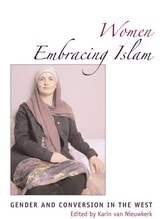
Women Embracing Islam
Gender and Conversion in the WestEdited by Karin van Nieuwkerk
University of Texas Press, 2006
Many Westerners view Islam as a religion that restricts and subordinates women in both private and public life. Yet a surprising number of women in Western Europe and America are converting to Islam. What attracts these women to a belief system that is markedly different from both Western Christianity and Western secularism? What benefits do they gain by converting, and what are the costs? How do Western women converts live their new Islamic faith, and how does their conversion affect their families and communities? How do women converts transmit Islamic values to their children? These are some of the questions that Women Embracing Islam seeks to answer.
In this vanguard study of gender and conversion to Islam, leading historians, sociologists, anthropologists, and theologians investigate why non-Muslim women in the United States, several European countries, and South Africa are converting to Islam. Drawing on extensive interviews with female converts, the authors explore the life experiences that lead Western women to adopt Islam, as well as the appeal that various forms of Islam, as well as the Nation of Islam, have for women. The authors find that while no single set of factors can explain why Western women are embracing Islamic faith traditions, some common motivations emerge. These include an attraction to Islam's high regard for family and community, its strict moral and ethical standards, and the rationality and spirituality of its theology, as well as a disillusionment with Christianity and with the unrestrained sexuality of so much of Western culture.

Women Rethinking Genres in Early Modern Europe
Simona Lorenzini
University of Delaware Press, 2027
Women Rethinking Genres in Early Modern Europe brings together research rooted in both gender and genre as categories of analysis to illustrate how the two frameworks are inextricably linked in how we understand the experiences of European women who wrote between the fifteenth and seventeenth centuries. Rather than considering genres as prescriptive, in this collection we emphasize that genres can take different forms and are central to the ways in which authors and readers understand and perceive the world. Together, these essays in this volume demonstrate that women authors not only experimented with genres in different ways but also contributed significantly to the development and circulation of ideas in early modern Europe. This volume includes a variety of case studies from different geographical areas within Western Europe that explore the role of gender in the dissemination of genres such as dialogue, poetry, pastoral, novellas, devotional literature, epic poems, account books, scientific treatises, and fictional romances. In doing so, the essays here contribute to scholarship on marginalized and less studied aspects of early modern female culture.
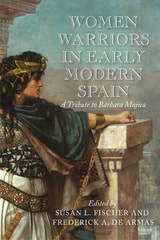
Women Warriors in Early Modern Spain
A Tribute to Barbara MujicaSusan L. Fischer
University of Delaware Press, 2019
Published by University of Delaware Press. Distributed worldwide by Rutgers University Press.
Women and Laughter in Medieval Comic Literature
Lisa Perfetti
University of Michigan Press, 2003
This study is the first to investigate women's laughter as a particular kind of "talking back" to medieval discourse on women, the subject of recent feminist medievalist studies. Female characters openly embrace women's laughter, associated with the body and castigated for its unruliness in conduct literature. Acknowledging that comic works were grounded in antifeminist traditions and that their female characters were in fact targets of laughter for male authors, this study argues that female characters who laugh and tell jokes also offer traces of how women might have used their laughter to respond to negative pronouncements about women in medieval culture. Both laughable and laughing, the female protagonists studied in this book will engage modern readers with their witty, sometimes bawdy jokes, allowing us to imagine the pleasures that medieval comic literature, so often labeled misogynous, offered to women as well as to men.
Lisa Perfetti is Assistant Professor of French, Muhlenberg College.
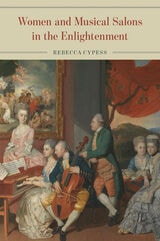
Women and Musical Salons in the Enlightenment
Rebecca Cypess
University of Chicago Press, 2022
In eighteenth-century Europe and America, musical salons—and the women who hosted and made music in them—played a crucial role in shaping their cultural environments. Musical salons served as a testing ground for new styles, genres, and aesthetic ideals, and they acted as a mediating force, bringing together professional musicians and their audiences of patrons, listeners, and performers. For the salonnière, the musical salon offered a space between the public and private spheres that allowed her to exercise cultural agency.
In this book, musicologist and historical keyboardist Rebecca Cypess offers a broad overview of musical salons between 1760 and 1800, placing the figure of the salonnière at its center. Cypess then presents a series of in-depth case studies that meet the salonnière on her own terms. Women such as Anne-Louise Brillon de Jouy in Paris, Marianna Martines in Vienna, Sara Levy in Berlin, Angelica Kauffman in Rome, and Elizabeth Graeme in Philadelphia come to life in multidimensional ways. Crucially, Cypess uses performance as a tool for research, and her interpretations draw on her experience with the instruments and performance practices used in eighteenth-century salons. In this accessible, interdisciplinary book, Cypess explores women’s agency and authorship, reason and sentiment, and the roles of performing, collecting, listening, and conversing in the formation of eighteenth-century musical life.
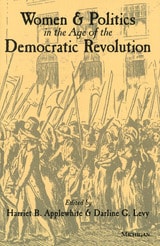
Women and Politics in the Age of the Democratic Revolution
Harriet B. Applewhite and Darline G. Levy, Editors
University of Michigan Press, 1993
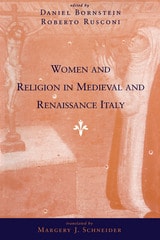
Women and Religion in Medieval and Renaissance Italy
Edited by Daniel Bornstein and Roberto Rusconi
University of Chicago Press, 1996
These essays explore the involvement of women in religious life throughout northern and central Italy and trace the evolution of communities of pious women as they tried to achieve their devotional goals despite the strictures of the ecclesiastical hierarchy. The contributors examine relations between holy women, their devout followers, and society at large.
Including contributions from leading figures in a new generation of Italian historians of religion, this book shows how women were able to carve out broad areas of influence by carefully exploiting the institutional church and by astutely manipulating religious percepts.
Women and Welfare
Theory and Practice in the United States and EuropeHirschmann, Nancy J
Rutgers University Press, 2001
The social welfare state is believed by many to be one of the great achievements of Western democracy in the twentieth century. It institutionalized for the first time a collective commitment to improving individual life chances and social well-being. However, as we move into a new century, the social welfare state everywhere has come under increasing pressure, raising serious doubts about its survival.
Featuring essays by experts from a variety of fields, including law, comparative politics, sociology, economics, cultural studies, philosophy, and political theory, Women and Welfare represents an interdisciplinary, multimethodological and multicultural feminist approach to recent changes in the welfare system of Western industrialized nations. The broad perspective, from the philosophical to the quantitative, provides an excellent overview of the subject and the most recent scholarly literature. The volume offers a crosscultural analysis of welfare “reform” in the 1990s, visions of what a “woman-friendly” welfare state requires, and an examination of theoretical and policy questions feminists and concerned others should be asking.
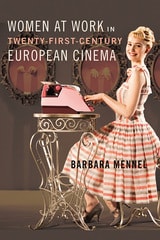
Women at Work in Twenty-First-Century European Cinema
Barbara Mennel
University of Illinois Press, 2019
Barbara Mennel delves into the ways these films about female labor capture the tension between feminist advances and their appropriation by capitalism in a time of ongoing transformation. Looking at independent and genre films from a cross-section of European nations, Mennel sees a focus on economics and work adapted to the continent's varied kinds of capitalism and influenced by concepts in second-wave feminism. More than ever, narratives of work put female characters front and center--and female directors behind the camera. Yet her analysis shows that each film remains a complex mix of progressive and retrogressive dynamics as it addresses the changing nature of work in Europe.
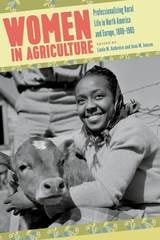
Women in Agriculture
Professionalizing Rural Life in North America and Europe, 1880-1965Linda M. Ambrose and Joan M. Jensen
University of Iowa Press, 2017
The contributors to Women in Agriculture examine how rural women’s expertise was disseminated and how it was received. Through these essays, readers meet subversively lunching ladies in Ontario and African American home demonstration agents in Arkansas. The rural sociologist Emily Hoag made a place for women at the US Department of Agriculture as well as in agricultural research. Canadian rural reformer Madge Watt, British radio broadcaster Mabel Webb, and US ethnobotanists Mary Warren English and Frances Densmore developed new ways to share and preserve rural women’s knowledge. These and the other women profiled here updated and expanded rural women’s roles in shaping their communities and the broader society. Their stories broaden and complicate the history of agriculture in North America and Western Europe.
Contributors:
Linda M. Ambrose, Maggie Andrews, Cherisse Branch-Jones, Joan M. Jensen, Amy McKinney, Anne Moore, Karen Sayer, Margreet van der Burg, Nicola Verdon
Women in German Expressionism
Gender, Sexuality, ActivismAnke Finger and Julie Shoults, Editors
University of Michigan Press, 2023
Women in Poland, 1945–1989
Modernity, Equality, CommunismKatarzyna Stanczak-Wislicz
Central European University Press, 2026
Women in Revolutionary Paris, 1789-1795
Edited and translated by Darlene Gay Levy, Harriet Branson Applewhite, and Mary Durham Johnson
University of Illinois Press, 1979
"This unique collection of documents will be a boon to teachers of history and to scholars of the French Revolution. . . . Recommended."
-- Library Journal
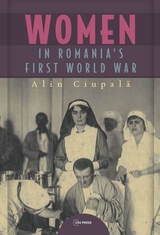
Women in Romania’s First World War
Alin Ciupalã
Central European University Press, 2025
Beyond women’s contribution to the war, the book also examines the effects of the First World War on gender roles in Romania. Feminist leaders expected that a wartime “training service” would entitle women to a life with full rights as citizens. Yet after the war, the situation returned to “normal,” and women largely continued to be excluded from the public sphere.
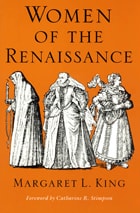
Women of the Renaissance
Margaret L. King
University of Chicago Press, 1991
Utilizing the perspectives of social, church, and intellectual history, King looks at women of all classes, in both usual and unusual settings. She first describes the familial roles filled by most women of the day—as mothers, daughters, wives, widows, and workers. She turns then to that significant fraction of women in, and acted upon, by the church: nuns, uncloistered holy women, saints, heretics, reformers,and witches, devoting special attention to the social and economic independence monastic life afforded them. The lives of exceptional women, those warriors, queens, patronesses, scholars, and visionaries who found some other place in society for their energies and strivings, are explored, with consideration given to the works and writings of those first protesting female subordination: the French Christine de Pizan, the Italian Modesta da Pozzo, the English Mary Astell.
Of interest to students of European history and women's studies, King's volume will also appeal to general readers seeking an informative, engaging entrance into the Renaissance period.
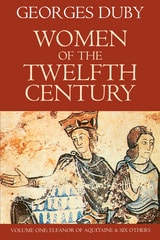
Women of the Twelfth Century, Volume 1
Eleanor of Aquitaine and Six OthersGeorges Duby
University of Chicago Press, 1997
The historical personages include Eleanor of Aquitaine whose several marriages brought her wealth and autonomy; the virtuous Héloïse; and the visionary recluse Juette. Duby also studies the literary figures of St. Marie-Madeleine, a composite figure who personified the essential female traits of frailty, ardent love, and evangelicalism; Iseut, literary beloved of Tristan; and two other emblematic figures, Dorée d'Amour and Phénix—women who became ladies through chivalrous love.
Provocative, informative, and entertaining, this book offers new insight on courtly love and the representations of women under medieval patriarchy.
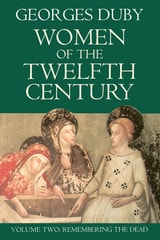
Women of the Twelfth Century, Volume 2
Remembering the DeadGeorges Duby
University of Chicago Press, 1997
The first section outlines the ways in which the dead—in both memory and legend—served to bond noble society in the twelfth century. Drawing on the Gesta by Dudo of Saint Quentin, the second section reflects on the roles that wives, concubines, and other women played during times of war and in the great exchanges of power that established the grand lineages of the Middle Ages. The third section reconstructs women as wives, mothers, and widows through the work of Lambert, Priest of Ardres.
Women of the Twelfth Century, Volume 3
Eve and the ChurchGeorges Duby
University of Chicago Press, 1998
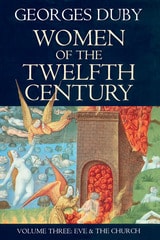
Drawing on these writings, Duby describes how women were thought to embody particular sins, such as sorcery, disobedience, and licentiousness. He evaluates Eve's role in man's fall from grace in the Garden of Eden and analyzes the reasoning behind the view that women are unstable, curious, frivolous creatures. He also notes that these charges are leveled against women, even as praise is heaped upon them for the conventional virtues they exhibit in their roles as wives and mothers.
As the final installment in Duby's three-volume study of French noblewomen of the twelfth century, Eve and the Church is the last work of this superb historian. It will be of interest to scholars of medieval history and women's history as well as to anyone interested in current debates about women and religion.
Georges Duby (1919-1996) was a member of the Académie française and for many years held the distinguished chair in medieval history at the Collège de France. His books include The Three Orders; The Age of Cathedrals; The Knight, the Lady, and the Priest; Love and Marriage in the Middle Ages; and History Continues, all published by the University of Chicago Press.
Women's Utopias of the Eighteenth Century
Alessa Johns
University of Illinois Press, 2003
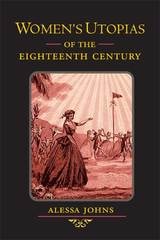
The most studied utopias have been proposed by men, but during the eighteenth century a group of reform-oriented female novelists put forth a series of work that expressed their views of, and their reservations about, ideal societies. In Women's Utopias of the Eighteenth Century, Alessa Johns examines the utopian communities envisaged by Mary Astell, Sarah Fielding, Mary Hamilton, Sarah Scott, and other writers from Britain and continental Europe, uncovering the ways in which they resembled--and departed from--traditional utopias.
Johns demonstrates that while traditional visions tended to look back to absolutist models, women's utopias quickly incorporated emerging liberal ideas that allowed far more room for personal initiative and gave agency to groups that were not culturally dominant, such as the female writers themselves. Women's utopias, Johns argues, were reproductive in nature. They had the potential to reimagine and perpetuate themselves.

Women's Words
Essay on French SingularityMona Ozouf
University of Chicago Press, 1997
Ozouf uses the woman's portrait, traditionally a male genre, to portray ten French women of letters whose lives span the period from the eve of the French Revolution to the resurgence of the feminist movement in the late twentieth century. She studies the letters and memoirs of Mme du Deffand, Mme de Charrière, Mme Roland, Mme de Staël, Mme de Rémusat, George Sand, Hubertine Auclert, Colette, Simone Weil, and Simone de Beauvoir. Rejecting the male constructions of femininity typical of this genre, Ozouf restores these women's voices in order to study their own often-conflicted attitudes toward education, marriage, motherhood, sex, and work, as well as the dilemma of writing in a literary world that did not support women's work.
Ozouf claims that a uniquely French feminism informed these women's lives, one that stems from the great egalitarian spirit of the French Revolution and is more tolerant of difference than its American counterparts. She argues that as a result, modern French culture has not isolated women from men in the same ways as American and British cultures have done.

Women's Work in Post-war Italy
An Oral and Filmic HistoryFlora Derounian
Intellect Books, 2023
Women’s Work in Post-War Italy explores women’s labor following World War II and Italy’s new republic. War and national reconstruction have typically been framed as masculine undertakings in Italy, but Flora Derounian shifts that frame to investigate the labor that Italian women were doing at this critical time of political, social, and ideological change, as well as how it was viewed by society and by women workers themselves. Drawing on original oral history interviews, Derounian compares women’s own words with the very different ways they were pictured in film, giving voice to the under-represented, and exposing the profound difference that work made to women’s lives.
Women, Gender and Fascism in Europe, 1919-45
Passmore, Kevin
Rutgers University Press, 2003
What attracts women to far-right movements that appear to denigrate their rights?
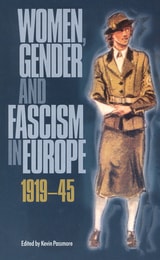
This question has vexed feminist scholars for decades and has led to many lively debates in the academy. In this context, during the 1980s, the study of women, gender, and fascism in twentieth-century Europe took off, pioneered by historians such as Claudia Koonz and Victoria de Grazia. This volume makes an exciting contribution to the evolving body of work based upon these earlier studies, bringing emerging scholarship on Central and Eastern Europe alongside that of more established Western European historiography on the topic.
Women, Gender and Fascism in Europe, 191945 features fourteen essays covering Serbia, Croatia, Yugoslavia, Romania, Hungary, Latvia, and Poland in addition to Germany, Italy, France, Spain, and Britain, and a conclusion that pulls together a European-wide perspective. As a whole, the volume provides a compelling comparative examination of this important topic through current research, literature reviews, and dialogue with existing debates. The essays cast new light on questions such as womens responsibility for the collapse of democracy in interwar Europe, the interaction between the womens movement and the extreme right, and the relationships between conceptions of national identity and gender.
Women, Jews and Muslims in the Texts of Reconquest Castile
Louise Mirrer
University of Michigan Press, 1996
This volume is the first in the field of medieval Hispanic studies to reexamine the canon in the light of recent critical work on language, gender, power, and the effects of domination. It shows how the texts imaginarily liberate Christian women from the authority of their husbands, in order to demonstrate how women's access to the discourses of power leads to tragedy and ruin for the men who fail to silence them.
Women, Jews, and Muslims in the Texts of Reconquest Castile makes the argument that dominant-"other" struggle, waged on the terrains of gender, religion, and war, is the most appropriate paradigm for discussing literary texts produced in the last centuries of reconquest. More than any other culture, medieval Spain reminds us of the provisional nature of national, religious, and sexual identity.
Exploring the gendering of subjects in society, the volume will be of interest to those in cultural and gender studies, Hispanic studies, medieval studies, and Middle Eastern studies. All texts are translated, and maps and illustrations help orient the reader.
Louise Mirrer is Professor and Chair, Department of Spanish and Portuguese, University of Minnesota.
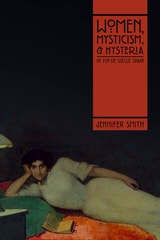
Women, Mysticism, and Hysteria in Fin-de-Siècle Spain
Jennifer Smith
Vanderbilt University Press, 2021
Author Jennifer Smith also directs modern historians to the writings of Emilia Pardo Bazán (1851-1921) as a thinker whose work points out mysticism's subversive potential in terms of the patriarchal order. Pardo Bazán, unlike her male counterparts, rejected the hysteria diagnosis and promoted mysticism as a path for women's personal development and self-realization.
Women, Production, and Patriarchy in Late Medieval Cities
Martha C. Howell
University of Chicago Press, 1986
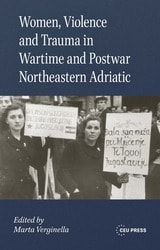
Women, Violence and Trauma in Wartime and Postwar Northeastern Adriatic
Marta Verginella
Central European University Press, 2026
Drawing on a rich range of sources—psychiatric records, diaries, autobiographies, oral histories, literature, film, and archival documents—the contributors foreground voices long marginalized in official histories. Together, the chapters reveal both vulnerability and resilience, tracing how trauma was lived, narrated, silenced, and politically instrumentalized across different post-war contexts, from the early Cold War to post-socialist societies. This collection reshapes debates in gender history, memory studies, and trauma research, offering new insights into how women endured, interpreted, and transformed the violent legacies of the twentieth century.

Women, Violence and War
Wartime Victimization of Refugees in the BalkansVesna Nikolic-Ristanovic
Central European University Press, 2000
Based on interviews with seventy women refugees, Women, Violence and War is a book about war as it is seen, lived and interpreted by women who were citizens of the former Yugoslavia.
Many of the accounts portray the horrific experiences the victims had to face and the book addresses issues of sexual, physical and psychological violence, as well as problems of confinement, upheaval and family separation. In a completely new insight the book dispels the myth that many of the women were peasants, and shows that in fact they were educated, middle-class women with independent careers. The study also depicts how some of the victims attempt to come to terms with the aftermath of wartime abuse.
This probing, accurate and unique investigation of victimization is an unparalleled volume that presents a completely new perspective maintaining that violence against women in war is not independent of peace-time victimization and the imbalance of power between sexes.
Women’s Bookscapes in Early Modern Britain
Reading, Ownership, CirculationLeah Knight, Micheline White, and Elizabeth Sauer, Editors
University of Michigan Press, 2018
Women in 16th- and 17th-century Britain read, annotated, circulated, inventoried, cherished, criticized, prescribed, and proscribed books in various historically distinctive ways. Yet, unlike that of their male counterparts, the study of women’s reading practices and book ownership has been an elusive and largely overlooked field.
In thirteen probing essays, Women’s Bookscapesin Early Modern Britain brings together the work of internationally renowned scholars investigating key questions about early modern British women’s figurative, material, and cultural relationships with books. What constitutes evidence of women’s readerly engagement? How did women use books to achieve personal, political, religious, literary, economic, social, familial, or communal goals? How does new evidence of women’s libraries and book usage challenge received ideas about gender in relation to knowledge, education, confessional affiliations, family ties, and sociability? How do digital tools offer new possibilities for the recovery of information on early modern women readers?
The volume’s three-part structure highlights case studies of individual readers and their libraries; analyses of readers and readership in the context of their interpretive communities; and new types of scholarly evidence—lists of confiscated books and convent rules, for example—as well as new methodologies and technologies for ongoing research. These essays dismantle binaries of private and public; reading and writing; female and male literary engagement and production; and ownership and authorship.
Interdisciplinary, timely, cohesive, and concise, this collection’s fresh, revisionary approaches represent substantial contributions to scholarship in early modern material culture; book history and print culture; women’s literary and cultural history; library studies; and reading and collecting practices more generally.
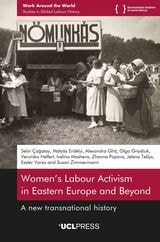
Women’s Labour Activism in Eastern Europe and Beyond
A New Transnational historySelin Çagatay, et al.
University College London, 2025
So often, theories of activism and social change neglect acts of resistance in informal, community, and domestic contexts. This collaborative investigation from a transnational team of scholars addresses two related shortcomings: the lack of class analysis in gender history and the neglect of gender dynamics in labor history. Women’s Labour Activism in Eastern Europe and Beyond highlights understudied topics in both of these fields, such as radical, grassroots, and interclass women’s labor activism on behalf of lower-income and working-class women and communities; women’s participation in trade unions on both sides of the Iron Curtain; and the heretofore neglected presence of Eastern European women in international organizations, including the cooperative movement.
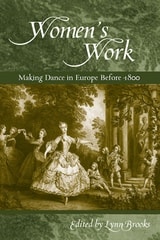
Women’s Work
Making Dance in Europe before 1800Edited by Lynn Matluck Brooks
University of Wisconsin Press, 2007
Through dance, women asserted power in spheres largely dominated by men: the court, the theater, and the church. As women’s dance worlds intersected with men’s, their lives and visions were supported or opposed, creating a complex politics of creative, spiritual, and political expression. From a women’s religious order in the thirteenth-century Low Countries that used dance as a spiritual rite of passage to the salon culture of eighteenth-century France where dance became an integral part of women’s cultural influence, the writers in this volume explore the meaning of these women’s stories, performances, and dancing bodies, demonstrating that dance is truly a field across which women have moved with finesse and power for many centuries past.

Wonderful Things from 400 Years of Collecting
The Bodleian Library 1602-2002Edited by the Bodleian Library
Bodleian Library Publishing, 2002
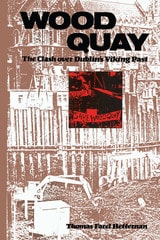
Wood Quay
The Clash over Dublin's Viking PastBy Thomas F. Heffernan
University of Texas Press, 1988
An urban archaeologist working anywhere in the world can imagine this scenario: armed with a small digging tool and a soft brush, the archaeologist stands at a freshly cut trench facing off a construction crew driving bulldozers. At stake is the past—the discovery and preservation of our history. Across the gap is the future—progress and new buildings for a modern world. A battle ensues. It happened in Dublin in the early 1960s.
While investigating and salvage-excavating the site for a new municipal office complex, archaeologists made one of the most important and exciting discoveries in Ireland’s history. Buried beneath the present-day city of Dublin was the original Viking settlement from the ninth or tenth century, in an extraordinary state of preservation: houses, undecayed wood, domestic furniture, jewelry, toys, tools, works of art, coins, plots, paths, a veritable map of the medieval town. Because of its impressive size and state of preservation, the site known as Wood Quay was not an “ordinary” kind of archaeological discovery, nor was the battle that followed typical.
What made Wood Quay unique was that its defender was not the archaeological authority—the National Museum of Ireland—as is usually the case, but rather a spontaneously formed movement of thousands of Dubliners. While the museum was ready to turn the site over to the city’s developers after routine salvage work had been done, a group of prominent literary and political figures seized Wood Quay, holding it for almost a month and preventing bulldozers from moving in. Realizing the significance of the find, the people of Dublin took charge and kept the builders at bay for eight years. At the same time, they were able to press the museum to return to its archaeological work there. Archaeologists ultimately were able to complete good maps of a large portion of the site and recover between one and two million artifacts.
Today, the completed Dublin civic office complex stands on the Wood Quay site, fully landscaped and without a trace of the archaeological gold mine that once lay buried below. What does remain, however, is the memory of the powerful impact the citizens of Dublin had in demanding and establishing the connection through Wood Quay to their medieval roots.
Of interest to archaeologists, historic preservationists, and city planners alike, this fascinating and beautifully written account will also engage the general reader.
Word Crimes
Blasphemy, Culture, and Literature in Nineteenth-Century EnglandJoss Marsh
University of Chicago Press, 1998
From extensive archival and literary research, Joss Marsh reconstructs a unified and particular account of blasphemy in Victorian England. Rewriting English history from the bottom up, she tells the forgotten stories of more than two hundred working-class "blasphemers," like Foote, whose stubborn refusal to silence their "hooligan" voices helped secure our rights to speak and write freely today. The new standards of criminality used to judge their "word crimes" rewrote the terms of literary judgment, demoting the Bible to literary masterpiece and raising Literature as the primary standard of Victorian cultural value.
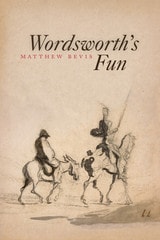
Wordsworth's Fun
Matthew Bevis
University of Chicago Press, 2019
Wordsworth’s Fun explores the writer’s debts to the ludic and the ludicrous in classical tradition; his reworkings of Ariosto, Erasmus, and Cervantes; his engagement with forms of English poetic humor; and his love of comic prose. Combining close reading with cultural analysis, Bevis travels many untrodden ways, studying Wordsworth’s interest in laughing gas, pantomime, the figure of the fool, and the value of play. Intrepid, immersive, and entertaining, Wordsworth’s Fun sheds fresh light on how one poet’s strange humor helped to shape modern literary experiment.
Work, Race, and the Emergence of Radical Right Corporatism in Imperial Germany
Dennis Sweeney
University of Michigan Press, 2010
---Andrew Zimmerman, George Washington University
World Film Locations
BarcelonaEdited by Helio San Miguel and Lorenzo J. Torres Hortelano
Intellect Books, 2013
World Film Locations
DublinEdited by Jez Conolly and Caroline Whelan
Intellect Books, 2011
World Film Locations
LiverpoolEdited by Jez Conolly and Caroline Whelan
Intellect Books, 2013
World Film Locations
LondonEdited by Neil Mitchell
Intellect Books, 2011
An exciting and visually focused tour of the diverse range of films shot on location in London, World Film Locations: London presents contributions spanning the Victorian era, the swinging ’60s, and the politically charged atmosphere following the 2005 subway bombings. Essays exploring key directors, themes, and historical periods are complemented by reviews of important scenes that offer particular insight into London's relationship to cinema. The book is illustrated throughout with full-color film stills and photographs of cinematic landmarks as they appear now—as well as city maps to aid those keen to investigate them.
From Terror on the Underground to Thames Tales to Richard Curtis's affectionate portrayal of the city in Love Actually, this user-friendly guide explores the diversity and distinctiveness of films shot in location in London.
World Film Locations
MadridEdited by Lorenzo J. Torres Hortelano
Intellect Books, 2011
World Film Locations
ParisEdited by Marcelline Block
Intellect Books, 2011
World Film Locations
PragueEdited by Marcelline Block
Intellect Books, 2013
World Film Locations
ViennaEdited by Robert Dassanowsky
Intellect Books, 2012
Vienna appears in cinema as, among other things, a historical crossroads, a source of great music, and a site of world-famous architecture ranging from gothic cathedrals and baroque palaces to landmark modern structures. A panorama that encompasses all these perspectives, World Film Locations: Vienna sheds new light on the movies shot in the former imperial capital—and on the city itself.
World War 1 in Outline
B. H. Liddell Hart
Westholme Publishing, 1936
An abridgement of the author’s History of the World War, 1914–1918, and first published in 1936, World War I in Outline is a compact but comprehensive history of the “war to end all wars.” Divided into five parts representing each year of the war, Liddell Hart discusses the war on land, at sea, and in the air while skillfully incorporating the political events occurring at the same time. From his own experiences in the war and through studying the conflict in detail, the author developed and expressed his most important observation about military principles: direct attacks against an enemy firmly in position should not be attempted. He also put forth the notion that battles are more often decided by the commander’s actions and not the armies themselves. A lively and engrossing read, World War I in Outline is an ideal overview in time for the centennial of one of the major wars in history.
World in the Balance
Behind the Scenes of World War IIGerhard L. Weinberg
Brandeis University Press, 1981