Results by title
2706 books match the query 'European' and 90 start with w
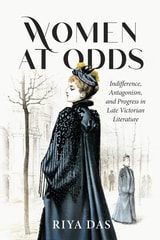
Women at Odds
Indifference, Antagonism, and Progress in Late Victorian LiteratureRiya Das
The Ohio State University Press, 2024
In Women at Odds, Riya Das demonstrates the limitations of female solidarity for the New Woman in Victorian society. On the one hand, feminist antagonism disrupts the status quo in unanticipated ways, and it helps open new domestic and professional pathways for women. On the other hand, the urban professional New Woman’s rhetoric recycles distinctly sexist, racist, and classist conventions, thereby bringing middle-class Englishwomen dialectically—what Das terms “retro-progressively”—into the labor pool of the British empire.
While foregrounding the figure of the New Woman as a white imperialist reformer, Das illustrates how the New Woman movement detaches itself from the domestic politics of female friendship. In works by George Eliot, George Gissing, Olive Schreiner, Bram Stoker, and others, antagonism and indifference enable the fin de siècle New Woman to transcend traditionally defined roles and fashion social progress for herself at the expense of femininities she excludes as “other.” By contesting the critical notion of solidarity as the only force that brings Victorian women’s narratives to fruition, Women at Odds reveals the troubled but effective role of antagonistic and indifferent reformist politics in loosening rigid social structures for privileged populations.
Women's Household Drama
Loves Victorie, A Pastorall, and The concealed FansyesMary Wroth, Jane Cavendish, and Elizabeth Brackley
Iter Press, 2018
Volume 66 in the Other Voice in Early Modern Europe - The Chicago Series
Women's Literary Networks and Media Cultures in the Long Eighteenth Century
Leith Davis
Bucknell University Press, 2027
This pathbreaking collection features original essays by leading scholars working at the intersections of women’s literary history, book history, and media cultures. Drawing on underexplored archives and innovative methodologies—from feminist bibliography to digital humanities—the contributors generate new narratives about the long eighteenth century and the centrality of gender to its literary production. Moving beyond a narrow focus on authorship, the chapters recover women as writers and readers, editors and curators, printers and book owners, scholars, preachers, and political actors. Across print, manuscript, and oral cultures, they illuminate the collaborative networks and material conditions shaping cultural production and circulation. Organized into sections on print histories, manuscript cultures, and new methodological approaches, this collection reshapes eighteenth-century studies while modeling ethically engaged archival research. Accessible and wide-ranging, it will appeal to scholars and students in literary studies, women’s and gender studies, and book history alike.
Published by Bucknell University Press. Distributed worldwide by Rutgers University Press.
Women's Speaking Justified and Other Pamphlets
Margaret Fell
Iter Press, 2018
The Other Voice in Early Modern Europe - The Toronto Series, volume 65
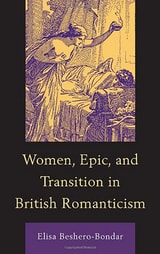
Women, Epic, and Transition in British Romanticism
Elisa Beshero-Bondar
University of Delaware Press, 2011
Women, Epic, and Transition in British Romanticism argues that early nineteenth-century women poets contributed some of the most daring work in modernizing the epic genre. The book examines several long poems to provide perspective on women poets working with and against men in related efforts, contributing together to a Romantic movement of large-scale genre revision. Women poets challenged longstanding categorical approaches to gender and nation in the epic tradition, and they raised politically charged questions about women’s importance in moments of historical crisis.
While Romantic epics did not all engage in radical questioning or undermining of authority, this study calls attention to some of the more provocative poems in their approach to gender, culture, and history. This study prioritizes long poems written by and about women during the Romantic era, and does so in context with influential epics by male contemporaries. The book takes its cue from a dramatic increase in the publication of epics in the early nineteenth-century. At their most innovative, Romantic epics provoked questions about the construction of ideological meaning and historical memory, and they centralized women’s experiences in entirely new ways to reflect on defeat, loss, and inevitable transition. For the first time the epic became an attractive genre for ambitious women poets.
The book offers a timely response to recent groundbreaking scholarship on nineteenth-century epic by Herbert Tucker and Simon Dentith, and should be of interest to Romanticists and scholars of 18th- and 19th-century literature and history, gender and genre, and women’s studies.
Published by University of Delaware Press. Distributed worldwide by Rutgers University Press.
Women, Jews and Muslims in the Texts of Reconquest Castile
Louise Mirrer
University of Michigan Press, 1996
This volume is the first in the field of medieval Hispanic studies to reexamine the canon in the light of recent critical work on language, gender, power, and the effects of domination. It shows how the texts imaginarily liberate Christian women from the authority of their husbands, in order to demonstrate how women's access to the discourses of power leads to tragedy and ruin for the men who fail to silence them.
Women, Jews, and Muslims in the Texts of Reconquest Castile makes the argument that dominant-"other" struggle, waged on the terrains of gender, religion, and war, is the most appropriate paradigm for discussing literary texts produced in the last centuries of reconquest. More than any other culture, medieval Spain reminds us of the provisional nature of national, religious, and sexual identity.
Exploring the gendering of subjects in society, the volume will be of interest to those in cultural and gender studies, Hispanic studies, medieval studies, and Middle Eastern studies. All texts are translated, and maps and illustrations help orient the reader.
Louise Mirrer is Professor and Chair, Department of Spanish and Portuguese, University of Minnesota.

Women, Work, and Representation
Needlewomen in Victorian Art and LiteratureLynn M. Alexander
Ohio University Press, 2003
In Victorian England, virtually all women were taught to sew; needlework was allied with images of domestic economy and with traditional female roles of wife and mother- with home rather than factory. The professional seamstress, however, labored long hours for very small wages creating gowns for the upper and middle classes. In her isolation and helplessness, she provided social reformers with a powerful image of working-class suffering that appealed to the sensibilities of the upper classes and helped galvanize public opinion around the need for reform.
Women, Work, and Representation addresses the use of that image in the reform movement, underscoring the shock to the Victorian public when reports revealed that the profession of needlework was extremely hazardous, even deadly.
Author Lynn M. Alexander traces the development of the symbol of the seamstress through a variety of presentations, drawing from the writings of Charles Dickens, Elizabeth Gaskell, Charlotte Elizabeth Tonna, and George W. M. Reynolds, and on visual representations by Richard Redgrave, Thomas Benjamin Kennington, John Everett Millais, John Leech, John Tenniel, and Hubert von Herkomer.
Written to appeal to Victorian scholars, women's studies scholars, and those interested in semiotics and aestheticism, Women, Work, and Representation includes twenty illustrations, most from periodicals of the day, providing new insights into the lives of working women throughout the Victorian era.
Women’s Friendship in Medieval Literature
Edited by Karma Lochrie and Usha Vishnuvajjala
The Ohio State University Press, 2022
Contributors:
Penelope Anderson, Andrea Boffa, Jennifer N. Brown, Christine Chism, Melissa Ridley Elmes, Laurie Finke, Carissa M. Harris, Lydia Yaitsky Kertz, Clare A. Lees, Karma Lochrie, Gillian R. Overing, Alexandra Verini, Usha Vishnuvajjala, Stella Wang
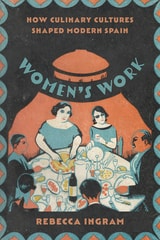
Women’s Work
How Culinary Cultures Shaped Modern SpainRebecca Ingram
Vanderbilt University Press, 2022
We are living in a moment in which famous chefs, Michelin stars, culinary techniques, and gastronomical accolades attract moneyed tourists to Spain from all over the world. This has prompted the Spanish government to declare its cuisine as part of Spanish patrimony. Even with this widespread global attention, we know little about how Spanish cooking became a litmus test for demonstrating Spain's modernity and, relatedly, the roles ascribed to the modern Spanish women responsible for daily cooking.
Efforts to articulate a new, modern Spain infiltrated writing in multiple genres and media. Women's Work offers a sharp reading of diverse sources, placed in their historical context, that yields a better understanding of the roles of food within an inherently uneven modernization process. Further, author Rebecca Ingram's perceptive critique reveals the paradoxical messages women have navigated, even in texts about a daily practice that shaped their domestic and work lives. Women's Work posits that this is significant because of the degree to which domestic activities, including cooking, occupied women's daily lives, even while issues like their fitness as citizens and participation in the public sphere were hotly debated. At the same time, progressive intellectuals from diverse backgrounds began to invoke Spanish cooking and eating as one measure of Spanish modernity.
Women's Work shows how culinary writing engaged these debates and reached women at the site of much of their daily labor—the kitchen—and, in this way, shaped their thinking about their roles in modernizing Spain.
Word Crimes
Blasphemy, Culture, and Literature in Nineteenth-Century EnglandJoss Marsh
University of Chicago Press, 1998
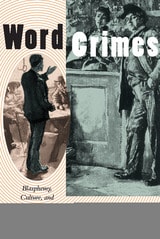
From extensive archival and literary research, Joss Marsh reconstructs a unified and particular account of blasphemy in Victorian England. Rewriting English history from the bottom up, she tells the forgotten stories of more than two hundred working-class "blasphemers," like Foote, whose stubborn refusal to silence their "hooligan" voices helped secure our rights to speak and write freely today. The new standards of criminality used to judge their "word crimes" rewrote the terms of literary judgment, demoting the Bible to literary masterpiece and raising Literature as the primary standard of Victorian cultural value.
Word Play
Experimental Poetry and Soviet Children’s LiteratureAinsley Morse
Northwestern University Press, 2021
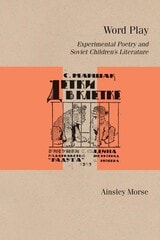
Word Play traces the history of the relationship between experimental aesthetics and Soviet children’s books, a relationship that persisted over the seventy years of the Soviet Union’s existence. From the earliest days of the Soviet project, children’s literature was taken unusually seriously—its quality and subject matter were issues of grave political significance. Yet, it was often written and illustrated by experimental writers and artists who found the childlike aesthetic congenial to their experiments in primitivism, minimalism, and other avant‑garde trends. In the more repressive environment following Stalin’s rise to power, experimental aesthetics were largely relegated to unofficial and underground literature, but unofficial writers continued to author children’s books, which were often more appealing than adult literature of the time.
Word Play focuses on poetry as the primary genre for both children’s and unofficial literature throughout the Soviet period. Five case studies feature poets‑cum‑children’s writers—Leonid Aronzon, Oleg Grigoriev, Igor Kholin, Vsevolod Nekrasov, and Dmitri Prigov—whose unpublished work was not written for children but features lexical and formal elements, abundant humor, and childlike lyric speakers that are aspects of the childlike aesthetic. The book concludes with an exploration of the legacy of this aesthetic in Russian poetry today. Drawing on rich primary sources, Word Play joins a growing literature on Russian children’s books, connecting them to avant-garde poetics in fresh, surprising ways.

Word on the Street
Edited by Elisha Foust and Sophie Fuggle
University of London Press, 2011
Words Are Something Else
David Albahari
Northwestern University Press, 1996

Words on the Air
Essays on Language, Manners, Morals, and LawsJohn Sparrow
University of Chicago Press, 1981
Wordsworth in His Major Lyrics
The Art and Psychology of Self-RepresentationLeon Waldoff
University of Missouri Press, 2001
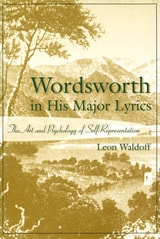
Wordsworth in His Major Lyrics explores the identity, role, and subjectivity of the speaker in Wordsworth's finest and best-known longer lyrics—"Tintern Abbey," "Resolution and Independence," "Ode: Intimations of Immortality," and "Elegiac Stanzas." Because Wordsworth is the most autobiographical poet of the Romantic period, and perhaps in the English language, readers naturally take the speaker to be the poet himself or, as Wordsworth says in his prefaces and essays, "the poet in his own person."
Some readers allow for a fictional dimension in the characterization of the speaker and refer to him as a persona; others treat him as a biographical self, defined in literary, political, historical, or cultural terms. Leon Waldoff examines the critical issues posed by these different understandings of the speaker's identity and argues for a conception of Wordsworth's lyrical "I" that deals with the dramatic and psychological complexities of the speaker's act of self-representation.
Taking concepts from Freud and Winnicott, this book presents a psychoanalytic model for defining the speaker and conceptualizing his subjectivity. Waldoff suggests that the lyrical "I" in each poem is a transitional self of the poet. The poem offers, in the suspended moment and cultural space of lyrical form, a self-dramatization in which the speaker attempts to act out, in the sense of both performing and attempting to achieve, a reconstitution and transformation of the self.
In a series of close readings that provide formalistic and psychological analysis, the book shows that the major lyrics contain compelling evidence that Wordsworth devoted much of his poetic art to each speaker's act of self-dramatization. The various strategies that each speaker employs and the self- dramatizing character of his utterance are theorized and assimilated into an understanding of the subjectivity he represents.
Waldoff concludes that Wordsworth's lyrical "I" requires a conception of subjectivity that gives greater recognition to its individual, psychological dimensions and to the art of self-representation in each poem than recent Wordsworth criticism has provided. This important new work will be appreciated by anyone interested in Wordsworth or in Romantic poetry.
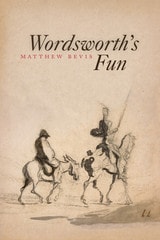
Wordsworth's Fun
Matthew Bevis
University of Chicago Press, 2019
Wordsworth’s Fun explores the writer’s debts to the ludic and the ludicrous in classical tradition; his reworkings of Ariosto, Erasmus, and Cervantes; his engagement with forms of English poetic humor; and his love of comic prose. Combining close reading with cultural analysis, Bevis travels many untrodden ways, studying Wordsworth’s interest in laughing gas, pantomime, the figure of the fool, and the value of play. Intrepid, immersive, and entertaining, Wordsworth’s Fun sheds fresh light on how one poet’s strange humor helped to shape modern literary experiment.
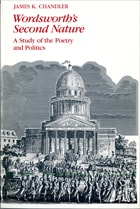
Wordsworth's Second Nature
A Study of the Poetry and PoliticsJames Chandler
University of Chicago Press, 1984
Central to the discussion, which restores Wordsworth to both the French and English contexts in which he matured, is a consideration of his relation to Rousseau and Burke. Chandler maintains that by the time Wordsworth set forth his "program for poetry" in 1798, he had turned away from the Rousseauist idea of nature that had informed his early republican writings. He had already become a poet of what Burke called "second nature"–human nature cultivated by custom, habit, and tradition–and an opponent of the quest for first principles that his friend Coleridge could not forsake. In his analysis of the poetry, Chandler suggests that even Wordsworth's most apparently private moments, the lyrical "spots of time," ideologically embodied the uncalculated habits of an oral narrative discipline and a native English mind.
Working Fictions
A Genealogy of the Victorian NovelCarolyn Lesjak
Duke University Press, 2006
Lesjak demonstrates how the ideological work of the literature of the Victorian era, the “golden age of the novel,” revolved around separating the domains of labor and pleasure and emphasizing the latter as the proper realm of literary representation. She reveals how the utopian works of Morris and Wilde grapple with this divide and attempt to imagine new relationships between work and pleasure, relationships that might enable a future in which work is not the antithesis of pleasure. In Working Fictions, Lesjak argues for the contemporary relevance of the “labor novel,” suggesting that within its pages lie resources with which to confront the gulf between work and pleasure that continues to characterize our world today.
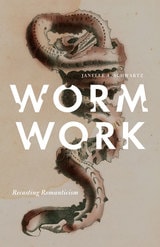
Worm Work
Recasting RomanticismJanelle A. Schwartz
University of Minnesota Press, 2012
Worms. Natural history is riddled with them. Literature is crawling with them. From antiquity to today, the ubiquitous and multiform worm provokes an immediate discomfort and unconscious distancing: it remains us against them in anthropocentric anxiety. So there is always something muddled, or dirty, or even offensive when talking about worms. Rehabilitating the lowly worm into a powerful aesthetic trope, Janelle A. Schwartz proposes a new framework for understanding such a strangely animate nature. Worms, she declares, are the very matter with which the Romantics rethought the relationship between a material world in constant flux and the human mind working to understand it.
Worm Work studies the lesser-known natural historical records of Abraham Trembley and his contemporaries and the familiar works of Erasmus Darwin, Charles Darwin, William Blake, Mary Shelley, and John Keats, to expose the worm as an organism that is not only reviled as a taxonomic terror but revered as a sign of great order in nature as well as narrative. This book traces a pattern of cultural production, a vermiculture that is as transformative of matter as it is of mind. It distinguishes decay or division as positive processes in Romantic era writings, compounded by generation or renewal and used to represent the biocentric, complex structuring of organicism.
Offering the worm as an archetypal figure through which to recast the evolution of a literary order alongside questions of taxonomy from 1740 to 1820 and on, Schwartz unearths Romanticism as a rich humus of natural historical investigation and literary creation.
Woven Shades of Green
An Anthology of Irish Nature LiteratureTim Wenzell
Bucknell University Press, 2019
Published by Bucknell University Press. Distributed worldwide by Rutgers University Press.
Writing AIDS
(Re)Conceptualizing the Individual and Social Body in Spanish American LiteratureJodie Parys
The Ohio State University Press, 2012
Writing Europe
What is European about the Literatures of Europe? Essays from 33 European CountriesUrsula Keller
Central European University Press, 2004
What do we mean by Europe? Thirty-three renowned authors from 33 European countries attempt an answer-in serious, ironic, skeptical, or optimistic tones. Their essays, written for the symposium held at the Literaturhaus Hamburg in 2003, reflect the astonishing diversity of European cultures. Not only are the style and experience of the individual authors remarkable for their distinctiveness, but their perspectives and views also appear to have little in common-at first glance.
The editors have created a unique literary project, a milestone in the vitally necessary cultural discourse about Europe.
Writing It Twice
Self-Translation and the Making of a World Literature in FrenchSara Kippur
Northwestern University Press, 2015
Though the practice of self-translation long predates modernity, it has found new forms of expression in the global literary market of the late twentieth and early twenty-first century. The international renown of self-translating authors Samuel Beckett, Joseph Brodsky, and Vladimir Nabokov has offered motivation to a new generation of writers who actively translate themselves.
Intervening in recent debates in world literature and translation studies, Writing It Twice establishes the prominence and vitality of self-translation in contemporary French literature. Because of its intrinsic connection to multiple literary communities, self-translation prompts a reexamination of the aesthetics and politics of reading across national lines. Kippur argues that self-translated works should be understood as the paradigmatic example of world literature and, as such, crucial for interpreting the dynamics of literary circulation into and out of French.
Writing Japonisme
Aesthetic Translation in Nineteenth-Century French ProsePamela A. Genova
Northwestern University Press, 2016
Writing Lives in the Eighteenth Century
Tanya M. Caldwell
Bucknell University Press, 2020
Published by Bucknell University Press. Distributed worldwide by Rutgers University Press.
Writing Maternity
Medicine, Anxiety, Rhetoric, and GenreDara Rossman Regaignon
The Ohio State University Press, 2021
Writing Ravenna
The Liber Pontificalis of Andreas AgnellusJoaquin Martinez Pizarro
University of Michigan Press, 1995
Writing Ravenna is an attempt to deal with this work's literary significance and specifically with what it tells us about the creation and circulation of narrative in the Early Middle Ages. The book's first chapter analyzes the ways in which the local and international interests of the Ravenna clergy are reflected in the design, genre, and narrative rhetoric of the Liber. The second chapter characterizes the specific textuality, given that the Liber was composed for oral delivery. The final chapter offers translations of the four most interesting narrative sequences in the Liber, followed by full analyses of sources, narrative technique, and ideological aims.
Writing Ravenna will be of interest to a broad spectrum of scholars, including art historians, scholars of late antiquity and the Early Middle Ages, religious historians, and literary critics.
Joaquin Martinez Pizarro is Associate Professor of English, State University of New York at Stony Brook. He is also the author of A Rhetoric of the Scene: Dramatic Narrative in the Early Middle Ages.
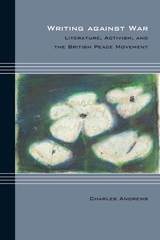
Writing against War
Literature, Activism, and the British Peace MovementCharles Andrews
Northwestern University Press, 2017
The cataclysm of the First World War gave rise to the British Peace Movement, a spectrum of pacifist, internationalist, and antiwar organizations and individuals. Antiwar sentiments found expression not only in editorials, criticism, and journalism but also in novels and other works of literature. Writing against War examines the work of Aldous Huxley, Storm Jameson, Siegfried Sassoon, Rose Macaulay, and Virginia Woolf to analyze the effects of their attempts to employ fiction in the service of peace activism. It further traces how Huxley, Woolf, and others sought to reconcile their antiwar beliefs with implacable military violence.
The British Peace Movement's failure to halt the rise of fascism and the Second World War continues to cast a shadow over contemporary pacifist movements. Writing about War will fascinate scholars of peace studies and literature and offers valuable insights for current-day peace activists and artists who seek to integrate creativity with activism.
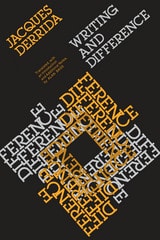
Writing and Difference
Jacques Derrida
University of Chicago Press, 1978
The second half of the book contains some of Derrida's most compelling analyses of why and how metaphysical thinking must exclude writing from its conception of language, finally showing metaphysics to be constituted by this exclusion. These essays on Artaud, Freud, Bataille, Hegel, and Lévi-Strauss have served as introductions to Derrida's notions of writing and différence—the untranslatable formulation of a nonmetaphysical "concept" that does not exclude writing—for almost a generation of students of literature, philosophy, and psychoanalysis.
Writing and Difference reveals the unacknowledged program that makes thought itself possible. In analyzing the contradictions inherent in this program, Derrida foes on to develop new ways of thinking, reading, and writing,—new ways based on the most complete and rigorous understanding of the old ways. Scholars and students from all disciplines will find Writing and Difference an excellent introduction to perhaps the most challenging of contemporary French thinkers—challenging because Derrida questions thought as we know it.
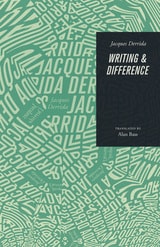
Writing and Difference
Jacques Derrida
University of Chicago Press, 1980
The second half of the book contains some of Derrida's most compelling analyses of why and how metaphysical thinking must exclude writing from its conception of language, finally showing metaphysics to be constituted by this exclusion. These essays on Artaud, Freud, Bataille, Hegel, and Lévi-Strauss have served as introductions to Derrida's notions of writing and différence—the untranslatable formulation of a nonmetaphysical "concept" that does not exclude writing—for almost a generation of students of literature, philosophy, and psychoanalysis.
Writing and Difference reveals the unacknowledged program that makes thought itself possible. In analyzing the contradictions inherent in this program, Derrida foes on to develop new ways of thinking, reading, and writing,—new ways based on the most complete and rigorous understanding of the old ways. Scholars and students from all disciplines will find Writing and Difference an excellent introduction to perhaps the most challenging of contemporary French thinkers—challenging because Derrida questions thought as we know it.
Writing and the West German Protest Movements
The Textual RevolutionMererid Puw Davies
University of London Press, 2016
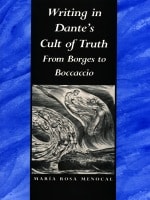
Writing in Dante's Cult of Truth
From Borges to BocaccioMaría Rosa Menocal
Duke University Press, 1991
Beginning with a reading of La vita nuova and the Commedia, this literary history of poetic literary histories explores the Dantean poetic experience as it has been limited and rewritten by later poets, particularly Petrarch, Boccaccio, Borges, Pound, Eliot, and the all but forgotten Silvio Pellico, author of Le mie prigioni. By blending discussions of Dante’s own marriage of literature and literary history with those investigations into the imitative qualities of later works, Writing in Dante’s Cult of Truth presents an intertextual literary history, one which seeks to maintain the uncanniness of literature, while imagining history to be neither linear nor clearly distinguishable from literature itself.
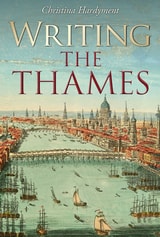
Writing the Thames
Christina Hardyment
Bodleian Library Publishing, 2016
Beautifully illustrated with seventy full-color illustrations, this book tells the river’s remarkable story through art, poetry, and prose, while celebrating the writers who helped form its enduring legacy.
Writing through Boyhood in the Long Eighteenth Century
Age, Gender, and WorkChantel Lavoie
University of Delaware Press, 2024
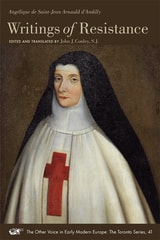
Writings of Resistance
Angélique de Saint-Jean Arnauld d’Andilly
Iter Press, 2015
An erudite abbess of Port-Royal, Angélique de Saint-Jean Arnauld d’Andilly (1624 – 1684) resisted the demands of church and state to condemn the Jansenist theological doctrines which the convent had long upheld. In her autobiographical Report on Captivity, Angélique de Saint-Jean recounts her personal methods of spiritual resistance as she and her fellow nuns underwent waves of persecution resulting in exile, house arrest, interdict, and excommunication. Her voluminous theological writings present the theoretical basis for this resistance, limiting the claims of political and ecclesiastical authorities over the conscience of the individual. In particular, she defends the right of women to refuse to surrender their convictions due to specious appeals to obedience and humility.
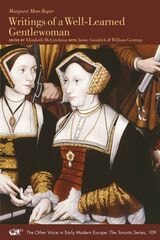
Writings of a Well-Learned Gentlewoman
Margaret More Roper
Iter Press, 2024
Margaret More Roper (1505–44) was, at the age of nineteen, the first early modern woman writer in Tudor England and the first nonroyal woman to have a book printed in the English language. As the eldest daughter of Sir Thomas More, Roper received a cutting-edge education in Latin and Greek that was virtually unprecedented for a woman. Besides gaining an international reputation for her outstanding erudition, Roper served as More’s confidante during his imprisonment. Her correspondence from this period offers valuable insight into a key moment in English history.
This Other Voice series edition recognizes Margaret More Roper as a notable historical figure in her own right and as one of the most learned women of her time. It publishes all her extant writings in modernized spelling, with annotations, a glossary, and a current bibliography of studies about her.
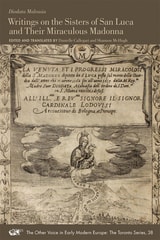
Writings on the Sisters of San Luca and Their Miraculous Madonna
Diodata Malvasia
Iter Press, 2015
The Bolognese nun Diodata Malvasia was presumed to have authored only one work, The Arrival and the Miraculous Workings of the Glorious Image of the Virgin (1617). In her recently discovered second manuscript chronicle, A Brief Discourse on What Occurred to the Most Reverend Sisters of the Joined Convents of San Mattia and San Luca (1575), her writing demonstrates active resistance to Tridentine convent reform. Together, Malvasia’s works read as the bookends to a lifelong crusade on behalf of her convent.

Wuthering Heights on Film and Television
A Journey Across Time and CulturesValérie V. Hazette
Intellect Books, 2015
Wuthering Heights
A StudyU.C. Knoepflmacher
Ohio University Press, 1994
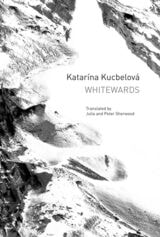
whitewards
Katarína Kucbelová
Seagull Books, 2025
Katarína Kucbelová’s whitewards is a haunting and deeply moving sequence of poems that unfolds in a stark, snowbound landscape where winter seems endless. Three unnamed figures struggle to find their way through a snow-covered mountainside, grappling with uncertainty, unspoken fears, and the weight of questions they can barely put into words. Framed as a series of brief fragments and longer passages that use a range of narrative and cinematic techniques, the collection explores themes of identity, survival, and the search for meaning in a time of global crisis—whether political, environmental, or technological. Yet amid the darkness, Kucbelová finds light in storytelling itself, offering it as a form of solace, a way to break through loneliness, and a means to endure. The beauty of her images stimulates and inspires, acting as an antidote to the bleakness of the world. This stunning collection of poems explores identity, survival, and the power that storytelling possesses to bring light even to the bleakest landscapes.