Results by title
22279 books match the query 'Social Science' and 963 start with w

Wannabes, Goths, and Christians
The Boundaries of Sex, Style, and StatusAmy C. Wilkins
University of Chicago Press, 2008
Amy C. Wilkins’s intimate ethnography of these three subcultures reveals a complex tug-of-war between the demands of race, class, and gender in which transgressing in one realm often means conforming to expectations in another. Subcultures help young people, especially women, navigate these connecting territories by offering them different sexual strategies: wannabes cross racial lines, goths break taboos by becoming involved with multiple partners, and Christians forego romance to develop their bond with God. Avoiding sanctimonious hysteria over youth gone astray, Wilkins meets these kids on their own terms, and the result is a perceptive and provocative portrait of the structure of young lives.
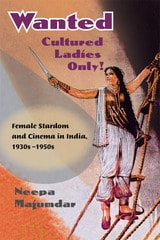
Wanted Cultured Ladies Only!
Female Stardom and Cinema in India, 1930s-1950sNeepa Majumdar
University of Illinois Press, 2008

Wanted Dead or Alive
THE AMERICAN WEST IN POPULAR CULTUREEdited by Richard Aquila
University of Illinois Press, 1996
Wanted Dead or Alive presents the first-ever comprehensive look at how the American West has been depicted in popular culture. Following Richard Aquila's introduction, which examines the birth and growth of the pop culture West in the context of American history, noted experts explore developments in popular Western fiction, major forms of live Western entertainment, trends in Western movies and television shows, images of the West in popular music, and visual images of the West in popular art and advertising. For the reader on the trail of even more information, each section of the book concludes with suggestions for further reading.
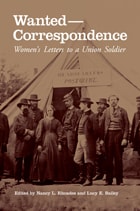
Wanted—Correspondence
Women’s Letters to a Union SoldierNancy L. Rhoades
Ohio University Press, 2009
A unique collection of more than 150 letters written to an Ohio serviceman during the American Civil War that offers glimpses of women’s lives as they waited, worked, and wrote from the Ohio home front. The letters reveal fascinating details of the lives of mostly young, single women—friends, acquaintances, love interests, and strangers who responded to one Union soldier’s advertisement for correspondents. Almost all of the women who responded to Lieutenant Edwin Lewis Lybarger’s lonely-hearts newspaper advertisement lived in Ohio and supported the Union. Lybarger carried the collection of letters throughout three years of military service, preserved them through his life, and left them to be discovered in an attic trunk more than a century after Lee’s surrender.
Women’s letter writing functioned as a form of “war work” that bolstered the spirits of enlisted men and “kinship work” that helped forge romantic relationships and sustain community bonds across the miles. While men’s letters and diaries abound in Civil War history, less readily available are comprehensive collections of letters from middle-class and rural women that survived the weathering of marches, camp life, and battles to emerge unscathed from men’s knapsacks at war’s end.
The collection is accompanied by a detailed editorial introduction that highlights significant themes in the letters. Together, they contribute to the still-unfolding historical knowledge concerning Northern women’s lives and experiences during this significant period in American history.
Wanting Children
Family-Planning Policies and the Engineering of America’s PopulationLeonard M. Lopoo
University of Chicago Press, 2026
On the eugenic origins of US reproductive laws—and the surprising policy changes needed to remedy it.
The US government spends hundreds of millions of dollars every year to promote and facilitate contraception. Whereas other wealthy countries support broader fertility interventions under the banner of “family planning,” the United States remains committed only to helping Americans—and especially poorer Americans—plan not to have a family.
In an unflinching treatise on one of the century’s defining social issues, Leonard M. Lopoo shows how the US’s asymmetric reproductive approach is a vestige of the country’s earlier sins: America’s first reproductive policies were authored by some of the twentieth century’s most prominent eugenicists, a group whose primary goal was birth prevention among lower economic classes and racial minorities. These origins have consequently created a contradictory position for the country today, in which contraception for the lowest-income Americans is subsidized, while many upper-class Americans employ technologies to have children with preferable traits.
Lopoo recasts this personal and politicized topic in elegant, stark terms. If the United States is to legislate reproduction, the only defensible approach is equity: helping people who want children to have children. Wanting Children posits a new and elevating criterion for how we think about fertility in the twenty-first century.
War & Terror
Feminist PerspectivesEdited by Karen Alexander and Mary Hawkesworth
University of Chicago Press, 2008
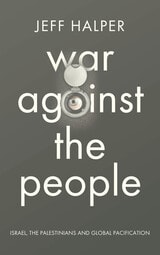
War Against the People
Israel, the Palestinians and Global PacificationJeff Halper
Pluto Press, 2015
Modern warfare has a new form. The days of international combat are fading. So how do major world powers maintain control over their people today?
This book is a disturbing insight into the new ways world powers such as the US, Israel, Britain and China forge war today. It is a subliminal war of surveillance and whitewashed terror, conducted through new, high-tech military apparatuses, designed and first used in Israel against the Palestinian population. Including nano-technology, hidden camera systems, information databases on civilian activity, automated targeting systems and unmanned drones, it is used to control the very people the nation's leaders profess to serve.
Jeff Halper reveals that this practice is much more insidious than was previously thought. As Western governments claw back individual liberties, War Against the People is a reminder that fundamental human rights are being compromised for vast sections of the world, and that this is a subject that should concern everyone.
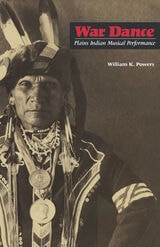
War Dance
Plains Indian Musical PerformanceWilliam K. Powers
University of Arizona Press, 1990
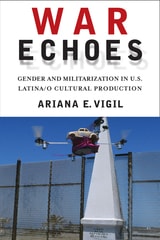
War Echoes
Gender and Militarization in U.S. Latina/o Cultural ProductionVigil, Ariana E
Rutgers University Press, 2014
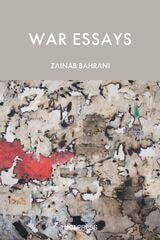
War Essays
Zainab Bahrani
University College London, 2025
In War Essays, Zainab Bahrani delivers a powerful reckoning of the destruction of Iraq’s cultural heritage in the wake of the 2003 invasion by weaving together personal experience and a critique of the enduring colonial practices of archaeology. Across two decades of essays, she examines the war’s devastating impact not only on human lives but also on Iraq’s historical landscapes, monuments, and memory, situating heritage loss within the broader geopolitics of the Middle East.
Bahrani confronts the prevailing narratives about the war, exposing how imperial violence extends beyond the battlefield to target history itself and reshaping the discipline of archaeology. By combining eyewitness testimony with theoretical inquiry, this book reflects on the role of intellectuals and historians in times of war and interrogates the responsibility of those who document conflict and its aftermath. Essential reading for scholars of Middle Eastern studies and archaeology, War Essays offers a unique and deeply personal perspective on the lasting scars of war and the fragile relationship between history and memory.
War Games
Jonna Eagle
Rutgers University Press, 2020
This Quick Take considers how various war games and simulations shape the ways we imagine war. Paradoxically, these games grant us a sense of mastery and control as we strategize and scrutinize the enemy, yet also allow us the thrilling sense of being immersed in the carnage and chaos of battle. But as simulations of war become more integrated into both popular culture and military practice, how do they shape our apprehension of the traumatic realities of warfare?
Covering everything from chess to football, from Saving Private Ryan to American Sniper, and from Call of Duty to drone interfaces, War Games is an essential guide for anyone seeking to understand the militarization of American culture, offering a compact yet comprehensive look at how we play with images of war.
War Stars
The Superweapon and the American ImaginationH. Bruce Franklin
University of Massachusetts Press, 2008
In this new and expanded edition of an already classic work, H. Bruce Franklin brings the epic story of the superweapon and the American imagination into the ominous twenty-first century, demonstrating its continuing importance both to comprehending our current predicament and to finding ways to escape from it.
Sweeping through two centuries of American culture and military history, Franklin traces the evolution of superweapons from Robert Fulton's eighteenth-century submarine through the strategic bomber, atomic bomb, and Star Wars to a twenty-first century dominated by “weapons of mass destruction,” real and imagined. Interweaving culture, science, technology, and history, he shows how and why the American pursuit of the ultimate defensive weapon—guaranteed to end all war and bring universal triumph to American ideals—has led our nation and the world into an epoch of terror and endless war.
War by Other Means
Aftermath in Post-Genocide GuatemalaCarlota McAllister and Diane M. Nelson, eds.
Duke University Press, 2013
Contributors consider a wide range of issues confronting present-day Guatemala: returning refugees, land reform, gang violence, neoliberal economic restructuring, indigenous and women's rights, complex race relations, the politics of memory, and the challenges of sustaining hope. From a sweeping account of Guatemalan elites' centuries-long use of violence to suppress dissent to studies of intimate experiences of complicity and contestation in richly drawn localities, War by Other Means provides a nuanced reckoning of the injustices that made genocide possible and the ongoing attempts to overcome them.
Contributors. Santiago Bastos, Jennifer Burrell, Manuela Camus, Matilde González-Izás, Jorge Ramón González Ponciano, Greg Grandin, Paul Kobrak, Deborah T. Levenson, Carlota McAllister, Diane M. Nelson, Elizabeth Oglesby, Luis Solano, Irmalicia Velásquez Nimatuj, Paula Worby
War in Modern US History
A Transatlantic PerspectiveOlivier Burtin and Hélène Solot
Ohio University Press, 2027
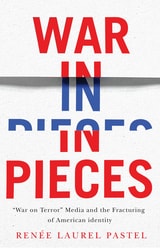
War in Pieces
"War on Terror" Media and the Fracturing of American IdentityRenée Laurel Pastel
Rutgers University Press, 2027
War in Pieces considers media representations of the first phase of the “War on Terror,” set between 2001 and 2013. The book argues that the central figures around which narratives of the conflicts cohered—the war journalist, the active-duty service member, the veteran, and the military family—served to mask the loss of the myth of a unified American national identity and embodied the negotiation of cultural anxieties. Offering a theory of narrative figuration that draws into conversation repetitions and differences across media forms (fiction and nonfiction films, television shows, and online videos), this book breaks down how these figures contributed to a continued sense of unified national identity even as different audiences came away with divergent understandings. This book frames these questions in terms of how US media packaged the “War on Terror” for future cultural memory even as the conflicts continued.
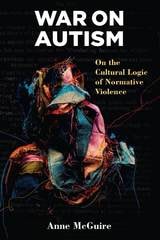
War on Autism
On the Cultural Logic of Normative ViolenceAnne McGuire
University of Michigan Press, 2016
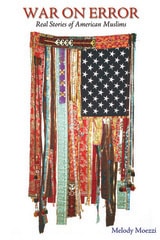
War on Error
Real Stories of American MuslimsMelody Moezzi
University of Arkansas Press, 2007
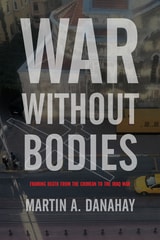
War without Bodies
Framing Death from the Crimean to the Iraq WarMartin Danahay
Rutgers University Press, 2022
Analyzing poetry, photographs, video and video games the book illustrates the ways in which war was framed in these different historical contexts. It examines the cultural assumptions that influenced the reception of images of war and discusses how death and damage to bodies was made acceptable to the public. War Without Bodies aims to heighten awareness of how acceptance of war is coded into texts and how active resistance to such hidden messages can help prevent future unnecessary wars.
War, Genocide, and Justice
Cambodian American Memory WorkCathy J. Schlund-Vials
University of Minnesota Press, 2012
In the three years, eight months, and twenty days of the Khmer Rouge’s deadly reign over Cambodia, an estimated 1.7 million Cambodians perished as a result of forced labor, execution, starvation, and disease. Despite the passage of more than thirty years, two regime shifts, and a contested U.N. intervention, only one former Khmer Rouge official has been successfully tried and sentenced for crimes against humanity in an international court of law to date. It is against this background of war, genocide, and denied justice that Cathy J. Schlund-Vials explores the work of 1.5-generation Cambodian American artists and writers.
Drawing on what James Young labels “memory work”—the collected articulation of large-scale human loss—War, Genocide, and Justice investigates the remembrance work of Cambodian American cultural producers through film, memoir, and music. Schlund-Vials includes interviews with artists such as Anida Yoeu Ali, praCh Ly, Sambath Hy, and Socheata Poeuv. Alongside the enduring legacy of the Killing Fields and post-9/11 deportations of Cambodian American youth, artists potently reimagine alternative sites for memorialization, reclamation, and justice. Traversing borders, these artists generate forms of genocidal remembrance that combat amnesic politics and revise citizenship practices in the United States and Cambodia.
Engaged in politicized acts of resistance, individually produced and communally consumed, Cambodian American memory work represents a significant and previously unexamined site of Asian American critique.
War, Judgment, and Memory in the Basque Borderlands, 1914-1945
Sandra Ott
University of Nevada Press, 2008
Warfare and the Dynamics of Political Control
Edited by Brian R. Billman
University of Arizona Press, 2025
Warfare and the Dynamics of Political Control draws on a wealth of interdisciplinary perspectives to explore how conflict shapes the establishment and maintenance of political institutions, from small-scale societies to expansive empires. The book examines the material and ideological factors that drive warfare, the organization of combatants, the ways leaders use violence to consolidate power, and how groups resist political domination in times of conflict. By posing critical questions about the efficacy of strategies and the varied outcomes of conflict-driven power struggles, this volume offers profound insights into the dynamics of political control throughout history.
Bringing together case studies from diverse regions and time periods, Warfare and the Dynamics of Political Controlilluminates the multifaceted nature of political violence. The volume includes discussions of human sacrifice, slave-taking, ideological signaling, and military strategy and tactics. The case studies reveal how different forms of political violence influence societal structures. From the fortifications of the Māori in New Zealand to the city walls of early historic India, each contribution provides a detailed analysis of how warfare has been used to both to challenge and to establish political hierarchies. Featuring examples from small foraging communities to large empires across various regions and time periods, the book offers a wide-ranging exploration of how different groups have used and resisted political violence.
This essential work contributes to our understanding of the intersections between conflict and political power, making it a vital resource for scholars of anthropology, archaeology, political science, and history.
Warfare and the Fall of a Fortified Center
Archaeological Investigations at AguatecaTakeshi Inomata
Vanderbilt University Press, 2006
VIMA Series #3
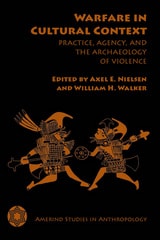
Warfare in Cultural Context
Practice, Agency, and the Archaeology of ViolenceEdited by Axel E. Nielsen and William H. Walker
University of Arizona Press, 2009
However, contributors argue, this model-and-evidence approach has given rise to multiple competing hypotheses and ambiguity rather than to full, coherent explanations of what turns out to be surprisingly complex acts of war. The chapters in Warfare in Cultural Context contend that agency and culture, inherited values and dispositions (such as religion and other cultural practices), beliefs, and institutions are always woven into the conduct of war.
This revealing book focuses on the ways that specific people construed their interests and life projects, and their problems and possibilities, and consequently chose among alternative courses of action. Using archaeological and ethnohistorical data from various parts of the world, the contributors explore the multiple avenues for the cultural study of warfare that these ideas make possible. Contributions focus on cultural aspects of warfare in Mesoamerica, South America, North America, and Southeast Asia. Case studies include warfare among the Maya, Inca, southwestern Pueblos, Mississippian cultures, and the Enga of Papua New Guinea.
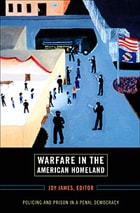
Warfare in the American Homeland
Policing and Prison in a Penal DemocracyJoy James, ed.
Duke University Press, 2007
Contributors consider the interning or policing of citizens of color, the activism of radicals, structural racism, destruction and death in New Orleans following Hurricane Katrina, and the FBI Counterintelligence Program designed to quash domestic dissent. Among the first-person accounts are an interview with Dhoruba Bin Wahad, a Black Panther and former political prisoner; a portrayal of life in prison by a Plowshares nun jailed for her antinuclear and antiwar activism; a discussion of the Puerto Rican Independence Movement by one of its members, now serving a seventy-year prison sentence for sedition; and an excerpt from a 1970 letter by the Black Panther George Jackson chronicling the abuses of inmates in California’s Soledad Prison. Warfare in the American Homeland also includes the first English translation of an excerpt from a pamphlet by Michel Foucault and others. They argue that the 1971 shooting of George Jackson by prison guards was a murder premeditated in response to human-rights and justice organizing by black and brown prisoners and their supporters.
Contributors. Hishaam Aidi, Dhoruba Bin Wahad (Richard Moore), Marilyn Buck, Marshall Eddie Conway, Susie Day, Daniel Defert, Madeleine Dwertman, Michel Foucault, Carol Gilbert, Sirène Harb, Rose Heyer, George Jackson, Joy James, Manning Marable, William F. Pinar, Oscar Lòpez Rivera, Dylan Rodríguez, Jared Sexton, Catherine vön Bulow, Laura Whitehorn, Frank B. Wilderson III
Wari Imperialism in Middle Horizon Peru
Katharina J. Schreiber with a foreword by Jeffrey R. Parsons
University of Michigan Press, 1992
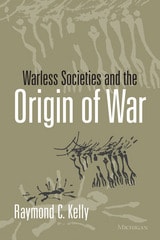
Warless Societies and the Origin of War
Raymond C. Kelly
University of Michigan Press, 2000
Kelly addresses fundamental questions concerning the trinity of interrelationship between human nature, war, and the constitution of society: Is war a primordial and pervasive feature of human existence or a set of practices that arose at a certain time in our recent prehistoric past? Are there peaceful societies in which war is absent and, if so, what are they like and how do they differ from warlike societies? Do the critical differentiating features pertain to child-rearing practices, to modes of conflict resolution, to social and economic inequality, to resource competition, or to the constitution of social groups?
As the conclusions of such an inquiry are central to our conceptions of human nature, the book will interest a wide range of readers, from those curious about the origins of collective violence to those studying the roles social institutions play in society.
Raymond C. Kelly is Professor of Anthropology, University of Michigan.
Warm Springs Millennium
Voices from the ReservationBy Michael Baughman and Charlotte Hadella
University of Texas Press, 2000
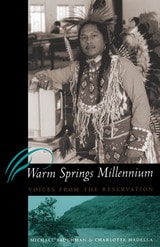
Established in 1855 on an area one-fifteenth the size of the lands relinquished in return for it, the Warm Springs Reservation in north central Oregon is home to some 3,600 Warm Springs, Wasco, and Paiute Indians, half of whom are under twenty. This book seeks to understand the reservation's inhabitants as a "viable people" who are both visible and vocal as they reflect on their daily lives, their struggles and successes, and their hopes for the future.
Michael Baughman and Charlotte Hadella present extended interviews with seven Indian and two non-Indian members of the community. They discuss issues such as the difficulty of maintaining traditional lifeways centered around hunting, fishing, and gathering; the disruptions caused by alcoholism and diseases such as diabetes; and the need for culturally appropriate education for the young. The authors frame the interviews with explanatory material that covers the reservation's history and relations with white society and its efforts to transmit native languages and cultural traditions to its children.
Warring Genealogies
Race, Kinship, and the Korean WarJoo Ok Kim
Temple University Press, 2022
Warring Genealogies examines the elaboration of kinships between Chicano/a and Asian American cultural production, such as the 1954 proxy adoption of a Korean boy by Leavenworth prisoners. Joo Ok Kim considers white supremacist expressions of kinship—in prison magazines, memorials, U.S. military songbooks—as well as critiques of such expressions in Chicana/o and Korean diasporic works to conceptualize racialized formations of kinship emerging from the Korean War.
Warring Genealogies unpacks writings by Rolando Hinojosa (Korean Love Songs, The Useless Servants) and Luis Valdez (I Don’t Have to Show You No Stinking Badges, Zoot Suit) to show the counter-representations of the Korean War and the problematic depiction of the United States as a benevolent savior. Kim also analyzes Susan Choi’s The Foreign Student as a novel that proposes alternative temporalities to dominant Korean War narratives. In addition, she examines Chicano military police procedurals, white supremacist women’s organizations, and the politics of funding Korean War archives.
Kim’s comparative study Asian American and Latinx Studies makes insightful connections about race, politics, and citizenship to critique the Cold War conception of the “national family.”
Warring Souls
Youth, Media, and Martyrdom in Post-Revolution IranRoxanne Varzi
Duke University Press, 2006
Highlighting trends that belie the government’s claim that Islamic values have taken hold—including rising rates of suicide, drug use, and sex outside of marriage—Varzi argues that by concentrating on images and the performance of proper behavior, the government’s campaign to produce model Islamic citizens has affected only the appearance of religious orthodoxy, and that the strictly religious public sphere is partly a mirage masking a profound crisis of faith among many Iranians. Warring Souls is a powerful account of contemporary Iran made more vivid by Varzi’s inclusion of excerpts from the diaries she maintained during her research and from journal entries written by Iranian university students with whom she formed a study group.
Warring over Valor
How Race and Gender Shaped American Military Heroism in the Twentieth and Twenty-First CenturiesWendt, Simon
Rutgers University Press, 2019
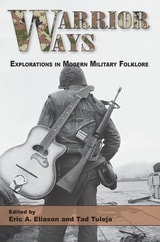
Warrior Ways
Explorations in Modern Military FolkloreEric Eliason and Tad Tuleja
Utah State University Press, 2012
Warrior Ways is one of the first book-length explorations of military folklife, and focuses on the lore produced by modern American warriors, illuminating the ways in which members of the armed services creatively express the complex experience of military life. In short, lively essays, contributors to the volume, all of whom have close personal or professional relationships to the military, examine battlefield talismans, personal narrative (storytelling), “Jody calls” (marching and running cadences), slang, homophobia and transgressive humor, music, and photography, among other cultural expressions.
Military folklore does not remain in an isolated subculture; it reveals our common humanity by delighting, disturbing, infuriating, and inspiring both those deeply invested in and those peripherally touched by military life. Highlighting the contemporary and historical importance of the military in American life, Warrior Ways will be of interest to scholars and students of folklore, anthropology, and popular culture; those involved in veteran services and education; and general readers interested in military culture.
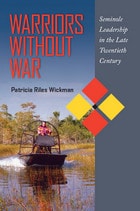
Warriors Without War
Seminole Leadership in the Late Twentieth CenturyPatricia Riles Wickman
University of Alabama Press, 2012
Warriors Without War takes readers beneath the placid waters of the Seminole’s public image and into the fascinating depths of Seminole society and politics.
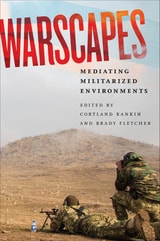
Warscapes
Mediating Militarized EnvironmentsCortland Rankin
Rutgers University Press, 2026
What do we see when we look at a battlefield? How do we come to understand environments as battlefields in the first place? What happens to our perception of war when we focus on the physical spaces of conflict? Warscapes is the first collection to pursue answers to such questions by considering the relationship between war, environment, and media along three lines: imagined geographies of control that prefigure environments as spaces of war; representations of resistance to occupation and ecocidal violence; and elemental reframings of archives and cultural memories of war. This book offers novel perspectives on historical conflict environments while also examining how hypothetical spaces of conflict are imagined. Deploying theoretical perspectives gleaned from film and media studies, ecocriticism, environmental history, urban studies, and postcolonial/decolonial studies, among others, authors highlight an international spectrum of 21st-century fiction films and television series, documentaries, and video installations that challenge how we look at war.
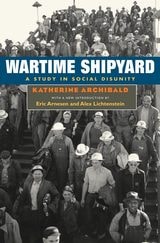
Wartime Shipyard
A STUDY IN SOCIAL DISUNITYKatherine Archibald
University of Illinois Press, 2006
An eye-opening first-hand account of life in a WWII shipyard from a woman's perspective
In 1942, Katherine Archibald, a graduate student at Berkeley, left the halls of academe to spend two years working in a nearby Oakland shipyard. She arrived with a host of preconceptions about the American working class, race relations and the prospect for their improvement, and wartime unity. Her experience working in a shipyard where women were seen as intruders, where "Okies" and black migrants from the South were regarded with barely-disguised hatred, and where trade unions preferred protecting their turf to defending workers' rights, threw much of her liberal faith into doubt.
Archibald's 1947 book about her experiences, Wartime Shipyard: A Study in Social Disunity, remains a classic account of life and labor on the home front. This new edition includes an introduction written by historians Eric Arnesen and Alex Lichtenstein, who explore Archibald's work in light of recent scholarship on women and African Americans in the wartime workplace.
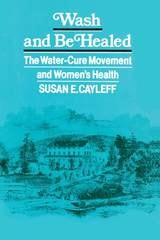
Wash and Be Healed
The Water-Cure Movement and Women's HealthSusan E. Cayleff
Temple University Press, 1991
In a century characterized by dramatic health-care remedies—bloodletting, purging, and leeching, for example—hydropathy was one of the most celebrated alternative forms of medical care. Unlike these other cures, however, hydropathy, which entailed various applications of cold water, also staunchly advocated the reformation of such personal habits as diet, exercise, dress, and way of life. Susan E. Cayleff explores the relationship between this fascinating sect of nineteenth-century medicine and the women who took the cure.
Wash and Be Healed investigates the theories, practices, medical and social philosophies, institutions, and the most prominent proponents of the water-cure movement and studies them in relation to the diverse reform networks of the nineteenth century. Documenting the popularity and importance of hydropathy among female activists, Cayleff argues that the water-cure movement was overpowered by allopathic (or orthodox) medicine which viewed hydropathy as a crackpot therapeutic largely because of its close association with nineteenth-century social activism. The book gives us an alternative view of social and sexual relationships which should contribute to the growing awareness among scholars that the history of health and healing must be more than the history of allopathic medicine.
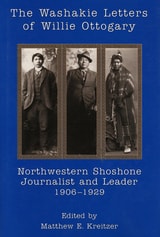
Washakie Letters Of Willie Ottogary
Matthew Kreitzer
Utah State University Press, 2000
Writings by American Indians from the early twentieth century or earlier are rare. Willie Ottogary's letters have the distinction of being firsthand reports of an Indian community's ongoing social life by a community member and leader. The Northwestern Shoshone residing at the Washakie colony in northern Utah descended from survivors of the Bear River Massacre. Most had converted to the Mormon Church and remained in northern Utah rather than moving to a federal Indian reservation. For over twenty years, local newspapers in Utah and southern Idaho regularly published letters from Ottogary reporting happenings-personal milestones and health crises, comings and goings, social events, economic conditions and activities, efforts at political redress-at Washakie and other Shoshone communities in the intermountain West.
Matthew Kreitzer compiled and edited the letters of Ottogary and added historical commentary and appendices, biographical data on individuals Ottogary mentioned, and eighty-five rare historical photographs. Written in a vernacular English and printed unedited in the newspapers, the letters describe a society in cultural transition and present Ottogary's distinctively Shoshone point of view on anything affecting his people. Thus, they provide an unusual picture of Shoshone life through a critical period, a time when many Indian communities reached a historical nadir. While the letters unflinchingly report the many difficulties and challenges the Shoshone faced, they portray a vital and dynamic society, whose members led full lives and actively pursued their own interests. Ottogary lobbied constantly for Shoshone rights, forging alliances with Shoshone throughout the region, visiting Washington D.C., advocating legislation, and participating in Goshute-Western Shoshone draft resistance during World War I.
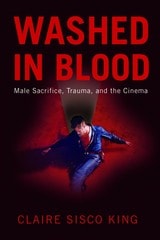
Washed in Blood
Male Sacrifice, Trauma, and the CinemaKing, Claire S
Rutgers University Press, 2012
Will Smith in I Am Legend. Leonardo DiCaprio in Titanic. Charlton Heston in just about everything.
Viewers of Hollywood action films are no doubt familiar with the sacrificial victim-hero, the male protagonist who nobly gives up his life so that others may be saved. Washed in Blood argues that such sacrificial films are especially prominent in eras when the nation—and American manhood—is thought to be in crisis. The sacrificial victim-hero, continually imperiled and frequently exhibiting classic symptoms of post-traumatic stress disorder, thus bears the trauma of the nation.
Claire Sisco King offers an in-depth study of three prominent cycles of Hollywood films that follow the sacrificial narrative: the early–to–mid 1970s, the mid–to–late 1990s, and the mid–to–late 2000s. From Vietnam-era disaster movies to post-9/11 apocalyptic thrillers, she examines how each film represents traumatized American masculinity and national identity. What she uncovers is a cinematic tendency to position straight white men as America’s most valuable citizens—and its noblest victims.
Wasita in a Lebanese Context
Social Exchange among Villagers and OutsidersFrederick Charles Huxley
University of Michigan Press, 1978

Waste Works
Vital Politics in Urban GhanaBrenda Chalfin
Duke University Press, 2023
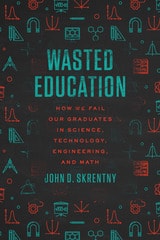
Wasted Education
How We Fail Our Graduates in Science, Technology, Engineering, and MathJohn D. Skrentny
University of Chicago Press, 2023
An urgent reality check for America’s blinkered fixation on STEM education.
We live in an era of STEM obsession. Not only do tech companies dominate American enterprise and economic growth while complaining of STEM shortages, but we also need scientific solutions to impending crises. As a society, we have poured enormous resources—including billions of dollars—into cultivating young minds for well-paid STEM careers. Yet despite it all, we are facing a worker exodus, with as many as 70% of STEM graduates opting out of STEM work. Sociologist John D. Skrentny investigates why, and the answer, he shows, is simple: the failure of STEM jobs.
Wasted Education reveals how STEM work drives away bright graduates as a result of “burn and churn” management practices, lack of job security, constant training for a neverending stream of new—and often socially harmful—technologies, and the exclusion of women, people of color, and older workers. Wasted Education shows that if we have any hope of improving the return on our STEM education investments, we have to change the way we’re treating the workers on whom our future depends.
Wasted Education
How We Fail Our Graduates in Science, Technology, Engineering, and MathJohn D. Skrentny
University of Chicago Press, 2023
This is an auto-narrated audiobook version of this book.
An urgent reality check for America’s blinkered fixation on STEM education.
We live in an era of STEM obsession. Not only do tech companies dominate American enterprise and economic growth while complaining of STEM shortages, but we also need scientific solutions to impending crises. As a society, we have poured enormous resources—including billions of dollars—into cultivating young minds for well-paid STEM careers. Yet despite it all, we are facing a worker exodus, with as many as 70% of STEM graduates opting out of STEM work. Sociologist John D. Skrentny investigates why, and the answer, he shows, is simple: the failure of STEM jobs.
Wasted Education reveals how STEM work drives away bright graduates as a result of “burn and churn” management practices, lack of job security, constant training for a neverending stream of new—and often socially harmful—technologies, and the exclusion of women, people of color, and older workers. Wasted Education shows that if we have any hope of improving the return on our STEM education investments, we have to change the way we’re treating the workers on whom our future depends.
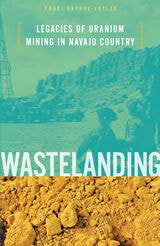
Wastelanding
Legacies of Uranium Mining in Navajo CountryTraci Brynne Voyles
University of Minnesota Press, 2015
Wastelanding tells the history of the uranium industry on Navajo land in the U.S. Southwest, asking why certain landscapes and the peoples who inhabit them come to be targeted for disproportionate exposure to environmental harm. Uranium mines and mills on the Navajo Nation land have long supplied U.S. nuclear weapons and energy programs. By 1942, mines on the reservation were the main source of uranium for the top-secret Manhattan Project. Today, the Navajo Nation is home to more than a thousand abandoned uranium sites. Radiation-related diseases are endemic, claiming the health and lives of former miners and nonminers alike.
Traci Brynne Voyles argues that the presence of uranium mining on Diné (Navajo) land constitutes a clear case of environmental racism. Looking at discursive constructions of landscapes, she explores how environmental racism develops over time. For Voyles, the “wasteland,” where toxic materials are excavated, exploited, and dumped, is both a racial and a spatial signifier that renders an environment and the bodies that inhabit it pollutable. Because environmental inequality is inherent in the way industrialism operates, the wasteland is the “other” through which modern industrialism is established.
In examining the history of wastelanding in Navajo country, Voyles provides “an environmental justice history” of uranium mining, revealing how just as “civilization” has been defined on and through “savagery,” environmental privilege is produced by portraying other landscapes as marginal, worthless, and pollutable.
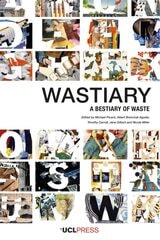
Wastiary
A Bestiary of WasteEdited by Michael Picard, Albert Brenchat-Aguilar, Timothy Carroll, Jane Gilbert, and Nicola Miller
University College London, 2023
Wastiary: A Bestiary of Waste is a creative exercise that occupies letters, numbers, and symbols of Western academic language to compose a list of thirty-five short entries on the uncomfortable but pressing topic of waste in the contemporary world. The collection is richly illustrated with artwork, photography, collage, and mixed media and conveys the message that various forms of waste and pollution have achieved a beast-like or untamable quality, at times pungently transferring to considerations of “the human,” or humans treated as waste.
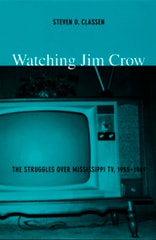
Watching Jim Crow
The Struggles over Mississippi TV, 1955–1969Steven D. Classen
Duke University Press, 2004
During the 1990s, Classen conducted extensive interviews with more than two dozen African Americans living in Jackson, several of whom, decades earlier, had fought to integrate television programming. He draws on these interviews not only to illuminate their perceptions—of the civil rights movement, what they accomplished, and the present as compared with the past—but also to reveal the inadequate representation of their viewpoints in the legal proceedings surrounding WLBT’s licensing. The story told in Watching Jim Crow has significant implications today, not least because the Telecommunications Act of 1996 effectively undid many of the hard-won reforms achieved by activists—including those whose stories Classen relates here.
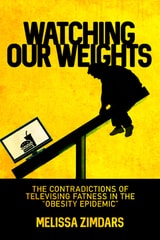
Watching Our Weights
The Contradictions of Televising Fatness in the “Obesity Epidemic”Zimdars, Melissa
Rutgers University Press, 2019
Watching Our Weights explores the competing and contradictory fat representations on television that are related to weight-loss and health, medicalization and disease, and body positivity and fat acceptance. While television—especially reality television—is typically understood to promote individual self-discipline and expert interventions as necessary for transforming fat bodies into thin bodies, fat representations and narratives on television also create space for alternative as well as resistant discourses of the body. Melissa Zimdars thus examines the resistance inherent within TV representations and narratives of fatness as a global health issue, the inherent and overt resistance found across stories of medicalized fatness, and programs that actively avoid dieting narratives in favor of less oppressive ways of thinking about the fat body. Watching Our Weights weaves together analyses of media industry lore and decisions, communication and health policies, medical research, activist projects, popular culture, and media texts to establish both how television shapes our knowledge of fatness and how fatness helps us better understand contemporary television.
Watching Race
Television and the Struggle for BlacknessHerman Gray
University of Minnesota Press, 1997
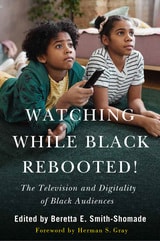
Watching While Black Rebooted!
The Television and Digitality of Black AudiencesBeretta E. Smith-Shomade
Rutgers University Press, 2024
Chapters rethink such historically significant programs as Roots and Underground, such seemingly innocuous programs as Soul Food, and such contemporary and culturally complicated programs as Being Mary Jane and Atlanta. The book makes a case for the centrality of these programs while always recognizing the racial dynamics that continue to shape Black representation on the small screen. Painting a decidedly introspective portrait across forty years of Black television, Watching While Black Rebooted sheds much-needed light on under examined demographics, broadens common audience considerations, and gives deference to the preferences of audiences and producers of Black-targeted programming.
Watching While Black
Centering the Television of Black AudiencesSmith-Shomade, Beretta E
Rutgers University Press, 2013
2013 Choice Outstanding Academic Title
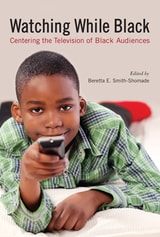
Television scholarship has substantially ignored programming aimed at Black audiences despite a few sweeping histories and critiques. In this volume, the first of its kind, contributors examine the televisual diversity, complexity, and cultural imperatives manifest in programming directed at a Black and marginalized audience.
Watching While Black considers its subject from an entirely new angle in an attempt to understand the lives, motivations, distinctions, kindred lines, and individuality of various Black groups and suggest what television might be like if such diversity permeated beyond specialized enclaves. It looks at the macro structures of ownership, producing, casting, and advertising that all inform production, and then delves into television programming crafted to appeal to black audiences—historic and contemporary, domestic and worldwide.
Chapters rethink such historically significant programs as Roots and Black Journal, such seemingly innocuous programs as Fat Albert and bro’Town, and such contemporary and culturally complicated programs as Noah’s Arc, Treme, and The Boondocks. The book makes a case for the centrality of these programs while always recognizing the racial dynamics that continue to shape Black representation on the small screen. Painting a decidedly introspective portrait across forty years of Black television, Watching While Black sheds much-needed light on under-examined demographics, broadens common audience considerations, and gives deference to the the preferences of audiences and producers of Black-targeted programming.
Watching Women's Liberation, 1970
Feminism's Pivotal Year on the Network NewsBonnie J. Dow
University of Illinois Press, 2014
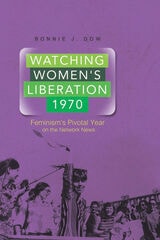
In Watching Women's Liberation, 1970: Feminism's Pivotal Year on the Network News, Bonnie J. Dow uses case studies of key media events to delve into the ways national TV news mediated the emergence of feminism's second wave. First legitimized as a big story by print media, the feminist movement gained broadcast attention as the networks’ eagerness to get in on the action was accompanied by feminists’ efforts to use national media for their own purposes. Dow chronicles the conditions that precipitated feminism's new visibility and analyzes the verbal and visual strategies of broadcast news discourses that tried to make sense of the movement.
Groundbreaking and packed with detail, Watching Women's Liberation, 1970 shows how feminism went mainstream--and what it gained and lost on the way.
Watching the Traffic Go By
Transportation and Isolation in Urban AmericaBy Paul Mason Fotsch
University of Texas Press, 2007
2007 — Jane Jacobs Urban Communication Publication Award – Urban Communication Foundation
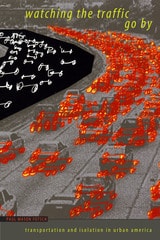
As twentieth-century city planners invested in new transportation systems to deal with urban growth, they ensured that the automobile rather than mass transit would dominate transportation. Combining an exploration of planning documents, sociological studies, and popular culture, Paul Fotsch shows how our urban infrastructure developed and how it has shaped American culture ever since.
Watching the Traffic Go By emphasizes the narratives underlying our perceptions of innovations in transportation by looking at the stories we have built around these innovations. Fotsch finds such stories in the General Motors "Futurama" exhibit at the 1939 World's Fair, debates in Munsey's magazine, films such as Double Indemnity, and even in footage of the O. J. Simpson chase along Los Angeles freeways.
Juxtaposed with contemporaneous critiques by Lewis Mumford, Theodor Adorno, and Max Horkheimer, Fotsch argues that these narratives celebrated new technologies that fostered stability for business and the white middle class. At the same time, transportation became another system of excluding women and the poor, especially African Americans, by isolating them in homes and urban ghettos.
A timely, interdisciplinary analysis, Watching the Traffic Go By exposes the ugly side of transportation politics through the seldom-used lens of popular culture.