Results by title
3576 books match the query 'American' and 207 start with w
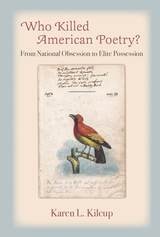
Who Killed American Poetry?
From National Obsession to Elite PossessionKaren L. Kilcup
University of Michigan Press, 2019
Conceptually and methodologically unique among studies of 19th-century American poetry, Who Killed American Poetry? not only charts changing attitudes toward American poetry, but also applies these ideas to the work of representative individual poets. Closely analyzing hundreds of reviews and critical essays, Karen L. Kilcup tracks the century’s developing aesthetic standards and highlights the different criteria reviewers used to assess poetry based on poets’ class, gender, ethnicity, and location. She shows that, as early as the 1820s, critics began to marginalize some kinds of emotional American poetry, a shift many scholars have attributed primarily to the late-century emergence of affectively restrained modernist ideals. Mapping this literary critical history enables us to more readily apprehend poetry’s status in American culture—both in the past and present—and encourages us to scrutinize the standards of academic criticism that underwrite contemporary aesthetics and continue to constrain poetry’s appeal.
Who American Killed Poetry? enlarges our understanding of American culture over the past two hundred years and will interest scholars in literary studies, historical poetics, American studies, gender studies, canon criticism, genre studies, the history of criticism, and affect studies. It will also appeal to poetry readers and those who enjoy reading about American cultural history.
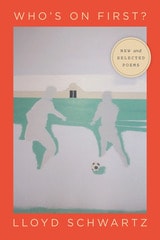
Who's on First?
New and Selected PoemsLloyd Schwartz
University of Chicago Press, 2021
For more than four decades, readers and critics have found Lloyd Schwartz’s poems unlike anyone else’s—a rare combination of the heartbreaking and the hilarious. With his ear for the poetry of the vernacular, Schwartz offers us a memorable cast of characters—both real and imagined, foolish and oracular. Readers experience his mother’s piercing flashes of memory, the perverse comic wisdom of Gracie Allen, the uninhibited yet loving exhibitionists of antique pornography, and eager travelers crossing America in a club-car or waiting in a Brazilian airport. Schwartz listens to these people without judging—understanding that they are all trying to live their lives, whenever possible, with tenderness, humor, and grace.
Who’s on First? brings together a selection of poems from all of Schwartz’s previous collections along with eagerly awaited new poems, highlighting his formal inventiveness in tangling and untangling the yarn of comedy and pathos. Underlying all of these poems is the question of what it takes and what it costs to make art.
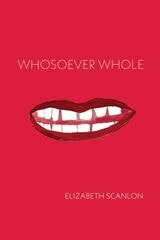
Whosoever Whole
Elizabeth Scanlon
Omnidawn, 2024
The poetry in Elizabeth Scanlon’s Whosoever Whole asks how we arrive at and nurture a sense of self amid a culture that wants us only to consume. Navigating the fractal and often fractured experiences of a citizen, a parent in the time of climate change, and a woman in an embattled era, Scanlon invites the reader into an interior space filled with anger, joy, wonder, and hope. Employing metaphor and metonymy, these poems portray a series of courageous portraits of the many faces a woman must wear to survive in today’s culture. Whosoever Whole is an anti-capitalist love song to all who refuse to be torn apart by the market valuation of their lives.
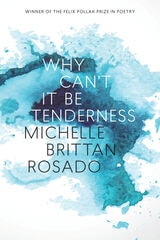
Why Can't It Be Tenderness
Michelle Brittan Rosado
University of Wisconsin Press, 2018
bring me back
to the in-between
where my breath
has always lived,
without containment,
like two legs pointing
toward the ocean, or these arms
reaching into sky
—excerpt from "Ode to the Double 'L'" Michelle Brittan Rosado. All rights reserved.
Why Dogs Stopped Flying
Kenneth Brewer
Utah State University Press, 2006
self-ironic. Yet, in this collection perhaps more than his earlier work, the particularity of the poet’s insight into the physical world and the warmth of his affection for it combine
to create an unexpected transcendence. Beasts and bodies are transformed in his lines, and our dim, unremarkable lives on this shadowed earth become somehow more
luminous—small words to the moon, small suns opening in the dark.
Why I Can't Read Wallace Stegner and Other Essays
A Tribal VoiceElizabeth Cook-Lynn
University of Wisconsin Press, 1996
This provocative collection of essays reveals the passionate voice of a Native American feminist intellectual. Elizabeth Cook-Lynn, a poet and literary scholar, grapples with issues she encountered as a Native American in academia. She asks questions of critical importance to tribal people: who is telling their stories, where does cultural authority lie, and most important, how is it possible to develop an authentic tribal literary voice within the academic community?
In the title essay, “Why I Can’t Read Wallace Stegner,” Cook-Lynn objects to Stegner’s portrayal of the American West in his fiction, contending that no other author has been more successful in serving the interests of the nation’s fantasy about itself. When Stegner writes that “Western history sort of stopped at 1890,” and when he claims the American West as his native land, Cook-Lynn argues, he negates the whole past, present, and future of the native peoples of the continent. Her other essays include discussion of such Native American writers as Michael Dorris, Ray Young Bear, and N. Scott Momaday; the importance of a tribal voice in academia, the risks to American Indian women in current law practices, the future of Indian Nationalism, and the defense of the land.
Cook-Lynn emphasizes that her essays move beyond the narrowly autobiographical, not just about gender and power, not just focused on multiculturalism and diversity, but are about intellectual and political issues that engage readers and writers in Native American studies. Studying the “Indian,” Cook-Lynn reminds us, is not just an academic exercise but a matter of survival for the lifeways of tribal peoples. Her goal in these essays is to open conversations that can make tribal life and academic life more responsive to one another.
Wicked Times
SELECTED POEMSAaron Kramer
University of Illinois Press, 2004
Wide Branches, Deep Roots
How Appalachian Wisdom Can Help in the Fight for a Sustainable FutureJessica M Jones
West Virginia University Press, 2026
To be Appalachian is to define oneself in terms of a place. Where we’re from plays a tremendous role in who we are, through storytelling about our homeplaces and the people who have loved them. However, what goes largely unaddressed is how this love of place can contribute to sustainability within the region, which has notoriously faced on-going environmental threats from extraction industries. The reality is that our relationship with the environment is thorny and intertwined with our identities, histories, and economic realities. The authors in the collection get down among the thorns to explore what sustainability means in Appalachia and how we can utilize the power of traditional folkways to achieve it.
This collection of over thirty pieces explores the connections between Appalachia’s stories, traditions, and modern events and the pathway to regional sustainability. The contributors — writers and scholars — examine how our definitions of sustainability have been formed, the power of education to encourage or inhibit it, and what moves are being made toward efficacy in the future. They also offer specific actions readers can take to better understand and build sustainability where they live.
Contributors: Greg Bealer, Luc Biscan-White, David Blackmore, Aysha Bodenhamer, Ivy Brashear, Matthew Calloway, Nicole Drewitz-Crockett, Christina Fisanick, Deborah Fleming, Amanda V. Garner, Karie Gunter-Seymour, Richard Hague, Amanda E. Hayes, Lockie Hunter, Jessica M. Jones, Kristen LeFevers, Sarah Long, Meghan Moore-Hubbard, Barbara Marie Minney, Jessica Radicic, Elizabeth Emmerth Rexroad, Barbara Sabol, Larry Smith, Patrice Stank, Taylor Nasim Stone, Paul Thomas, Elizabeth Tussey, and Betsy Weems.
Wilbur's Poetry
Music in a Scattering TimeBruce Michelson
University of Massachusetts Press, 2009
The first extended study of Wilbur's work in twenty-five years, Wilbur's Poetry explores the light poems, the darker mediations, the brilliant translations of Moliere and Racine, as well as the risks Wilbur has taken as an artist. There are chapters on Wilbur's unique use of language and his response to a vast poetic heritage, on form and closure and their thematic implications, and of Wilbur's place as a poet in a complex and "scattering" time.
Wild Child
Intensive Parenting and Posthumanist EthicsNaomi Morgenstern
University of Minnesota Press, 2018
Exploring how the figure of the “wild child” in contemporary fiction grapples with contemporary cultural anxieties about reproductive ethics and the future of humanity
In the eighteenth century, Western philosophy positioned the figure of “the child” at the border between untamed nature and rational adulthood. Contemporary cultural anxieties about the ethics and politics of reproductive choice and the crisis of parental responsibility have freighted this liminal figure with new meaning in twenty-first-century narratives.
In Wild Child, Naomi Morgenstern explores depictions of children and their adult caregivers in extreme situations—ranging from the violence of slavery and sexual captivity to accidental death, mass murder, torture, and global apocalypse—in such works as Toni Morrison’s A Mercy, Cormac McCarthy’s The Road, Lionel Shriver’s We Need to Talk about Kevin, Emma Donoghue’s Room, and Denis Villeneuve’s film Prisoners. Morgenstern shows how, in such narratives, “wild” children function as symptoms of new ethical crises and existential fears raised by transformations in the technology and politics of reproduction and by increased ethical questions about the very decision to reproduce. In the face of an uncertain future that no longer confirms the confidence of patriarchal humanism, such narratives displace or project present-day apprehensions about maternal sacrifice and paternal protection onto the wildness of children in a series of hyperbolically violent scenes.
Urgent and engaging, Wild Child offers the only extended consideration of how twenty-first-century fiction has begun to imagine the decision to reproduce and the ethical challenges of posthumanist parenting.
Wild Intelligence
Poets' Libraries and the Politics of Knowledge in Postwar AmericaM. C. Kinniburgh
University of Massachusetts Press, 2022
Information science was a burgeoning field in the early years of the Cold War, and while public and academic libraries acted as significant sites for the information boom, it is unsurprising that McCarthyism and censorship would shape what they granted readers access to and acquired. Wild Intelligence traces a different history of information management, examining the privately assembled collections of poets and their knowledge-building practices at midcentury.
Taking up case studies of four poets who began writing during the 1950s and 1960s, including Charles Olson (1910–1970), Diane di Prima (1934–2020), Gerrit Lansing (1928–2018), and Audre Lorde (1934–1992), M. C. Kinniburgh shows that the postwar American poet’s library should not just be understood according to individual books within their collection but rather as an archival resource that reveals how poets managed knowledge in a growing era of information overload. Exploring traditions and systems that had been overlooked, buried, occulted, or censored, these poets sought to recover a sense of history and chart a way forward.
Wild Rice Goose and Other Dishes of the Upper Midwest
John G. Motoviloff
University of Wisconsin Press, 2014
Wild Rice Goose also revives overlooked dishes popular in times past. If you have carp, redhorse, smelt, or turtle, dandelion greens or mulberries, you can turn these humble finds into tasty treats with tips from experienced fishermen and foragers. Cooks will appreciate the clear, kitchen-tested recipes, and fans of sporting literature will enjoy the lyrical writing.
You’ll find here:
• more than 100 recipes for wildfoods from asparagus to venison
• sidebars on regional foods, specialty preparations, and folk history
• tips on finding and cleaning game, fish, and wild edibles
• advice on freezing and drying
• a list of Upper Midwest wildfoods vendors.
Best Regional Special Interest Books, selected by the American Association of School Librarians
Best Regional General Interest Books, selected by the Public Library Reviewers
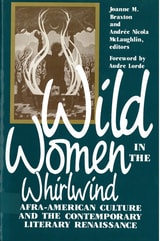
Wild Women in the Whirlwind
Afra-American Culture and the Contemporary Literary RenaissanceEdited by Joanne M. Braxton and Andree Nicola McLaughlin
Rutgers University Press, 1989
--New York Times Book Review
"The cultural and literary achievements of black American women are examined and celebrated in some 20 enjoyable, erudite essays by prominent scholars, critics, and activists."
--Publishers Weekly
This book is the first comprehensive collection of critical and theoretical essays to explore the literary and multi-cultural traditions of Black American women in many genres over a broad span of time. The essays explore cultural and literary experience in a wide context and offer a variety of critical theoretical constructs in which to view that experience. The editors have written excellent introductions providing both historical and comparative discussions of the contemporary literary renaissance. The book also includes a valuable bibliography of selected English-language works by Black women in the Americas from the 1970s to the present.
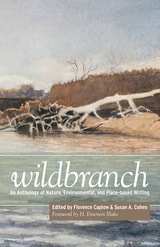
Wildbranch
An Anthology of Nature, Environmental, and Place-based WritingEdited by Florence Caplow and Susan A. Cohen. Foreword by H. Emerson Blake
University of Utah Press, 2010
Wildbranch: An Anthology of Nature, Environmental, and Place-based Writing is a powerful collection of mostly unpublished essays and poetry by both prominent American environmental writers and exciting new voices. The poetry and essays by more than fifty contributors offer the reader glimpses into places as diverse as a forest in West Africa, the moors of Ireland, the canyons of the Sonoran desert mountains, and the fields of New England, and they reflect the varied perspectives of field biologists, hunters, farmers, environmental educators, wilderness guides, academics, writers, and artists.
The collection is an intimate portrait of the natural world drawn through the wisdom, ecological consciousness, and open hearts of these exceptional contributors. The Wildbranch Writing Workshop, cosponsored by Orion magazine and Sterling College, has encouraged thoughtful natural history, outdoor, and environmental writing for more than twenty years. The Wildbranch faculty has included its founder E. Anne Proulx, the essayists Edward Hoagland, Janisse Ray, and Scott Russell Sanders, the poet Alison Hawthorne Deming, and many other notable authors. Many have work included in the anthology.
Winner of the New Mexico Book Association's Southwest Book Design & Production Awards for Excellence in the category Trade Books: Non-illustrated.
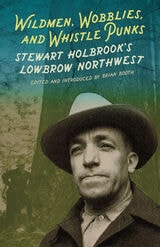
Wildmen, Wobblies, and Whistle Punks
Stewart Holbrook's Lowbrow NorthwestBrian Booth
Oregon State University Press, 0
Stewart Holbrook was a high school dropout who emerged from logging camps to become the author of three dozen books, the Pacific Northwest’s foremost storyteller, one of the nation’s most popular historians, and a satirical painter known as “Mr. Otis.”
Today readers are rediscovering Holbrook’s colorful and irreverent accounts of Pacific Northwest history. Wildmen, Wobblies, and Whistle Punks collects twenty-six of Holbrook’s best writings about the region. Combining solid scholarship with humor and a gift for celebrating the offbeat, Holbrook’s stories record a vibrant, often overlooked side of Northwest history. Here are forgotten scandals and murders; stories of forest fires, floods, and other calamities; tales of loggers and life in the logging camps; and profiles of various lowbrow characters—radicals, do-gooders, dreamers, schemers, and zealots.
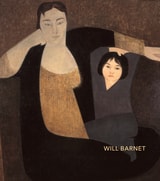
Will Barnet
Will Barnet
The Artist Book Foundation, 2024
The first monograph on Will Barnet in nearly 40 years, this title reflect's the artist's unique interpretation of the world's evolving genres.
Will Barnet’s artistic career as a painter and printmaker spanned nearly eight decades of continuous creativity. Few artists, other than perhaps Picasso or Monet, can claim such an extended period of uninterrupted and innovative art making. From the darkness of the Great Depression to the opening decade of the twenty-first century, his oeuvre reflects his unique interpretation of the art world’s evolving genres: Social Realism, Modernism, Abstract Expressionism, and ultimately representational Minimalism with the human figure as his primary subject.
This book is the first comprehensive monograph on Will Barnet in nearly 40 years. With scholarly essays by the four distinguished authors, an extensive plate section, a comprehensive chronology, lists of awards and exhibitions, and a detailed bibliography, this monograph is a thorough presentation of Barnet's iconic images and consistently evolving style while celebrating his unquenchable joie de vivre.
Barnet was devoted to making art every day and worked diligently even at the very end of his life. "The Old Masters are still alive after 400 years, and that's what I want to be," he once said. "At the age of 10 or 12, I discovered that being an artist would give me an ability to create something which would live on after death." Live on it does; in addition to his acclaimed body of work, he influenced a broad spectrum of artists such as Jackson Pollock, Mark Rothko, James Rosenquist, Cy Twombly, and Ethel Fisher.
Willa Cather and Material Culture
Real-World Writing, Writing the Real WorldEdited by Janis P. Stout
University of Alabama Press, 2004
Willa Cather and Material Culture is a collection of 11 new essays that tap into a recent and resurgent interest among Cather scholars in addressing her work and her career through the lens of cultural studies. One of the volume's primary purposes is to demonstrate the extent to which Cather did participate in her culture and to correct the commonplace view of her as a literary connoisseur set apart from her times.
The contributors explore both the objects among which Cather lived and the objects that appear in her writings, as well as the commercial constraints of the publishing industry in which her art was made and marketed. Essays address her relationship to quilts both personally and as symbols in her work; her contributions to domestic magazines such as Home Monthly and Woman's Home Companion; the problematic nature of Hollywood productions of her work; and her efforts and successes as a businesswoman. By establishing the centrality of material matters to her writing, these essays contribute to the reclaiming of Cather as a modernist and highlight the significance of material culture, in general, to the study of American literature.
Willa Cather and Others
Jonathan Goldberg
Duke University Press, 2001
The “others” referred to in the title are women, for the most part Cather’s contemporaries, whose artistic projects allow for points of comparison with Cather. They include the Wagnerian diva Olive Fremstad, renowned for her category-defying voice; Blair Niles, an ethnographer and novelist of jazz-age Harlem and the prisons of New Guinea; Laura Gilpin, photographer of the American Southwest; and Pat Barker, whose Regeneration trilogy places World War I writers—and questions of sexuality and gender—at its center. In the process of studying these women and their work, Goldberg forms innovative new insights into a wide range of Cather’s celebrated works, from O Pioneers! and My Ántonia to her later books The Song of the Lark, One of Ours, The Professor’s House, Death Comes for the Archbishop, and Sapphira and the Slave Girl.
By applying his unique talent to the study of Cather’s literary genius, Jonathan Goldberg makes a significant and new contribution to the study of American literature and queer studies.
Willem de Kooning Nonstop
Cherchez la femmeRosalind E. Krauss
University of Chicago Press, 2016
Krauss demonstrates that contrary to popular conceptions of de Kooning as an artist who painted chaotically only to finish abruptly, he was in fact constantly reworking the same subject based on a compositional template. This template informed all of his art and included a three-part vertical structure; the projection of his male point of view into the painting or sculpture; and the near-universal inclusion of the female form, which was paired with her redoubled projection onto his work. Krauss identifies these elements throughout de Kooning’s oeuvre, even in his paintings of highways, boats, and landscapes: Woman is always there. A thought-provoking study by one of America’s greatest art critics, Willem de Kooning Nonstop revolutionizes our understanding of de Kooning and shows us what has always been hiding in plain sight in his work.
William Burroughs and the Secret of Fascination
Oliver Harris
Southern Illinois University Press, 2006
Unraveling the mysteries of Naked Lunch, exploring the allure of fascination
William Burroughs is both an object of widespread cultural fascination and one of America’s great writers. In this study, Oliver Harris elucidates the complex play of secrecy and revelation that defines the allure of fascination. Unraveling the mystifications of Burroughs the writer, Harris discovers what it means to be fascinated by a figure of major cultural influence and unearths a secret history behind the received story of one of America’s great original writers.
In William Burroughs and the Secret of Fascination, Harris examines the major works Burroughs produced in the 1950s—Junky, Queer, The Yage Letters, and Naked Lunch—to piece together an accurate, material record of his creative history during his germinal decade as a writer. Refuting the “junk paradigm” of addiction that has been used to categorize and characterize much of Burroughs’ oeuvre, Harris instead focuses on the significance of Burroughs’ letter writing and his remarkable and unsuspected use of the epistolary for his fiction. As Burroughs said to Allen Ginsberg about Naked Lunch, “the real novel is letters to you.” Drawing on rare access to manuscripts, the book suggests new ways of comprehending Burroughs’s unique politics and aesthetics and offers the first accurate account of the writing of Naked Lunch.
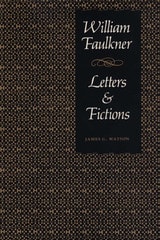
William Faulkner, Letters & Fictions
By James G. Watson
University of Texas Press, 1989
Besides the groundbreaking novels and stories that brought him fame, William Faulkner throughout his life wrote letters—to his publisher, his lovers, his family, and his friends. In this first major study of epistolarity in Faulkner's work, James G. Watson examines Faulkner's personal correspondence as a unique second canon of writing, separate from his literary canon with its many fictional letters but developing along parallel lines. By describing the similarity of forms and conventions in Faulkner's personal and fictional correspondence, Watson clearly demonstrates that Faulkner's personal experience as a writer of letters significantly shaped his imaginative work early and late.
Letters are always about themselves; they re-create a world between the sender and the receiver. In this illuminating study, Faulkner's personal letters are treated as a form of reflexive writing: first-person narratives in which Sender self-consciously portrays Self to a specific Receiver, likewise portrayed in the letter-text. This duality of actual experience and imaginative re-creation measures the personal distances between the life of the writer and the written self-image. It reveals that letters are at once fragments of autobiography and fictions of self.
Such "laws of letters" apply equally to the letters that appear throughout Faulkner's novels and stories. The twenty-one letters and telegrams in The Sound and the Fury, for example, portray character, propel plot, and convey important themes of failed communication and broken identity. From Soldiers' Pay to his last work, Faulkner's carefully lettered canon of fiction is dramatic evidence of his understanding of epistolarity and of the extent to which he adapted letters, including some of his own, to shape his fictional world.
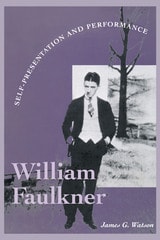
William Faulkner
Self-Presentation and PerformanceBy James G. Watson
University of Texas Press, 2000
In his life and writings, William Faulkner continually created and "performed" selves. Even in letters, he often played a part—gentleman dandy, soldier, farmer—while in his fictions these and other personae are counterpoised against one another to create a world of controlled chaos, made in Faulkner's own protean image and reflective of his own multiple sense of self.
In this groundbreaking book, James Watson draws on the entire Faulkner canon, including letters and photographs, to decipher the complicated ways in which Faulkner put himself forth as the artist he felt himself to be through written performances and displays based on the life he actually lived and the ones he imagined living. The topics Watson treats include the overtly performative aspects of The Sound and the Fury, self-presentation and performance in private records of Faulkner's life, the ways in which his complicated marriage and his relationships to male mentors underlie his fictions' recurring motifs of marriages and fatherhood, Faulkner's readings of Melville, Hawthorne, and Thoreau and the problematics of authorial sovereignty, his artist-as-God creation of a fictional cosmos, and the epistolary relationships with women that lie in the correspondence behind Requiem for a Nun.
William Faulkner
Six Decades of CriticismLinda Wagner-Martin
Michigan State University Press, 2002
Few twentieth-century writers are as revered as William Faulkner. This collection brings together the best literary criticism on Faulkner from the last six decades, detailing the imaginative and passionate responses to his still-controversial novels. By focusing on the criticism rather than the works, Linda Wagner-Martin shows the primary directions in Faulkner’s influence on critics, writers, and students of American literature today. This invaluable volume reveals the patterns of change in literary criticism over time, while exploring the various critical streams—language theory, feminism, deconstruction, and psychoanalysis—that have elevated Faulkner’s work to the highest rank of the American literary pantheon.
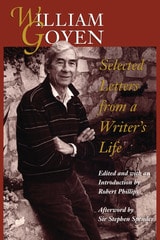
William Goyen
Selected Letters from a Writer’s LifeBy William Goyen
University of Texas Press, 1995
Proclaimed "one of the great American writers of short fiction" by the New York Times Book Review, William Goyen (1915-1983) had a quintessentially American literary career, in which national recognition came only after years of struggle to find his authentic voice, his audience, and an artistic milieu in which to create. These letters, which span the years 1937 to 1983, offer a compelling testament to what it means to be a writer in America.
A prolific correspondent, Goyen wrote regularly to friends, family, editors, and other writers. Among the letters selected here are those to such major literary figures as W. H. Auden, Archibald MacLeish, Joyce Carol Oates, William Inge, Elia Kazan, Elizabeth Spencer, and Katherine Anne Porter.
These letters constitute a virtual autobiography, as well as a fascinating introduction to Goyen's work. They add an important chapter to the study of American and Texas literature of the twentieth century.
William March
An Annotated ChecklistRoy S. Simmonds
University of Alabama Press, 1988
This deeply researched reference includes both primary materials, an exhaustive checklist of the forms and editions of each of March’s works, and secondary materials, which include plays and films adapted from March’s writing, biographical and critical articles, doctoral dissertations, and contemporary reviews of March’s work.
The reissue in 2015 of the novels in his Pearl County series—Come in at the Door, The Tallons, and The Looking-Glass—is part of a fresh wave of interest in March, one of the most influential American writers from the mid-1930s until his death in 1954.

William Maxwell
A Literary LifeBarbara A. Burkhardt
University of Illinois Press, 2004
Known as a beloved, longtime fiction editor at The New Yorker, William Maxwell worked closely with such legendary writers as Vladimir Nabokov, John Updike, Mary McCarthy, and John Cheever. His own novels include They Came Like Swallows and the American Book Award-winning So Long, See You Tomorrow, and many consider him to be one of the twentieth century's most important writers. Barbara Burkhardt's William Maxwell: A Literary Life represents the first major critical study of this Illinois writer's life and work.
Writing with an economy and elegance befitting her subject, Burkhardt addresses Maxwell's highly autobiographical fiction by skillfully interweaving his biography with her own critical interpretations. She contextualizes his fiction in terms of events including his mother's early death from influenza, his marriage, and the role of his psychoanalysis under the guidance of Theodor Reik. Drawing on a wide range of previously unavailable material, Burkhardt includes letters Maxwell received from authors such as Eudora Welty and Louise Bogan, excerpts from his unpublished manuscripts and correspondence, and her own interviews with Maxwell and key figures from his life, including John Updike, Roger Angell, New Yorker fiction editor Robert Henderson, and Maxwell's family and friends.
William S. Burroughs At the Front
Critical Reception, 1959 - 1989Jennie Skerl
Southern Illinois University Press, 1991
Jennie Skerl and Robin Lydenberg have selected twenty-five critical essays on Burroughs that reflect the historical reception of his work, both positive and negative, decade by decade, and that represent the best essays written about him.
The essays cover Burroughs’ major novels—including the cut-up and new trilogies—the censorship issue, and his work in film and painting. The chronological organization brings into critical focus the shift from moral questions raised by the novels’ content, through examinations of Burroughs’ relationship to humanism and modernism, and finally to more focused literary and linguistic issues. In their introduction, the editors survey the progress of Burroughs’ critical reception and examine the reasons for the varied and intense responses to the work and the theoretical assumptions behind those responses.
The reviewers include prominent figures such as Mary McCarthy and Marshall McLuhan as well as major academic critics such as Cary Nelson, Tony Tanner, and Ihab Hassan.
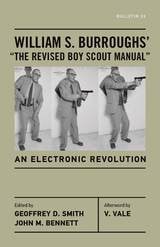
William S. Burroughs' "The Revised Boy Scout Manual"
An Electronic RevolutionEdited by Geoffrey D. Smith & John M. Bennett with an afterword by V. Vale
The Ohio State University Press, 2018
The Revised Boy Scout Manual was a work Burroughs revisited many times, but which has never before been published in its complete form. Based primarily on recordings of a performance of the complete piece found in the archives at the OSU libraries, as well as various incomplete versions of the typescript found at Arizona State University and the New York Public Library archives, this lost masterpiece of satiric subversion is finally available in its entirety.

William Styron
Melvin J. Friedman
University of Wisconsin Press, 1974
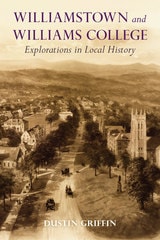
Williamstown and Williams College
Explorations in Local HistoryDustin Griffin
University of Massachusetts Press, 2018
Well researched and written in an accessible style, Williamstown and Williams College is a must-have resource for anyone connected with Williams College—from students and parents to alumni—as well as visitors who want to understand what makes this town unique.
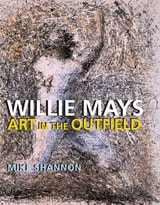
Willie Mays
Art in the OutfieldMike Shannon
University of Alabama Press, 2007
As much as any other sports figure, Willie Mays embodies the changes that racial integration brought to America’s game fields and its larger culture in the mid-20th century. Playing baseball with grace, skill, flair, and obvious delight, Willie Mays broke color barriers for more than just himself. He combined the ability to stroke majestic home runs while with an equal ability to outrun and catch what would have been home runs for opponents most famously when he turned Vic Wertz’s titantic blast into a long out in the 1954 World Series. As is often said of great players but never more true than in his case, Willie Mays could do it all.
Assembled in this work are 40 representations of how contemporary artists respond to and portray the skill, fame, and sheer love of the game that make Mays so remarkable and memorable. The art includes a broad range of styles and media from impressionistic graphite pencil drawings on paper through realistic Kodachrome photographic prints to expressionistic colored acrylics on canvas or glass. Mike Shannon offers a perceptive introductory essay on Mays’s long career and places the art in the context of his times. First curated as a traveling exhibit to honor Willie Mays’s 75th birthday, the exhibit opened at the Louisville Slugger Museum in Louisville, Kentucky, and is currently on tour.
Willow Hammer
Patrick Donnelly
Four Way Books, 2025
In response to this crime, Donnelly traces the consequences of ignorance, denial, bargaining, complicity, and finally revelation that reverberated through his and his loved ones’ lives for five decades. His discovery of this catalyzing violation not only recontextualizes the siblings’ shared history, but inflects the present as—finding analogues of his sister’s abuse in the classical canon—he remembers his escape from home into spiritual disciplines and the study of dead languages. Revisiting the evolution of his own sexuality, he remembers singing a Byrd Mass after a night at a gay bathhouse, characterizing the tenor and bass as “two wrestling saints,” “lowest of the four voices— / once I thought I saw them kiss each other’s faces.”
And that—recovering glimpses of his sister’s unknowable interiority, reckoning with a truth that is unbearable and inescapable—is this book’s difficult and endless work. In the wake of a particular kind of harm, Willow Hammer seems to suggest, justice may be a wishful concept—but that doesn’t preclude testimony and salvage. “Now” documents the poet’s arrival at this compromise: “I remember my / little sister that was, / little willow of glass / upon whom he laid / his hammer hands.” There is no revocation of the hands, but with tenderness, wit, and fury, Donnelly’s lyrics refuse to let their shadow obscure his sister’s recovery of her own agency.
Win These Posters and Other Unrelated Prizes Inside
Norma Cole
Omnidawn, 2012
Windows and Doors
A Poet Reads Literary TheoryNatasha Saje
University of Michigan Press, 2014
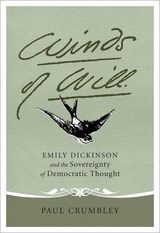
Winds of Will
Emily Dickinson and the Sovereignty of Democratic ThoughtPaul Crumbley
University of Alabama Press, 2010
A sophisticated literary analysis positioning Emily Dickinson’s poetry within the framework of democratic thought and individual sovereignty.
In this study, Paul Crumbley asserts that, contrary to popular opinion, Emily Dickinson consistently communicated political views through her poetry. Dickinson’s life of self-isolation—today her most notable personal characteristic—by no means extended into the political sphere, he argues. While she rarely addressed political issues directly and was curiously disengaged from the liberal causes and female reform movements of her time, Dickinson’s poems are deeply rooted both in matters of personal sovereignty and reader choice. The significant choices Dickinson extends to the reader underscore the democratic dimensions of reading her work, and of reading itself as a political act.
Crumbley employs close readings of Dickinson’s poems and letters, highlighting the many changing—and often contradictory—voices in her work, both throughout her oeuvre and in individual poems themselves. In Dickinson’s letters Crumbley finds just as many unique and conflicting voices; thus, both her personal correspondence and the poems make political demands by placing the burden of interpretation on the reader.
Rather than reflecting explicit political values, Dickinson’s work chronicles an ongoing decision-making process that magnifies the role of individual choice, not the advocacy of specific outcomes. In the end, Dickinson’s readers must either accept an isolated lyric subjectivity or invest that subjectivity with the substance necessary for engagement with the larger world.

Windy McPherson's Son
Sherwood Anderson
University of Illinois Press, 1993
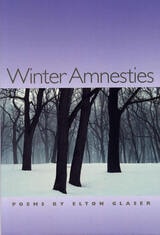
Winter Amnesties
Elton Glaser
Southern Illinois University Press, 2000
Winter Amnesties is a book of origins and endings, griefs and reconciliations. Each poem addresses the dilemma posed by G. K. Chesterton: “One must somehow find a way of loving the world without trusting it.” The poems revisit the past, assess the present, and stare hard into the future. At middle age, Glaser remembers his youth in Louisiana and settles into the long stretch of his adult years in Ohio; he makes his peace with “the life that allows.” As son, as father, as poet, he looks to his legacy, whatever dim remnant of himself might continue after “all flesh falls back to salt and cinder.”
But these are poems of brio and bitter wit, not of self-pity and surrender. They take a jaunty stance towards life and welcome whatever the days may bring, confident that, like crows in the harvest cornfield, we can live on “the shocks and waste of this world” and “wring gold grain from the ruin.”
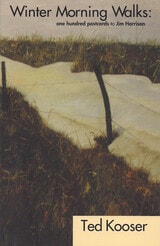
Winter Morning Walks
100 Postcards to Jim HarrisonTed Kooser
Carnegie Mellon University Press, 2001
In the late 1990s, when poet Ted Kooser was recovering from cancer surgery, he started sending postcards to his friend Jim Harrison, a novelist known for Legends of the Fall and numerous other books. On each postcard, he wrote a poem. Harrison did the same in return. In 2001, Kooser turned his half of the exchange into Winter Morning Walks: 100 Postcards to Jim Harrison, a collection of engaging, witty, clever, insightful poems that serve simultaneously as snapshots of a friendship and a view into a poet's daily observations.
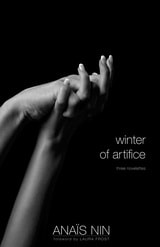
Winter of Artifice
Three NovelettesAnaïs Nin
Ohio University Press, 2016
Swallow Press first published Winter of Artifice in 1945, following two vastly different versions from other presses. The book opens with a film star, Stella, studying her own, but alien, image on the screen. It ends in the Manhattan office of a psychoanalyst—the Voice—who, as he counsels patients suffering from the maladies of modern life, reveals himself as equally susceptible to them. The middle, title story explores one of Nin’s most controversial themes, that of a woman’s sexual relationship with her father. Elliptical, fragmented prose; unconventional structure; surrealistic psychic landscapes—Nin forged these elements into a style that engaged with the artistic concerns of her time but still registers as strikingly contemporary.
This reissue, accompanied by a new introduction by Laura Frost and the original engravings by Nin’s husband Ian Hugo, presents an important opportunity to consider anew the work of an author who laid the groundwork for later writers. Swallow Press’s Winter of Artifice represents a literary artist coming into her own, with the formal experimentation, thematic daring, and psychological intrigue that became her hallmarks.
Winterkill
Todd Davis
Michigan State University Press, 2016

Wisconsin Cocktails
Jeanette Hurt
University of Wisconsin Press, 2020
Beyond delving into mythic origins of several classic creations, Jeanette Hurt introduces a new generation of cocktails that offer a spin on standard concoctions. She explores the state’s unique farm-to-table ethos influenced by an abundance of locally sourced ingredients. Also included are a wealth of interviews with notable mixologists, sharing numerous favorite recipes for specialty pick-me-ups that connoisseurs and home bartenders alike will be clamoring to try. A definitive account of the beverages we love, Wisconsin Cocktails insists we order our Old Fashioneds the right way—with brandy.
Wisconsin Indian Literature
Anthology of Native VoicesEdited by Kathleen Tigerman; Foreward by Jim Ottery
University of Wisconsin Press, 2006
Literature of the Indian Nations of Wisconsin is a unique anthology that presents the oral traditions, legends, speeches, myths, histories, literature, and historically significant documents of the current twelve independent bands and Indian Nations of Wisconsin. Kathleen Tigerman sought input from tribe elders and educators to provide an accurate chronological portrait of each nation, including the Siouan Ho-Chunk; the Algonquian Menominee, Ojibwe, and Potawatomi; and three groups originally from what is now New York State: the Iroquoian Oneida, the Stockbridge-Munsee band of the Mohican Nations, and the Brothertown Nation.
Some of these works feature a cultural hero or refer to very ancient times—more than six thousand years ago—and others are contemporary. These pieces focus on issues of Wisconsin Native communities by sharing Native knowledge and dialogue about sovereignty, decolonization, cultural genocide, forced removals, assimilation, and other concerns.
This anthology introduces us to a vivid and unforgettable group of voices, enhanced by many maps, photographs, and chronologies. Literature of the Indian Nations of Wisconsin fosters cross-cultural understanding among non-Native readers and the people of the First Nations.
With Music and Justice for All
Some Southerners and Their PassionsFrye Gaillard
Vanderbilt University Press, 2008
But Gaillard examines the South from other angles as well--the religious heritage, for example, that once led Flannery O'Connor to write about a "Christ-haunted" South. We meet Billy Graham, the greatest evangelist of his time, who admitted in the course of interviews with Gaillard that his ministry represented a "very narrow gift." There are profiles here of the Southern Baptist renegade Will Campbell and former President Jimmy Carter, whose commitment to his own understanding of Christianity has sometimes led him into controversy. Gaillard writes also about the revealing power of Southern music--how the great Johnny Cash, for example, became a force for reconciliation in America. In the final section of the book we meet some of the characters Gaillard has covered through the years, including John T. Scopes, whose final public appearance Gaillard wrote about as a young reporter in Nashville.
With Strings
Charles Bernstein
University of Chicago Press, 2001
Charles Bernstein is perhaps best known as one of the founders of the L=A=N=G=U=A=G=E poetry movement of the 1970s. He remains one of America's liveliest advocates and practitioners of radically inventive poetry. The title of his new collection, With Strings, suggests the lush arrangement of a musical work as well as the unacknowledged implications of our everyday agreements. Just as language binds us together with its associated meanings, With Strings bounces against the ties that rend us apart as they fasten us together. From his samplings of everyday life, to his demented yet sonorous iambic beats, Bernstein has once again created a poetry of our time, for our time, and by our time.
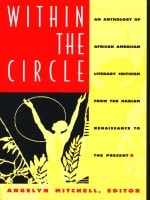
Within the Circle
An Anthology of African American Literary Criticism from the Harlem Renaissance to the PresentAngelyn Mitchell
Duke University Press, 1994
The essays in this collection—many of which are not widely available today—either initiated or gave critical definition to specific periods or movements of African American literature. They address issues such as integration, separatism, political action, black nationalism, Afrocentricity, black feminism, as well as the role of art, the artist, the critic, and the audience. With selections from Langston Hughes, Sterling Brown, W. E. B. DuBois, Zora Neale Hurston, Richard Wright, James Baldwin, Toni Morrison, Barbara Smith, Alice Walker, Henry Louis Gates, Jr., and many others, this definitive collection provides a dynamic model of the cultural, ideological, historical, and aesthetic considerations in African American literature and literary criticism.
A major contribution to the study of African American literature, this volume will serve as a foundation for future work by students and scholars. Its importance will be recognized by all those interested in modern literary theory as well as general readers concerned with the African American experience.
Selections by (partial list): Houston A. Baker, Jr., James Baldwin, Sterling Brown, Barbara Christian, W. E. B. DuBois, Ralph Ellison, LeRoi Jones, Sarah Webster Fabio, Henry Louis Gates, Jr., W. Lawrence Hogue, Langston Hughes, Zora Neale Hurston, Alain Locke, Deborah E. McDowell, Toni Morrison, J. Saunders Redding, George Schuyler, Barbara Smith, Valerie Smith, Hortense J. Spillers, Robert B. Stepto, Alice Walker, Margaret Walker, Mary Helen Washington, Richard Wright
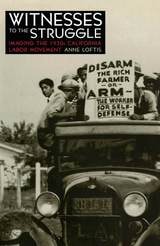
Witnesses to the Struggle
Imaging the 1930s California Labor MovementAnne Loftis
University of Nevada Press, 2014
In this groundbreaking interdisciplinary study, Loftis examines the artists who put a human face on the farmworkers’ plight in California during the Great Depression, focusing on writer John Steinbeck, photographer Dorothea Lange, sociologist and author Paul Taylor, and journalist Carey McWilliams. Loftis probes the interplay between journalism and art in the 1930s, when both academics and artists felt an urgent need to be relevant in the face of enormous misery. The power of their work grew out of their personal involvement in both the labor struggles and the hardships endured by workers and their families. Steinbeck, Lange, and the other artists and intellectuals in their circles created the public images of their times. Works such as The Grapes of Wrath or Lange’s Migrant Mother actually helped mold public opinion and form government policies. Even today these works remain icons in our shared perception of that era. Loftis helps us understand why this art still seems the truest representation of those desperate times, three-quarters of a century later.
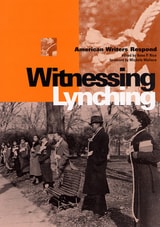
Witnessing Lynching
American Writers RespondEdited by Anne P. Rice
Rutgers University Press, 2003
Witnessing Lynching: American Writers Respond is the first anthology to gather poetry, essays, drama, and fiction from the height of the lynching era (1889–1935). During this time, the torture of a black person drew thousands of local onlookers and was replayed throughout the nation in lurid newspaper reports. The selections gathered here represent the courageous efforts of American writers to witness the trauma of lynching and to expose the truth about this uniquely American atrocity. Included are well-known authors and activists such as Frederick Douglass, W.E.B. Du Bois, Langston Hughes, Ida B. Wells, and Theodore Dreiser, as well as many others. These writers respond to lynching in many different ways, using literature to protest and educate, to create a space of mourning in which to commemorate and rehumanize the dead, and as a cathartic release for personal and collective trauma. Their words provide today’s reader with a chance to witness lynching and better understand the current state of race relations in America.
An introduction by Anne P. Rice offers a broad historical and thematic framework to ground the selections.
Wolf Lake, White Gown Blown Open
PoemsDiane Seuss
University of Massachusetts Press, 2010
Diane Seuss's poems grow out of the fertile soil of southwest Michigan, bursting any and all stereotypes of the Midwest and turning loose characters worthy of Faulkner in their obsession, their suffering, their dramas of love and sex and death. The first section of this collection pays homage to the poet's roots in a place where the world hands you nothing and promises less, so you are left to invent yourself or disappear. From there these poems both recount and embody repeated acts of defiant self-creation in the face of despair, loss, and shame, and always in the shadow of annihilation.
With darkly raucous humor and wrenching pathos, Seuss burrows furiously into liminal places of no dimension— state lines, lakes' edges, the space “between the m and the e in the word amen.” From what she calls “this place inbetween” come profane prayers in which "the sound of hope and the sound of suffering" are revealed to be “the same music played on the same instrument.”
Midway through this book, a man tells the speaker that beauty is that which has not been touched. This collection is a righteous and fierce counterargument: in the world of this imagination, beauty spills from that which has been crushed, torn, and harrowed. “We receive beauty,” Seuss writes, “as a nail receives / the hammer blow.” This is the poetry that comes only after the white dress has been blown open—the poetry of necessity, where a wild imagination is the only hope.
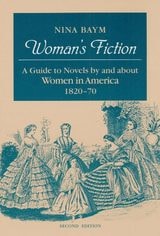
Woman's Fiction
A Guide to Novels by and about Women in America, 1820-70Nina Baym. With a New Introduction and Supplementary Bibliography
University of Illinois Press, 1993
This reissue of the pioneering and standard book on antebellum women's domestic novels contains a new introduction situating the book in the context of important recent developments in the study of women's writing. Nina Baym considers 130 novels by 48 women, focusing on the works of a dozen especially productive and successful writers.
Woman's Fiction is a major-work in nineteenth-century literature, reexamining changes in the literary canon and the meaning of sentimentalism, while responding to current critical discussions of 'the body' in literary texts.
Women Artists, Women Exiles
"Miss Grief" and Other Stories by Constance Fenimore WoolsonEdited by Joan Myers Weimar
Rutgers University Press, 1988
Woolson's early stories are witty and incisive critiques of those conventions of literary Romanticism that encode women's marginality. Set in the wilderness that surrounded the Great Lakes, these stories revise male literary texts to clear a space where women's voices can be heard.
In a group of stories set in the post-Civil War south, women artists are shown as exiles both away from their homes and from themselves. One superb tale, "Felipa," pairs a repressed woman artist with a wild child who rejects both patriarchal religion and approved heterosexual behavior. Woolson here explores the possibility of a collaboration between female wildness and female form of control.
Stories written during Woolson's years in Europe confront woman artists with successful male writers and critics who resemble Henry James. These carefully crafted stories reflect James's mixed impact on women artists: as a model literary realist and as a subtle denigrator of women's talent.
Joan Weimar's introduction uses unpublished letters to reconstruct and interpret Wool's life and her probable suicide. It places Woolson in the male and female literary traditions of her time and offers extended analysis of the stories.