Results by title
5550 books match the query 'Biography & Autobiography' and 258 start with w
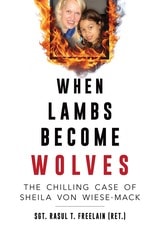
When Lambs Become Wolves
The Chilling Case of Sheila von Wiese-MackSgt. Rasul T. Freelain (Ret.)
Southern Illinois University Press, 2026
A bold firsthand account of the circumstances surrounding the notorious Bali “Suitcase Murder” and the human cost of overlooking child-to-parent violence and abuse
On August 12, 2014, the body of 62-year-old Sheila von Wiese-Mack—the wealthy Oak Park, Illinois, widow of famed composer James L. Mack—was found stuffed inside a suitcase in the trunk of a taxi in Bali. Back in the Midwest, listening to the radio, Sgt. Rasul Freelain of the Oak Park Police Department pulled his car over to absorb the unthinkable news. Amid his shock, one coherent thought surfaced: “Heather did this.”
Freelain had met the Macks more than three years earlier, when Sheila first reached out to the police for help with her increasingly volatile daughter. Although Heather Mack was just a teenager, she had already displayed a disturbing pattern of escalating violence. Freelain did everything he could to intervene. But as the abuse worsened, he found himself sidelined by a justice system unprepared to deal with child-to-parent violence and abuse (CPVA).
In this gripping and empathetic memoir, Freelain traces the Mack family’s descent from privilege to tragedy, bringing overdue attention to CPVA as a critical yet overlooked public health crisis. He recounts the glamorous but troubled world of the Macks—the parties, the talent, the dysfunction—and his efforts to support both mother and daughter. With rare insight into the web of trauma, race, wealth, and grief that surrounded them, he shows how the system failed them both—and how, even after Sheila’s death, he remained committed to seeking justice and change.
When Lambs Become Wolves moves beyond sensational headlines to examine the roots of one of America’s most hidden forms of domestic violence. While media coverage fixated on the exotic setting and shocking brutality of the crime, along with the growing notoriety of the teenage killer, Freelain urges readers—and institutions in law enforcement, child welfare, and mental health—to focus instead on those harmed. Sheila was more than a victim; she was a sharp, compassionate, creative woman who loved her daughter to the very end. Through meticulous research and raw personal reflection, Freelain explores how abuse cycles form, how institutions look away, and what it means to try—and fail—to protect someone in crisis.
This memoir, with a foreword by Sheila’s brother William Wiese, is a call to action, offering a rare blend of true crime, compassion, and advocacy. This deeply human account of a police officer caught in an impossible situation shows the price of ignoring the violence that starts at home.
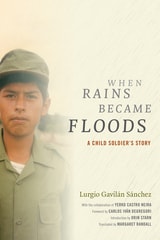
When Rains Became Floods
A Child Soldier's StoryLurgio Gavilán Sánchez
Duke University Press, 2015
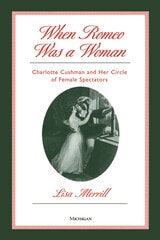
When Romeo Was a Woman
Charlotte Cushman and Her Circle of Female SpectatorsLisa Merrill
University of Michigan Press, 2000
Lisa Merrill examines Cushman's personal correspondence to shed new light on the actress's relationships and in turn on our understandings of the nature of women's "romantic friendships." She demonstrates how Cushman's androgynous presence served as a symbol to many of her contemporaries, and revealed their multiple and often contradictory attitudes toward female performers, women, and the unspeakable possibilities of same-sex desire.
The biography draws upon unpublished archival material as well as on current critical work to view Cushman's career, relationships, and posthumous reception. When Romeo Was a Woman examines as autobiographical performance Cushman's own narratives, the stories she authorized others to write, and the letters she wrote to intimates. The book is richly illustrated with many previously unpublished portraits of Cushman in her various stage roles, including Romeo and Lady Macbeth, and other revealing photographs of her family, lovers and friends.
When Romeo Was a Woman will find an appreciative audience among general readers as well as specialists in gay/lesbian history, women's history, theater and performance, popular culture, Victorian studies, and American studies.
"A fascinating story, and a major contribution to our understanding of lesbian history. . . . The work done on archival resources is both impressive in its extent and wholly convincing in its effect." --Jacky Bratton, University of London
Lisa Merrill is Associate Professor of Communication and Performance Studies, Hofstra University. She is the coauthor of The Power to Communicate: Gender Differences as Barriers, and the author of Untying the Tongue: Power, Gender, and the Word, forthcoming.

When You Dare to Say Yes
Jill Derby and Nevada ActivismJill Derby
University of Nevada Press, 2024
Derby’s account of the awakening of her post-college experience living abroad and stories of her global travels infuse this memoir with an international perspective and entertaining vignettes. Ultimately, Derby shares her personal understanding of the transformative power of living among different cultures.
When You Learn the Alphabet
Kendra Allen
University of Iowa Press, 2019
These dynamics strive for some semblance of accountability, and the essays within this collection are used as displays of deep unlearning and restoring—balancing trauma and humor, poetics and reality, forgiveness and resentment.
When You Learn the Alphabet allots space for large moments of tenderness and empathy for all black bodies—but especially all black woman bodies—space for the underrepresented humanity and uncared for pain of black girls, and space to have the opportunity to be listened to in order to evolve past it.
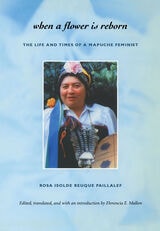
When a Flower Is Reborn
The Life and Times of a Mapuche FeministRosa Isolde Reuque Paillalef, Edited, translated, and with an introduction by Florencia E. Mallon
Duke University Press, 2002
A leading activist during the Pinochet dictatorship, Reuque—a woman, a Catholic, and a Christian Democrat—often felt like an outsider within the male-dominated, leftist Mapuche movement. This sense of herself as both participant and observer allows for Reuque’s trenchant, yet empathetic, critique of the Mapuche ethnic movement and of the policies regarding indigenous people implemented by Chile’s post-authoritarian government. After the 1990 transition to democratic rule, Reuque collaborated with the government in the creation of the Indigenous Development Corporation (CONADI) and the passage of the Indigenous Law of 1993. At the same time, her deepening critiques of sexism in Chilean society in general, and the Mapuche movement in particular, inspired her to found the first Mapuche feminist organization and participate in the 1996 International Women’s Conference in Beijing. Critical of the democratic government’s inability to effectively address indigenous demands, Reuque reflects on the history of Mapuche activism, including its disarray in the early 1990s and resurgence toward the end of the decade, and relates her hopes for the future.
An important reinvention of the testimonial genre for Latin America’s post-authoritarian, post-revolutionary era, When a Flower Is Reborn will appeal to those interested in Latin America, race and ethnicity, indigenous people’s movements, women and gender, and oral history and ethnography.
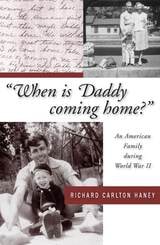
When is Daddy Coming Home?
An American Family during World War IIRichard Carlton Haney
Wisconsin Historical Society Press, 2024
World War II was coming to a close in Europe and Richard Haney was only four years old when the telegram arrived at his family's home in Janesville, Wisconsin. That moment, when Haney learned of his father's death in the final months of fighting, changed his and his mother's lives forever.
In this powerful book, Haney explores the impact of war on an American family. He skillfully weaves together those memories with his parents' wartime letters and his mother's recollections to create a unique blend of history and memoir. Through his father's letters he reveals the war's effect on a man who fought in the Battle of the Bulge with the 17th Airborne but wanted nothing more than to return home. Haney illuminates life on the home front in small-town America as well, describing how profoundly the war changed such communities.
With When Is Daddy Coming Home?, Richard Haney makes an exceptional contribution to the literature on the Greatest Generation—one that is both devastatingly personal and representative of what families all over America endured during that testing time.
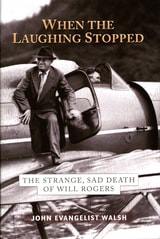
When the Laughing Stopped
The Strange, Sad Death of Will RogersJohn Evangelist Walsh
University of Alaska Press, 2008
The plane carrying Rogers and aviator Wiley Post crashed in a lagoon just outside Barrow, Alaska on August 15, 1935. Walsh retells the tragic tale from various angles, primarily alternating between Rogers and Post’s journey and the actions of the two men’s families on that fateful day. In particular, Walsh reveals moving details about the families and their struggle with grief, such as the fact that Post’s daughter was in a stage play about plane crashes at the time of the crash, or how Will Rogers’s daughter Mary never fully recovered from her father’s death and subsequently abandoned her promising acting career.
When the Laughing Stopped is a gripping and poignant retelling of the death of a beloved American legend, and it shines a humanizing light upon a pivotal moment in American history and culture.
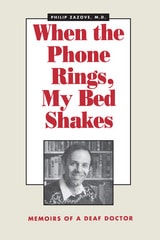
When the Phone Rings, My Bed Shakes
The Memoirs of a Deaf DoctorPhilip Zazove
Gallaudet University Press, 1993
Born almost totally deaf, Philip Zazove has spent his entire life beating the odds first by excelling in public schools during an era when most deaf children went to special schools, then by aspiring to become a medical doctor. When the Phone Rings, My Bed Shakes is the remarkable story of his determination and achievement in realizing his dreams.
Despite his stellar record at Northwestern University, Zazove was rejected by a host of medical schools. This only caused him to press harder, which won him acceptance at Rutgers University. He transferred to Washington University in St. Louis where, again against all advice, he decided to specialize in family practice. In vignettes of his patients, some amusing, others moving, he reveals the dedication and humanity that have made him a respected and well-loved doctor. His story will inspire all who read it.

When the White House Calls
From Immigrant Entrepreneur to U.S. AmbassadorJohn Price
University of Utah Press, 2011
When the White House Calls tells the life story of John Price, one of Utah’s most prominent citizens, beginning with his birth in Germany through his years as a successful builder and real estate developer—with business interests in broadcasting, manufacturing, distribution, and banking—to his life as a diplomat. Born in Berlin on August 18, 1933, Hans Joachim Praiss was five years old when he and his family fled Nazi Germany in April 1939. The family found temporary refuge in Panama, finally arriving at Ellis Island in September 1940 and settling in New York City. Following the advice of a professor at CCNY, Price traveled west to fulfill a geology fieldwork course requirement, but upon seeing the snow-capped mountains surrounding Salt Lake City, knew he would stay. He earned his Bachelor of Science in Geological Engineering from the University of Utah in 1956. He practiced in that field before tiring of the often rigorous travel requirements and the desolate nature of the work. He soon turned to new opportunities.
Years later, after operating successful business enterprises throughout the Intermountain region and nationally, and serving on numerous local, state, and national boards, Price had become the consummate entrepreneur, businessman, and community leader. He was ready to serve his country when the White House called. In February 2002 he was sworn in as U.S. Ambassador to the Republic of Mauritius, the Republic of Seychelles, and the Union of the Comoros, three Indian Ocean island nations off the east coast of Africa, where he served until 2005.
In this telling autobiography, John Price focuses on his years as an ambassador and includes his thoughts on the future of sub-Saharan Africa. The account of his service as a diplomat offers readers a view of the daily life of an ambassador—the protocol for official meetings with heads of state, the routine of the office, the process of handling official communications, and the intricacies of diplomacy. More than that, in a world concerned with the global war on terror, he reflects on the three island nations where he served and on the region’s increasing strategic importance to the national security of the United States.
In the years since the 2001 attacks on the World Trade Center and the Pentagon, the al-Qaeda movement has grown and its members have dispersed throughout the world, including the region known as the Horn of Africa and East Africa. Price calls attention to the vulnerability of sub-Saharan Africa as a haven for terrorists, and the critical need for our engagement of this desperate continent with economic development, health care, and education to counter this threat. His concern for this region of Africa is carefully articulated in the text, as well as in interviews (included as appendixes) with notable country leaders. When the White House Calls is a compelling story of the American Dream realized, and the importance of service to country. This is a book that will both educate and inspire young people, their mentors, and others, as they work to make a difference in the world.
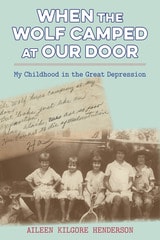
When the Wolf Camped at Our Door
My Childhood in the Great DepressionAileen Kilgore Henderson
University of Alabama Press, 2022
Recounts the hardships and joys the Kilgore family and their neighbors experienced in a close-knit southern rural community during the Great Depression
As the Great Depression tightened its grip on the world, six members of the Kilgore family were living in a cramped farmhouse in Brookwood, Alabama. Crops didn’t grow well, food was scarce, shoes were in short supply, and the few clothes they had were all hand-me-downs. The Kilgores struggled to make ends meet, cobbling together odd jobs and working the land by hand.
Despite all of this, young Aileen thought life was full of hope. She longed to hold on to it and scribbled down daily events on whatever odds and ends of paper she could find. In her new memoir, When the Wolf Camped at Our Door, Aileen Kilgore Henderson creates a vivid portrait of what life was like for so many living in the rural South during the Depression. The book begins when Aileen is ten years old and follows her into her teenage years over the course of twenty-seven episodic chapters. Drawing on her girlhood diaries and told through the charismatic voice of her younger self, Henderson’s nuanced storytelling sheds light on the common struggle for survival during a time when people were at their most vulnerable.
Against the backdrop of a world where hard work and harsh conditions like hunger, privation, sickness, and early death were everyday realities, Henderson’s stories are nevertheless tinged with young Aileen’s lively sense of humor and optimistic faith in people and in the promise of life despite trying circumstances. We follow her rambles in the woods, her visits with friends, a trip to a fortune teller, and a search for the Howton Horror, a mysterious monster rumored to live deep in the Alabama backwoods.
When the World Explodes
EssaysAmy Lee Scott
The Ohio State University Press, 2025
When “I” Was Born
Women’s Autobiography in Modern ChinaJing M. Wang
University of Wisconsin Press, 2008
When “I” Was Born: Women’s Autobiography in Modern China reclaims the voices of these particular writers, voices that have been misinterpreted and overlooked for decades. Tracing women writers as they move from autobiographical fiction, often self-revelatory and personal, to explicit autobiographies that focused on women’s roles in public life, Jing M. Wang reveals the factors that propelled this literary movement, the roles that liberal translators and their renditions of Western life stories played, and the way in which these women writers redefined writing and gender in the stories they told. But Wang reveals another story as well: the evolving history and identity of women in modern Chinese society. When “I” Was Born adds to a growing body of important work in Chinese history and culture, women’s studies, and autobiography in a global context.
Writers discussed include Xie Bingying, Zhang Ailing, Yu Yinzi, Fei Pu, Lu Meiyen, Feng Heyi, Ye Qian, Bai Wei, Shi Wen, Fan Xiulin, Su Xuelin, and Lu Yin.
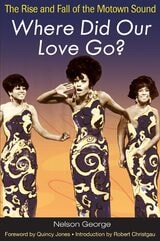
Where Did Our Love Go?
The Rise and Fall of the Motown SoundNelson George. Foreword by Quincy Jones, Introduction by Robert Christgau.
University of Illinois Press, 2007
Gordy's uncanny instinct for finding extraordinary talent--from performers and musicians to songwriters and producers—packed the label's roster with a who's who of historic artists and hitmakers. Here is the story of the Supremes and superstar Diana Ross, of the towering solo acts Marvin Gaye and Stevie Wonder, of vocal groups led by the Temptations and Four Tops, of the phenomenal Jackson Five and Michael Jackson, and of singer/songwriter and Motown executive Smokey Robinson. Up front about Gordy's manipulative and complex relationships with his artists, George reveals the inner workings of how Motown conducted its business. He also offers portraits of the Funk Brothers and other musicians who played the unforgettable songs.
George's preface shows how Motown influenced a later generation of young artists and music moguls, including R. Kelly, D'Angelo, Sean Combs, and Russell Simmons.
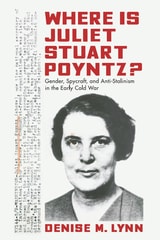
Where Is Juliet Stuart Poyntz?
Gender, Spycraft, and Anti-Stalinism in the Early Cold WarDenise Lynn
University of Massachusetts Press, 2021
In Where Is Juliet Stuart Poyntz?, Denise M. Lynn argues that Poyntz's sudden disappearance was the final straw for many on the American political left, who then abandoned Marxism and began to embrace anti-communism. In the years to follow, the left crafted narratives of her disappearance that became central to the Cold War. While scholars have thoroughly analyzed the influence of the political right in the anti-communism of this era, this captivating and compelling study is unique in exploring the influence of the political left.
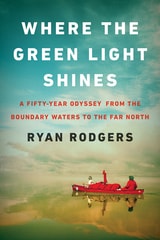
Where the Green Light Shines
A Fifty-Year Odyssey from the Boundary Waters to the Far NorthRyan Rodgers
University of Minnesota Press, 2026
A unique glimpse into the world of arctic canoeing through the travels of one of North America’s most renowned paddlers
A centuries-long story of adventure runs through the Boundary Waters. Stretching from northern Minnesota into the Canadian Shield, this lake-dappled expanse—long an Indigenous homeland and later also a fur trading hub—is the most visited designated wilderness in North America, with more than 200,000 people dipping their paddles into its ancient waterways each year. Bridging the legendary arctic expeditions of the nineteenth century and the making of today’s recreational paddling tradition, Where the Green Light Shines is a fascinating chronicle of canoe exploration, told through the journeys of a true master of the craft, Bob O’Hara.
O’Hara first launched his canoe as a Boy Scout in the 1950s, and he spent every summer for the next sixty-five years venturing further north into the Canadian barrens, a region rarely seen by paddlers. Mentored by a generation of adventurers and by the Inuit who long paddled the northern tundra rivers, O’Hara would become a guiding light for many young canoeists. Passionate yet guarded, O’Hara dedicated his life to the thrill of paddling, and his extraordinary journeys here become a touchstone as Ryan Rodgers tells the story of a nascent canoeing scene that continues to thrive today.
A vivid depiction of the northern wilds traversed by an eclectic roster of paddlers, bush pilots, and historic characters, Where the Green Light Shines illuminates a lost world of arctic canoeing remade in our time. It is bound to transport anyone interested in outdoor adventure—from wilderness canoeists to armchair travelers—and to bring home the eternal allure of the far north.
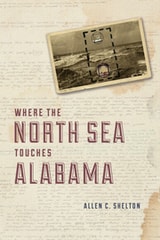
Where the North Sea Touches Alabama
Allen C. Shelton
University of Chicago Press, 2013
A few years later, 180 miles away from Keim’s grave, a bulldozer operator uncovered a pine coffin in an old beaver swamp down the road from Allen C. Shelton’s farm. He quickly reburied it, but Shelton, a friend of Keim’s who had a suitcase of his unfinished projects, became convinced that his friend wasn’t dead and fixed in the ground, but moving between this world and the next in a traveling coffin in search of his incomplete work.
In Where the North Sea Touches Alabama, Shelton ushers us into realms of fantasy, revelation, and reflection, paced with a slow unfurling of magical correspondences. Though he is trained as a sociologist, this is a genre-crossing work of literature, a two-sided ethnography: one from the world of the living and the other from the world of the dead.
What follows isn’t a ghost story but an exciting and extraordinary kind of narrative. The psycho-sociological landscape that Shelton constructs for his reader is as evocative of Kafka, Bataille, and Benjamin as it is of Weber, Foucault, and Marx. Where the North Sea Touches Alabama is a work of sociological fictocriticism that explores not only the author’s relationship to the artist but his physical, historical, and social relationship to northeastern Alabama, in rare style.
Where the Strange Roads Go Down
Mary del Villar and Fred del Villar; Foreword by Susan Hardy Aiken
University of Arizona Press, 1999
Where the Wild Animals Is Plentiful
Diary of an Alabama Fur Trader's Daughter, 1912-1914May Jordan
University of Alabama Press, 2006
This rare find--a journal of a young backwoods woman--provides a unique picture of rural life in southwestern Alabama early in the 20th century.
"I am a little Alabama girl living on the frontier where the wild animals is plentiful," wrote May Jordan in 1912. During the hunting season her father traveled Washington County buying furs, and May--already 23--accompanied him on two of these trips, cooking meals, helping out with the business, and recording their experiences.
May's diary of these trips from December 1912 to March 1914 describes the routine of the fur trade and provides a vivid portrait of wilderness travel and social customs. Through May's eyes, readers can experience the sights and sounds of pine forests and swamps, the difficulty of wading through waist-deep mud, and the neighborliness of the people living in this isolated area. May also shares both the solace of religious faith and her love of laughter as reflected in the jokes she records.
Elisa Moore Baldwin provides an introduction that traces Jordan family history and describes economic, social, and political conditions during the period. Baldwin also includes annotations based on court records, census rolls, and other primary sources and photographs of many of the characters in May's narrative to provide a vivid picture of the times. Because few first-person accounts exist of the life of poor whites, this diary will be invaluable to students of southern and women's history; no comparable work exists for this part of Alabama during this era. May's journal takes us to another world and teaches us about the lively human spirit in the face of hardship and loneliness.
Wherever the Sound Takes You
Heroics and Heartbreak in Music MakingDavid Rowell
University of Chicago Press, 2019
This wide-ranging and openhearted book blossoms outward from there. Rowell visits clubs, concert halls, street corners, and open mics, traveling from the Rock and Roll Hall of Fame in Cleveland to a death metal festival in Maryland, with stops along the way in the Swiss Alps and Appalachia. His keen reportorial eye treats us to in-depth portraits of musicians from platinum-selling legend Peter Frampton to a devout Christian who spends his days alone in a storage unit bashing away on one of the largest drum sets in the world. Rowell illuminates the feelings that both spur music’s creation and emerge from its performance, as well as the physical instruments that enables their expression. With an uncommon sensitivity and grace, he charts the pleasure and pain of musicians consumed with what they do—as all of us listen in.
Whiskey Breakfast
My Swedish Family, My American LifeRichard C. Lindberg
University of Minnesota Press, 2011
Chicago in the 1920s: Clark Street was the city’s last Swedetown, a narrow corridor of weather-beaten storefronts, coal yards, and taverns running along the north side of the city and the locus of Swedish community life in Chicago during the first half of the twentieth century. It represented a way station for a generation of working-class immigrants escaping the hardships of the old country for the promise of a brighter new day in a halfway house of sorts, perched between the old and new lands. For Richard C. Lindberg, whose Swedish immigrant parents and grandparents settled there, it was also the staging ground for an intensely personal, multigenerational, coming-of-age drama based on the struggles of two disparate families—their dreams and their depravities, their victories and their failures.
Whiskey Breakfast is Lindberg’s captivating tale of life as a first-generation baby-boomer Swedish American, caught between the customs of a land he had never been to and the desire to conform and fit into a troubled existence, tragically scarred by alcoholism, divorce, and peer abuse. But it is also a powerful and intimate portrait of his immigrant ancestors, and especially of his father, Oscar—a contractor and master builder who helped develop Chicago’s post–World War II suburbs. A paradoxical man, known to some as a socialist, an anarchist, and a serious drinker, Oscar would carry with him to the grave a sixty-two-year-old family secret, a secret that for Lindberg lies at the very heart of the great Swedish unrest that drove his father and countless other men and women out of Sweden and onward to America.
Masterfully blending autobiography with immigrant history, Whiskey Breakfast surrounds Lindberg’s family story with Swedish cultural history and politics, as well as remarkable Chicago history and how Clark Street and Swedetown became, and in many ways remain, a center of Swedish immigrants’ social and cultural life. Far from a eulogy for an idealized past, Lindberg has crafted a moving and sobering memoir of a young man’s struggle to come to terms with his father and himself, his immigrant heritage, and his native home.

Whiskey River (Take My Mind)
The True Story of Texas Honky-TonkBy Johnny Bush with Rick Mitchell
University of Texas Press, 2007
When it comes to Texas honky-tonk, nobody knows the music or the scene better than Johnny Bush. Author of Willie Nelson's classic concert anthem "Whiskey River," and singer of hits such as "You Gave Me a Mountain," "Undo the Right," "Jim, Jack and Rose," and "I'll Be There," Johnny Bush is a legend in country music, a singer-songwriter who has lived the cheatin', hurtin', hard-drinkin' life and recorded some of the most heart-wrenching songs about it. He has one of the purest honky-tonk voices ever to come out of Texas. And Bush's career has been just as dramatic as his songs—on the verge of achieving superstardom in the early 1970s, he was sidelined by a rare vocal disorder that he combated for thirty years. But, survivor that he is, Bush is once again filling dance halls across Texas and inspiring a new generation of musicians who crave the authenticity—the "pure D" country—that Johnny Bush has always had and that Nashville country music has lost.
In Whiskey River (Take My Mind), Johnny Bush tells the twin stories of his life and of Texas honky-tonk music. He recalls growing up poor in Houston's Kashmere Gardens neighborhood and learning his chops in honky-tonks around Houston and San Antonio—places where chicken wire protected the bandstand and deadly fights broke out regularly. Bush vividly describes life on the road in the 1960s as a band member for Ray Price and Willie Nelson, including the booze, drugs, and one-night stands that fueled his songs but destroyed his first three marriages. He remembers the time in the early 1970s when he was hotter than Willie and on the fast track to superstardom—until spasmodic dysphonia forced his career into the slow lane. Bush describes his agonizing, but ultimately successful struggle to keep performing and rebuild his fan base, as well as the hard-won happiness he has found in his personal life.
Woven throughout Bush's autobiography is the never-before-told story of Texas honky-tonk music, from Bob Wills and Floyd Tillman to Junior Brown and Pat Green. Johnny Bush has known almost all the great musicians, past and present, and he has wonderful stories to tell. Likewise, he offers shrewd observations on how the music business has changed since he started performing in the 1950s—and pulls no punches in saying how Nashville music has lost its country soul. For everyone who loves genuine country music, Johnny Bush, Willie Nelson, and stories of triumph against all odds, Whiskey River (Take My Mind) is a must-read.
Whisper Not
The Autobiography of Benny GolsonBenny Golson
Temple University Press, 2016
“One of the greatest artists our country has is Benny Golson. He is not only a great musician, but an original and fabulous composer. He is inventive and creative and his work is loved the world over. Benny is a rare, creative genius. All I would like to say is THREE CHEERS for Benny Golson!”—Tony Bennett
“Composer supreme, tenor man supreme, jazz man supreme, good guy supreme: that’s BENNY GOLSON!"—Sonny Rollins
Born during the de facto inaugural era of jazz, saxophonist Benny Golson learned his instrument and the vocabulary of jazz alongside John Coltrane while Golson was still in high school in Philadelphia. Quickly establishing himself as an iconic fixture on the jazz landscape, Golson performed with dozens of jazz greats, from Sonny Rollins, Coleman Hawkins, and Jimmy Heath to Dizzy Gillespie, Freddie Hubbard, and many others. An acclaimed composer, Golson also wrote music for Hollywood films and television and composed such memorable jazz standards as “Stablemates,” “Killer Joe,” and “Whisper Not.”
An eloquent account of Golson’s exceptional life—presented episodically rather than chronologically—Whisper Not includes a dazzling collection of anecdotes, memories, experiences, and photographs that recount the successes, the inevitable failures, and the rewards of a life eternally dedicated to jazz.
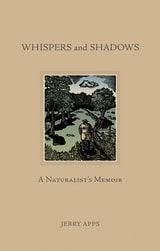
Whispers and Shadows
A Naturalist’s MemoirJerry Apps
Wisconsin Historical Society Press, 2015
Combining his signature lively storytelling and careful observations of nature, Apps draws on a lifetime of experiences, from his earliest years growing up on a central Wisconsin farm to his current ventures as gardener, tree farmer, and steward of wetlands, prairies, and endangered Karner blue butterflies. He also takes inspiration from the writings of Aldo Leopold, Annie Dillard, Henry David Thoreau, Sigurd Olson, Ralph Waldo Emerson, John Muir, Barbara Kingsolver, Wendell Berry, Richard Louv, and Rachel Carson. With these eloquent essays, Jerry Apps reminds us to slow down, turn off technology, and allow our senses to reconnect us to the natural world. For it is there, he writes, that “I am able to return to a feeling I had when I was a child, a feeling of having room to stretch my arms without interfering with another person, a feeling of being a small part of something much larger than I was, and I marvel at the idea.”
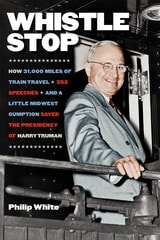
Whistle Stop
How 31,000 Miles of Train Travel, 352 Speeches, and a Little Midwest Gumption Saved the Presidency of Harry TrumanPhilip White
University Press of New England, 2015
White Boy
A MemoirMark D. Naison
Temple University Press, 2002
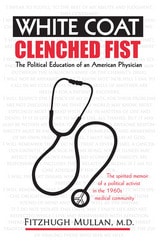
White Coat, Clenched Fist
The Political Education of an American PhysicianFitzhugh Mullan, M.D.
University of Michigan Press, 2006
In the sixties, Fitzhugh Mullan was an activist in the civil rights struggle. While in medical school, Mullan was shocked by gaps in what the students learned, and the lack of humanity in the classroom. Later, Dr. Mullan was outraged at the conditions he discovered when he began to practice. He helped found the Student Health Organization, organized the Controversial Medical Collective at Lincoln Hospital in the Bronx, and struggled to offer improved medical care to those who needed it most and could afford it least.
This landmark book charts the state of medical school and practices in the 1960s and 70s. This new edition is updated with a preface in which Dr. Mullan reflects on the changes in the medical field over the last thirty-plus years.
Fitzhugh Mullan is Murdock Head Professor of Medicine and Health Policy at George Washington University. He worked at the U.S. Public Health Service where he attained the rank of Assistant Surgeon General (1991-1996). Dr. Mullan is the co-founder of the National Coalition for Cancer Survivorship and the author of numerous books, including Plagues and Politics: The Story of the United States Public Health Service, and his most recent book, Narrative Matters: The Power of the Personal Essay in Health Policy.
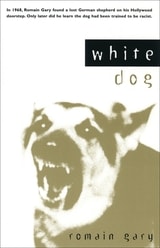
White Dog
Romain Gary
University of Chicago Press, 2004
Using the re-education of this adopted pet as a metaphor for the need to quash American racism, Gary develops a domestic crisis into a full-scale social allegory.
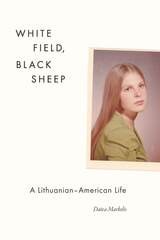
White Field, Black Sheep
A Lithuanian-American LifeDaiva Markelis
University of Chicago Press, 2010
Her parents never really explained what a D.P. was. Years later Daiva Markelis learned that “displaced person” was the designation bestowed upon European refugees like her mom and dad who fled communist Lithuania after the war. Growing up in the Chicago suburb of Cicero, though, Markelis had only heard the name T.P., since her folks pronounced the D as a T: “In first grade we had learned about the Plains Indians, who had lived in tent-like dwellings made of wood and buffalo skin called teepees. In my childish confusion, I thought that perhaps my parents weren’t Lithuanian at all, but Cherokee. I went around telling people that I was the child of teepees.” So begins this touching and affectionate memoir about growing up as a daughter of Lithuanian immigrants.
Markelis was raised during the 1960s and 1970s in a household where Lithuanian was the first language. White Field, Black Sheep derives much of its charm from this collision of old world and new: a tough but cultured generation that can’t quite understand the ways of America and a younger one weaned on Barbie dolls and The Brady Bunch, Hostess cupcakes and comic books, The Monkees and Captain Kangaroo. Throughout, Markelis recalls the amusing contortions of language and identity that animated her childhood. She also humorously recollects the touchstones of her youth, from her First Communion to her first game of Twister. Ultimately, she revisits the troubles that surfaced in the wake of her assimilation into American culture: the constricting expectations of her family and community, her problems with alcoholism and depression, and her sometimes contentious but always loving relationship with her mother.
Deftly recreating the emotional world of adolescence, but overlaying it with the hard-won understanding of adulthood, White Field, Black Sheep is a poignant and moving memoir—a lively tale of this Lithuanian-American life.
White Poplar, Black Locust
Louise Wagenknecht
Oregon State University Press, 2021
Originally published by the University of Nebraska Press in 2003, this first book in Louise Wagenknecht’s trilogy about life in the Klamath Mountains is now available through Oregon State University Press, together with Light on the Devils (2011) and Shadows on the Klamath (2021).
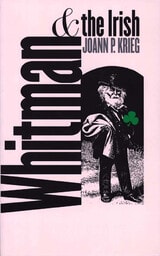
Whitman and the Irish
Joann P. Krieg
University of Iowa Press, 2000
Though Walt Whitman created no Irish characters in his early works of fiction, he did include the Irish as part of the democratic portrait of America that he drew in Leaves of Grass. He could hardly have done otherwise. In 1855, when the first edition of Leaves of Grass was published, the Irish made up one of the largest immigrant populations in New York City and, as such, maintained a cultural identity of their own. All of this “Irishness” swirled about Whitman as he trod the streets of his Mannahatta, ultimately becoming part of him and his poetry. As members of the working class, famous authors, or close friends, the Irish left their mark on Whitman the man and poet. In Whitman and the Irish, Joann Krieg convincingly establishes their importance within the larger framework of Whitman studies.
Focusing on geography rather than biography, Krieg traces Whitman's encounters with cities where the Irish formed a large portion of the population—New York City, Boston, Camden, and Dublin—or where, as in the case of Washington, D.C., he had exceptionally close Irish friends. She also provides a brief yet important historical summary of Ireland and its relationship with America.
Whitman and the Irish does more than examine Whitman's Irish friends and acquaintances: it adds a valuable dimension to our understanding of his personal world and explores a number of vital questions in social and cultural history. Krieg places Whitman in relation to the emerging labor culture of ante-bellum New York, reveals the relationship between Whitman's cultural nationalism and the Irish nationalism of the late nineteenth century, and reflects upon Whitman's involvement with the Union cause and that of Irish American soldiers.
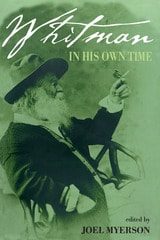
Whitman in His Own Time
A Biographical Chronicle of His Own Life, Drawn from Recollections, Memoirs, and Interviews by Friends and AssociatesJoel Myerson
University of Iowa Press, 2000
Few American writers were as concerned with their public image as was Walt Whitman. He praised his own work in unsigned reviews; he included engravings or photographs of himself in numerous editions of his work; and he assisted in the writing of two biographies of himself. Whitman was also written about extensively by others throughout his lifetime. Whitman in His Own Time is a collection of these contemporary accounts of the "good gray poet."
The interviews with and recollections of Whitman collected by Joel Myerson represent a wide spectrum of accounts—visitors from America and abroad; newspaper interviewers; Whitman's doctor and nurse during his final illness; his literary executors; a student from his early schoolteaching days; and such well-known authors as Bronson Alcott, John Burroughs, and Henry David Thoreau. The selections also paint a well-rounded picture of Whitman, from his early days as a schoolteacher to the moment of his death, and demonstrate a varying range of attitudes toward the poet. Yet throughout the entire collection, Whitman himself holds center stage, and he is seen as vividly today as he was over one hundred years ago. Myerson's introduction to this expanded edition places these accounts of Whitman within the context of the time and discusses new scholarship on Whitman's life.
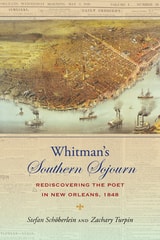
Whitman's Southern Sojourn
Rediscovering the Poet in New Orleans, 1848Stefan Schöberlein
University of Iowa Press, 2025
Far from some brief escape, New Orleans was a significant milestone in Whitman’s development as a political firebrand, as well as a major step for a professional journalist on the rise. Through a wealth of new texts, contexts, and personalities, Stefan Schöberlein and Zachary Turpin paint a vivid picture of a writer on the verge of Leaves of Grass, embracing the contradictions and the multitudes of New Orleans.
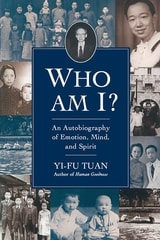
Who Am I?
An Autobiography of Emotion, Mind, and SpiritYi-Fu Tuan
University of Wisconsin Press, 1999
Who Am I? is the bittersweet memoir of a Chinese American who came to this country as a twenty-year-old graduate student and stayed to become one of America’s most innovative intellectuals, whose work has explored the aesthetic and moral dimensions of human relations with landscape, nature, and environment. This unusually introspective autobiography mixes Yi-Fu Tuan’s reflections on a life filled with recognition, accolades, and affection with what he deems moral failings, his lack of courage—including the courage to be open about his homosexuality.
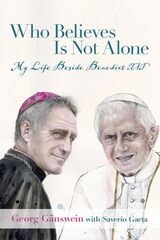
Who Believes Is Not Alone
My Life Beside Benedict XVIGeorg Gänswein
St. Augustine's Press, 2023
Written with the involvement of the regarded Vaticanista Saverio Gaeta, Mons. Gänswein offers an account of a particular decade in history and confronts false claims of intrigue and cover-up (Vatileaks, the Orlandi abduction case, the sexual abuse scandal, among other issues) to tell the real story of a pope who faced a changing landscape and a public who largely misunderstood him and his style of governance. Here we meet one of the most affable and intellectually formidable popes the Catholic Church has ever known, and a priest who might also be considered a prophet of the post-modern age. Gänswein brilliantly contextualizes many of Benedict's most poignant theological positions, and in giving us a sense of their origin reveals that Benedict seamlessly lived everything he promulgated. His faith was the single bulwark upon which his personality as both teacher and leader were built. No biography has yet to establish the integrity and heart of Joseph Ratzinger as well as his friend, Georg Gänswein, does here.
As a spiritual testament more than just a journalistic exposé, Gänswein provides something only he can give––namely, the candid intelligence and sanctity witnessed up close. This is a remarkable and singular contribution to the history of the papacy and the record of the life of a saint. As Gänswein asserts, knowing this man is to encounter heroic virtue and an invitation to meet God, the greatest lover of mankind. Pope Benedict's own friendship with God will continue to provide warmth for as long as there are people on this earth who believe.
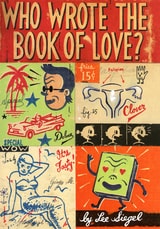
Who Wrote the Book of Love?
Lee Siegel
University of Chicago Press, 2005
Vignettes from the author's childhood provide the material for the construction of what is at once comic fiction, imaginative historical reportage, and an ironically nostalgic confession. The book evokes the tone and tempo of a decade during which America was blatantly happy, wholesome, and confident, and yet, at the same time, deeply fearful of communism and nuclear holocaust. Siegel recounts both the cheer and the paranoia of the period and the ways in which those sentiments informed wondering about sex and falling in love.
"Part of my plan," Mark Twain wrote in The Adventures of Tom Sawyer, "has been to try to pleasantly remind adults of what they once were themselves, and of how they felt and thought and talked." With the same motive, Lee Siegel has written what Twain might have composed had he been Jewish, raised in Beverly Hills in the 1950s, and joyously obsessed with sex and love.
Whom God Wishes to Destroy . . .
Francis Coppola and the New HollywoodJon Lewis
Duke University Press, 1995
Why I Left the Amish
A MemoirSaloma Miller Furlong
Michigan State University Press, 2011
There are two ways to leave the Amish—one is through life and the other through death. When Saloma Miller Furlong’s father dies during her first semester at Smith College, she returns to the Amish community she had left twenty four years earlier to attend his funeral. Her journey home prompts a flood of memories. Now a mother with grown children of her own, Furlong recalls her painful childhood in a family defined by her father’s mental illness, her brother’s brutality, her mother’s frustration, and the austere traditions of the Amish—traditions Furlong struggled to accept for years before making the difficult decision to leave the community. In this personal and moving memoir, Furlong traces the genesis of her desire for freedom and education and chronicles her conflicted quest for independence. Eloquently told, Why I Left the Amish is a revealing portrait of life within—and without—this frequently misunderstood community.
Why Not the Best?
The First Fifty YearsJimmy Carter
University of Arkansas Press, 1996
Why the Grateful Dead Matter
Michael Benson
University Press of New England, 2016
Wide Branches, Deep Roots
How Appalachian Wisdom Can Help in the Fight for a Sustainable FutureJessica M Jones
West Virginia University Press, 2026
To be Appalachian is to define oneself in terms of a place. Where we’re from plays a tremendous role in who we are, through storytelling about our homeplaces and the people who have loved them. However, what goes largely unaddressed is how this love of place can contribute to sustainability within the region, which has notoriously faced on-going environmental threats from extraction industries. The reality is that our relationship with the environment is thorny and intertwined with our identities, histories, and economic realities. The authors in the collection get down among the thorns to explore what sustainability means in Appalachia and how we can utilize the power of traditional folkways to achieve it.
This collection of over thirty pieces explores the connections between Appalachia’s stories, traditions, and modern events and the pathway to regional sustainability. The contributors — writers and scholars — examine how our definitions of sustainability have been formed, the power of education to encourage or inhibit it, and what moves are being made toward efficacy in the future. They also offer specific actions readers can take to better understand and build sustainability where they live.
Contributors: Greg Bealer, Luc Biscan-White, David Blackmore, Aysha Bodenhamer, Ivy Brashear, Matthew Calloway, Nicole Drewitz-Crockett, Christina Fisanick, Deborah Fleming, Amanda V. Garner, Karie Gunter-Seymour, Richard Hague, Amanda E. Hayes, Lockie Hunter, Jessica M. Jones, Kristen LeFevers, Sarah Long, Meghan Moore-Hubbard, Barbara Marie Minney, Jessica Radicic, Elizabeth Emmerth Rexroad, Barbara Sabol, Larry Smith, Patrice Stank, Taylor Nasim Stone, Paul Thomas, Elizabeth Tussey, and Betsy Weems.
Widows' Words
Women Write on the Experience of Grief, the First Year, the Long Haul, and Everything in BetweenRutgers University Press, 2019
Some were widowed young, while others were married for decades. Some cared for their late partners through long terminal illnesses, while others lost their partners suddenly. Some had male partners, while others had female partners. Yet each of these women faced the same basic dilemma: how to go on living when a part of you is gone.
Widows’ Words is arranged chronologically, starting with stories of women preparing for their partners’ deaths, followed by the experiences of recent widows still reeling from their fresh loss, and culminating in the accounts of women who lost their partners many years ago but still experience waves of grief. Their accounts deal honestly with feelings of pain, sorrow, and despair, and yet there are also powerful expressions of strength, hope, and even joy. Whether you are a widow yourself or have simply experienced loss, you will be sure to find something moving and profound in these diverse tales of mourning, remembrance, and resilience.
Wild Forest Home
Stories of Conservation in the Pacific NorthwestBetsy L. Howell
University of Utah Press, 2024
The twenty-five essays in Wild Forest Home chronicle Howell’s career and personal experiences studying the wildlife of the Pacific Northwest during the litigious listing of the northern spotted owl and marbled murrelet under the Endangered Species Act and the Clinton administration’s adoption of the seminal 1994 Northwest Forest Plan. Meanwhile, Howell toiled on fire crews, searched for rare species, helped to monitor fishers reintroduced to the Olympic Peninsula, tested amphibians for deadly diseases, became a writer, and mourned the deaths of her parents. This captivating memoir seamlessly blends story and science to reveal a unique portrait of the struggles and joys of one wildlife biologist.
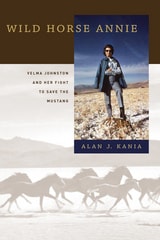
Wild Horse Annie
Velma Johnston and Her Fight to Save the MustangAlan J. Kania
University of Nevada Press, 2013
Wild horses have been a subject of bitter controversy in the West for decades. To some, they are symbols of the West’s wild, free heritage. To others, they are rapacious grazers that destroy habitat and compete with domestic livestock and indigenous wildlife for scanty food and water. For years, free-ranging horses and burros were rounded up and shipped to slaughterhouses to be killed and turned into pet food. This practice provided an income for the “mustangers” who trapped and sold them, but it also involved horrendous cruelty and abuse of the animals.
Velma Johnston, who became known as “Wild Horse Annie,” undertook to stop the removal of wild horses and burros from US public lands and protect them from the worst aspects of mustanging. Her campaign attracted nationwide attention, as it led her from her rural Nevada County to state offices and finally to Washington, DC. Author Alan J. Kania worked closely with Johnston for seven years, and his biography provides unique insight into Wild Horse Annie’s life and her efforts to save the West’s wild horse herds through the passage of protective legislation.
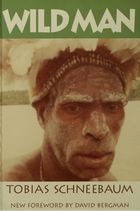
Wild Man
Tobias Schneebaum
University of Wisconsin Press, 2003
Part autobiographical journal, part social-historical novel, Wild Man tracks Tobias Schneebaum's fascinating and almost epic life story, from his earliest contemplation of homoerotic desire through his life in Peru, Borneo, and beyond. A young man from New York, Schneebaum "disappeared" in 1955 on the eastern slopes of the Andes. He was, in actuality, living for more than a year among the remote Harakhambut people, discovering a way of being that was strange, primitive, and powerfully attractive to him. This longing to find the "wild man" in other cultures—and in himself—eventually led him on an odyssey through South America, India, Tibet, Africa, Borneo, New Guinea, and Southeast Asia. He lived among isolated forest peoples, including headhunters and cannibals, in regions where few, if any, white men had ever been.
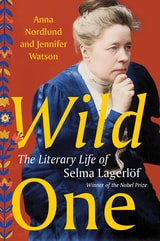
Wild One
The Literary Life of Selma LagerlöfAnna Nordlund
University of Minnesota Press, 2027
The definitive English-language biography of Sweden’s most celebrated novelist
Wild One details the captivating life of Selma Lagerlöf (1858–1940), the most celebrated Swedish novelist of her time and the first woman to win the Nobel Prize for Literature. Best known for her classic books The Saga of Gösta Berling and The Wonderful Adventures of Nils, Lagerlöf wrote dozens of acclaimed works and used her fame to advocate for women’s rights, humanitarian causes, and international peace. During her lifetime, however, even though she introduced Neo-Romanticism to Scandinavian literature, the male-dominated literary establishment strategically tried to downplay her as a modest spinster who reworked old stories and folktales from her rural Swedish province of Värmland.
Anna Nordlund and Jennifer Watson describe how, behind the old-fashioned public image placed on her, Lagerlöf was always on the front line, a forward-looking innovator whose writing is distinguished by inventive structures and a deep understanding of modern psychology. A savvy promoter of her own career, she utilized the new medium of radio, invested in the nascent Swedish film industry as adaptations of her novels became international sensations, and closely tracked translations of her work. After winning the Nobel Prize in 1909, Lagerlöf became even more vocal in her support for women’s rights and suffrage.
Drawing on a wide range of sources, including private letters, Nordlund and Watson offer new insights into Lagerlöf’s remarkable personal life, including her passionate love for her frequent traveling companion, Sophie Elkan, and for fellow suffragette Valborg Olander. As Wild One makes clear, through her written works and social activism Lagerlöf embodied her own famous quotation: “I want to set the world in motion.”
Retail e-book files for this title are screen-reader friendly with images accompanied by short alt text and/or extended descriptions.
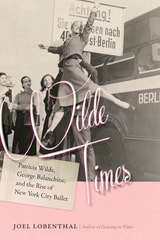
Wilde Times
Patricia Wilde, George Balanchine, and the Rise of New York City BalletJoel Lobenthal
University Press of New England, 2016
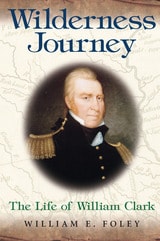
Wilderness Journey
The Life of William ClarkWilliam E. Foley
University of Missouri Press, 2005
Coinciding with the bicentennial in 2004 of the departure of Lewis and Clark’s famed Corps of Discovery, Wilderness Journey fills a major gap in scholarship. Intended for the general reader, as well as for specialists in the field, this fascinating book provides a well-balanced and thorough account of one of America’s most significant frontiersmen.
Wilderness, Water, and Rust
A Journey toward Great Lakes ResilienceJane Elder
Michigan State University Press, 2024
Wildland Sentinel
Field Notes from an Iowa Conservation OfficerErika Billerbeck
University of Iowa Press, 2020