Results by title
4531 books match the query 'Cultural & Ethnic Studies' and 180 start with w
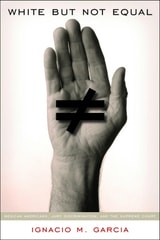
White But Not Equal
Mexican Americans, Jury Discrimination, and the Supreme CourtIgnacio M. García
University of Arizona Press, 2008
Ignacio García’s White But Not Equal explores this historic but mostly forgotten case, which became the first to recognize discrimination against Mexican Americans. Led by three dedicated Mexican American lawyers, the case argued for recognition of Mexican Americans under the 14th Amendment as a “class apart.” Despite a distinct history and culture, Mexican Americans were considered white by law during this period, yet in reality they were subjected to prejudice and discrimination. This was reflected in Hernández’s trial, in which none of the selected jurors were Mexican American. The concept of Latino identity began to shift as the demand for inclusion in the political and judicial system began.
García places the Hernández v. Texas case within a historical perspective and examines the changing Anglo-Mexican relationship. More than just a legal discussion, this book looks at the whole case from start to finish and examines all the major participants, placing the story within the larger issue of the fight for Mexican American civil rights.

White Field, Black Sheep
A Lithuanian-American LifeDaiva Markelis
University of Chicago Press, 2010
Her parents never really explained what a D.P. was. Years later Daiva Markelis learned that “displaced person” was the designation bestowed upon European refugees like her mom and dad who fled communist Lithuania after the war. Growing up in the Chicago suburb of Cicero, though, Markelis had only heard the name T.P., since her folks pronounced the D as a T: “In first grade we had learned about the Plains Indians, who had lived in tent-like dwellings made of wood and buffalo skin called teepees. In my childish confusion, I thought that perhaps my parents weren’t Lithuanian at all, but Cherokee. I went around telling people that I was the child of teepees.” So begins this touching and affectionate memoir about growing up as a daughter of Lithuanian immigrants.
Markelis was raised during the 1960s and 1970s in a household where Lithuanian was the first language. White Field, Black Sheep derives much of its charm from this collision of old world and new: a tough but cultured generation that can’t quite understand the ways of America and a younger one weaned on Barbie dolls and The Brady Bunch, Hostess cupcakes and comic books, The Monkees and Captain Kangaroo. Throughout, Markelis recalls the amusing contortions of language and identity that animated her childhood. She also humorously recollects the touchstones of her youth, from her First Communion to her first game of Twister. Ultimately, she revisits the troubles that surfaced in the wake of her assimilation into American culture: the constricting expectations of her family and community, her problems with alcoholism and depression, and her sometimes contentious but always loving relationship with her mother.
Deftly recreating the emotional world of adolescence, but overlaying it with the hard-won understanding of adulthood, White Field, Black Sheep is a poignant and moving memoir—a lively tale of this Lithuanian-American life.

White Identities
A Critical Sociological ApproachSteve Garner and Simon Clarke
Pluto Press, 2009
The study of white ethnicities is becoming increasingly important in the social sciences. This book provides a critical introduction to the topic.
Whiteness has traditionally been seen as "ethnically transparent" - the marker against which other ethnicities are measured. This analysis is clearly incorrect, but only recently have many race and ethnicity scholars moved away from focusing on ethnic minorities and instead oriented their studies around the construction of white identities. Simon Clarke and Steve Garner's book is designed to guide students as they explore how white identities are forged using both sociological and psycho-social ideas.
Including an excellent survey of the existing literature and original research from the UK, this book will be an invaluable guide for sociology students taking modules in race and ethnicity.
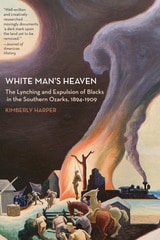
White Man's Heaven
The Lynching and Expulsion of Blacks in the Southern Ozarks, 1894-1909Kimberly Harper
University of Arkansas Press, 2010
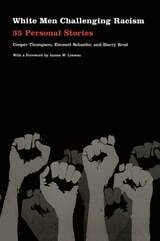
White Men Challenging Racism
35 Personal StoriesCooper Thompson, Emmett Schaefer, and Harry Brod
Duke University Press, 2003
Ranging in age from twenty-six to eighty-six, the men whose stories are presented here include some of the elder statesmen of antiracism work as well as members of the newest generation of activists. They come from across the United States—from Denver, Nashville, and San Jose; rural North Carolina, Detroit, and Seattle. Some are straight; some are gay. A few—such as historian Herbert Aptheker, singer/songwriter Si Kahn, Stetson Kennedy (a Klan infiltrator in the 1940s), and Richard Lapchick (active in organizing the sports community against apartheid)—are relatively well known; most are not. Among them are academics, ministers, police officers, firefighters, teachers, journalists, union leaders, and full-time community organizers. They work with Latinos and African-, Asian-, and Native-Americans. Many ground their work in spiritual commitments. Their inspiring personal narratives—whether about researching right-wing groups, organizing Central American immigrants, or serving as pastor of an interracial congregation—connect these men with one another and with their allies in the fight against racism in the United States.
All authors’ royalties go directly to fund antiracist work. To read excerpts from the book, please visit http://www.whitemenchallengingracism.com/
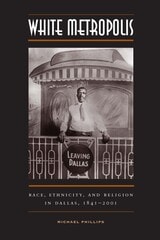
White Metropolis
Race, Ethnicity, and Religion in Dallas, 1841-2001By Michael Phillips
University of Texas Press, 2006
Winner, T. R. Fehrenbach Award, Texas Historical Commission, 2007
From the nineteenth century until today, the power brokers of Dallas have always portrayed their city as a progressive, pro-business, racially harmonious community that has avoided the racial, ethnic, and class strife that roiled other Southern cities. But does this image of Dallas match the historical reality? In this book, Michael Phillips delves deeply into Dallas's racial and religious past and uncovers a complicated history of resistance, collaboration, and assimilation between the city's African American, Mexican American, and Jewish communities and its white power elite.
Exploring more than 150 years of Dallas history, Phillips reveals how white business leaders created both a white racial identity and a Southwestern regional identity that excluded African Americans from power and required Mexican Americans and Jews to adopt Anglo-Saxon norms to achieve what limited positions of power they held. He also demonstrates how the concept of whiteness kept these groups from allying with each other, and with working- and middle-class whites, to build a greater power base and end elite control of the city. Comparing the Dallas racial experience with that of Houston and Atlanta, Phillips identifies how Dallas fits into regional patterns of race relations and illuminates the unique forces that have kept its racial history hidden until the publication of this book.
White Rebels in Black
German Appropriation of Black Popular CulturePriscilla Layne
University of Michigan Press, 2018
White Scholars/African American Texts
Edited by Lisa A. Long
Rutgers University Press, 2005
What makes someone an authority? What makes one person's knowledge more credible than another's? In the ongoing debates over racial authenticity, some attest that we can know each other's experiences simply because we are all "human," while others assume a more skeptical stance, insisting that racial differences create unbridgeable gaps in knowledge.
Bringing new perspectives to these perennial debates, the essays in this collection explore the many difficulties created by the fact that white scholars greatly outnumber black scholars in the study and teaching of African American literature. Contributors, including some of the most prominent theorists in the field as well as younger scholars, examine who is speaking, what is being spoken and what is not, and why framing African American literature in terms of an exclusive black/white racial divide is problematic and limiting.
In highlighting the "whiteness" of some African Americanists, the collection does not imply that the teaching or understanding of black literature by white scholars is definitively impossible. Indeed such work is not only possible, but imperative. Instead, the essays aim to open a much needed public conversation about the real and pressing challenges that white scholars face in this type of work, as well as the implications of how these challenges are met.
White Slave Crusades
Race, Gender, and Anti-vice Activism, 1887-1917Brian Donovan
University of Illinois Press, 2005
Focusing on the intersection of race, gender, and sex in the antiprostitution campaigns, Brian Donovan analyzes the reactions of native-born whites to new immigrant groups in Chicago, to African Americans in New York City, and to Chinese immigrants in San Francisco. Donovan shows how reformers employed white slavery narratives of sexual danger to clarify the boundaries of racial categories, allowing native-born whites to speak of a collective "us" as opposed to a "them." These stories about forced prostitution provided an emotionally powerful justification for segregation, as well as other forms of racial and sexual boundary maintenance in urban America.
White Southerners
Lewis M. Killian
University of Massachusetts Press, 1985
Originally published in 1970 as part of the series Ethnic Groups in Comparative Perspective, White Southerners is widely regarded as a classic in the sociology and history of the American South. In it, Lewis M. Killian, himself a white Southerner and a distinguished sociologist of race relations, advances the provocative and influential argument that white Southerners can be understood as a distinct American ethnic group, shaped by a shared regional identity, history, and culture that sets them apart from other white Americans. Drawing on decades of research into race relations and Southern society, Killian examines the formation and persistence of Southern white identity, its relationship to the broader struggles over race and civil rights, and the tensions between regional loyalty and national belonging. This revised edition includes a new preface and a substantial new concluding chapter that extends the analysis through the period from 1970 to 1984, bringing the study up to date with the transformed landscape of the post-civil rights South. Essential reading for students and scholars of American race relations, regional identity, and the sociology of ethnicity, White Southerners remains a foundational text in Southern studies.
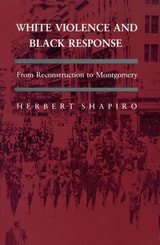
White Violence and Black Response
From Reconstruction to MontgomeryHerbert Shapiro
University of Massachusetts Press, 1988
We are taught that America is a society based on respect for the law and orderly procedures. That the Constitution stands as a safeguard of individual freedom, and the courts and the police are supposedly established to enforce the law. When a controversial issue arises in the American fabric, it is to be resolved not in the streets but through the democratic processes of elections. Yet, for blacks these liberal values have been turned into their opposites. The courts have most often stood silent in the face of racist violence or have turned their wrath against the victims, not the perpetrators; the police have protected the mob rather than the mobbed and have often either aided the lynchers or displayed amazing inability to identify them. Where race is concerned, legislative or judicial action to deal with controversial issues has often come late and been partial in nature, while white violence has continued to terrorize black Americans without hindrance.
In White Violence and Black Response: From Reconstruction to Montgomery, Herbert Shapiro explores the depths of violence generated by white racism and the irony of the American association with violence as a behavior of black people. Citing the nation's political leadership, educational institutions, and news media as institutions that fail to educate Americans about the oppressive social conditions that have root in these criminal acts, Shapiro is able to expose the ways in which white supremacy operates within American institutions and the responses by black people in this powerful read.
Whiteness Interrupted
White Teachers and Racial Identity in Predominantly Black SchoolsMarcus Bell
Duke University Press, 2021
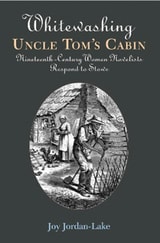
Whitewashing Uncle Tom's Cabin
Nineteenth-Century Women Novelists Respond to StoweJoy Jordan-Lake
Vanderbilt University Press, 2005
Whitewashing the Movies
Asian Erasure and White Subjectivity in U.S. Film CultureDavid C Oh
Rutgers University Press, 2022
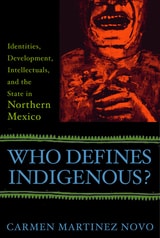
Who Defines Indigenous?
Identities, Development, Intellectuals, and the State in Northern MexicoMartinez Novo, Carmen
Rutgers University Press, 2006
For years, conventional scholarship has argued that minority groups are better served when the majority groups that absorb them are willing to recognize and allow for the preservation of indigenous identities. But is the reinforcement of ethnic identity among migrant groups always a process of self-liberation? In this surprising study, Carmen Martínez Novo draws on her ethnographic research of the Mixtec Indians’ migration from the southwest of Mexico to Baja California to show that sometimes the push for indigenous labels is more a process of external oppression than it is of minority empowerment.
In Baja California, many Mixtec Indians have not made efforts to align themselves as a coherent demographic. Instead, Martínez Novo finds that the push for indigenous identity in this region has come from local government agencies, economic elites, intellectuals, and other external agents. Their concern has not only been over the loss of rich culture. Rather, the pressure to maintain an indigenous identity has stemmed from the desire to secure a reproducible abundance of cheap “Indian” labor. Meanwhile, many Mixtecs reject their ethnic label precisely because being “Indian” means being a commercial agriculture low-wage worker or an urban informal street vendor—an identity that interferes with their goals of social mobility and economic integration.
Bringing a critical new perspective to the complex intersection among government and scholarly agendas, economic development, global identity politics, and the aspirations of local migrants, this provocative book is essential reading for scholars working in the fields of sociology, anthropology, and ethnic studies.
Who Gets the Good Jobs?
Combating Race and Gender DisparitiesCherry, Robert
Rutgers University Press, 2001
Racial and gender employment inequalities are alive and well today. In 2000, the U.S. government offered $508 million to settle more than one thousand lawsuits brought against the federally funded Voice of America by female workers. At the same time, African American employees of Coca-Cola sued their employer, citing the large number of minorities in low-paying jobs, with just a handful at top levels. Even Alan Greenspan has urged firms to eliminate the “distortions that arise as a result of discrimination.”
The political agenda regarding this issue is polarized. Many conservative economists claim that financial considerations have led businesses to hire minorities because such practices increase profits. In opposition, many liberal economists believe businesses will hire minorities only if forced to do so by equal employment opportunity policies. Robert Cherry bridges these two positions, arguing that there is some truth to the positive effect of the profit motive, but that market forces alone are not enough to eliminate employment and earnings disparities.
Cherry surveys the political and economic forces that influenced labor market practices in the nineteenth and twentieth centuries, focusing on the employment barriers African Americans, women, and immigrants encounter. He then assesses the effects of 1960s civil rights legislation and finds that improvements have been substantial, primarily for college-educated African Americans and women; therefore, he recommends that equal employment opportunity policies be strengthened. Cherry demonstrates how the promotion of full employment can further the advancement of working-class African Americans and women.

Who Got the Camera?
A History of Rap and RealityEric Harvey
University of Texas Press, 2021
Reality first appeared in the late 1980s—in the sense not of real life but rather of the TV entertainment genre inaugurated by shows such as Cops and America’s Most Wanted; the daytime gabfests of Geraldo, Oprah, and Donahue; and the tabloid news of A Current Affair. In a bracing work of cultural criticism, Eric Harvey argues that reality TV emerged in dialog with another kind of entertainment that served as its foil while borrowing its techniques: gangsta rap. Or, as legendary performers Ice Cube and Ice-T called it, “reality rap.”
Reality rap and reality TV were components of a cultural revolution that redefined popular entertainment as a truth-telling medium. Reality entertainment borrowed journalistic tropes but was undiluted by the caveats and context that journalism demanded. While N.W.A.’s “Fuck tha Police” countered Cops’ vision of Black lives in America, the reality rappers who emerged in that group’s wake, such as Snoop Doggy Dogg and Tupac Shakur, embraced reality’s visceral tabloid sensationalism, using the media's obsession with Black criminality to collapse the distinction between image and truth. Reality TV and reality rap nurtured the world we live in now, where politics and basic facts don’t feel real until they have been translated into mass-mediated entertainment.

Whose Art Is It?
Jane Kramer
Duke University Press, 1994
This compelling narrative raises questions about community and public art policies, about stereotypes and multiculturalism. With wit, drama, sympathy, and circumspection, Kramer draws the reader into the multicultural debate, challenging our assumptions about art, image, and their relation to community. Her portrait of the South Bronx takes the argument to its grass roots—provocative, surprising in its contradictions and complexities and not at all easy to resolve.
Accompanied by an introduction by Catharine R. Stimpson exploring the issues of artistic freedom, "political correctness," and multiculturalism, Whose Art Is It? is a lively and accessible introduction to the ongoing debate on representation and private expression in the public sphere.
Whose Beloved Community?
The Intersections of Black and LGBTQ Civil RightsEdited by Dwight A. McBride, Beverly Guy-Sheftall, and Justin A. Joyce
University of Illinois Press, 2026
Martin Luther King Jr.’s idea of “the beloved community” focused on the hoped-for new relationship between the oppressor and the oppressed after the success of a nonviolent movement. But the vision excluded, and sometimes still excludes, LGBTQIA+ people and Black women.
The editors curate essays that see beloved community as a generative space that centers justice. Taking inspiration from the radical moral vision of figures like Bayard Rustin and Audre Lorde, the contributors look at how Black queer, feminist, and trans thought and practice can cultivate belonging across lines of race, gender, sexuality, class, and region. Essayists use a variety of disciplinary and methodological perspectives that includes archival recovery, institutional critique, cultural analysis, ethnography, and political theory. The contributors define beloved community for themselves while offering entry points—through art, culture, activism, policy, pedagogy, and theory—for exploring what it means to belong, to resist, and to build.
Expansive and interdisciplinary, <i>Whose Beloved Community?</i> begins the process of advancing toward truly inclusive communities that are more honest, more complex, and more loving.

Why Afterschool Matters
Nelson, Ingrid A.
Rutgers University Press, 2017
Why Afterschool Matters takes a different approach, closely following ten Mexican American students who attended the same extracurricular program in California, then chronicling its long-term effects on their lives, from eighth grade to early adulthood. Discovering that participation in the program was life-changing for some students, yet had only a minimal impact on others, sociologist Ingrid A. Nelson investigates the factors behind these very different outcomes. Her research reveals that while afterschool initiatives are important, they are only one component in a complex network of school, family, community, and peer interactions that influence the educational achievement of disadvantaged students.
Through its detailed case studies of individual students, this book brings to life the challenges marginalized youth en route to college face when navigating the intersections of various home, school, and community spheres. Why Afterschool Matters may focus on a single program, but its findings have major implications for education policy nationwide.

Why Americans Hate Welfare
Race, Media, and the Politics of Antipoverty PolicyMartin Gilens
University of Chicago Press, 1999
"With one out of five children currently living in poverty and more than 100,000 families with children now homeless, Gilens's book is must reading if you want to understand how the mainstream media have helped justify, and even produce, this state of affairs." —Susan Douglas, The Progressive
"Gilens's well-written and logically developed argument deserves to be taken seriously." —Choice
"A provocative analysis of American attitudes towards 'welfare.'. . . [Gilens] shows how racial stereotypes, not white self-interest or anti-statism, lie at the root of opposition to welfare programs." -Library Journal
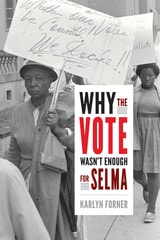
Why the Vote Wasn't Enough for Selma
Karyn Forner
Duke University Press, 2017

Wild Tongue
A Borderlands MixtapeJonathan Leal
Duke University Press, 2026
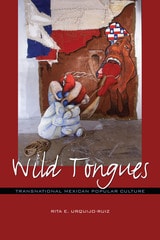
Wild Tongues
Transnational Mexican Popular CultureBy Rita E. Urquijo-Ruiz
University of Texas Press, 2012
Tracing the configuration of the slapstick, destitute Peladita/Peladito and the Pachuca/Pachuco (depicted in flashy zoot suits) from 1928 to 2004, Wild Tongues is an ambitious, extensive examination of social order in Mexican and Chicana/o cultural productions in literature, theater, film, music, and performance art.
From the use of the Peladita and the Peladito as stock characters who criticized various aspects of the Mexican government in the 1920s and 1930s to contemporary performance art by María Elena Gaitán and Dan Guerrero, which yields a feminist and queer-studies interpretation, Rita Urquijo-Ruiz emphasizes the transnational capitalism at play in these comic voices. Her study encompasses both sides of the border, including the use of the Pachuca and the Pachuco as anti-establishment, marginal figures in the United States. The result is a historically grounded, interdisciplinary approach that reimagines the limitations of nation-centered thinking and reading.
Beginning with Daniel Venegas’s 1928 novel, Las aventuras de don Chipote o Cuando los pericos mamen, Rita Urquijo-Ruiz’s Wild Tongues demonstrates early uses of the Peladito to call attention to the brutal physical demands placed on the undocumented Mexican laborer. It explores Teatro de Carpa (tent theater) in-depth as well, bringing to light the experience of Mexican Peladita Amelia Wilhelmy, whose “La Willy” was famous for portraying a cross-dressing male soldier who criticizes the failed Revolution. In numerous other explorations such as these, the political, economic, and social power of creativity continually takes center stage.
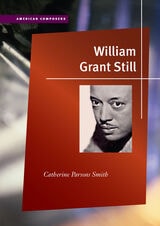
William Grant Still
Catherine Parsons Smith
University of Illinois Press, 2008
Catherine Parsons Smith’s biography tracks the composer's interrelated careers in popular and concert music. Still’s artistic journey took him from conservatory study with George W. Chadwick to collaborating with Langston Hughes, working as a commercial arranger and composer on Broadway and radio, arranging for artists like Sophie Tucker and Artie Shaw, and serving as the recording director for the first Black-owned record label. But despite his prolific production and multidimensional talents, Still endured financial struggles and declining attention to his work.

William J. Seymour and the Origins of Global Pentecostalism
A Biography and Documentary HistoryGastón Espinosa
Duke University Press, 2014
The 104 primary sources include all of Seymour's extant writings in full and without alteration and some of Parham's theological, social, and racial writings, which help explain why the two parted company. To capture the revival's diversity and global influence, this book includes Black, Latino, Swedish, and Irish testimonies, along with those of missionaries and leaders who spread Seymour's vision of Pentecostalism globally.
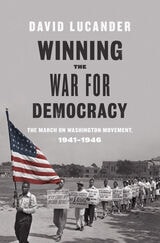
Winning the War for Democracy
The March on Washington Movement, 1941-1946David Lucander
University of Illinois Press, 2014
Winning the War for Democracy: The March on Washington Movement, 1941-1946 recalls that triumph, but also looks beyond Randolph and the MOWM's national leadership to focus on the organization's evolution and actions at the local level. Using the personal papers of previously unheralded MOWM members such as T.D. McNeal, internal government documents from the Roosevelt administration, and other primary sources, David Lucander highlights how local affiliates fighting for a double victory against fascism and racism helped the national MOWM accrue the political capital it needed to effect change.
Lucander details the efforts of grassroots organizers to implement MOWM's program of empowering African Americans via meetings and marches at defense plants and government buildings and, in particular, focuses on the contributions of women activists like Layle Lane, E. Pauline Myers, and Anna Arnold Hedgeman. Throughout he shows how local activities often diverged from policies laid out at MOWM's national office, and how grassroots participants on both sides ignored the rivalry between Randolph and the leadership of the NAACP to align with one another on the ground.
Winnowing
Suzanne Matson
Duke University Press, 2026
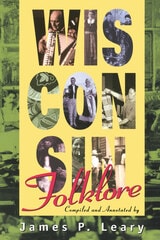
Wisconsin Folklore
Edited by James P. Leary
University of Wisconsin Press, 1999
Highly entertaining and richly informative, Wisconsin Folklore offers the first comprehensive collection of writings about the surprisingly varied folklore of Wisconsin. Beginning with a historical introduction to Wisconsin's folklore and concluding with an up-to-date bibliography, this anthology offers more than fifty annotated and illustrated entries in five sections: "Terms and Talk," "Storytelling," "Music, Song, and Dance," "Beliefs and Customs," and "Material Traditions and Folklife."
The various contributors, from 1884 to 1997, are anthropologists, ethnomusicologists, historians, journalists, museologists, ordinary citizens reminiscing, sociologists, students, writers of fiction, practitioners of folklore, and folklorists. Their interests cover an enormous range of topics: from Woodland Indian place names and German dialect expressions to Welsh nicknames and the jargon of apple-pickers, brewers, and farmers; from Ho-Chunk and Ojibwa mythological tricksters and Paul Bunyan legends to stories of Polish strongmen and Ole and Lena jokes; from Menominee dances and Norwegian fiddling and polka music to African-American gospel groups and Hmong musicians; from faith healers and wedding and funeral customs to seasonal ethnic festivities and tavern amusements; and from spearing decoys and needlework to church dinners, sacred shrines, and the traditional work practices of commercial fishers, tobacco growers, and pickle packers.
For general readers, teachers, librarians, and scholars alike, Wisconsin Folklore exemplifies and illuminates Wisconsin's cultural traditions, and establishes the state's significant but long neglected contributions to American folklore.
Wisconsin My Home
Thurine Oleson; As told to her daughter Erna Oleson Xan; Introduction by Odd Lovoll
University of Wisconsin Press, 2012
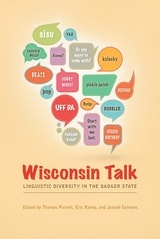
Wisconsin Talk
Linguistic Diversity in the Badger StateEdited by Thomas Purnell, Eric Raimy, and Joseph Salmons
University of Wisconsin Press, 2013
An engaging survey for both general readers and language scholars, Wisconsin Talk brings together perspectives from linguistics, history, cultural studies, and geography to illuminate why language matters in our everyday lives. The authors highlight such topics as:
• words distinctive to the state
• how recent and earlier immigrants have negotiated cultural and linguistic challenges
• the diversity of bilingual speakers that enriches our communities
• how maps can convey the stories of language
• the relation of Wisconsin's Indian languages to language loss worldwide.
Witchcraft Dialogues
Anthropological and Philosophical ExchangesGeorge Clement Bond
Ohio University Press, 2001
While many Africanist scholars shun the analysis of witchcraft as an appropriate domain of investigation, the experiences, thoughts, activities, and powers that witchcraft encompasses have become increasingly the source of interest and debate. Concepts of witchcraft and the phenomena to which they are applied express something fundamental to the human condition and have their equation in the logic of other human practices such as racism and its various crafts. Thus, the focus on witchcraft is not just a concern with the occult, but a manifestation of the convergence of interest in mediating and transcending disciplinary domains.
The contributors to this volume embrace the challenge of exploring witchcraft as a mode of experiencing and explaining human circumstances as well as confronting the limitations of their own intellectual traditions and paradigms. The range of their explorations takes us in new directions, making use not only of their academic training but also of their personal experiences, to reframe the conceptual terrain of the occult and the epistemological orientations of their various academic fields of inquiry.

Witchcraft in England, 1558-1618
Barbara Rosen
University of Massachusetts Press, 1991
Anyone interested in manifestations of witchcraft in Elizabethan and Jacobean England will find this book an invaluable source. Barbara Rosen has gathered and edited a rare collection of documents—pamphlets, reports, trial accounts, and other material—that describes the experience, interpretation, and punishment of witchcraft in the late sixteenth and early seventeenth centuries.
In her introduction, Rosen explores the full range of practices and beliefs associated with witchcraft and situates these phenomena in historical context. She explains how ignorance of science and medicine combined with social circumstance and religious ideology to shape popular perceptions and superstitions. Distinguishing between English and Continental forms of witchcraft, she also examines the legal definitions, disciplines, and punishments applied to wizards, witches, wise women, and conjures in the Elizabethan age.
The pamphlets and other original texts have been modernized in certain respects to make them more accessible to general readers. But the book retains its value for scholars: omissions are detailed in the notes and additions marked; obsolete words and grammar are explained in the glossary.
Originally published in England in 1970 under the title Witchcraft, this book appears now for the first time in paperback and includes a new preface by the editor.
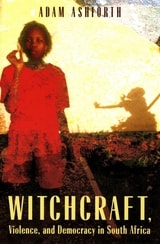
Witchcraft, Violence, and Democracy in South Africa
Adam Ashforth
University of Chicago Press, 2004
In Witchcraft, Violence, and Democracy in South Africa, Adam Ashforth examines how people in Soweto and other parts of post-apartheid South Africa manage their fear of 'evil forces' such as witchcraft. Ashforth examines the dynamics of insecurity in the everyday life of Soweto at the turn of the twenty-first century. He develops a new framework for understanding occult violence as a form of spiritual insecurity and documents new patterns of interpretation attributing agency to evil forces. Finally, he analyzes the response of post-apartheid governments to issues of spiritual insecurity and suggests how these matters pose severe long-term challenges to the legitimacy of the democratic state.
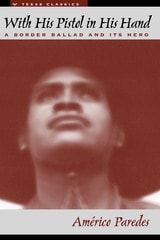
With His Pistol in His Hand
A Border Ballad and Its HeroBy Américo Paredes
University of Texas Press, 1958
Gregorio Cortez Lira, a ranchhand of Mexican parentage, was virtually unknown until one summer day in 1901 when he and a Texas sheriff, pistols in hand, blazed away at each other after a misunderstanding. The sheriff was killed and Gregorio fled immediately, realizing that in practice there was one law for Anglo-Texans, another for Texas-Mexicans. The chase, capture, and imprisonment of Cortez are high drama that cannot easily be forgotten. Even today, in the cantinas along both sides of the Rio Grande, Mexicans sing the praises of the great "sheriff-killer" in the ballad which they call "El Corrido de Gregorio Cortez."
Américo Paredes tells the story of Cortez, the man and the legend, in vivid, fascinating detail in "With His Pistol in His Hand," which also presents a unique study of a ballad in the making. Deftly woven into the story are interpretations of the Border country, its history, its people, and their folkways.
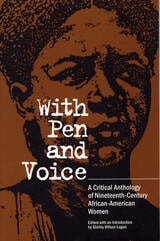
With Pen and Voice
A Critical Anthology of Nineteenth-Century African-American WomenShirley Wilson Logan
Southern Illinois University Press, 1995
"Owoman, woman! upon you I call; for upon your exertions almost entirely depends whether the rising generation shall be any thing more than we have been or not. Owoman, woman! your example is powerful, your influence great."—Maria W. Stewart, "An Address Delivered Before the Afric-American Female Intelligence Society of Boston" (1832)
Here—in the only collection of speeches by nineteenth-century African-American women—is the battle of words these brave women waged to address the social ills of their century. While there have been some scattered references to the unique roles these early "race women" played in effecting social change, until now few scholars have considered the rhetorical strategies they adopted to develop their powerful arguments.
In this chronological anthology, Shirley Wilson Logan highlights the public addresses of these women, beginning with Maria W. Stewart’s speech at Franklin Hall in 1832, believed to be the first delivered to an audience of men and women by an American-born woman. In her speech, she focused on the plight of the Northern free black. Sojourner Truth spoke in 1851 at the Akron, Ohio, Women’s Rights Convention not only for the rights of black women but also for the rights of all oppressed nineteenth-century women. Frances Ellen Watkins Harper struggled with the conflict between universal suffrage and suffrage for black men. Anna Julia Cooper chastised her unique audience of black Episcopalian clergy for their failure to continue the tradition of the elevation of womanhood initiated by Christianity and especially for their failure to support the struggling Southern black woman. Ida B. Wells’s rhetoric targeted mob violence directed at Southern black men. Her speech was delivered less than a year after her inaugural lecture on this issue—following a personal encounter with mob violence in Memphis. Fannie Barrier Williams and Victoria Earle Matthews advocated social and educational reforms to improve the plight of Southern black women. These speeches—all delivered between 1832 and 1895—are stirring proof that, despite obstacles of race and gender, these women still had the courage to mount the platform in defense of the oppressed.
Introductory essays focus on each speaker’s life and rhetoric, considering the ways in which these women selected evidence and adapted language to particular occasions, purposes, and audiences in order to persuade. This analysis of the rhetorical contexts and major rhetorical tactics in the speeches aids understanding of both the speeches and the skill of the speakers. A rhetorical timeline serves as a point of reference.
Historically grounded, this book provides a black feminist perspective on significant events of the nineteenth century and reveals how black women of that era influenced and were influenced by the social problems they addressed.
"A government which can protect and defend its citizens from wrong and outrage and does not is vicious. A government which would do itand cannot is weak; and where human life is insecure through either weakness or viciousness in the administration of law, there must be a lack of justice, and where this is wanting nothing can make up the deficiency."—Frances Ellen Watkins Harper, "Duty to Dependent Races," National Council of Women of the United States, Washington, D.C. (1891)
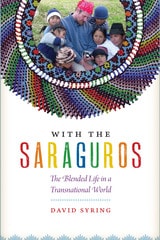
With the Saraguros
The Blended Life in a Transnational WorldBy David Syring
University of Texas Press, 2014
Highlighting globalization’s effects on humanity through the lens of Ecuador’s indigenous Saraguro people, With the Saraguros marks a compelling departure from conventional approaches to ethnography. While documenting and exploring the social patterns among the Saraguro, with an emphasis on the role of women beadworkers, David Syring blends storytelling, dialogue, poetry, and memoir to describe his own realm as a fieldworker in anthropology. As he considers the influence of women’s labor in a community in which the artistry of beadwork is richly symbolic, he also considers how the Saraguro view their observers—the anthropologists.
Probing the role of researchers in a time when basic humanistic questions now often reflect a critical balance between commerce and sustainability, With the Saraguros asks, “What does it mean to live ‘the good life’ in different cultural contexts, and how does our work life relate to this pursuit?” For those who have chosen a work life of anthropology, Syring captures the impact of fieldwork—which uproots the researcher from his or her daily routine—and its potential to deliver new levels of consciousness. The result constitutes more than just the first English-language book dedicated to the dynamic creativity of the Saraguro, contextualized by their social and political history; Syring’s work, which ranges from the ecological imagination to the metaphors of trade, is also a profound meditation on the ways we experience boundaries now that borders no longer create sharply drawn divides between cultural worlds, and “distant” no longer means “separate.”

Without Masters
Autogestión, Anarchist Ethics, and Mexico City PunkLivia K. Stone
Duke University Press, 2026
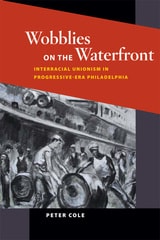
Wobblies on the Waterfront
Interracial Unionism in Progressive-Era PhiladelphiaPeter Cole
University of Illinois Press, 2007
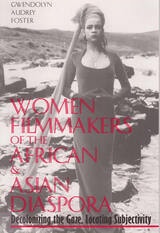
Women Filmmakers of the African & Asian Diaspora
Decolonizing the Gaze, Locating SubjectivityGwendolyn Audrey Foster
Southern Illinois University Press, 1997
Black women filmmakers not only deserve an audience, Gwendolyn Audrey Foster asserts, but it is also imperative that their voices be heard as they struggle against Hollywood’s constructions of spectatorship, ownership, and the creative and distribution aspects of filmmaking.
Foster provides a voice for Black and Asian women in the first detailed examination of the works of six contemporary Black and Asian women filmmakers. She also includes a detailed introduction and a chapter entitled "Other Voices," documenting the work of other Black and Asian filmmakers.
Foster analyzes the key films of Zeinabu irene Davis, "one of a growing number of independent Black women filmmakers who are actively constructing [in the words of bell hooks] ‘an oppositional gaze’"; British filmmaker Ngozi Onwurah and Julie Dash, two filmmakers working with time and space; Pratibha Parmar, a Kenyan/Indian-born British Black filmmaker concerned with issues of representation, identity; cultural displacement, lesbianism, and racial identity; Trinh T. Minh-ha, a Vietnamese-born artist who revolutionized documentary filmmaking by displacing the "voyeuristic gaze of the ethnographic documentary filmmaker"; and Mira Nair, a Black Indian woman who concentrates on interracial identity.
Women In Latin America
Christine Bose
Temple University Press, 1995
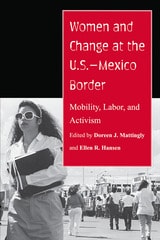
Women and Change at the U.S.–Mexico Border
Mobility, Labor, and ActivismEdited by Doreen J. Mattingly and Ellen R. Hansen
University of Arizona Press, 2006
Women and Politics in Latin America
Craske, Nikki
Rutgers University Press, 1999
This book provides a comprehensive view of women's political participation in Latin America. Focusing on the latter half of the twentieth century, it examines five different arenas of action and debate: political institutions, workplaces, social movements, revolutions, and feminisms. Nikki Craske explores the ways in which women have become more effective in the public arena as the context of politics has altered.
Craske demonstrates how gender relations shape political institutions and practices while simultaneously being shaped by them. She examines the moments when women's action has challenged received ideas, and had a significant impact on the political life of Latin American nations. Women remain heavily underrepresented in political lie, despite their important role in popular movements against authoritarianism, Craske states, and posits that the economy is a substantial constraint on women's political participation. This powerful book analyzes the gains made since the 1950s while scrutinizing the challenges and difficulties which still constrain women's political participation.
Women and Public Life in Early Meiji Japan
The Development of the Feminist MovementMara Patessio
University of Michigan Press, 2011
Women and Slavery in America
A Documentary HistoryCatherine M. Lewis
University of Arkansas Press, 2011
Women and Slavery, Volume One
Africa, the Indian Ocean World, and the Medieval North AtlanticGwyn Campbell
Ohio University Press, 2007
Women enslaved in the Americas came to bear highly gendered reputations among whites—as “scheming Jezebels,” ample and devoted “mammies,” or suffering victims of white male brutality and sexual abuse—that revealed more about the psychology of enslaving than about the courage and creativity of the women enslaved. These strong images of modern New World slavery contrast with the equally expressive virtual invisibility of the women enslaved in the Old—concealed in harems, represented to meddling colonial rulers as “wives” and “nieces,” taken into African families and kin-groups in subtlely nuanced fashion.
Women and Slavery presents papers developed from an international conference organized by Gwyn Campbell.
Volume 1 Contributors: Sharifa Ahjum, Richard B. Allen, Katrin Bromber, Gwyn Campbell, Catherine Coquery-Vidrovitch, Jan-Georg Deutsch, Timothy Fernyhough, Philip J. Havik, Elizabeth Grzymala Jordan, Martin A. Klein, George Michael La Rue, Paul E. Lovejoy, Fred Morton, Richard Roberts, Kirsten A. Seaver
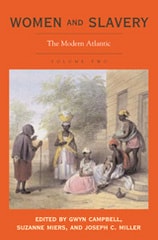
Women and Slavery, Volume Two
The Modern AtlanticGwyn Campbell
Ohio University Press, 2008
Women enslaved in the Americas came to bear highly gendered reputations among whites—as “scheming Jezebels,” ample and devoted “mammies,” or suffering victims of white male brutality and sexual abuse—that revealed more about the psychology of enslaving than about the courage and creativity of the women enslaved. These strong images of modern New World slavery contrast with the equally expressive virtual invisibility of the women enslaved in the Old—concealed in harems, represented to meddling colonial rulers as “wives” and “nieces,” taken into African families and kin-groups in subtlely nuanced fashion.
Volume 2 Contributors: Henrice Altin,k Laurence Brown, Myriam Cottias, Laura F. Edwards, Richard Follett, Tara Inniss, Barbara Krauthamer, Joseph C. Miller, Bernard Moitt, Kenneth Morgan, Claire Robertson, Marsha Robinson, Felipe Smith, and Mariza de Carvalho Soares.
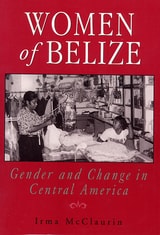
Women of Belize
Gender and Change in Central AmericaMcClaurin, Irma
Rutgers University Press, 1996
This engaging ethnography is set in the remote district of Toledo in Belize, Central America, where three women weave personal stories about the events in their lives. Each describes her experiences of motherhood, marriage, family illness, emigration, separation, work, or domestic violence that led her to recognize gender inequality and then to do something about it. All three challenge the culture of gender at home and in the larger community.
Zola, an East Indian woman without primary school education, invents her own escape from a life of subordination by securing land, then marries the man she's lived with since the age of fourteen--but on her terms. Once she needed permission to buy a dress, now she advocates against domestic violence. Evelyn, a thirty-nine-year old Creole woman, has raised eight children virtually alone, yet she remains married "out of habit." A keen entrepreneur, she has run a restaurant, a store, and a sewing business, and she now owns a mini-mart attached to her home. Rose, a Garifuna woman, is a mother of two whose husband left when she would not accept his extra-marital affairs. While she ekes out a survival in the informal economy by making tamales, she gets spiritual comfort from her religious beliefs, love of music, and two children.
The voices of these ordinary Belizean women fill the pages of this book. Irma McClaurin reveals the historical circumstances, cultural beliefs, and institutional structures that have rendered women in Belize politically and socially disenfranchised and economically dependent upon men. She shows how some ordinary women, through their participation in women's grassroots groups, have found the courage to change their lives. Drawing upon her own experiences as a black woman in the United States, and relying upon cross-cultural data about the Caribbean and Latin America, she explains the specific way gender is constructed in Belize.
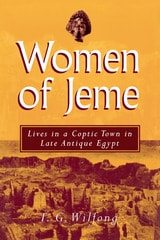
Women of Jeme
Lives in a Coptic Town in Late Antique EgyptT.G. Wilfong
University of Michigan Press, 2002
Contrary to the submissive, demure ideals for women proposed by the religious writers of Christian Egypt, the evidence from Jeme points to a more complex, dynamic situation. Women were active in the home, but some also played important and visible parts in the religious and economic life of their community. A bishop's attempts to monitor the behavior of the women in his district, the intricate inheritance dispute between an aunt and her niece, one woman's pious donations of murals to a church, three women's agonized decisions to give up their children to the local monastery, and the transactions of a family of women moneylenders--all these episodes paint a vivid picture of life in a Coptic town.
Although the remains of Jeme have long been known to scholars, little synthetic work has been done on this rich source for social history in Egypt before and after the Muslim conquests. The Women of Jeme is the first book-length study of the evidence. It will be of interest to Egyptologists and papyrologists, as well as to scholars of Coptic studies, early Christianity, social history and women's studies. The book assumes no prior knowledge of the subject, and the author has taken care to make it accessible to anyone with an interest in the ancient world.
T. G. Wilfong is Assistant Professor of Egyptology and Assistant Curator for Greco-Roman Egypt, University of Michigan.
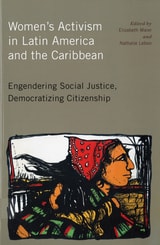
Women's Activism in Latin America and the Caribbean
Engendering Social Justice, Democratizing CitizenshipEdited and with an introduction by Elizabeth Maier and Nathalie Lebon
Rutgers University Press, 2010