Results by title
4038 books match the query 'Social aspects' and 161 start with w

Wildlife and People
THE HUMAN DIMENSIONS OF WILDLIFE ECOLOGYGary G. Gray
University of Illinois Press, 1993

Will Big League Baseball Survive?
Globalization, the End of Television, Youth Sports, and the Future of Major League BaseballLincoln A. Mitchell
Temple University Press, 2016
Major League Baseball is a beloved American institution that has been a product of the economic, social, and media structures that have evolved in the United States over the last century. In his shrewd analysis, Will Big League Baseball Survive?, Lincoln Mitchell asks whether the sport will continue in its current form as a huge, lucrative global business that offers a monopoly in North America—and whether those structures are sustainable.
Mitchell places baseball in the context of the larger, evolving American and global entertainment sector. He examines how both changes directly related to baseball—including youth sports and the increased globalization of the game—as well as broader societal trends such as developments in media consumption and celebrity culture will impact big league baseball over the next few decades.
His book ultimately proposes several possible scenarios for what big league baseball might look like. Will it become more global, smaller, or remain the same, or will it transform into some kind of hybrid of the three?
Willful Subjects
Sara Ahmed
Duke University Press, 2014
Windows into the Soul
Surveillance and Society in an Age of High TechnologyGary T. Marx
University of Chicago Press, 2016
In this landmark book, Marx sums up a lifetime of work on issues of surveillance and social control by disentangling and parsing the empirical richness of watching and being watched. Using fictional narratives as well as the findings of social science, Marx draws on decades of studies of covert policing, computer profiling, location and work monitoring, drug testing, caller identification, and much more, Marx gives us a conceptual language to understand the new realities and his work clearly emphasizes the paradoxes, trade-offs, and confusion enveloping the field. Windows into the Soul shows how surveillance can penetrate our social and personal lives in profound, and sometimes harrowing, ways. Ultimately, Marx argues, recognizing complexity and asking the right questions is essential to bringing light and accountability to the darker, more iniquitous corners of our emerging surveillance society.
For more information, please see www.garymarx.net.

Wired Wisdom
How to Age Better OnlineEszter Hargittai and John Palfrey
University of Chicago Press, 2025
Many popular accounts say the older you are, the greater your tech struggles. And it’s worrying to think of loved ones emailing cringe-worthy misinformation, falling for phishing attacks, or becoming lonelier with increasing time spent online.
But in their eye-opening book on the internet’s fastest-growing demographic, researchers Eszter Hargittai and John Palfrey offer a more nuanced picture—debunking common myths about older adults’ internet use to offer hope and a necessary call to action. Incorporating original interviews and survey results from thousands of people sixty and over, Wired Wisdom shows that many, in fact, use technology in ways that put younger peers to shame. Over-sixties are often nimble online and quicker to abandon social media platforms that don’t meet their needs. Despite being targeted more often, they also may be less likely to fall for scams than younger peers. And fake news actually fools fewer people over sixty, who have far more experience evaluating sources and detecting propaganda. Still, there are unseen risks and missed opportunities for this group. Hargittai and Palfrey offer practical advice and show that our stereotypes can be hurdles that keep us from building intergenerational support communities, helping loved ones adopt new technology that may improve their lives, and thriving together online.
Wired Wisdom
How to Age Better OnlineEszter Hargittai and John Palfrey
University of Chicago Press, 2025
A surprising window into the online lives of people sixty and over—offering essential insights, no matter your age.
Many popular accounts say the older you are, the greater your tech struggles. And it’s worrying to think of loved ones emailing cringe-worthy misinformation, falling for phishing attacks, or becoming lonelier with increasing time spent online.
But in their eye-opening book on the internet’s fastest-growing demographic, researchers Eszter Hargittai and John Palfrey offer a more nuanced picture—debunking common myths about older adults’ internet use to offer hope and a necessary call to action. Incorporating original interviews and survey results from thousands of people sixty and over, Wired Wisdom shows that many, in fact, use technology in ways that put younger peers to shame. Over-sixties are often nimble online and quicker to abandon social media platforms that don’t meet their needs. Despite being targeted more often, they also may be less likely to fall for scams than younger peers. And fake news actually fools fewer people over sixty, who have far more experience evaluating sources and detecting propaganda. Still, there are unseen risks and missed opportunities for this group. Hargittai and Palfrey offer practical advice and show that our stereotypes can be hurdles that keep us from building intergenerational support communities, helping loved ones adopt new technology that may improve their lives, and thriving together online.

Wired into Nature
The Telegraph and the North American FrontierJames Schwoch
University of Illinois Press, 2018
Merging new research with bold interpretation, James Schwoch details the unexplored dimensions of the frontier telegraph and its impact. The westward spread of telegraphy entailed encounters with environments that challenged Americans to acquire knowledge of natural history, climate, and a host of other fields. Telegraph codes and ciphers, meanwhile, became important political, military, and economic secrets. Schwoch shows how the government's use of commercial networks drove a relationship between the two sectors that served increasingly expansionist aims. He also reveals the telegraph's role in securing high ground and encouraging surveillance. Both became vital aspects of the American effort to contain, and conquer, the West's indigenous peoples—and part of a historical arc of concerns about privacy, data gathering, and surveillance that remains pertinent today.
Entertaining and enlightening, Wired into Nature explores an unknown history of the West.

Wisecracks
Humor and Morality in Everyday LifeDavid Shoemaker
University of Chicago Press, 2024
A good sense of humor is key to the good life, but a joke taken too far can get anyone into trouble. Where to draw the line is not as simple as it may seem. After all, even the most innocent quips between friends rely on deception, sarcasm, and stereotypes and often run the risk of disrespect, meanness, and harm. How do we face this dilemma without taking ourselves too seriously?
In Wisecracks, philosopher David Shoemaker examines this interplay between humor and morality and ultimately argues that even morally suspect humor is an essential part of ethical life. Shoemaker shows how improvised “wisecracks” between family and friends—unlike scripted stand-up, sketches, or serials—help us develop a critical human skill: the ability to carry on and find the funny in tragedy. In developing a new ethics of humor in defense of questionable gibes, Wisecracks offers a powerful case for humor as a healing presence in human life.
Witchcraft, Intimacy, and Trust
Africa in ComparisonPeter Geschiere
University of Chicago Press, 2013
Geschiere begins in the forests of southeast Cameroon with the Maka, who fear “witchcraft of the house” above all else. Drawing a variety of local conceptions of intimacy into a global arc, he tracks notions of the home and family—and witchcraft’s transgression of them—throughout Africa, Europe, Brazil, and Oceania, showing that witchcraft provides powerful ways of addressing issues that are crucial to social relationships. Indeed, by uncovering the link between intimacy and witchcraft in so many parts of the world, he paints a provocative picture of human sociality that scrutinizes some of the most prevalent views held by contemporary social science.
One of the few books to situate witchcraft in a global context, Witchcraft, Intimacy, and Trust is at once a theoretical tour de force and an empirically rich and lucid take on a difficult-to-understand spiritual practice and the private spaces throughout the world it so greatly affects.
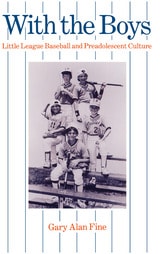
With the Boys
Little League Baseball and Preadolescent CultureGary Alan Fine
University of Chicago Press, 1987

With the Saraguros
The Blended Life in a Transnational WorldBy David Syring
University of Texas Press, 2014
Highlighting globalization’s effects on humanity through the lens of Ecuador’s indigenous Saraguro people, With the Saraguros marks a compelling departure from conventional approaches to ethnography. While documenting and exploring the social patterns among the Saraguro, with an emphasis on the role of women beadworkers, David Syring blends storytelling, dialogue, poetry, and memoir to describe his own realm as a fieldworker in anthropology. As he considers the influence of women’s labor in a community in which the artistry of beadwork is richly symbolic, he also considers how the Saraguro view their observers—the anthropologists.
Probing the role of researchers in a time when basic humanistic questions now often reflect a critical balance between commerce and sustainability, With the Saraguros asks, “What does it mean to live ‘the good life’ in different cultural contexts, and how does our work life relate to this pursuit?” For those who have chosen a work life of anthropology, Syring captures the impact of fieldwork—which uproots the researcher from his or her daily routine—and its potential to deliver new levels of consciousness. The result constitutes more than just the first English-language book dedicated to the dynamic creativity of the Saraguro, contextualized by their social and political history; Syring’s work, which ranges from the ecological imagination to the metaphors of trade, is also a profound meditation on the ways we experience boundaries now that borders no longer create sharply drawn divides between cultural worlds, and “distant” no longer means “separate.”
Within Reason
A Liberal Public Health for an Illiberal TimeSandro Galea
University of Chicago Press, 2023
A provocative chronicle of how US public health has strayed from its liberal roots.
The Covid-19 response was a crucible of politics and public health—a volatile combination that produced predictably bad results. As scientific expertise became entangled with political motivations, the public-health establishment found itself mired in political encampment.
It was, as Sandro Galea argues, a crisis of liberalism: a retreat from the principles of free speech, open debate, and the pursuit of knowledge through reasoned inquiry that should inform the work of public health.
Across fifty essays, Within Reason chronicles how public health became enmeshed in the insidious social trends that accelerated under Covid-19. Galea challenges this intellectual drift towards intolerance and absolutism while showing how similar regressions from reason undermined social progress during earlier eras. Within Reason builds an incisive case for a return to critical, open inquiry as a guiding principle for the future public health we want—and a future we must work to protect.
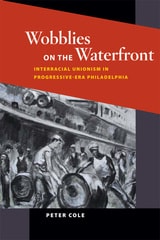
Wobblies on the Waterfront
Interracial Unionism in Progressive-Era PhiladelphiaPeter Cole
University of Illinois Press, 2007

Women March for Peace
Black Radical Women’s Anti-Korean War ActivismDenise Lynn
University of Massachusetts Press, 2025
The Korean War is commonly known as the “forgotten war” because it supposedly had little impact on American culture in comparison to World War II or the American War in Vietnam. Yet from 1950–1953, the conflict produced vigorous anti-war activism, particularly among Black radical women. Informed by their experiences with racism and misogyny within the US, these women were convinced that peace was not just the absence of military aggression, but that it required the liberation of the most oppressed, including the end of capitalist exploitation of women and People of Color and the return of self-determination to colonized peoples—themes that later anti-war activists would echo and develop. Whether or not the Korean War has ever truly been forgotten, the visionary activism of these women has been largely overlooked.
In Women March for Peace, Denise Lynn examines the lives of seven Black women—Louise Thompson Patterson, Claudia Jones, Charlotta Bass, Shirley Graham Du Bois, Eslanda Robeson, Lorraine Hansberry, and Beulah Richardson—and their resistance to domestic and foreign US policies during the height of anticommunist hysteria. While much peace scholarship focuses on the threat of nuclear conflict, Lynn instead explores how these women connected issues of civil rights at home with international military campaigns, highlights the hypocrisy of containment policies that sought to secure the freedom and rights for Koreans when US citizens were still oppressed. Lynn traces their peace advocacy through their personal papers, local and national articles, Progressive Party documents, and global conventions. Women March for Peace recovers the radical activism of these Black women to understand a crucial chapter in the fight against American imperialism and white supremacy.
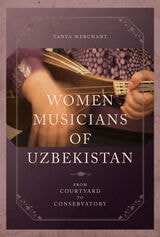
Women Musicians of Uzbekistan
From Courtyard to ConservatoryTanya Merchant
University of Illinois Press, 2015
Drawing on fieldwork and music study carried out between 2001 and 2014, Merchant challenges the Western idea of Central Asian women as sequestered and oppressed. Instead, she notes, Uzbekistan's women stand at the forefront of four prominent genres: maqom, folk music, Western art music, and popular music. Merchant's recounting of the women's experiences, stories, and memories underscores the complex role that these musicians and vocalists play in educational institutions and concert halls, street kiosks and the culturally essential sphere of wedding music. Throughout the book, Merchant ties nationalism and femininity to performances and reveals how the music of these women is linked to a burgeoning national identity.
Important and revelatory, Women Musicians of Uzbekistan looks into music's part in constructing gendered national identity and the complicated role of femininity in a former Soviet republic's national project.

Women Physicians and Professional Ethos in Nineteenth-Century America
Carolyn Skinner
Southern Illinois University Press, 2014
Women physicians in nineteenth-century America faced a unique challenge in gaining acceptance to the medical field as it began its transformation into a professional institution. The profession had begun to increasingly insist on masculine traits as signs of competency. Not only were these traits inaccessible to women according to nineteenth-century gender ideology, but showing competence as a medical professional was not enough. Whether women could or should be physicians hinged mostly on maintaining their femininity while displaying the newly established standard traits of successful practitioners of medicine.
Women Physicians and Professional Ethos provides a unique example of how women influenced both popular and medical discourse. This volume is especially notable because it considers the work of African American and American Indian women professionals. Drawing on a range of books, articles, and speeches, Carolyn Skinner analyzes the rhetorical practices of nineteenth-century American women physicians. She redefines ethos in a way that reflects the persuasive efforts of women who claimed the authority and expertise of the physician with great difficulty.
Descriptions of ethos have traditionally been based on masculine communication and behavior, leaving women’s rhetorical situations largely unaccounted for. Skinner’s feminist model considers the constraints imposed by material resources and social position, the reciprocity between speaker and audience, the effect of one rhetor’s choices on the options available to others, the connections between ethos and genre, the potential for ethos to be developed and used collectively by similarly situated people, and the role ethos plays in promoting social change. Extending recent theorizations of ethos as a spatial, ecological, and potentially communal concept, Skinneridentifies nineteenth-century women physicians’ rhetorical strategies and outlines a feminist model of ethos that gives readers a more nuanced understanding of how this mode of persuasion operates for all speakers and writers.
Women Resisting AIDS
Feminist Strategies of Empowermentedited by Beth E. Schneider and Nancy E. Stoller
Temple University Press, 1995
This collection of original essays discusses the increasingly rapid spread of AIDS among women, considering the varying experiences and responses of women of color, lesbians, and economically impoverished women. The essays range widely from policy assessments to case studies, focusing on women as sufferers, caretakers, policy activists, community organizers, and educators.
Women and Deafness
Double VisionsBrenda Jo Brueggemann
Gallaudet University Press, 2006
This new collection bridges two dynamic academic fields: Women’s Studies and Deaf Studies. The 14 contributors to this interdisciplinary volume apply research and methodological approaches from sociology, ethnography, literary/film studies, history, rhetoric, education, and public health to open heretofore unexplored territory.
Part One: In and Out of the Community addresses female dynamics within deaf schools; Helen Keller’s identity as a deaf woman; deaf women’s role in Deaf organizations; and whether or not the inequity in education and employment opportunities for deaf women is bias against gender or disability. Part Two: (Women’s) Authority and Shaping Deafness explores the life of 19th-century teacher Marcelina Ruis Y Fernandez; the influence of single, hearing female instructors in deaf education; the extent of women’s authority over oralist educational dictates during the 1900s; and a deaf daughter’s relationship with her hearing mother in the late 20th century.
Part Three: Reading Deaf Women considers two deaf sisters’ exceptional creative freedom from 1885 to 1920; the depictions of deaf or mute women in two popular films; a Deaf woman’s account of blending the public-private, deaf-hearing, and religious-secular worlds; how five Deaf female ASL teachers define “gender,” “feminism,” “sex,” and “patriarchy” in ASL and English; and 20th-century American Deaf beauty pageants that emphasize physicality while denying Deaf identity, yet also challenge mainstream notions of “the perfect body.”
Women and Dieting Culture
Inside a Commercial Weight Loss GroupKandi Stinson
Rutgers University Press, 2001
American women invest millions of dollars, as well as much time and energy, in a quest for a body that meets our culture’s standard of beauty—slenderness. Since we define a woman’s sexual attractiveness as essential to her social worth, it is no wonder that “fat is a feminist issue.”
Commercial weight loss organizations have come under attack from feminist scholars for perpetuating the very social values that cause women to obsess about their weight. In Women and Dieting Culture, sociologist Kandi Stinson asks how these values are transmitted and how the women who join such organizations actually think about their bodies and weight loss. As part of her research, Stinson fully participated in a national, commercial weight-loss organization as a paying member. Her acute analysis and sensitive insider’s portrayal vividly illustrate the central roles dieting and body image play in women’s lives.
As she experiences the program and interviews other members, Stinson discovers that the women view the causes and cures of being overweight according to five distinct, though often overlapping, concepts: self-help, work, religion, addiction, and feminism. Drawing extensively on the dieters’ own words, Stinson explores each of these concepts and outlines how they form interrelated patterns which, when analyzed, yield an exciting new perspective on the transmission of cultural values.
Armed with fresh insights into how women feel about weight and their bodies, Stinson finally ponders the question: Can one be a feminist and still wish to lose weight?
Women and Migration in the U.S.-Mexico Borderlands
A ReaderDenise A. Segura and Patricia Zavella, eds.
Duke University Press, 2007
This reader includes twenty-three essays—two of which are translated from the Spanish—that illuminate women’s engagement with diverse social and cultural challenges. One contributor critiques the statistical fallacy of nativist discourses within the United States that portray Chicana and Mexican women’s fertility rates as “out of control.” Other contributors explore the relation between sexual violence and women’s migration from rural areas to urban centers within Mexico, the ways that undocumented migrant communities challenge conventional notions of citizenship, and young Latinas’ commemorations of the late, internationally renowned singer Selena. Several essays address workplace intimidation and violence, harassment and rape by U.S. border patrol agents and maquiladora managers, sexual violence, and the brutal murders of nearly two hundred young women near Ciudad Juárez. This rich collection highlights both the structural inequities faced by Mexican women in the borderlands and the creative ways they have responded to them.
Contributors. Ernestine Avila, Xóchitl Castañeda, Sylvia Chant, Leo R. Chavez, Cynthia Cranford, Adelaida R. Del Castillo, Sylvanna M. Falcón, Gloria González-López, Maria de la Luz Ibarra, Jonathan Xavier Inda, Rosa Linda Fregoso, Jennifer S. Hirsch, Pierrette Hondagneu-Sotelo, Eithne Luibheid, Victoria Malkin, Faranak Miraftab, Olga Nájera-Ramírez, Norma Ojeda de la Peña, Deborah Paredez, Leslie Salzinger, Felicity Schaeffer-Grabiel, Denise A. Segura, Laura Velasco Ortiz, Melissa W. Wright, Patricia Zavella
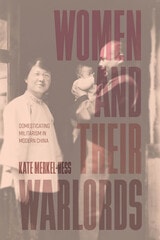
Women and Their Warlords
Domesticating Militarism in Modern ChinaKate Merkel-Hess
University of Chicago Press, 2024
In Women and Their Warlords, historian Kate Merkel-Hess examines the lives and personalities of the female relatives of the military rulers who governed regions of China from 1916 to 1949. Posing for candid photographs and sitting for interviews, these women did not merely advance male rulers’ agendas. They advocated for social and political changes, gave voice to feminist ideas, and shaped how the public perceived them. As the first publicly political partners in modern China, the wives and concubines of Republican-era warlords changed how people viewed elite women’s engagement in politics. Drawing on popular media sources, including magazine profiles and gossip column items, Merkel-Hess draws unexpected connections between militarism, domestic life, and state power in this insightful new account of gender and authority in twentieth-century China.

Women and the Everyday City
Public Space in San Francisco, 1890–1915Jessica Ellen Sewell
University of Minnesota Press, 2011
Focusing on women's everyday use of streetcars, shops, restaurants, and theaters, Sewell reveals the impact of women on these public places-what women did there, which women went there, and how these places were changed in response to women's presence. Using the diaries of three women in San Francisco-Annie Haskell, Ella Lees Leigh, and Mary Eugenia Pierce, who wrote extensively on their everyday experiences-Sewell studies their accounts of day trips to the city and combines them with memoirs, newspapers, maps, photographs, and her own observations of the buildings that exist today to build a sense of life in San Francisco at this pivotal point in history.
Women in Hollywood's Dream Factory
Tales of Inequality, Abuse, and ResistanceEdited by Karen McNally
University of Illinois Press, 2026
The #MeToo revelations put a twenty-first-century stamp on the age-old story of women’s mistreatment in Hollywood. Karen McNally edits a collection focused on examining and revising film history in the aftermath of the women’s stories, past and present, that have come to light.
The collection begins with essays on the interplay between reality and imagination in narratives and representations of women’s experiences of unequal treatment. In Part 2, contributors discuss how the gendered attitudes of the media’s stories enable inequality in Hollywood and look at the forces that arise whenever women resist these media assaults. The next section addresses the structures that built the inequalities and mistreatment while Part 4 revisits established narratives to challenge, renew, and expand upon our understanding of film history through women’s stories. Essays in the final section address the combination of inequality and resistance that defines women’s experiences in Hollywood.
Piercing and astute, Women in Hollywood’s Dream Factory confronts our perception of Hollywood as a mythological land of dreams.
Contributors: Alicia Byrnes, Anna M. Dempsey, Harriet Fletcher, Amanda Konkle, Tamar Jeffers McDonald, Kerry McElroy, Adrienne L. McLean, Karen McNally, Donna Peberdy, Melanie Piper, Victoria K. Pistivsek, Sarah Polley, Ina C. Seethaler, Gabrielle Stecher, and Jennifer Voss
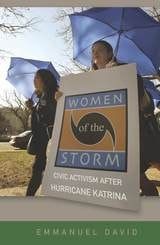
Women of the Storm
Civic Activism after Hurricane KatrinaEmmanuel David
University of Illinois Press, 2017
Women's Professional Lives in Rhetoric and Composition
Choice, Chance, and SerendipityEdited by Elizabeth A. Flynn and Tiffany Bourelle
The Ohio State University Press, 2018
This collection, edited by Elizabeth A. Flynn and Tiffany Bourelle, contributes to the valuable work of chronicling the professional and personal lives of women in academia. Through its line-up of contributors from diverse backgrounds, locations, and career paths, Women’s Professional Lives in Rhetoric and Composition showcases the voices of multiple scholars occupying a multitude of different roles in the profession: from prestigious professors emeritae and endowed chairs to assistant professors starting their careers to an independent scholar to part-time faculty.
The collection sets itself apart from other volumes not just in its diversity of perspectives but also by speaking against linear stories of success in the profession—sharing moments of shame and failure, showing how the personal and professional often intertwine and influence one another, and ultimately revealing how choice, chance, serendipity, and kairos have all played a role in the lives of its contributors. In focusing on this convergence, Women’s Professional Lives in Rhetoric and Composition offers a more nuanced picture of the professional and intellectual trajectories of women in rhetoric and composition.
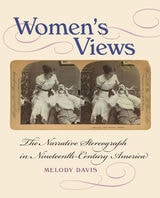
Women's Views
The Narrative Stereograph in Nineteenth-Century AmericaMelody Davis
University of Massachusetts Press, 2015
In this remarkable book, Melody Davis analyzes the underexamined genre of narrative stereoviews and their audiences. Because stereoviews were created for and marketed primarily to middle-class women in domestic settings, Davis argues that they represent one of the best sources for addressing the flow of historical change in women's lives. By analyzing dozens of stereoviews—including depictions of gender stereotypes, power dynamics, comical or sentimental situations, and scenes of both serious and playful innuendo—Davis energetically spins a broad history of the real social, sexual, and economic changes in the lives of American women. Her close reading and rich contextualization of these compelling vernacular objects bridge the gaps between the private viewing that took place within the home and the outside world of consumption and power that women were gradually entering.
Illustrated with more than one hundred stereographs and including a three-dimensional viewer, this book will appeal to readers with an interest in U.S. women's history, the history of photography, visual and cultural studies, and American studies.
Women's Voices in Digital Media
The Sonic Screen from Film to MemesJennifer O'Meara
University of Texas Press, 2022
2023 Publication Award Honorable Mention, British Association for Film, Television and Screen Studies
An examination of the sound and silence of women in digital media.
In today’s digital era, women’s voices are heard everywhere—from smart home devices to social media platforms, virtual reality, podcasts, and even memes—but these new forms of communication are often accompanied by dated gender politics. In Women’s Voices in Digital Media, Jennifer O’Meara dives into new and well-established media formats to show how contemporary screen media and cultural practices police and fetishize women’s voices, but also provide exciting new ways to amplify and empower them.
As she travels through the digital world, O’Meara discovers newly acknowledged—or newly erased—female voice actors from classic films on YouTube, meets the AI and digital avatars in Her and The Congress, and hears women’s voices being disembodied in new ways via podcasts and VR voice-overs. She engages with dialogue that is spreading with only the memory of a voice, looking at how popular media like Clueless and The Simpsons have been mined for feminist memes, and encounters vocal ventriloquism on RuPaul’s Drag Race that queers and valorizes the female voice. Through these detailed case studies, O’Meara argues that the digital proliferation of screens alters the reception of sounds as much as that of images, with substantial implications for women’s voices.
Women, Gender, and Technology
Edited by Mary Frank Fox, Deborah G. Johnson, and Sue V. Rosser
University of Illinois Press, 2006
An interdisciplinary investigation of the co-creation of gender and technology
Each of the ten chapters in Women, Gender, and Technology explores a different aspect of how gender and technology work--and are at work--in particular domains, including film narratives, reproductive technologies, information technology, and the profession of engineering. The volume's contributors include representatives of over half a dozen different disciplines, and each provides a novel perspective on the foundational idea that gender and technology co-create one another. Together, their articles provide a window on to the rich and complex issues that arise in the attempt to understand the relationship between these profoundly intertwined notions.

Women, Mysticism, and Hysteria in Fin-de-Siècle Spain
Jennifer Smith
Vanderbilt University Press, 2021
Author Jennifer Smith also directs modern historians to the writings of Emilia Pardo Bazán (1851-1921) as a thinker whose work points out mysticism's subversive potential in terms of the patriarchal order. Pardo Bazán, unlike her male counterparts, rejected the hysteria diagnosis and promoted mysticism as a path for women's personal development and self-realization.
Women, Work, and Worship in Lincoln's Country
The Dumville Family LettersEdited by Anne M. Heinz and John P. Heinz
University of Illinois Press, 2016

Women’s Bookscapes in Early Modern Britain
Reading, Ownership, CirculationLeah Knight, Micheline White, and Elizabeth Sauer, Editors
University of Michigan Press, 2018
Women in 16th- and 17th-century Britain read, annotated, circulated, inventoried, cherished, criticized, prescribed, and proscribed books in various historically distinctive ways. Yet, unlike that of their male counterparts, the study of women’s reading practices and book ownership has been an elusive and largely overlooked field.
In thirteen probing essays, Women’s Bookscapesin Early Modern Britain brings together the work of internationally renowned scholars investigating key questions about early modern British women’s figurative, material, and cultural relationships with books. What constitutes evidence of women’s readerly engagement? How did women use books to achieve personal, political, religious, literary, economic, social, familial, or communal goals? How does new evidence of women’s libraries and book usage challenge received ideas about gender in relation to knowledge, education, confessional affiliations, family ties, and sociability? How do digital tools offer new possibilities for the recovery of information on early modern women readers?
The volume’s three-part structure highlights case studies of individual readers and their libraries; analyses of readers and readership in the context of their interpretive communities; and new types of scholarly evidence—lists of confiscated books and convent rules, for example—as well as new methodologies and technologies for ongoing research. These essays dismantle binaries of private and public; reading and writing; female and male literary engagement and production; and ownership and authorship.
Interdisciplinary, timely, cohesive, and concise, this collection’s fresh, revisionary approaches represent substantial contributions to scholarship in early modern material culture; book history and print culture; women’s literary and cultural history; library studies; and reading and collecting practices more generally.
Women’s Ways of Making
Maureen Daly Goggin
Utah State University Press, 2021
Since the Enlightenment, embodied knowledge creation has been overlooked, ignored, or disparaged as inferior to other forms of expression or thinking that seem to leave the material world behind. Privileging the hand over the eye, as the work in this collection does, thus problematizes the way in which the eye has been co-opted by thinkers as the mind’s tool of investigation. Contributors to this volume argue that other senses—touch, taste, smell, hearing—are keys to knowing one’s materials. Only when all these ways of knowing are engaged can making be understood as a rhetorical practice.
In Women’s Ways of Making contributors explore ideas of making that run the gamut from videos produced by beauty vloggers to zine production and art programs at women’s correctional facilities. Bringing together senior scholars, new voices, and a fresh take on material rhetoric, this book will be of interest to a broad range of readers in composition and rhetoric.
Contributors: Angela Clark-Oates, Jane L. Donawerth, Amanda Ellis, Theresa M. Evans, Holly Fulton-Babicke, Bre Garrett, Melissa Greene, Magdelyn Hammong Helwig, Linda Hanson, Jackie Hoermann, Christine Martorana, Aurora Matzke, Jill McCracken, Karen S. Neubauer, Daneryl Nier-Weber, Sherry Rankins-Roberson, Kathleen J. Ryan, Rachael Ryerson, Andrea Severson, Lorin Shellenberger, Carey Smitherman-Clark, Emily Standridge, Charlese Trower, Christy I. Wenger, Hui Wu, Kathleen Blake Yancey
Words like Water
Queer Mobilization and Social Change in ChinaFugazzola, Caterina
Temple University Press, 2023
Words like Water explores the nonconfrontational strategies the tongzhi movement uses in contemporary China. Caterina Fugazzola analyzes tongzhi organizers’ conceptualizations of, and approaches to, social change, explaining how they avoid the backlash that meets Western tactics, such as protests, confrontation, and language about individual freedoms. In contrast, the groups’ intentional use of community and family-oriented narratives, discourses, and understandings of sexual identity are more effective, especially in situations where direct political engagement is not possible.
Providing on-the-ground stories that examine the social, cultural, and political constraints and opportunities, Words like Water emphasizes the value of discursive flexibility that allows activists to adapt to changing social and political conditions.

Words of Passage
National Longing and the Imagined Lives of Mexican MigrantsBy Hilary Parsons Dick
University of Texas Press, 2018
Migration fundamentally shapes the processes of national belonging and socioeconomic mobility in Mexico—even for people who never migrate or who return home permanently. Discourse about migrants, both at the governmental level and among ordinary Mexicans as they envision their own or others’ lives in “El Norte,” generates generic images of migrants that range from hardworking family people to dangerous lawbreakers. These imagined lives have real consequences, however, because they help to determine who can claim the resources that facilitate economic mobility, which range from state-sponsored development programs to income earned in the North.
Words of Passage is the first full-length ethnography that examines the impact of migration from the perspective of people whose lives are affected by migration, but who do not themselves migrate. Hilary Parsons Dick situates her study in the small industrial city of Uriangato, in the state of Guanajuato. She analyzes the discourse that circulates in the community, from state-level pronouncements about what makes a “proper” Mexican to working-class people’s talk about migration. Dick shows how this migration discourse reflects upon and orders social worlds long before—and even without—actual movements beyond Mexico. As she listens to men and women trying to position themselves within the migration discourse and claim their rights as “proper” Mexicans, she demonstrates that migration is not the result of the failure of the Mexican state but rather an essential part of nation-state building.

Words of the Inuit
A Semantic Stroll through a Northern CultureLouis-Jacques Dorais
University of Manitoba Press, 2020
Word’s Out
Gay Men’s EnglishWilliam Leap
University of Minnesota Press, 1996
The first book-length analysis of the language used by gay men.
Do gay men communicate with each other differently than they do with straight people? If they do, how is “gay men’s English” different from “straight English”? In Word’s Out, William Leap addresses these questions in an entertaining account that looks at gay men’s English as a cultural and a linguistic phenomenon.
Whereas previous studies of “gay language” have centered almost entirely on vocabulary, word history, and folklore, Word's Out focuses on the linguistic practices-cooperation, negotiation, and risk taking-that underlie gay men’s conversations, storytelling, verbal dueling, self-description, and construction of outrageous references. Leap “reads” conversations for covert and overt signs of gay men's English, using anecdotes drawn from gay dinner parties, late-night airplane flights, restaurants, department stores, and gourmet shops, and from other all-gay and gay/straight settings. He incorporates material from life-story narratives and other interviews and discussions with gay men, from gay magazines, newspapers, and books, and from events in his own life. The topics addressed include establishing the gay identities of “suspect gays,” recollections of gay childhood, erotic negotiation in health club locker rooms, and gay men’s language of AIDS. Leap shows how gay English speakers use language to create gay-centered spaces within public places, to protect themselves when speaking with strangers, and to establish common interests when speaking with “suspect gays,” and explores why learning gay English is a critical component in gay men’s socialization and entry into gay culture. Provocative and potentially controversial, Word's Out provides fascinating insight into the politics of gay experience by exploring the connections between language and daily experience in gay men's lives.
Work Requirements
Race, Disability, and the Print Culture of Social WelfareTodd Carmody
Duke University Press, 2022
Work!
A Queer History of ModelingElspeth H. Brown
Duke University Press, 2019

Work, Fight, or Play Ball
How Bethlehem Steel Helped Baseball's Stars Avoid World War IEcenbarger, William
Temple University Press, 2024
Some players used the steel mill and shipyard leagues to avoid wartime military duty, irking Major League owners, who saw their rosters dwindling. Bethlehem Steel President Charles Schwab (no relation to the financier) saw the league as a means to stave off employee and union organizing. Most fans loudly criticized the ballplayers, but nevertheless showed up to watch the action on the diamond.
Ecenbarger traces the 1918 Steel League’s season and compares the fates of the players who defected to industry or continued to play stateside with the travails of the Major Leaguers, such as Christy Mathewson, Ty Cobb, and Grover Cleveland Alexander, who served during the war.
Work, Fight, or Play Ball reveals the home field advantage brought on by the war, which allowed companies to profit from Major League players.
Work, Inc.
A Philosophical InquiryEdmund F. Byrne
Temple University Press, 1992
Many workers today feel that the longstanding social contract between government, business, and labor has been broken. This book examines legal and philosophical problems that must be addressed if there is to be a new social contract that is fair to workers. Drawing on a wide variety of sources, from the popular press to technical philosophy, Edmund F. Byrne brings into focus ethical issues involved in corporate decisions to reorganize, relocate, or automate. In assessing the human costs of these decisions, he shows why, to a worker, "corporations are not reducible to their assets and liabilities any more than a government is merely its annual budget. That they are organizations, that these organizations do things, and that they are socially responsible for what they do."
In support of this assignment of responsibility, Byrne seeks to demythologize corporate hegemony by confronting a variety of intellectual "dragons" that guard the gates of the status quo. These include legal assumptions about corporate personhood and commodification, private property and eminent domain; management ideas about the autonomous employee and profit without payrolls; technocratic dreams of a dehumanized workplace: ideological belief in progress and competition; and philosophical arguments for libertarian freedom, liberal welfare, and global justice.
Because of these and other mainstream perspectives, workers today are widely perceived, in law and in common parlance, to be isolated atoms. But, Byrne emphasizes, work. including work done for a transnational corporation, is done in a community. Since corporate leaders make decisions that have an impact on people’s lives and on communities, involvement in such decisions must be not only corporate or governmental but community-based as well.

Workin' It
Women Living Through Drugs and CrimeLeon Pettiway
Temple University Press, 1997
These are the words with which Margaret, a thirty-three-year-old cocaine-using prostitute, begins her story. In this book, she and four other women, all inner-city hustlers, describe their lives, how they came to be where they are, and where they hope to go.
Margaret, Charlie, Virginia, Tracy, and Laquita are all drug users who are involved in regular criminal activity: prostitution, burglary, shoplifting, robbery, drug selling, petty theft, and various kinds of fraud. Four of the women are black; one is white and Puerto Rican. While all five have been involved in same-sex relationships, three are primarily straight and two are primarily lesbian. They come from working-class or welfare families; some women characterize their mothers as strict, abusive, intolerant, and distant while other mothers are characterized as being concerned, religious, and loving. The women talk frankly about their drug use, their sexual and criminal activities, their childhoods, their personal relationships with their families of origin, children, partners, their fears and future goals, and the ordinary trappings of their lives.
While these accounts describe lives lived at the margins of society, they also reveal women who practice self-evaluation. These are women who have a deep understanding of individual accountability and responsibility. These accounts are connected by themes of violence and poverty, but they are also connected by the variety and richness of these women's lives. The women also assert a control over their activities and talk of independent judgment in terms that we imagine are reserved for men. There is a tendency in criminology to treat the data generated by research on men as fundamentally true for women as well. By allowing female law-breakers to describe their lives in their own way, Pettiway underlines not only their differences from men but also their differences from each other.
However, their stories also reveal their common humanity and their profound will to survive despite all obstacles. These women manage to live self-defined and self-validated lives in a world even more turbulent than that of their mainstream sisters. They share a web of experiences created out of race and ethnicity, sexual orientation, drug use, and urbanization that provides them with meaning and courage. They speak movingly about guilt and responsibility, about rape and intimacy, and about ambition and despair. Through their stories we can grasp the traumas and turning points that lead us all to make bad decisions as well as those ideals and inspirations that can help to redeem us.

Working Law
Courts, Corporations, and Symbolic Civil RightsLauren B. Edelman
University of Chicago Press, 2016
One reason for the limited success of antidiscrimination policies, argues Lauren B. Edelman, is that the law regulating companies is broad and ambiguous, and managers therefore play a critical role in shaping what it means in daily practice. Often, what results are policies and procedures that are largely symbolic and fail to dispel long-standing patterns of discrimination. Even more troubling, these meanings of the law that evolve within companies tend to eventually make their way back into the legal domain, inconspicuously influencing lawyers for both plaintiffs and defendants and even judges. When courts look to the presence of antidiscrimination policies and personnel manuals to infer fair practices and to the presence of diversity training programs without examining whether these policies are effective in combating discrimination and achieving racial and gender diversity, they wind up condoning practices that deviate considerably from the legal ideals.

Working Out in Japan
Shaping the Female Body in Tokyo Fitness ClubsLaura Spielvogel
Duke University Press, 2003
Fitness clubs have proliferated in Japanese cities over the past decade. Yet, despite the pervasive influence of a beauty industry that values thinness above all else, they have met with only mixed success . Exploring this paradox, Spielvogel focuses on the tensions and contradictions within the world of Japanese fitness clubs and on the significance of differences between Japanese and North American philosophies of mind and body. Working Out in Japan explores the ways spaces and bodies are organized and regulated within the clubs, the frustrations of female instructors who face various gender inequities, and the difficult demands that the ideal of slimness places on Japanese women. Spielvogel’s vivid investigation illuminates not only the fitness clubs themselves, but also broader cultural developments including the growth of the service industry and the changing character of work and leisure in Japan.

Working in Music on the Semiperiphery
Local Cultural Production and Global CapitalismEmília Barna
Central European University Press, 2025
This book embraces the widest possible range of workers in the music industry. It deals with all music genres from high-flying to commercial and observes various workers in the production chain beyond musicians. Niche segments of the sector, such as YouTube-based commercial hip hop, are given special treatment. Using a variety of empirical research methods, the study examines the trends as workers are pushed towards digital entrepreneurship and platform work, on the one hand, and live performance, on the other. The focus on domestic work and informality offers a feminist analysis of work in music. This approach sheds light on gendered divisions of labor and forms of (self-)exploitation that usually remain invisible. The book proposes a new model of cultural autonomy that takes account of the semiperipheral relationship of music industry workers and institutions to both the market and the state.
World Bank Literature
Amitava Kumar
University of Minnesota Press, 2002
A trailblazing interrogation of the cultural, political, and economic implications of World Bank hegemony.
World Bank literature is more than a concept-it is a provocation, a call to arms. It is intended to prompt questions about each word, to probe globalization, political economy, and the role of literary and cultural studies. As asserted in this major work, it signals a radical rewriting of academic debates, a rigorous analysis of the World Bank and the International Monetary Fund (IMF), and a consideration of literature that deals with new global realities.
Made more relevant than ever by momentous antiglobalization demonstrations in Seattle and Genoa, World Bank Literature brings together essays by a distinguished group of economists, cultural and literary critics, social scientists, and public policy analysts to ask how to understand the influence of the World Bank/IMF on global economic power relations and cultural production. The authors attack this question in myriad ways, examining World Bank/IMF documents as literature, their impact on developing nations, the relationship between literature and globalization, the connection between the academy and the global economy, and the emergence of coalitions confronting the new power. World Bank Literature shows, above all, the multifarious and sometimes nefarious ways that abstract academic debates play themselves out concretely in social policy and cultural mores that reinforce traditional power structures. Contributors: Anthony C. Alessandrini, Kent State U; Bret Benjamin, SUNY, Albany; John Berger; Suzanne Bergeron, U of Michigan, Dearborn; Lorrayne Carroll, U of Southern Maine; Manthia Diawara, NYU; Grant Farred, Duke; Barbara Foley, Rutgers; Claire F. Fox, U of Iowa; Rosemary Hennessy, SUNY, Albany; Doug Henwood, Left Business Observer; Caren Irr, Brandeis; Joseph Medley, U of Southern Maine; Cary Nelson, U of Illinois; Gautam Premnath, U of Massachusetts, Boston; Bruce Robbins, Columbia; Andrew Ross, NYU; Subir Sinha, U of London; Kenneth Surin, Duke; Rashmi Varma, U of North Carolina; Evan Watkins, U of California, Davis; Phillip E. Wegner, U of Florida; Richard Wolff, U of Massachusetts.
World Below
Body and Cosmos in Otomí Indian RitualJacques Galinier
University Press of Colorado, 2004
Drawing upon both Freud and theories of the carnivalesque, Galinier argues that the "world below" (the lower half of the body) provides the foundation for an indigenous metapsychology that is at once very close to and very far away from the Freudian conceptual apparatus.
World Making in Nepantla
Feminists of Color Navigating Life and Work in the PandemicGloria González-LópezSharmila RudrappaChristen A. Smith
University of Texas Press, 2025
Writings from feminist scholars of color about their experiences during the pandemic.
Bringing uncertainty, fear, and change, the COVID-19 pandemic shook the world, altered people’s lives, and sparked a wave of introspection. Underserved communities—people of color, women, and queer people among them—were affected the most, and their experiences, in turn, reflected hope and opportunities to reinvent themselves individually and collectively. Drawing on Gloria Anzaldúa’s use of nepantla—the Náhuatl word meaning “in-between space,” the en medio and a liminal space between worlds imbued with change—World Making in Nepantla collects writings about the hurdles feminist scholars of color faced during the pandemic years.
Contributors explore how COVID affected feminist scholars of color while recognizing the ways in which inequality influences experience and also celebrating the resilience of communities all over the world. Dispatches from classrooms and quarantined homes and introspective essays on disability, mutual aid, and borders are included among the essays here. These pieces serve as a concrete record, capturing an ephemeral time already being lost to memory. Created during the heart of the pandemic, World Making in Nepantla is an honest and intimate recording of how feminist scholars of color navigated struggles and found strength during an era that forever changed the modern world.

World-Systems Analysis
An IntroductionImmanuel Wallerstein
Duke University Press, 2004
Wallerstein explains the defining characteristics of world-systems analysis: its emphasis on world-systems rather than nation-states, on the need to consider historical processes as they unfold over long periods of time, and on combining within a single analytical framework bodies of knowledge usually viewed as distinct from one another—such as history, political science, economics, and sociology. He describes the world-system as a social reality comprised of interconnected nations, firms, households, classes, and identity groups of all kinds. He identifies and highlights the significance of the key moments in the evolution of the modern world-system: the development of a capitalist world-economy in the sixteenth-century, the beginning of two centuries of liberal centrism in the French Revolution of 1789, and the undermining of that centrism in the global revolts of 1968. Intended for general readers, students, and experienced practitioners alike, this book presents a complete overview of world-systems analysis by its original architect.
Worldmaking
Race, Performance, and the Work of CreativityDorinne Kondo
Duke University Press, 2018
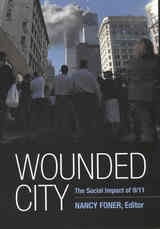
Wounded City
The Social Impact of 9/11 on New York CityNancy Foner
Russell Sage Foundation, 2005