Results by title
3576 books match the query 'American' and 207 start with w
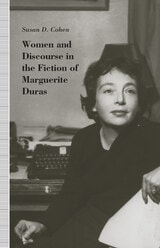
Women and Discourse in the Fiction of Marguerite Duras
Love, Legends, LanguageSusan D. Cohen
University of Massachusetts Press, 1993
One of the most famous living French writers, Marguerite Duras is renowned for her provocative and hauntingly beautiful works of fiction, drama, and cinema. This book offers the first comprehensive study of the narrative and stylistic characteristics of Duras's fiction. Susan D. Cohen examines the entire range of Duras's works, combining close textual analyses with a more general discussion of narrativity and its connections with gender, class, and race. The focus throughout is on language, representation, and difference, which Duras explores on every structural level.
Cohen shows how Duras's writings, even the controversial “erotic” works, expose and subvert the repression of women in traditional, dominant discourse and at the same time present an alternative, nonrepressive discursive model. She formulates a concept of creative “ignorance,” which she identifies as the generative principle of Duras's textual production and the approach to language it proposes. Cohen also explores the distinctive features of Duras's prose, describing how the writer achieves the ritual, legendary aura that characterizes her work.
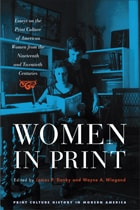
Women in Print
Essays on the Print Culture of American Women from the Nineteenth and Twentieth CenturiesEdited by James P. Danky and Wayne A. Wiegand
University of Wisconsin Press, 2006
Women readers, editors, librarians, authors, journalists, booksellers, and others are the subjects in this stimulating new collection on modern print culture. The essays feature women like Marie Mason Potts, editor of Smoke Signals, a mid-twentieth century periodical of the Federated Indians of California; Lois Waisbrooker, publisher of books and journals on female sexuality and women's rights in the decades after the Civil War; and Elizabeth Jordan, author of two novels and editor of Harper's Bazaar from 1900 to 1913. The volume presents a complex and engaging picture of print culture and of the forces that affected women's lives in the nineteenth and twentieth centuries.
Published in collaboration among the University of Wisconsin Press, the Center for the History of Print Culture in Modern America (a joint program of the University of Wisconsin–Madison and the Wisconsin Historical Society), and the University of Wisconsin–Madison General Library System Office of Scholarly Communication.
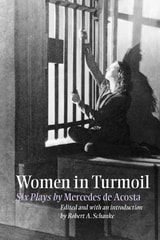
Women in Turmoil
Six Plays by Mercedes de AcostaEdited and with an introduction by Robert A. Schanke
Southern Illinois University Press, 2003
In this first publication of six plays by the flamboyantly uninhibited author, poet, and playwright Mercedes de Acosta (1893–1968), theater historian Robert A. Schanke rescues these lost theatrical writings from the dusty margins of obscurity. Often autobiographical, always rife with gender struggle, and still decidedly stageworthy, Women in Turmoil: Six Plays by Mercedes de Acosta constitutes a significant find for the canon of gay and lesbian drama.
In her 1960 autobiography Here Lies the Heart, de Acosta notes that as she was contemplating marriage to a man in 1920, she was "in a strange turmoil about world affairs, my own writing, suffrage, sex, and my inner spiritual development." The voice in these plays is that of a lesbian in turmoil, marginalized and ignored. Her same-sex desires and struggles for acceptance fueled her writings, and nowhere is that more evident than in the plays contained herein. The women characters struggle with unfulfilling marriages, divorce, unrequited sexual desire, suppressed identity, and a longing for recognition.
Of the six plays, only the first two were ever produced. Jehanne d’Arc (1922) premiered in Paris with de Acosta’s lover at the time, Eva Le Gallienne, starring and Norman Bel Geddes designing the set and lights. In 1934, de Acosta adapted it into a screenplay for Greta Garbo, then her lover, but it was never filmed. Portraying rampant anti-Semitism in a small New England town, Jacob Slovak (1923) was performed both on Broadway and in London, with the London production starring John Gielgud and Ralph Richardson.
The Mother of Christ (1924) is a long one-act play written for the internationally known actress Eleonora Duse. After Duse’s death, several other actresses including Eva Bartok, Jeanne Eagels, and Lillian Gish explored productions of the play. Igor Stravinsky wrote a score, Norman Bel Geddes designed a set, and Gladys Calthrop designed costumes. However, the play was never produced.
Her most autobiographical play, World Without End (1925), and her most sensational play, The Dark Light (1926), both unfold through plots of sibling rivalry, incest, and suicide. With overtones of Ibsen, Illusion (1928) continues the themes of de Acosta’s previous plays with her rough and seedy cast of characters, but here the playwright’s drama grows to incorporate a yearning for belonging as well as strong elements of class conflict.
What notoriety remains associated with de Acosta has less to do with her writing than with her infamous romances with the likes of Greta Garbo, Marlene Dietrich, Isadora Duncan, Alla Nazimova, Eva Le Gallienne, Tamara Karsavina, Pola Negri, and Ona Munson. Through this collection of six powerfully poignant dramas, editor Robert A. Schanke strives to correct myths about Mercedes de Acosta and to restore both her name and her literary achievements to their proper place in history.
Robert A. Schanke has authored the original biography, “That Furious Lesbian:” The Story of Mercedes de Acosta, also available from Southern Illinois University Press.
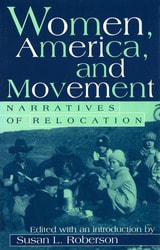
Women, America, and Movement
Narratives of RelocationEdited & Intro by Susan L. Roberson
University of Missouri Press, 1998
Since the colonial days, American women have traveled, migrated, and relocated, always faced with the challenge of reconstructing their homes for themselves and their families. Women, America, and Movement offers a journey through largely unexplored territory—the experiences of migrating American women. These narratives, both real and imagined, represent a range of personal and critical perspectives; some of the women describe their travels as expansive and freeing, while others relate the dreadful costs and sacrifices of relocating.
Despite the range of essays featured in this study, the writings all coalesce around the issues of politics, poetry, and self- identity described by Adrienne Rich as the elements of the "politics of location," treated here as the politics of relocation. The narratives featured in this book explore the impact of race, class, and sexual economics on migratory women, their self-identity, and their roles in family and social life. These issues demonstrate that in addition to geographic place, ideology is itself a space to be traversed.
By examining the writings of such women as Louise Erdrich, Zora Neale Hurston, and Gertrude Stein, the essayists included in this volume offer a variety of experiences. The book confronts such issues as racist politicking against Native Americans, African Americans, and Asian immigrants; sexist attitudes that limit women to the roles of wife, mother, and sexual object; and exploitation of migrants from Appalachia and of women newly arrived in America.
These essays also delve into the writings themselves by looking at what happens to narrative structure as authors or their characters cross geographic boundaries. The reader sees how women writers negotiate relocation in their texts and how the written word becomes a place where one finds oneself.
Women, Compulsion, Modernity
The Moment of American NaturalismJennifer L. Fleissner
University of Chicago Press, 2004
Fleissner shows that this era's expanding opportunities for women were inseparable from the same modern developments—industrialization, consumerism—typically believed to constrain human freedom. With Women, Compulsion, and Modernity, Fleissner creates a new language for the strange way the writings of the time both broaden and question individual agency.
Women, the New York School, and Other True Abstractions
Maggie Nelson
University of Iowa Press, 2007
Wonder Cabinet
PoemsDavid Barber
Northwestern University Press, 2006
Wonderful Words, Silent Truth
Essays on Poetry and a MemoirCharles Simic
University of Michigan Press, 1990
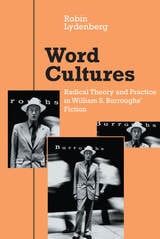
Word Cultures
Radical Theory and Practice in William S. Burroughs' FictionRobin Lydenberg
University of Illinois Press, 1987
Lydenberg focuses upon the stylistic accomplishments of this controversial and
experimental writer. In doing so, she skillfully demonstrates that the ideas
we now recognize as characteristic of post-structuralism and deconstruction
were being developed independently by Burroughs long ago.

Word Rides Again
Rereading The Frontier In American FictionJ. David Stevens
Ohio University Press, 2001
With much recent scholarship polarizing frontier novels into “popular” and “literary” camps, The Word Rides Again challenges the critical orthodoxy that such works have little in common, arguing instead that formulaic Western fictions can subtly (and even subversively) share cultural concerns with more highbrow brethren. Each chapter focuses on a writer who has traditionally been classified as either popular or artistic, reading a representative fictional work against prevailing scholarly trends. In this manner, Bret Harte’s sentimental stories become gender-bending experiments in which women assume male roles and even enjoy lesbian relationships. Owen Wister’s The Virginian is transmuted from a misogynistic diatribe into a complex meditation on the peculiarly American relation of violence to male identity. And even Willa Cather’s Death Comes for the Archbishop, rather than the apotheosis of a religious leader, becomes a somewhat standard version of the popular frontier story.
The Word Rides Again represents a significant departure from more traditional studies of frontier literature. It reaffirms the continuum between popular and literary texts and explores the ways that frontier novels have echoed, endorsed, and extended each other from the inception of the genre.

Words in Transit
Stories of ImmigrantsIlan Stavans
University of Massachusetts Press, 2016
Gathered together in a beautifully designed book that showcases Beth Reynolds's photographic portraits of each immigrant, these oral histories illuminate the many paths leading to the Pioneer Valley and demonstrate the shared experience among those seeking a new life in a foreign land. Storytellers include a massage therapist from Ireland, a Fulbright scholar from Palestine, a health educator from Taiwan, a literature professor from Spain, and a yoga teacher from Romania. Other participants hail from far-flung places including Haiti, Jamaica, El Salvador, Côte d'Ivoire, the Dominican Republic, Bhutan, Laos, Syria, Cambodia, Sri Lanka, Nepal, Congo, Slovenia, Iraq, and Ukraine. Introduced by the renowned scholar of translation and global literature Ilan Stavans, these stories testify to the resilience, bravery, and hopefulness of western New England émigrés. Proceeds from this book go to scholarships for immigrants at Holyoke Community College.
Words to Create a World
Daniel Hoffman
University of Michigan Press, 1993
Between these are discussions of books by and about founding modernists (Pound, Moore, Sitwell, Frost, Graves, Auden) who do not “succumb to the imitative fallacy and gibber at the window because the house is on fire.” Hoffman’s historical imagination elucidates the work of many other contemporary American and British poets, including his own. Words to Create a World will appeal to the reader who enjoys poetry and who hopes for guidance over the sprawling terrain of verse in the twentieth century.
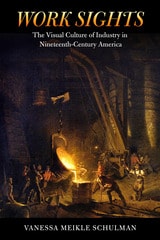
Work Sights
The Visual Culture of Industry in Nineteenth-Century AmericaVanessa Meikle Schulman
University of Massachusetts Press, 2015
Ranging across the fields of art history, visual studies, the history of technology, and American studies, Work Sights captures both the richness of nineteenth-century American visual culture and the extent to which Americans had begun to perceive their country as a modern nation connected by a web of interlocking technological systems.
Workin' on the Chain Gang
Shaking Off the Dead Hand of HistoryWalter Mosley
University of Michigan Press, 2006
A passionate examination of the social and economic injustices that continue to shackle the American people
Praise for Workin’ on the Chain Gang:
“. . . bracing and provocative. . . .”
—Publishers Weekly
“. . . clear-sighted . . . Mosley offers chain-breaking ideas. . . .”
—Los Angeles Times Book Review
“[A] thoroughly potent dismantling of Yanqui capitalism, the media, and the entertainment business, and at the same time a celebration of rebellion, truth as a tool for emancipation, and much else besides. . . .”
—Toronto Globe and Mail
“Workin’ on the Chain Gang excels at expressing feelings of ennui that transcend race. . . . beautiful language and penetrating insights into the necessity of confronting the past.”
—Washington Post
“Mosley eloquently examines what liberation from consumer capitalism might look like. . . . readers receptive to a progressive critique of the religion of the market will value Mosley’s creative contribution.”
—Booklist
Walter Mosley’s most recent essay collection is Life Out of Context, published in 2006. He is the best-selling author of the science fiction novel Blue Light, five critically acclaimed mysteries featuring Easy Rawlins, the blues novel RL’s Dream, a finalist for the NAACP Award in Fiction, and winner of the Black Caucus of the American Library Association’s Literary Award. His books have been translated into twenty languages. He lives in New York.
Clyde Taylor is Professor of Africana Studies at NYU’s Gallatin School and author of The Mask of Art: Breaking the Aesthetic Contract—Film and Literature.
Workings of the Spirit
The Poetics of Afro-American Women's WritingHouston A. Baker Jr.
University of Chicago Press, 1990
"Brilliant, and tenderly riveted to gratitude as an indispensable facet of analysis, Houston Baker arrives, yet again, bearing the loveliest flowers of his devotion and delight: thank God he's here!"—June Jordan
Workshops of Empire
Stegner, Engle, and American Creative Writing during the Cold WarEric Bennett
University of Iowa Press, 2015
Creative writing emerged as a graduate discipline in the United States amid this astonishing swirl of grand conceptions. The early workshops were formed not only at the time of, but in the image of, and under the tremendous urgency of, the postwar imperatives for the humanities. Vivid renderings of personal experience would preserve the liberal democratic soul—a soul menaced by the gathering leftwing totalitarianism of the USSR and the memory of fascism in Italy and Germany.
Workshops of Empire explores this history via the careers of Paul Engle at the University of Iowa and Wallace Stegner at Stanford. In the story of these founding fathers of the discipline, Eric Bennett discovers the cultural, political, literary, intellectual, and institutional underpinnings of creative writing programs within the university. He shows how the model of literary technique championed by the first writing programs—a model that values the interior and private life of the individual, whose experiences are not determined by any community, ideology, or political system—was born out of this Cold War context and continues to influence the way creative writing is taught, studied, read, and written into the twenty-first century.
World Beats
Beat Generation Writing and the Worlding of U.S. LiteratureJimmy Fazzino
Dartmouth College Press, 2016
World Over Water
PoemsRobert Gibb
University of Arkansas Press, 2007
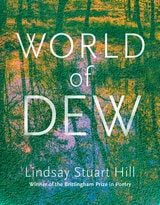
World of Dew
Lindsay Stuart Hill
University of Wisconsin Press, 2025

World-Wide-Walks
Peter d'Agostino: Crossing Natural-Cultural-Virtual FrontiersEdited by Peter d'Agostino and David Tafler
Intellect Books, 2018
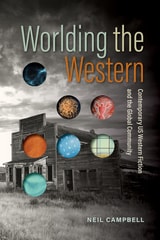
Worlding the Western
Contemporary US Western Fiction and the Global CommunityNeil Campbell
University of Nevada Press, 2022
Diversity, disparity, and opposition are central to the dynamic frictional fiction considered in this book. The American West provides a powerful test case in which these features are present and yet, historically, have often been masked or denied in the rush toward unanimity and nation building. Worlding is, therefore, a positive, critical concept through which to view the notion of a single world under pressure.
Worlding the Western
Contemporary US Western Fiction and the Global CommunityNeil Campbell
University of Nevada Press, 2022
Diversity, disparity, and opposition are central to the dynamic frictional fiction considered in this book. The American West provides a powerful test case in which these features are present and yet, historically, have often been masked or denied in the rush toward unanimity and nation building. Worlding is, therefore, a positive, critical concept through which to view the notion of a single world under pressure.
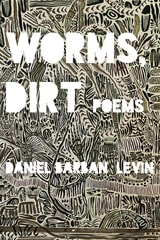
Worms, Dirt
Daniel Barban Levin
Four Way Books, 2026
“The / drugs, the page, none of it is here. That was years ago,” Daniel Barban Levin writes in his debut collection of poems, trying to create an inventory of blank spaces, to describe the persistent presence — the psychological furniture — of what no longer exists. “There was a room. I lived there. / Now, I can’t find it anymore.”
Written in the wake of the media storm surrounding the revelation of the Sarah Lawrence cult, interrogating the constructs of confessionalism and journalistic epistemology after the release of memoirs and viral articles and a Hulu docu-series, Worms, Dirt considers the soil beneath the story playing out aboveground. These poems are a unique telling of two kinds of departure – leaving a cult and exiting a relationship. They weave together fragments and elisions of memory — “Was any of it right? Did any of it happen the way / You remembered?” — reverse engineering a story from the aftermath — “The piece you still can’t find. It must be true. He was // Gentle. Sometimes, he was gentle.” Devastating and open-hearted, these pages transcribe transformation and reconstruction of self, survival, reckoning. They confront the intimate betrayals of belonging to a high-control group or seeking love from the wrong romantic relationships. These lyrics confront horror and a fragile hope in their recognition of this inconceivable thing, the soft flesh smothered by the scar: “The hands’ capacity / For gentleness even as you watched them, in disbelief, dismantle you.”
Traversing New York and New Hampshire and landing in Los Angeles, Levin treats the things we leave behind as the material from which we grow. Most striking about Worms, Dirt is its lyrical metacommentary — as a book about writing a book, it constantly refuses the constraints of the imposed narrative memoir and the parasitic appetite for sensationalism, easily commodified true crime, and flattening characterizations of victims and villains. “For I am at work, writing this / For I have accrued so many reasons to live.”
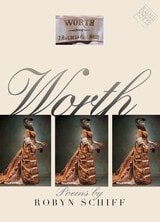
Worth
Robyn Schiff
University of Iowa Press, 2002
In Worth Robyn Schiff inquires about making, buying, selling, and stealing in the material world, the natural landscape, and the human soul. Opening with the renowned couture house of Charles Frederick Worth, the father of high fashion— “The dress was so big, / one's hand is useless to take glass from table; / the skirt approaches while the hand is yet distanced” —and ending with the House of De Beers and a diamond thief named Adam Worth— “You'll know me by my approach / I'm coming on foot with a diamond in my mouth” —Schiff moves from Cartier and Tiffany to the Shedd Aquarium, from Marie Antoinette to the Civil War, from Mary Pickford to Marilyn Monroe.
Would We Still Be
James Henry Knippen
New Issues Poetry and Prose, 2021
In Would We Still Be, James Henry Knippen crafts the anxieties that emanate from human existence—grief, fear, hopelessness, uncertainty—into poetic reflections that express a deep reverence for the musicality and incantational capacity of language. Like a moon or a wren, two of the book’s obsessions, these haunting poems call us to consider beauty’s connection to the transitory. Among the ghosts that wander these pages—those of loved ones, those we are, and those we will become—Knippen asks if image is enough, if sound is enough, if faith is enough. In doing so, these poems seek out the soul’s communion with voice, encouraging us to sing our fate.
Woven Stone
Simon J. Ortiz
University of Arizona Press, 1992
Going for the Rain (1976) expresses closeness to a specific Native American way of life and its philosophy and is structured in the narrative form of a journey on the road of life. A Good Journey (1977), an evocation of Ortiz's constant awareness of his heritage, draws on the oral tradition of his Pueblo culture. Fight Back: For the Sake of the People, For the Sake of the Land (1980)—revised for this volume—has its origins in his work as a laborer in the uranium industry and is intended as a political observation and statement about that industry's effects on Native American lands and lives.
In an introduction written for this volume, Ortiz tells of his boyhood in Acoma Pueblo, his early love for language, his education, and his exposure to the wider world. He traces his development as a writer, recalling his attraction to the Beats and his growing political awareness, especially a consciousness of his and other people's social struggle.
"Native American writers must have an individual and communally unified commitment to their art and its relationship to their indigenous culture and people," writes Ortiz. "Through our poetry, prose, and other written works that evoke love, respect, and responsibility, Native Americans may be able to help the United States of America to go beyond survival."
Wreading
A Poetics of Awareness, or How Do We Know What We Know?Jed Rasula
University of Alabama Press, 2022
A diverse collection of essays and interviews on reading, teaching, and writing poetry from a preeminent critic and scholar.
Jed Rasula is a distinguished scholar of avant-garde poetics, noted for his erudition, intellectual range, and critical independence. Wreading: A Poetics of Awareness, or How Do We Know What We Know? is a collection of essays and interviews that reflects the breadth and diversity of his curiosity.
While this volume presents highlights from Rasula’s criticism, it also serves as a carefully assembled intellectual autobiography. Wreading consists of two parts: an assortment of Rasula’s solo criticism and selected interviews and conversations with other poets and scholars. These detailed conversations are with Evelyn Reilly, Leonard Schwartz, Tony Tost, Mike Chasar, Joel Bettridge, and Ming-Qian Ma. Their exchanges address ecopoetics, the corporate university, the sheer volume of contemporary poetry, and more. This substantial set of dialogues gives readers a glimpse inside a master critic’s deeply informed critical practice, illuminating his intellectual touchstones.
The balance between essay and interview achieves a distillation of Rasula’s long-established idea of “wreading.” In his original use, the term denotes how any act of criticism inherently adds to the body of writing that it purports to read. In this latest form, Wreading captures a critical perception that sparks insight and imagination, regardless of what it sees.
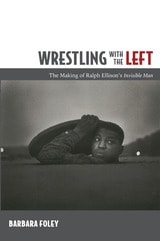
Wrestling with the Left
The Making of Ralph Ellison’s Invisible ManBarbara Foley
Duke University Press, 2010
Writers of Conviction
The Personal Politics of Zona Gale, Dorothy Canfield Fisher, Rose Wilder Lane, and Josephine HerbstJulia C. Ehrhardt
University of Missouri Press, 2004
Writing Against Reform
Aesthetic Realism in the Progressive EraArielle Zibrak
University of Massachusetts Press, 2024
Throughout the Progressive Era, reform literature became a central feature of the American literary landscape. Works like Upton Sinclair’s The Jungle, Charlotte Perkins Gilman’s “The Yellow Wall-Paper,” and Jacob Riis’s How the Other Half Lives topped bestseller lists and jolted middle-class readers into action.
While realism and social reform have a long-established relationship, prominent writers of the period such as Henry James, Edith Wharton, James Weldon Johnson, Rebecca Harding Davis, and Kate Chopin resisted explicit political rhetoric in their own works and critiqued reform aesthetics, which too often rang hollow. Arielle Zibrak reveals that while these writers were often seen as indifferent to the political currents of their time, their work is a part of a little explored debate on the relationship between literature and politics at the heart of Progressive Era publishing. Examining the critique of reform aesthetics within the tradition of American realist literature of the late nineteenth and early twentieth centuries, Writing Against Reform promises to change the way we think about the fiction of this period and many of America’s leading writers.
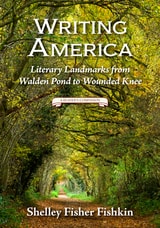
Writing America
Literary Landmarks from Walden Pond to Wounded Knee (A Reader's Companion)Fishkin, Shelley Fisher
Rutgers University Press, 2015
American novelist E.L. Doctorow once observed that literature “endows places with meaning.” Yet, as this wide-ranging new book vividly illustrates, understanding the places that shaped American writers’ lives and their art can provide deep insight into what makes their literature truly meaningful.
Published on the eve of the 50th anniversary of the Historic Preservation Act, Writing America is a unique, passionate, and eclectic series of meditations on literature and history, covering over 150 important National Register historic sites, all pivotal to the stories that make up America, from chapels to battlefields; from plantations to immigration stations; and from theaters to internment camps. The book considers not only the traditional sites for literary tourism, such as Mark Twain’s sumptuous Connecticut home and the peaceful woods surrounding Walden Pond, but also locations that highlight the diversity of American literature, from the New York tenements that spawned Abraham Cahan’s fiction to the Texas pump house that irrigated the fields in which the farm workers central to Gloria Anzaldúa’s poetry picked produce. Rather than just providing a cursory overview of these authors’ achievements, acclaimed literary scholar and cultural historian Shelley Fisher Fishkin offers a deep and personal reflection on how key sites bore witness to the struggles of American writers and inspired their dreams. She probes the global impact of American writers’ innovative art and also examines the distinctive contributions to American culture by American writers who wrote in languages other than English, including Yiddish, Chinese, and Spanish.
Only a scholar with as wide-ranging interests as Shelley Fisher Fishkin would dare to bring together in one book writers as diverse as Gloria Anzaldúa, Nicholas Black Elk, David Bradley, Abraham Cahan, S. Alice Callahan, Raymond Chandler, Frank Chin, Elizabeth Cook-Lynn, Countee Cullen, Frederick Douglass, Paul Laurence Dunbar, Jessie Fauset, William Faulkner, F. Scott Fitzgerald, Allen Ginsberg, Jovita González, Rolando Hinojosa, Langston Hughes, Zora Neale Hurston, Lawson Fusao Inada, James Weldon Johnson, Erica Jong, Maxine Hong Kingston, Irena Klepfisz, Nella Larsen, Emma Lazarus, Sinclair Lewis, Genny Lim, Claude McKay, Herman Melville, N. Scott Momaday, William Northup, John Okada, Miné Okubo, Simon Ortiz, Américo Paredes, John P. Parker, Ann Petry, Tomás Rivera, Wendy Rose, Morris Rosenfeld, John Steinbeck, Harriet Beecher Stowe, Henry David Thoreau, Mark Twain, Yoshiko Uchida, Tino Villanueva, Nathanael West, Walt Whitman, Richard Wright, Hisaye Yamamoto, Anzia Yezierska, and Zitkala-Ša.
Leading readers on an enticing journey across the borders of physical places and imaginative terrains, the book includes over 60 images, and extended excerpts from a variety of literary works. Each chapter ends with resources for further exploration. Writing America reveals the alchemy though which American writers have transformed the world around them into art, changing their world and ours in the process.
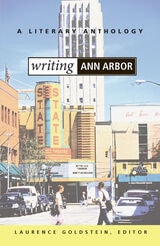
Writing Ann Arbor
A Literary AnthologyLaurence Goldstein, Editor
University of Michigan Press, 2005
The anthology is eclectic and engaging, with many wonderful surprises: an essay on the Underground Railroad in Ann Arbor; one on basketball legend Cazzie Russell; an essay by Arthur Miller; an excerpt from Joyce Carol Oates's All the Good People I've Left Behind; a selection from Tender at the Bone: Growing Up at the Table by food writer and Gourmet magazine editor Ruth Reichl; and much more.
This is more than a series of portraits of Ann Arbor and the University of Michigan; it is a miniature time capsule, a look into the shifting cultural currents of the last two centuries from some of the greatest thinkers and writers of those times.
Poet and literary scholar Laurence Goldstein is Professor of English at the University of Michigan and Editor of the Michigan Quarterly. He is the author of three books of poetry and several books of literary criticism, including The American Poet at the Movies.
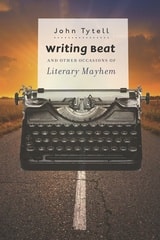
Writing Beat and Other Occasions of Literary Mayhem
John Tytell
Vanderbilt University Press, 2014
Approaching the history of post-war twentieth century American literature, and in particular the Beat literary movement of Kerouac, Ginsberg, Burroughs, and others, Tytell finds himself uniquely positioned as an eyewitness to many of these stories. In this book, he shares his insight with the reader. As he interviewed, drank, traveled, and survived countless moments with some of these literary legends, Tytell discovered much about the craft of nonfiction, biography, and the nature of history. Writing Beat demonstrates, through Tytell's growth as a professor and historian of the Beats, lessons learned and hazards encountered for those aspiring to become writers themselves.
As we approach the sixtieth anniversary of Allen Ginsberg's Howl, Writing Beat reminds us writers do not spring to life fully formed, and the struggle to get to literature can be a blast.
Writing Human Rights
The Political Imaginaries of Writers of ColorCrystal Parikh
University of Minnesota Press, 2017
The legal texts and aspirational ideals of human rights are usually understood and applied in a global context with little bearing on the legal discourse, domestic political struggles, or social justice concerns within the United States. In Writing Human Rights, Crystal Parikh uses the international human rights regime to read works by contemporary American writers of color—Toni Morrison, Chang-rae Lee, Ana Castillo, Aimee Phan, and others—to explore the conditions under which new norms, more capacious formulations of rights, and alternative kinds of political communities emerge.
Parikh contends that unlike humanitarianism, which views its objects as victims, human rights provide avenues for the creation of political subjects. Pairing the ethical deliberations in such works as Beloved and A Gesture Life with human rights texts like the United Nations Convention Against Torture, she considers why principles articulated as rights in international conventions and treaties—such as the right to self-determination or the right to family—are too often disregarded at home. Human rights concepts instead provide writers of color with a deeply meaningful method for political and moral imagining in their literature.
Affiliating transnational works of American literature with decolonization, socialist, and other political struggles in the global south, this book illuminates a human rights critique of idealized American rights and freedoms that have been globalized in the twenty-first century. In the absence of domestic human rights enforcement, these literatures provide a considerable repository for those ways of life and subjects of rights made otherwise impossible in the present antidemocratic moment.
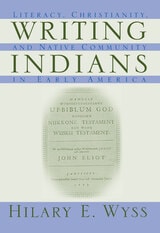
Writing Indians
Literacy, Christianity, and Native Community in Early AmericaHilary E. Wyss
University of Massachusetts Press, 2000
A study of cultural encounter, this book takes a fresh look at the much ignored and often misunderstood experience of Christian Indians in early America. Focusing on New England missionary settlements from the mid-seventeenth to the early nineteenth centuries, Hilary E. Wyss examines the ways in which Native American converts to Christianity developed their own distinct identity within the context of a colonial culture.
With an approach that weaves together literature, religious studies, and ethno-history, Wyss grounds her work in the analysis of a rarely read body of “autobiographical” writings by Christian Indians, including letters, journal entries, and religious confessions. She then juxtaposes these documents to the writings of better known Native Americans like Samson Occom as well as to the published works of Anglo-Americans, such as Mary Rowlandson's famous captivity narrative and Eleazor Wheelock's accounts of his charity schools.
In their search for ostensibly “authentic” Native voices, scholars have tended to overlook the writings of Christian Indians. Yet, Wyss argues, these texts reveal the emergence of a dynamic Native American identity through Christianity. More specifically, they show how the active appropriation of New England Protestantism contributed to the formation of a particular Indian identity that resisted colonialism by using its language against itself.
Writing Like a Woman
Alicia Ostriker
University of Michigan Press, 1983
Writing Nature
Henry Thoreau's JournalSharon Cameron
University of Chicago Press, 1989
Writing Through Writer's Block
Lessons from Modern American FictionAaron Colton
University of Iowa Press, 2025
Writing Vietnam, Writing Life
Caputo, Heinemann, O'Brien, ButlerTobey C. Herzog
University of Iowa Press, 2008
Philip Caputo, Larry Heinemann, Tim O'Brien, and Robert Olen Butler: four young midwestern Americans coming of age during the 1960s who faced a difficult personal decision—whether or not to fight in Vietnam. Each chose to participate. After coming home, these four veterans became prizewinning authors telling the war stories and life stories of soldiers and civilians. The four extended conversations included in Writing Vietnam, Writing Life feature revealing personal stories alongside candid assessments of each author's distinct roles as son, soldier, writer, and teacher of creative writing.
As Tobey Herzog's thoughtful interviews reveal, these soldier-authors have diverse upbringings, values, interests, writing careers, life experiences, and literary voices. They hold wide-ranging views on, among other things, fatherhood, war, the military, religion, the creative process, the current state of the world, and the nature of both physical and moral courage. For each author, the conversation and richly annotated chronology provide an overview of the writer's life, the intersection of memory and imagination in his writing, and the path of his literary career. Together, these four life stories also offer mini-tableaux of the fascinating and troubling time of 1960s and 1970s America. Above all, the conversations reveal that each author is linked forever to the Vietnam War, the country of Vietnam, and its people.
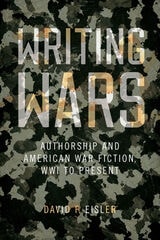
Writing Wars
Authorship and American War Fiction, WWI to PresentDavid F. Eisler
University of Iowa Press, 2022
2024 Senators Bob and Elizabeth Dole Biennial Award for Distinguished Book in Veterans Studies, winner
Who writes novels about war? For nearly a century after World War I, the answer was simple: soldiers who had been there. The assumption that a person must have experienced war in the flesh in order to write about it in fiction was taken for granted by writers, reviewers, critics, and even scholars.
Contemporary American fiction tells a different story. Less than half of the authors of contemporary war novels are veterans. And that’s hardly the only change. Today’s war novelists focus on the psychological and moral challenges of soldiers coming home rather than the physical danger of combat overseas. They also imagine the consequences of the wars from non-American perspectives in a way that defies the genre’s conventions. To understand why these changes have occurred, David Eisler argues that we must go back nearly fifty years, to the political decision to abolish the draft. The ramifications rippled into the field of cultural production, transforming the foundational characteristics— authorship, content, and form—of the American war fiction genre.

Writing Wrongs
W.D. King
Temple University Press, 1997
Writing Wrongs: The Work of Wallace Shawn is a close and personal look into the life and literary work of the man whom Joseph Papp called "a dangerous writer." As the son of the late William Shawn, renowned editor of The New Yorker, Wallace Shawn was born into privilege and trained to thoroughly liberal values, but his plays relentlessly question the liberal faith in individualism and common decency. In an uncompromising way that is all his own, Shawn registers the shock of the new.
In works such as Aunt Dan and Lemon, My Dinner with Andre, and The Designated Mourner, he wrenches out of place all of the usual, comfortable mechanisms by which we operate as audiences. Perhaps our discomfort and struggle to understand a play might provoke some change in the way we see ourselves and behave in relation to others -- but Shawn offers little in the way of solace.
W.D. King's incisive critiques of the plays and inquiry into the life and times of their author develop a portrait of Shawn as a major figure in contemporary theater.
Writing across the Color Line
U.S. Print Culture and the Rise of Ethnic Literature, 1877-1920Lucas A. Dietrich
University of Massachusetts Press, 2020
Writing across the Color Line details how this body of literature was selected for publication, edited, manufactured, advertised, and distributed, even as it faced hostile criticism and frequent misinterpretation by white readers. Shedding light on the transformative potential of multiethnic literature and the tenacity of racist attitudes that dominated the literary marketplace, Dietrich proves that Native American, African American, Latinx, Asian American, and Irish American writers of the period relied on self-caricature, tricksterism, and the careful control of authorial personae to influence white audiences.
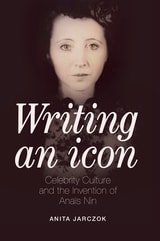
Writing an Icon
Celebrity Culture and the Invention of Anaïs NinAnita Jarczok
Ohio University Press, 2017
Anaïs Nin, the diarist, novelist, and provocateur, occupied a singular space in twentieth-century culture, not only as a literary figure and voice of female sexual liberation but as a celebrity and symbol of shifting social mores in postwar America. Before Madonna and her many imitators, there was Nin; yet, until now, there has been no major study of Nin as a celebrity figure.
In Writing an Icon, Anita Jarczok reveals how Nin carefully crafted her literary and public personae, which she rewrote and restyled to suit her needs and desires. When the first volume of her diary was published in 1966, Nin became a celebrity, notorious beyond the artistic and literary circles in which she previously had operated. Jarczok examines the ways in which the American media appropriated and deconstructed Nin and analyzes the influence of Nin’s guiding hand in their construction of her public persona.
The key to understanding Nin’s celebrity in its shifting forms, Jarczok contends, is the Diary itself, the principal vehicle through which her image has been mediated. Combining the perspectives of narrative and cultural studies, Jarczok traces the trajectory of Nin’s celebrity, the reception of her writings. The result is an innovative investigation of the dynamic relationships of Nin’s writing, identity, public image, and consumer culture.
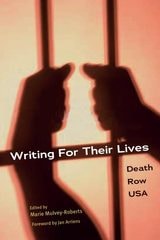
Writing for Their Lives
Death Row USAEdited by Marie Mulvey-Roberts. Foreword by Jan Arriens
University of Illinois Press, 2007
Exposing little-known facts about the five modes of execution practiced in the United States today, Writing for Their Lives documents the progress of life on death row from a capital trial to execution and beyond, through the testimony of the prisoners themselves as well as those who watch, listen, and write to them. What emerges are stories of the survival of the human spirit under even the most unimaginable circumstances, and the ways in which some prisoners find penitence and peace in the most unlikely surroundings. In spite of the uniformity of their prison life and its nearly inevitable conclusion, prisoners able to read and write letters are shown to retain and develop their individuality and humanity as their letters become poems and stories.
Writing for Their Lives serves ultimately as an affirmation of the value of life and provides bountiful evidence that when a state executes a prisoner, it takes a life that still had something to give.
This edition features an introduction by the editor as well as a foreword by Jan Arriens. Dr. Mulvey-Roberts will be donating her profits from the sale of this volume to the legal charity Amicus, which assists in capital defense in the United States."
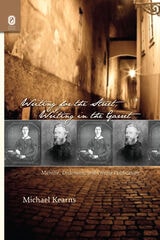
Writing for the Street, Writing in the Garret
Melville, Dickinson, and Private PublicationMichael Kearns
The Ohio State University Press, 2010
Although Herman Melville and Emily Dickinson differed dramatically in terms of their lives and writing careers, they shared not only a distaste for writing “for the street” (mass readership) but a preference for the intimate writer–reader relationship created by private publication, especially in the form of manuscripts. In Writing for the Street, Writing in the Garret: Melville, Dickinson, and Private Publication, Michael Kearns shows that this distaste and preference were influenced by American copyright law, by a growing tendency in America to treat not only publications but their authors as commodities, and by the romantic stereotype of the artist (usually suffering in a garret) living only for her or his own work.
Writing into the Future
New American Poetries from "The Dial" to the DigitalAlan Golding
University of Alabama Press, 2022
Writing into the Future: New American Poetries from “The Dial” to the Digital collects Alan Golding’s essays on the futures (past and present) of poetry and poetics. Throughout the 13 essays gathered in this collection, Golding skillfully joins literary critique with a concern for history and a sociological inquiry into the creation of poetry. In Golding’s view, these are not disparate or even entirely distinct critical tasks. He is able to fruitfully interrogate canons and traditions, both on the page and in the politics of text, culture, and institution.
A central thread running through the chapters is a longstanding interest in how various versions of the “new” have been constructed, received, extended, recycled, resisted, and reanimated in American poetry since modernism. To chart the new, Golding contends with both the production and the reception of poetry, in addition to analyzing the poems themselves. In a generally chronological order, Golding reconsiders the meaning for contemporary poets of high modernists like Ezra Pound and William Carlos Williams, as well as the influential poetry venues The Dial and The Little Review, where less prominent but still vital poets contested what should come “next.” Subsequent essays track that contestation through The New American Poetry and later anthologies.
Mid-century major figures like Robert Creeley and George Oppen are discussed in their shared concern for the serial poem. Golding’s essays bring us all the way back to the present of the poetic future, with writing on active poets like Rachel Blau DuPlessis, Susan Howe, and Bruce Andrews and on the anticipation of digital poetics in the material texts of L=A=N=G=U=A=G=E writing. Golding charts the work of defining poetry’s future and how we rewrite the past for an unfolding present.
Writing on the Edge
A Borderlands ReaderEdited by Tom Miller
University of Arizona Press, 2003
This wide-ranging anthology—gathering short stories and essays, song lyrics and poems—offers readers a new appreciation of the border and its literature. Residents of the region may be startled to learn how many passers-by have been struck by this unruly slice of North America, while those living in other parts of the country may be surprised to find it more than a dateline for reports of smuggling and illegal immigration.
Collected here are both celebrated and underappreciated gems of American and Mexican literature depicting a region that for some writers represents an exotic land, for others home. Writing on the Edge juxtaposes passages by New Jersey poet William Carlos Williams and native songwriter Flaco Jiménez, British novelist Graham Greene and American poet Demetria Martínez, to show us the border from both sides and from a distance. In all of the selections, La Frontera looms larger than life—an energizing force that frames the lives of the characters living within its boundaries. Included in the book is a literary map of the border highlighting the sites with which each author is identified.
As editor Tom Miller observes, the very notion of literature in a region considered an "irrelevant nuisance" allows for more free-ranging creative output." Writing on the Edge sparkles with such creativity and invites readers to enjoy the best of two worlds—and of the world they share.
Print a literary map of the borderlands here!
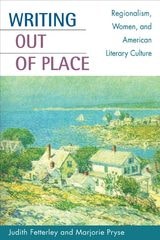
Writing out of Place
Regionalism, Women, and American Literary CultureJudith Fetterley and Marjorie Pryse
University of Illinois Press, 2002
Regionalist writers such as Alice Cary, Mary E. Wilkins Freeman, Sarah Orne Jewett, Grace King, Alice Dunbar–Nelson, Sui Sin Far, and Mary Austin present narrators who serve as cultural interpreters for persons often considered "out of place" by urban readers. Critiquing the approaches to regional subjects characteristic of local color, this book gives contemporary readers a vantage point from which to approach regions and regional people in the global economy of our own time.
Reclaiming the ground of "close" reading for texts that have been insufficiently read, Fetterley and Pryse situate textual analyses within larger questions such as the ideology of form, feminist standpoint epistemology, queer theory, intersections of race and class, and narrative empathy. In its combination of the critical and the visionary, Writing out of Place proposes regionalism as a model for narrative connection between texts and readers that has the potential to transform American literary culture. Arguing the need for other models for human development than those produced in heroic stories about men and boys, the authors offer regionalism as a source of unconventional and counterhegemonic fictions that should be passed on to future generations of readers.
Writing the Australian Crawl
William Stafford
University of Michigan Press, 1978
Writing the Ghetto
Class, Authorship, and the Asian American Ethnic EnclaveChang, Yoonmee
Rutgers University Press, 2010
Yoonmee Chang examines the class structure of Chinatowns, Koreatowns, Little Tokyos, and Little Indias, arguing that ghettoization in these spaces is disguised. She maintains that Asian American literature both contributes to and challenges this masking through its marginalization by what she calls the "ethnographic imperative." Chang discusses texts from the late nineteenth century to the present, including those of Sui Sin Far, Winnifred Eaton, Monica Sone, Fae Myenne Ng, Chang-rae Lee, S. Mitra Kalita, and Nam Le. These texts are situated in the contexts of the Chinese Exclusion Era, Japanese American internment during World War II, the globalization of Chinatown in the late twentieth century, the Vietnam War, the 1992 Los Angeles riots, and the contemporary emergence of the "ethnoburb."