Results by title
8812 books match the query 'Political Science' and 354 start with w

Whose Liberty is it Anyway?
Europe at the CrossroadsStefan Auer
Seagull Books, 2012
Europe's turn of fortune is humbling, humiliating and, perhaps, irreversible. What went wrong, and when? Europe's most audacious moment occurred sometime between 1989 and 1991, a brief period that encapsulated both the demise of communism in Central and Eastern Europe and the bold steps forward on the path towards an 'ever-closer union' in Western Europe. Twenty years later, the dramatic failures of economic and political integration have forced Europeans to re-consider the underpinnings of their project. The economic crisis of 2010-11 also manifested itself as a crisis of European democracy. Old questions acquired new meaning: Is it possible to maintain conditions for self-government while undermining the nation-state? What are the limits of solidarity? Can Europe be truly united through its common history, or its common currency? Is further unity in Europe even desirable?
In Whose Liberty Is It Anyway? Stefan Auer exposes the limits of the current European project by interrogating some of its many incongruities, particularly when it comes to its commitment to freedom. The author argues that the calls for more European solidarity are not convincing when Europe's poor are asked to pay for the mistakes of those who are more fortunate. Europe's unity, Auer asserts, can only be maintained by accepting its limitations and by beginning to fulfill some of its many promises.

Whose Rights?
Counterterrorism and the Dark Side of American Public OpinionClem Brooks
Russell Sage Foundation, 2013
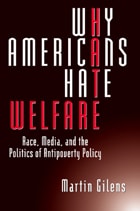
Why Americans Hate Welfare
Race, Media, and the Politics of Antipoverty PolicyMartin Gilens
University of Chicago Press, 1999
"With one out of five children currently living in poverty and more than 100,000 families with children now homeless, Gilens's book is must reading if you want to understand how the mainstream media have helped justify, and even produce, this state of affairs." —Susan Douglas, The Progressive
"Gilens's well-written and logically developed argument deserves to be taken seriously." —Choice
"A provocative analysis of American attitudes towards 'welfare.'. . . [Gilens] shows how racial stereotypes, not white self-interest or anti-statism, lie at the root of opposition to welfare programs." -Library Journal
Why Americans Split Their Tickets
Campaigns, Competition, and Divided GovernmentBarry C. Burden and David C. Kimball
University of Michigan Press, 2004
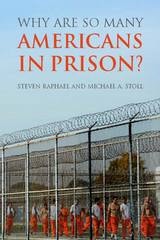
Why Are So Many Americans in Prison?
Steven Raphael
Russell Sage Foundation, 2013
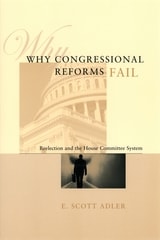
Why Congressional Reforms Fail
Reelection and the House Committee SystemE. Scott Adler
University of Chicago Press, 2002
What lies behind the House's resistance to change? Challenging recent explanations of this phenomenon, Scott Adler contends that legislators resist rearranging committee powers and jurisdictions for the same reason they cling to the current House structure—the ambition for reelection. The system's structure works to the members' advantage, helping them obtain funding (and favor) in their districts. Using extensive evidence from three major reform periods—the 1940s, 1970s, and 1990s—Adler shows that the reelection motive is still the most important underlying factor in determining the outcome of committee reforms, and he explains why committee reform in the House has never succeeded and probably never will.
Why Everyone Hates White Liberals (Including White Liberals)
A HistoryKevin M. Schultz
University of Chicago Press, 2025
If there’s one thing most Americans can agree on, it’s that everyone hates white liberals. Conservatives hate them for being culturally tolerant and threatening to usher in communism. Libertarians hate them for believing in the power of the state. Socialists hate them for serving as capitalism’s beard. Even liberals hate liberals—either because they can’t manage to overcome their own prejudices, or precisely because they’re so self-hating.
This is the starting point for Kevin M. Schultz’s lively new history of white liberals in the United States. He efficiently lays out the array of objections to liberals—ineffective, spineless, judgmental, authoritarian, and more—in a historical frame that shows how protean the concept has been throughout the past hundred years. It turns out, he declares, that how you define a “white liberal” is less a reflection of reality and more a Rorschach test revealing your own anxieties.
Sharply assessing how decades of attacks on liberals and liberalism have steadily hollowed out the center of American political life, Schultz also explains precisely what needs to be done to avoid digging ourselves even further into the hole of polarization. The ultimate goal, he argues, is to achieve political fragmentation that will fuel the rise of a true multiparty system, where ideology will matter more, not less.
With a tight command of postwar American history and a spirited voice, Why Everyone Hates White Liberals (Including White Liberals) is a must-read for anyone wishing to understand—and envision a way forward in—the complicated landscape of American politics.
Why Iowa?
How Caucuses and Sequential Elections Improve the Presidential Nominating ProcessDavid P. Redlawsk, Caroline J. Tolbert, and Todd Donovan
University of Chicago Press, 2010
If Barack Obama had not won in Iowa, most commentators believe that he would not have been able to go on to capture the Democratic nomination for president. Why Iowa? offers the definitive account of those early weeks of the campaign season: from how the Iowa caucuses work and what motivates the candidates’ campaigns, to participation and turnout, as well as the lingering effects that the campaigning had on Iowa voters. Demonstrating how “what happens in Iowa” truly reverberates throughout the country, five-time Iowa precinct caucus chair David P. Redlawsk and his coauthors take us on an inside tour of one of the most media-saturated and speculated-about campaign events in American politics.
Considering whether a sequential primary system, in which early, smaller states such as Iowa and New Hampshire have such a tremendous impact is fair or beneficial to the country as a whole, the authors here demonstrate that not only is the impact warranted, but it also reveals a great deal about informational elements of the campaigns. Contrary to conventional wisdom, this sequential system does confer huge benefits on the nominating process while Iowa’s particularly well-designed caucus system—extensively explored here for the first time—brings candidates’ arguments, strengths, and weaknesses into the open and under the media’s lens.
Why Kosovo Matters
Denis MacShane
Haus Publishing, 2011
Why Not Parties?
Party Effects in the United States SenateEdited by Nathan W. Monroe, Jason M. Roberts, and David W. Rohde
University of Chicago Press, 2008
Why Parties Matter
Political Competition and Democracy in the American SouthJohn H. Aldrich and John D. Griffin
University of Chicago Press, 2017
With Why Parties Matter, John H. Aldrich and John D. Griffin make a compelling case that competition between political parties is an essential component of a democracy that is responsive to its citizens and thus able to address their concerns. Tracing the history of the parties through four eras—the Democratic-Whig party era that preceded the Civil War; the post-Reconstruction period; the Jim Crow era, when competition between the parties virtually disappeared; and the modern era—Aldrich and Griffin show how and when competition emerged between the parties and the conditions under which it succeeded and failed. In the modern era, as party competition in the South has come to be widely regarded as matching that of the North, the authors conclude by exploring the question of whether the South is poised to become a one-party system once again with the Republican party now dominant.
Why Parties?
A Second LookJohn H. Aldrich
University of Chicago Press, 2011
Since its first appearance fifteen years ago, Why Parties? has become essential reading for anyone wishing to understand the nature of American political parties. In the interim, the party system has undergone some radical changes. In this landmark book, now rewritten for the new millennium, John H. Aldrich goes beyond the clamor of arguments over whether American political parties are in resurgence or decline and undertakes a wholesale reexamination of the foundations of the American party system.
Surveying critical episodes in the development of American political parties—from their formation in the 1790s to the Civil War—Aldrich shows how they serve to combat three fundamental problems of democracy: how to regulate the number of people seeking public office, how to mobilize voters, and how to achieve and maintain the majorities needed to accomplish goals once in office. Aldrich brings this innovative account up to the present by looking at the profound changes in the character of political parties since World War II, especially in light of ongoing contemporary transformations, including the rise of the Republican Party in the South, and what those changes accomplish, such as the Obama Health Care plan. Finally, Why Parties? A Second Look offers a fuller consideration of party systems in general, especially the two-party system in the United States, and explains why this system is necessary for effective democracy.
Why Parties?
The Origin and Transformation of Political Parties in AmericaJohn H. Aldrich
University of Chicago Press, 1995
Surveying three critical episodes in the development of American political parties—from their formation in the 1790s to the Civil War—Aldrich shows how parties serve to combat three fundamental problems of democracy: how to regulate the number of people seeking public office; how to mobilize voters; and how to achieve and maintain the majorities needed to accomplish goals once in office. Overcoming these obstacles, argues Aldrich, is possible only with political parties.
Aldrich brings this innovative account up to date by looking at the profound changes in the character of political parties since World War II. In the 1960s, he shows, parties started to become candidate-centered organizations that are servants to their office seekers and officeholders. Aldrich argues that this development has revitalized parties, making them stronger, and more vital, with well-defined cleavages and highly effective governing ability.

Why So Easily . . . Some Family Reasons for the Velvet Revolution
A Sociological EssayIvo Možný
Karolinum Press, 2023
Thirty-two years after its initial publication, this respected sociological essay, written in the history-making years of 1989 and 1990, is available for the first time in English. The essay tells the story of a despotic Socialist state expropriating the family (and with it the private sphere of life) only to be colonized by the very thing it expropriated forty years later. The essay plunges the reader into the pivotal time of the Velvet Revolution and provides valid explanations for the grassroots causes of the old regime’s downfall, examining the private aspirations and strategies of highly disparate groups of nameless social actors of the old regime that eventually sapped almost everyone of any interest in keeping the regime afloat.

Why They Die
Civilian Devastation in Violent ConflictDaniel Rothbart and Karina V. Korostelina
University of Michigan Press, 2013
Why do civilians suffer most during times of violent conflict? Why are civilian fatalities as much as eight times higher, calculated globally for current conflicts, than military fatalities? In Why They Die, Daniel Rothbart and Karina V. Korostelina address these questions through a systematic study of civilian devastation in violent conflicts. Pushing aside the simplistic definition of war as a guns-and-blood battle between two militant groups, the authors investigate the identity politics underlying conflicts of many types. During a conflict, all those on the opposite side are perceived as the enemy, with little distinction between soldiers and civilians. As a result, random atrocities and systematic violence against civilian populations become acceptable.
Rothbart and Korostelina devote the first half of the book to case studies: deportation of the Crimean Tatars from the Ukraine, genocide in Rwanda, the Lebanon War, and the war in Iraq. With the second half, they present new methodological tools for understanding different types of violent conflict and discuss the implications of these tools for conflict resolution.

Why Veterans Run
Military Service in American Presidential Elections, 1789-2016Jeremy M. Teigen
Temple University Press, 2017
The assumptions that military service helps candidates attract votes—while lacking it harms a candidate’s chances—has been an article of faith since the electoral coronation of George Washington in 1789. Perhaps the most compelling fact driving the perception that military service helps win votes is the large number of veterans who have held public office. Some candidates even exaggerate their military service to persuade voters. However, sufficient counter-examples undermine the idea that military veterans enjoy an advantage when seeking political office.
In Why Veterans Run, Jeremy Teigenexplains the tendency of parties to elevate those with armed forces experience to run for high office. He describes the veteran candidate phenomenon by examining the related factors and patterns, showing why different eras have more former generals running and why the number of veterans in election cycles varies. With both quantitative and qualitative analysis, Why Veterans Run investigates each postwar era in U.S. electoral history and elaborates why so many veterans run for office. Teigen also reveals how election outcomes with veteran candidates illuminate the relationship between the military and civilian spheres as well as the preferences of the American electorate.
Why Washington Won't Work
Polarization, Political Trust, and the Governing CrisisMarc J. Hetherington and Thomas J. Rudolph
University of Chicago Press, 2015
In Why Washington Won’t Work, Marc J. Hetherington and Thomas J. Rudolph argue that a contemporary crisis of trust—people whose party is out of power have almost no trust in a government run by the other side—has deadlocked Congress. On most issues, party leaders can convince their own party to support their positions. In order to pass legislation, however, they must also create consensus by persuading some portion of the opposing party to trust in their vision for the future. Without trust, consensus fails to develop and compromise does not occur. Up until recently, such trust could still usually be found among the opposition, but not anymore. Political trust, the authors show, is far from a stable characteristic. It’s actually highly variable and contingent on a variety of factors, including whether one’s party is in control, which part of the government one is dealing with, and which policies or events are most salient at the moment.
Political trust increases, for example, when the public is concerned with foreign policy—as in times of war—and it decreases in periods of weak economic performance. Hetherington and Rudolph do offer some suggestions about steps politicians and the public might take to increase political trust. Ultimately, however, they conclude that it is unlikely levels of political trust will significantly increase unless foreign concerns come to dominate and the economy is consistently strong.

Why We Lost the ERA
Jane J. Mansbridge
University of Chicago Press, 1986
In March 1972 the Equal Rights Amendment to the United States Constitution-the ERA-passed the Senate of the United States with a vote of 84 to 8, seventeen votes more than the two-thirds required for constitutional amendments. In the ensuing ten years, a majority of Americans consistently told interviewers that they favored this amendment to the Constitution. Yet on June 30, 1982, the deadline for ratifying the amendment passed with only thirty-five of the required thirty-eight states having ratified.
How did this happen? In How We Lost the ERA, political scientist Jane J. Mansbridge tells the story of the ERA's rise and fall, revealing self-defeating, contradictory forces within the movement supporting the amendment and how those contributed to its demise. The surprising challenges Mansbridge uncovers here remain salient to political struggles and democratic theory today.

Why We Lost the Sex Wars
Sexual Freedom in the #MeToo EraLorna N. Bracewell
University of Minnesota Press, 2021
Reexamining feminist sexual politics since the 1970s—the rivalries and the remarkable alliances
Since the historic #MeToo movement materialized in 2017, innumerable survivors of sexual assault and misconduct have broken their silence and called out their abusers publicly—from well-known celebrities to politicians and high-profile business leaders. Not surprisingly, conservatives quickly opposed this new movement, but the fact that “sex positive” progressives joined in the opposition was unexpected and seldom discussed. Why We Lost the Sex Wars explores how a narrow set of political prospects for resisting the use of sex as a tool of domination came to be embraced across this broad swath of the political spectrum in the contemporary United States.
To better understand today’s multilayered sexual politics, Lorna N. Bracewell offers a revisionist history of the “sex wars” of the 1970s, ’80s, and ’90s. Rather than focusing on what divided antipornography and sex-radical feminists, Bracewell highlights significant points of contact and overlap between these rivals, particularly the trenchant challenges they offered to the narrow and ambivalent sexual politics of postwar liberalism. Bracewell leverages this recovered history to illuminate in fresh and provocative ways a range of current phenomena, including recent controversies over trigger warnings, the unimaginative politics of “sex-positive” feminism, and the rise of carceral feminism. By foregrounding the role played by liberal concepts such as expressive freedom and the public/private divide as well as the long-neglected contributions of Black and “Third World” feminists, Bracewell upends much of what we think we know about the sex wars and makes a strong case for the continued relevance of these debates today.
Why We Lost the Sex Wars provides a history of feminist thinking on topics such as pornography, commercial sex work, LGBTQ+ identities, and BDSM, as well as discussions of such notable figures as Patrick Califia, Alan Dershowitz, Andrea Dworkin, Elena Kagan, Audre Lorde, Catharine MacKinnon, Cherríe Moraga, Robin Morgan, Gayle Rubin, Nadine Strossen, Cass Sunstein, and Alice Walker.
Why Welfare States Persist
The Importance of Public Opinion in DemocraciesClem Brooks and Jeff Manza
University of Chicago Press, 2007
The world’s richer democracies all provide such public benefits as pensions and health care, but why are some far more generous than others? And why, in the face of globalization and fiscal pressures, has the welfare state not been replaced by another model? Reconsidering the myriad issues raised by such pressing questions, Clem Brooks and Jeff Manza contend here that public opinion has been an important, yet neglected, factor in shaping welfare states in recent decades.
Analyzing data on sixteen countries, Brooks and Manza find that the preferences of citizens profoundly influence the welfare policies of their governments and the behavior of politicians in office. Shaped by slow-moving forces such as social institutions and collective memories, these preferences have counteracted global pressures that many commentators assumed would lead to the welfare state’s demise. Moreover, Brooks and Manza show that cross-national differences in popular support help explain why Scandinavian social democracies offer so much more than liberal democracies such as the United States and the United Kingdom.
Significantly expanding our understanding of both public opinion and social policy in the world’s most developed countries, this landmark study will be essential reading for scholars of political economy, public opinion, and democratic theory.

Why Women are Oppressed
Anne Jonasdottir
Temple University Press, 1994

Why the American Century?
Olivier Zunz
University of Chicago Press, 1998
"It should certainly be the task of historians to explain the nation's triumphs as effectively as they have explained its failures, and Zunz in this intelligent, learned and ambitious book suggests a valuable new model for doing so."—Alan Brinkley, Times Literary Supplement
"Zunz is evenhanded in his judgments. . . . His thesis is both imaginative and well grounded in the appropriate sources."—David M. Oshinsky, New York Times Book Review
"Zunz is an innovative and perceptive social critic. He crosses disciplinary boundaries with ease and felicity, and is particularly adept at illustrating large themes with unusual but telling details."—Kent Blaser, American Studies
"An eye-opening introduction to the shaping of modern America."—Foreign Affairs
Wide Branches, Deep Roots
How Appalachian Wisdom Can Help in the Fight for a Sustainable FutureJessica M Jones
West Virginia University Press, 2026
To be Appalachian is to define oneself in terms of a place. Where we’re from plays a tremendous role in who we are, through storytelling about our homeplaces and the people who have loved them. However, what goes largely unaddressed is how this love of place can contribute to sustainability within the region, which has notoriously faced on-going environmental threats from extraction industries. The reality is that our relationship with the environment is thorny and intertwined with our identities, histories, and economic realities. The authors in the collection get down among the thorns to explore what sustainability means in Appalachia and how we can utilize the power of traditional folkways to achieve it.
This collection of over thirty pieces explores the connections between Appalachia’s stories, traditions, and modern events and the pathway to regional sustainability. The contributors — writers and scholars — examine how our definitions of sustainability have been formed, the power of education to encourage or inhibit it, and what moves are being made toward efficacy in the future. They also offer specific actions readers can take to better understand and build sustainability where they live.
Contributors: Greg Bealer, Luc Biscan-White, David Blackmore, Aysha Bodenhamer, Ivy Brashear, Matthew Calloway, Nicole Drewitz-Crockett, Christina Fisanick, Deborah Fleming, Amanda V. Garner, Karie Gunter-Seymour, Richard Hague, Amanda E. Hayes, Lockie Hunter, Jessica M. Jones, Kristen LeFevers, Sarah Long, Meghan Moore-Hubbard, Barbara Marie Minney, Jessica Radicic, Elizabeth Emmerth Rexroad, Barbara Sabol, Larry Smith, Patrice Stank, Taylor Nasim Stone, Paul Thomas, Elizabeth Tussey, and Betsy Weems.
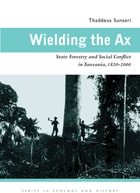
Wielding the Ax
State Forestry and Social Conflict in Tanzania, 1820–2000Thaddeus Sunseri
Ohio University Press, 2009
Forests have been at the fault lines of contact between African peasant communities in the Tanzanian coastal hinterland and outsiders for almost two centuries. In recent decades, a global call for biodiversity preservation has been the main challenge to Tanzanians and their forests.
Thaddeus Sunseri uses the lens of forest history to explore some of the most profound transformations in Tanzania from the nineteenth century to the present. He explores anticolonial rebellions, the world wars, the depression, the Cold War, oil shocks, and nationalism through their intersections with and impacts on Tanzania’s coastal forests and woodlands. In Wielding the Ax, forest history becomes a microcosm of the origins, nature, and demise of colonial rule in East Africa and of the first fitful decades of independence.
Wielding the Ax is a story of changing constellations of power over forests, beginning with African chiefs and forest spirits, both known as “ax–wielders,” and ending with international conservation experts who wield scientific knowledge as a means to controlling forest access. The modern international concern over tropical deforestation cannot be understood without an awareness of the long–term history of these forest struggles.

Wildly Successful Farming
Sustainability and the New Agricultural Land EthicBrian DeVore
University of Wisconsin Press, 2020
Written by agricultural journalist Brian DeVore, the book is based on interviews he has conducted at farms, wildlife refuges, laboratories, test plots, and gardens over the past twenty-five years. He documents innovations in cover cropping, managed rotational grazing, perennial polyculture, and integrated pest management. His accounts provide insight into the impacts regenerative farming methods can have on wildlife, water, landscape, soils, and rural communities and suggest ways all of us can support wildly successful farmers.

William S. Burroughs' "The Revised Boy Scout Manual"
An Electronic RevolutionEdited by Geoffrey D. Smith & John M. Bennett with an afterword by V. Vale
The Ohio State University Press, 2018
The Revised Boy Scout Manual was a work Burroughs revisited many times, but which has never before been published in its complete form. Based primarily on recordings of a performance of the complete piece found in the archives at the OSU libraries, as well as various incomplete versions of the typescript found at Arizona State University and the New York Public Library archives, this lost masterpiece of satiric subversion is finally available in its entirety.

Willing and Unable
Doctors' Constraints in Abortion CareLori R. Freedman
Vanderbilt University Press, 2010
Structural barriers to the mainstream practice of abortion effectively institutionalize the buck-passing of abortion patients to abortion clinics. As the author notes, "Public-health-minded HMOs and physician practices could significantly change the world of abortion care if they stopped outsourcing it."
Drawing from forty in-depth interviews, the book presents a challenge to a commonly held assumption that physicians decide whether or not to provide abortion based on personal ideology. Physician narratives demonstrate how their choices around learning, doing, and even having abortions themselves disrupt the pro-choice/pro-life moral and political binary.

Win, Lose, or Draw
Domestic Politics and the Crucible of WarAllan C. Stam III
University of Michigan Press, 1996
While the factors affecting the initiation of war have been extensively studied, the factors that determine the outcome of war have been neglected. Using quantitative data and historical illustrations from the early 1800s to the late 1980s, Allan Stam investigates the relative effect on war outcomes of both the choices leaders must make during war and the resources they have at their disposal. Strategy choices, along with decisions about troop levels and defense spending, are not made in a vacuum, according to Stam, but are made in the crucible of domestic politics. Because of domestic political constraints, states must frequently choose less than optimal strategies in the international arena. Stam shows how we must go beyond simply counting resources and look at the process or strategy by which they are employed as the key factor determining who will win. Challenging the assumptions of many realist and neorealist thinkers on war and interstate conflict, Stam shows how domestic political factors affect the outcome of war. Using a rational choice analysis, Stam looks at the factors that affect the decisionmakers' preferences for different outcomes of military conflict, as well as how the payoffs of those outcomes are affected by both domestic and structural factors. Structural factors, such as the state's population, define a state's power relative to that of other states and will affect the probability of a policy succeeding. Domestic factors, such as the positions taken by domestic political groups, will affect the preferences of the leaders for particular outcomes and their willingness to bear the costs associated with the payoffs and probabilities of the various outcomes. This book will be of interest to political scientists studying war and conflict in the international system as well as to historians and military strategists interested in understanding the factors that predict the outcome of war.
Windows into the Soul
Surveillance and Society in an Age of High TechnologyGary T. Marx
University of Chicago Press, 2016
In this landmark book, Marx sums up a lifetime of work on issues of surveillance and social control by disentangling and parsing the empirical richness of watching and being watched. Using fictional narratives as well as the findings of social science, Marx draws on decades of studies of covert policing, computer profiling, location and work monitoring, drug testing, caller identification, and much more, Marx gives us a conceptual language to understand the new realities and his work clearly emphasizes the paradoxes, trade-offs, and confusion enveloping the field. Windows into the Soul shows how surveillance can penetrate our social and personal lives in profound, and sometimes harrowing, ways. Ultimately, Marx argues, recognizing complexity and asking the right questions is essential to bringing light and accountability to the darker, more iniquitous corners of our emerging surveillance society.
For more information, please see www.garymarx.net.
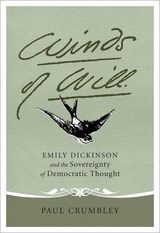
Winds of Will
Emily Dickinson and the Sovereignty of Democratic ThoughtPaul Crumbley
University of Alabama Press, 2010
A sophisticated literary analysis positioning Emily Dickinson’s poetry within the framework of democratic thought and individual sovereignty.
In this study, Paul Crumbley asserts that, contrary to popular opinion, Emily Dickinson consistently communicated political views through her poetry. Dickinson’s life of self-isolation—today her most notable personal characteristic—by no means extended into the political sphere, he argues. While she rarely addressed political issues directly and was curiously disengaged from the liberal causes and female reform movements of her time, Dickinson’s poems are deeply rooted both in matters of personal sovereignty and reader choice. The significant choices Dickinson extends to the reader underscore the democratic dimensions of reading her work, and of reading itself as a political act.
Crumbley employs close readings of Dickinson’s poems and letters, highlighting the many changing—and often contradictory—voices in her work, both throughout her oeuvre and in individual poems themselves. In Dickinson’s letters Crumbley finds just as many unique and conflicting voices; thus, both her personal correspondence and the poems make political demands by placing the burden of interpretation on the reader.
Rather than reflecting explicit political values, Dickinson’s work chronicles an ongoing decision-making process that magnifies the role of individual choice, not the advocacy of specific outcomes. In the end, Dickinson’s readers must either accept an isolated lyric subjectivity or invest that subjectivity with the substance necessary for engagement with the larger world.

Wine By Design
Santa Barbara's Quest for TerroirVictor W. Geraci
University of Nevada Press, 2020
As the American demand for premium wine grapes intensified in the late twentieth century, the Northern California wine industry rapidly grew its boutique and innovative local designer winemaking to increase profit to meet demand and compete on a global scale. Set in the context of the regional, national, and global wine community, this story illuminates a regional story of how the Santa Barbara wine industry found solutions to current market conditions while utilizing local traditions to develop a new version of local wine terroir. An accomplishment that allowed them to compete in the global marketplace yet develop highly specialized wine that is unique to the region.
By employing leading-edge technology and entrepreneurship, the California Central Coast region of Santa Barbara became a model for the American vision of agricultural innovation and an integral part of the international wine trade, developing a personalized version of local wine terroir.
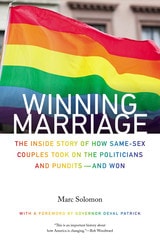
Winning Marriage
The Inside Story of How Same-Sex Couples Took on the Politicians and Pundits—and WonMarc Solomon
University Press of New England, 2014
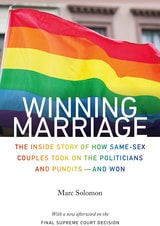
Winning Marriage
The Inside Story of How Same-Sex Couples Took on the Politicians and Pundits—and WonMarc Solomon
University Press of New England, 2015
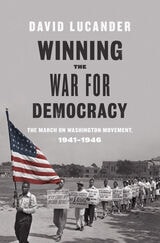
Winning the War for Democracy
The March on Washington Movement, 1941-1946David Lucander
University of Illinois Press, 2014
Winning the War for Democracy: The March on Washington Movement, 1941-1946 recalls that triumph, but also looks beyond Randolph and the MOWM's national leadership to focus on the organization's evolution and actions at the local level. Using the personal papers of previously unheralded MOWM members such as T.D. McNeal, internal government documents from the Roosevelt administration, and other primary sources, David Lucander highlights how local affiliates fighting for a double victory against fascism and racism helped the national MOWM accrue the political capital it needed to effect change.
Lucander details the efforts of grassroots organizers to implement MOWM's program of empowering African Americans via meetings and marches at defense plants and government buildings and, in particular, focuses on the contributions of women activists like Layle Lane, E. Pauline Myers, and Anna Arnold Hedgeman. Throughout he shows how local activities often diverged from policies laid out at MOWM's national office, and how grassroots participants on both sides ignored the rivalry between Randolph and the leadership of the NAACP to align with one another on the ground.
Winters of Discontent
The Winter Olympics and a Half Century of Protest and ResistanceEdited by Russell Field
University of Illinois Press, 2025
The essays collectively explore the shifting dynamics and power relations between the civic coalitions that pursue the Winter Olympics and the social movements that oppose their efforts. The contributors look at specific Games impacted by dissent and probe the issues that swirled around failed and withdrawn bids. In addition, contributions on the contemporary Olympics describe current or future bids while delving into the campaigns demanding host nations pay attention to economic, social, humanitarian, and environmental concerns.
A first-of-its-kind collection, Winters of Discontent profiles the wide range of activists and social movements that have organized against the Winter Olympics.

Wisconsin Agriculture
A HistoryJerry Apps
Wisconsin Historical Society Press, 2015
"I'm embarrassed to say I thought I knew anything substantial about Wisconsin agriculture or its history before I read this book. 'Wisconsin Agriculture' should be required reading in history classes from high school to the collegiate level. It makes me thankful that Jerry Apps has such a sense of commitment to Wisconsin's agricultural heritage--and to getting the story right." --Pam Jahnke, Farm Director, Wisconsin Farm Report Radio
Wisconsin has been a farming state from its very beginnings. And though it's long been known as "the Dairy State," it produces much more than cows, milk, and cheese. In fact, Wisconsin is one of the most diverse agricultural states in the nation.
The story of farming in Wisconsin is rich and diverse as well, and the threads of that story are related and intertwined. In this long-awaited volume, celebrated rural historian Jerry Apps examines everything from the fundamental influences of landscape and weather to complex matters of ethnic and pioneer settlement patterns, changing technology, agricultural research and education, and government regulations and policies. Along with expected topics, such as the cranberry industry and artisan cheesemaking, "Wisconsin Agriculture" delves into beef cattle and dairy goats, fur farming and Christmas trees, maple syrup and honey, and other specialty crops, including ginseng, hemp, cherries, sugar beets, mint, sphagnum moss, flax, and hops. Apps also explores new and rediscovered farming endeavors, from aquaculture to urban farming to beekeeping, and discusses recent political developments, such as the 2014 Farm Bill and its ramifications. And he looks to the future of farming, contemplating questions of ethical growing practices, food safety, sustainability, and the potential effects of climate change.
Featuring first-person accounts from the settlement era to today, along with more than 200 captivating photographs, "Wisconsin Agriculture" breathes life into the facts and figures of 150 years of farming history and provides compelling insights into the state's agricultural past, present, and future.
Wisconsin Votes
An Electoral HistoryRobert Booth Fowler
University of Wisconsin Press, 2008
Wisconsin Watershed
Tony Earl and the New Politics of the Democratic PartyDave Cieslewicz
Michigan State University Press, 2027
In 1982, Tony Earl stormed into the Wisconsin governorship with a sweeping victory, rallying blue-collar Democrats around a progressive political platform. Four years later, observers were stunned when he was soundly defeated by conservative Republican Tommy Thompson—not because of any failure as governor, but because, as Dave Cieslewicz notes, the Democratic Party and American politics had undergone a dramatic transformation.
Wisconsin Watershed traces Earl’s journey from Michigan’s Upper Peninsula and the U.S. Navy, through his years in Wisconsin politics and his single, controversial term as Wisconsin’s governor. Earl tackled acid rain, comparable worth, AIDS policy, and tax reform with equal force; he kept American Motors in the state and pulled Wisconsin from a fiscal crisis. Yet voters could not connect his name with his accomplishments. The progressivism that energized new constituencies also alienated the working-class Catholics who had formed the Democratic Party’s backbone. “It’s not the taxes,” one legislator explained. “It’s the desks”—the name for Earl’s symbolic offices to advocate for Native Americans, African Americans, and women.
Earl refused negative campaigning, and he believed that good policy would ultimately prove good politics. His defeat marked the beginning of the end of an era of civility. Through Earl’s story, we witness the Democratic Party’s evolution from New Deal coalition to the emergence of a modern campaign culture that values image and anger over good governance.

Wisconsin and the Shaping of American Law
Joseph A. Ranney
University of Wisconsin Press, 2017
Organized around periods of social need and turmoil, the book considers the role of states as legal laboratories in establishing American authority west of the Appalachians, in both implementing and limiting Jacksonian reforms and in navigating legal crises before and during the Civil War—including Wisconsin's invocation of sovereignty to defy federal fugitive slave laws. Ranney also surveys judicial revolts, the reforms of the Progressive era, and legislative responses to struggles for civil rights by immigrants, women, Native Americans, and minorities in the nineteenth and twentieth centuries. Since the 1960s, battles have been fought at the state level over such issues as school vouchers, voting, and abortion rights.
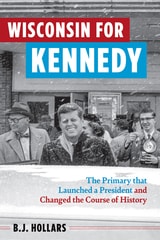
Wisconsin for Kennedy
The Primary That Launched a President and Changed the Course of HistoryB. J. Hollars
Wisconsin Historical Society Press, 2024
When John F. Kennedy ran for president in 1960, he did something no candidate had done before: he leveraged the power of state primaries to win his party’s nomination. Kennedy’s first battleground state? Wisconsin—a state that would prove more arduous, more exhausting, and more crucial to winning the presidency than any other.
Wisconsin for Kennedy brings to life the stories behind JFK’s history-making 1960 Wisconsin primary campaign, and how Kennedy’s team managed to outmaneuver his politically seasoned opponent, Hubert Humphrey. From Jackie Kennedy commandeering a supermarket loudspeaker in Kenosha, to the Wisconsin forklift driver who planned President Kennedy’s final trip to Dallas, this captivating book places readers at the heart of the action.
Author B.J. Hollars chronicles JFK’s nail-biting Wisconsin win by drawing on rarely cited oral histories from the eclectic team of people who worked together to make it happen: a cranberry farmer, a union leader, a mayor, an architect, and others. Wisconsin for Kennedy explores how Wisconsin helped propel JFK all the way to the White House in a riveting historical account that reads like a work of rollicking, page-turning fiction.
“In the spirit of Theodore H. White’s The Making of The President: 1960, B.J. Hollars offers a vivid account of the Wisconsin primary that launched JFK’s successful presidential campaign, inspiring voters to pass the torch to a new generation of leadership for our country. Anyone mesmerized by JFK’s legacy will enjoy this great read.”
—Former US Representative Ron Kind
“For generations, my family has had the great privilege of serving the people of Wisconsin. In Wisconsin for Kennedy, B.J. Hollars performs his own act of service, recounting the riveting and untold story of Wisconsin’s politically perilous 1960 primary. A poignant contribution to political history that reads like a page-turner.”
—Former Wisconsin Governor James Doyle Jr.
"A hopeful quality . . . pervades Wisconsin for Kennedy, written about a time and place when politics was conducted in a less severe and divisive way than it is now. Hollars further succeeds in showing how political history is made by a wide range of citizens. Wisconsinites, Midwesterners, and indeed Americans of all political persuasions can be grateful to B.J. Hollars for these important reminders."
— Middle West Review
With All Deliberate Speed
Implementing Brown v. Board of EducationBrian J. Daugherity
University of Arkansas Press, 2008
Some of the common themes in these efforts were the importance of black activism, especially the crucial role played by the NAACP; entrenched white opposition to school integration, which wasn’t just a southern state issue, as is shown in Delaware, Wisconsin, and Indiana; and the role of the federal government, a sometimes inconstant and sometimes reluctant source of support for implementing Brown.
With All Deliberate Speed
The Life of Philip ElmanNorman I. Silber
University of Michigan Press, 2004
-Anthony Lewis, New York Times columnist, and Pulitzer Prize-winning
author of Gideon's Trumpet
"The fascinating, eloquent, and skillfully edited oral memoir of a distinguished public servant, who was at the epicenter of major legal controversies that his memoir illuminates. A major contribution to modern American legal history."
-Richard A. Posner
"With All Deliberate Speed provides an insider's rich account, spanning over thirty years, of the inner workings of the Supreme Court, the Solicitor General's Office and the Federal Trade Commission that anyone seriously interested in a frank behind-the-scenes view of the federal government should find exceptionally provocative and intriguing"
-Drew Days III, Alfred M. Rankin Professor of Law, Yale University, and former Solicitor General of the United States, 1993-96
From a modest childhood in Patterson, N. J., Philip Elman rose to become clerk for the great Supreme Court Justice Felix Frankfurter, and then to a position in the U.S. Solicitor General's Office. As a member of that office, Philip Elman had an exceptional vantage point on one of the most momentous cases in U.S. Supreme Court history: Brown v. Board of Education.
In this oral history memoir of Elman's life, With All Deliberate Speed, author Norman I. Silber reveals the maneuvering that led to the Court's overturning the doctrine of "separate but equal." Working behind the scenes, it was Justice Department attorney Elman who came up with the concept of gradual integration-an idea that worked its way into the final decision as the famous phrase "with all deliberate speed." Though this expression angered those pressing for immediate desegregation, Elman claims that it unified a divided Court, thus enabling them to stand together against the evil of segregation.
With All Deliberate Speed records a decisive moment in Supreme Court history, but it is also Philip Elman's unforgettable oral memoir-the story of his entire career in government service, including his work with Attorney General Robert F. Kennedy as commissioner of the FTC, and his role in founding the modern consumer protection movement, which includes the antismoking campaign that put the Surgeon General's warning on cigarette packs.
At once rich historical testimony and a gripping read, With All Deliberate Speed offers a rarely glimpsed insider's understanding of the politics of the American legal system.

With Freedom in Our Ears
Histories of Jewish AnarchismEdited by Anna Elena Torres and Kenyon Zimmer
University of Illinois Press, 2023
Contributors bring to light the presence and persistence of Jewish anarchism throughout histories of radical labor, women’s studies, political theory, multilingual literature, and ethnic studies.
These essays reveal an ongoing engagement with non-Jewish radical cultures, including the translation practices of the Jewish anarchist press. Jewish anarchists drew from a matrix of secular, cultural, and religious influences, inventing new anarchist forms that ranged from mystical individualism to militantly atheist revolutionary cells.
With Freedom in Our Ears brings together more than a dozen scholars and translators to write the first collaborative history of international, multilingual, and transdisciplinary Jewish anarchism.
With Honor
Melvin Laird in War, Peace, and PoliticsVan Atta
University of Wisconsin Press, 2008
The first book ever to focus on Laird’s legacy, this authorized biography reveals his central and often unrecognized role in managing the crisis of national identity sparked by the Vietnam War—and the challenges, ethical and political, that confronted him along the way. Drawing on exclusive interviews with Laird, Henry Kissinger, Gerald Ford, and numerous others, author Dale Van Atta offers a sympathetic portrait of a man striving for open government in an atmosphere fraught with secrecy. Van Atta illuminates the inner workings of high politics: Laird’s behind-the-scenes sparring with Kissinger over policy, his decisions to ignore Nixon’s wilder directives, his formative impact on arms control and health care, his key role in the selection of Ford for vice president, his frustration with the country’s abandonment of Vietnamization, and, in later years, his unheeded warning to Donald Rumsfeld that “it’s a helluva lot easier to get into a war than to get out of one.”
With Their Backs to the Mountains
A History of Carpathian Rus' and Carpatho-RusynsPaul Robert Magocsi
Central European University Press, 2016
This is a history of a stateless people, the Carpatho-Rusyns, and their historic homeland, Carpathian Rus’, located in the heart of central Europe. A little over 100,000 Carpatho-Rusyns are registered in official censuses but their population is estimated at around 1,000,000, the greater part in Ukraine and Slovakia. The majority of the diaspora—nearly 600,000—lives in the US.
At the present, when it is fashionable to speak of nationalities as “imagined communities” created by intellectuals or elites who may live in the historic homeland, Carpatho-Rusyns provide an ideal example of a people made—or some would say still being made—before our very eyes. The book traces the evolution of Carpathian Rus’ from earliest prehistoric times to the present, and the complex manner in which a distinct Carpatho-Rusyn people, since the mid-nineteenth century, came into being, disappeared, and then re-appeared in the wake of the revolutions of 1989 and the collapse of communist rule in central and eastern Europe.
To help guide the reader further there are 34 detailed maps plus an annotated discussion of relevant books, chapters, and journal articles.
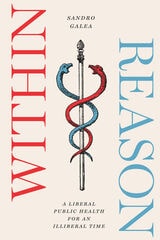
Within Reason
A Liberal Public Health for an Illiberal TimeSandro Galea
University of Chicago Press, 2023
A provocative chronicle of how US public health has strayed from its liberal roots.
The Covid-19 response was a crucible of politics and public health—a volatile combination that produced predictably bad results. As scientific expertise became entangled with political motivations, the public-health establishment found itself mired in political encampment.
It was, as Sandro Galea argues, a crisis of liberalism: a retreat from the principles of free speech, open debate, and the pursuit of knowledge through reasoned inquiry that should inform the work of public health.
Across fifty essays, Within Reason chronicles how public health became enmeshed in the insidious social trends that accelerated under Covid-19. Galea challenges this intellectual drift towards intolerance and absolutism while showing how similar regressions from reason undermined social progress during earlier eras. Within Reason builds an incisive case for a return to critical, open inquiry as a guiding principle for the future public health we want—and a future we must work to protect.

Without Sympathy or Enthusiasm
The Problem of Administrative CompassionVictor A. Thompson
University of Alabama Press, 2007
This classic study brings to bear the findings and principles of political science, sociology, psychology, and economics on various proposals for the solution of ills traditionally associated with governmental administration.

Witness through Encounter
The Diplomacy of Benedict XVIBernard J. O'Connor
St. Augustine's Press, 2019
Appealing to dialogue is often just a safe way of referring to something negative, or at best blandly neutral: the avoidance of conflict, the denial of similarity, not stirring deep-seated disagreement, etc. When Bernard o’Connor says pope Benedict XVI facilitated dialogue, however, he means something quite positive, very much tangible and certainly transformative. In providing an account of the pope’s interactions with various groups of the international community, O’Connor attempts to convey Benedict XVI’s diplomacy as encounter, where even in the sphere of international relations exhortations to “dialogue” are invitations to see more clearly and be moved as much as move.
To dialogue is to embrace, revise perception such that our approaches to the great questions of our day are not simply shared but correct. As O’Connor writes, “Pope Benedict attempts to promote the outlook that a renewed emphasis upon objective, critical and structured philosophical reasoning positions practice, diplomatic and otherwise, to regain its lost foundation and framework. the quest for integrity, if nothing else, should motivate our fidelity to academic pursuit, to intellectual investigation, and to rigorous interdisciplinary inquiry. so influenced, practice will then reject what is arbitrary and be guided by what is time-tested and enduring.”
O’Connor illustrates true dialogue emerging from the encounter, and in turn provides scores of characteristics of this encounter as it unfolds in papal diplomacy. In providing scores of addresses and speeches to various bodies, O’Connor presents pope Benedict XVI as an example of effective diplomacy that treats the meetings on the world stage as engaging in true dialogue. encounter is the true basis of dialogue and one that allows it to open to what is truly a catalyst for change toward cooperation––witness, both personal and collective. As o’Connor shows, “where there is authentic encounter, as meeting in mutual trust, what arises is context for witness.” If authentic even the diplomatic encounter has the means to deepen and transform one’s being.
Witness Through Encounter intends to fulfill multiple needs. the diplomatic approach exemplified herein is singular and worthy of study among political scientists, sociologists, philosophers and diplomats eager to embrace a worldview that is more personal than simply humanistic. this work will also be useful in inter-religious settings. An additional advantage of O’Connor’s presentation of Benedict XVI’s diplomatic approach, his witness through encounter, is that it contains insight valuable to the scholar alongside the resources used.
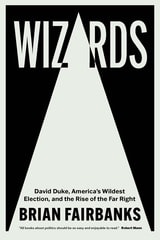
Wizards
David Duke, America's Wildest Election, and the Rise of the Far RightBrian Fairbanks
Vanderbilt University Press, 2022
A surging Republican populist.
The Democrat, hounded by corruption allegations; the Republican, dogged by business failures and ties to white supremacists.
The Republican turned out thousands of screaming supporters for speeches blaming illegal immigrants and crime on the Democrats, and the Democrat plummeted in the polls.
Sound familiar?
The '91 Louisiana Governor's race was supposed to be forgettable. But when former KKK Grand Wizard David Duke shocked the nation by ousting incumbent Republican Governor Buddy Roemer in the primary, the world took notice. Democrat Edwin Edwards, a former three-term governor and two-time corruption defendant, was left alone to face Duke in the general election—and he was going to lose.
Then a little-known state committeewoman stepped in with evidence of Duke's nefarious past. Could her evidence be enough to sway the minds of fired-up voters, or would Louisiana welcome a far-right radical into the highest office in the state?
Journalist Brian Fairbanks explores how the final showdown between Duke and Edwards in November 1991 led to a major shift in our national politics, as well as the rise of the radical right and white supremacist groups, and how history repeated itself in the 2016 presidential election. The story of these political "wizards," almost forgotten by history, remains eerily prescient and disturbingly relevant, and a compulsive page-turner.