Results by title
20 books match the query 'American History'
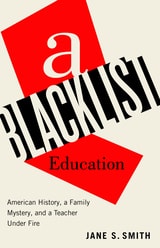
A Blacklist Education
American History, a Family Mystery, and a Teacher Under FireJane S. Smith
Rutgers University Press, 2025
Finalist for the Society of Midland Authors Richard Frisbie Award for Adult Nonfiction
In A Blacklist Education, a mysterious file of family papers triggers a journey through the dark days of political purges in the 1950s. Jane S. Smith tells the story of the anticommunist witch hunt that sent shockwaves through New York City’s public schools as more than a thousand teachers were targeted by Board of Education investigators. Her father was one of them—a fact she learned only long after his death.
Beginning in 1949, amid widespread panic about supposed communist subversion, investigators questioned teachers in their homes, accosted them in their classrooms, and ordered them to report to individual hearings. The interrogations were not published, filmed, open to the public, or reported in the news. By 1956, hundreds of New York City teachers had been fired, often because of uncorroborated reports from paid informers or anonymous accusers.
Most of the targeted teachers resigned or retired without any public process, their names recorded only in municipal files and their futures never known. Their absence became the invisible outline of an educational void, a narrowing of thought that pervaded classrooms for decades. In this highly personal story, family lore and childhood memory lead to restricted archives, forgotten inquisitions, and an eerily contemporary campaign to control who could teach and what was acceptable for students to learn.
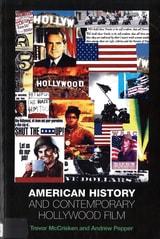
American History and Contemporary Hollywood Film
McCrisken, Trevor
Rutgers University Press, 2005
Hollywood has always been fascinated by America's past, but never more so than in the past fifteen years. Bringing exciting new perspectives to how and why Hollywood has sought to repicture American history, this book offers analysis of more than twenty mainstream contemporary films, including The Patriot, Amistad, Glory, Ride with the Devil, Cold Mountain, Saving Private Ryan, TheThin Red Line, Pearl Harbor, U-571, Platoon, Born on the Fourth of July, Heaven and Earth, JFK, Nixon, Malcolm X, Ali, Black Hawk Down, and Three Kings.
Both authoritative and engaging, American History and Contemporary Hollywood Film is the first book to comprehensively explore the post-cold war period of filmmaking, and to navigate the complex ways that film mediates history-sometimes challenging or questioning, but more frequently reaffirming traditional interpretations. The authors consider why such films are becoming increasingly integral to the ambitions of a globally focused American film industry.
Structured by historical periods, chapters cover significant events and eras such as the American Revolution, slavery and the Civil War, World War II, the sixties and seventies, civil rights and black nationalism, the Vietnam War, and post-cold war global conflicts. The lessons learned from the examples will be illuminating for general readers and college students alike.
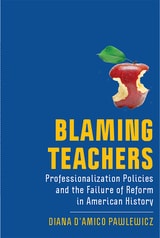
Blaming Teachers
Professionalization Policies and the Failure of Reform in American HistoryDiana D'Amico Pawlewicz
Rutgers University Press, 2020
Historically, Americans of all stripes have concurred that teachers were essential to the success of the public schools and nation. However, they have also concurred that public school teachers were to blame for the failures of the schools and identified professionalization as a panacea.
In Blaming Teachers, Diana D'Amico Pawlewicz reveals that historical professionalization reforms subverted public school teachers’ professional legitimacy. Superficially, professionalism connotes authority, expertise, and status. Professionalization for teachers never unfolded this way; rather, it was a policy process fueled by blame where others identified teachers’ shortcomings. Policymakers, school leaders, and others understood professionalization measures for teachers as efficient ways to bolster the growing bureaucratic order of the public schools through regulation and standardization. Beginning in the mid-nineteenth century with the rise of municipal public school systems and reaching into the 1980s, Blaming Teachers traces the history of professionalization policies and the discourses of blame that sustained them.
Free Speech, The People's Darling Privilege
Struggles for Freedom of Expression in American HistoryMichael Kent Curtis
Duke University Press, 2000
Curtis analyzes three crucial political struggles: the controversy that surrounded the 1798 Sedition Act, which raised the question of whether criticism of elected officials would be protected speech; the battle against slavery, which raised the question of whether Americans would be free to criticize a great moral, social, and political evil; and the controversy over anti-war speech during the Civil War. Many speech issues raised by these controversies were ultimately decided outside the judicial arena—in Congress, in state legislatures, and, perhaps most importantly, in public discussion and debate. Curtis maintains that modern proposals for changing free speech doctrine can usefully be examined in the light of this often ignored history. This broader history shows the crucial effect that politicians, activists, ordinary citizens—and later the courts—have had on the American understanding of free speech.
Filling a gap in legal history, this enlightening, richly researched historical investigation will be valuable for students and scholars of law, U.S. history, and political science, as well as for general readers interested in civil liberties and free speech.
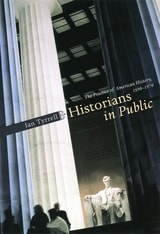
Historians in Public
The Practice of American History, 1890-1970Ian Tyrrell
University of Chicago Press, 2005
Tyrrell's elegant history of the practice of American history traces debates, beginning shortly after the profession's emergence in American academia, about history's role in school curricula. He also examines the use of historians in and by the government and whether historians should utilize mass media such as film and radio to influence the general public. As Historians in Public shows, the utility of history is a distinctive theme throughout the history of the discipline, as is the attempt to be responsive to public issues among pressure groups.
A superb examination of the practice of American history since the turn of the century, Historians in Public uncovers the often tangled ways history-makers make history-both as artisans and as actors.

Immigration and American History
Essays in Honor of Theodore C. BlegenHenry Steele Commager, Editor
University of Minnesota Press, 1961
Immigration and American History was first published in 1961. Minnesota Archive Editions uses digital technology to make long-unavailable books once again accessible, and are published unaltered from the original University of Minnesota Press editions.
Ten scholars noted for their studies in immigration history contribute essays to this volume. Dr. Commager surveys the course of immigration studies over the years. Oscar Handlin reappraises the role of immigration in American life. Ingrid Semmingsen, Norwegian historian, writes on the image of American in Europe. Philip D. Jordan focuses on the immigrant's view of America. John T. Flanagan discusses the immigrant in fiction. Carlton C. Qualey contributes two essays. In the first he surveys world population movements and in the second he suggests new source materials for immigration studies. Henry A. Pochmann discusses the migration of ideas—what ideas have come into America, from where, and to what end? Franklin D. Scott inquires into the value of immigration studies of nationality groups. The Reverend Colman J. Barry explores possibilities for future immigration studies. Theodore C. Blegen takes a backward glance and a forward look at immigration studies.
The volume is based on the papers given at a conference held at the University of Minnesota in honor of Dr. Blegen on his retirement from the university.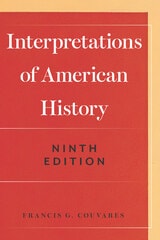
Interpretations of American History
Francis G. Couvares
University of Massachusetts Press, 2025
Without a doubt, the teaching of American history has changed since George Billias and Gerald Grob first issued Interpretations of American History, a comprehensive introduction to the major debates and schools of thought within the field of American history. For this ninth edition, Francis G. Couvares has thoroughly updated the text to include both developments in scholarly debate and changes in the format. He has consolidated two chapters on the revolutionary era into one, and he has also merged formerly separate chapters on profit and commerce in the trading of human beings and the complex and resilient culture that enslaved people sustained. Additionally, he has written a completely new chapter on environmental history and updated the final chapters of the text to include recent scholarship that connects the history of the Civil Rights Movement to the Black Lives Matter Movement; scholarship that discusses intersectionality within feminism, and recent work on political realignment and fragmentation.
In a major revision to the format, Couvares has omitted excerpts of scholarly articles. However, for curious students or research assignments, he includes ample current references. Further, this updated edition anticipates electronic reading of discrete chapters rather than the entire book, and each chapter stands alone well enough to be assigned individually.

MOTHERS MOTHERHOOD
READINGS IN AMERICAN HISTORYEdited by Rima D. Apple and Janet Golden
The Ohio State University Press, 1997

Modern Motherhood
An American HistoryVandenberg-Daves, Jodi
Rutgers University Press, 2014
Modern Motherhood travels through redefinitions of motherhood over time, as mothers encountered a growing cadre of medical and psychological experts, increased their labor force participation, gained the right to vote, agitated for more resources to perform their maternal duties, and demonstrated their vast resourcefulness in providing for and nurturing their families. Navigating rigid gender role prescriptions and a crescendo of mother-blame by the middle of the twentieth century, mothers continued to innovate new ways to combine labor force participation and domestic responsibilities. By the 1960s, they were poised to challenge male expertise, in areas ranging from welfare and abortion rights to childbirth practices and the confinement of women to maternal roles. In the twenty-first century, Americans continue to struggle with maternal contradictions, as we pit an idealized role for mothers in children’s development against the social and economic realities of privatized caregiving, a paltry public policy structure, and mothers’ extensive employment outside the home.
Building on decades of scholarship and spanning a wide range of topics, Vandenberg-Daves tells an inclusive tale of African American, Native American, Asian American, working class, rural, and other hitherto ignored families, exploring sources ranging from sermons, medical advice, diaries and letters to the speeches of impassioned maternal activists. Chapter topics include: inventing a new role for mothers; contradictions of moral motherhood; medicalizing the maternal body; science, expertise, and advice to mothers; uplifting and controlling mothers; modern reproduction; mothers’ resilience and adaptation; the middle-class wife and mother; mother power and mother angst; and mothers’ changing lives and continuous caregiving. While the discussion has been part of all eras of American history, the discussion of the meaning of modern motherhood is far from over.
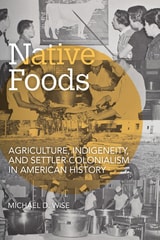
Native Foods
Agriculture, Indigeneity, and Settler Colonialism in American HistoryMichael D. Wise
University of Arkansas Press, 2023
Combining original historical research with interdisciplinary perspectives and informed by the work of Indigenous food sovereignty advocates and activists, this study sheds new light on the historical roles of Native American cuisine in American history and the significance of ongoing colonial processes in present-day discussions about the place of Native foods and Native history in our evolving worlds of taste, justice, and politics.
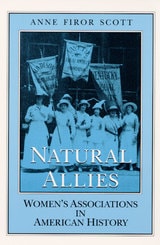
Natural Allies
Women's Associations in American HistoryAnne Firor Scott
University of Illinois Press, 1991
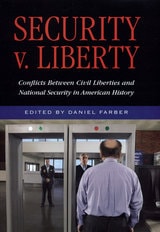
Security V. Liberty
Conflicts Between National Security and Civil Liberties in American HistoryDaniel Farber
Russell Sage Foundation, 2008
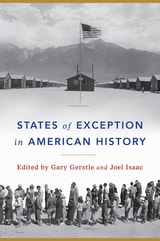
States of Exception in American History
Edited by Gary Gerstle and Joel Isaac
University of Chicago Press, 2020
The first comprehensive account of the politics of exceptions and emergencies in the history of the United States, this book weaves together historical studies of moments and spaces of exception with conceptual analyses of emergency, the state of exception, sovereignty, and dictatorship. The Civil War, the Great Depression, and the Cold War figure prominently in the essays; so do Francis Lieber, Frederick Douglass, John Dewey, Clinton Rossiter, and others who explored whether it was possible for the United States to survive states of emergency without losing its democratic way. States of Exception combines political theory and the history of political thought with histories of race and political institutions. It is both inspired by and illuminating of the American experience with constitutional rule in the age of terror and Trump.
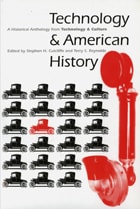
Technology and American History
A Historical Anthology from Technology and CultureEdited by Stephen H. Cutcliffe and Terry S. Reynolds
University of Chicago Press, 1997
Emphasizing a societal context for technology, this carefully organized collection demonstrates both the manner in which cultural, political, and economic forces shape innovation, and the ways that technology has influenced society and shaped its values. Individual essays explore the importance of textile manufacturing in American industrialization, the role of the federal government in regulating new modes of transport, the development of interchangeable parts in production, the process of innovation, the notion of technological systems, and the relationship between technological change and work in the factory, on the farm, and in the home.
The essays were selected to be accessible to both the general reader and the undergraduate student.
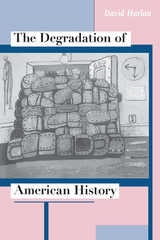
The Degradation of American History
David Harlan
University of Chicago Press, 1997
Part One, "The Legacy of the Sixties," describes the impact of literary theory in the 1970s and beyond, the rise of women's history, the various forms of ideological analysis developed by historians on the left, and the crippling obsession with professionalism in the 1980s. Part Two, "The Renewal of American Historical Writing," focuses on the contributions of John Patrick Diggins, Hayden White, Richard Rorty, Elaine Showalter, Henry Louis Gates Jr., and others. Harlan argues that at the end of the twentieth century American historical writing is perfectly poised to become what it once was: not one of the social sciences in historical costume, but a form of moral reflection that speaks to all Americans.
"[A] wholly admirable work. This book will be talked about for years."—Library Journal
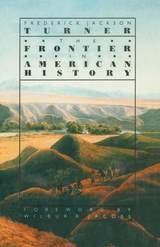
The Frontier in American History
Frederick Jackson Turner
University of Arizona Press, 1986
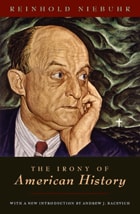
The Irony of American History
Reinhold Niebuhr
University of Chicago Press, 2008
“The supreme American theologian of the twentieth century.”—Arthur Schlesinger Jr., New York Times
“Niebuhr is important for the left today precisely because he warned about America’s tendency—including the left’s tendency—to do bad things in the name of idealism. His thought offers a much better understanding of where the Bush administration went wrong in Iraq.”—Kevin Mattson, The Good Society
“Irony provides the master key to understanding the myths and delusions that underpin American statecraft. . . . The most important book ever written on US foreign policy.”—Andrew J. Bacevich, from the Introduction
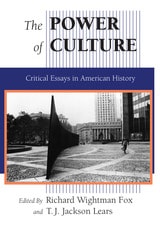
The Power of Culture
Critical Essays in American HistoryEdited by Richard Wightman Fox and T. J. Jackson Lears
University of Chicago Press, 1993
More and more scholars are turning to cultural history in order to make sense of the American past. This volume brings together nine original essays by some leading practitioners in the field. The essays aim to exhibit the promise of a cultural approach to understanding the range of American experiences from the seventeenth century to the present.
Expanding on the editors' pathbreaking The Culture of Consumption, the contributors to this volume argue for a cultural history that attends closely to language and textuality without losing sight of broad configurations of power that social and political history at its best has always stressed. The authors here freshly examine crucial topics in both private and public life. Taken together, the essays shed new light on the power of culture in the lives of Americans past and present.
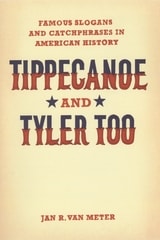
Tippecanoe and Tyler Too
Famous Slogans and Catchphrases in American HistoryJan R. Van Meter
University of Chicago Press, 2008
“By necessity, by proclivity, by delight,” Ralph Waldo Emerson said in 1876, “we all quote.” But often the phrases that fall most readily from our collective lips—like “fire when ready,” “speak softly and carry a big stick,” or “nice guys finish last”—are those whose origins and true meanings we have ceased to consider. Restoring three-dimensionality to more than fifty of these American sayings, Tippecanoe and Tyler Too turns clichés back into history by telling the life stories of the words that have served as our most powerful battle cries, rallying points, laments, and inspirations.
In individual entries on slogans and catchphrases from the early seventeenth to the late twentieth century, Jan Van Meter reveals that each one is a living, malleable entity that has profoundly shaped and continues to influence our public culture. From John Winthrop’s “We shall be as a city upon a hill” and the 1840 Log Cabin Campaign’s “Tippecanoe and Tyler Too” to Martin Luther King Jr.’s “I have a dream” and Ronald Reagan’s “Mr. Gorbachev, tear down this wall,” each of Van Meter’s selections emerges as a memory device for a larger political or cultural story. Taken together in Van Meter’s able hands, these famous slogans and catchphrases give voice to our common history even as we argue about where it should lead us.
“As Van Meter argues, these are important ‘memory devices for a larger story.’ . . . The author has thoroughly researched all the catchphrases . . . . This book would make delightful in-flight reading or a nice gift for a trivia buff. Recommended.”—Choice
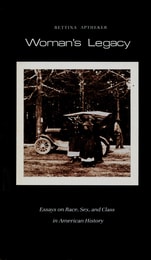
Woman's Legacy
Essays on Race, Sex, and Class in American HistoryBettina Aptheker
University of Massachusetts Press, 1982
Woman's Legacy: Essays on Race, Sex, and Class in American History is a groundbreaking collection of essays by prominent feminist scholar and historian Bettina Aptheker. Emerging from her dissertation research, this work examines the interconnected systems of racial, sexual, and class oppression that have shaped the experiences of women in American history. Through careful historical analysis and feminist scholarship, Aptheker explores how race, sex, and class work together to form complex systems of domination and resistance in the American historical context. The essays investigate women's community roles, activism, and agency while centering the lived experiences of women, particularly Black women, across different historical periods. This seminal work contributes to African American women's history and feminist historiography, bridging women's studies with critical analysis of historical structures and social movements. An essential text for those interested in intersectional approaches to American history and women's studies.