Results by title
33 books match the query 'Archive'
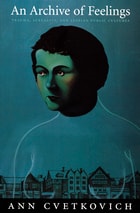
An Archive of Feelings
Trauma, Sexuality, and Lesbian Public CulturesAnn Cvetkovich
Duke University Press, 2003
An Archive of Feelings brings together oral histories from lesbian activists involved in act up/New York; readings of literature by Dorothy Allison, Leslie Feinberg, Cherríe Moraga, and Shani Mootoo; videos by Jean Carlomusto and Pratibha Parmar; and performances by Lisa Kron, Carmelita Tropicana, and the bands Le Tigre and Tribe 8. Cvetkovich reveals how activism, performance, and literature give rise to public cultures that work through trauma and transform the conditions producing it. By looking closely at connections between sexuality, trauma, and the creation of lesbian public cultures, Cvetkovich makes those experiences that have been pushed to the peripheries of trauma culture the defining principles of a new construction of sexual trauma—one in which trauma catalyzes the creation of cultural archives and political communities.
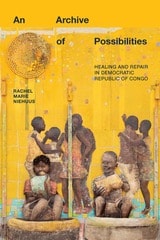
An Archive of Possibilities
Healing and Repair in Democratic Republic of CongoRachel Marie Niehuus
Duke University Press, 2024
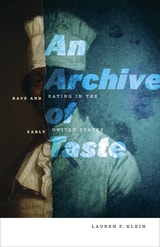
An Archive of Taste
Race and Eating in the Early United StatesLauren F. Klein
University of Minnesota Press, 2020
A groundbreaking synthesis of food studies, archival theory, and early American literature
There is no eating in the archive. This is not only a practical admonition to any would-be researcher but also a methodological challenge, in that there is no eating—or, at least, no food—preserved among the printed records of the early United States. Synthesizing a range of textual artifacts with accounts (both real and imagined) of foods harvested, dishes prepared, and meals consumed, An Archive of Taste reveals how a focus on eating allows us to rethink the nature and significance of aesthetics in early America, as well as of its archive.
Lauren F. Klein considers eating and early American aesthetics together, reframing the philosophical work of food and its meaning for the people who prepare, serve, and consume it. She tells the story of how eating emerged as an aesthetic activity over the course of the eighteenth century and how it subsequently transformed into a means of expressing both allegiance and resistance to the dominant Enlightenment worldview. Klein offers richly layered accounts of the enslaved men and women who cooked the meals of the nation’s founders and, in doing so, directly affected the development of our national culture—from Thomas Jefferson’s emancipation agreement with his enslaved chef to Malinda Russell’s Domestic Cookbook, the first African American–authored culinary text.
The first book to examine the gustatory origins of aesthetic taste in early American literature, An Archive of Taste shows how thinking about eating can help to tell new stories about the range of people who worked to establish a cultural foundation for the United States.
Archive of Aurelius Isidorus
in the Egyptian Museum, Cairo, and the University of MichiganArthur E. R. Boak and Herbert Chayyim Youtie, Editors
University of Michigan Press, 1960
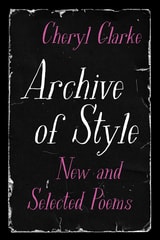
Archive of Style
New and Selected PoemsCheryl Clarke
Northwestern University Press, 2024
Award-winning poet and essayist Cheryl Clarke’s illustrious career has spanned more than four decades and culminates in Archive of Style: New and Selected Poems, a long-awaited retrospective of the indelible work of a Black feminist, community and LGBTQ activist, and educator. This collection features carefully curated poems from Narratives: Poems in the Tradition of Black Women (1982), Living as a Lesbian (1986), The Days of Good Looks: Prose and Poetry 1980-2005 (2006), By My Precise Haircut (2016), and Targets (2019). Together these works show a brilliant thinker who has profoundly impacted generations of writers and activists.
Clarke’s poetry and essays, centered around the Black, lesbian, feminist experience, have attracted an audience around the world. Her essays, “Lesbianism: an Act of Resistance” and “The Failure to Transform: Homophobia in the Black Community” revolutionized the thinking about lesbians of color and the struggle against homophobia. Her poetry and non-fiction have been reprinted in numerous anthologies and assigned in women and sexuality courses globally. Having published since 1977, Clarke and her work have become a foundational part of LGBTQ literature and activism. Archive of Style is a celebration and homage to one of American literature’s Black Women literary warriors.
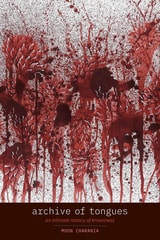
Archive of Tongues
An Intimate History of BrownnessMoon Charania
Duke University Press, 2023
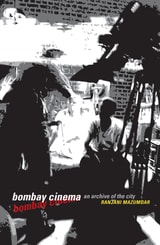
Bombay Cinema
An Archive of the CityRanjani Mazumdar
University of Minnesota Press, 2007
In this analysis of the cinematic city, Mazumdar reveals a complex postnationalist world, convulsed by the social crisis of the 1970s and transformed by the experience of globalization in the 1990s. She argues that the upheaval of postcolonial nationalism led to Bombay cinema’s articulation of urban life in entirely new terms. Specifically, the place of the village in the imaginary constitution of anticolonial nationalism gave way to a greater acknowledgment, even centrality, of urban space. Bombay Cinema takes the reader on an inventive journey through a cinematic city of mass crowds, violence, fashion, architectural fantasies, and subcultural identities. Moving through the world of gangsters and vamps, families and drifters, and heroes and villains, Bombay Cinema explores an urban landscape marked by industrial decline, civic crisis, working-class disenchantment, and diverse street life.Combining the anecdotal with the theoretical, the philosophical with the political, and the textual with the historical, Bombay Cinema leads the reader into the heart of the urban labyrinth in India, revising and deepening our understanding of both the city and the cinema.
"A landmark study—carefully researched, well organized and offering refreshingly uncondescending and strikingly insightful discussions of mainstream films—that deserves to be read by anyone interested in India's popular cinema or its contemporary urban life." —Journal of Asian Studies
"Bombay Cinema is an exciting and important contribution to a field that has, to date, been under researched and under theorized. Lively, provocative and richly suggestive, it will also serve as a surefire incentive to watch those films all over again." —Screen
"Here, at last, is a book length study on Cinema in India that does not get locked into a dance of hermetic closure between what transpires on screen and a set of stock off screen textual and cultural references, but more importantly, walks the streets where the films are set, looks at shop windows, publicity material, costumes, fashion, architecture, telecommunications and the concrete materiality that surrounds the film object." —Seminar
"Bombay Cinema is lucid, provocative, stylish and substantial. It is an illuminating scholarly study that spares no effort to bring Bombay cinema out of the academic closet." —The Book Review India
"Departing from the obsession that Film Studies in India has displayed with the idea of cinema as a national allegory, the book convincingly argues for the need to examine the city's hidden archive as one that cannot be subsumed within the sign of the national." —Biblio
"Mazumdar has a great capacity to discuss Indian cinema, with a brilliant grasp of its political, historical, and aesthetic developments, but equally she is well attuned to the interests and ruptures in the academic discourse of film and cinema studies."—Film International
"Mazumdar's experience as a filmmaker allowed her to offer significant readings of not just the narratives and character development in the films, but of the cinematography, mise-en-scene, and other technical and performance aspects of production." —Journal of Popular Culture
"At once about Hindi films, spatial practices, urban modernity and globalization . . . the strength of Bombay Cinema lies in bringing all of them together in a productive conversation.” —Economic and Political Weekly
"Bombay Cinema is methodologically challenging in its deployment of moments rather than discursiveformations of film as text. The book also refuses to read film alone, but interprets the medium alongside the detailed insights of people involved in making them, and with the recent history of Bombay, within which the film industry is located. In Mazumdar's evocative reading of the films she engages with, the cinematic city becomes the space of critique of the nation, the site of the ruin of the modern nationalist project." —Contemporary South Asia
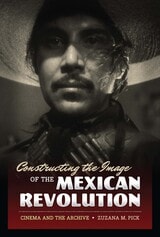
Constructing the Image of the Mexican Revolution
Cinema and the ArchiveBy Zuzana M. Pick
University of Texas Press, 2009
Katherine Singer Kovács Book Award, Society for Cinema and Media Studies, 2011
With a cast ranging from Pancho Villa to Dolores del Río and Tina Modotti, Constructing the Image of the Mexican Revolution demonstrates the crucial role played by Mexican and foreign visual artists in revolutionizing Mexico's twentieth-century national iconography. Investigating the convergence of cinema, photography, painting, and other graphic arts in this process, Zuzana Pick illuminates how the Mexican Revolution's timeline (1910–1917) corresponds with the emergence of media culture and modernity.
Drawing on twelve foundational films from Que Viva Mexico! (1931–1932) to And Starring Pancho Villa as Himself (2003), Pick proposes that cinematic images reflect the image repertoire produced during the revolution, often playing on existing nationalist themes or on folkloric motifs designed for export. Ultimately illustrating the ways in which modernism reinvented existing signifiers of national identity, Constructing the Image of the Mexican Revolution unites historicity, aesthetics, and narrative to enrich our understanding of Mexicanidad.

Crate Missions
The Art and Archive of Hip Hop Beat-MakingJason D. Rawls
University of Michigan Press, 2027
Crate Missions takes readers inside the world of Hip Hop producers, where dusty record stores, forgotten albums, and decades-old recordings become the raw materials for new musical creation. Drawing on qualitative research, autoethnography, and oral history, Crate Missions combines the author’s more than twenty-five years of experience as a producer and DJ with interviews conducted with influential Hip Hop practitioners, including Pete Rock, Diamond D, Buckwild, Ski Beatz, K-Def, Mr. Walt and Evil Dee of the Beatminerz, and Breakbeat Lou. The online audio component allows readers to hear three new beats created by Rawls for this project, as well as “producer’s commentaries” in which Rawls walks listeners through his inspiration and process. Together, the text and audio reveal how crate digging is far more than collecting records—it is a form of historical discovery, cultural preservation, and creative expression.
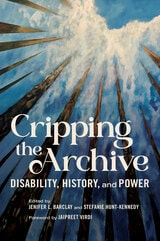
Cripping the Archive
Disability, History, and PowerEdited by Jenifer L. Barclay and Stefanie Hunt-Kennedy Foreword by Jaipreet Virdi
University of Illinois Press, 2025
Jenifer L. Barclay and Stefanie Hunt-Kennedy edit a collection of interdisciplinary essays that consider how and why physical, sensory, intellectual, and psychological disabilities are underrepresented, erased, or distorted in the historical record. The contributors draw on the methodology and practice of cripping to uncover disability in contested archives and explore ways to build inclusive archives accountable to, and centered on, disabled people and disability justice. Throughout, they show ableness informing the politics of the archive as a physical space, a discriminatory record, and a collection of silences.
An essential contribution to research methods and disability justice, Cripping the Archive offers a blueprint for intersectional and interdisciplinary approaches that bridge disability studies, history, and archival studies.
Digital Memory and the Archive
Wolfgang Ernst
University of Minnesota Press, 2012
In the popular imagination, archives are remote, largely obsolete institutions: either antiquated, inevitably dusty libraries or sinister repositories of personal secrets maintained by police states. Yet the archive is now a ubiquitous feature of digital life. Rather than being deleted, e-mails and other computer files are archived. Media software and cloud storage allow for the instantaneous cataloging and preservation of data, from music, photographs, and videos to personal information gathered by social media sites.
In this digital landscape, the archival-oriented media theories of Wolfgang Ernst are particularly relevant. Digital Memory and the Archive, the first English-language collection of the German media theorist’s work, brings together essays that present Ernst’s controversial materialist approach to media theory and history. His insights are central to the emerging field of media archaeology, which uncovers the role of specific technologies and mechanisms, rather than content, in shaping contemporary culture and society.
Ernst’s interrelated ideas on the archive, machine time and microtemporality, and the new regimes of memory offer a new perspective on both current digital culture and the infrastructure of media historical knowledge. For Ernst, different forms of media systems—from library catalogs to sound recordings—have influenced the content and understanding of the archive and other institutions of memory. At the same time, digital archiving has become a contested site that is highly resistant to curation, thus complicating the creation and preservation of cultural memory and history.
Dust
The Archive and Cultural HistoryCarolyn Steedman
Rutgers University Press, 2002
In this witty, engaging, and challenging book, Carolyn Steedman has produced an originaland sometimes irreverentinvestigation into how modern historiography has developed. Dust: The Archive and Cultural History considers our stubborn set of beliefs about an objective material worldinherited from the nineteenth centurywith which modern history writing and its lack of such a belief, attempts to grapple. Drawing on her own published and unpublished writing, Carolyn Steedman has produced a sustained argument about the way in which history writing belongs to the currents of thought shaping the modern world.
Steedman begins by asserting that in recent years much attention has been paid to the archive by those working in the humanities and social sciences; she calls this practice "archivization." By definition, the archive is the repository of "that which will not go away," and the book goes on to suggest that, just like dust, the "matter of history" can never go away or be erased.
This unique work will be welcomed by all historians who want to think about what it is they do.

Economists Papers, 1750-1950
A Guide to Archive and other Manuscript Sources for the History of British and Irish Economic ThoughtR. P. Sturges
Duke University Press, 1975
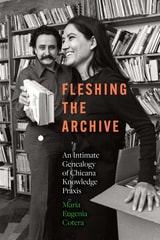
Fleshing the Archive
An Intimate Genealogy of Chicana Knowledge PraxisMaría Eugenia Cotera
University of Texas Press, 2025
The history of the Chicana por mi Raza Digital Memory Collective, an archive dedicated to preserving Chicana feminist knowledge of the 1970s and memory work.
The late 1960s and early 1970s witnessed an explosion of publishing by Chicana activists as they took part in the Movimiento against oppression of ethnic Mexicans in the United States. Today, thousands of these documents, including written works and oral histories, have been assembled by the Chicana por mi Raza Digital Memory Collective. Drawing on these unique resources, Fleshing the Archive traces the innovative Chicana knowledge projects of the Movimiento years.
Seeking to think with the past rather than about it, María Cotera explores transgressive sites and discourses of Chicana knowledge, from poems and essays to newspapers, bibliographies, and testimonies. Often published independently and distributed by readers themselves, these works embodied a praxis of feminist and queer consciousness-raising. Observing the startling convergences between Chicana praxis of the 1970s and digital knowledge production in the present, Cotera argues that the Chicana archive enables transformative moments of recognition across time that unsettle supposedly objective accounts of history. The materials preserved by Chicana por mi Raza offer Chicana scholars a model of teaching and learning liberated from a corporate academy that is increasingly hostile to intellectual inquiry.
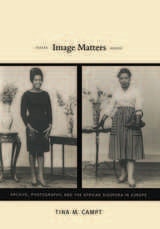
Image Matters
Archive, Photography, and the African Diaspora in EuropeTina M. Campt
Duke University Press, 2012
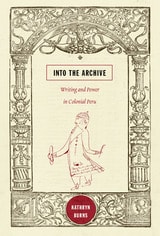
Into the Archive
Writing and Power in Colonial PeruKathryn Burns
Duke University Press, 2010
Kathryn Burns argues that the archive itself must be historicized. Using the case of colonial Cuzco, she examines the practices that shaped document-making. Notaries were businessmen, selling clients a product that conformed to local “custom” as well as Spanish templates. Clients, for their part, were knowledgeable consumers, with strategies of their own for getting what they wanted. In this inside story of the early modern archive, Burns offers a wealth of possibilities for seeing sources in fresh perspective.
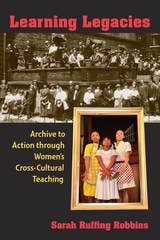
Learning Legacies
Archive to Action through Women's Cross-Cultural TeachingSarah Ruffing Robbins
University of Michigan Press, 2017
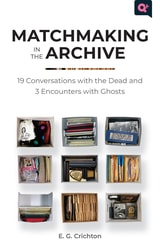
Matchmaking in the Archive
19 Conversations with the Dead and 3 Encounters with GhostsE.G. Crichton
Rutgers University Press, 2023
Working with the archives of the Gay Lesbian Bisexual Transgender Historical Society, artist E.G. Crichton decided to do something to bridge this generation gap. She selected 19 innovative LGBTQ artists, writers, and musicians, then paired each of them with a deceased person whose personal artifacts are part of the archive.
Including 25 pages of vivid images, Matchmaking in the Archive documents this monumental creative project and adds essays by Jonathan D. Katz, Michelle Tea, and Chris Vargas, who describe their own unique encounters with the ghosts of LGBTQ history. Together, they make the archive come alive in remarkably intimate ways.
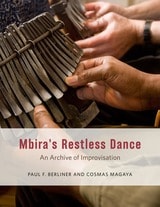
Mbira's Restless Dance
An Archive of ImprovisationPaul F. Berliner and Cosmas Magaya
University of Chicago Press, 2020
Mbira’s Restless Dance is written to be played. This two-volume, spiral-bound set features musical transcriptions of thirty-nine compositions and variations, annotated with the master player’s advice on technique and performance, his notes and observations, and commentary by Berliner. Enhanced with extensive website audiovisuals, Mbira’s Restless Dance is in effect a series of masterclasses with Magaya, suitable for experienced mbira players and those learning the fundamentals.
Together with Berliner's The Art of Mbira, in which he provides an indispensable historical and cultural guide to mbira in a changing world, Mbira's Restless Dance breaks new ground in the depth and specificity of its exploration of an African musical tradition, and in the entwining of the authors’ collaborative voices. It is a testament to the powerful relationship between music and social life—and the rewards of lifelong musical study, performance, and friendship.
Myth and Archive
A Theory of Latin American NarrativeRoberto González-Echevarría
Duke University Press, 1998
Providing ways to link literary and nonliterary narratives, González Echevarría examines a variety of archival writings—from the chronicles of the discovery and conquest of the New World to scientific travel narratives and records of criminal confessions—and explores the relationship of these writings to novels by authors such as García Márquez, Borges, Barnet, Sarmiento, Carpentier, and Garcilaso de la Vega. Moving beyond demonstrating that early forms of creative narrative had their geneses in the sixteenth-century authoritative discourse of the Spanish Empire, González Echevarría shows how this same originating process has been repeated in other key moments in the history of the Latin American narrative. He shows how the discourse of scientific discovery was the model for much nineteenth-century literature, as well as how anthropological writings on the nature of language and myth have come to shape the ideology and form of literature in the twentieth century. This most recent form of Latin American narrative creates its own mythic form through an atavistic return to its legal origins—the archive.
This acclaimed book—originally published in 1990—will be of continuing interest to historians, anthropologists, literary theorists, and students of Latin American culture.
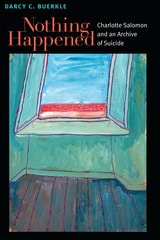
Nothing Happened
Charlotte Salomon and an Archive of SuicideDarcy C. Buerkle
University of Michigan Press, 2013
Charlotte Salomon's (1917-43) fantastical autobiography, Life? or Theater?, consists of 769 sequenced gouache paintings, through which the artist imagined the circumstances of the eight suicides in her family, all but one of them women. But Salomon's focus on suicide was not merely a familial idiosyncrasy. Nothing Happened argues that the social history of early-twentieth-century Germany has elided an important cultural and social phenomenon by not including the story of German Jewish women and suicide. This absence in social history mirrors an even larger gap in the intellectual history of deeply gendered suicide studies that have reproduced the notion of women's suicide as a rarity in history. Nothing Happened is a historiographic intervention that operates in conversation and in tension with contemporary theory about trauma and the reconstruction of emotion in history.
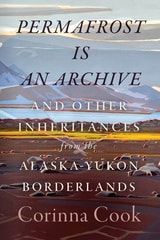
Permafrost Is an Archive
and Other Inheritances from the Alaska-Yukon BorderlandsCorinna Cook
West Virginia University Press, 2026
The Yukon Ice Patch Project reveals ancient lives. A road through the boreal forest reads like a map of climate upheaval. Those houses with broken doorknobs—a legacy of government regulation over Indigenous life. Corinna Cook, who was born white on Áak’w Kwáan Tlingit land in Juneau, Alaska, wrestles with the past and future into Canada’s Yukon Territory. With writing that blends research and reverie, her essays ask how we might come into right relations with our most difficult, shared histories. How can we carry the past together, in a good way, as the land melts? The answers—elusive as they are—carry global resonance, taking shape through a deeply personal lens combined with careful study of local arts, artifacts, maps, and the land we depend on.
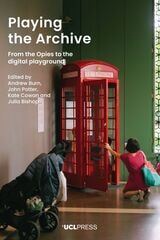
Playing the Archive
From the Opies to the Digital PlaygroundEdited by Andrew Burn, John Potter, Kate Cowan, and Julia Bishop
University College London, 2025
Playing the Archive: From the Opies to the Digital Playground revisits the trailblazing work of Iona and Peter Opie, who documented children’s playground games, rhymes, and traditions in mid-20th century Britain, and brings their research into the digital age. Through a major new study, this book explores how children’s play has evolved, drawing on fresh ethnographic research, digital storytelling, and interactive media to compare past and present-day playground cultures.
By making the Opie Archive publicly accessible and involving children through digital interfaces, the project opens up new ways of understanding play as a dynamic, ever-changing practice. The chapters offer novel theoretical insights into the shifting landscapes of play, considering the role of archives and digital media in shaping children’s cultural expressions. Playing the Archive questions stereotypes about childhood in the digital era, positioning children as active creators of their own play cultures.
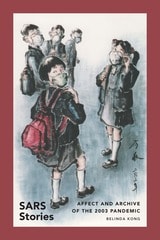
SARS Stories
Affect and Archive of the 2003 PandemicBelinda Kong
Duke University Press, 2024
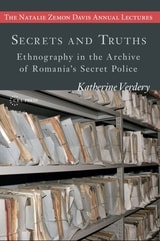
Secrets and Truths
Ethnography in the Archive of Romania's Secret PoliceKatherine Verdery
Central European University Press, 2014
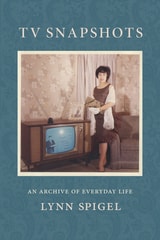
TV Snapshots
An Archive of Everyday LifeLynn Spigel
Duke University Press, 2022
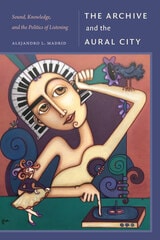
The Archive and the Aural City
Sound, Knowledge, and the Politics of ListeningAlejandro L. Madrid
Duke University Press, 2025
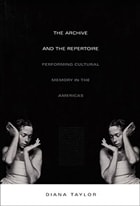
The Archive and the Repertoire
Performing Cultural Memory in the AmericasDiana Taylor
Duke University Press, 2003
Examining various genres of performance including demonstrations by the children of the disappeared in Argentina, the Peruvian theatre group Yuyachkani, and televised astrological readings by Univision personality Walter Mercado, Taylor explores how the archive and the repertoire work together to make political claims, transmit traumatic memory, and forge a new sense of cultural identity. Through her consideration of performances such as Coco Fusco and Guillermo Gómez-Peña’s show Two Undiscovered Amerindians Visit . . . , Taylor illuminates how scenarios of discovery and conquest haunt the Americas, trapping even those who attempt to dismantle them. Meditating on events like those of September 11, 2001 and media representations of them, she examines both the crucial role of performance in contemporary culture and her own role as witness to and participant in hemispheric dramas. The Archive and the Repertoire is a compelling demonstration of the many ways that the study of performance enables a deeper understanding of the past and present, of ourselves and others.
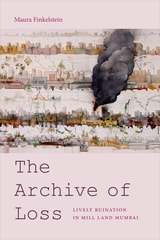
The Archive of Loss
Lively Ruination in Mill Land MumbaiMaura Finkelstein
Duke University Press, 2019
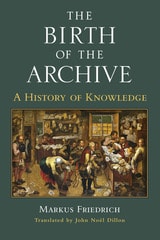
The Birth of the Archive
A History of KnowledgeMarkus Friedrich, translated by John Noël Dillon
University of Michigan Press, 2018
Friedrich provides an essential background to the history of archives over the centuries and enriches the story of their evolution with chapters on key sociocultural aspects of European archival culture. He discusses their meaning and symbolism in European thought, early modern conceptions of the archive’s function, and questions of access and usability. Exploring the close, often vexed relationship between archives and political power, Friedrich illustrates the vulnerability of archives to political upheaval and war. He concludes with an introspective look at how historians used their knowledge of and work with archives to create distinct representations of themselves and their craft.
The Birth of the Archive engages with scholarship in political history, the history of mentalities, conceptions of space, historiography, and the history of everyday life in early modern Europe. It has much to offer for specialists and scholars, while the jargon-free prose of this translation is also accessible to the general reader.
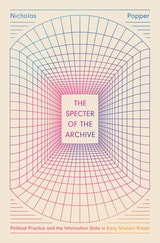
The Specter of the Archive
Political Practice and the Information State in Early Modern BritainNicholas Popper
University of Chicago Press, 2024
We are used to thinking of ourselves as living in a time when more information is more available than ever before. In The Specter of the Archive, Nicholas Popper shows that earlier eras had to grapple with the same problem—how to deal with too much information at their fingertips.
He reveals that early modern Britain was a society newly drowning in paper, a light and durable technology whose spread allowed statesmen to record drafts, memoranda, and other ephemera that might otherwise have been lost, and also made it possible for ordinary people to collect political texts. As original paperwork and copies alike flooded the government, information management became the core of politics. Focusing on two of the primary political archives of early modern England, the Tower of London Record Office and the State Paper Office, Popper traces the circulation of their materials through the government and the broader public sphere. In this early media-saturated society, we find the origins of many issues we face today: Who shapes the archive? Can we trust the pictures of the past and the present that it shows us? And, in a more politically urgent vein: Does a huge volume of widely available information (not all of it accurate) risk contributing to polarization and extremism?
Transforming the Authority of the Archive
Undergraduate Pedagogy and Critical Digital ArchivesAndi Gustavson and Charlotte Nunes, Editors
Lever Press, 2023
Contributions to this volume represent a range of institutions including small liberal arts colleges, HBCUs, Ivy Leagues, large research institutions, and community-based collections. The assignments, projects, and initiatives described across this volume are fundamentally concerned with the challenge to model digital archival collections so as to center individual and community voices that are historically under-engaged in the archives. To address this challenge, contributors describe various approaches to substantively, often radically, redistribute archival resources and authority. The chapters within Transforming the Authority of the Archive offer thoughtful and creative pedagogical approaches to counter the presumed neutrality of the archive and advocate a shared understanding of the contingency of archival collections. This book is a must-read for liberal arts faculty, graduate students, archivists (both community- and institutionally-affiliated), information-studies professionals, librarians, and other professionals working and teaching in archives, museums, libraries, and other cultural heritage institutions.
Up Against the Archive
Experiments in Writing British Empire History OtherwiseAntoinette Burton, editor
Duke University Press, 2027