Results by title
20 books match the query 'Assessment, Testing & Measurement'

Adolescent Personality and Behavior
MMPI Patterns of Normal, Delinquent, Dropout, and Other OutcomesStarke Hathaway
University of Minnesota Press, 1963

American Beliefs About Intelligence
Orville G., Jr. Brim
Russell Sage Foundation, 1969
Assessing Police and Other Public Safety Personnel with the MMPI-3
A Practical GuideDavid M. Corey
University of Minnesota Press, 2024
A hands-on guide for using the MMPI-3 when assessing suitability and fitness for duty of public safety personnel
Factors unique to police and public safety candidate selection require adjustments to standard guidelines when interpreting MMPI-3 scores. David M. Corey and Yossef S. Ben-Porath’s latest work broadly focuses on use of the MMPI-3 in both prehire suitability evaluations and posthire fitness-for-duty evaluations of individuals in public safety occupations.
This practical guide was written for clinicians who conduct evaluations of incumbent public safety personnel as well as candidates for law enforcement, correctional, firefighter/medic, or emergency dispatcher positions. The chapters are devoted to foundational and practical knowledge required for conducting these evaluations, including a concise primer on the MMPI-3, common procedural and legal requirements, and contextual factors affecting evaluations. The book also provides case illustrations that demonstrate use of integrative models in preemployment and fitness-for-duty evaluations and includes expanded coverage of the updated MMPI-3 Police Candidate Interpretive Report as well as the newly released Correctional Candidate Interpretive Report, Dispatcher Candidate Interpretive Report, and Firefighter Candidate Interpretive Report.
Autistic Intelligence
Interaction, Individuality, and the Challenges of DiagnosisDouglas W. Maynard and Jason Turowetz
University of Chicago Press, 2022
Winner 2024 Outstanding Recent Contribution in Social Psychology Award, Social Psychology Section, American Sociological Association
Winner 2024 Melvin Pollner Prize, Ethnomethodology and Conversation Analysis Section, American Sociological Association
As autism has grown in prevalence, so too have our attempts to make sense of it. From placing unfounded blame on vaccines to seeking a genetic cause, Americans have struggled to understand what autism is and where it comes from. Amidst these efforts, however, a key aspect of autism has been largely overlooked: the diagnostic process itself. That process is the central focus of Autistic Intelligence. The authors ask us to question the norms by which we measure autistic behavior, to probe how that behavior can be considered sensible rather than disordered, and to explore how we can better appreciate the individuality of those who receive the diagnosis.Drawing on hundreds of hours of video recordings and ethnographic observations at a clinic where professionals evaluated children for autism, the authors’ analysis of interactions among clinicians, parents, and children demystifies the categories, tools, and practices involved in the diagnostic process. Autistic Intelligence shows that autism is not a stable category; it is the outcome of complex interactional processes involving professionals, children, families, and facets of the social and clinical environments they inhabit. The authors suggest that diagnosis, in addition to carefully classifying children, also can highlight or include unique and particular contributions those with autism potentially can make to the world around us.
Basic Sources On The Mmpi-2
James N. Butcher
University of Minnesota Press, 2000
Case Studies for Interpreting the MMPI-A-RF
Daniel L. Davis
University of Minnesota Press, 2021
A collection of illustrative adolescent case studies to aid clinicians in problem identification, diagnosis, and treatment planning—the only casebook for the MMPI-A-RF
The MMPI-A-RF is linked to current models of psychopathology and personality, and features scales relevant for use with adolescents in a variety of clinical, forensic, and school settings. It mirrors the structure of the MMPI-2-RF, resulting in the most up-to-date, empirically based personality assessment for use with adolescents. Written by the authors of the earlier Case Studies for Interpreting the MMPI-A, this book continues the goal of serving as an authentic and illustrative guide for clinicians in understanding and using the MMPI-A-RF.
Since the publication of the original Case Studies, much has changed for clinicians who assess and treat adolescents. The interpretive model described in this book demonstrates how the MMPI-A-RF can assist clinicians in assessing youth today by highlighting sixteen cases that broadly represent adolescents evaluated in clinical and forensic practice. In addition, one of the most common uses for the MMPI-A-RF is in the juvenile court setting—a landscape that has also dramatically changed since the publication of the original MMPI-A. Case Studies for Interpreting the MMPI-A-RF focuses on detailed forensic issues, including legal backgrounds, case law, and assessment methods specific to use of the MMPI-A-RF in juvenile court and related settings.
Case Studies for Interpreting the MMPI-A-RF will assist clinicians in understanding MMPI-A-RF interpretation, while also being a valuable teaching tool for courses in assessment.
Classifying Criminal Offenders with the MMPI-2
The Megargee SystemEdwin I. Megargee
University of Minnesota Press, 2001
Educational and Psychological Testing
A Study of the Industry and its PracticesMartin Holeman
Russell Sage Foundation, 1972
Essentials of MMPI-2 and MMPI-A Interpretation
James N. Butcher
University of Minnesota Press, 2000
The best resource for interpreting these widely used personality assessment tests.
The best resource for interpreting these widely used personality assessment tests.
Essentials of MMPI-2 and MMPI-A Interpretation presents innovative interpretive strategies for both the Minnesota Multiphasic Personality Inventory-2, or MMPI-2, and the adaptation for adolescents, the MMPI-A. James N. Butcher and Carolyn L. Williams detail the rationale for the revision and development of the instruments and their scales, and describe how to administer, score, profile, code, and interpret the tests.The revised edition includes the most recent MMPI research, including new information on ethnic background and cultural setting as they relate to assessment. Focusing primarily on studies of profile validity and external correlates, the revision also includes interpretive guidelines for several scales that will be introduced into the MMPI tests in 2000.Translation inquiries: University of Minnesota Press
Forensic Mental Health Assessment With the MMPI-3
Dustin Wygant
University of Minnesota Press, 2026
A comprehensive, evidence-based handbook for using the MMPI-3 in forensic evaluations
Since its release in 2020, the MMPI-3 has become a cornerstone of clinical and forensic assessment. Forensic Mental Health Assessment With the MMPI-3 is an essential, evidence-based resource that explores use of the MMPI-3 in a variety of forensic contexts. In addition to elucidating the test’s development and the interpretation of its scales, this comprehensive guide delves into critical forensic issues including admissibility (e.g., Daubert criteria), telehealth assessment, cross-cultural considerations, and response bias.
Dustin B. Wygant and Martin Sellbom draw on contemporary research to discuss the unique challenges of forensic evaluations. Through case analyses, this book illustrates how to interpret and integrate MMPI-3 profiles into clinical and diagnostic impressions, and it addresses common psycholegal questions in criminal (e.g., competency to stand trial, insanity), civil (e.g., disability), and family (e.g., child custody) contexts.
Providing practical insights into real-world MMPI-3 applications, Forensic Mental Health Assessment With the MMPI-3 is an indispensable resource for forensic practitioners and legal professionals.
MMPI-2 Correlates for Outpatient Community Mental Health Settings
John R. Graham
University of Minnesota Press, 1999

Masculinity and Femininity in the MMPI-2 and MMPI-A
Hale Martin
University of Minnesota Press, 2010
Martin and Finn consider the factor structure and correlates of masculinity and femininity in the MMPI in multiple samples. Through their analyses, they are able to address such questions as: Is there such a thing as masculinity/femininity? If so, are masculinity and femininity separate constructs, or are they opposite ends of a bipolar dimension? What are the core aspects of masculinity and femininity? Are they the same for men and women? Do the meanings of masculinity and femininity vary across the human life span and in different cultures? To what extent are masculinity and femininity biologically or socially determined? Can masculinity and femininity be adequately measured by the MMPI-2 and MMPI-A?
This insightful work uses solid empirical methods to clarify significant constructs. It will be an essential resource for researchers in the areas of personality, psychological assessment, and gender studies, as well as for clinicians working with clients who have nontraditional gender identities.
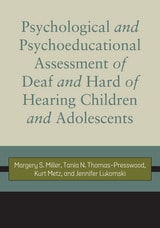
Psychological and Psychoeducational Assessment of Deaf and Hard of Hearing Children and Adolescents
Margery S. Miller
Gallaudet University Press, 2015
Authors Margery S. Miller, Tania Thomas-Presswood, Kurt Metz, and Jennifer Lukomski bring a wealth of knowledge and experience to this in-depth treatment of topics essential to educators and school psychologists. They cover such critical areas as test construction and measurement; the diversity in American Deaf culture; the role of parents in the assessment process; neuropsychological assessments; nonverbal methods for assessing intelligence; and the need for sign language competency when testing cognitive and language skills.
The text concludes with recommendations for the development of valid and reliable tests for all students who are deaf and hard of hearing.
Questions About Questions
Inquiries into the Cognitive Bases of SurveysJudith M. Tanur
Russell Sage Foundation, 1992
Teachers and Testing
David A. Goslin
Russell Sage Foundation, 1967
The Kuhlman-Binet Tests for Children of Preschool Age
Florence Goodenough
University of Minnesota Press, 1928
The Mmpi-2 Content Component Scales
Development, Psychometric Characteristics, and Clinical ApplicationYossef S. Ben-Porath
University of Minnesota Press, 1993
The Search for Ability
Standardized Testing in Social PerspectiveDavid A. Goslin
Russell Sage Foundation, 1963
Vocational Interest Measurement
Theory and PracticeJohn G. Darley and Theda Hagenah
University of Minnesota Press, 1955
Vocational Interest Measurement was first published in 1955. Minnesota Archive Editions uses digital technology to make long-unavailable books once again accessible, and are published unaltered from the original University of Minnesota Press editions.
Many years of clinical experience at the University of Minnesota, using the Strong Vocational Interest Bank in counseling services, form the basis for this book. The work will help other counselors to understand the meaning of the interest scores which they obtain with this test. In successive chapters, the authors discuss the meaning of work and jobs in our society, deal with the anatomy of interests, analyze interest patterns and outline a normative framework for their system of analysis, discuss personality factors as related to interests, review theories of origin and development of interests, and illustrate the use of interest measurement in counseling through a series of case studies. A volume in the Minnesota Library on Student Personnel Work.
Workbook-Essentials Of Mmpi-2
James N. Butcher
University of Minnesota Press, 2000