Results by title

37 books match the query 'Augustine, of Hippo, Saint'
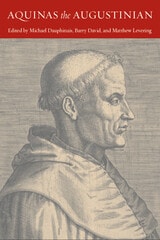
cover of Aquinas the Augustinian

Aquinas the Augustinian

Michael Dauphinais

Catholic University of America Press, 2007
The book is composed of eleven essays by an international group of renowned scholars from the United States, England, Switzerland, Holland, and Italy
[more]
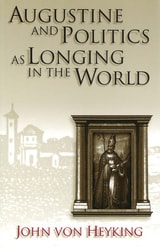
cover of Augustine and Politics as Longing in the World

Augustine and Politics as Longing in the World

John von Heyking

University of Missouri Press, 2001

Saint Augustine's political thought has usually been interpreted by modern readers as suggesting that politics is based on sin. In Augustine and Politics as Longing in the World, John von Heyking shows that Augustine actually considered political life a substantive good that fulfills a human longing for a kind of wholeness.

Rather than showing Augustine as supporting the Christian church's domination of politics, von Heyking argues that he held a subtler view of the relationship between religion and politics, one that preserves the independence of political life. And while many see his politics as based on a natural-law ethic or on one in which authority is conferred by direct revelation, von Heyking shows how Augustine held to an understanding of political ethics that emphasizes practical wisdom and judgment in a mode that resembles Aristotle rather than Machiavelli.

Augustine and Politics as Longing in the World demonstrates some of the deficiencies in the way Augustine's political thought has been interpreted. It also explains why a rereading of his thought illuminates the current debates between "secularists" and proponents of "orthodoxy" and shows why these debates are miscast. By examining Augustine's political thought, von Heyking provides a way of resolving this controversy and shows how we can move beyond conflicting claims and thus moderate yet elevate political life.

Behind Augustine's apparent antipolitical rhetoric lies his substantial agreement with his Roman philosophical interlocutors on virtue and politics. This allegedly antipolitical rhetoric is meant to tame the lust for domination of Roman patriots by showing that lust can never be satisfied by political goods. By opposing extreme "worldliness" with extreme "otherworldliness," Augustine appears to reject politics as a natural good. On the contrary, he affirmed politics as a natural good.

Augustine and Politics as Longing in the World shows how Augustine's belief that politics was a way for humans to fulfill their longings for a kind of wholeness discloses a deeper affirmation of a more meaningful, pluralistic, and robust political life than his interpreters have previously appreciated.
[more]
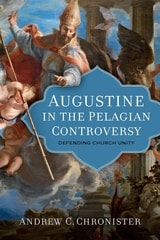
cover of Augustine in the Pelagian Controversy: Defending Church Unity

Augustine in the Pelagian Controversy

Defending Church Unity

Andrew Chronister

Catholic University of America Press, 2024
This book examines St. Augustine of Hippo’s involvement in the Pelagian controversy and argues that this involvement was prompted not simply by his opposition to Pelagian doctrinal views but, to a significant degree, by his desire to defend Church unity. To prove this thesis, Andrew Chronister analyzes the historical context of the controversy as well as Augustine’s argumentation in his anti-Pelagian works. Attending to the historical context reveals the fact that at various moments in the controversy, Augustine was faced with what he believed to be significant threats to Church unity. For example, the beginnings of the controversy coincided with a key attempt in June 411 to end the Donatist schism that had split the African Church for a century: at the very moment when one schism was being healed, another threat to unity appeared in Caelestius and Pelagius. At the same time, internal evidence in Augustine’s anti-Pelagian works reveals his desire not only to refute Pelagian doctrinal views but also to undermine the Pelagians’ claims that they were simply teaching what the Church had always and everywhere taught. This can be seen in a particular way in Augustine’s frequent appeals to liturgical and sacramental praxis as well as in his rather novel practice of citing renowned Christian authors as evidence for the antiquity and universality of his views. Augustine in the Pelagian Controversy has two main contributions: (1) it offers a new perspective on Augustine’s involvement in the controversy that makes his prolonged and polemical engagement with the Pelagians more intelligible and (2) it provides a detailed history of the controversy itself.
[more]
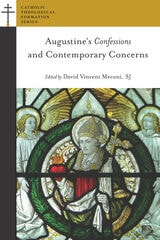
cover of Augustine's Confessions and Contemporary Concerns

Augustine's Confessions and Contemporary Concerns

David Vincent Meconi, SJ

Saint Paul Seminary Press, 2022
[more]
cover of Christian Metaphysics and Neoplatonism

Christian Metaphysics and Neoplatonism

Albert Camus, Translated & Intro by Ronald D. Srigley

University of Missouri Press, 2007

      Contemporary scholarship tends to view Albert Camus as a modern, but he himself was conscious of the past and called the transition from Hellenism to Christianity “the true and only turning point in history.” For Camus, modernity was not fully comprehensible without an examination of the aspirations that were first articulated in antiquity and that later received their clearest expression in Christianity. These aspirations amounted to a fundamental reorientation of human life in politics, religion, science, and philosophy.

Understanding the nature and achievement of that reorientation became the central task of Christian Metaphysics and Neoplatonism. Primarily known through its inclusion in a French omnibus edition, ithas remained one of Camus’ least-read works, yet it marks his first attempt to understand the relationship between Greek philosophy and Christianity as he charted the movement from the Gospels through Gnosticism and Plotinus to what he calls Augustine’s “second revelation” of the Christian faith.

            Ronald Srigley’s translation of this seminal document helps illuminate these aspects of Camus’ work. His freestanding English edition exposes readers to an important part of Camus’ thought that is often overlooked by those concerned primarily with the book’s literary value and supersedes the extant McBride translation by retaining a greater degree of literalness.

Srigley has fully annotated Christian Metaphysics to include nearly all of Camus’ original citations and has tracked down many poorly identified sources. When Camus cites an ancient primary source, whether in French translation or in the original language, Srigley substitutes a standard English translation in the interest of making his edition accessible to a wider range of readers. His introduction places the text in the context of Camus’ better-known later work, explicating its relationship to those mature writings and exploring how its themes were reworked in subsequent books.

Arguing that Camus was one of the great critics of modernity through his attempt to disentangle the Greeks from the Christians, Srigley clearly demonstrates the place of Christian Metaphysics in Camus’ oeuvre. As the only stand-alone English version of this important work—and a long-overdue critical edition—his fluent translation is an essential benchmark in our understanding of Camus and his place in modern thought. 
[more]
cover of Freedom and Necessity: St. Augustine's Teaching on Divine Power and Human Freedom

Freedom and Necessity

St. Augustine's Teaching on Divine Power and Human Freedom

Gerald Bonner

Catholic University of America Press, 2007
This book seeks to explain this paradox in Augustine's theology by tracing how these different emphases arose in his thought, and speculating as to why he endorsed, in the end, his theology of predestination. T
[more]
cover of God Owes Us Nothing: A Brief Remark on Pascal's Religion and on the Spirit of Jansenism

God Owes Us Nothing

A Brief Remark on Pascal's Religion and on the Spirit of Jansenism

Leszek Kolakowski

University of Chicago Press, 1995

God Owes Us Nothing reflects on the centuries-long debate in Christianity: how do we reconcile the existence of evil in the world with the goodness of an omnipotent God, and how does God's omnipotence relate to people's responsibility for their own salvation or damnation. Leszek Kolakowski approaches this paradox as both an exercise in theology and in revisionist Christian history based on philosophical analysis. Kolakowski's unorthodox interpretation of the history of modern Christianity provokes renewed discussion about the historical, intellectual, and cultural omnipotence of neo-Augustinianism.

"Several books a year wrestle with that hoary conundrum, but few so dazzlingly as the Polish philosopher's latest."—Carlin Romano, Washington Post Book World

"Kolakowski's fascinating book and its debatable thesis raise intriguing historical and theological questions well worth pursuing."—Stephen J. Duffy, Theological Studies

"Kolakowski's elegant meditation is a masterpiece of cultural and religious criticism."—Henry Carrigan, Cleveland Plain Dealer
[more]
cover of Grace for Grace

Grace for Grace

Alexander Y. Hwang

Catholic University of America Press, 2014
The contributors to Grace for Grace focus on the debates on grace and free will inspired by Augustine's later teachings on grace and the various reactions to it. In both popular and scholarly literature, the conflict has been traditionally referred to as the "Semi-Pelagian Controversy." For several decades, scholars have distanced themselves from that overly-simplistic and inaccurate portrayal. This book intends to solidify a disparate movement of scholarly thought and offer a secure basis for renewed study of the persons, texts, and events of this critical period in the reception of Augustine in the Early Middle Ages. This volume brings together new perspectives, based on fresh study of a wealth of primary sources, from an international team of scholars to explore the intra-church debates over grace and free will, after Augustine and Pelagius.
[more]
cover of Happiness and Wisdom: Augustine's Early Theology of Education

Happiness and Wisdom

Augustine's Early Theology of Education

Ryan N. S. Topping

Catholic University of America Press, 2012
Happiness and Wisdom contributes to ongoing debates about the nature of Augustine's early development, and argues that Augustine's vision of the soul's ascent through the liberal arts is an attractive and basically coherent view of learning, which, while not wholly novel, surpasses both classical and earlier patristic renderings of the aims of education.
[more]
cover of Heidegger's Confessions: The Remains of Saint Augustine in "Being and Time" and Beyond

Heidegger's Confessions

The Remains of Saint Augustine in "Being and Time" and Beyond

Ryan Coyne

University of Chicago Press, 2015

Although Martin Heidegger is nearly as notorious as Friedrich Nietzsche for embracing the death of God, the philosopher himself acknowledged that Christianity accompanied him at every stage of his career. In Heidegger's Confessions, Ryan Coyne isolates a crucially important player in this story: Saint Augustine. Uncovering the significance of Saint Augustine in Heidegger’s philosophy, he details the complex and conflicted ways in which Heidegger paradoxically sought to define himself against the Christian tradition while at the same time making use of its resources.
           
Coyne first examines the role of Augustine in Heidegger’s early period and the development of his magnum opus, Being and Time. He then goes on to show that Heidegger owed an abiding debt to Augustine even following his own rise as a secular philosopher, tracing his early encounters with theological texts through to his late thoughts and writings. Bringing a fresh and unexpected perspective to bear on Heidegger’s profoundly influential critique of modern metaphysics, Coyne traces a larger lineage between religious and theological discourse and continental philosophy.   
[more]
cover of In Search of Ancient North Africa: A History in Six Lives

In Search of Ancient North Africa

A History in Six Lives

Barnaby Rogerson

Haus Publishing, 2019

During years of travelling through North Africa, author Barnaby Rogerson has encountered a handful of stories so complicated that he could not place them into neat, tidy narratives. These are stories of characters who were neither distinctly good nor noticeably bad, neither malicious nor noble. In Search of Ancient North Africa is a journey into the ruins of a landscape to make sense of these stories through the multilayered lives of six individuals. Rogerson digs into the lives of Queen Dido, who was a sacrificial refugee; King Juba II, a prisoner of war who became a compliant tool of the Roman Empire; Septimius Severus, an unpromising provincial who, as its leader, brought his empire to its dazzling apogee; St. Augustine, an intellectual careerist who became a bishop and a saint; Hannibal, the greatest general the world has ever known; and Masinissa, the man who eventually defeated him. Together these six lives, clouded with as much myth as fact, are characters that represent classical North Africa. Among these life stories, we explore ruins and monuments tell of their lives and see the multiple connections that bind the culture of this region with the wider world, particularly the spiritual traditions of the ancient Near East.

In Search of Ancient North Africa sheds new light on a time and place at the crossroads of numerous histories and cultures. It offers the first history of ancient North Africa told through the lives of North Africans themselves.
[more]
cover of Letters, Volume 6 (1*–29*)

Letters, Volume 6 (1*–29*)

Saint Augustine

Catholic University of America Press, 1989
No description available
[more]
cover of Love and Saint Augustine

Love and Saint Augustine

Hannah Arendt

University of Chicago Press, 1995

Hannah Arendt's classic philosophical study, which Kirkus called “a revelation”
 
Hannah Arendt began her scholarly career with an exploration of Saint Augustine's concept of caritas, or neighborly love, written under the direction of Karl Jaspers and the influence of Martin Heidegger. After her German academic life came to a halt in 1933, Arendt carried her dissertation into exile in France, and years later took the same battered and stained copy to New York. During the late 1950s and early 1960s, as she was completing or reworking her most influential studies of political life, Arendt was simultaneously annotating and revising her dissertation on Augustine, amplifying its argument with terms and concepts she was using in her political works of the same period. The disseration became a bridge over which Arendt traveled back and forth between 1929 Heidelberg and 1960s New York, carrying with her Augustine's question about the possibility of social life in an age of rapid political and moral change.

In Love and Saint Augustine, Joanna Vecchiarelli Scott and Judith Chelius Stark make this important early work accessible for the first time. Here is a completely corrected and revised English translation that incorporates Arendt's own substantial revisions and provides additional notes based on letters, contracts, and other documents as well as the recollections of Arendt's friends and colleagues during her later years.
[more]
cover of Once Out of Nature: Augustine on Time and the Body

Once Out of Nature

Augustine on Time and the Body

Andrea Nightingale

University of Chicago Press, 2011
Once Out of Nature offers an original interpretation of Augustine’s theory of time and embodiment. Andrea Nightingale draws on philosophy, sociology, literary theory, and social history to analyze Augustine’s conception of temporality, eternity, and the human and transhuman condition.
 
In Nightingale’s view, the notion of embodiment illuminates a set of problems much larger than the body itself: it captures the human experience of being an embodied soul dwelling on earth. In Augustine’s writings, humans live both in and out of nature—exiled from Eden and punished by mortality, they are “resident aliens” on earth. While the human body is subject to earthly time, the human mind is governed by what Nightingale calls psychic time. For the human psyche always stretches away from the present moment—where the physical body persists—into memories and expectations. As Nightingale explains, while the body is present in the here and now, the psyche cannot experience self-presence. Thus, for Augustine, the human being dwells in two distinct time zones, in earthly time and in psychic time. The human self, then, is a moving target. Adam, Eve, and the resurrected saints, by contrast, live outside of time and nature: these transhumans dwell in an everlasting present.
 
Nightingale connects Augustine’s views to contemporary debates about transhumans and suggests that Augustine’s thought reflects our own ambivalent relationship with our bodies and the earth. Once Out of Nature offers a compelling invitation to ponder the boundaries of the human.
[more]
cover of Patience and Salvation in Third Century North Africa: A Christian Latin Reader

Patience and Salvation in Third Century North Africa

A Christian Latin Reader

Sarah Wear

Catholic University of America Press, 2022
Patience and Salvation in Third Century North Africa: A Christian Latin Reader features the entirety of Tertullian’s To Martyrs and The Passion of Perpetua and Felicity, with selections from Cyprian’s On the Good of Patience and a short appendix on Augustine’s Commentary on Psalm 121.6. The Latin text has facing vocabulary and theological, historical, philosophical, and grammatical notes. In the first three centuries, Roman Carthage produced some of the earliest literature composed originally in Latin by Christians. Tertullian’s Ad Martyras (197); Passio Perpetuae et Felicitatis (203), and Cyprian’s De Bono Patientiae (256) all embody the force of this new genre of Latin literature. With this literature, we see a variant of Latin often denoted “Christian Latin.” Christian Latin featured linguistic elements marked by characteristics of biblical Latin, later Latin, as well as vulgarisms. In addition to converging philologically, Tertullian, the author of the Passio, and Cyprian align themselves in topos: they all ask the question of how one can endure torment and anxiety in this world. Patience (patientia), derived from the verb for “to suffer” (patior), is a virtue that allows one to endure troubles, anxieties, and physical pains with the hope of eternal happiness and salvation in heaven. In this Reader, the student will find three different literary perspectives on this theme. The book also draws parallels to the works of Seneca and Cicero on patience and suffering.
[more]
cover of Politics and the Order of Love: An Augustinian Ethic of Democratic Citizenship

Politics and the Order of Love

An Augustinian Ethic of Democratic Citizenship

Eric Gregory

University of Chicago Press, 2008

Augustine—for all of his influence on Western culture and politics—was hardly a liberal. Drawing from theology, feminist theory, and political philosophy, Eric Gregory offers here a liberal ethics of citizenship, one less susceptible to anti-liberal critics because it is informed by the Augustinian tradition. The result is a book that expands Augustinian imaginations for liberalism and liberal imaginations for Augustinianism. 
Gregory examines a broad range of Augustine’s texts and their reception in different disciplines and identifies two classical themes which have analogues in secular political theory: love—and related notions of care, solidarity, and sympathy—and sin—as well as related notions of cruelty, evil, and narrow self-interest. From an Augustinian point of view, Gregory argues, love and sin constrain each other in ways that yield a distinctive vision of the limits and possibilities of politics.
In providing a constructive argument for Christian participation in liberal democratic societies, Gregory advances efforts to revive a political theology in which love’s relation to justice is prominent.  Politics and the Order of Love will provoke new conversations for those interested in Christian ethics, moral psychology, and the role of religion in a liberal society.
[more]
cover of Prodigal Son/Elder Brother: Interpretation and Alterity in Augustine, Petrarch, Kafka, Levinas

Prodigal Son/Elder Brother

Interpretation and Alterity in Augustine, Petrarch, Kafka, Levinas

Jill Robbins

University of Chicago Press, 1991

"I don't know of any other book that deals with the hermeneutical problem of the relationship between Christianity and Judaism in the way this one does. Full of cunning and unpredictable turns, Prodigal Son/Elder Brother addresses the question of the elder brother's fate by opposing two sets of readings, Christian and Jewish, ancient and modern, figural and midrashic. No one, after reading this book, will any longer connect Judaism and Christianity with a hyphen."—Gerald L. Burns, University of Notre Dame

"Through a creative reading of the prodigal son parable, Jill Robbins demonstrates the hermeneutical impasse of the Christian exegete who must and yet cannot incorporate the Old Testament. Having disclosed the aporia at the heart of Christian hermeneutics, she proposes an alternative approach to the Hebrew Bible and new interpretations of Augustine, Petrarch, Kafka, and Levinas. Robbins brilliantly integrates the discourses of biblical texts, literary works, and critical analysis."—Mark C. Taylor, Williams College
[more]
cover of Putting on Christ: Augustine's Early Theology of Salvation and the Sacraments

Putting on Christ

Augustine's Early Theology of Salvation and the Sacraments

Ty Paul Monroe

Catholic University of America Press, 2022
Putting on Christ aims to situate Augustine’s early soteriology and sacramental theology within the context of his personal history and intellectual development. Beginning with an extended analysis of the theology of salvation and sacramental efficacy contained within Augustine’s Confessions (ca. 400), the study then traces the maturation of his views on these matters, beginning with his earliest extant works, the Cassicacum dialogues (ca. 386). The journey entails treating Augustine’s earliest discussions of Christ’s person and his saving work, as well as the believer’s subjective experience of conversion and salvation. As Augustine’s corpus shifts from philosophical dialogues to explicitly apologetic and scriptural-exegetical works, so too does his soteriological lexicon expand to include concepts and terms that will later become his stock-in-trade, such as the virtue of humilitas. And as his roles in the North African Church come to include participation in the presbyterate and the episcopacy, so too does his engagement expand to a wider set of polemical contexts, both anti-Manichaean and anti-Donatist. Putting on Christ tracks these and many other aspects of Augustine’s maturing thought, showing where lines of both continuity and development lie and aiming to uncover their reasons. In doing so, it reveals Augustine to be a thinker and a teacher who continued to hone his understanding of salvation, the very heartbeat of Christian life and thought, as well as its relation to various other aspects of the Christian theological worldview, from Christology and anthropology to sacramental theology and ecclesiology.
[more]
cover of Rereading the Renaissance: Petrarch, Augustine, and the Language of Humanism

Rereading the Renaissance

Petrarch, Augustine, and the Language of Humanism

Carol Everhart Quillen

University of Michigan Press, 1998

Although Francesco Petrarca's position as the "father" of Italian Renaissance humanism has long been acknowledged, the specific meanings of his works and his legacy remain matters of controversy. Basic questions about the tension between his devotion to secular pursuits and his respect for religious withdrawal, about the authenticity of his ostensibly autobiographical writings, and about his relationship to scholasticism still provoke sustained debate. Rereading the Renaissance, a study of Petrarch's uses of Augustine, uses methods drawn from history and literary criticism to establish a framework for exploring Petrarch's humanism by approaching it through it central practices of reading and writing.
Carol Quillen argues that the essential role of Augustine's words and authority in the expression of Petrarch's humanism is best grasped through a study of the complex textual practices exemplified in the writings of both men. Petrarch's reliance on Augustine is most evident in his ways of reading and in his strategies of argument. Secondly, she maintains that Petrarch's appropriation of Augustine's words is only intelligible in light of his struggle to legitimate his cultural ideals in the face of compelling opposition. Finally, Quillen shows how Petrarch's uses of Augustine can simultaneously uphold his humanist ideals and challenge the legitimacy of the assumptions on which those ideals were founded.
Interdisciplinary in scope and method, this volume speaks to important debates that span the humanities. Scholars of literary and historical studies, as well as those in the fields of classical studies, patristics, and comparative literature, will find in Rereading the Renaissance a solid contribution to their interests.
Carol Everhart Quillen is Associate Professor of History, Rice University.
[more]
cover of Saint Augustine and the Fall of the Soul: Beyond O'Connell & His Critics

Saint Augustine and the Fall of the Soul

Beyond O'Connell & His Critics

Ronnie J. Rombs 

Catholic University of America Press, 2006
Saint Augustine and the Fall of the Soul: Beyond O'Connell and His Critics provides first a critical examination of O'Connell's theses in a readable summary of his work that spanned over thirty years.
[more]
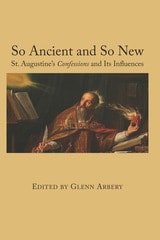
cover of So Ancient and So New: St. Augustine's Confessions and Its Influence

So Ancient and So New

St. Augustine's Confessions and Its Influence

Glenn Arbery

St. Augustine's Press, 2016

The study of any masterpiece can change one’s life, but the Confessions of St. Augustine, like Plato’s Republic or Dante’s Commedia, has the almost uncanny power to enact in the reader what it describes. Plato’s book reconfigures the city of the soul by freeing it from enslavement to the tyrannical passions and making it answerable to reason in its pursuit of the good. For Augustine, who shares many of the same ends, the pursuit of the good is not the rectification of philosophical reason, but (as it was for Dante) an intensely personal and consuming love: the encounter with the living God. Oddly, it may seem, that encounter comes for Augustine through the act of reading. Unlike Plato, who depicts the process of reasoning toward the truth, Augustine finds the truth revealed in another, immeasurably greater book that cannot be read in its true sense without the help of its author.

The essays uncover a variety of themes, from Augustine’s act of reading (Marc LePain and Bercier), his emphasis on memory (Roger Corriveau), and his choice to reveal to the world his “hidden and unworldly activity” (Daniel Maher), to the way Augustine’s own education might serve as a corrective to contemporary understandings of “assessment” (Gavin Colvert). The vast wake of Augustine’s work includes writers from Dante and Montaigne to Nabokov, but three representative figures were chosen to show his influence: Jean-Jacques Rousseau in the Confessions (Rick Sorenson), James Joyce in the whole range of his work (Eloise Knowlton), and T.S. Eliot in the Four Quartets (Glenn Arbery). The most direct engagement with Augustine is obviously Rousseau’s. In his essay comparing and contrasting the pivotal moments of the two Confessions, Rick Sorenson explores major differences between the way of faith and the path of reliance on reason. Joyce might be said to have taken Rousseau’s path (at least in rejecting revelation), whereas Eliot took Augustine’s.

In its sophistications and anxieties, the late antiquity Augustine inhabited feels a great deal like the late modernity we inhabit now. Certainly, the barbarians of materialist thought long ago sacked the civilization our ancestors inhabited. When Eliot published The Waste Land in 1922, he already saw the old order of antiquity and Christendom as “stony rubble,” “a heap of broken images.” As one of his speakers puts it, “Dry bones can harm no one.” This old book, the Confessions, might seem to our contemporaries as dry and dead as those bones, but it is not so.

Without being a defense of Christianity (as the City of God is) or a work of catechesis, the Confessions might be the greatest counter to the materialist creed in Western literature. It recounts Augustine’s central, intensely personal, and ultimately liberating struggle to conceive of spiritual substance, an intellectual achievement without which he cannot even hope to accommodate his understanding to the reality of God. This book of essays has one primary end, which is to entice the reader to reopen Augustine’s book, to look over his shoulder and see what the act of reading means to him and what it has accomplished: the world-changing encounter with the substance of the Word.
[more]
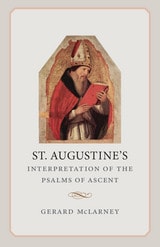
cover of St. Augustine's Interpretaion of the Psalms of Ascent

St. Augustine's Interpretaion of the Psalms of Ascent

Gerard McLarney

Catholic University of America Press, 2014
Recent research has explored how past interpretation can help contextualize current interpretation as well as provide a more colorful and theologically meaningful understanding of scripture. In St. Augustine's Interpretation of the Psalms of Ascent, Gerald McLarney examines Augustine of Hippo's (d. 430) interpretation of the ascent motif in sermons on Psalms 119-133. He looks at the delivery, transmission, and broader context of the sermons, as well as examining the sermons as they stand.
[more]
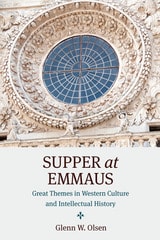
cover of Supper at Emmaus

Supper at Emmaus

Glenn W. Olsen

Catholic University of America Press, 2016
Supper at Emmaus traces various important intellectual topics from the ancient world to the modern period. Generally, as in its treatment of the question of whether the long-standing contrast between cyclical and linear views of history is helpful, it introduces important thinkers who have considered the question. A preoccupation of the book is the appearance and reappearance across the centuries of patterns used to organize temporal and cultural experience. After an opening essay on transcendental truth and cultural relativism, the second chapter traces a distinction, common in historical writings during the past two centuries, between an alleged ancient classical "cyclic" view of time and history, used to describe the claimed repetitiveness of and similarities between historical events ("nothing is new under the sun"), and a contrasting Jewish-Christian linear view, sometimes described as providential in that it moves through a series of unique events to some end intended by God. In the latter, history is "about something," the education of the human race or the redemption of humankind. As in each of the remaining essays, the book then attempts to draw out the limitations of what the current consensus on this topic has become. It does this for such things as our current understanding of religious toleration, humanism, natural law, and teleology. Some of the essays, such as those on debate about Augustine's understanding of marriage or the concluding illustrated essay on the baroque city of Lecce, are published for the first time. Others are based on previously published contributions to the scholarly literature, though generally each of these chapters concludes with a postscript that engages with current scholarly debate on the subject.
[more]
cover of The Augustinian Person

The Augustinian Person

Peter Burnell

Catholic University of America Press, 2005
Through careful analysis of Augustine's writings, Burnell concludes that Augustine conceives of human nature as a unity at every level--socially, morally, and in basic constitution--despite very common objections that he fails to achieve such a conception
[more]
cover of The Metamorphoses of the City of God

The Metamorphoses of the City of God

Etienne Gilson

Catholic University of America Press, 2021
Étienne Gilson (1884-1978) was a French philosopher and historian of philosophy, as well as a scholar of medieval philosophy. In 1946 he attained the distinction of being elected an "Immortal" (member) of the Académie française. He was nominated for the Nobel Prize in Literature in 1959 and 1964. The appearance of Gilson's Metamorphosis of the City of God, which were originally delivered as lectures at the University of Louvain, Belgium, in the Spring of 1952, coincided with the first steps toward what would become the European Union. The appearance of this English translation coincides with the upheaval of Brexit. Gilson traces the various attempts of thinkers through the centuries to describe Europe's soul and delimit its parts. The Scots, Catalonians, Flemings, and probably others may nod in agreement in Gilson's observation on how odd would be a Europe composed of the political entities that existed two and a half centuries ago. Those who think the European Union has lost its soul may not be comforted by the difficulty thinkers have had over the centuries in defining that soul. Indeed the difficulties that have thus far prevented integrating Turkey into the EU confirm Gilson's description of the conundrum involved even in distinguishing Europe's material components. And yet, the endeavor has succeeded, so that the problem of shared ideals remain inescapable. One wonders which of the thinkers in the succession studied by Gilson might grasp assent and illuminate the EU's path.
[more]
cover of The Modern Age

The Modern Age

James V. Schall

St. Augustine's Press, 2011
[more]
cover of The One Christ

The One Christ

David Vincent Meconi

Catholic University of America Press, 2013
By treating Augustine's passages on deification both chronologically and constructively, Meconi situates Augustine in a long chorus of Christian pastors and theologians who understand the essence of Christianity as the human person's total and transformative union with God.
[more]
cover of The Predestination of Humans: Augustinus, <i>Tome III, Book IX</i>

The Predestination of Humans

Augustinus, <i>Tome III, Book IX</i>

Cornelius Jansen

Catholic University of America Press, 2022
No other theological text polarized the early modern Catholic world as much as Cornelius Jansen's Augustinus. In it the erudite bishop not only reconstructed St. Augustine's teaching on grace and free will, but also boldly claimed that his views were in line with the Council of Trent and the Society of Jesus. For Jansen the latter had marginalized the Church Father's doctrine on divine predestination by overemphasizing human free will. Published after his death in 1640, Jansen's work drew a large crowd of followers and inspired an Augustinian reform movement. Its papal condemnation unintentionally spread this theology, but stifled an impassionate, academic engagement with the Augustinus. This first-ever translation of some of its central chapters enables historians, philosophers and theologians to finally engage with the founding text of Jansenism.
[more]
cover of The Quotable Augustine

The Quotable Augustine

Phillip H. Melton

Catholic University of America Press, 2016
This book is ideal for those who wish to read some of the wisest and most wonderful sayings of Augustine. It will help all those who wish to pepper a speech, or a sermon, or an essay with the wisdom of Saint Augustine. The book is a valuable resource, too, for anyone who wants to find out "Did Augustine really say that?" and, if he did, in which of his voluminous writings it appeared. Drawn from the internationally acclaimed and successful series, the 'Fathers of the Church,' The Quotable Augustine presents a wide-ranging sample of the writings of a towering figure of the early church.
[more]
cover of The Retractions

The Retractions

Saint Augustine

Catholic University of America Press, 1999
No description available
[more]
cover of The Revelation of Imagination: From Homer and the Bible through Virgil and Augustine to Dante

The Revelation of Imagination

From Homer and the Bible through Virgil and Augustine to Dante

William Franke

Northwestern University Press, 2015

In The Revelation of Imagination, William Franke attempts to focus on what is enduring and perennial rather than on what is accommodated to the agenda of the moment. Franke’s book offers re-actualized readings of representative texts from the Bible, Homer, and Virgil to Augustine and Dante. The selections are linked together in such a way as to propose a general interpretation of knowledge. They emphasize, moreover, a way of articulating the connection of humanities knowledge with what may, in various senses, be called divine revelation. This includes the sort of inspiration to which poets since Homer have typically laid claim, as well as that proper to the biblical tradition of revealed religion. The Revelation of Imagination invigorates the ongoing discussion about the value of humanities as a source of enduring knowledge.
[more]
cover of The Unity of the Nations

The Unity of the Nations

Joseph Ratzinger

Catholic University of America Press, 2015
What did ancient Christians and pagans believe makes the unity of the nations? Just as he began serving as a major adviser at the Second Vatican Council in 1962, Joseph Ratzinger (the future Pope Benedict XVI) studied this question in lectures delivered at Austria's University of Salzburg. These lectures, originally published in German, are now made available in English in this volume.
[more]
cover of The Way of Humility: St. Augustine's Theology of Preaching

The Way of Humility

St. Augustine's Theology of Preaching

Charles J. Kim

Catholic University of America Press, 2023
For Augustine, that the Word became flesh transformed a merely human understanding of the virtues and grounds all virtue in humility. The Way of Humility: Augustine’s Theology of Preaching explores how this truth became a new paradigm for understanding the scriptures and thus, how Augustine embodied the virtue in the preaching of the scriptures. One of Augustine’s most devoted students, Possidius, said that anyone can learn from reading Augustine, but “those were able to profit still more who could hear him speak in church and see him with their own eyes. Truly, he was indeed one of those of whom it is written, ‘speak this way and act the same way.’” The Way of Humility searches for evidence of the virtue of humility in action through the preaching of the humble Word in the sermons of Augustine. Many know of Augustine through his more famous treatises but few have encountered the Doctor of Grace where he had his most immediate impact, preaching. The Way of Humility follows the sermons through several traditional theological loci, ecclesiology, Christology, soteriology to uncover what can be learned about Augustine’s theology through the way he preached to a mixed audience of urbanites and rustics, many of whom did not have the benefit of a formal education. Throughout the book, we see the interplay between Augustine’s action in speech and Augustine’s more direct statements on his theology of Preaching. Through handing over Christ in his sermons, he became himself an example of humility for the congregation on their journey toward the final end for all people, the Beatific Vision.
[more]
cover of Thomistic Considerations: Themes in Aquinas, Aristotle, Augustine, Dante and Eliot

Thomistic Considerations

Themes in Aquinas, Aristotle, Augustine, Dante and Eliot

Kevin White

Catholic University of America Press, 2026
This collection of essays considers a variety of themes in philosophy, theology, and poetry, three ways of thinking that share a certain openness and comprehensiveness. The essays show how philosophy, theology, and poetry are ways of thinking in the medium of words—in large part in the medium of written words—against the background of all things and from the point of view of all of human life. As the essays make clear, philosophy, theology, and poetry are special ways of thinking and speaking, but they are the contrary of specializations. Many of the themes are perennial preoccupations in philosophy: being, time, number, friendship, pleasure, purpose, choice, reason, and order. Others are particular concerns of theology and poetry, such as the divine presence and absence in the world, and poetic form. The volume is divided into two parts: a first part consisting of eight essays on themes in Aquinas’s work, and a second part consisting of five essays on other authors whose thought, in one way or another, has an affinity with the thought of Aquinas: Aristotle, Augustine, Anselm, Dante, T. S. Eliot, and Robert Sokolowski. The volume’s title pays homage to Aquinas’s use of the Latin word consideratio, a favorite term of the scholastics that could refer to any careful attending to what one knows. The essays illustrate ways in which considerations undertaken in philosophy, theology, and poetry provide points of survey from which to take in, to the extent we can, the great panorama of the whole of things.
[more]
cover of To Know God and the Soul: Essays on the Thought of Saint Augustine

To Know God and the Soul

Essays on the Thought of Saint Augustine

Roland J. Teske

Catholic University of America Press, 2008
To Know God and the Soul presents a collection of essays on Augustine of Hippo written over the past twenty-five years by renowned philosopher Roland Teske.
[more]
cover of Understanding the Medieval Meditative Ascent: Augustine, Anselm, Boethius and Dante

Understanding the Medieval Meditative Ascent

Augustine, Anselm, Boethius and Dante

Robert McMahon

Catholic University of America Press, 2006

Understanding the Medieval Meditative Ascent uses literary analysis to discover new philosophical meanings in these works. Clearly written in nontechnical language, its account of their literary structures and of the hidden meanings they generate will inform nonspecialist and specialist alike.
[more]
cover of With the World at Heart: Studies in the Secular Today

With the World at Heart

Studies in the Secular Today

Thomas A. Carlson

University of Chicago Press, 2019

What is the role of love in opening and sustaining the temporal worlds we inhabit? One of the leading scholars in philosophy and the history of religious thought, Thomas A. Carlson here traces this question through Christian theology, twentieth-century phenomenological and deconstructive philosophy, and nineteenth-century individualism. Revising Augustine’s insight that when we love a place, we dwell there in the heart, Carlson also pointedly resists lines of thought that seek to transcend loss and its grief by loving all things within the realm of the eternal. Through masterful readings of Heidegger, Derrida, Marion, Nancy, Emerson, and Nietzsche, Carlson shows that the fragility and sorrow of mortal existence in its transience do not, in fact, contradict love, but instead empower love to create a world.
 
[more]