Results by title
21 books match the query 'Bernstein, Charles'

99 Poets/1999
An International Poetics Symposium, Volume 26Charles Bernstein
Duke University Press, 0
Each poet was asked to ponder a series of questions: Is identity an important issue for your work, and, if so, in what sense? What do you see as the most urgent, yet insufficiently addressed or considered, issue or issues for poetry and poetics at this moment? Do you see your work in the context of a national state, or in the context of international capital, or in some other context?
After years of exchange between the artists—through translations, readings, and visits—the result is a collection of unique and significant literary works, one that is richly suggestive for the future not only of poetry but of literary and cultural studies as well.
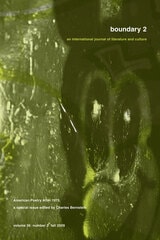
American Poetry after 1975, Volume 36
Charles Bernstein, ed.
Duke University Press, 0
Writing from the forefront of American poetry criticism, contributors to this special issue address topics such as the poetics of disability and the work of clairvoyant poet Hannah Weiner, ambience and the work of Tan Lin, the continuing influence of Wallace Stevens, and the use of found text in Susan Howe’s “The Midnight.” Two younger critics address their generation’s poetics, one by considering the social relevance of the lyric and the other by examining resistance to innovative poetry practice. The intersection of poetry and technology is explored in articles about digital spaces and radical poetry’s relationship with the digital archive. One contributor applies the work of philosopher J. L. Austin to the language of hip-hop and the work of rapper Rakim. Also included are four short poems, a panegyric for the poetics of sophism in critical discourse, and essays that address the aesthetics of sentimental poetry and the poetics of place.
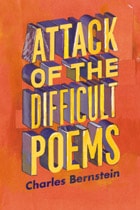
Attack of the Difficult Poems
Essays and InventionsCharles Bernstein
University of Chicago Press, 2011
Charles Bernstein is our postmodern jester of American poesy, equal part surveyor of democratic vistas and scholar of avant-garde sensibilities. In a career spanning thirty-five years and forty books, he has challenged and provoked us with writing that is decidedly unafraid of the tensions between ordinary and poetic language, and between everyday life and its adversaries. Attack of the Difficult Poems, his latest collection of essays, gathers some of his most memorably irreverent work while addressing seriously and comprehensively the state of contemporary humanities, the teaching of unconventional forms, fresh approaches to translation, the history of language media, and the connections between poetry and visual art.
Applying an array of essayistic styles, Attack of the Difficult Poems ardently engages with the promise of its title. Bernstein introduces his key theme of the difficulty of poems and defends, often in comedic ways, not just difficult poetry but poetry itself. Bernstein never loses his ingenious ability to argue or his consummate attention to detail. Along the way, he offers a wide-ranging critique of literature’s place in the academy, taking on the vexed role of innovation and approaching it from the perspective of both teacher and practitioner.
From blues artists to Tin Pan Alley song lyricists to Second Wave modernist poets, The Attack of the Difficult Poems sounds both a battle cry and a lament for the task of the language maker and the fate of invention.
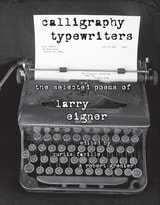
Calligraphy Typewriters
The Selected Poems of Larry EignerLarry Eigner, Edited and introduced by Curtis Faville and Robert Grenier, Foreword by Charles Bernstein
University of Alabama Press, 2016
The first and only single-volume collection of Larry Eigner’s most significant poems, gathering in one place the most celebrated of the several thousand poems that constitute his remarkable life’s work
Larry Eigner began writing poetry at age eight and was first published at age nine. Revered by poets and artists across a broad spectrum of generations and schools, Eigner’s remarkably moving poetry was created through enormous effort: because of severe physical disabilities, he produced his texts by typing with only one index finger and thumb on a 1940 Royal manual typewriter, creating a body of work that is unparalleled in its originality.
Calligraphy Typewriters showcases the most celebrated of Eigner's several thousand poems, which are an important part of the Black Mountain/Projectivist movement that began in the 1950s and which remain a primary inspiration for many younger writers, including those in the Language movement that began in the 1970s. In its two sections—Swampscott and Berkeley, named for the two locales where Eigner lived and worked—the volume traces his fantastic perception of the ordinary and his zeal for language. Eigner’s use of visual space, metaphor, and description provide fascinating insights into both his own life and the world that surrounded him. This volume maintains the distinctive visual spacing of his original typescripts, reminders of his method, aesthetic sensibility, and creative ability to compose on the typewriter.
A collection that reimagines the ordinary, Calligraphy Typewriters is the definitive selection of Eigner’s poems, and will serve well not only poets and students of poetry, but readers and writers of every vein.
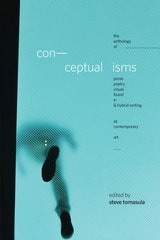
Conceptualisms
The Anthology of Prose, Poetry, Visual, Found, E- & Hybrid Writing as Contemporary ArtEdited by Steve Tomasula
University of Alabama Press, 2022
A wide-ranging anthology of experimental writing—prose, poetry, and hybrid—from its most significant practitioners and innovators
A variety of names have been used to describe fiction, poetry, and hybrid writing that explore new forms and challenges mainstream traditions. Those phrases include experimental, conceptual, avant-garde, hybrid, surfiction, fusion, radical, slip-stream, avant-pop, postmodern, self-conscious, innovative, L=A=N=G=U=A=G=E writing, alternative, and anti- or new literature. Conceptualisms: The Anthology of Prose, Poetry, Visual, Found, E- & Hybrid Writing as Contemporary Art is the first major anthology of writing that offers readers an overview of this other tradition as it lives in the early decades of the 21st century.
Featuring over 100 pieces from more than 90 authors, this anthology offers a plethora of aesthetics and approaches to a wide variety subjects. Editor Steve Tomasula has gathered poems, prose, and hybrid pieces that all challenge our understanding of what literature means. Intended as a collection of the most exciting and bold literary work being made today, Tomasula has put a spotlight on the many possibilities available to writers and readers wishing for a glimpse of literature’s future.
Readers will recognize authors who have shaped contemporary writing, as among them Lydia Davis, Charles Bernstein, Jonathan Safran Foer, Shelley Jackson, Nathaniel Mackey, David Foster Wallace, and Claudia Rankine. Even seasoned readers will find authors, and responses to the canon, not yet encountered. Conceptualisms is a book of ideas for writers, teachers and scholars, as well as readers who wonder how many ways literature can live.
The text features headnotes to chapters on themes such as sound writing, electronic literature, found text, and other forms, offering accessible introductions for readers new to this work. An online companion presents statements about the work and biographies of the authors in addition to audio, video, and electronic writing that can’t be presented in print. Visit www.conceptualisms.info to read more.

Dodging
Charles Bernstein
University of Chicago Press, 0
A new, expansive collection by one of the most provocative and inventive poets of our time.
In Dodging, Charles Bernstein pushes his poetics toward new kinds of formal and tonal attentions. This multifaceted work brings together comic velocity, pointed political critique, and passages of lyric intensity. Bernstein calls these poems “too late”: written late in life as irreversibility presses against reflection, regret, and renewed resistance—a situation in which dodging is not evasion but survival, a way of moving through political catastrophe and personal loss without being silenced by either.
The collection unfolds in three interrelated “fits”—a term suggesting bursts of composition, rhythmic surges, and formal groupings—titled “Dodging,” “Struggle,” and “Reflection.” These sections move from a series of flashes and fragments, then to assembled riffs and collaborations with poet Tracie Morris, and finally turn to refractions and aphorisms that embrace active contradiction. Together they trace a shifting field of contrasts: between satire and elegy, volatility and concentration, comedy and grief.
Both fundamentally true to Bernstein’s voice and radically radiant in its range, Dodging is a work that moves restlessly across forms and tones—by turns sly, searching, and unguarded, where humor and grief occupy the same ground.
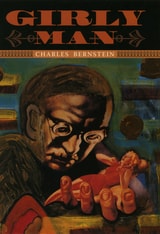
Girly Man
Charles Bernstein
University of Chicago Press, 2006
After 9/11, postmodernism and irony were declared dead. Charles Bernstein here proves them alive and well in poems elegiac, defiant, and resilient to the point of approaching song. Heir to the democratic and poetic sensibilities of Walt Whitman and Allen Ginsberg, Bernstein has always crafted verse that responds to its historical moment, but no previous collection of his poems so specifically addresses the events of its time as Girly Man, whichfeatures works written on the evening of September 11, 2001, and in response to the war in Iraq. Here, Bernstein speaks out, combining self-deprecating humor with incisive philosophical and political thinking.
Composed of works of very different forms and moods—etchings from moments of acute crisis, comic excursions, formal excavations, confrontations with the cultural illogics of contemporary political consciousness—the poems work as an ensemble, each part contributing something necessary to an unrealizable and unrepresentable whole. Indeed, representation—and related claims to truth and moral certainty—is an active concern throughout the book. The poems of Girly Man may be oblique, satiric, or elusive, but their sense is emphatic. Indeed, Bernstein’s poetry performsits ideas so that they can be experienced as well as understood.
A passionate defense of contingency, resistance, and multiplicity, Girly Man is a provocative and aesthetically challenging collection of radical verse from one of America’s most controversial poets.
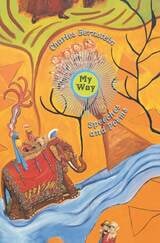
My Way
Speeches and PoemsCharles Bernstein
University of Chicago Press, 1998
In My Way, (in)famous language poet and critic Charles Bernstein deploys a wide variety of interlinked forms—speeches and poems, interviews and essays—to explore the place of poetry in American culture and in the university. Sometimes comic, sometimes dark, Bernstein's writing is irreverent but always relevant, "not structurally challenged, but structurally challenging."
Addressing many interrelated issues, Bernstein moves from the role of the public intellectual to the poetics of scholarly prose, from vernacular modernism to idiosyncratic postmodernism, from identity politics to the resurgence of the aesthetic, from cultural studies to poetry as a performance art, from the small press movement to the Web. Along the way he provides "close listening" to such poets as Charles Reznikoff, Laura Riding, Susan Howe, Ezra Pound, Allen Ginsberg, and Gertrude Stein, as well as a fresh perspective on L=A=N=G=U=A=G=E, the magazine he coedited that became a fulcrum for a new wave of North American writing.
In his passionate defense of an activist, innovative poetry, Bernstein never departs from the culturally engaged, linguistically complex, yet often very funny writing that has characterized his unique approach to poetry for over twenty years. Offering some of his most daring work yet—essays in poetic lines, prose with poetic motifs, interviews miming speech, speeches veering into song—Charles Bernstein's My Way illuminates the newest developments in contemporary poetry with its own contributions to them.
"The result of [Bernstein's] provocative groping is more stimulating than many books of either poetry or criticism have been in recent years."—Molly McQuade, Washington Post Book World
"This book, for all of its centrifugal activity, is a singular yet globally relevant perspective on the literary arts and their institutions, offered in good faith, yet cranky and poignant enough to not be easily ignored."—Publishers Weekly
"Bernstein has emerged as postmodern poetry's sous-chef of insouciance. My Way is another of his rich concoctions, fortified with intellect and seasoned with laughter."—Timothy Gray, American Literature
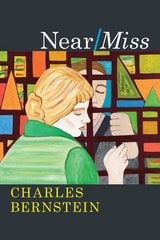
Near/Miss
Charles Bernstein
University of Chicago Press, 2018
This collection’s title highlights poetry’s ability to graze reality without killing it, and at the same time implies that the poems themselves are wounded by the grief of loss. The book opens with a rollicking satire of difficult poetry—proudly declaring itself “a totally inaccessible poem”—and moves on to the stuff of contrarian pop culture and political cynicism—full of malaprops, mondegreens, nonsequiturs, translations of translations, sardonically vandalized signs, and a hilarious yet sinister feed of blog comments. At the same time, political protest also rubs up against epic collage, through poems exploring the unexpected intimacies and continuities of “our united fates.” These poems engage with works by contemporary painters—including Amy Sillman, Rackstraw Downes, and Etel Adnan—and echo translations of poets ranging from Catullus and Virgil to Goethe, Cruz e Souza, and Kandinsky.
Grounded in a politics of multiplicity and dissent, and replete with both sharp edges and subtle intimacies, Near/Miss is full of close encounters of every kind.
Near/Miss
Charles Bernstein
University of Chicago Press, 2018
This collection’s title highlights poetry’s ability to graze reality without killing it, and at the same time implies that the poems themselves are wounded by the grief of loss. The book opens with a rollicking satire of difficult poetry—proudly declaring itself “a totally inaccessible poem”—and moves on to the stuff of contrarian pop culture and political cynicism—full of malaprops, mondegreens, nonsequiturs, translations of translations, sardonically vandalized signs, and a hilarious yet sinister feed of blog comments. At the same time, political protest also rubs up against epic collage, through poems exploring the unexpected intimacies and continuities of “our united fates.” These poems engage with works by contemporary painters—including Amy Sillman, Rackstraw Downes, and Etel Adnan—and echo translations of poets ranging from Catullus and Virgil to Goethe, Cruz e Souza, and Kandinsky.
Grounded in a politics of multiplicity and dissent, and replete with both sharp edges and subtle intimacies, Near/Miss is full of close encounters of every kind.
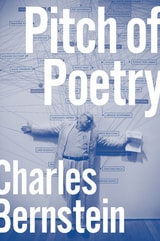
Pitch of Poetry
Charles Bernstein
University of Chicago Press, 2016
Subjects range across Holocaust representation, Occupy Wall Street, and the figurative nature of abstract art. Detailed overviews of formally inventive work include essays on—or “pitches” for—a set of key poets, from Gertrude Stein and Robert Creeley to John Ashbery, Barbara Guest, Larry Eigner, and Leslie Scalapino. Bernstein also reveals the formative ideas behind the magazine L=A=N=G=U=A=G=E. The final section, published here for the first time, is a sweeping work on the poetics of stigma, perversity, and disability that is rooted in the thinking of Edgar Allan Poe, Emily Dickinson, Ralph Waldo Emerson, and William Blake.
Pitch of Poetry makes an exhilarating case for what Bernstein calls echopoetics: a poetry of call and response, reason and imagination, disfiguration and refiguration.
Radical Poetics and Secular Jewish Culture
Edited by Stephen Paul Miller and Daniel Morris
University of Alabama Press, 2009
--Franz Kafka
Kafka's quip--paradoxical, self-questioning, ironic--highlights vividly some of the key issues of identity and self-representation for Jewish writers in the 20th century. No group of writers better represents the problems of Jewish identity than Jewish poets writing in the American modernist tradition--specifically secular Jews: those disdainful or suspicious of organized religion, yet forever shaped by those traditions.
This collection of essays is the first to address this often obscured dimension of modern and contemporary poetry: the secular Jewish dimension. Editors Daniel Morris and Stephen Paul Miller asked their contributors to address what constitutes radical poetry written by Jews defined as "secular," and whether or not there is a Jewish component or dimension to radical and modernist poetic practice in general. These poets and critics address these questions by exploring the legacy of those poets who preceded and influenced them--Stein, Zukofsky, Reznikoff, Oppen, and Ginsberg, among others.
While there is no easy answer for these writers about what it means to be a Jew, in their responses there is a rich sense of how being Jewish reflects on their aesthetics and practices as poets, and how the tradition of the avant-garde informs their identities as Jews. Fragmented identities, irony, skepticism, a sense of self as "other" or "outsider," distrust of the literal, and belief in a tradition that questions rather than answers--these are some of the qualities these poets see as common to themselves, the poetry they make, and the tradition they work within.
Reading the Difficulties
Dialogues with Contemporary American Innovative PoetryThomas Fink
University of Alabama Press, 2013
New Strategies for Reading the Most Innovative Poetry of Our Time.
Definitions of what constitutes innovative poetry are innumerable and are offered from every quarter. Some critics and poets argue that innovative poetry concerns free association (John Ashbery), others that experimental poetry is a “re-staging” of language (Bruce Andrews) or a syntactic and cognitive break with the past (Ron Silliman and Lyn Hejinian). The tenets of new poetry abound.
But what of the new reading that such poetry demands? Essays in Reading the Difficulties ask what kinds of stances allow readers to interact with verse that deliberately removes many of the comfortable cues to comprehension—poetry that is frequently nonnarrative, nonrepresentational, and indeterminate in subject, theme, or message.
Some essays in Thomas Fink and Judith Halden-Sullivan’s collection address issues of reader reception and the way specific stances toward reading support or complement the aesthetic of each poet. Others suggest how we can be open readers, how innovative poetic texts change the very nature of reader and reading, and how critical language can capture this metamorphosis. Some contributors consider how the reader changes innovative poetry, what language reveals about this interaction, which new reading strategies unfold for the audiences of innovative verse, and what questions readers should ask of innovative verse and of events and experiences that we might bring to reading it.
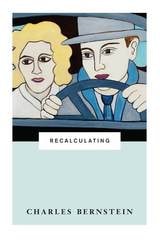
Recalculating
Charles Bernstein
University of Chicago Press, 2013
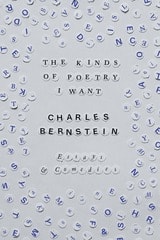
The Kinds of Poetry I Want
Essays & ComediesCharles Bernstein
University of Chicago Press, 2024
For more than four decades, Charles Bernstein has been at the forefront of experimental poetry, ever reaching for a radical poetics that defies schools, periods, and cultural institutions. The Kinds of Poetry I Want is a celebration of invention and includes not only poetry but also essays on aesthetics and literary studies, interviews with other poets, autobiographical sketches, and more.
At once a dialogic novel, long poem, and grand opera, The Kinds of Poetry I Want arrives amid renewed attacks on humanistic expression. In his polemical, humorous style, Bernstein faces these challenges head-on and affirms the enduring vitality and attraction of poetry, poetics, and literary criticism.
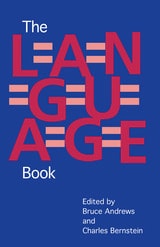
The Language Book
Bruce Andrews and Charles Bernstein
Southern Illinois University Press, 1984
“Ok murky in alter all end, unpredictable day, with rainshine any degree night, the sun kin warm and hot. Enough stone or other jugs lineup of whatever is In Through Out That’s light as much as known Differences evanesce Like, where and/or what on the equator might be french or spanish Longitude and latitude, yep yep sure Americana.”—Larry Eigner, commentary on a selection from Gertrude Stein’s Tender Buttons
This selection of essays and poetry from the first three volumes of L=A=N=G=U=A=G=E magazine discusses a “spectrum of writing that places its attention primarily on language and ways of making meaning, that takes for granted neither vocabulary, grammar, process, shape, syntax, program, nor subject matter.” (Bernstein and Andrews) The various writers shun labels, slogans, or catch-phrases; their exploration of the ways that meanings and values are revealed through the written word is intended to open the field of poetic activity, not close it.
The common thread of these essays is the multitude and scope of words’ referential powers—denotative, connotative, and associational; and studying these powers is ultimately a social and political activity as well as an aesthetic one.
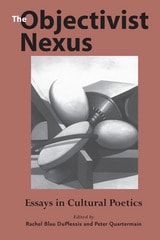
The Objectivist Nexus
Essays in Cultural PoeticsPeter Quartermain
University of Alabama Press, 1999
Outstanding poets and critics present cultural readings of the Objectivist poets, a group whose works have been largely unexamined.
"Objectivist" writers, conjoined through a variety of personal, ideological, and literary-historical links, have, from the late 1920s to the present, attracted emulation and suspicion. Representing a nonsymbolist, postimagist poetics and characterized by a historical, realist, antimythological worldview, Objectivists have retained their outsider status. Despite such status, however, the formal, intellectual, ideological, and ethical concerns of the Objectivist nexus have increasingly influenced poetry and poetics in the United States.
Thus, argue editors Rachel Blau DuPlessis and Peter Quartermain, the time has come for an anthology that unites essential works on Objectivist practices and presents Objectivist writing as an enlargement of the possibilities of poetry rather than as a determinable and definable literary movement. The authors' collective aim is to bring attention to this group of poets and to exemplify and specify cultural readings for poetic texts--readings alert to the material world, politics, society, and history, and readings concerned with the production, dissemination, and reception of poetic texts.
The contributors consider Basil Bunting, Lorine Niedecker, George Oppen, Carl Rakosi, Charles Reznikoff, and Louis Zukofsky within both their historical milieu and our own. The essays insist on poetry as a mode of thought; analyze and evaluate Objectivist politics; focus on the ethical, spiritual, and religious issues raised by certain Objectivist affiliations with Judaism; and explore the dissemination of poetic texts and the vagaries of Objectivist reception. Running throughout the book are two related threads: Objectivist writing as generally a practice aware of its own historical and social contingency and Objectivist writing as a site of complexity, contestation, interrogation, and disagreement.
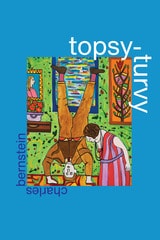
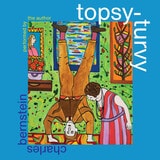
Topsy-Turvy
Charles Bernstein
University of Chicago Press, 2021
Though Bernstein’s poems play with form, they incorporate a melancholy, even tragic, sensibility. This “cognitive dissidence,” as Bernstein calls it, is reflected in a lyrically explosive mix of pathos, comedy, and wit, though the reader is kept guessing which is which at almost every turn. Topsy-Turvy includes an ode to the New York City subway and a memorial for Harpers Ferry hero Shields Green, along with collaborations with artists Amy Sillman and Richard Tuttle. This collection is also full of other voices: Pessoa, Geeshie Wiley, Friedrich Rückert, and Rimbaud; Carlos Drummond, Virgil, and Brian Ferneyhough; and even Caudio Amberian, an imaginary first-century aphorist.
Bernstein didn’t set out to write a book about the pandemic, but these poems, performances, and translations are oddly prescient, marking a path through dark times with a politically engaged form of aesthetic resistance: We must “Continue / on, as / before, as / after.”
The audio version of Topsy-Turvy is performed by the author.
Topsy-Turvy
Charles Bernstein
University of Chicago Press, 2021
Though Bernstein’s poems play with form, they incorporate a melancholy, even tragic, sensibility. This “cognitive dissidence,” as Bernstein calls it, is reflected in a lyrically explosive mix of pathos, comedy, and wit, though the reader is kept guessing which is which at almost every turn. Topsy-Turvy includes an ode to the New York City subway and a memorial for Harpers Ferry hero Shields Green, along with collaborations with artists Amy Sillman and Richard Tuttle. This collection is also full of other voices: Pessoa, Geeshie Wiley, Friedrich Rückert, and Rimbaud; Carlos Drummond, Virgil, and Brian Ferneyhough; and even Caudio Amberian, an imaginary first-century aphorist.
Bernstein didn’t set out to write a book about the pandemic, but these poems, performances, and translations are oddly prescient, marking a path through dark times with a politically engaged form of aesthetic resistance: We must “Continue / on, as / before, as / after.”
The audio version of Topsy-Turvy is performed by the author.

Transpoetic Exchange
Haroldo de Campos, Octavio Paz, and Other Multiversal DialoguesMarília Librandi
Bucknell University Press, 2020
The volume is divided into three parts. “Essays” unites seven texts by renowned scholars who focus on the relationship between the two authors, their impact and influence, and their cultural resonance by exploring explore the historical background and the different stylistic and cultural influences on the authors, ranging from Latin America and Europe to India and the U.S. The second section, “Remembrances,” collects four experiences of interaction with Haroldo de Campos in the process of transcreating Paz’s poem and working on Transblanco and Galáxias. In the last section, “Poems,” five poets of international standing--Jerome Rothenberg, Antonio Cicero, Keijiro Suga, André Vallias, and Charles Bernstein.
Paz and Campos, one from Mexico and the other from Brazil, were central figures in the literary history of the second half of the 20th century, in Latin America and beyond. Both poets signal the direction of poetry as that of translation, understood as the embodiment of otherness and of a poetic tradition that every new poem brings back as a Babel re-enacted.
This volume is a print corollary to and expansion of an international colloquium and poetic performance held at Stanford University in January 2010 and it offers a discussion of the role of poetry and translation from a global perspective. The collection holds great value for those interested in all aspects of literary translation and it enriches the ongoing debates on language, modernity, translation and the nature of the poetic object.
Published by Bucknell University Press. Distributed worldwide by Rutgers University Press.
With Strings
Charles Bernstein
University of Chicago Press, 2001
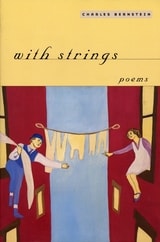
Charles Bernstein is perhaps best known as one of the founders of the L=A=N=G=U=A=G=E poetry movement of the 1970s. He remains one of America's liveliest advocates and practitioners of radically inventive poetry. The title of his new collection, With Strings, suggests the lush arrangement of a musical work as well as the unacknowledged implications of our everyday agreements. Just as language binds us together with its associated meanings, With Strings bounces against the ties that rend us apart as they fasten us together. From his samplings of everyday life, to his demented yet sonorous iambic beats, Bernstein has once again created a poetry of our time, for our time, and by our time.