Results by title
16 books match the query 'Business and politics'
American Business and Political Power
Public Opinion, Elections, and DemocracyMark A. Smith
University of Chicago Press, 2000
Rather than succumbing to corporate America, Smith argues, representatives paradoxically become more responsive to their constituents when facing a united corporate front. Corporations gain the most influence over legislation when they work with organizations such as think tanks to shape Americans' beliefs about what government should and should not do.
Chinese Business in the Making of a Malay State, 1882-1941
Kedah and PenangWu Xiao An
National University of Singapore Press, 2010
Using Penang and Kedah as a case study, Wu draws on archival sources, family histories and an examination of legal arrangements and the press to show that personal business and business networks were not bound by the territorial borders of traditional or modern states, but extended across much of Southeast Asia and into China. His demonstration of the complexity of interactions involving new migrants, sojourners and settlers, both Chinese and non-Chinese, challenges understandings of state formation and economic growth in colonial Malaya based on ethnic stereotypes and accounts of events limited by fixed political boundaries.
Chocolate on Trial
Slavery, Politics, and the Ethics of BusinessLowell J. Satre
Ohio University Press, 2005
Chocolate on Trial: Cadbury, Slavery and the Economics of Virtue in Imperial Britain gives a lively and highly readable account of the events surrounding the libel trial in which Cadbury Bros. Ltd. sued the London Standard, following the newspaper's accusation that the firm was hypocritical in its use of slave-grown cocoa. As compelling now as at the turn of the previous century, the issues probed by Lowell J. Satre give invaluable historical background to contemporary issues of business ethics, corporate social responsibility, and globalization. The story Satre tells illuminates what a stubbornly persistent institution slavery was and shows how Cadbury, a company with a well-regarded brand name and logo, endured ethical dilemmas and challenges to its record for social responsibility. Chocolate on Trial brings to life the age-old conflict between economic interests and the value of human life.
Satre illuminates the stubborn persistence of the institution of slavery and shows how Cadbury, a company with a well-regarded brand name from the nineteenth century, faced ethical dilemmas and challenges to its record for social responsibility. Chocolate on Trial brings to life the age-old conflict between economic interests and regard for the dignity of human life.
Conspicuous Corporation
Business, Public Policy, and Representative DemocracyNeil J. Mitchell
University of Michigan Press, 1997
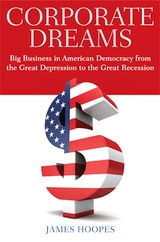
Corporate Dreams
Big Business in American Democracy from the Great Depression to the Great RecessionHoopes, James
Rutgers University Press, 2011
Public trust in corporations plummeted in the wake of the 2008 financial crisis, when “Lehman Brothers” and “General Motors” became dirty words for many Americans. In Corporate Dreams, James Hoopes argues that Americans still place too much faith in corporations and, especially, in the idea of “values-based leadership” favored by most CEOs. The danger of corporations, he suggests, lies not just in their economic power, but also in how their confused and undemocratic values are infecting Americans’ visions of good governance.
Corporate Dreams proposes that Americans need to radically rethink their relationships with big business and the government. Rather than buying into the corporate notion of “values-based leadership,” we should view corporate leaders with the same healthy suspicion that our democratic political tradition teaches us to view our political leaders. Unfortunately, the trend is moving the other way. Corporate notions of leadership are invading our democratic political culture when it should be the reverse.
To diagnose the cause and find a cure for our toxic attachment to corporate models of leadership, Hoopes goes back to the root of the problem, offering a comprehensive history of corporate culture inAmerica, from the Great Depression to today’s Great Recession. Combining a historian’s careful eye with an insider’s perspective on the business world, this provocative volume tracks changes in government economic policy, changes in public attitudes toward big business, and changes in how corporate executives view themselves.
Whether examining the rise of Leadership Development programs or recounting JFK’s Pyrrhic victory over U.S. Steel, Hoopes tells a compelling story of how America lost its way, ceding authority to the policies and values of corporate culture. But he also shows us how it’s not too late to return to our democratic ideals—and that it’s not too late to restore the American dream.
Dallas
The Making of a Modern CityBy Patricia Evridge Hill
University of Texas Press, 1996
From the ruthless deals of the Ewing clan on TV's "Dallas" to the impeccable customer service of Neiman-Marcus, doing business has long been the hallmark of Dallas. Beginning in the 1920s and 1930s, Dallas business leaders amassed unprecedented political power and civic influence, which remained largely unchallenged until the 1970s.
In this innovative history, Patricia Evridge Hill explores the building of Dallas in the years before business interests rose to such prominence (1880 to 1940) and discovers that many groups contributed to the development of the modern city. In particular, she looks at the activities of organized labor, women's groups, racial minorities, Populist and socialist radicals, and progressive reformers—all of whom competed and compromised with local business leaders in the decades before the Great Depression.
This research challenges the popular view that business interests have always run Dallas and offers a historically accurate picture of the city's development. The legacy of pluralism that Hill uncovers shows that Dallas can accommodate dissent and conflict as it moves toward a more inclusive public life. Dallas will be fascinating and important reading for all Texans, as well as for all students of urban development.
Does Business Learn?
Tax Breaks, Uncertainty, and Political StrategiesSandra L. Suarez
University of Michigan Press, 2000
Dollars And Votes
Dan Clawson
Temple University Press, 1998
What donors, especially business donors, expect for their money is "access" and access means a lot more than a chance to meet and talk. They count on secret behind-the-scenes deals, like a tax provision that applies only to a "corporation incorporated on June 13, 1917, which has its principal place of business in Bartlesville, Oklahoma." After a deal is worked out behind closed doors, one executive explains, "it doesn't much matter how people vote afterwards."
Ordinary contributions give access to Congress; megabuck "soft money" contributions ensure access to the President and top leaders. The striking truth revealed by these authors is that half the soft money comes from fewer than five hundred big donors, and that most contributions come, directly or indirectly, from business. Reform is possible, they argue, by turning away from the temptation of looking at specific scandals and developing a new system that removes the influence of big money campaign contributors.
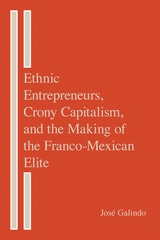
Ethnic Entrepreneurs, Crony Capitalism, and the Making of the Franco-Mexican Elite
José Galindo
University of Alabama Press, 2021
A groundbreaking historical narrative of corruption and economic success in Mexico.
Ethnic Entrepreneurs, Crony Capitalism, and the Making of the Franco-Mexican Elite provides a new way to understand the scope and impact of crony capitalism on institutional development in Mexico. Beginning with the Porfiriato, the period between 1876 and 1911 named for the rule of President Porfirio Díaz, José Galindo identifies how certain behavioral patterns of the Mexican political and economic elite have repeated over the years, and analyzes aspects of the political economy that have persisted, shaping and at times curtailing Mexico’s economic development.
Strong links between entrepreneurs and politicians have allowed elite businessmen to receive privileged support, such as cheap credit, tax breaks, and tariff protection, from different governments and to run their companies as monopolies. In turn, successive governments have obtained support from businesses to implement public policies, and, on occasion, public officials have received monetary restitution. Galindo notes that Mexico’s early twentieth-century institutional framework was weak and unequal to the task of reining in these systematic abuses. The cost to society was high and resulted in a lack of fair market competition, unequal income distribution, and stunted social mobility.
The most important investors in the banking, commerce, and manufacturing sectors at the beginning of the twentieth century in Mexico were of French origin, and Galindo explains the formation of the Franco-Mexican elite. This Franco-Mexican narrative unfolds largely through the story of one of the richest families in Mexico, the Jeans, and their cotton textile empire. This family has maintained power and wealth through the current day as Emilio Azcárraga Jean, a great-grandson of one of the members of the first generation of the Jean family to arrive in Mexico, owns Televisa, a major mass media company with one of the largest audiences for Spanish-language content in the world.
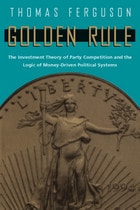
Golden Rule
The Investment Theory of Party Competition and the Logic of Money-Driven Political SystemsThomas Ferguson
University of Chicago Press, 1995
Thomas Ferguson breaks completely with traditional voter centered accounts of party politics. In its place he outlines an "investment approach," in which powerful investors, not unorganized voters, dominate campaigns and elections. Because businesses "invest" in political parties and their candidates, changes in industrial structures—between large firms and sectors—can alter the agenda of party politics and the shape of public policy.
Golden Rule presents revised versions of widely read essays in which Ferguson advanced and tested his theory, including his seminal study of the role played by capital intensive multinationals and international financiers in the New Deal. The chapter "Studies in Money Driven Politics" brings this aspect of American politics into better focus, along with other studies of Federal Reserve policy making and campaign finance in the 1936 election. Ferguson analyzes how a changing world economy and other social developments broke up the New Deal system in our own time, through careful studies of the 1988 and 1992 elections. The essay on 1992 contains an extended analysis of the emergence of the Clinton coalition and Ross Perot's dramatic independent insurgency. A postscript on the 1994 elections demonstrates the controlling impact of money on several key campaigns.
This controversial work by a theorist of money and politics in the U.S. relates to issues in campaign finance reform, PACs, policymaking, public financing, and how today's elections work.
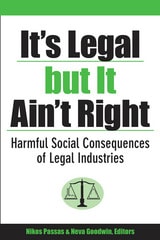
It's Legal but It Ain't Right
Harmful Social Consequences of Legal IndustriesNikos Passas and Neva Goodwin
University of Michigan Press, 2005
--William S. Laufer, Professor, The Wharton School of Business
"This delightful and serious book involves a matter I have long felt of first importance. That is our tendency to make social truth and acceptance conform to personal or larger corporate interests. On this I have written , but gladly yield to this persuasive parallel. No one concerned with literate, informed, and relevant---as distinct from self-serving---truth should miss It's Legal but It Ain't Right."
--John Kenneth Galbraith
"This absorbing and well-written book of essays on the harmful consequences of legal industries skillfully illuminates the ways in which some corporate harms fail to be transformed into criminal law-making and enforcement, and offers cogent suggestions for better regulation in the public interest."
--Dr. Michael Levi, Professor of Criminology, Cardiff University
Many U.S. corporations and the goods they produce negatively impact our society without breaking any laws. We are all too familiar with the tobacco industry's effect on public health and health care costs for smokers and nonsmokers, as well as the role of profit in the pharmaceutical industry's research priorities. It's Legal but It Ain't Right tackles these issues, plus the ethical ambiguities of legalized gambling, the firearms trade, the fast food industry, the pesticide industry, private security companies, and more. Aiming to identify industries and goods that undermine our societal values and to hold them accountable for their actions, this collection makes a valuable contribution to the ongoing discussion of ethics in our time.
This accessible exploration of corporate legitimacy and crime will be important reading for advocates, journalists, students, and anyone interested in the dichotomy between law and legitimacy.
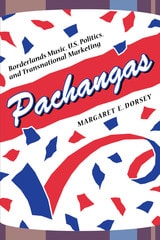
Pachangas
Borderlands Music, U.S. Politics, and Transnational MarketingBy Margaret E. Dorsey
University of Texas Press, 2006
A uniquely Tejano version of the old-fashioned political barbeque, the traditional South Texas pachanga allowed politicians to connect with voters in a relaxed setting where all could enjoy live music and abundant food and drink along with political speeches and dealmaking. Today's pachanga still combines politics, music, and votes—along with a powerful new element. Corporate sponsorships have transformed the pachanga into a major marketing event, replete with celebrity performers and product giveaways, which can be recorded and broadcast on TV or radio to vastly increase the reach of the political—and the commercial—messages.
This book explores the growing convergence of politics, transnational marketing, and borderlands music in the South Texas pachanga. Anthropologist Margaret Dorsey has observed some one hundred pachangas and interviewed promoters, politicians, artists, and local people. She investigates how candidates and corporations market their products to Hispanic consumers, as well as how the use of traditional music for marketing is altering traditional forms such as the corrido. Her multifaceted study also shows clearly that the lines of influence run both ways—while corporate culture is transforming the traditions of the border, Tejano voters/consumers only respond to marketing appeals (whether for politicians or products) that resonate with their values and the realities of their lives. Far from being an example of how transnational marketing homogenizes culture, the pachanga demonstrates that local cultures can exert an equally strong influence on multinational corporations.

Taking the Risk Out of Democracy
Corporate Propaganda versus Freedom and LibertyAlex Carey
University of Illinois Press, 1995
The Political Influence of Business in the European Union
Andreas Dür, David Marshall, and Patrick Bernhagen
University of Michigan Press, 2019

Thinker, Faker, Spinner, Spy
Corporate PR and the Assault on DemocracyEdited by David Miller and William Dinan
Pluto Press, 2007
Written by leading activists and writers, this book reveals the secrets of the PR trade including deception, the use of fake 'institutes', spying and dirty tricks. The impact can be devastating -- when the public is denied access to the truth, the results are rising inequality and environmental catastrophe.
Exposing the misdeeds of famous companies including Coca Cola, British Aerospace, Exxon and Monsanto, and revealing information about the covert funding of various apparently independent thinks tanks and institutes, the authors offer a guide to campaigns that can help us roll back corporate power and resist deceptive PR.
Unequal Partnerships
The Political Economy of Urban Redevelopment in Postwar AmericaEdited by Gregory Squires
Rutgers University Press, 1989