Results by title
401 books match the query 'Civil War, 1861-1865' and 45 start with a
A Blockaded Family
Life in Southern Alabama During the Civil WarParthenia Hague
University of Alabama Press, 2005
Parthenia Hague experienced the Civil War while employed as a schoolteacher on a plantation near Eufaula, Alabama. This book recounts how a frightened and war-weary household dealt with privations during the blockade imposed on the South by the federal navy. The memoir of Parthenia Hague is a detailed look at the ingenious industry and self-sufficiency employed by anxious citizens as the northern army closed in.
A Confederate Chronicle
The Life of a Civil War SurvivorPamela Chase Hain
University of Missouri Press, 2005
A Damned Iowa Greyhound
The Civil War Letters of William Henry Harrison ClaytonDonald C. Elder, III
University of Iowa Press, 1998
William Henry Harrison Clayton was one of nearly 75,000 soldiers from Iowa to join the Union ranks during the Civil War. Possessing a high school education and superior penmanship, Clayton served as a company clerk in the 19th Infantry, witnessing battles in the Trans-Mississippi theater. His diary and his correspondence with his family in Van Buren County form a unique narrative of the day-to-day soldier life as well as an eyewitness account of critical battles and a prisoner-of-war camp.
Clayton participated in the siege of Vicksburg and took part in operations against Mobile, but his writings are unique for the descriptions he gives of lesser-known but pivotal battles of the Civil War in the West. Fighting in the Battle of Prairie Grove, the 19th Infantry sustained the highest casualties of any federal regiment on the field. Clayton survived that battle with only minor injuries, but he was later captured at the Battle of Stirling's Plantation and served a period of ten months in captivity at Camp Ford, Texas.
Clayton's writing reveals the complicated sympathies and prejudices prevalent among Union soldiers and civilians of that period in the country's history. He observes with great sadness the brutal effects of war on the South, sympathizing with the plight of refugees and lamenting the destruction of property. He excoriates draft evaders and Copperheads back home, conveying the intra-sectional acrimony wrought by civil war. Finally, his racist views toward blacks demonstrate a common but ironic attitude among Union soldiers whose efforts helped lead to the abolition of slavery in the United States.
A Forgotten Front
Florida during the Civil War EraEdited by Seth A. Weitz and Jonathan C. Sheppard
University of Alabama Press, 2018
In many respects Florida remains the forgotten state of the Confederacy. Journalist Horace Greeley once referred to Florida in the Civil War as the “smallest tadpole in the dirty pool of secession.” Although it was the third state to secede, Florida’s small population and meager industrial resources made the state of little strategic importance. Because it was the site of only one major battle, it has, with a few exceptions, been overlooked within the field of Civil War studies.
During the Civil War, more than fifteen thousand Floridians served the Confederacy, a third of which were lost to combat and disease. The Union also drew the service of another twelve hundred white Floridians and more than a thousand free blacks and escaped slaves. Florida had more than eight thousand miles of coastline to defend, and eventually found itself with Confederates holding the interior and Federals occupying the coasts—a tenuous state of affairs for all. Florida’s substantial Hispanic and Catholic populations shaped wartime history in ways unique from many other states. Florida also served as a valuable supplier of cattle, salt, cotton, and other items to the blockaded South.
A Forgotten Front: Florida during the Civil War Era provides a much-needed overview of the Civil War in Florida. Editors Seth A. Weitz and Jonathan C. Sheppard provide insight into a commonly neglected area of Civil War historiography. The essays in this volume examine the most significant military engagements and the guerrilla warfare necessitated by the occupied coastline. Contributors look at the politics of war, beginning with the decade prior to the outbreak of the war through secession and wartime leadership and examine the period through the lenses of race, slavery, women, religion, ethnicity, and historical memory.
A Hard Fight for We
Women's Transition from Slavery to Freedom in South CarolinaLeslie A. Schwalm
University of Illinois Press, 1997
African-American women fought for their freedom with courage and vigor during and after the Civil War. Leslie Schwalm explores the vital roles of enslaved and formerly enslaved women on the rice plantations of lowcountry South Carolina, both in antebellum plantation life and in the wartime collapse of slavery. From there, she chronicles their efforts as freedwomen to recover from the impact of the war while redefining their lives and labor.
Freedwomen asserted their own ideas of what freedom meant and insisted on important changes in the work they performed both for white employers and in their own homes. As Schwalm shows, these women rejected the most unpleasant or demeaning tasks, guarded the prerogatives they gained under the South's slave economy, and defended their hard-won freedoms against unwanted intervention by Northern whites and the efforts of former owners to restore slavery's social and economic relations during Reconstruction. A bold challenge to entrenched notions, A Hard Fight for We places African American women at the center of the South's transition from a slave society.
A History of Southern Missouri and Northern Arkansas
Being an Account of the Early Settlements, the Civil War, the Ku-Klux, and Times of PeaceWilliam Monks
University of Arkansas Press, 2006
Originally published in 1907 and now reprinted for the first time, this is the only account published by a Union guerrilla in the border region of the central Ozarks, where political and civil violence lasted from the Civil War well into the 1880s.
There were probably many people who wanted to shoot Billy Monks. He was a Union patriot and skilled guerrilla fighter to some, but others called him a bushwhacker, a murderer, and a thief. His was a very personal combat: he commanded, rallied, arrested, killed, quarreled with, and sued people he knew. His life provides a striking example of the cliché that the war did not end in 1865, but continued fiercely on several fronts for another decade as partisan factions settled old scores and battled for local political control.
This memoir was Monks’s last salvo at his old foes, by turns self-defense and an uncompromising affirmation of the Radical Union cause in the Ozarks. The editors include a new biographical sketch of the author, fill in gaps in his narrative, identify all the people and places to which he refers, and offer a detailed index. Monks himself illustrated the volume with staged photographs of key events re-created by aged comrades who appear to have been just barely able to hoist the muskets they hold as props.
A History of the Ninth Regiment
Illinois Volunteer Infantry, with the Regimental RosterMarion Morrison. Foreword by John Y. Simon
Southern Illinois University Press, 1997
When the Civil War erupted in April 1861, many German immigrants in Illinois rushed to enlist in the Union Army. Volunteers from Illinois towns in St. Clair County—Belleville, Millstadt, Mascoutah, Lebanon, and others—marched to Springfield under the command of August Mersy, a veteran of the failed 1848 revolt in Baden, Germany.
Marion Morrison notes that when the German immigrants reached Springfield, August Mersy was rejected as commander because of his limited facility with English. Replaced by Colonel Eleazer A. Paine, an Ohioan and West Point graduate, Lieutenant Colonel Mersy fell to second in command of the Ninth Illinois Infantry Volunteers. Within a few months, however, Paine received a promotion to general that left Mersy in charge of the "Bloody Ninth."
Once Grant began his Tennessee River campaign, the Ninth found itself in the thick of battle, bearing the brunt of the Confederate attempt at Fort Donelson to break Grant’s siege lines. Less than two months later, the Ninth shored up sagging Union lines after the surprise Confederate attack at Shiloh Church, retreating only when their ammunition was gone.
Morrison’s account of the "Bloody Ninth" is one of the few histories written during the war.
A Just and Righteous Cause
Benjamin H. Grierson’s Civil War MemoirEdited by Bruce J. Dinges and Shirley A. Leckie
Southern Illinois University Press, 2008
General Benjamin H. Grierson is most widely known as the brilliant cavalryman whose actions in the Civil War's Mississippi Valley campaign facilitated Ulysses S. Grant's capture of Vicksburg. There is, however, much more to this key Union officer than a successful raid into Confederate-held Mississippi. In A Just and Righteous Cause: Benjamin H. Grierson's Civil War Memoir, edited by Bruce J. Dinges and Shirley A. Leckie, Grierson tells his story in forceful, direct, and highly engaging prose.
A Just and Righteous Cause paints a vivid picture of Grierson's prewar and Civil War career, touching on his antislavery views, Republican Party principles, and military strategy and tactics. His story begins with his parents' immigration to the United States and follows his childhood, youth, and career as a musician; the early years of his arriage; his business failures prior to becoming a cavalry officer in an Illinois regiment; his experiences in battle; and his Reconstruction appointment. Grierson also provides intimate accounts of his relationships with such prominent politicians and Union leaders as Abraham Lincoln, Richard Yates, Andrew Johnson, William T. Sherman, Ulysses S.
Grant, John C. Frémont, and Benjamin Prentiss.
Because Grierson wrote the memoir mainly with his family as the intended audience, he manages to avoid the self-promotion that plagues many of his contemporaries' chronicles. His reliance on military records and correspondence, along with family letters, lends an immediacy rarely found in military memoirs. His reminiscences also add fuel to a reemerging debate on soldiers' motivations for enlisting—in Grierson's case, patriotism and ideology—and shed new light on the Western theater of the Civil War, which has seen a recent surge in interest among Civil War enthusiasts.
A non-West Point officer, Grierson owed his developing career to his independent studies of the military and his connections to political figures in his home state of Illinois and later to important Union leaders. Dinges and Leckie provide a helpful introduction, which gives background on the memoir and places Grierson's career into historical context. Aided by fourteen photos and two maps, as well as the editors' superb annotations, A Just and Righteous Cause is a valuable addition to Civil War history.
A Leaf of Voices
Stories of the American Civil War in the Words of Those Who Lived and Died, 1861-65Jennifer McSpadden
Indiana Historical Society Press, 2014
A Perfect Picture Of Hell
Eyewitness Accounts By Civil War Prisoners From 12Th IoTed Genoways
University of Iowa Press, 2000
From the shooting of an unarmed prisoner at Montgomery, Alabama, to a successful escape from Belle Isle, from the swelling floodwaters overtaking Cahaba Prison to the inferno that finally engulfed Andersonville, A Perfect Picture of Hell is a collection of harrowing narratives by soldiers from the 12th Iowa Infantry who survived imprisonment in the South during the Civil War.
Editors Ted Genoways and Hugh Genoways have collected the soldiers' startling accounts from diaries, letters, speeches, newspaper articles, and remembrances. Arranged chronologically, the eyewitness descriptions of the battles of Shiloh, Corinth, Jackson, and Tupelo, together with accompanying accounts of nearly every famous Confederate prison, create a shared vision
A Place Called Appomattox
William Marvel
Southern Illinois University Press, 2007
In A Place Called Appomattox, William Marvel turns his extensive Civil War scholarship toward Appomattox County, Virginia, and the village of Appomattox Court House, which became synonymous with the end of the Civil War when Robert E. Lee surrendered to Ulysses S. Grant there in 1865. Marvel presents a formidably researched and elegantly written analysis of the county from 1848 to 1877, using it as a microcosm of Southern attitudes, class issues, and shifting cultural mores that shaped the Civil War and its denouement.
With an eye toward correcting cultural myths and enriching the historical record, Marvel analyzes the rise and fall of the village and county from 1848 to 1877, detailing the domestic economic and social vicissitudes of the village, and setting the stage for the flight of Lee’s Army toward Appomattox and the climactic surrender that still resonates today.
Now available for the first time in paperback, A Place Called Appomattox reveals a new view of the Civil War, tackling some of the thorniest issues often overlooked by the nostalgic exaggerations and historical misconceptions that surround Lee’s surrender.
A Prussian Observes the American Civil War
The Military Studies of Justus ScheibertEdited & Translated by Frederic Trautmann
University of Missouri Press, 2001
Prussia, like much of nineteenth-century Germany, was governed by the belief that knowledge, and thus understanding, was best derived from direct observation and communicated through documentation. Justus Scheibert, an officer in the Royal Prussian Engineers, was therefore sent to the United States for seven months to observe the Civil War and report the effects of artillery on fortifications. His interests, however, surpassed that limited assignment, and his observations, as well as the writings translated in this work, went on to include tactics, strategy, logistics, intelligence, combined operations, and the medical service.
Scheibert, an expert on warfare, had access to the Confederate high command, including such luminaries as Robert E. Lee, J. E. B. Stuart, and Stonewall Jackson. He brought to the war not only the fresh perspective of a foreigner, but also the insightful eye of a career military officer and a skillful author and correspondent. Although he was personally sympathetic to the South, Scheibert researched both sides of the conflict in order to write unbiased, informed commentary for his fellow Prussian officers. His firsthand account of many aspects of the Civil War included a theoretical discussion of every branch of service and the Confederate high command, illustrated with his personal observations.
Sheibert's narrative portrays soldiers, weaponry, and battles, including the first, and one of the few, studies of combined operations in the Civil War. Trautmann combines two of Scheibert's publications, The Civil War in the North American States: A Military Study for the German Officer (1874) and Combined Operations by Army and Navy: A Study Illustrated by the War on the Mississippi, 1861-1863 (ca. 1887), which for decades influenced German military writing. Trautmann's translations evince the grace and achieve the readability of Scheibert's intricate and complex works.
A Prussian Observes the American Civil War makes an important addition to Civil War studies and will appeal greatly to professional historians and those interested in, and dedicated to, Civil War and military studies.
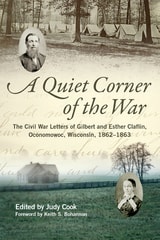
A Quiet Corner of the War
The Civil War Letters of Gilbert and Esther Claflin, Oconomowoc, Wisconsin, 1862–1863Gilbert Claflin and Esther Claflin; Edited by Judy Cook; Foreword by Keith S. Bohannon
University of Wisconsin Press, 2013
In 2002, Judy Cook discovered a packet of letters written by her great-great-grandparents, Gilbert and Esther Claflin, during the American Civil War. An unexpected bounty, these letters from 1862–63 offer visceral witness to the war, recounting the trials of a family separated. Gilbert, an articulate and cheerful forty-year-old farmer, was drafted into the Union Army and served in the Thirty-Fourth Wisconsin Infantry garrisoned in western Kentucky along the Mississippi. Esther had married Gilbert when she was fifteen; now a woman with two teenage sons, she ran the family farm near Oconomowoc, Wisconsin, in Gilbert’s absence.
In his letters, Gilbert writes about food, hygiene, rampant desertions by drafted men, rebel guerrilla raids, and pastimes in the daily life of a soldier. His comments on interactions with Confederate prisoners and ex-slaves before and after the Emancipation Proclamation reveal his personal views on monumental events. Esther shares in her letters the challenges and joys of maintaining the farm, accounts of their boys Elton and Price, concerns about finances and health, and news of their local community and extended family. Esther’s experiences provide insight into family, farm, and village life in the wartime North, an often overlooked aspect of Civil War history.
Judy Cook has made the letters accessible to a wider audience by providing historical context with notes and appendixes. The volume includes a foreword by Civil War historian Keith S. Bohannon.
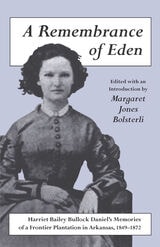
A Remembrance of Eden
Harriet Bailey Bullock Daniel's Memories of a Frontier Plantation in Arkansas, 1849–1872Margaret Jones Bolsterli
University of Arkansas Press, 1993
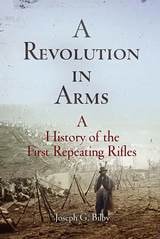
A Revolution in Arms
A History of the First Repeating RiflesJoseph G. Bilby
Westholme Publishing, 2005
Historians often call the American Civil War the first modern war, pointing to the use of observation balloons, the telegraph, trains, mines, ironclad ships, and other innovations. Although recent scholarship has challenged some of these “firsts,” the war did witness the introduction of the first repeating rifles. No other innovation of the turbulent 1860s would have a greater effect on the future of warfare. In A Revolution in Arms: A History of the First Repeating Rifles, historian Joseph G. Bilby unfolds the fascinating story of how two New England inventors, Benjamin Henry and Christopher Spencer, each combined generations of cartridge and rifle technology to develop reliable repeating rifles. In a stroke, the Henry rifle and Spencer rifle and carbine changed warfare forever, accelerating the abandonment of the formal battle line tactics of previous generations and when properly applied, repeating arms could alter the course of a battle. Although slow to enter service, the repeating rifle soon became a sought after weapon by both Union and Confederate troops. Oliver Winchester purchased the rights to the Henry and transformed it into “the gun that won the West.” The Spencer, the most famous of all Civil War small arms, was the weapon of choice for Federal cavalrymen. The revolutionary technology represented by repeating arms used in the American Civil War, including self-contained metallic cartridges, large capacity magazines, and innovative cartridge feeding systems, was copied or adapted by arms manufacturers around the world, and these features remain with us today.
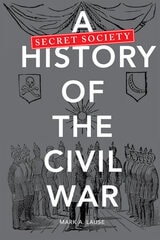
A Secret Society History of the Civil War
Mark A. Lause
University of Illinois Press, 2014
Antebellum secret societies ranged politically from those with progressive or even revolutionary agendas to those that pursued conservative or oppressive goals. This book shows how, in the years leading up to the Civil War, these clandestine organizations exacerbated existing sectional tensions in the United States. Lause's research indicates that the pervasive influence of secret societies may have played a part in key events such as the Freesoil movement, the beginning of the Republican party, John Brown's raid on Harpers Ferry, Lincoln's election, and the Southern secession process of 1860-1861.
This exceptional study encompasses both white and African American secret society involvement, revealing the black fraternal experience in antebellum America as well as the clandestine operations that provided assistance to escaped slaves via the Underground Railroad. Unraveling these pervasive and extensive networks of power and influence, A Secret Society History of the Civil War demonstrates that antebellum secret societies played a greater role in affecting Civil War-era politics than has been previously acknowledged.
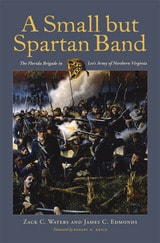
A Small but Spartan Band
The Florida Brigade in Lee's Army of Northern VirginiaZack C. Waters
University of Alabama Press, 2013
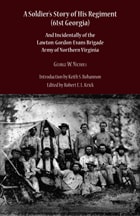
A Soldier's Story of His Regiment (61st Georgia)
And Incidentally of the Lawton-Gordon-Evans Brigade Army of Northern VirginiaGeorge W. Nichols
University of Alabama Press, 2011
Nichol’s 61st Georgia fought in the renowned brigade commanded consecutively by generals Alexander R. Lawton, John B. Gordon, and Clement A. Evans.
Framed without any excess of sentimental hindsight, in addition to reporting on great battles and dramatic moments, Nichol’s told the story of two cousins killing each other in a quarrel about cooking duties and described maggot-infested corpses around Spotsylvania’s Bloody Angle.
Includes an annotated roster of the 61st supplies which details about Nichol’s fellow veterans, some of which is not available anywhere else.
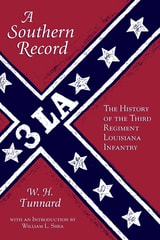
A Southern Record
The History of the Third Regiment Louisiana InfantryWilliam Tunnard
University of Arkansas Press, 1997
Originally published in a limited edition in 1866, this memoir of Will Tunnard’s experiences and observations of the Civil War in the West, where he served in the famed Third Louisiana Infantry, is one of only a handful of chronicles left by western Confederate soldiers. His first-person account of the battles of Wilson’s Creek, Pea Ridge, Iuka, and Corinth as well as the seige of Vicksburg, is a vivid history of these hard-fought campaigns which determined the outcome of the war in the Trans-Mississippi theater.
Using letters and diaries assembled from former comrades as well as his own daily journal, Tunnard tells the story of his regiment and its extraordinary odyssey from the Gulf of Mexico to the Ozark Plateau and from the Indian Territory to Mobile Bay. He offers an extensive and valuable account of capture and parole at Vicksburg and includes muster rolls which will interest genealogists as well as Civil War scholars and history enthusiasts. With a clear eye for detail and an engaging, objective style, Tunnard conveys the pathos of war and recounts the trials of camp life, social conditions, and the war’s affect on the civilian population.
Noted Civil War scholar William L. Shea supports the original text with background on the regiment and the time period, sketching a helpful chronology of events. In retelling this remarkable story of comradeship, hardship, endurance, courage, pride, and eventual defeat, Tunnard and Shea give modern readers a rare glimpse of the war in the West.
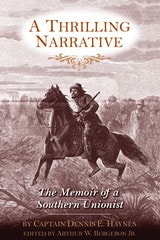
A Thrilling Narrative
The Memoir of a Southern UnionistDennis E. Haynes
University of Arkansas Press, 2006

A Voice of Thunder
A BLACK SOLDIER'S CIVIL WAREdited by Donald Yacovone
University of Illinois Press, 1997
important African-American war correspondent of his era, served in the
famed black Fifty-fourth Massachusetts Regiment, subject of the film Glory.
His letters from the front, published in the New York Weekly Anglo-African,
brilliantly detail two wars: one against the Confederacy and one against
the brutal, debilitating racism within his own Union Army. Together with
Donald Yacovone's biographical introduction detailing Stephens's life
and times, they provide a singular perspective on the greatest crisis
in the history of the United States.
Stephens chronicled the African-American
quest for freedom in reports from southern Maryland and eastern Virginia
in 1861 and 1862 that detailed, among other issues of the day, the Army
of the Potomac's initial encounter with slavery, the heroism of fugitive
slaves, and the brutality both Southerners and Union troops inflicted
on them.
From the inception of the
Fifty-fourth early in 1863 Stephens was the unit's voice, telling of its
struggle against slavery and its quest to win the pay it had been promised.
His description of the July 18, 1863, assault on Battery Wagner near Charleston,
South Carolina, and his writings on the unit's eighteen-month campaign
to be paid as much as white troops are gripping accounts of continued
heroism in the face of persistent insult.
The Weekly Anglo-African
was the preeminent African-American newspaper of its time. Stephens's
correspondence, intimate and authoritative, takes in an expansive array
of issues and anticipates nearly all modern assessments of the black role
in the Civil War. His commentary on the Lincoln administration's wartime
policy and his conviction that the issues of race and slavery were central
to nineteenth-century American life mark him as a major American social
critic.
A War State All Over
Alabama Politics and the Confederate CauseBen H. Severance
University of Alabama Press, 2020
Alabama’s military forces were fierce and dedicated combatants for the Confederate cause.In his study of Alabama during the Civil War, Ben H. Severance argues that Alabama’s electoral and political attitudes were, in their own way, just as unified in their support for the cause of southern independence. To be sure, the civilian populace often expressed unease about the conflict, as did a good many of Alabama’s legislators, but the majority of government officials and military personnel displayed pronounced Confederate loyalty and a consistent willingness to accept a total war approach in pursuit of their new nation’s aims. As Severance puts it, Alabama was a “war state all over.”
In A War State All Over: Alabama Politics and the Confederate Cause, Severance examines the state’s political leadership at multiple levels of governance—congressional, gubernatorial, and legislative—and orients much of his analysis around the state elections of 1863. Coming at the war’s midpoint, these elections provide an invaluable gauge of popular support for Alabama’s role in the Civil War, particularly at a time when the military situation for Confederate forces was looking bleak. The results do not necessarily reflect a society that was unreservedly prowar, but they clearly establish a polity that was committed to an unconditional Confederate victory, in spite of the probable costs.
Severance’s innovative work focuses on the martial character of Alabama’s polity while simultaneously acknowledging the widespread angst of Alabama’s larger culture and society. In doing so, it puts a human face on the election returns by providing detailed character sketches of the principal candidates that illuminate both their outlook on the war and their role in shaping policy.
A War of Words
The Rhetorical Leadership of Jefferson DavisR. Jarrod Atchison
University of Alabama Press, 2017
Numerous biographies of Jefferson Davis have been penned; however, until now, there had been no substantive analysis of his public discourse as president of the Confederacy. R. Jarrod Atchison’s A War of Words uses concepts from rhetorical theory and public address to help answer a question that has intrigued scholars from a variety of disciplines since the collapse of the Confederacy: what role, if any, did Davis play in the collapse of Confederate nationalism?
Most discussions of Davis and nationalism focus on the military outcomes of his controversial wartime decisions. A War of Words focuses less on military outcomes and argues instead that, in the context of the Confederacy, Jefferson Davis’s rhetorical leadership should have been responsible for articulating a vision for the nation—including the core tenets of its identity, the values the nation should hold dear, the principles it should never compromise, and the goals it should set for its future. Undoubtedly, Davis possessed the skills necessary to make a persuasive public argument. It is precisely because Davis’s oratory skills were so powerful that there is room to judge how he used them. In short, being a great orator is not synonymous with successful rhetorical leadership.
Atchison posits that Davis’s initial successes constrained his rhetorical options later in the war. A War of Words concludes that, in the end, Davis’s rhetorical leadership was a failure because he was unable to articulate a coherent Confederate identity in light of the sacrifices endured by the populace in order to sustain the war effort.
A Wisconsin Boy in Dixie
Civil War Letters of James K. NewtonSelected and Edited by Stephen E. Ambrose
University of Wisconsin Press, 1995
“When I wrote to you last I was at Madison with no prospect of leaving very soon, but I got away sooner than I expected to.” So wrote James Newton upon leaving Camp Randall for Vicksburg in 1863 with the Fourteenth Wisconsin Volunteer Infantry. Newton, who had been a rural schoolteacher before he joined the Union army in 1861, wrote to his parents of his experiences at Shiloh, Corinth, Vicksburg, on the Red River, in Missouri, at Nashville, at Mobile, and as a prisoner of war. His letters, selected and edited by noted historian Stephen E. Ambrose, reveal Newton as a young man who matured in the war, rising in rank from private to lieutenant.
A Wisconsin Boy in Dixie reveals Newton as a young man who grew to maturity through his Civil War experience, rising in rank from private to lieutenant. Writing soberly about the less attractive aspects of army life, Newton's comments on fraternizing with the Rebs, on officers, and on discipline are touched with a sense of humor—"a soldier's best friend," he claimed. He also became sensitive to the importance of political choices. After giving Lincoln the first vote he had ever cast, Newton wrote: "In doing so I felt that I was doing my country as much service as I have ever done on the field of battle."
A Woman's Civil War
A Diary with Reminiscences of the War, from March 1862Cornelia Peake McDonald; Edited, with an Introduction by Minrose C. Gwin
University of Wisconsin Press, 1992
McDonald’s story of the Civil War records a personal and distinctly female battle of her own—a southern woman’s lonely struggle in the midst of chaos to provide safety and shelter for herself and her children. For McDonald, history is what happens “inside the house.” She relates the trauma that occurs when the safety of the home is disrupted and destroyed by the forces of war—when women and children are put out of their houses and have nowhere to go.
Whether she is describing a Union soldier’s theft of her Christmas cakes, the discovery of a human foot in her garden, or the death of her baby daughter, McDonald’s story of the Civil War at home is compelling and disturbing. Her tremendous determination and unyielding spirit in the face of the final collapse of her world is testimony to a woman’s will to preserve her family and her own sense of purpose as a “rebel” against all that she regarded as tyrannical and brutal in war itself.
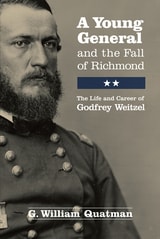
A Young General and the Fall of Richmond
The Life and Career of Godfrey WeitzelG. William Quatman
Ohio University Press, 2015
A History Book Club Reading Selection
Despite his military achievements and his association with many of the great names of American history, Godfrey Weitzel (1835–1884) is perhaps the least known of all the Union generals. After graduating from West Point, Weitzel, a German immigrant from Cincinnati, was assigned to the Army Corps of Engineers in New Orleans. The secession of Louisiana in 1861, with its key port city of New Orleans, was the first of a long and unlikely series of events that propelled the young Weitzel to the center of many of the Civil War’s key battles and brought him into the orbit of such well-known personages as Lee, Beauregard, Butler, Farragut, Porter, Grant, and Lincoln. Weitzel quickly rose through the ranks and was promoted to brigadier general and, eventually to commander of Twenty-Fifth Corps, the Union Army’s only all-black unit. After fighting in numerous campaigns in Louisiana and Virginia, on April 3, 1865, Weitzel marched his troops into Richmond, the capital of the Confederacy, capturing the city for the Union and precipitating the eventual collapse of the Southern states’ rebellion.
G. William Quatman’s minute-by-minute narrative of the fall of Richmond lends new insight into the war’s end, and his keen research into archival sources adds depth and nuance to the events and the personalities that shaped the course of the Civil War.
Abolitionist Politics and the Coming of the Civil War
James Brewer Stewart
University of Massachusetts Press, 2008
Before the Civil War, slaveholders made themselves into the most powerful, most deeply rooted, and best organized private interest group within the United States. Not only did slavery represent the national economy's second largest capital investment, exceeded only by investment in real estate, but guarantees of its perpetuation were studded throughout the U.S. Constitution. The vast majority of white Americans, in North and South, accepted the institution, and pro-slavery presidents and congressmen consistently promoted its interests.
In Abolitionist Politics and the Coming of the Civil War, James Brewer Stewart explains how a small group of radical activists, the abolitionist movement, played a pivotal role in turning American politics against this formidable system. He examines what influence the movement had in creating the political crises that led to civil war and evaluates the extent to which a small number of zealous reformers made a truly significant political difference when demanding that their nation face up to its most excruciating moral problem. In making these assessments, Stewart addresses a series of more specific questions: What were the abolitionists actually up against when seeking the overthrow of slavery and white supremacy? What motivated and sustained them during their long and difficult struggles? What larger historical contexts (religious, social, economic, cultural, and political) influenced their choices and determined their behavior? What roles did extraordinary leaders play in shaping the movement, and what were the contributions of abolitionism's unheralded “foot soldiers”? What factors ultimately determined, for better or worse, the abolitionists' impact on American politics and the realization of their equalitarian goals?
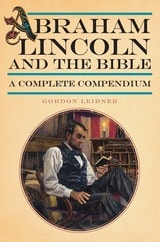
Abraham Lincoln and the Bible
A Complete CompendiumGordon Leidner
Southern Illinois University Press, 2023
How did Abraham Lincoln’s lifelong study of scripture influence him as a man and, ultimately, as president? Historian Gordon Leidner believes the impact was profound—more than previously recognized—and has investigated all the known writings of Abraham Lincoln to identify, catalog, and study every instance in which Lincoln quoted from or alluded to the Bible. Rather than dwelling on the never-ending debate about Lincoln’s religious beliefs, Leidner shows how scripture affected Lincoln personally, professionally, and politically.
Leidner offers first a short biography that focuses on Lincoln’s use of the Bible, how it shaped him as a person, how its influence changed over time, and how biblical quotations peppered his letters, speeches, and conversations. The book concludes with an unparalleled appendix that tabulates nearly 200 instances of Lincoln’s quoting from or alluding to scripture, giving locators for the Bible and Roy P. Basler’s nine volume Collected Works of Abraham Lincoln and quotations from both sources. The appendix also includes when and where Lincoln used each quote, providing valuable context, whether the use was in personal letters such as one to Queen Victoria after the death of Prince Albert, political speeches such as the Gettysburg Address, or state addresses such as the Second Inaugural Address.
By showcasing Lincoln’s specific biblical references and influences, Leidner reframes the question of Lincoln’s religious beliefs so that readers may evaluate for themselves what solace and guidance the Bible afforded the sixteenth president.
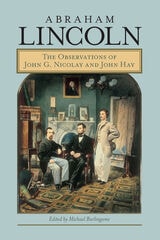
Abraham Lincoln
The Observations of John G. Nicolay and John HayEdited by Michael Burlingame
Southern Illinois University Press, 2007
Editor Michael Burlingame sifted through the original forty-seven-hundred-page work and selected only the personal observations of the secretaries during the Lincoln presidency, placing ten excerpts in chronological order in Abraham Lincoln: The Observations of John G. Nicolay and John Hay. The result is an important collection of Nicolay and Hay’s interpretations of Lincoln’s character, actions, and reputation, framed by Burlingame’s compelling preface, introduction, chapter introductions, and notes. The volume provides vivid descriptions of such events as Election Day in 1860, the crisis at Fort Sumter, the first major battle of the war at Bull Run, and Lincoln’s relationship with Edwin Stanton and George McClellan.
In this clear and captivating new work, Burlingame has made key portions of Nicolay and Hay’s immense biography available to a wide audience of today’s readers.
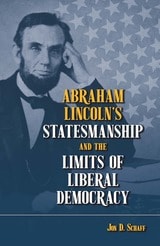
Abraham Lincoln’s Statesmanship and the Limits of Liberal Democracy
Jon D. Schaff
Southern Illinois University Press, 2019
Though Lincoln’s presidency is inextricably linked to the Civil War, and he is best known for his defense of the Union and executive wartime leadership, Lincoln believed that Congress should be at the helm of public policy making. Likewise, Lincoln may have embraced limited government in vague terms, but he strongly supported effective rule of law and distribution of income and wealth. Placing the Lincoln presidency within a deeper and more meaningful historical context, Abraham Lincoln’s Statesmanship and the Limits of Liberal Democracy highlights Lincoln’s significance in the development of American power institutions and social movement politics.
Using Lincoln’s prepresidential and presidential words and actions, this book argues that decent government demands a balance of competing goods and the strong statesmanship that Lincoln exemplified. Instead of relying too heavily on the will of the people and institutional solutions to help prevent tyranny, Jon D. Schaff proposes that American democracy would be better served by a moderate and prudential statesmanship such as Lincoln’s, which would help limit democratic excesses.
Schaff explains how Lincoln’s views on prudence, moderation, natural rights, and economics contain the notion of limits, then views Lincoln’s political and presidential leadership through the same lens. He compares Lincoln’s views on governmental powers with the defense of unlimited government by twentieth-century progressives and shows how Lincoln’s theory of labor anticipated twentieth-century distributist economic thought. Schaff’s unique exploration falls squarely between historians who consider Lincoln a protoprogressive and those who say his presidency was a harbinger of industrialized, corporatized America.
In analyzing Lincoln’s approach, Abraham Lincoln’s Statesmanship and the Limits of Liberal Democracy rejects the idea he was a revolutionary statesman and instead lifts up Lincoln’s own affinity for limited presidential power, making the case for a modest approach to presidential power today based on this understanding of Lincoln’s statesmanship. As a counterpoint to the contemporary landscape of bitter, uncivil politics, Schaff points to Lincoln’s statesmanship as a model for better ways of engaging in politics in a democracy.
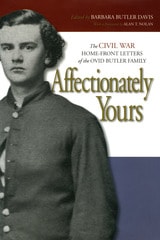
Affectionately Yours
The Civil War Home-Front Letters of the Ovid Butler FamilyBarbara Butler Davis
Indiana Historical Society Press, 2004
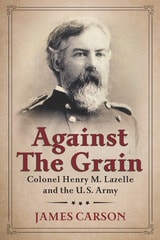
Against the Grain
Colonel Henry M. Lazelle and the U.S. ArmyJames Carson
University of North Texas Press, 2015

America's War
Talking about the Civil War and Emancipation on Their 150th AnniversariesAmerican Library Association, 2012
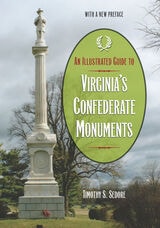
An Illustrated Guide to Virginia's Confederate Monuments
Timothy S. Sedore
Southern Illinois University Press, 2011
From well-known battlefields, such as Manassas, Fredericksburg, and Appomattox, to lesser-known sites, such as Sinking Spring Cemetery and Rude’s Hill, Sedore leads readers on a vivid journey through Virginia’s Confederate history. Tablets, monoliths, courthouses, cemeteries, town squares, battlefields, and more are cataloged in detail and accompanied by photographs and meticulous commentary. Each entry contains descriptions, fascinating historical information, and location, providing a complete portrait of each site.
Much more than a visual tapestry or a tourist’s handbook, An Illustrated Guide to Virginia’s Confederate Monuments draws on scholarly and field research to reveal these sites as public efforts to reconcile mourning with Southern postwar ideologies. Sedore analyzes in depth the nature of these attempts to publicly explain Virginia’s sense of grief after the war, delving deep into the psychology of a traumatized area. From commemorations of famous generals to memories of unknown soldiers, the dead speak from the pages of this sweeping companion to history.
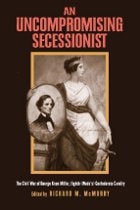
An Uncompromising Secessionist
The Civil War of George Knox Miller, Eighth (Wade's) Confederate CavalryGeorge Knox Miller, edited by Richard M. McMurry
University of Alabama Press, 2006
Offers significant insight into the life, heart, mind, and attitudes of an intelligent, educated, young mid-19th-century white Southerner
This book contains the letters of George Knox Miller who served as a line officer in the Confederate cavalry and participated in almost all of the major campaigns of the Army of Tennessee. He was, clearly, a very well-educated young man. Born in 1836 in Talladega, Alabama, he developed a great love for reading and the theater and set his sights upon getting an education that would lead to a career in law or medicine; meanwhile he worked as an apprentice in a painting firm to earn tuition. Miller then enrolled in the University of Virginia, where he excelled in his studies.
Eloquent, bordering on the lyrical, the letters provide riveting first-hand accounts of cavalry raids, the monotony of camp life, and the horror of battlefield carnage. Miller gives detailed descriptions of military uniforms, cavalry tactics, and prison conditions. He conveys a deep commitment to the Confederacy, but he was also critical of Confederate policies that he felt hindered the army's efforts. Dispersed among these war-related topics is the story of Miller's budding relationship with Celestine “Cellie” McCann, the love of his life, whom he would eventually marry.
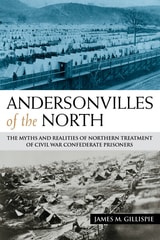
Andersonvilles of the North
The Myths and Realities of Northern Treatment of Civil War Confederate PrisonersJames M. Gillispie
University of North Texas Press, 2008
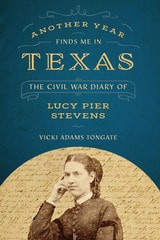
Another Year Finds Me in Texas
The Civil War Diary of Lucy Pier StevensBy Vicki Adams Tongate
University of Texas Press, 2016
Lucy Pier Stevens, a twenty-one-year-old woman from Ohio, began a visit to her aunt’s family near Bellville, Texas, on Christmas Day, 1859. Little did she know how drastically her life would change on April 4, 1861, when the outbreak of the Civil War made returning home impossible. Stranded in enemy territory for the duration of the war, how would she reconcile her Northern upbringing with the Southern sentiments surrounding her?
Lucy Stevens’s diary—one of few women’s diaries from Civil War–era Texas and the only one written by a Northerner—offers a unique perspective on daily life at the fringes of America’s bloodiest conflict. An articulate, educated, and keen observer, Stevens took note seemingly of everything—the weather, illnesses, food shortages, parties, church attendance, chores, schools, childbirth, death, the family’s slaves, and political and military news. As she confided her private thoughts to her journal, she unwittingly revealed how her love for her Texas family and the Confederate soldier boys she came to care for blurred her loyalties, even as she continued to long for her home in Ohio. Showing how the ties of heritage, kinship, friendship, and community transcended the sharpest division in US history, this rare diary and Vicki Adams Tongate’s insightful historical commentary on it provide a trove of information on women’s history, Texas history, and Civil War history.
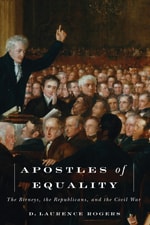
Apostles of Equality
The Birneys, the Republicans, and the Civil WarD. Laurence Rogers
Michigan State University Press, 2011
The first biographical account of the life of James Gillespie Birney in more than fifty years, this fabulously insightful history illuminates and elevates an all-but-forgotten figure whose political career contributed mightily to the American political fabric. Birney was a southern-born politician at the heart of the antislavery movement, with two southern-born sons who were major generals involved in key Union Army activities, including the leadership of the black troops. The interaction of the Birneys with historical figures (Abraham Lincoln, Harriet Beecher Stowe, and Henry Clay) highlights the significance of the family’s activities in politics and war. D. Laurence Rogers offers a unique historiography of the abolition movement, the Civil War, and Reconstruction through the experiences of one family navigating momentous developments from the founding of the Republic until the late 19th century.
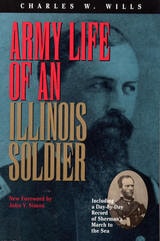
Army Life of an Illinois Soldier
Including a Day-by-Day Record of Sherman's March to the SeaCharles W. Wills. Foreword by John Y. Simon
Southern Illinois University Press, 1996
A high-spirited idealist who craved excitement when he enlisted in the Eighth Illinois Volunteers for three months and reenlisted for three years, Charles W. Wills of Canton, Illinois, wrote frequently to his sister Mary Emily Wills and kept a diary of General William T. Sherman’s campaigns during the last year of the war. In the beginning of his service, Wills could boast that his company refused to enlist "roughs." He reported that he and his comrades "drink no liquors and keep ourselves as cleanly as possible.... Almost all are reading or writing, and I defy anyone to find 75 men without any restraint, paying more attention to the Sabbath. . . . Health generally excellent in our company, because we are all careful."
A student and store clerk before enlisting, Wills found that army life "beats clerking." He enlisted as a private at the age of twenty-one and by twenty-four was a major. He had thought he might receive an infantry commission eventually, but when the opportunity arose for promotion to first lieutenant in the Seventh Illinois Cavalry, "cupidity and ambition" caused him to abandon the Eighth, enabling him to hold rank "without so much walking." For a while, though, he seriously rued his lack of action. "Haven’t I a brilliant record," he wrote. "Thirty-three months in service and not a battle." As Simon points out, however, "in the year ahead, Wills would have more than his fill of battles." Battle starved once, his enthusiasm for carnage waned as he marched with Sherman to the sea. Yet Major Wills was impressed by his troops’ "endurance, spirit and recklessness."
Wills matured in the army. He joined solely to preserve the Union, and his early comments on slaves "lacked sympathy, even decency," according to Simon. Later he came to the point where he would arm blacks—in part, with an eye toward gaining rank by leading the new regiments. Yet he was not blind to the anomalies of a slave society.
Wills died in 1883. To preserve his memory, his sister (now Mary Kellogg) printed his diary in 1904. Two years later, Kellogg combined the diary with the letters Wills had written to her earlier in the war. Simon renders this assessment: "Wills had a sparkling, witty style that contrasted sharply with that of both his contemporaries in the field and the seven regimental veterans who compiled their diaries. In assembling this book, Mary E. Kellogg wisely allowed her brother to speak for himself; rarely intruding a comment of her own, excising from his letters home inevitable expressions of concern for his sister and her welfare but leaving intact the sparkling flow of camp gossip and military speculation."
Army Life
From a Soldier's JournalA. O. Marshall
University of Arkansas Press, 2009
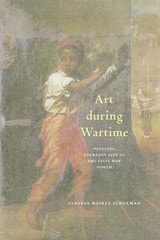
Art during Wartime
Painting Everyday Life in the Civil War NorthVanessa Meikle Schulman
University of Massachusetts Press, 2024
While the Civil War raged on, many northern artists depicted everyday life rather than grand battles or landscapes of noble sacrifice. Amidst a conflict that was upending antebellum social norms, these artists created realistic scenes of mundane events, known as genre paintings. While many of the paintings seem merely to show everyday incidents, Vanessa Meikle Schulman argues that artists connected the visuals to larger concerns.
With attention to how the war shaped new definitions of gender, race, and disability, Art during Wartime uncovers the complexity of these genre paintings. Schulman uses seven case studies of prominent and lesser-known artists who explored how the war instigated social change and shaped northern opinions about current events, including George Cochran Lambdin, Vincent Colyer, and Eastman Johnson. Utilizing detailed visual analysis and extensive historical research, Art during Wartime reframes our narrative of Civil War visual culture, placing genre painting in a central ideological role.
Ashes of the Mind
War and Memory in Northern Literature, 1865-1900Martin Griffin
University of Massachusetts Press, 2009
The memory of the American Civil War took many forms over the decades after the conflict ended: personal, social, religious, and political. It was also remembered and commemorated by poets and fiction writers who understood that the war had bequeathed both historical and symbolic meanings to American culture. Although the defeated Confederacy became best known for producing a literature of nostalgia and an ideological defensiveness intended to protect the South's own version of history, authors loyal to the Union also confronted the question of what the memory of the war signified, and how to shape the literary response to that individual and collective experience.
In Ashes of the Mind, Martin Griffin examines the work of five Northerners—three poets and two fiction writers—who over a period of four decades tried to understand and articulate the landscape of memory in postwar America, and in particular in that part of the nation that could, with most justification, claim the victory of its beliefs and values. The book begins with an examination of the rhetorical grandeur of James Russell Lowell's Harvard Commemoration Ode, ranges across Herman Melville's ironic war poetry, Henry James's novel of North-South reconciliation, The Bostonians, and Ambrose Bierce's short stories, and ends with the bitter meditation on race and nation presented by Paul Laurence Dunbar's elegy “Robert Gould Shaw.” Together these texts reveal how a group of representative Northern writers were haunted in different ways by the memory of the
conflict and its fraught legacy.
Griffin traces a concern with individual and community loss, ambivalence toward victory, and a changing politics of commemoration in the writings of Lowell, Melville, James, Bierce, and Dunbar. What links these very different authors is a Northern memory of the war that became more complex and more compromised as the century went on, often replacing a sense of justification and achievement with a perception of irony and failed promise.
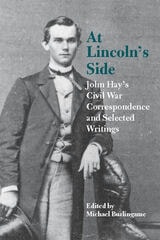
At Lincoln's Side
John Hay's Civil War Correspondence and Selected WritingsEdited by Michael Burlingame
Southern Illinois University Press, 2006
John Hay believed that “real history is told in private letters,” and the more than 220 surviving letters and telegrams from his Civil War days prove that to be true, showing Abraham Lincoln in action: “The Tycoon is in fine whack. I have rarely seen him more serene & busy. He is managing this war, the draft, foreign relations, and planning a reconstruction of the Union, all at once. I never knew with what tyrannous authority he rules the Cabinet, till now. The most important things he decides & there is no cavil.”
Along with Hay’s personal correspondence, Burlingame includes his surviving official letters. Though lacking the “literary brilliance of [Hay’s] personal letters,” Burlingame explains, “they help flesh out the historical record.” Burlingame also includes some of the letters Hay composed for Lincoln’s signature, including the celebrated letter of condolence to the Widow Bixby.
More than an inside glimpse of the Civil War White House, Hay’s surviving correspondence provides a window on the world of nineteenth-century Washington, D.C.
Attack and Die
Civil War Military Tactics and the Southern HeritageGrady McWhiney
University of Alabama Press, 1984
Why did the Confederacy lose so many men? The authors contend that the Confederates bled themselves nearly to death in the first three years of the war by making costly attacks more often than the Federals. Offensive tactics, which had been used successfully by Americans in the Mexican War, were much less effective in the 1860s because an improved weapon—the rifle—had given increased strength to defenders. This book describes tactical theory in the 1850s and suggests how each related to Civil War tactics. It also considers the development of tactics in all three arms of the service during the Civil War.
In examining the Civil War the book separates Southern from Northern tactical practice and discusses Confederate military history in the context of Southern social history. Although the Southerners could have offset their numerical disadvantage by remaining on the defensive and forcing the Federals to attack, they failed to do so. The authors argue that the Southerners’ consistent favoring of offensive warfare was attributable, in large measure, to their Celtic heritage: they fought with the same courageous dash and reckless abandon that had characterized their Celtic forebears since ancient times. The Southerners of the Civil War generation were prisoners of their social and cultural history: they attacked courageously and were killed—on battlefields so totally defended by the Federals that “not even a chicken could get through.”
Autobiography of Samuel S. Hildebrand
The Renowned Missouri BushwhackerKirby Ross
University of Arkansas Press, 2016