Results by title
26 books match the query 'Colorado River (Colo.-Mexico)'
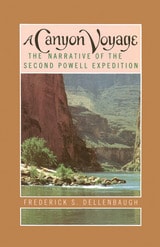
A Canyon Voyage
The Narrative of the Second Powell Expedition down the Green-Colorado River from Wyoming, and the Explorations on Land, in the Years 1871 and 1872Frederick S. Dellenbaugh
University of Arizona Press, 1980
"One of the seminal books on western history . . . The author was only 17 when he began the expedition, and he honestly hero-worshipped Powell all his life. Yet this bright, sharp account is so detailed and truthful that the reader can see through his enthusiasm to discover Powell's mean spirit and sometimes reckless nature. It's also a great river-running book." —Deseret News
"It was decidedly worth writing, this detailed record: a more absorbing, and at times stirring, story of adventure has not seen the light in a long time, and the author's unadorned, yet vivid, style enables the reader to share all the emotions of the explorers:" —The Nation
"In these later years (1909) when amateur travel in the west is frequent, a detailed record of this kind will be of value to seekers after adventure." —Science
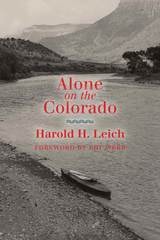
Alone on the Colorado
Harold H. Leich
University of Utah Press, 2019
Alone on the Colorado takes readers on the adventure of running rivers and riding the rails, while painting a unique and optimistic portrait of Depression-era America.
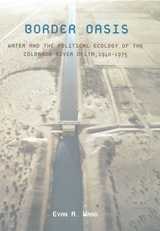
Border Oasis
Water and the Political Ecology of the Colorado River Delta, 1940–1975Evan R. Ward
University of Arizona Press, 2003
Evan Ward explores the rapid development of this region, examining the ways in which regional politics and international relations created a garden in the Mexicali, Yuma, and Imperial Valleys while simultaneously threatening the life of the Colorado River. Tracing the transformation of the delta by irrigated agribusiness through the twentieth century, he draws on untapped archival resources from both sides of the border to offer a new look at one of the world's most contested landscapes.
Border Oasis tells how two very different nations developed the delta into an agricultural oasis at enormous environmental cost. Focusing on the years 1940 to 1975—including the disastrous salinity crisis of the 1960s and 1970s—it combines Mexican, Native American, and U.S. perspectives to demonstrate that the political and diplomatic influences on the delta played as much a part in the region's transformation as did irrigation. Ward reveals how mistrust among political and economic participants has been fueled by conflict between national and local officials on both sides of the border, by Mexican nationalism, and by a mutual recognition that water is the critical ingredient for regional economic development.
With overemphasis on development in both nations leading to an ecological breaking point, Ward demonstrates that conflicting interests have made sound binational management of the delta nearly impossible. By weaving together all of these threads that have produced the fabric of today's lower Colorado, his study shows that the environmental history of the delta must be understood as a whole, not from the standpoint of only one of many competing interests.
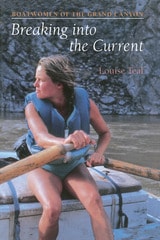
Breaking Into the Current
Boatwomen of the Grand CanyonLouise Teal
University of Arizona Press, 1994
Breaking Into the Current is a story of romance between women and a place. Each woman tells a part of every Canyon boatwoman's story: when Marilyn Sayre talks about leaving the Canyon, when Ellen Tibbets speaks of crew camaraderie, or when Martha Clark recalls the thrill of white water, each tells how all were involved in the same romance.
All the boatwomen have stories to tell of how they first came to the Canyon and why they stayed. Some speak of how they balanced their passion for being in the Canyon against the frustration of working in a traditionally male-oriented occupation, where today women account for about fifteen percent of the Canyon's commercial river guides.
As river guides in love with the Canyon and their work, these women have followed their hearts. "I've done a lot," says Becca Lawton, "but there's been nothing like holding those oars in my hands and putting my boat exactly where I wanted it. Nothing."
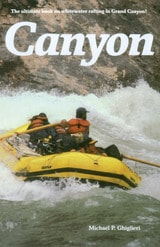
Canyon
Michael P. Ghiglieri
University of Arizona Press, 1992
From Lee's Ferry to Diamond Creek, Ghiglieri leads you down 226 miles of wild river and through some of the most breathtaking scenery on earth. Along the way, he navigates the Colorado River's dozens of notorious rapids—many of which drop fifteen feet or more—and shares the excitement of waves and boulders, thunder and foam. Recounting a real journey through this geological wonder, Canyon interweaves heart-pounding adventure with factual insights into the world of Grand Canyon. Between the rapids, Ghiglieri relates tales of river runners past and present, lessons in geology and wildlife, observations on the impact of Glen Canyon Dam, and stories of Native inhabitants, from Anasazi ancestors to Havasupai Rastafarians. This trip also offers more than its share of human drama for the passengers aboard, leaving them with tales of their own to tell.
"Running the Colorado River in the Grand Canyon is to me the most impressive journey on our planet," writes Ghiglieri, "an adventure that leaves no traveler unchanged." For anyone who has ever shared or contemplated that adventure, Canyon recreates an unforgettable ride.
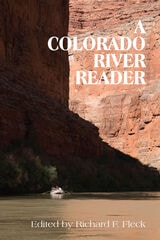
Colorado River Reader
Richard F. Fleck
University of Utah Press, 2000
"This canyon world where water yearns toward the ocean is a place so large I can’t take it in. Instead, I am taken in, traveling a near dream as we journey by water, contained by rock walls. In order to see this shorn-away world, I narrow my vision to the small and nearly secret. Never mind the stone’s illusion of permanence or the great strength of water. I look to the most fragile of things here, to the plant world of the canyon. The other river travelers seem taken in by stone, time, and water, and do not see the small things that tempt my attention, the minute fern between stones, the tiny black snails in a pond of water. I am drawn in by the growing life and not by the passing."
- from 'Plant Journey' by Linda Hogan
The mystique of the Colorado River is no less enduring and powerful than is its physical presence in the landscape of the West. Little wonder that narratives about the Colorado still arouse and intrigue readers, or that the river continues to inspire new writing among contemporary authors. What is surprising is that no anthology offering a comprehensive introduction to these works existed - until now.
A Colorado River Reader spans hundreds of years and many cultures and voices to capture an array of responses to this mighty river and tributaries. The collection opens with a Paiute creation myth set in the Grand Canyon and progresses through time, encompassing the Spanish and American exploration narratives of the eighteenth and nineteenth centuries and culminating in the adventure and nature writings of the twentieth.
This is a book that deserves a place next to every armchair and in a pocket of every backpack.
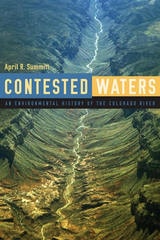
Contested Waters
An Environmental History of the Colorado RiverApril R. Summitt
University Press of Colorado, 2013
-From the conclusion
The Colorado River is a vital resource to urban and agricultural communities across the Southwest, providing water to 30 million people. Contested Waters tells the river's story-a story of conquest, control, division, and depletion.
Beginning in prehistory and continuing into the present day, Contested Waters focuses on three important and often overlooked aspects of the river's use: the role of western water law in its over-allocation, the complexity of power relationships surrounding the river, and the concept of sustainable use and how it has been either ignored or applied in recent times. It is organized in two parts, the first addresses the chronological history of the river and long-term issues, while the second examines in more detail four specific topics: metropolitan perceptions, American Indian water rights, US-Mexico relations over the river, and water marketing issues. Creating a complete picture of the evolution of this crucial yet over-utilized resource, this comprehensive summary will fascinate anyone interested in the Colorado River or the environmental history of the Southwest.
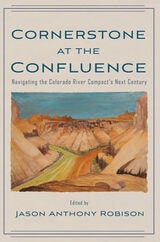
Cornerstone at the Confluence
Navigating the Colorado River Compact's Next CenturyEdited by Jason Anthony Robison
University of Arizona Press, 2022
No fewer than forty million people have come to rely on the Colorado River system in modern times—a river system immersed in an unprecedented, unrelenting megadrought for more than two decades. Attempting to navigate this “new normal,” policymakers are in the midst of negotiating new management rules for the river system, a process coinciding with the compact’s centennial that must be completed by 2026.
Animated by this remarkable confluence of events, Cornerstone at the Confluence leverages the centennial year to reflect on the compact and broader “Law of the River” to envision the future. It is a volume inviting dialogue about how the Colorado River system’s flows should be apportioned given climate change, what should be done about environmental issues such as ecosystem restoration and biodiversity protection, and how long-standing issues of water justice facing Native American communities should be addressed.
In one form or another, all these topics touch on the concept of “equity” embedded within the compact—a concept that tees up what is perhaps the foundational question confronted by Cornerstone at the Confluence: Who should have a seat at the table of Colorado River governance?
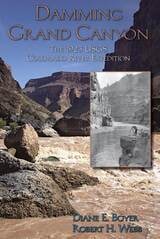
Damming Grand Canyon
The 1923 USGS Colorado River ExpeditionDiane E Boyer and Robert H. Webb
Utah State University Press, 2007
In 1923, America paid close attention, via special radio broadcasts, newspaper headlines, and cover stories in popular magazines, as a government party descended the Colorado to survey Grand Canyon. Fifty years after John Wesley Powell's journey, the canyon still had an aura of mystery and extreme danger. At one point, the party was thought lost in a flood.
Something important besides adventure was going on. Led by Claude Birdseye and including colorful characters such as early river-runner Emery Kolb, popular writer Lewis Freeman, and hydraulic engineer Eugene La Rue, the expedition not only made the first accurate survey of the river gorge but sought to decide the canyon's fate. The primary goal was to determine the best places to dam the Grand. With Boulder Dam not yet built, the USGS, especially La Rue, contested with the Bureau of Reclamation over how best to develop the Colorado River. The survey party played a major role in what was known and thought about Grand Canyon.
The authors weave a narrative from the party's firsthand accounts and frame it with a thorough history of water politics and development and the Colorado River. The recommended dams were not built, but the survey both provided base data that stood the test of time and helped define Grand Canyon in the popular imagination.
Also by Robert Webb: Lee's Ferry
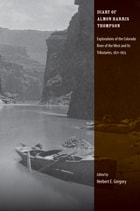
Diary of Almon Harris Thompson
Explorations of the Colorado River of the West and Its Tributaries, 1871-1875Herbert E Gregory
University of Utah Press, 2009
Originally published in 1939 as volume seven of the Utah Historical Quarterly, Thompson’s journal is reprinted here for the first time in seventy years. Co-published with the Utah State Historical Society.
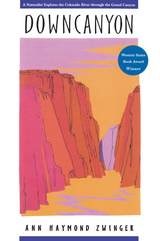
Downcanyon
A Naturalist Explores the Colorado River through the Grand CanyonAnn Haymond Zwinger
University of Arizona Press, 1995
Teamed with scientists and other volunteer naturalists, Zwinger was part of an ongoing study of change along the Colorado. In all seasons and all weathers, in almost every kind of craft that goes down the waves, she returned to the Grand Canyon again and again to explore, look, and listen. From the thrill of running the rapids to the wonder in a grain of sand, her words take the reader down 280 miles of the "ever-flowing, energetic, whooping and hollering, galloping" river.
Zwinger's book begins with a bald eagle count at Nankoweap Creek in January and ends with a subzero, snowy walk out of the canyon at winter solstice. Between are the delights of spring in side canyons, the benediction of rain on a summer beach, and the chill that comes off limestone walls in November.
Her eye for detail catches the enchantment of small things played against the immensity of the river: the gatling-gun love song of tree frogs; the fragile beauty of an evening primrose; ravens "always in close attendance, like lugubrious, sharp-eyed, nineteenth-century undertakers"; and a golden eagle chasing a trout "with wings akimbo like a cleaning lady after a cockroach."
As she travels downstream, Zwinger follows others in history who have risked—and occasionally lost—their lives on the Colorado. Hiking in narrow canyons, she finds cliff dwellings and broken pottery of prehistoric Indians. Rounding a bend or running a rapid, she remembers the triumphs and tragedies of early explorers and pioneers. She describes the changes that have come with putting a big dam on a big river and how the dam has affected the riverine flora and fauna as well as the rapids and their future.
Science in the hands of a poet, this captivating book is for armchair travelers who may never see the grandiose Colorado and for those who have run it wisely and well. Like the author, readers will find themselves bewitched by the color and flow of the river, and enticed by what's around the next bend. With her, they will find its rhythms still in the mind, long after the splash and spray and pound are gone.
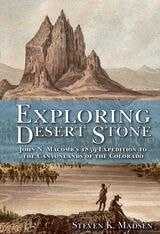
Exploring Desert Stone
John N. Macomb's 1859 Expedition to the Canyonlands of the ColoradoSteven K. Madsen
Utah State University Press, 2022
The soldiers and scientists followed in part the Old Spanish Trail, whose location they documented and verified. Seeking to find the confluence of the Colorado and the Green and looking for alternative routes into Utah, which was of particular interest in the wake of the Utah War, they produced a substantial documentary record, most of which is published for the first time in this volume. Theirs is also the first detailed map of the region, and it is published in Exploring Desert Stone, as well.
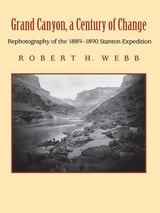
Grand Canyon, A Century of Change
Rephotography of the 1889-1890 Stanton ExpeditionRobert H. Webb
University of Arizona Press, 1996
Grand Canyon, a Century of Change assembles the most dramatic of these paired photographs to demonstrate both the persistence of nature and the presence of humanity. Unexpected longevity of some plant species, effects of animal grazing, and expansion of cacti are all captured by the replicate photographs. More telling is evidence of the impact of Glen Canyon Dam: increased riparian vegetation, new marshes, aggraded debris fans, and eroded sand bars. In the accompanying text, Webb provides a thorough analysis of what each pair of photographs shows and places the project in its historical context. Complementing his narrative are six sidebar articles by authorities on Canyon natural history that further attest to a century of change. The level of detail obtained from the photographs represents one of the most extensive long-term monitoring efforts ever conducted in a national park; it is the most detailed documentation effort ever performed using repeat photography.
Much more than simply a picture book, Grand Canyon, a Century of Change is an environmental history of the river corridor, a fascinating book that clearly shows the impact of human influence on Grand Canyon and warns us that its future is very much in our hands.
Hell Or High Water
James White's Disputed Passage through Grand Canyon, 1867Eilean Adams
Utah State University Press, 2001
Although John Wesley Powell and party are usually given credit for the first river descent through the Grand Canyon, the ghost of James White has haunted those claims. White was a Colorado prospector, who, almost two years before Powell's journey, washed up on a makeshift raft at Callville, Nevada. His claim to have entered the Colorado above the San Juan River with another man (soon drowned) as they fled from Indians was widely disseminated and believed for a time, but Powell and his successors on the river publically discounted it. Colorado River runners and historians have since debated whether White's passage through Grand Canyon even could have happened.
Hell or High Water is the first full account of White's story and how it became distorted and he disparaged over time. It is also a fascinating detective story, recounting how White's granddaughter, Eilean Adams, over decades and with the assistance of a couple of notable Colorado River historians who believed he could have done what he claimed, gradually uncovered the record of James White's adventure and put together a plausible narrative of how and why he ended up floating helplessly down a turbulent river, entrenched in massive cliffs, with nothing but a driftwood raft to carry him through.
Law and the Living Colorado River
Robert W. Adler
University of Utah Press, 2023
Law and the Living Colorado River asserts that the so-called Law of the River—the vast assemblage of interstate compacts, international treaties, federal and state statutes, regulations, contracts, and other legal documents governing use and management of the Colorado River—ignores the needs of the river as a nested system of aquatic and aquatic-dependent ecosystems. Although society now recognizes and appreciates the natural values of the Colorado River, the Law of the River remains fixed in service of human economies like irrigation and hydropower. Robert W. Adler contends that the law must respond to changing values that prioritize natural systems alongside human ones. He proposes acknowledging the legal rights of the river itself, following the recent movement to recognize rights of nature in other ecosystems around the world. Recognizing that U.S. law has significant barriers to that proposal, however, Adler borrows from aspects of international water law to propose as a shorter-term strategy amendments to the Colorado River Compact that would enhance protection of the river’s environmental needs and values.
Adler delivered this lecture on March 17, 2022, at the 27th annual symposium of the Wallace Stegner Center for Land, Resources and the Environment, jointly sponsored by the Wallace Stegner Center and the Water & Tribes Initiative | Colorado River Basin.

Photographed All the Best Scenery
Don Fowler
University of Utah Press, 1972
Steamboats on the Colorado River, 1852-1916
Richard E. Lingenfelter
University of Arizona Press, 1978
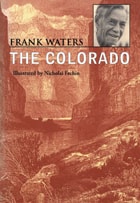
The Colorado
Frank Waters
Ohio University Press, 1985
The vast Colorado River collects water from the highest Rocky Mountain peaks and traverses the widest plateaus, the deepest canyons, and the lowest deserts before emptying into the delta of northern Mexico. This austere land and mighty river resist exploration, settlement, and description. But in the hands of one of the West’s great writers, Frank Waters, the history and lore of its past make irresistible reading and a resounding case for mankind’s respect for the environment.
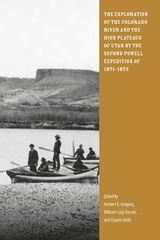
The Exploration of the Colorado River and the High Plateaus of Utah by the Second Powell Expedition of 1871-1872
Herbert E Gregory
University of Utah Press, 2009
Originally published from 1948 to 1949 as volumes sixteen and seventeen of the Utah Historical Quarterly, this volume looks to the larger significance and fruits of the second of Powell’s explorations, a more carefully constituted and better equipped scientific operation, yet one strangely neglected in historical records. Copublished with the Utah State Historical Society.
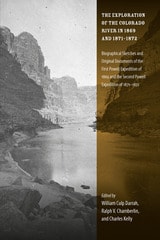
The Exploration of the Colorado River in 1869 and 1871-1872
Biographical Sketches and Original Documents of the First Powell Expedition of 1869 and the Second Powell Expedition of 1871-1872William Culp Darrah
University of Utah Press, 2009
This volume contains the journals of Major John Wesley Powell, George Young Bradley, Walter Henry Powell, and J. C. Sumner. Also included are various letters and notes by the members of the first expedition, and the journal of Francis Marion Bishop from the second expedition. All of the writings offer vivid descriptions of both adventure and of able and energetic scientific field work, and are of enduring interest and importance.
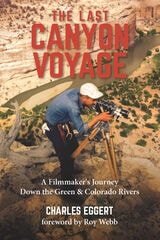
The Last Canyon Voyage
A Filmmaker's Journey Down the Green and Colorado RiversCharles Eggert Foreword by Roy Webb
University of Utah Press, 2020
This book finally brings Eggert’s writings out of the archives and into the public eye. With his keen photographer’s vision and colloquial voice, Eggert describes canyons and towns now deep under water as he tells the story of friendships forged upon the rapids and currents of the rivers. Roy Webb’s foreword provides historical context; river historian Alfred E. Holland Jr. introduces Eggert, the man who transformed into an environmentalist after visiting the West; and Sarah Holcombe’s afterword looks at what transpired in the lives of all eight crew members after the journey. Color and black-and-white illustrations further enliven the text. An engaging read, this is an important piece of river history that also shines light on Eggert’s tremendous influence as a conservation cinematographer.
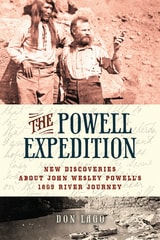
The Powell Expedition
New Discoveries about John Wesley Powell's 1869 River JourneyDon Lago
University of Nevada Press, 2017
Lago offers a feast of new and important material about the river trip, and it will significantly rewrite the story of Powell’s famous expedition. This book is not only a major work on the Powell expedition, but on the history of American exploration of the West.
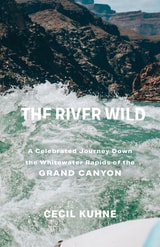
The River Wild
A Celebrated Journey Down the Whitewater Rapids of the Grand CanyonCecil Kuhne
University of Utah Press, 2026
Embark on an unforgettable adventure down the mighty Colorado River in The River Wild: A Celebrated Journey down the Whitewater Rapids of the Grand Canyon. Former professional river guide Cecil Kuhne takes readers through 225 miles of towering canyon walls, surging currents, and legendary rapids that have challenged explorers for over 150 years. From the historic first descent of John Wesley Powell’s expedition to the modern thrill-seekers navigating Lava Falls, Crystal, and Hance, this book captures the heart-pounding excitement of whitewater rafting.
With vivid descriptions of the canyon’s breathtaking geology, lush flora, and abundant wildlife, Kuhne blends history, adventure, and natural beauty into an immersive journey. Whether you’re a seasoned river runner or an armchair explorer, The River Wild offers a front-row seat to one of the world’s most exhilarating river expeditions.
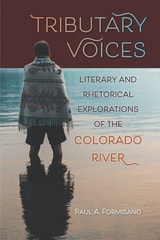
Tributary Voices
Literary and Rhetorical Exploration of the Colorado RiverPaul A. Formisano
University of Nevada Press, 2022
Through literary, rhetorical, and historical analysis of some of the Colorado River’s lesser-known stakeholders, Tributary Voices considers a more comprehensive approach to river management on the eve of the one-hundredth anniversary of the signing of the Colorado River Compact, which governs the allocation of water rights to the seven states in the region. Ranging from the early twentieth century to the present, Tributary Voices examines nature writing, women’s narratives, critiques of dam development, the Latina/o communities’ appeals for river restoration, American Indian authors’ and tribal nations’ claims of water sovereignty, and teachings about environmental stewardship and provident living. This innovative study models an interdisciplinary approach to water governance and reinvigorates our imagination in achieving a more sustainable water ethic.
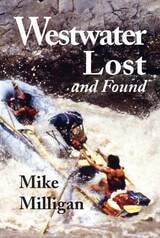
Westwater Lost and Found
Mike Milligan
Utah State University Press, 2004
Westwater Lost and Found
Expanded EditionMike Milligan
Utah State University Press, 2024
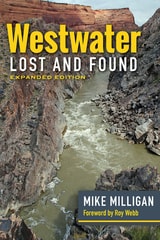
This expanded edition brings to light historical events and explores how Westwater’s location greatly contributed to early Grand (Upper) Colorado River boaters’ knowledge and how the lush Westwater Valley and Cisco became critical stops for water, wood, and grass along the North Branch of the Old Spanish Trail. Other new additions include explorer Ellsworth Kolb’s unpublished manuscript describing his 1916–1917 boating experiences on the Grand and Gunnison Rivers; two stories relating to Outlaw Cave, one of which expands upon the mystery of the outlaw brothers; a letter from James E. Miller to Frederick S. Dellenbaugh in 1906 revealing new information about his boating excursion with Oro DeGarmo Babcock on the Grand River in 1897; and a portion of botanist Frederick Kreutzfeld’s little-known journal of 1853 that describes Captain John W. Gunnison’s railroad survey.
Loaded with extensive information and river-running history, Milligan’s guide is sure to enhance readers’ knowledge of the Upper Colorado River and Grand Canyon regions. Boaters, river guides, scholars of the American West, and historians of the Colorado, Green, and Gunnison Rivers or the Old Spanish Trail will gain much from this new edition.