Results by title
22 books match the query 'Concentration camps'
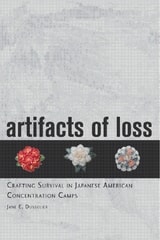
Artifacts of Loss
Crafting Survival in Japanese American Concentration CampsDusselier, Jane E
Rutgers University Press, 2008
In Artifacts of Loss, Jane E. Dusselier looks at the lives of these internees through the lens of their art. These camp-made creations included flowers made with tissue paper and shells, wood carvings of pets left behind, furniture made from discarded apple crates, gardens grown next to their housingùanything to help alleviate the visual deprivation and isolation caused by their circumstances. Their crafts were also central in sustaining, re-forming, and inspiring new relationships. Creating, exhibiting, consuming, living with, and thinking about art became embedded in the everyday patterns of camp life and helped provide internees with sustenance for mental, emotional, and psychic survival.
Dusselier urges her readers to consider these often overlooked folk crafts as meaningful political statements which are significant as material forms of protest and as representations of loss. She concludes briefly with a discussion of other displaced people around the globe today and the ways in which personal and group identity is reflected in similar creative ways.
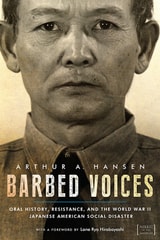
Barbed Voices
Oral History, Resistance, and the World War II Japanese American Social DisasterArthur A. Hansen
University Press of Colorado, 2021
What historically was benignly termed the “Japanese American Evacuation” was in fact a social disaster, which, unlike a natural disaster, is man-made. Examining the emotional implications of targeted systemic incarceration, Hansen highlights the psychological traumas that transformed Japanese American identity and culture for generations after the war. While many accounts of Japanese American incarceration rely heavily on government documents and analytic texts, Hansen’s focus on first-person Nikkei testimonies gathered through powerful oral history interviews gives expression to the resistance to this social disaster.
Analyzing the evolving historical memory of the effects of wartime incarceration, Barbed Voices presents a new scholarly framework of enduring value. It will be of interest to students and scholars of oral history, US history, public history, and ethnic studies as well as the general public interested in the WWII experience and civil rights.
Camp Life Is Paradise for Freddy
A Childhood in the Dutch East Indies, 1933–1946Fred Lanzing
Ohio University Press, 2017
“Children see and hear what is there; adults see and hear what they are expected to and mainly remember what they think they ought to remember,” David Lowenthal wrote in The Past Is a Foreign Country. It is on this fraught foundation that Fred Lanzing builds this memoir of his childhood in a Japanese internment camp for Dutch colonialists in the East Indies during the World War II.
When published in the Netherlands in 2007, the book triggered controversy, if not vitriol, for Lanzing’s assertion that his time in the camp was not the compendium of horrors commonly associated with the Dutch internment experience. Despite the angry reception, Lanzing’s account corresponds more closely with the scant historical record than do most camp memoirs. In this way, Lanzing’s work is a substantial addition to ongoing discussions of the politics of memory and the powerful—if contentious—contributions that subjective accounts make to historiography and to the legacies of the past.
Lanzing relates an aspect of the war in the Pacific seldom discussed outside the Netherlands and, by focusing on the experiences of ordinary people, expands our understanding of World War II in general. His compact, beautifully detailed account will be accessible to undergraduate students and a general readership and, together with the introduction by William H. Frederick, is a significant contribution to literature on World War II, the Dutch colonial experience, the history of childhood, and Southeast Asian history.

Civilian Internment in Canada
Histories and LegaciesRhonda Hinther
University of Manitoba Press, 2020
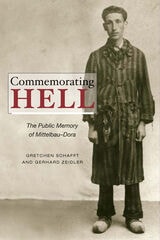
Commemorating Hell
The Public Memory of Mittelbau-DoraGretchen Schafft and Gerhard Zeidler
University of Illinois Press, 2011
Prisoners at Mittelbau-Dora built the V-1 and V-2 missiles, some of them coming into direct contact with Wernher von Braun and Arthur Rudolph, who later became leading engineers in the U.S. space program. Through the continuing story of Mittelbau-Dora, from its operation as a labor camp to its social construction as a monument, Schafft and Zeidler reflect an abiding interest in the memory and commemoration of notorious national events. In extending the analysis of Mittelbau-Dora into post-war and present-day Germany, Commemorating Hell uncovers the intricate relationship between the politics of memory and broader state and global politics, revealing insights about the camp's relationship to the American space pioneers and the fate of the nearby city of Nordhausen.
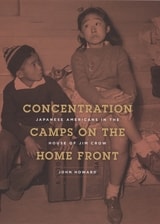
Concentration Camps on the Home Front
Japanese Americans in the House of Jim CrowJohn Howard
University of Chicago Press, 2008
While the basic facts of Japanese-American incarceration are well known, John Howard’s extensive research gives voice to those whose stories have been forgotten or ignored. He highlights the roles of women, first-generation immigrants, and those who forcefully resisted their incarceration by speaking out against dangerous working conditions and white racism. In addition to this overlooked history of dissent, Howard also exposes the government’s aggressive campaign to Americanize the inmates and even convert them to Christianity. After the war ended, this movement culminated in the dispersal of the prisoners across the nation in a calculated effort to break up ethnic enclaves.
Howard’s re-creation of life in the camps is powerful, provocative, and disturbing. Concentration Camps on the Home Front rewrites a notorious chapter in American history—a shameful story that nonetheless speaks to the strength of human resilience in the face of even the most grievous injustices.
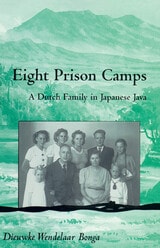
Eight Prison Camps
A Dutch Family in Japanese JavaDieuwke Wendelaar Bonga
Ohio University Press, 1996
Eldest daughter of eight children, the author grew up in Surakarta, Java, in what is now Indonesia. In the months following the bombing of Pearl Harbor, however, Dutch nationals were rounded up by Japanese soldiers and put in internment camps. Her father and brother were sent to separate men’s camps, leaving the author, her mother, and the five younger children in the women’s camp. In this and later seven other prison camps in central Java, their lives gradually deteriorated from early days of fear and crowding to near starvation, forced labor, beatings, and seeing others disappear or die. On the family’s return to Holland after the war, they found a nation recovering from German occupation and largely ignorant of the horror of the Far East experience.
Gasa Gasa Girl Goes to Camp
A Nisei Youth Behind A World War II FenceLily Yuriko Nakai Havey
University of Utah Press, 2014
In this creative memoir, Lily Havey combines storytelling, watercolor, and personal photographs to recount her youth in two Japanese-American internment camps during World War II. In short vignettes snapshots of people, recreated scenes and events a ten-year-old girl develops into a teenager while confined. Vintage photographs reveal the historical, cultural, and familial contexts of that growth and of the Nakais’ dislocation. The paintings and her animated writing together pull us into a turbulent era when America disgracefully incarcerated, without due process, thousands of American citizens because of their race.
These stories of love, loss, and discovery recall a girl balancing precariously between childhood and adolescence. In turn wrenching, funny, touching, and biting but consistently engrossing, they elucidate the daily challenges of life in the camp and the internees’ many adaptations.
Winner of the Evans Biography Award.
Selected by the American Library Association as one the Best of the Best from University Presses.
Finalist in the cover design category in the Southwest Book Design and Production Awards.
I Call to Remembrance
Toyo Suyemoto's Years of InternmentToyo Suyemoto and Edited by Susan B. Richardson
Rutgers University Press, 2007
A uniquely poetic contribution to the small body of internment memoirs, Suyemoto's account includes information about policies and wartime decisions that are not widely known, and recounts in detail the way in which internees adjusted their notions of selfhood and citizenship, lending insight to the complicated and controversial questions of citizenship, accountability, and resistance of first- and second-generation Japanese Americans.
Suyemoto's poems, many written during internment, are interwoven throughout the text and serve as counterpoints to the contextualizing narrative. Suyemoto's poems, many written during internment, are interwoven throughout the text and serve as counterpoints to the contextualizing narrative. A small collection of poems written in the years following her incarceration further reveal the psychological effects of her experience.
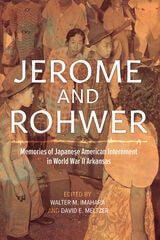
Jerome and Rohwer
Memories of Japanese American Internment in World War II ArkansasWalter M. Imahara
University of Arkansas Press, 2022
This book is a collection of brief memoirs written by former internees of Jerome and Rohwer and their close family members. Here dozens of individuals, almost all of whom are now in their eighties or nineties, share their personal accounts as well as photographs and other illustrations related to their life-changing experiences. The collection, likely to be one of the last of its kind, is the only work composed solely of autobiographical remembrances of life in Jerome and Rohwer, and one of the very few that gathers in a single volume the experiences of internees in their own words.
What emerges is a vivid portrait of lives lived behind barbed wire, where inalienable rights were flouted and American values suspended to bring a misguided sense of security to a race-obsessed nation at war. However, in the barracks and the fields, the mess halls and the makeshift gathering places, values of perseverance, tolerance, and dignity—the gaman the internees shared—gave significance to a transformative experience that changed forever what it means to call oneself an American.
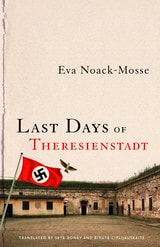
Last Days of Theresienstadt
Eva Noack-Mosse; Translated by Skye Doney and Biruté Ciplijauskaité
University of Wisconsin Press, 2018
Noack-Mosse's aim in documenting the horrors of daily life within Theresienstadt was to ensure that such a catastrophe could never be repeated. She also gathered from surviving inmates information about earlier events within the walled fortress, witnessed the defeat and departure of the Nazis, saw the arrival of the International Red Cross and the Soviet Army takeover of the camp and town, assisted in administration of the camp's closure, and aided displaced persons in discovering the fates of their family and friends. After the war ended, and she returned home, Noack-Mosse cross-referenced her data with that of others to provide evidence of Nazi crimes. At least 35,000 people died at Theresienstadt and another 90,000 were sent on to death camps.
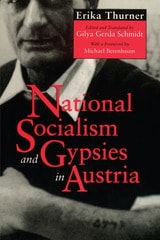
National Socialism and Gypsies in Austria
Erika Thurner
University of Alabama Press, 1998
In this first English translation of Erika Thurner's National Socialism and Gypsies in Austria, Gilya Gerda Schmidt makes available Thurner’s investigation of Camps Salzburg and Lackenbach, the two central areas of Gypsy persecution in Austria. Two factors made Thurner’s research especially difficult: the Roma and Sinti have more an oral tradition than a written one, and scholarship on the plight of the Gypsies is sparse. Through painstaking research, Thurner has been able to piece together fragments from Nazi documents, recollections of victims, accounts of bystanders and other eyewitnesses, and formal records to present her account. The result is a volume that truly enhances our understanding of the Gypsies’ experiences during this period.
The volume also focuses on broader aspects of the Gypsies’ ordeals: the ideological foundations and legal ordinances regarding Gypsies, the discrimination and persecution in Burgenland as a whole, the transports from Austria to Lodz and Chelmo, and the medical experimentation. The book has also been expanded, with a new study of Camp Salzburg, an updated bibliography, and numerous photographs, which were not included in the German edition.
The recent upsurge of anti-Gypsy violence in Austria illustrates both the horror of the treatment of Gypsy tribes and the timeliness of the subject of this volume.
Profiles in Survival
The Experiences of American POWs in the Philippines during World War IIJohn C. Shively
Indiana Historical Society Press, 2012
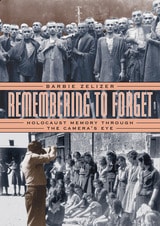
Remembering to Forget
Holocaust Memory through the Camera's EyeBarbie Zelizer
University of Chicago Press, 1998
"[A] fascinating study. . . . Here we have a completely fresh look at the emergence of photography as a major component of journalistic reporting in the course of the liberation of the camps by the Western Allies. . . . Well written and argued, superbly produced with more photographs of atrocity than most people would want to see in a lifetime, this is clearly an important book."—Omer Bartov, Times Literary Supplement
Seventeen Syllables and Other Stories
Yamamoto, Hisaye
Rutgers University Press, 2001
In addition to the contents of the original volume, this edition brings back into print the following works:
- Death Rides the Rails to Poston
- Eucalyptus
- A Fire in Fontana
- Florentine Gardens
Seventeen Syllables and Other Stories
Yamamoto, Hisaye
Rutgers University Press, 2001
The Complete Lives of Camp People
Colonialism, Fascism, Concentrated ModernityRudolf Mrázek
Duke University Press, 2020
The Politics of Fieldwork
Research in an American Concentration CampLane Ryo Hirabayashi
University of Arizona Press, 1999
In addressing these questions, author Lane Hirabayashi examines the case of the late Dr. Tamie Tsuchiyama. At the time an advanced doctoral student in anthropology, Tsuchiyama was hired in 1942 to conduct ethnographic fieldwork for the University of California at Berkeley's Japanese American Evacuation and Resettlement Study. Drawing from personal letters, ethnographic fieldnotes, reports, interviews, and other archival sources, The Politics of Fieldwork describes Tsuchiyama's experiences as a researcher at Poston, Arizona—a.k.a. the Colorado River Relocation Center. The book relates the daily life, fieldwork methodology, and politics of the residents and researchers at the Poston camp, as well as providing insight into the pressures that led to Tsuchiyama's ultimate resignation, in protest, from the JERS project in 1945.
Facilitating the critical analysis of Tsuchiyama's role in the JERS research are questions regarding the relationships between Japanese American research and the nature of "colonial science" that merit discussion in contemporary field research. A multidisciplinary synthesis of anthropological, historical, and ethnic studies perspectives, The Politics of Fieldwork is rich with lessons about the ethics and politics of ethnographic fieldwork.

The Red Kimono
A NovelJan Morrill
University of Arkansas Press, 2013
The Resistance Network
The Armenian Genocide and Humanitarianism in Ottoman Syria, 1915–1918Khatchig Mouradian
Michigan State University Press, 2021
Torture, Humiliate, Kill
Inside the Bosnian Serb Camp SystemHikmet Karcic
University of Michigan Press, 2022
Half a century after the Holocaust, on European soil, Bosnian Serbs orchestrated a system of concentration camps where they subjected their Bosniak Muslim and Bosnian Croat neighbors to torture, abuse, and killing. Foreign journalists exposed the horrors of the camps in the summer of 1992, sparking worldwide outrage. This exposure, however, did not stop the mass atrocities. Hikmet Karčić shows that the use of camps and detention facilities has been a ubiquitous practice in countless wars and genocides in order to achieve the wartime objectives of perpetrators. Although camps have been used for different strategic purposes, their essential functions are always the same: to inflict torture and lasting trauma on the victims.
Torture, Humiliate, Kill develops the author’s collective traumatization theory, which contends that the concentration camps set up by the Bosnian Serb authorities had the primary purpose of inflicting collective trauma on the non-Serb population of Bosnia and Herzegovina. This collective traumatization consisted of excessive use of torture, sexual abuse, humiliation, and killing. The physical and psychological suffering imposed by these methods were seen as a quick and efficient means to establish the Serb “living space.” Karčić argues that this trauma was deliberately intended to deter non-Serbs from ever returning to their pre-war homes. The book centers on multiple examples of experiences at concentration camps in four towns operated by Bosnian Serbs during the war: Prijedor, Bijeljina, Višegrad, and Bileća. Chosen according to their political and geographical position, Karčić demonstrates that these camps were used as tools for the ethno-religious genocidal campaign against non-Serbs. Torture, Humiliate, Kill is a thorough and definitive resource for understanding the function and operation of camps during the Bosnian genocide.

Voices from the Gulag
Aleksandr Solzhenitsyn
Northwestern University Press, 2010
After the publication in 1962 of One Day in the Life of Ivan Denisovich, Aleksandr Solzhenitsyn began receiving, and would continue to receive throughout his life, testimonies from fellow survivors of the gulag. Originally selected by Solzhenitsyn, the memoirs in this volume are an important addition to the literature of the Soviet gulag. Written by men from a wide variety of occupations and social classes, the writing in Voices from the Gulag lends a voice to the many ordinary people—including a circus performer, a teenage boy, and a Red Army soldier—whom a brutal system attempted to erase from memory.