Results by title
40 books match the query 'Country music'
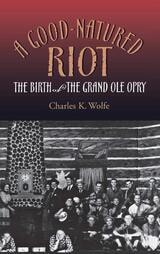
A Good-Natured Riot
The Birth of the Grand Ole OpryCharles K. Wolfe
Vanderbilt University Press, 1999
Winner of the ASCAP Deems Taylor Award
On November 28, 1925, a white-bearded man sat before one of Nashville radio station WSM's newfangled carbon microphones to play a few old-time fiddle tunes. Uncle Jimmy Thompson played on the air for an hour that night, and throughout the region listeners at their old crystal sets suddenly perked up. Back in Nashville the response at the offices of National Life Insurance Company, which owned radio station WSM ("We Shield Millions"), was dramatic; phone calls and telegrams poured into the station, many of them making special requests. It was not long before station manager George D. Hay was besieged by pickers and fiddlers of every variety, as well as hoedown bands, singers, and comedians--all wanting their shot at the Saturday night airwaves. "We soon had a good-natured riot on our hands," Hay later recalled. And, thus, the Opry was born.
Or so the story goes. In truth, the birth of the Opry was a far more complicated event than even Hay, "the solemn old Judge," remembered. The veteran performers of that era are all gone now, but since the 1970s pioneering country music historian Charles K. Wolfe has spent countless hours recording the oral history of the principals and their families and mining archival materials from the Country Music Foundation and elsewhere to understand just what those early days were like. The story that he has reconstructed is fascinating. Both a detailed history and a group biography of the Opry's early years, A Good-Natured Riot provides the first comprehensive and thoroughly researched account of the personalities, the music, and the social and cultural conditions that were such fertile ground for the growth of a radio show that was to become an essential part of American culture.
Wolfe traces the unsure beginnings of the Opry through its many incarnations, through cast tours of the South, the Great Depression, commercial sponsorship by companies like Prince Albert Tobacco, and the first national radio linkups. He gives colorful and engaging portraits of the motley assembly of the first Opry casts--amateurs from the hills and valleys surrounding Nashville, like harmonica player Dr. Humphrey Bate ("Dean of the Opry") and fiddler Sid Harkreader, virtuoso string bands like the Dixieliners, colorful hoedown bands like the Gully Jumpers and the Fruit Jar Drinkers, the important African American performer DeFord Bailey, vaudeville acts and comedians like Lasses and Honey, through more professional groups such as the Vagabonds, the Delmore Brothers, Bill Monroe and the Blue Grass Boys, and perennial favorite Roy Acuff and his Smoky Mountain Boys.
With dozens of wonderful photographs and a complete roster of every performer and performance of these early Opry years, A Good-Natured Riot gives a full and authoritative portrayal of the colorful beginnings of WSM's barn dance program up to 1940, by which time the Grand Ole Opry had found its national audience and was poised to become the legendary institution that it remains to this day.
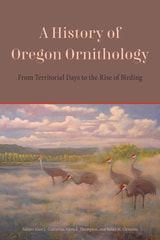
A History of Oregon Ornithology
From Territorial Days to the Rise of BirdingAlan L. Contreras
Oregon State University Press, 2022
Editors Alan Contreras, Vjera Thompson, and Nolan Clements have assembled chapters exploring the differences and interplay between the amateur and professional study of birds, along with discussions of early birding societies, notable observers, and ornithological studies. It includes significant chapters on Charles Bendire, William L. Finley, Ira Gabrielson, Stanley Jewett, and David B. Marshall. It also notes the sometimes-overlooked contributions of women to our expanding knowledge of western birds. Special attention is paid to the development of seabird observation, the impact of the Internet, and the rise of digital resources for bird observers.
Intended for readers interested in the history of Oregon, the history of scientific explorations in the west, and the origins of modern birding and field ornithology, A History of Oregon Ornithology offers a detailed and entertaining tour of how birds were first observed and studied by explorers in what is now Oregon.
All That Glitters
Country Music in AmericaGeorge H. Lewis
University of Wisconsin Press, 1993

Baseball and Country Music
Don Cusic
University of Wisconsin Press, 2003
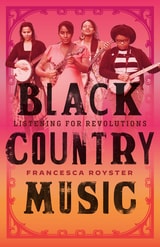
Black Country Music
Listening for RevolutionsFrancesca T. Royster
University of Texas Press, 2022
2023 Ralph J. Gleason Music Book Award, Rock & Roll Hall of Fame
2024 Woody Guthrie Book Award, International Association for the Study of Popular Music-US Branch (IASPM-US)
2023 Certificate of Merit, ARSC Awards for Excellence in Historical Recorded Sound Research, Association for Recorded Sound Collections
2023 The Judy Tsou Critical Race Studies Award, American Musicological Society
How Black musicians have changed the country music landscape and brought light to Black creativity and innovation.
After a century of racist whitewashing, country music is finally reckoning with its relationship to Black people. In this timely work—the first book on Black country music by a Black writer—Francesca Royster uncovers the Black performers and fans, including herself, who are exploring the pleasures and possibilities of the genre.
Informed by queer theory and Black feminist scholarship, Royster’s book elucidates the roots of the current moment found in records like Tina Turner’s first solo album, Tina Turns the Country On! She reckons with Black “bros” Charley Pride and Darius Rucker, then chases ghosts into the future with Valerie June. Indeed, it is the imagination of Royster and her artists that make this music so exciting for a genre that has long been obsessed with the past. The futures conjured by June and others can be melancholy, and are not free of racism, but by centering Black folk Royster begins to understand what her daughter hears in the banjo music of Our Native Daughters and the trap beat of Lil Nas X’s “Old Town Road.” A Black person claiming country music may still feel a bit like a queer person coming out, but, collectively, Black artists and fans are changing what country music looks and sounds like—and who gets to love it.
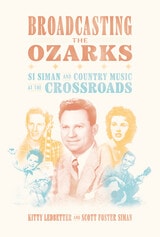
Broadcasting the Ozarks
Si Siman and Country Music at the CrossroadsKitty Ledbetter
University of Arkansas Press, 2024
“It’s good to see Si Siman and the Ozark Jubilee get their due in Broadcasting the Ozarks.”
—Willie Nelson
Broadcasting the Ozarks explores the vibrant country music scene that emerged in Springfield, Missouri, in the 1930s and thrived for half a century. Central to this history is the Ozark Jubilee (1955–60), the first regularly broadcast live country music show on network television. Dubbed the “king of the televised barn dances,” the show introduced the Ozarks to viewers across America and put Springfield in the running with Nashville for dominance of the country music industry—with the Jubilee’s producer, Si Siman, at the helm.
Siman’s life story is almost as remarkable as the show he produced. He was booking Tommy Dorsey, Ella Fitzgerald, and Glenn Miller during the mid-1930s while still a high school student and produced nationally syndicated country music radio shows in the decades that followed. Siman was a promotional genius with an ear for talent, a persuasive gift for gab, and the energy and persistence to make things happen for many future Country Music Hall of Famers, including Chet Atkins, Porter Wagoner, the Browns, and Brenda Lee. Following the Jubilee’s five-year run, Siman had a hand in some of the greatest hits of the twentieth century as a music publisher, collaborating with such songwriters as rockabilly legend and fellow Springfieldian Ronnie Self, who wrote Brenda Lee’s signature hit, “I’m Sorry,” and Wayne Carson, who wrote Willie Nelson’s “Always on My Mind.” Although Siman had numerous opportunities to find success in bigger cities, he chose to do it all from his hometown in the Ozarks.

Country Comes to Town
The Music Industry and the Transformation of NashvilleHill Jeremy
University of Massachusetts Press, 0
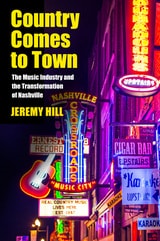
Country Comes to Town
The Music Industry and the Transformation of NashvilleJeremy Hill
University of Massachusetts Press, 2016
Country music evokes a simple, agrarian past, with images of open land and pickup trucks. While some might think of the genre as a repository of nostalgia, popular because it preserves and reveres traditional values, Jeremy Hill argues that country music has found such expansive success because its songs and its people have forcefully addressed social and cultural issues as well as geographic change. Hill demonstrates how the genre and its fans developed a flexible idea of “country,” beyond their rural roots, and how this flexibility allowed fans and music to “come to town,” to move into and within urban spaces, while retaining a country “character.”
To understand how the genre has become the far-reaching commercial phenomenon that it is today, Hill explores how various players within the country music fold have grappled with the notion of place. He shows both how the industry has transformed the city of Nashville and how country music—through song lyrics, imagery associated with the music, and branding—has reshaped ideas about the American landscape and character. As the genre underwent significant change in the last decades of the twentieth century, those who sought to explain its new styles and new locations relied on a traditional theme: “You can take the boy out of the country, but you can't take the country out of the boy.” Hill demonstrates how this idea—that you can still be “country” while no longer living in a rural place—has been used to expand country's commercial appeal and establish a permanent home in the urban space of Nashville.
Country Music Message
RevisitedJimmie Rogers
University of Arkansas Press, 1988
The Country Music Message: Revisited is more than a history of commercial country music, a discussion of the performers, or a compilation of song lyrics. It is an examination of the way the “message” in country songs is relayed and received: why the songs move us as they do. As Jimmie Rogers saying in his preface, “A country song is a special form of communication——communication that more closely resembles interpersonal or face-to-face interaction between two people than do other types of mass appeal music. This close bond that exists between audience and performers, as well as the unique treatment of the song topics, helps to make the music, the performers, and the audience special. After the characteristics are reviewed, observations are made about the audience that accepts and approves these messages. The topics, and the approach to those topics by the songwriter and by the singers, tell us much about the audience that chose to listen to country music.”
If you are already a fan of country music, this book will provide insights into a process you’ve probably taken for granted. If you are a newcomer, you will better understand and appreciate the music that a “few folks are performing for a large number of people.”
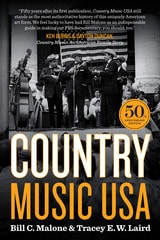
Country Music USA
50th Anniversary EditionBy Bill C. Malone and Tracey E. W. Laird
University of Texas Press, 2018
“Fifty years after its first publication, Country Music USA still stands as the most authoritative history of this uniquely American art form. Here are the stories of the people who made country music into such an integral part of our nation’s culture. We feel lucky to have had Bill Malone as an indispensable guide in making our PBS documentary; you should, too.”
—Ken Burns and Dayton Duncan, Country Music: An American Family Story
From reviews of previous editions:
“Considered the definitive history of American country music.”
—Los Angeles Times
“If anyone knows more about the subject than [Malone] does, God help them.”
—Larry McMurtry, from In a Narrow Grave
“With Country Music USA, Bill Malone wrote the Bible for country music history and scholarship. This groundbreaking work, now updated, is the definitive chronicle of the sweeping drama of the country music experience.”
—Chet Flippo, former editorial director, CMT: Country Music Television and CMT.com
“Country Music USA is the definitive history of country music and of the artists who shaped its fascinating worlds.”
—William Ferris, University of North Carolina at Chapel Hill, former chairman of the National Endowment for the Humanities and coeditor of the Encyclopedia of Southern Culture
Since its first publication in 1968, Bill C. Malone’s Country Music USA has won universal acclaim as the definitive history of American country music. Starting with the music’s folk roots in the rural South, it traces country music from the early days of radio into the twenty-first century. In this fiftieth-anniversary edition, Malone, the featured historian in Ken Burns’s 2019 documentary on country music, has revised every chapter to offer new information and fresh insights. Coauthor Tracey Laird tracks developments in country music in the new millennium, exploring the relationship between the current music scene and the traditions from which it emerged.
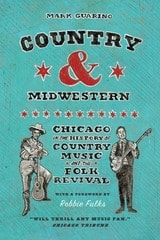
Country and Midwestern
Chicago in the History of Country Music and the Folk RevivalMark Guarino
University of Chicago Press, 2023
Chicago is revered as a musical breeding ground, having launched major figures like blues legend Muddy Waters, gospel soul icon Mavis Staples, hip-hop firebrand Kanye West, and the jazz-rock band that shares its name with the city. Far less known, however, is the vital role Chicago played in the rise of prewar country music, the folk revival of the 1950s and 1960s, and the contemporary offspring of those scenes.
In Country and Midwestern, veteran journalist Mark Guarino tells the epic century-long story of Chicago’s influence on sounds typically associated with regions further south. Drawing on hundreds of interviews and deep archival research, Guarino tells a forgotten story of music, migration, and the ways that rural culture infiltrated urban communities through the radio, the automobile, and the railroad. The Midwest’s biggest city was the place where rural transplants could reinvent themselves and shape their music for the new commercial possibilities the city offered. Years before Nashville emerged as the commercial and spiritual center of country music, major record labels made Chicago their home and recorded legendary figures like Bill Monroe, The Carter Family, and Gene Autry. The National Barn Dance—broadcast from the city’s South Loop starting in 1924—flourished for two decades as the premier country radio show before the Grand Ole Opry. Guarino chronicles the makeshift niche scenes like “Hillbilly Heaven” in Uptown, where thousands of relocated Southerners created their own hardscrabble honky-tonk subculture, as well as the 1960s rise of the Old Town School of Folk Music, which eventually brought national attention to local luminaries like John Prine and Steve Goodman. The story continues through the end of the twentieth century and into the present day, where artists like Jon Langford, The Handsome Family, and Wilco meld contemporary experimentation with country traditions.
Featuring a foreword from Grammy-nominated singer-songwriter Robbie Fulks and casting a cross-genre net that stretches from Bob Dylan to punk rock, Country and Midwestern rediscovers a history as sprawling as the Windy City—celebrating the creative spirit that modernized American folk idioms, the colorful characters who took them into new terrain, and the music itself, which is still kicking down doors even today.
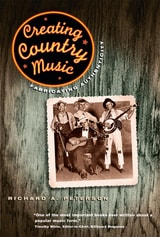
Creating Country Music
Fabricating AuthenticityRichard A. Peterson
University of Chicago Press, 1997
"[Peterson] restores to the music a sense of fun and diversity and possibility that more naive fans (and performers) miss. Like Buck Owens, Peterson knows there is no greater adventure or challenge than to 'act naturally.'"—Ken Emerson, Los Angeles Times Book Review
"A triumphal history and theory of the country music industry between 1920 and 1953."—Robert Crowley, International Journal of Comparative Sociology
"One of the most important books ever written about a popular music form."—Timothy White, Billboard Magazine
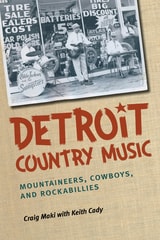
Detroit Country Music
Mountaineers, Cowboys, and RockabilliesCraig Maki with Keith Cady
University of Michigan Press, 2013
The richness of Detroit’s music history has by now been well established. We know all about Motown, the MC5, and Iggy and the Stooges. We also know about the important part the Motor City has played in the history of jazz. But there are stories about the music of Detroit that remain untold. One of the lesser known but nonetheless fascinating histories is contained within Detroit’s country music roots. At last, Craig Maki and Keith Cady bring to light Detroit’s most important country and western and bluegrass stars, such as Chief Redbird, the York Brothers, and Roy Hall. Beyond the individuals, Maki and Cady also map out the labels, radio programs, and performance venues that sustained Detroit’s vibrant country and bluegrass music scene. In the process, Detroit Country Music examines how and why the city’s growth in the early twentieth century, particularly the southern migration tied to the auto industry, led to this vibrant roots music scene.
This is the first book—the first resource of any kind—to tell the story of Detroit’s contributions to country music. Craig Maki and Keith Cady have spent two decades collecting music and images, and visiting veteran musicians to amass more than seventy interviews about country music in Detroit. Just as astounding as the book’s revelations are the photographs, most of which have never been published before. Detroit Country Musicwill be essential reading for music historians, record collectors, roots music fans, and Detroit music aficionados.
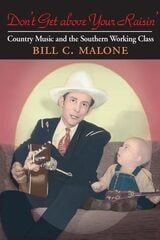
Don't Get above Your Raisin'
Country Music and the Southern Working ClassBill C. Malone
University of Illinois Press, 2002
Widely recognized as country music's ranking senior authority, Bill C. Malone explores how the music's defining themes (home and family, religion, rambling, frolic, humor, and politics) have emerged out of the particularities of working people's day-to-day lives. He traces the many contradictory voices and messages of a music that simultaneously extols the virtues of home and the joys of rambling, the assurances of the Christian life and the ecstasies of hedonism, the strength of working-class life and the material lure of middle-class aspirations. The resulting tensions, Malone argues, are a principal source of the music's enduring appeal.
Country musicians have often been people from undistinguished blue-collar backgrounds who have tried to make their way as entertainers in a society that has little respect for the working class. From this ambivalent position, they have voiced the sometimes contradictory values and longings of their culture while also attempting to fulfill the romantic expectations of outsiders.
"For every Garth Brooks," Malone says, "there are a thousand country musicians who perform in local bars, taverns, and American Legion halls and who have never been able to ‘give up their day jobs.' These are musicians whose middle-class dreams are tempered by working-class realities." A powerful and honest expression of the hopes, longings, frailties, and failings of ordinary people, country music increasingly resonates with listeners beyond its core constituency as they struggle with a complex and uncertain world.

For the Sake of the Song
Essays on Townes Van ZandtAnn Norton Holbrook
University of North Texas Press, 2022
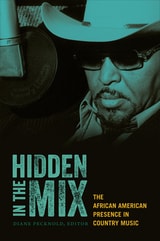
Hidden in the Mix
The African American Presence in Country MusicDiane Pecknold, ed.
Duke University Press, 2013
The contributors to Hidden in the Mix examine how country music became "white," how that fictive racialization has been maintained, and how African American artists and fans have used country music to elaborate their own identities. They investigate topics as diverse as the role of race in shaping old-time record catalogues, the transracial West of the hick-hopper Cowboy Troy, and the place of U.S. country music in postcolonial debates about race and resistance. Revealing how music mediates both the ideology and the lived experience of race, Hidden in the Mix challenges the status of country music as "the white man’s blues."
Contributors. Michael Awkward, Erika Brady, Barbara Ching, Adam Gussow, Patrick Huber, Charles Hughes, Jeffrey A. Keith, Kip Lornell, Diane Pecknold, David Sanjek, Tony Thomas, Jerry Wever
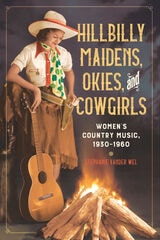
Hillbilly Maidens, Okies, and Cowgirls
Women's Country Music, 1930-1960Stephanie Vander Wel
University of Illinois Press, 2020
From the 1930s to the 1960s, the booming popularity of country music threw a spotlight on a new generation of innovative women artists. These individuals blazed trails as singers, musicians, and performers even as the industry hemmed in their potential popularity with labels like woman hillbilly, singing cowgirl, and honky-tonk angel.
Stephanie Vander Wel looks at the careers of artists like Patsy Montana, Rose Maddox, and Kitty Wells against the backdrop of country music's golden age. Analyzing recordings and appearances on radio, film, and television, she connects performances to real and imagined places and examines how the music sparked new ways for women listeners to imagine the open range, the honky-tonk, and the home. The music also captured the tensions felt by women facing geographic disruption and economic uncertainty. While classic songs and heartfelt performances might ease anxieties, the subject matter underlined women's ambivalent relationships to industrialism, middle-class security, and established notions of femininity.
I'd Fight the World
A Political History of Old-Time, Hillbilly, and Country MusicPeter La Chapelle
University of Chicago Press, 2019
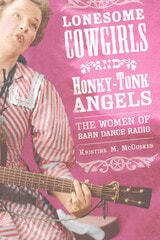
Lonesome Cowgirls and Honky-Tonk Angels
The Women of Barn Dance RadioKristine M. McCusker
University of Illinois Press, 2007
Drawing on personal interviews and rich archival material from the Grand Ole Opry, Kristine M. McCusker examines the gendered politics of the images through the lives and careers of six women performers: Linda Parker, the Girls of the Golden West (Milly and Dolly Good), Lily May Ledford, Minnie Pearl, and Rose Lee Maphis.
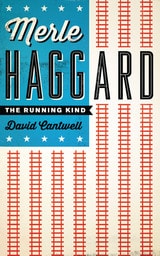
Merle Haggard
The Running KindBy David Cantwell
University of Texas Press, 2013
Merle Haggard has enjoyed artistic and professional triumphs few can match. He’s charted more than a hundred country hits, including thirty-eight number ones. He’s released dozens of studio albums and another half dozen or more live ones, performed upwards of ten thousand concerts, been inducted into the Country Music Hall of Fame, and seen his songs performed by artists as diverse as Lynryd Skynyrd, Elvis Costello, Tammy Wynette, Willie Nelson, the Grateful Dead, and Bob Dylan. In 2011 he was feted as a Kennedy Center Honoree. But until now, no one has taken an in-depth look at his career and body of work.
In Merle Haggard: The Running Kind, David Cantwell takes us on a revelatory journey through Haggard’s music and the life and times out of which it came. Covering the entire breadth of his career, Cantwell focuses especially on the 1960s and 1970s, when Haggard created some of his best-known and most influential music, which helped invent the America we live in today. Listening closely to a masterpiece-crowded catalogue (including songs such as “Okie from Muskogee,” “Sing Me Back Home,” “Mama Tried,” “Working Man Blues,” “Kern River,” “White Line Fever,” “Today I Started Loving You Again,” and “If We Make It through December,” among many more), Cantwell explores the fascinating contradictions—most of all, the desire for freedom in the face of limits set by the world or self-imposed—that define not only Haggard’s music and public persona but the very heart of American culture.
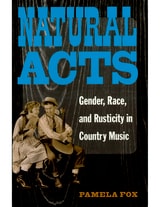
Natural Acts
Gender, Race, and Rusticity in Country MusicPamela Fox
University of Michigan Press, 2009
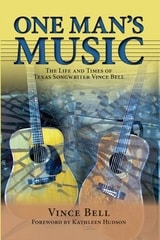
One Man's Music
The Life and Times of Texas Songwriter Vince BellVince Bell
University of North Texas Press, 2009
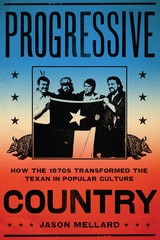
Progressive Country
How the 1970s Transformed the Texan in Popular CultureBy Jason Mellard
University of Texas Press, 2013
Winner, Coral Horton Tullis Memorial Prize, Texas State Historical Association, 2014
During the early 1970s, the nation’s turbulence was keenly reflected in Austin’s kaleidoscopic cultural movements, particularly in the city’s progressive country music scene. Capturing a pivotal chapter in American social history, Progressive Country maps the conflicted iconography of “the Texan” during the ’70s and its impact on the cultural politics of subsequent decades.
This richly textured tour spans the notion of the “cosmic cowboy,” the intellectual history of University of Texas folklore and historiography programs, and the complicated political history of late-twentieth-century Texas. Jason Mellard analyzes the complex relationship between Anglo-Texan masculinity and regional and national identities, drawing on cultural studies, American studies, and political science to trace the implications and representations of the multi-faceted personas that shaped the face of powerful social justice movements. From the death of Lyndon Johnson to Willie Nelson’s picnics, from the United Farm Workers’ marches on Austin to the spectacle of Texas Chic on the streets of New York City, Texas mattered in these years not simply as a place, but as a repository of longstanding American myths and symbols at a historic moment in which that mythology was being deeply contested.
Delivering a fresh take on the meaning and power of “the Texan” and its repercussions for American history, this detail-rich exploration reframes the implications of a populist moment that continues to inspire progressive change.
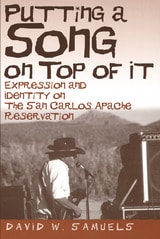
Putting a Song on Top of It
Expression and Identity on the San Carlos Apache ReservationDavid W. Samuels
University of Arizona Press, 2004
For many people on the San Carlos reservation, both the traditional calls of the Mountain Spirits and the hard edge of a country, rock, or reggae song can evoke the feeling of being Apache. Using insights gained from both linguistic and musical practices in the community—as well as from his own experience playing in an Apache country band—David W. Samuels explores the complex expressive lives of these people to offer new ways of thinking about cultural identity.
Samuels analyzes how people on the reservation make productive use of popular culture forms to create and transform contemporary expressions of Apache cultural identity. As Samuels learned, some popular songs—such as those by Bob Marley—are reminiscent of history and bring about an alignment of past and present for the Apache listener. Thinking about Geronimo, for instance, might mean one thing, but “putting a song on top of it” results in a richer meaning. Samuels also proposes that the concept of the pun, as both a cultural practice and a means of analysis, helps us understand the ways in which San Carlos Apaches are able to make cultural symbols point in multiple directions at once. Through these punning, layered expressions, people on the reservation express identities that resonate with the complicated social and political history of the Apache community.
This richly detailed study challenges essentialist notions of Native American tribal and ethnic identity by revealing the turbulent complexity of everyday life on the reservation. Samuels’s work is a multifaceted exploration of the complexities of sound, of language, and of the process of constructing and articulating identity in the twenty-first century.
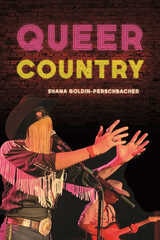
Queer Country
Shana Goldin-Perschbacher
University of Illinois Press, 2022
- A Variety Best Music Book of 2022
- A No Depression Most Memorable Music Book of 2022
- A Library Journal Best Arts and Humanities Book of 2022
- A Pitchfork Best Music Book of 2022
- A Boot Best Music Book of 2022
- A Ticketmaster Best Music Book of 2022
- A Happy Magazine Best Music Book of 2022
- Woody Guthrie First Book Award winner
- Awarded a Certificate of Merit in the 2023 ARSC Awards for Excellence in Historical Recorded Sound Research in the category Best Historical Research in Country, Folk, Roots, or World Music.
Though frequently ignored by the music mainstream, queer and transgender country and Americana artists have made essential contributions as musicians, performers, songwriters, and producers. Queer Country blends ethnographic research with analysis and history to provide the first in-depth study of these artists and their work. Shana Goldin-Perschbacher delves into the careers of well-known lesbian artists like k.d. lang and Amy Ray and examines the unlikely success of singer-songwriter Patrick Haggerty, who found fame forty years after releasing the first out gay country album. She also focuses on later figures like nonbinary transgender musician Rae Spoon and renowned drag queen country artist Trixie Mattel; and on recent breakthrough artists like Orville Peck, Amythyst Kiah, and chart-topping Grammy-winning phenomenon Lil Nas X. Many of these musicians place gender and sexuality front and center even as it complicates their careers. But their ongoing efforts have widened the circle of country/Americana by cultivating new audiences eager to connect with the artists’ expansive music and personal identities.
Detailed and one-of-a-kind, Queer Country reinterprets country and Americana music through the lives and work of artists forced to the margins of the genre's history.
Reading Country Music
Steel Guitars, Opry Stars, and Honky Tonk BarsCecelia Tichi, ed.
Duke University Press, 1998
Bringing together a wide range of scholars and critics from literature, communications, history, sociology, art, and music, this anthology looks at everything from the inner workings of the country music industry to the iconography of certain stars to the development of distinctive styles within the country music genre. Essays include a look at the shift from "hard-core" to "soft-shell" country music in recent years; Johnny Cash as lesbian icon; gender, class, and region in Dolly Parton’s star image; and bluegrass’s gothic tradition. Originally published as a special issue of South Atlantic Quarterly, this expanded book edition includes new articles on the spirituality of Willie Nelson, the legacy and tradition of stringed music, and the revival of Stephen Foster’s blackface musical, among others.
Contributors. Mary A. Bufwack, Don Cusic, Curtis W. Ellison, Mark Fenster, Vivien Green Fryd, Teresa Goddu, T. Walter Herbert, Christine Kreyling, Michael Kurek, Amy Schrager Lang, Charmaine Lanham, Bill Malone, Christopher Metress, Jocelyn Neal, Teresa Ortega, Richard A. Peterson, Ronnie Pugh, John W. Rumble, David Sanjek, Cecelia Tichi, Pamela Wilson, Charles K. Wolfe
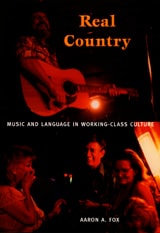
Real Country
Music and Language in Working-Class CultureAaron A. Fox
Duke University Press, 2004
Fox spent hundreds of hours observing, recording, and participating in talk and music-making in homes, beer joints, and garage jam sessions. He renders the everyday life of Lockhart’s working-class community in detail, right down to the ice cold beer, the battered guitars, and the technical skills of such local musical legends as Randy Meyer and Larry “Hoppy” Hopkins. Throughout, Fox focuses on the human voice. His analyses of conversations, interviews, songs, and vocal techniques show how feeling and experience are expressed, and how local understandings of place, memory, musical aesthetics, working-class social history, race, and gender are shared. In Real Country, working-class Texans re-imagine their past and give voice to the struggles and satisfactions of their lives in the present through music.
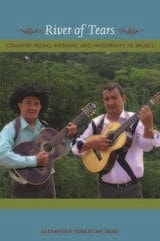
River of Tears
Country Music, Memory, and Modernity in BrazilAlexander Sebastian Dent
Duke University Press, 2009
Since 1998, Alexander Sebastian Dent has analyzed rural music in the state of São Paulo, interviewing and spending time with listeners, musicians, songwriters, journalists, record-company owners, and radio hosts. Dent not only describes the production and reception of this music, he also explains why the genre experienced such tremendous growth as Brazil transitioned from an era of dictatorship to a period of intense neoliberal reform. Dent argues that rural genres reflect a widespread anxiety that change has been too radical and has come too fast. In defining their music as rural, Brazil’s country musicians—whose work circulates largely in cities—are criticizing an increasingly inescapable urban life characterized by suppressed emotions and an inattentiveness to the past. Their performances evoke a river of tears flowing through a landscape of loss—of love, of life in the countryside, and of man’s connections to the natural world.
So Lonesome
Hank Williams and the Creation of Country MusicRichard A. Peterson
University of Chicago Press, 1997
Sweet Dreams
The World of Patsy ClineEdited by Warren R. Hofstra
University of Illinois Press, 2013
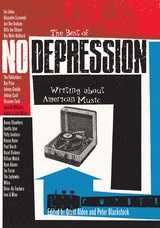
The Best of No Depression
Writing about American MusicEdited by Grant Alden and Peter Blackstock
University of Texas Press, 2005
Since the magazine's founding in 1995, No Depression has reported on and helped define the music that goes by names such as alt.country, Americana, and roots music. Though dismissed by the commercial country music establishment as "music that doesn't sell," alternative country has attracted thousands of listeners who long for the authenticity and rich complexity that come from its potent blend of country and rock 'n' roll and any number of related musical genres and subgenres.
To celebrate No Depression's tenth anniversary and spotlight some of the most important artists and trends in alt.country music, editors Grant Alden and Peter Blackstock have compiled this anthology of twenty-five of the magazine's best and most representative feature articles. Their subjects range from venerated country artists such as Johnny Cash and Ray Price to contemporary songwriters such as Lucinda Williams and Buddy and Julie Miller to the post-punk country-influenced bands Wilco and the Drive-By Truckers. All of the articles included here illustrate No Depression's commitment to music writing that puts the artist front-and-center and covers his or her career in sufficient depth to be definitive. Alden and Blackstock have also written a preface to this volume in which they discuss the alt.country phenomenon and the history and editorial philosophy that have made No Depression the bible for everyone seeking genuine American roots music.
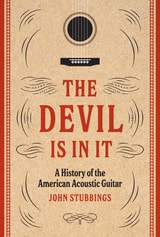
The Devil Is in It
A History of the American Acoustic GuitarJohn Stubbings
University of Texas Press, 2025
The rich history of the acoustic guitar and its impact on the music world.
In 2020, guitar expert John Stubbings released a limited-edition book on the American acoustic guitar that sold out in days. Now, The Devil Is in It returns with additional research and subject matter for a new generation of readers. Stubbings traveled the country and met with guitar makers, players, collectors, and historians to unravel the long and rich history of the acoustic guitar, its evolution, and the music it has made over the last hundred years.
Starting with the eighteenth-century European classical guitar, luthiers altered the instrument, changing the way musicians played them, and in turn the music they made. This slow but steady transformation created the iconic American flat-top that became influential across genres and rooted itself in cultural significance. The guitar developed from an obscure instrument into a superstar of the musical world, rivaling then overshadowing its competition. Tied to artists from Gillian Welch and Tracy Chapman to Taylor Swift and Ed Sheeran, the acoustic guitar maintains its eminence in American music and culture. The story of an alluring instrument that shaped the music of the twentieth century, The Devil Is in It is a must-read for lovers of the acoustic guitar and the music it has made.
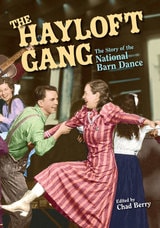
The Hayloft Gang
The Story of the National Barn DanceEdited by Chad Berry
University of Illinois Press, 2007
The Hayloft Gang draws on the colorful commentary of performers and former listeners to analyze the National Barn Dance, its audience, and its impact. Contributors trace the history of barn dance radio, explore the paradox of a foundational country music program broadcast from a major city, investigate notions of authenticity in the presentation of country music and entertainment, and delve into provocative issues raised by the barn dance phenomenon.
Contributors: Chad Berry, Michael T. Bertrand, Lisa Krissoff Boehm, Don Cusic, Wayne W. Daniel, Loyal Jones, Kristine M. McCusker, Stephen Parry, Susan Smulyan, Paul L. Tyler, and Michael Ann Williams.
The Honky Tonk on the Left
Progressive Thought in Country MusicMark Allan Jackson
University of Massachusetts Press, 2018
Bringing together a wide spectrum of cultural critics, The Honky Tonk on the Left takes on this conservative stereotype and reveals how progressive thought has permeated country music from its beginnings to the present day. The original essays in this collection analyze how diverse performers, including Fiddlin' John Carson, Webb Pierce, Loretta Lynn, Johnny Cash, O. B. McClinton, Garth Brooks, and Uncle Tupelo, have taken on such issues as government policies, gender roles, civil rights, prison reform, and labor unrest. Taking notice of the wrongs in their eras, these musicians worked to address them in song and action, often with strong support from fans.
In addition to the volume editor, this collection includes work by Gregory N. Reish, Peter La Chapelle, Stephanie Vander Wel, Charles L. Hughes, Ted Olson, Nadine Hubbs, Stephanie Shonekan, Stephen A. King, P. Renee Foster, Tressie McMillan Cottom, Travis D. Stimeling, and Jonathan Silverman.

The Running Kind
Listening to Merle HaggardDavid Cantwell
University of Texas Press, 2022
2022 Belmont Award for the Best Book on Country Music, International Country Music Conference/Belmont University
New and expanded biography of one of country music’s most celebrated singer-songwriters.
Merle Haggard enjoyed numerous artistic and professional triumphs, including more than a hundred country hits (thirty-eight at number one), dozens of studio and live album releases, upwards of ten thousand concerts, induction into the Country Music Hall of Fame, and songs covered by artists as diverse as Lynryd Skynyrd, Elvis Costello, Tammy Wynette, Bobby "Blue" Bland, Willie Nelson, the Grateful Dead, and Bob Dylan.
In The Running Kind, a new edition that expands on his earlier analysis and covers Haggard's death and afterlife as an icon of both old-school and modern country music, David Cantwell takes us on a revelatory journey through Haggard’s music and the life and times out of which it came. Covering the breadth of his career, Cantwell focuses especially on the 1960s and 1970s, when Haggard created some of his best-known and most influential music: songs that helped invent the America we live in today. Listening closely to a masterpiece-crowded catalogue (including “Okie from Muskogee,” “Sing Me Back Home,” “Mama Tried,” and “Working Man Blues,” among many more), Cantwell explores the fascinating contradictions—most of all, the desire for freedom in the face of limits set by the world or self-imposed—that define not only Haggard’s music and public persona but the very heart of American culture.
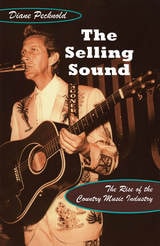
The Selling Sound
The Rise of the Country Music IndustryDiane Pecknold
Duke University Press, 2007
Pecknold draws on sources as diverse as radio advertising journals, fan magazines, Hollywood films, and interviews with industry insiders. Her sweeping social history encompasses the genre’s early days as an adjunct of radio advertising in the 1920s, the friction between Billboard and more genre-oriented trade papers over generating the rankings that shaped radio play lists, the establishment of the Country Music Association, and the influence of rock ‘n’ roll on the trend toward single-genre radio stations. Tracing the rise of a large and influential network of country fan clubs, Pecknold highlights the significant promotional responsibilities assumed by club organizers until the early 1970s, when many of their tasks were taken over by professional publicists.
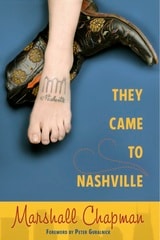
They Came to Nashville
Marshall Chapman
Vanderbilt University Press, 2010
In They Came to Nashville, Chapman records the personal stories of musicians shaping the modern history of music in Nashville, from the mouths of the musicians themselves. The trials, tribulations, and evolution of Music City are on display, as she sits down with influential figures like Kris Kristofferson, Emmylou Harris, and Miranda Lambert, and a dozen other top names, to record what brought each of them to Nashville and what inspired them to persevere. The book culminates in a hilarious and heroic attempt to find enough free time with Willie Nelson to get a proper interview. Instead, she's brought along on his raucous 2008 tour and winds up onstage in Beaumont, Texas singing "Good-Hearted Woman" with Willie.
They Came to Nashville reveals the daily struggle facing newcomers to the music business, and the promise awaiting those willing to fight for the dream.
Co-published with the Country Music Foundation Press
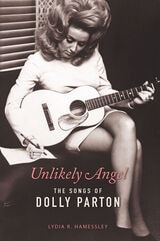
Unlikely Angel
The Songs of Dolly PartonLydia R. Hamessley
University of Illinois Press, 2020
Lydia R. Hamessley's expert analysis and Parton’s characteristically straightforward input inform this comprehensive look at the process, influences, and themes that have shaped the superstar's songwriting artistry. Hamessley reveals how Parton’s loving, hardscrabble childhood in the Smoky Mountains provided the musical language, rhythms, and memories of old-time music that resonate in so many of her songs. Hamessley further provides an understanding of how Parton combines her cultural and musical heritage with an artisan’s sense of craft and design to compose eloquent, painfully honest, and gripping songs about women's lives, poverty, heartbreak, inspiration, and love.
Filled with insights on hit songs and less familiar gems, Unlikely Angel covers the full arc of Dolly Parton's career and offers an unprecedented look at the creative force behind the image.
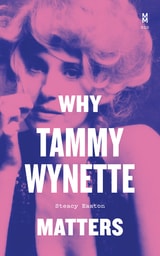
Why Tammy Wynette Matters
Steacy Easton
University of Texas Press, 2023
How Tammy Wynette channeled the conflicts of her life into her music and performance.
With hits such as “Stand By Your Man” and “Golden Ring,” Tammy Wynette was an icon of American domesticity and femininity. But there were other sides to the first lady of country. Steacy Easton places the complications of Wynette’s music and her biography in sharp-edged relief, exploring how she made her sometimes-tumultuous life into her work, a transformation that was itself art.
Wynette created a persona of high femininity to match the themes she sang about—fawning devotion, redemption in heterosexual romance, the heartbreak of loneliness. Behind the scenes, her life was marked by persistent class anxieties; despite wealth and fame, she kept her beautician’s license. Easton argues that the struggle to meet expectations of southernness, womanhood, and southern womanhood, finds subtle expression in Wynette’s performance of “Apartment #9”—and it’s because of these vocal subtleties that it came to be called the saddest song ever written. Wynette similarly took on elements of camp and political critique in her artistry, demonstrating an underappreciated genius. Why Tammy Wynette Matters reveals a musician who doubled back on herself, her façade of earnestness cracked by a melodrama that weaponized femininity and upended feminist expectations, while scoring twenty number-one hits.
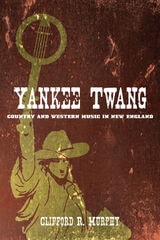
Yankee Twang
Country and Western Music in New EnglandClifford R. Murphy
University of Illinois Press, 2014
As Murphy shows, an extraordinary multiculturalism sets New England country and western music apart from other regional and national forms. Once segregated at work and worship, members of different ethnic groups used the country and western popularized on the radio and by barnstorming artists to come together at social events, united by a love of the music. Musicians, meanwhile, drew from the wide variety of ethnic musical traditions to create the New England style.
But the music also gave--and gives--voice to working-class feeling. Murphy explores how the Yankee love of country and western emphasizes the western, reflecting the longing of many blue collar workers for the mythical cowboy's life of rugged but fulfilling individualism. Indeed, many New Englanders use country and western to comment on economic disenfranchisement and express their resentment of a mass media, government, and Nashville music establishment that they believe neither reflects their experiences nor considers them equal participants in American life.