Results by title
7 books match the query 'Cultural Appropriation'
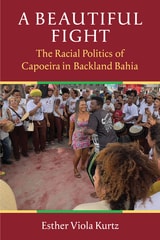
A Beautiful Fight
The Racial Politics of Capoeira in Backland BahiaEsther Viola Kurtz
University of Michigan Press, 2025
2026 Dance Studies Association de la Torre Bueno First Book Award Shortlist Finalist
A Beautiful Fight examines the potentials and limits of capoeira Angola to cohere a multiracial community committed to antiracist struggle. Capoeira, a musical fight-game that originated among enslaved Africans in Brazil, holds special significance for Black Brazilian activists as a spiritual and political practice that affirms the value of Black lives, thus countering anti-Black violence sanctioned by the Brazilian state. However, many capoeira groups count more white practitioners than Black, especially groups of the politicized, Afrocentric style capoeira Angola, raising debates about appropriation of Black culture that resonate across the Americas. A Beautiful Fight addresses these tensions. Drawing on ethnographic research with a multiracial capoeira Angola group in Brazil’s Bahian sertão or backlands, Esther Viola Kurtz explores diverse group members’ understandings of capoeira’s spiritual and political meanings and considers how white participation impacts capoeira’s antiracist politics. A Beautiful Fight argues that white practitioners occupying space in capoeira divert attention from Black members’ concerns and reproduce racist and colonialist ideologies, albeit unintentionally. In this way, the book complicates claims that shared music and dance bridge differences and facilitate cross-racial unity, yet Kurtz proposes that capoeira still transmits knowledge and tools that, when used with intention, commitment, and care, can be wielded to collaboratively contest racism and imagine a more just world.
Acoustic Colonialism
Acts of Mapuche InterferenceLuis E. Cárcamo-Huechante
Duke University Press, 2025
Borrowed Power
Essays on Cultural AppropriationEdited by Bruce Ziff
Rutgers University Press, 1997
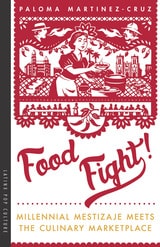
Food Fight!
Millennial Mestizaje Meets the Culinary MarketplacePaloma Martinez-Cruz
University of Arizona Press, 2019
In Food Fight! author Paloma Martinez-Cruz takes us on a Chicanx gastronomic journey that is powerful and humorous. Martinez-Cruz tackles head on the real-world politics of food production from the exploitation of farmworkers to the appropriation of Latinx bodies and culture, and takes us right into transformative eateries that offer a homegrown, mestiza consciousness.
The hard-hitting essays in Food Fight! bring a mestiza critique to today’s pressing discussions of labeling, identity, and imaging in marketing and dining. Not just about food, restaurants, and coffee, this volume employs a decolonial approach and engaging voice to interrogate ways that mestizo, Indigenous, and Latinx peoples are objectified in mainstream ideology and imaginary.
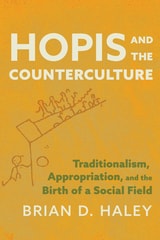
Hopis and the Counterculture
Traditionalism, Appropriation, and the Birth of a Social FieldBrian D. Haley
University of Arizona Press, 2024
Exploring the new social field that developed to spread these ideas, Hopis and the Counterculture meticulously traces the trajectories of figures such as Ammon Hennacy, Craig Carpenter, Frank Waters, and the Firesign Theatre, among others. Drawing on insights into the interplay between primitivism, radicalism, stereotyping, and identity, Haley expands on concepts from scholars such as Roy Harvey Pearce’s notion of “isolated radicals” and Jonathan Friedman’s observations regarding the ascendancy of primitivism amid global crises. Haley scrutinizes the roles played by non-Hopi actors and the timing behind the widespread popularization of Hopi religious practices.
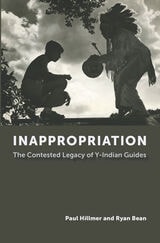
Inappropriation
The Contested Legacy of Y-Indian GuidesPaul Hillmer
University of Missouri Press, 2023
The Y-Indian Guides was a father-son (and later parent-child) program that encouraged real and enduring bonds through play and an authentic appreciation of family. While “playing Indian” seemed harmless to most participants during the program’s heyday, Paul Hillmer and Ryan Bean demonstrate the problematic nature of its methods. In the process of seeking to admire and emulate Indigenous Peoples, Y-Indian Guide participants often misrepresented American Indians and reinforced harmful stereotypes. Ultimately, this history demonstrates many ways in which American culture undermines and harms its Indigenous communities.
Unsettling Scripture
Iroquois and the Book of MormonThomas W Murphy
University of Utah Press, 2025
In Unsettling Scripture: Iroquois and the Book of Mormon, anthropologist Thomas W Murphy delves into the visions of Seneca prophet Handsome Lake, the epic narratives of the Iroquois Confederacy, and the origin story of the Book of Mormon, revealing surprising parallels between Indigenous and Mormon traditions.
Through ethnohistorical research and decolonizing methodologies, Murphy reexamines how both communities understand their origins, faith, and prophecy. From Handsome Lake’s revelations to Joseph Smith’s seer stone, from ancient sibling rivalries to the Great Peace, this book unsettles traditional narratives while opening new conversations on scripture, identity, and cultural exchange. Drawing from living Indigenous voices, Unsettling Scripture challenges readers to rethink sacred texts and the histories they tell.