Results by title
14 books match the query 'Death Penalty'

A Courageous Fool
Marie Deans and Her Struggle against the Death PenaltyTodd C. Peppers
Vanderbilt University Press, 2017
Marie found herself fighting to bring justice to the legal process and to bring humanity not only to prisoners on death row but to the guards and wardens as well. During Marie's time as a death penalty opponent in South Carolina and Virginia, she experienced the highs of helping exonerate the innocent and the lows of standing death watch in the death house with thirty-four condemned men.
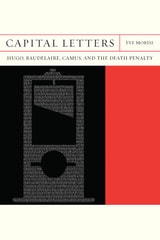
Capital Letters
Hugo, Baudelaire, Camus, and the Death PenaltyÈve Morisi
Northwestern University Press, 2020
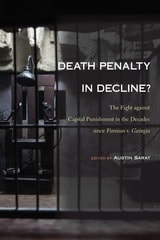
Death Penalty in Decline?
The Fight against Capital Punishment in the Decades since Furman v. GeorgiaAustin Sarat
Temple University Press, 2024
At a time when the United States is undertaking an unprecedented national reconsideration of the death penalty, Death Penalty in Decline? seeks to evaluate how abolitionists might succeed today.
Contributors: John Bessler, Corinna Barrett Lain, James R. Martel, Linda Ross Meyer, Carol S. Steiker, Jordan M. Steiker, and the editor
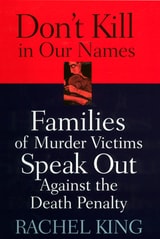
Don't Kill in Our Names
Families of Murder Victims Speak Out against the Death PenaltyKing, Rachel
Rutgers University Press, 2003
Could you forgive the murderer of your husband? Your mother? Your son?
Families of murder victims are often ardent and very public supporters of the death penalty. But the people whose stories appear in this book have chosen instead to forgive their loved ones’ murderers, and many have developed personal relationships with the killers and have even worked to save their lives. They have formed a nationwide group, Murder Victims’ Families for Reconciliation (MVFR), to oppose the death penalty.
MVFR members are often treated as either saints or lunatics, but the truth is that they are neither. They are ordinary people who have responded to an extraordinary and devastating tragedy with courage and faith, choosing reconciliation over retribution, healing over hatred. Believing that the death penalty is a form of social violence that only repeats and perpetuates the violence that claimed their loved one’s lives, they hold out the hope of redemption even for those who have committed the most hideous crimes.
Weaving third-person narrative with wrenching first-hand accounts, King presents the stories of ten MVFR members. Each is a heartrending tale of grief, soul searching, and of the challenge to choose forgiveness instead of revenge. These stories, which King sets in the context of the national discussion over the death penalty debate and restorative versus retributive justice, will appeal not only to those who oppose the death penalty, but also to those who strive to understand how people can forgive the seemingly unforgivable.
Facing the Death Penalty
Essays on a Cruel and Unusual Punishmentedited by Michael L. Radelet, foreword by Henry Schwarzschild
Temple University Press, 1990
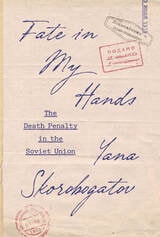
Fate in My Hands
The Death Penalty in the Soviet UnionYana Skorobogatov
University of Chicago Press, 2026
A striking examination of the death penalty in the Soviet Union that documents in heart-rending detail how its citizens, hopeful for a new life post-Stalin, lost faith that their transgressions could be forgiven.
From 1954 to 1991 in the Soviet Union, nearly forty thousand citizens were executed after the death penalty was reinstated as a punishment for homicide. Fate in My Hands introduces readers to the many citizens in this period—women and men of all ages and backgrounds—who found themselves on death row and tried to escape it in the only way available to them: asking for forgiveness.
Examining the letters and objects the dead left behind, Skorobogatov recovers their voices and allows them to speak anew. She offers a striking portrait of life in the Soviet Union and the citizens who dreamed of new possibilities even as they faced their tragic end. Using a corpus of never-before-accessed criminal court records, Fate in My Hands brings readers not just into the police interrogation rooms, courthouses, and cells where the condemned awaited their fates, but into the homes, workplaces, and psychiatric hospitals where families and friends alike came together to pursue an elusive, bitter justice in the wake of violent tragedy.
Fighting the Death Penalty
A Fifty-Year Journey of Argument and PersuasionEugene G. Wanger
Michigan State University Press, 2019
Hidden Victims
The Effects of the Death Penalty on Families of the AccusedSharp, Susan F
Rutgers University Press, 2005
"Everyone concerned with the effects of capital punishment must have this book."—Margaret Vandiver, professor, department of criminology and criminal justice, University of Memphis
Murderers, particularly those sentenced to death, are considered by most to be unusually heinous, often sub-human, and entirely different from the rest of us. In Hidden Victims, sociologist Susan F. Sharp challenges this culturally ingrained perspective by reminding us that those individuals facing a death sentence, in addition to being murderers, are brothers or sisters, mothers or fathers, daughters or sons, relatives or friends. Through a series of vivid and in-depth interviews with families of the accused, she demonstrates how the exceptionally severe way in which we view those on death row trickles down to those with whom they are closely connected. Sharp shows how family members and friends—in effect, the indirect victims of the initial crime—experience a profoundly complicated and socially isolating grief process.
Departing from a humanist perspective from which most accounts of victims are told, Sharp makes her case from a sociological standpoint that draws out the parallel experiences and coping mechanisms of these individuals. Chapters focus on responses to sentencing, the particular structure of grieving faced by this population, execution, aftermath, wrongful conviction, family formation after conviction, and the complex situation of individuals related to both the killer and the victim.
Powerful, poignant, and intelligently written, Hidden Victims challenges all of us—regardless of which side of the death penalty you are on—to understand the economic, social, and psychological repercussions that shape the lives of the often forgotten families of death row inmates.
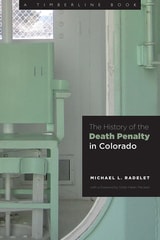
History of the Death Penalty in Colorado
Michael Radelet
University Press of Colorado, 2017
In The History of the Death Penalty in Colorado, noted death penalty scholar Michael Radelet chronicles the details of each capital punishment trial and execution that has taken place in Colorado since 1859. The book describes the debates and struggles that Coloradans have had over the use of the death penalty, placing the cases of the 103 men whose sentences were carried out and 100 more who were never executed into the context of a gradual worldwide trend away from this form of punishment.
For more than 150 years, Coloradans have been deeply divided about the death penalty, with regular questions about whether it should be expanded, restricted, or eliminated. It has twice been abolished, but both times state lawmakers reinstated the contentious punitive measure. Prison administrators have contributed to this debate, with some refusing to participate in executions and some lending their voices to abolition efforts. Colorado has also had a rich history of experimenting with execution methods, first hanging prisoners in public and then, starting in 1890, using the "twitch-up gallows" for four decades. In 1933, Colorado began using a gas chamber and eventually moved to lethal injection in the 1990s.
Based on meticulous archival research in official state archives, library records, and multimedia sources, The History of the Death Penalty in Colorado, will inform the conversation on both sides of the issue anywhere the future of the death penalty is under debate.
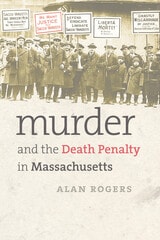
Murder and the Death Penalty in Massachusetts
Alan Rogers
University of Massachusetts Press, 2008
For more than 300 years Massachusetts executed men and women convicted of murder, but with a sharp eye on “due proceeding” and against the backdrop of popular ambivalence about the death penalty's morality, cruelty, efficacy, and constitutionality. In this authoritative book, Alan Rogers offers a comprehensive account of how the efforts of reformers and abolitionists and the Supreme Judicial Court's commitment to the rule of law ultimately converged to end the death penalty in Massachusetts.
In the seventeenth century, Governor John Winthrop and the Massachusetts General Court understood murder to be a sin and a threat to the colony's well-being, but the Puritans also drastically reduced the crimes for which death was the prescribed penalty and expanded a capital defendant's rights. Following the Revolution, Americans denounced the death penalty as “British and brutish” and the state's Supreme Judicial Court embraced its role as protector of the rights extended to all men by the Massachusetts Constitution. In the 1830s popular opposition nearly stopped the machinery of death and a vote in the Massachusetts House fell just short of abolishing capital punishment.
A post–Civil War effort extending civil rights to all men also stimulated significant changes in criminal procedure. A “monster petition” begging the governor to spare the life of a murderer convicted on slight circumstantial evidence and the grim prospect of executing nine Chinese men found guilty of murder fueled a passionate debate about the death penalty in the decade before World War I.
The trials and executions of Sacco and Vanzetti focused unwanted international and national attention on Massachusetts. This was a turning point. Sara Ehrmann took charge of the newly formed Massachusetts Council Against the Death Penalty, relentlessly lobbied the legislature, and convinced a string of governors not to sign death warrants. In the 1970s the focus shifted to the courts, and eventually, in 1980, the Supreme Judicial Court abolished the death penalty on the grounds that it violated the Massachusetts Constitution.
The Death Penalty in the Eighties
An Examination of the Modern System of Capital PunishmentWelsh S. White
University of Michigan Press, 1987
The Death Penalty in the Nineties
An Examination of the Modern System of Capital PunishmentWelsh S. White
University of Michigan Press, 1991
The Death Penalty, Volume I
Jacques Derrida
University of Chicago Press, 2013
With his signature genius and patient yet dazzling readings of an impressive breadth of texts, Derrida examines everything from the Bible to Plato to Camus to Jean Genet, with special attention to Kant and post–World War II juridical texts, to draw the landscape of death penalty discourses. Keeping clearly in view the death rows and execution chambers of the United States, he shows how arguments surrounding cruel and unusual punishment depend on what he calls an “anesthesial logic,” which has also driven the development of death penalty technology from the French guillotine to lethal injection. Confronting a demand for philosophical rigor, he pursues provocative analyses of the shortcomings of abolitionist discourse. Above all, he argues that the death penalty and its attendant technologies are products of a desire to put an end to one of the most fundamental qualities of our finite existence: the radical uncertainty of when we will die.
Arriving at a critical juncture in history—especially in the United States, one of the last Christian-inspired democracies to resist abolition—The Death Penalty is both a timely response to an important ethical debate and a timeless addition to Derrida’s esteemed body of work.
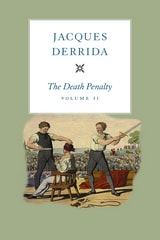
The Death Penalty, Volume II
Jacques Derrida
University of Chicago Press, 2017
Of central importance in this second volume is Kant’s explicit justification of the death penalty in the Metaphysics of Morals. Thoroughly deconstructing Kant’s position—which holds the death penalty as exemplary of the eye-for-an-eye Talionic law—Derrida exposes numerous damning contradictions and exceptions. Keeping the current death penalty in the United States in view, he further explores the “anesthesial logic” he analyzed in volume one, addressing the themes of cruelty and pain through texts by Robespierre and Freud, reading Heidegger, and—in a fascinating, improvised final session—the nineteenth-century Spanish Catholic thinker Donoso Cortés. Ultimately, Derrida shows that the rationality of the death penalty as represented by Kant involves an imposition of knowledge and calculability on a fundamental condition of non-knowledge—that we don’t otherwise know what or when our deaths will be. In this way, the death penalty acts out a phantasm of mastery over one’s own death.
Derrida’s thoughts arrive at a particular moment in history: when the death penalty in the United States is the closest it has ever been to abolition, and yet when the arguments on all sides are as confused as ever. His powerful analysis will prove to be a paramount contribution to this debate as well as a lasting entry in his celebrated oeuvre.