Results by title
19 books match the query 'Deception'
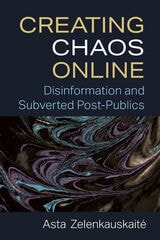
Creating Chaos Online
Disinformation and Subverted Post-PublicsAsta Zelenkauskaite
University of Michigan Press, 2022
With the prevalence of disinformation geared to instill doubt rather than clarity, Creating Chaos Online unmasks disinformation when it attempts to pass as deliberation in the public sphere and distorts the democratic processes. Asta Zelenkauskaitė finds that repeated tropes justifying Russian trolling were found to circulate across not only all analyzed media platforms’ comments but also across two analyzed sociopolitical contexts suggesting the orchestrated efforts behind messaging. Through a dystopian vision of publics that are expected to navigate in the sea of uncertain both authentic and orchestrated content, pushed by human and nonhuman actors, Creating Chaos Online offers a concept of post-publics. The idea of post-publics is reflected within the continuum of treatment of public, counter public, and anti-public. This book argues that affect-instilled arguments used in public deliberation in times of uncertainty, along with whataboutism constitute a playbook for chaos online.
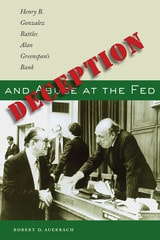
Deception and Abuse at the Fed
Henry B. Gonzalez Battles Alan Greenspan's BankBy Robert D. Auerbach
University of Texas Press, 2008
The Federal Reserve—the central bank of the United States—is the most powerful peacetime bureaucracy in the federal government. Under the chairmanship of Alan Greenspan (1987-2006), the Fed achieved near mythical status for its part in managing the economy, and Greenspan was lauded as a genius. Few seemed to notice or care that Fed officials operated secretly with almost no public accountability. There was a courageous exception to this lack of oversight, however: Henry B. Gonzalez (D-TX)—chairman of the U.S. House of Representatives Financial Services (banking) Committee.
In Deception and Abuse at the Fed, Robert Auerbach, a former banking committee investigator, recounts major instances of Fed mismanagement and abuse of power that were exposed by Rep. Gonzalez, including:
- Blocking Congress and the public from holding powerful Fed officials accountable by falsely declaring—for 17 years—it had no transcripts of its meetings;
- Manipulating the stock and bond markets in 1994 under cover of a preemptive strike against inflation;
- Allowing $5.5 billion to be sent to Saddam Hussein from a small Atlanta branch of a foreign bank—the result of faulty bank examination practices by the Fed;
- Stonewalling Congressional investigations and misleading the Washington Post about the $6,300 found on the Watergate burglars.
Auerbach provides documentation of these and other abuses at the Fed, which confirms Rep. Gonzalez's belief that no government agency should be allowed to operate with the secrecy and independence in which the Federal Reserve has shrouded itself. Auerbach concludes with recommendations for specific, broad-ranging reforms that will make the Fed accountable to the government and the people of the United States.

Deception in High Places
A History of Bribery in Britain's Arms TradeNicholas Gilby
Pluto Press, 2014
Based on painstaking research in government archives, collections of private and court papers and documents won by the author in a landmark Freedom of Information Tribunal against the Foreign and Commonwealth Office, the book illuminates a shadow world of bribery and elite enrichment.
Deception in High Places charts British government involvement in arms trade corruption and presents the fullest history yet of bribery in Britain’s arms deals with Saudi Arabia. It includes the backstory of the controversial termination of a Serious Fraud Office corruption investigation following pressure by the Saudi Royal Family and the British establishment.
Deception on All Accounts
Sara Sue Hoklotubbe
University of Arizona Press, 2003
Sadie Walela's life is about to be turned upside down.
One morning Sadie unlocks the door at the Mercury Savings Bank and confronts a robber who's been lying in wait for her and her fellow employees. He flees after stealing money and killing her coworker. When a whirlwind of events leaves Sadie herself under suspicion, she sets out to clear her name.
This banker turned sleuth is suddenly plunged into an unfamiliar world in which people are not always as they appear-not her employer, not the homeless man she's befriended, not the police officer who takes an interest in the case, not the man she falls in love with. And, as she's beginning to imagine, not even herself.
Sadie is a blue-eyed Cherokee living in northeastern Oklahoma, a half-blood who finds she sometimes has to adapt to get by in the white man's world, much as her father's ancestors did. In this story of robbery, murder, love, and intrigue, she faces adversity at each bend in the road, but in the tradition of her people she adapts and moves forward—even if it means having to re-think her relationships and expectations.
Set against the backdrop of small-town Oklahoma and its Native culture, Deception on All Accounts draws readers into the real lives of contemporary American Indians as it shines a light on violence, corporate corruption, and prejudice in modern America. As Sadie Walela comes to terms with murder, romance, and her hopes for a career, she finds deception on all accounts.
Doctors of Deception
What They Don't Want You to Know about Shock TreatmentAndre, Linda
Rutgers University Press, 2009
Doctors of Deception is a revealing history of ECT (or shock therapy) in the United States, told here for the first time. Through the examination of court records, medical data, FDA reports, industry claims, her own experience as a patient of shock therapy, and the stories of others, Andre exposes tactics used by the industry to promote ECT as a responsible treatment when all the scientific evidence suggested otherwise.
As early as the 1940s, scientific literature began reporting incidences of human and animal brain damage resulting from ECT. Despite practitioner modifications, deleterious effects on memory and cognition persisted. Rather than discontinue use of ECT, the $5-billion-per-year shock industry crafted a public relations campaign to improve ECT’s image. During the 1970s and 1980s, psychiatry’s PR efforts misled the government, the public, and the media into believing that ECT had made a comeback and was safe.
Andre carefully intertwines stories of ECT survivors and activists with legal, ethical, and scientific arguments to address issues of patient rights and psychiatric treatment. Echoing current debates about the use of psychopharmaceutical interventions shown to have debilitating side-effects, she candidly presents ECT as a problematic therapy demanding greater scrutiny, tighter control, and full disclosure about its long-term cognitive effects.
Duped
Truth-Default Theory and the Social Science of Lying and DeceptionTimothy R. Levine
University of Alabama Press, 2020
Unmasking the science of deception—and why truth wins by default.
From the advent of fake news to climate-science denial and Bernie Madoff’s appeal to investors, people can be astonishingly gullible. Some people appear authentic and sincere even when the facts discredit them, and many people fall victim to conspiracy theories and economic scams that should be dismissed as obviously ludicrous. This happens because of a near-universal human tendency to operate within a mindset that can be characterized as a “truth-default.” We uncritically accept most of the messages we receive as “honest.” We all are perceptually blind to deception. We are hardwired to be duped. The question is, can anything be done to militate against our vulnerability to deception without further eroding the trust in people and social institutions that we so desperately need in civil society?
Timothy R. Levine’s Duped: Truth-Default Theory and the Social Science of Lying and Deception recounts a decades-long program of empirical research that culminates in a new theory of deception—truth-default theory. This theory holds that the content of incoming communication is typically and uncritically accepted as true, and most of the time, this is good. Truth-default allows humans to function socially. Further, because most deception is enacted by a few prolific liars, the so called “truth-bias” is not really a bias after all. Passive belief makes us right most of the time, but the catch is that it also makes us vulnerable to occasional deceit.
Levine’s research on lie detection and truth-bias has produced many provocative new findings over the years. He has uncovered what makes some people more believable than others and has discovered several ways to improve lie-detection accuracy. In Duped, Levine details where these ideas came from, how they were tested, and how the findings combine to produce a coherent new understanding of human deception and deception detection.
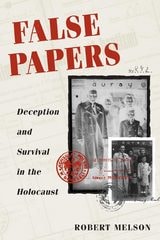
False Papers
DECEPTION AND SURVIVAL IN THE HOLOCAUSTRobert Melson
University of Illinois Press, 2000
Armed with their new lives and their new pasts, the Count and Countess Zamojski and their son, Count Bobi, took shelter in the very shadow of the Nazi machine, hiding day after day in plain sight behind a façade of elegant good manners and cultivated self-assurance, even arrogance: "you had to shout [the Gestapo] down or they would kill you." Melson's father took advantage of his flawless German to build a lucrative business career while working for a German businessman of the Schindler type. The Zamojskis acquired beautiful homes in the German quarter of Krakow and in Prague, where they had maids and entertained Nazi officials. Their masquerade enabled them to save not only themselves and their son but also an uncle and three Jewish women, one of whom became part of the family.
False Papers is a candid, sometimes funny account of a stylish couple who dazzled the Nazis with flamboyant theatrics then gradually, tragically fell apart after the war. Particularly arresting is Melson himself, who was just a child when his family embarked on their grand charade. A resilient boy who had to negotiate bewildering shifts of identify–-now Catholic, now Jewish; now European aristocrat, now penniless refugee who becomes an American college student--Melson closes each chapter of his parents' recollections with his childhood perceptions of the same events.
Against the totalizing, flattening, unrelenting Nazi behemoth, Melson says, "I wished to pit our very bodies, our quirky, sexy, funny, wicked, frail, ordinary selves." By balancing the adults' maneuvering with the perspective of a child, Melson crafts an account of the Holocaust that is at once poignant, entertaining, and troubling.

How to Lie with Maps
Mark Monmonier
University of Chicago Press, 1996
The second edition is updated with the addition of two new chapters, 10 color plates, and a new foreword by renowned geographer H. J. de Blij. One new chapter examines the role of national interest and cultural values in national mapping organizations, including the United States Geological Survey, while the other explores the new breed of multimedia, computer-based maps.
To show how maps distort, Monmonier introduces basic principles of mapmaking, gives entertaining examples of the misuse of maps in situations from zoning disputes to census reports, and covers all the typical kinds of distortions from deliberate oversimplifications to the misleading use of color.
"Professor Monmonier himself knows how to gain our attention; it is not in fact the lies in maps but their truth, if always approximate and incomplete, that he wants us to admire and use, even to draw for ourselves on the facile screen. His is an artful and funny book, which like any good map, packs plenty in little space."—Scientific American
"A useful guide to a subject most people probably take too much for granted. It shows how map makers translate abstract data into eye-catching cartograms, as they are called. It combats cartographic illiteracy. It fights cartophobia. It may even teach you to find your way. For that alone, it seems worthwhile."—Christopher Lehmann-Haupt, The New York Times
". . . witty examination of how and why maps lie. [The book] conveys an important message about how statistics of any kind can be manipulated. But it also communicates much of the challenge, aesthetic appeal, and sheer fun of maps. Even those who hated geography in grammar school might well find a new enthusiasm for the subject after reading Monmonier's lively and surprising book."—Wilson Library Bulletin
"A reading of this book will leave you much better defended against cheap atlases, shoddy journalism, unscrupulous advertisers, predatory special-interest groups, and others who may use or abuse maps at your expense."—John Van Pelt, Christian Science Monitor
"Monmonier meets his goal admirably. . . . [His] book should be put on every map user's 'must read' list. It is informative and readable . . . a big step forward in helping us to understand how maps can mislead their readers."—Jeffrey S. Murray, Canadian Geographic
How to Lie with Maps, Third Edition
Mark Monmonier
University of Chicago Press, 2018
Fully updated for the digital age, this new edition of How to Lie with Maps examines the myriad ways that technology offers new opportunities for cartographic mischief, deception, and propaganda. While retaining the same brevity, range, and humor as its predecessors, this third edition includes significant updates throughout as well as new chapters on image maps, prohibitive cartography, and online maps. It also includes an expanded section of color images and an updated list of sources for further reading.
In Favor of Deceit
A Study of Tricksters in an Amazonian SocietyEllen B. Basso
University of Arizona Press, 1988
Ellen Basso's new study of these stories considers their relationship to other kinds of Kalapalo activities involving deception and features a unique collection of South American Indian narratives translated directly from performances by master storytellers in their original Carib language. Combining an ethnopoetic, performance-focused approach to storytelling with an action-oriented psychology, Basso arrives at an ethnographic understanding of Kalapalo trickster myths and Kalapalo ideas about deception.
The commentary on the translations considers matters of theme, discourse, narrative progression, and performance context. The dialogical, interactive nature of Kalapalo storytelling, the development of characters through their conversations with one another, and the many ways storytelling and ordinary life enrich one another are examined to reveal the complex psychology of trickster myths and the special tricksterish quality of day-to-day Kalapalo behavior.
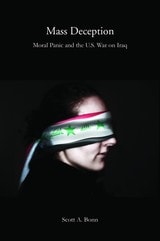
Mass Deception
Moral Panic and the U.S. War on IraqScott A. Bonn
Rutgers University Press, 2010
Mass Deception argues that the George W. Bush administration manufactured public support for the war on Iraq. Scott A. Bonn introduces a unique, integrated, and interdisciplinary theory called "critical communication" to explain how and why political elites and the news media periodically create public panics that benefit both parties. Using quantitative analysis of public opinion polls and presidential rhetoric pre- and post-9/11 in the news media, Bonn applies the moral panic concept to the Iraq war. He critiques the war and occupation of Iraq as violations of domestic and international law. Finally, Mass Deception connects propaganda and distortion efforts by the Bush administration to more general theories of elite deviance and state crime.
Measure for Measure
William Shakespeare
Arizona Center for Medieval and Renaissance Studies, 2023
One of Shakespeare’s most difficult plays, Measure for Measure has long challenged performers and audiences alike. In reworking the play in her translation, Aditi Brennan Kapil honors the structure, rhythms, and themes of Shakespeare’s original. Kapil’s updated language makes this cautionary fable about frailty, power, and the perils of legislating morality accessible for today’s audiences.
This translation of Measure for Measure was written as part of the Oregon Shakespeare Festival’s Play On! project, which commissioned new translations of thirty-nine Shakespeare plays. These translations present the work of “The Bard” in language accessible to modern audiences while never losing the beauty of Shakespeare’s verse. Enlisting the talents of a diverse group of contemporary playwrights, screenwriters, and dramaturges from diverse backgrounds, this project reenvisions Shakespeare for the twenty-first century. These volumes make these works available for the first time in print—a new First Folio for a new era.
Really Fake
Alexandra Juhasz
University of Minnesota Press, 2020
The new truth is the one that circulates: digital truth emerges from lists, databases, archives, and conditions of storage. Multiple truths may be activated through search, link, and retrieve queries. Alexandra Juhasz, Ganaele Langlois, and Nishant Shah respond by taking up story, poetry, and other human logics of care, intelligence, and dignity to explore sociotechnological and politico-aesthetic emergences in a world where information overload has become a new ontology of not-knowing. Their feminist digital methods allow considerations of internet things through alternative networked internet time: slowing down to see, honor, and engage with our past; invoking indeterminacy as a human capacity that lets multiple truths commingle on a page or in a body; and saving the truths of ourselves and our others differently from the corporate internet’s perpetual viral movement.
Writing across their own shared truisms, actors, and touchstones, the authors propose creative tactics, theoretical overtures, and experimental escape routes built to a human scale as ways to regain our capacities to know and tell truths about ourselves.
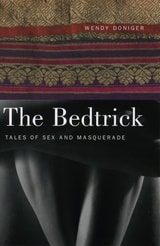
The Bedtrick
Tales of Sex and MasqueradeWendy Doniger
University of Chicago Press, 2000
The Bedtrick brings together hundreds of stories from all over the world, from the earliest recorded Hindu and Hebrew texts to the latest item in the Weekly World News, to show the hilariously convoluted sexual scrapes that people manage to get themselves into and out of. Here you will find wives who accidentally commit adultery with their own husbands. You will read Lincoln's truly terrible poem about a bedtrick. You will learn that in Hong Kong the film The Crying Game was retitled Oh No! My Girlfriend Has a Penis. And that President Clinton was not the first man to be identified by an idiosyncratic organ.
At the bottom of these wonderful stories, ancient myths, and historical anecdotes lie the dynamics of sex and gender, power and identity. Why can't people tell the difference in the dark? Can love always tell the difference between one lover and another? And what kind of truth does sex tell? Funny, sexy, and engaging, The Bedtrick is a masterful work of energetic storytelling and dazzling scholarship. Give it to your spouse and your lover.
The Gallant Spaniard
Miguel de Cervantes; Translated by Philip Krummrich
Vanderbilt University Press, 2023
This edition, translated by Philip Krummrich, consists of a critical introduction and a full verse translation of the play with notes.
The Habit of Lying
Sacrificial Studies in Literature, Philosophy, and Fashion TheoryJohn Vignaux Smyth
Duke University Press, 2002
With recourse to Rene Girard, Paul de Man, Theodor Adorno, Leo Strauss, and other theoreticians not usually considered together, Smyth arrives at some surprising conclusions about the connections between lying, mimesis, sacrifice, sadomasochism, and the sacred, among other central subjects. Arguing that the relation between lying and truthtelling has been characterized in the West by sharply sacrificial features, he begins with a critique of the philosophies of lying espoused by Kant and Sissela Bok, then concludes that the problem of truth and lies leads to the further problem of the relation between law and arbitrariness as well as to the relation between rationality and unanimity. Constructively criticizing the work of such philosophers as Bertrand Russell, Ludwig Wittgenstein, Richard Rorty, and Nelson Goodman, Smyth shows how these problems occur comparably in fiction theory and how Paul de Man’s definition of fiction as arbitrariness finds confirmation in analytic philosophy. Through the novels of Defoe, Stendhal, and Beckett—with topics ranging from Defoe’s treatment of lies, fiction, and obscenity to Beckett’s treatment of the anus and the sacred—Smyth demonstrates how these texts generalize the issues of mendacity, concealment, and sacrificial arbitrariness in Girard’s sense to almost every aspect of experience, fiction theory, and cultural life. The final section of the book, taking its cue from Shakespeare, elaborates a sacrificial view of the history of fashion and dress concealment.
The Inquisitor's Tongue
A NovelAlan Singer
University of Alabama Press, 2012
Alan Singer’s riveting new novel, The Inquisitor’s Tongue, reimagines the Spanish Inquisition as a world in which spiritual horrors and acts of violence are the birth pangs of otherwise unimaginable identities.
The Science of Deception
Psychology and Commerce in AmericaMichael Pettit
University of Chicago Press, 2012
The Varnished Truth
Truth Telling and Deceiving in Ordinary LifeDavid Nyberg
University of Chicago Press, 1993
The Varnished Truth takes us beyond philosophical speculation and clinical analysis to give us a sense of what it really means to tell the truth. As Nyberg lays out the complexities involved in leading a morally decent life, he compels us to see the spectrum of alternatives to telling the truth and telling a clear-cut lie.