Results by title
7 books match the query 'Early Republic'
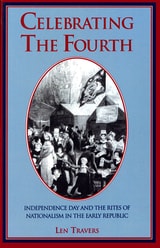
Celebrating the Fourth
Independence Day and the Rites of Nationalism in the Early RepublicLen Travers
University of Massachusetts Press, 1997
A CHOICE Outstanding Academic Book
Public rituals have always held a vital place in American culture. By far the noisiest and most popular of these to emerge in the nation's early years was Independence Day. After a decade of fitful starts, the Fourth of July eclipsed local and regional patriotic observances to become the premier “American Jubilee.” Celebrating the Fourth provides a history of this holiday and explores its role in shaping a national identity and consciousness in three cities—Boston, Charleston, and Philadelphia—during the first fifty years of the American republic. Independence Day celebrations justified, validated, and helped maintain nationalism among people unused to offering political allegiance beyond their own state borders. As the observances became increasingly popular and symbolically important, political partisans competed hotly for the right to control the meaning of the festivals.

Enemyship
Democracy and Counter-Revolution in the Early RepublicJeremy Engels
Michigan State University Press, 2010
The Declaration of Independence is usually celebrated as a radical document that inspired revolution in the English colonies, in France, and elsewhere. In Enemyship, however, Jeremy Engels views the Declaration as a rhetorical strategy that outlined wildly effective arguments justifying revolution against a colonial authority—and then threatened political stability once independence was finally achieved.
Enemyship examines what happened during the latter years of the Revolutionary War and in the immediate post-Revolutionary period, when the rhetorics and energies of revolution began to seem problematic to many wealthy and powerful Americans.
To mitigate this threat, says Engles, the founders of the United States deployed the rhetorics of what he calls "enemyship," calling upon Americans to unite in opposition to their shared national enemies.
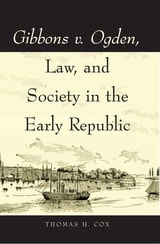
Gibbons v. Ogden, Law, and Society in the Early Republic
Thomas H. Cox
Ohio University Press, 2009
Gibbons v. Ogden, Law, and Society in the Early Republic examines a landmark decision in American jurisprudence, the first Supreme Court case to deal with the thorny legal issue of interstate commerce.
Decided in 1824, Gibbons v. Ogden arose out of litigation between owners of rival steamboat lines over passenger and freight routes between the neighboring states of New York and New Jersey. But what began as a local dispute over the right to ferry the paying public from the New Jersey shore to New York City soon found its way into John Marshall’s court and constitutional history. The case is consistently ranked as one of the twenty most significant Supreme Court decisions and is still taught in constitutional law courses, cited in state and federal cases, and quoted in articles on constitutional, business, and technological history.
Gibbons v. Ogden initially attracted enormous public attention because it involved the development of a new and sensational form of technology. To early Americans, steamboats were floating symbols of progress—cheaper and quicker transportation that could bring goods to market and refinement to the backcountry. A product of the rough-and-tumble world of nascent capitalism and legal innovation, the case became a landmark decision that established the supremacy of federal regulation of interstate trade, curtailed states’ rights, and promoted a national market economy. The case has been invoked by prohibitionists, New Dealers, civil rights activists, and social conservatives alike in debates over federal regulation of issues ranging from labor standards to gun control. This lively study fills in the social and political context in which the case was decided—the colorful and fascinating personalities, the entrepreneurial spirit of the early republic, and the technological breakthroughs that brought modernity to the masses.
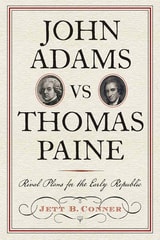
John Adams vs Thomas Paine
Rival Plans for the Early RepublicJett B. Conner
Westholme Publishing, 2018
Initially admiring Thomas Paine’s efforts for independence, John Adams nevertheless was rattled by the political philosophy of Common Sense and responded to it by publishing his Thoughts on Government to counteract Paine’s proposals, which Adams said were far too “democratical.” Although John Adams is given credit for his substantive contributions to American constitutionalism, especially his notions of separation of powers, checks and balances, and representation, in John Adams vs Thomas Paine: Rival Plans for the Early Republic, historian Jett B. Conner makes the case that Thomas Paine was more than just a revolutionary figure who spurred Americans toward declaring independence. Common Sense made important contributions to American constitutional thought, too, particularly its call for more equal representation, popular sovereignty, a constitutional convention, and a federal system of governance with a strong central government. The book explores how the two rivals helped shape America’s first constitutions—the Articles of Confederation and those of several states— and how they continued contributing to American political thought as it developed during the so-called “critical period” between the adoption of the Articles of Confederation and the start of the Constitutional Convention of 1787. It also focuses on the creation of our democratic republic and compares Paine’s and Adams’s approaches to structuring constitutions to ensure free government while guarding against abuses of power and the excesses of democratic majorities. An abridged version of Common Sense and the short but complete Thoughts on Government are included in an appendix for easy reader reference.
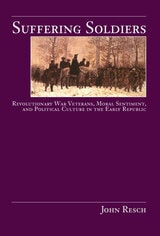
Suffering Soldiers
Revolutionary War Veterans, Moral Sentiment, and Political Culture in the Early RepublicJohn Resch
University of Massachusetts Press, 1999
The Center of a Great Empire
The Ohio Country in the Early RepublicAndrew R. L. Cayton
Ohio University Press, 2005
“The people who lived in what became the seventeenth state in the American Union in 1803 were not only at the center of a great empire, they were at the center of the most important historical developments in the revolutionary Atlantic World.”
—From the introduction
Nowhere did the revolutions in politics, commerce, and society in the late eighteenth and early nineteenth centuries occur more quickly or more thoroughly than in the Ohio country. A forested borderland dominated by American Indians in 1780, Ohio was a landscape of farms and towns inhabited by people from all over the world by 1830. The Center of a Great Empire: The Ohio Country in the Early Republic chronicles this dramatic and all-encompassing change.
Andrew R. L. Cayton and Stuart D. Hobbs have assembled an impressive collection of articles by established and rising scholars. They address the conquest of Native Americans, the emergence of a democratic political culture, the origins of capitalism, the formation of public culture, the growth of evangelical Protestantism, the ambiguous status of African Americans, and social life in a place that most regarded as the cutting edge of human history.
For The Center of a Great Empire, distinguished historians of the American nation in its first decades question conventional wisdom. They emphasize contingency rather than inevitability and contention rather than progress. Downplaying the frontier character of Ohio, they offer new interpretations and open new paths of inquiry through investigations of race, education, politics, religion, family, commerce, colonialism, and conquest. As it underscores key themes in the history of the United States, The Center of a Great Empire pursues issues that have fascinated people for two centuries.

The Genius of Place
The Geographic Imagination in the Early RepublicChristopher C. Apap
University of New Hampshire Press, 2019
The Genius of Place examines how, after the War of 1812, concerns about the scale of the nation resulted in a fundamental reorientation of American identity away from the Atlantic or global ties that held sway in the early republic and toward more localized forms of identification. Instead of addressing the sweep of the nation, American authors, artists, geographers, and politicians shifted from the larger reach of the globe to the more manageable scope of the local and sectional. Paradoxically, that local representation became the primary mode through which early Americans construed their emerging national identity. This newfound cultural obsession with locality impacted the literary consolidation and representation of key American imagined places—New England, the plantation, the West—in the decades between 1816 and 1836.
Apap's examination of the intersections between local and national representations and exploration of the myths of space and place that shaped U.S. identity through the nineteenth century will appeal to a broad, interdisciplinary readership.