Results by title
16 books match the query 'Emily Dickinson'
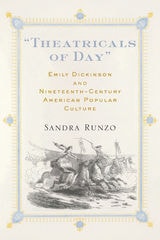
"Theatricals of Day"
Emily Dickinson and Nineteenth-Century American Popular CultureSandra Runzo
University of Massachusetts Press, 2019
In her own private ways, Emily Dickinson participated in the popular entertainments of her time. On her piano, she performed popular musical numbers, many from the tradition of minstrelsy, and at theaters, she listened to famous musicians, including Jenny Lind and, likely, the Hutchinson Family Singers. In reading the Atlantic Monthly, the Springfield Republican, and Harper's, she kept up with the roiling conflicts over slavery and took in current fiction and verse. And, she enjoyed the occasional excursion to the traveling circus and appreciated the attractions of the dime museum. Whatever her aspirations were regarding participation in a public arena, the rich world of popular culture offered Dickinson a view of both the political and social struggles of her time and the amusements of her contemporaries.
“Theatricals of Day” explores how popular culture and entertainments are seen, heard, and felt in Dickinson's writing. In accessible prose, Sandra Runzo proposes that the presence of popular entertainment in Dickinson's life and work opens our eyes to new dimensions of the poems, illuminating the ways in which the poet was attentive to strife and conflict, to amusement, and to play.
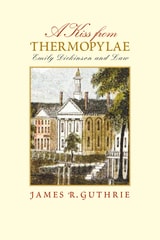
A Kiss from Thermopylae
Emily Dickinson and LawJames R. Guthrie
University of Massachusetts Press, 2015
Yet Dickinson was also capable of criticizing, even satirizing, law and lawyers. Her poetic personae inhabit various legal roles including those of jurymen, judges, and attorneys, and some poems simulate courtroom contests pitting the rights of individuals against the power of the state. She was keenly interested in legal matters pertaining to women, such as breach of promise, dower, and trusts. With her tone ranging from subservient to domineering, from reverential to ridiculing, Dickinson's writings reflect an abiding concern with philosophic and political principles underpinning the law, as well as an identification with the plight of individuals who dared confront authority.
A Kiss from Thermopylae reveals a new dimension of Dickinson's writing and thinking, one indicating that she was thoroughly familiar with the legal community's idiomatic language, actively engaged with contemporary political and ethical questions, and skilled at deploying a poetic register ranging from high romanticism to low humor.
Amherst Suite
Emily Dickinson, Spanish Translation & Poetic TranscreationBy Alberto Blanco, Translated and Edited by Jennifer Rathbun, with an Introduction by Ilan Stavans
Amherst College Press, 2026
Opening with a creative essay by renowned author Ilan Stavans, the volume also includes a conversation between Blanco and scholar Ronald J. Friis; Blanco’s own essay on Dickinson, translated into English by Jennifer Rathbun; as well as an introduction by Rathbun that helpfully situates this interlinguistic, intercultural, and inter-generational network. Amherst Suite is a fascinating and unique look into the work and worlds of poets and their translators and will be an invaluable text for students, scholars, and all readers of Emily Dickinson.
Concordance to the Letters of Emily Dickinson
Cynthia MacKenzie
University Press of Colorado, 2000
The similarities between the letters and the poems makes the typical concordance search for the poet's thematically significant words and biographical references particularly relevant. Tracing Dickinson's thoughts through her correspondence complements the ideas within her poetry and thus provides a more comprehensive insight into the poet's personal and artistic development. The concordance will facilitate an understanding of words or concepts that may be obscure in the poetry by itself. Research into Dickinson's problematic style, characterized by gaps, disjunctions, and ellipses, will be greatly enhanced.
By listing Dickinson's words together with their contexts and frequencies, the concordance provides the scholar with the ability to answer confidently questions of a statistical or stylistic nature. Finally, one of the most important functions of this concordance is to provide scholar, student, and general reader alike with endless opportunities to make exciting and unexpected discoveries by way of browsing.

Emily Dickinson and the Labor of Clothing
Daneen Wardrop
University of New Hampshire Press, 2009

Emily Dickinson in Love
The Case for Otis LordWalsh, John Evangelist
Rutgers University Press, 2012
From the award-winning author of Poe the Detective: The Curious Circumstances Behind "The Mystery of Marie Roget" comes a compelling argument for the identity of Emily Dickinson’s true love
Proud of my broken heart
Since thou didst break it,
Proud of the pain I
Did not feel till thee . . .
Those words were written by Emily Dickinson to a married man. Who was he?
For a century or more the identity of Emily Dickinson’s mysterious “Master” has been eagerly sought, especially since three letters from her to him were found and published in 1955. In Emily Dickinson in Love, John Evangelist Walsh provides the first book-length treatment of this fascinating subject, offering a solution based wholly on documented facts and the poet’s own writings.
Crafting the affair as a love story of rare appeal, and writing with exquisite attention to detail, in Part I Walsh reveals and meticulously proves the Master to be Otis Lord, a friend of the poet’s father and a man of some reputation in law and politics. Part II portrays the full dimensions of their thirty-year romance, most of it clandestine, including a series of secret meetings in Boston.
After uncovering and confirming the Master’s identity, Walsh fits that information into known events of Emily’s life to make sense of facts long known but little understood—Emily’s decision to dress always in white, for instance, or her extreme withdrawal from a normal existence when she had previously been an active, outgoing friend to many men and women.
In a lengthy section of Notes and Sources, Walsh presents his proofs in abundant detail, demonstrating that the evidence favors one man so irresistibly that there is left no room for doubt. Each reader will decide if he has truly succeeded in making the case for Otis Lord.
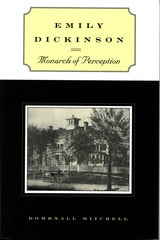
Emily Dickinson
Monarch of PerceptionDomhnall Mitchell
University of Massachusetts Press, 2000
Emily Dickinson has often been pictured as a sensitive but isolated poet—someone who published very little in her lifetime and limited herself to lyrics, considered to be the kind of poems most removed from social and political life. In recent years, scholars have challenged that view, and this book extends the discussion in valuable new directions.
Domhnall Mitchell begins by focusing on three historical phenomena—the railroad, the Dickinson homestead, and horticulture—and argues that poems about trains, home, and flowers engage with their meanings in ways that extend beyond the confines of the aesthetic. He shows how Dickinson's poems and letters reveal the full complexity of her position as a woman situated within a larger social and economic class.
In the second half of the book, Mitchell considers the ideological, textual, and editorial implications of Dickinson's strategic privatization of her art. He relates the particular forms of her manuscripts' appearance, distribution, and collation to aspects of her social as well as her literary consciousness. In a chapter that is certain to provoke debate, he explores what it means to read individual poems and letters in manuscript versions rather than in printed editions. By paying close attention to textual evidence, he makes the case that various features of the manuscripts are actually matters of accident or immediate convenience rather than the visual markers of a new aesthetic principle.
Mitchell closes by using the theories of Mikhail Bakhtin to explore the contradictions of a “private” poetry that engages verbally in multiple areas of nineteenth-century life and discourse. By attending to the contemporaneous particularities of recurrent words and images, he demonstrates that Dickinson could stay at home and still be at home in history, too.
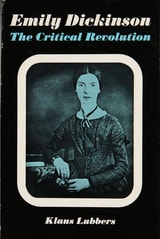
Emily Dickinson
The Critical RevolutionKlaus Lubbers
University of Michigan Press, 2025

Lunacy of Light
Emily Dickinson and the Experience of MetaphorWendy Barker
Southern Illinois University Press, 0
"Are you afraid of the sun?" Emily Dickinson asked a friend in 1859.
Wendy Barker states here that that apparently casual query reveals a major theme of Dickinson’s poetry, a theme she shares with women writers ranging from Anne Finch to Anne Sexton. It is a tradition based upon the inversion of the traditional male-centered metaphors of light and dark. Through time the light-giving sun has represented vitality, order, God; the light-swallowing night death, chaos, Satan. These metaphors are reinforced in the writing of Emerson, Thoreau, Hawthorne, and Keats,but Eliot, Brontë, Browning, and Dickinson use the sun and images of light quite differently.
Barker argues that since light was a masculine tradition, ithad come to represent male power, energy, sexuality—not only to Dickinson but to other women writing during the era. To these writers the inversion of the light/darkness metaphor became a countertradition used as a means to express their energies in a society that was hostile to their intelligence. Dickinson, who read avidly, could not have been insensitive to this usage of light as a masculine symbol—of her Calvinist God, of her father, of all that was male—and of darkness as a feminine symbol.
Emily Dickinson thought in a richly symbolic manner. Her most frequently used metaphor is one of light in contrast to darkness, employing single-word references to light more than one thousand times in her 1,775 poems. Barker offers close readings and new interpretations of some previously overlooked or misunderstood poems and demonstrates that "Many of her most ecstatic images are oflittle lights created from darkness." Inanswer to those critics who have characterized her poems as being piecemeal, Barker argues that Dickinson’s consistent use of light as a metaphor unifies her poetry.
In her final chapter, Barker explores the ways in which twentieth-century female writers have carried on the countertradition of the light/darkness metaphor. "That Dickinson was able so brilliantly to transform and transcend the normative metaphoric patterning of her culture, creating, in effect, a metaphor of her own, has much to do with the genius of her art."
Reading in Time
Emily Dickinson in the Nineteenth CenturyCristanne Miller
University of Massachusetts Press, 2012
Before 1865, Dickinson at least ambivalently considered publication, circulated relatively few poems, and saved almost everything she wrote in organized booklets. After this date, she wrote far fewer poems, circulated many poems without retaining them, and took less interest in formally preserving her work. Yet, Miller argues, even when circulating relatively few poems, Dickinson was vitally engaged with the literary and political culture of her day and, in effect, wrote to her contemporaries. Unlike previous accounts placing Dickinson in her era, Reading in Time demonstrates the extent to which formal properties of her poems borrow from the short-lined verse she read in schoolbooks, periodicals, and single-authored volumes. Miller presents Dickinson's writing in relation to contemporary experiments with the lyric, the ballad, and free verse, explores her responses to American Orientalism, presents the dramatic lyric as one of her preferred modes for responding to the Civil War, and gives us new ways to understand the patterns of her composition and practice of poetry.
Reading the Fascicles of Emily Dickinson
Dwelling in PossibilitiesEleanor Elson Heginbotham
The Ohio State University Press, 2020
We cannot know why Dickinson compiled the books or what she thought of them, but we can observe what she left in them. What she left is visible only by noting the way the poem answers in a dialogue across the pages, the way lines spilling onto a second page introduce the next poem, the way openings suggest image clusters so that each book has its own network of concerns and language—not a story or philosophical preachment but an aesthetic wholeness.
This book is the first to demonstrate that Dickinson’s poetic and philosophical creativity is most startling when the reader observes the individual lyric in the poet’s own, and only, context for them. For teacher, student, scholar, and poetry lover, Heginbotham creates an important new framework for understanding one of the most complex, clever, and profound U.S. poets.

Six American Poets from Emily Dickinson to the Present
An IntroductionAllen Tate
University of Minnesota Press, 1969
Talking Back to Emily Dickinson, and Other Essays
William H. Pritchard
University of Massachusetts Press, 2009
The essays, all of them about English and American writers, are arranged chronologically, beginning with Shakespeare, an Edmund Burke, and proceeding through the nineteenth and twentieth centuries to end with contemporaries like Kinglsey Amis, V. S. Naipaul, and Doris Lessing. Pritchard writes with equal authority about poetry and fiction; the collection also includes assessments of critics such as Matthew Arnold and Thomas Carlyle, Ford Madox Ford and R. P. Blackmur.
The Networked Recluse
The Connected World of Emily DickinsonMike Kelly, Carolyn Vega, Marta Werner, Susan Howe, Richard Wilbur
Amherst College Press, 2017
Yet that image scarcely captures the fullness and vitality of Dickinson’s life, most notably her many connections—to family, to friends, to correspondents, to the literary tastemakers of her day, even to the unnamed, and perhaps unknowable, “Master” to whom she addressed three of her most breathtaking works of prose. Through an exploration of a relatively small group of items from Dickinson’s vast literary remains, this volume—an accompaniment to an exhibition on Dickinson mounted at The Morgan Library & Museum in New York—demonstrates the complex ways in which these often humble objects came into conversation with other people, places, and events in the poet’s life. Seeing the network of connections and influences that shaped Dickinson’s life presents us with a different understanding of this most enigmatic yet elegiac poet in American letters, and allows us more fully to appreciate both her uniqueness and her humanity.
The materials collected here make clear that the story of Dickinson’s manuscripts, her life, and her work is still unfolding. While the image of Dickinson as the reclusive poet dressed only in white remains a popular myth, details of Dickinson’s life continue to emerge. Several items included both in the exhibit and in this volume were not known to exist until the present century. The scrap of biographical intelligence recorded by Sarah Tuthill in a Mount Holyoke catalogue, or the concern about Dickinson’s salvation expressed by Abby Wood in a private letter to Abiah Root, were acquired by Amherst College in the last fifteen years. What additional pieces of evidence remain to be uncovered and identified in the attics and basements of New England?
Published to accompany The Morgan Library & Museum’s pathbreaking exhibit I’m Nobody! Who are You? The Life and Poetry of Emily Dickinson—part of a series of exhibits at the Morgan celebrating and exploring the creative lives of significant women authors—The Networked Recluse offers the reader an account of the exhibit itself, together with a series of contributions by curators, scholars of Dickinson, and poets whose own work her words have influenced.
Trying to Think with Emily Dickinson
Jed Deppman
University of Massachusetts Press, 2008
This book presents Emily Dickinson as one of America's great thinkers and argues that she has even more to say to the twenty-first century than she did to the nineteenth. Jed Deppman weaves together many strands in Dickinson's intellectual culture—philosophy, lexicography, religion, experimental science, the female Bildungsroman—and shows how she developed a lyricized, conversational hermeneutics uniquely suited to rethinking the authoritative discourses of her time.
Through Deppman's original analysis, readers come to see how Dickinson's mind and poetry were informed by two strong but opposing philosophical vocabularies: on the one hand, the Lockean materialism and Scottish Common Sense that dominated her schoolbooks in logic and mental philosophy—Reid, Hedge, Watts, Stewart, Brown, and Upham—and on the other, the neo-Kantian modes of apprehending the supersensible that circulated throughout German idealism and Transcendentalism.
Blending close readings with philosophical and historical approaches, Deppman affirms Dickinson's place in the history of ideas and brings her to the center of postmodern conversations initiated by Jean-François Lyotard, Jean-Luc Nancy, Jacques Derrida, Richard Rorty, and Gianni Vattimo. Trying her out in various postmodern roles—the Nietzschean accomplished nihilist, the Nancian finite thinker, the Vattimian weak thinker, and the Rortian liberal ironist—Deppman adds to the traditional expressive functions of her poetry a valuable, timely, and interpretable layer of philosophical inquiry. Dickinson, it turns out, is an ideal companion for anybody trying to think in the contemporary conditions that Vattimo characterizes as the “weakened experience of truth.”
Winds of Will
Emily Dickinson and the Sovereignty of Democratic ThoughtPaul Crumbley
University of Alabama Press, 2010
A sophisticated literary analysis positioning Emily Dickinson’s poetry within the framework of democratic thought and individual sovereignty.
In this study, Paul Crumbley asserts that, contrary to popular opinion, Emily Dickinson consistently communicated political views through her poetry. Dickinson’s life of self-isolation—today her most notable personal characteristic—by no means extended into the political sphere, he argues. While she rarely addressed political issues directly and was curiously disengaged from the liberal causes and female reform movements of her time, Dickinson’s poems are deeply rooted both in matters of personal sovereignty and reader choice. The significant choices Dickinson extends to the reader underscore the democratic dimensions of reading her work, and of reading itself as a political act.
Crumbley employs close readings of Dickinson’s poems and letters, highlighting the many changing—and often contradictory—voices in her work, both throughout her oeuvre and in individual poems themselves. In Dickinson’s letters Crumbley finds just as many unique and conflicting voices; thus, both her personal correspondence and the poems make political demands by placing the burden of interpretation on the reader.
Rather than reflecting explicit political values, Dickinson’s work chronicles an ongoing decision-making process that magnifies the role of individual choice, not the advocacy of specific outcomes. In the end, Dickinson’s readers must either accept an isolated lyric subjectivity or invest that subjectivity with the substance necessary for engagement with the larger world.