Results by title
11 books match the query 'Epic poetry, Latin'
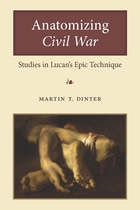
Anatomizing Civil War
Studies in Lucan's Epic TechniqueMartin T. Dinter
University of Michigan Press, 2013
Imperial Latin epic has seen a renaissance of scholarly interest. This book illuminates the work of the poet Lucan, a contemporary of the emperor Nero who as nephew of the imperial adviser Seneca moved in the upper echelons of Neronian society. This young and maverick poet, whom Nero commanded to commit suicide at the age of 26, left an epic poem on the civil war between Caesar and Pompey that epitomizes the exuberance and stylistic experimentation of Neronian culture. This study focuses on Lucan's epic technique and traces his influence through the Middle Ages and the Renaissance.
Martin T. Dinter's newest volume engages with Lucan's use of body imagery, sententiae, Fama (rumor), and open-endedness throughout his civil war epic. Although Lucan's Bellum Civile is frequently decried as a fragmented as well as fragmentary epic, this study demonstrates how Lucan uses devices other than teleology and cohesive narrative structure to bind together the many parts of his epic body.
Anatomizing Civil War places at center stage characteristics of Lucan's work that have so far been interpreted as excessive, or as symptoms of an overly rhetorical culture indicating a lack of substance. By demonstrating that they all contribute to Lucan's poetic technique, Martin T. Dinter shows how they play a fundamental role in shaping and connecting the many episodes of the Bellum Civile that constitute Lucan's epic body. This important volume will be of interest to students of classics and comparative literature as well as literary scholars. All Greek and Latin passages have been translated.
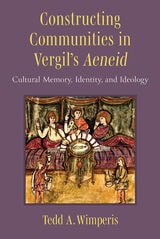
Constructing Communities in Vergil's Aeneid
Cultural Memory, Identity, and IdeologyTedd A. Wimperis
University of Michigan Press, 2024
Where previous studies of identity and memory in the Aeneid have focused on the poem’s constructions of Roman identity, Constructing Communities turns the spotlight onto the characters themselves to show how the world inside the poem is replicating, as if in miniature, real forms of contemporary political and cultural discourse, reflecting an historical milieu where appeals to Roman identity were vigorously asserted in political rhetoric. The book applies this evidence to a broad literary analysis of the Aeneid, as well as a reevaluation of its engagement with Roman imperial ideology in the Age of Augustus.
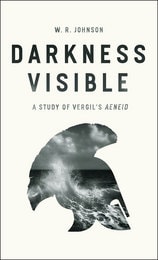
Darkness Visible
A Study of Vergil's "Aeneid"W. R. Johnson
University of Chicago Press, 1976
With an approach to the text that is both grounded in scholarship and intensely personal, and in a style both rhetorically elegant and passionate, Johnson offers readings of specific passages that are nuanced and suggestive as he focuses on the “somber and nourishing fictions” in Vergil’s poem. A timeless work of scholarship, Darkness Visible will enthrall classicists as well as students and scholars of the history of criticism—specifically the way in which politics influence modern readings of the classics—and of poetry and literature.
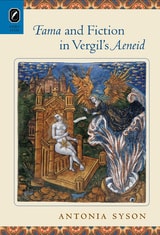
Fama and Fiction in Vergil's Aeneid
Antonia Syson
The Ohio State University Press, 2013
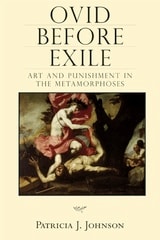
Ovid before Exile
Art and Punishment in the MetamorphosesPatricia J. Johnson
University of Wisconsin Press, 2007
Patricia J. Johnson demonstrates how the production of art—specifically poetry—changed dramatically during the reign of Augustus. By Ovid’s final decade in Rome, the atmosphere for artistic work had transformed, leading to a drop in poetic production of quality. Johnson shows how Ovid, in the episodes of artistic creation that anchor his Metamorphoses, responded to his audience and commented on artistic circumstances in Rome.
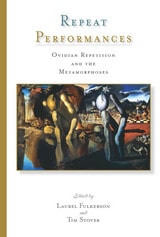
Repeat Performances
Ovidian Repetition and the <i>Metamorphoses<i/>Edited by Laurel Fulkerson and Tim Stover
University of Wisconsin Press, 2016
A shared vision of the possibilities of Latin epic poetry unites the essays, as does a series of attempts to realize those opportunities. Some of the pieces represent a traditional vein of allusion and intertextuality; others are more innovative in their approaches. Each, in a sense, stands as a placeholder for a methodology of theorizing the repetitive practices of poetry, of epic, and of Ovid in particular.
Contributors: Antony Augoustakis, Neil W. Bernstein, Barbara Weiden Boyd, Andrew Feldherr, Peter Heslin, Stephen Hinds, Sharon L. James, Alison Keith, Peter E. Knox, Darcy Krasne

The Aeneid
Virgil
University of Chicago Press, 2017
The paperback and e-book editions include a new introduction by Richard F. Thomas, along with a new glossary of names that makes the book even more accessible for students and for general readers coming to the Aeneid for the first time who may need help acclimating to Virgil’s world.
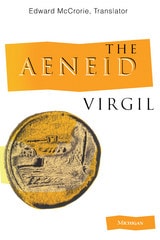
The Aeneid of Virgil
Virgil
University of Michigan Press, 1995
In this new translation Edward McCrorie has performed the difficult task of rendering Virgil's compact, dense Latin into fine, readable, modern English verse. The sometimes complex text is made clear and comprehensible even for first-time readers, and a glossary of names helps identify characters and place-names in the poem. The translation is well suited for students at all levels, and readers already familiar with Virgil will find many fresh images and ideas.
"A brilliant effort."--Robert Bly
"I admire the ambition of the project, and the generosity of many of the lines."--Robert Fagles
Edward McCrorie is Professor of English, Providence College. His poetry and translations of Latin verse have been widely published.
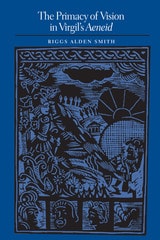
The Primacy of Vision in Virgil's Aeneid
By Riggs Alden Smith
University of Texas Press, 2006
One of the masterpieces of Latin and, indeed, world literature, Virgil's Aeneid was written during the Augustan "renaissance" of architecture, art, and literature that redefined the Roman world in the early years of the empire. This period was marked by a transition from the use of rhetoric as a means of public persuasion to the use of images to display imperial power. Taking a fresh approach to Virgil's epic poem, Riggs Alden Smith argues that the Aeneid fundamentally participates in the Augustan shift from rhetoric to imagery because it gives primacy to vision over speech as the principal means of gathering and conveying information as it recounts the heroic adventures of Aeneas, the legendary founder of Rome.
Working from the theories of French phenomenologist Maurice Merleau-Ponty, Smith characterizes Aeneas as a voyant-visible, a person who both sees and is seen and who approaches the world through the faculty of vision. Engaging in close readings of key episodes throughout the poem, Smith shows how Aeneas repeatedly acts on what he sees rather than what he hears. Smith views Aeneas' final act of slaying Turnus, a character associated with the power of oratory, as the victory of vision over rhetoric, a triumph that reflects the ascendancy of visual symbols within Augustan society. Smith's new interpretation of the predominance of vision in the Aeneid makes it plain that Virgil's epic contributes to a new visual culture and a new mythology of Imperial Rome.
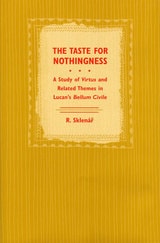
The Taste for Nothingness
A Study of Virtus and Related Themes in Lucan's Bellum CivileR. Sklenar
University of Michigan Press, 2003
The Taste for Nothingness traces Lucan's own analytical method by showing how virtus and related concepts operate--or rather, fail to operate--in Lucan's appropriations and distortions of the traditional epic-battle narrative; in the philosophical commitment of Cato the Younger; and in the personalities of the two antagonists, Pompey and Caesar. Much recent scholarship has reached a consensus that Lucan's literary method is mimetic, that his belief in a chaotic cosmos produces a poetics of chaos. While accepting many of the recent findings about Lucan's view of language and the universe, The Taste for Nothingness also allows an even bolder Lucan to emerge: a committed aesthete who regards art as the only realm in which order is possible.
Robert Sklenár is Visiting Assistant Professor of Classical Studies, Tulane University.
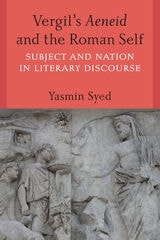
Vergil's Aeneid and the Roman Self
Subject and Nation in Literary DiscourseYasmin Syed
University of Michigan Press, 2005
Now in Paper!
As the most widely read Roman poem in antiquity, the Aeneid was indelibly burned into the memories of generations of Roman school children. In this book, author Yasmin Syed analyzes the formative influence the poem exerted on its broad audience of educated Romans. Syed analyzes Roman pedagogy and reading practices as well as ancient beliefs about the powerful influence of poetry. Her study considers these cultural components together with the aspects of identity that define the Aeneid’s characters. By doing so, Syed shows how Vergil’s ancient audiences saw themselves—their experiences, goals, and values—reflected in the poem and guided by it. In particular, Syed’s treatment of gender and ethnicity brings to light the key role of Vergil’s poem in the formation of Romanness.