Results by title
8 books match the query 'Executions and executioners'
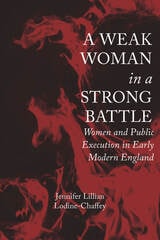
A Weak Woman in a Strong Battle
Women and Public Execution in Early Modern EnglandJennifer Lillian Lodine-Chaffey
University of Alabama Press, 2022
A scholarly study of how women’s executions were staged, interpreted, and recorded in Renaissance England
A Weak Woman in a Strong Battle: Women and Public Execution in Early Modern England provides critical insights on representations of women on the scaffold, focusing on how female victims and those writing about them constructed meaning from the ritual. Jennifer Lodine-Chaffey draws on a wide range of genres, from accounts of martyrdom to dramatic works, to explore not only the words of women executed in Tudor and Stuart England, but also the ways that writers represented female bodies as markers of penitence or deviance.
A significant part of the execution spectacle—one used to assess the victim’s proper acceptance of death and godly repentance—was the final speech offered at the foot of the gallows or before the pyre. To ensure their final words held value for audiences, women adopted conventionally gendered language and positioned themselves as subservient and modest. The reception of women’s speeches, Lodine-Chaffey argues, depended on their performances of accepted female behaviors and language as well as physical signs of interior regeneration. Indeed, when women presented themselves or were represented as behaving in stereotypically feminine and virtuous ways, they were able to offer limited critiques of their fraught positions in society.
Just as important as their words, though, were the depictions of women’s bodies. The executed woman’s body, Lodine-Chaffey contends, functioned as a text, scrutinized by witnesses and readers for markers of innocence or guilt. The intense focus on the words and bodies of women facing execution during this period, Lodine-Chaffey argues, became a catalyst for a more thorough interest in and understanding of women’s roles not just as criminals but as subjects
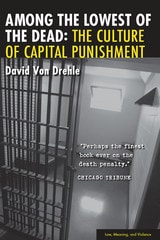
Among the Lowest of the Dead
The Culture of Capital PunishmentDavid Von Drehle
University of Michigan Press, 2010
"Has all the tension of the best true crime stories . . . This is journalism at its best."
--Library Journal
"A compelling argument against capital punishment. . . . Examining politicians, judges (including Supreme Court Justices), prosecutors, defense attorneys and the condemned themselves, the author makes an effective case that, despite new laws, execution is no less a lottery than it has always been."
--Publishers Weekly
"In a fine and important book, Von Drehle writes elegantly and powerfully. . . . Anyone certain of their opinion about the death penalty ought to read this book."
-- Booklist
"An extremely well-informed and richly insightful book of great value to students of the death penalty as well as intelligent general readers with a serious interest in the subject, Among the Lowest of the Dead is also exciting reading. The book is an ideal guide for new generations of readers who want to form knowledgeable judgments in the continuing--and recently accelerating--controversies about capital punishment."
--Anthony Amsterdam, New York University
"Among the Lowest of the Dead is a powerfully written and meticulously researched book that makes an invaluable contribution to the growing public dialogue about capital punishment in America. It's one of those rare books that bridges the gap between mass audiences and scholarly disciplines, the latter including sociology, political science, criminology and journalism. The book is required reading in my Investigative Journalism classes--and my students love it!"
--David Protess, Northwestern University
"Among The Lowest of the Dead deserves a permanent place in the literature as literature, and is most relevant to today's death penalty debate as we moderate advocates and abolitionists search for common ground."
--Robert Blecker, New York Law School
David Von Drehle is Senior Writer, The Washington Post and author of Triangle: The Fire that Changed America.

Billy Budd, Sailor
Herman Melville
University of Chicago Press, 1962
Catherine
A StoryWilliam Makepeace Thackeray
University of Michigan Press, 1999
The Thackeray Edition proudly announces two additions to its collection: Catherine and The Luck of Barry Lyndon. The Thackeray Edition is the first full-scale scholarly edition of William Makepeace Thackeray's works to appear in over seventy years, and the only one ever to be based on an examination of manuscripts and relevant printed texts. It is also a concrete attempt to put into practice a theory of scholarly editing that gives new insight into Thackeray's own compositional process.
Written in 1839-40 for Fraser's Magazine, Catherine was Thackeray's first novel. Although originally intended as a spoof of the 1830s Newgate school of criminal romance, it has intrinsic merit of its own for its cynical narrator and roguish heroine, both of whom harbinger similar creations in Vanity Fair eight years later.

Ghosts Over the Boiler
Voices from Alabama's Death RowProject Hope to Abolish the Death Penalty; Edited by Katie Owens-Murphy
Vanderbilt University Press, 2023
Ghosts Over the Boiler is a curated collection of poetry, visual art, photographs, essays, creative writings, and other archival materials that have emerged from Alabama's death row from the organization Project Hope to Abolish the Death Penalty (PHADP). This group was founded at Holman Correctional Facility and has been operating autonomously since 1989 toward its mission to abolish the death penalty in Alabama and in the nation.
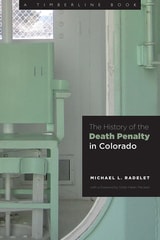
History of the Death Penalty in Colorado
Michael Radelet
University Press of Colorado, 2017
In The History of the Death Penalty in Colorado, noted death penalty scholar Michael Radelet chronicles the details of each capital punishment trial and execution that has taken place in Colorado since 1859. The book describes the debates and struggles that Coloradans have had over the use of the death penalty, placing the cases of the 103 men whose sentences were carried out and 100 more who were never executed into the context of a gradual worldwide trend away from this form of punishment.
For more than 150 years, Coloradans have been deeply divided about the death penalty, with regular questions about whether it should be expanded, restricted, or eliminated. It has twice been abolished, but both times state lawmakers reinstated the contentious punitive measure. Prison administrators have contributed to this debate, with some refusing to participate in executions and some lending their voices to abolition efforts. Colorado has also had a rich history of experimenting with execution methods, first hanging prisoners in public and then, starting in 1890, using the "twitch-up gallows" for four decades. In 1933, Colorado began using a gas chamber and eventually moved to lethal injection in the 1990s.
Based on meticulous archival research in official state archives, library records, and multimedia sources, The History of the Death Penalty in Colorado, will inform the conversation on both sides of the issue anywhere the future of the death penalty is under debate.
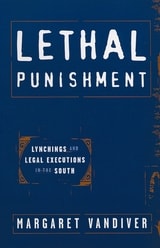
Lethal Punishment
Lynchings and Legal Executions in the SouthVandiver, Margaret
Rutgers University Press, 2005
Why did some offenses in the South end in mob lynchings while similar crimes led to legal executions? Why did still other cases have nonlethal outcomes? In this well-researched and timely book, Margaret Vandiver explores the complex relationship between these two forms of lethal punishment, challenging the assumption that executions consistently grew out of-and replaced-lynchings.
Vandiver begins by examining the incidence of these practices in three culturally and geographically distinct southern regions. In rural northwest Tennessee, lynchings outnumbered legal executions by eleven to one and many African Americans were lynched for racial caste offenses rather than for actual crimes. In contrast, in Shelby County, which included the growing city of Memphis, more men were legally executed than lynched. Marion County, Florida, demonstrated a firmly entrenched tradition of lynching for sexual assault that ended in the early 1930s with three legal death sentences in quick succession.
With a critical eye to issues of location, circumstance, history, and race, Vandiver considers the ways that legal and extralegal processes imitated, influenced, and differed from each other. A series of case studies demonstrates a parallel between mock trials that were held by lynch mobs and legal trials that were rushed through the courts and followed by quick executions.
Tying her research to contemporary debates over the death penalty, Vandiver argues that modern death sentences, like lynchings of the past, continue to be influenced by factors of race and place, and sentencing is comparably erratic.
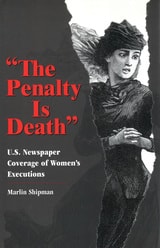
The Penalty Is Death
U.S. Newspaper Coverage of Women's ExecutionsMarlin Shipman
University of Missouri Press, 2002